This Inflation Isn’t Going Away

Popular Economics Weekly

“The Consumer Price Index for All Urban Consumers (CPI-U) increased 0.3 percent on a seasonally adjusted basis in December, the U.S. Bureau of Labor Statistics reported today. Over the last 12 months, the all items index increased 2.7 percent before seasonal adjustment.BLS.gov

FREDcpi

It’s no surprise that CPI inflation is still high—up +2.7 percent in a year. And I fear it can’t come down for ordinary Americans, at least, without another recession.

The gap in the graph shows why. In was in part because of the government shutdown when congress couldn’t agree on insurance policies that would bring down health care costs. And prices are rising elsewhere, especially in groceries and other everyday items without a Federal Reserve and regulatory agencies (such as the Consumer Financial Protection Bureau) able to do their job.

The inflation data gap is therefore the most important item in the CPI report. The ignorance of upcoming data could breed more inflation, especially during the ongoing wars; both domestic (tariffs), foreign (Ukraine), and Trump’s threat to fire more government statisticians he doesn’t like.

Why? Because it creates supply chain shortages, and there’s the upcoming budget battle for the full fiscal year. And what if there’s another shutdown in February because congress can’t agree on a full year’s budget?

We know that data lapses also increase the possibility of more bad news, which breeds only more economic uncertainty. That’s what businesses are not hiring more employees or knowing what to plan for the future.

And who takes the most advantage of the data blackout? Supermarkets, for one, that can sneak in higher grocery prices. That’s a main reason for soaring food costs that have risen +3.1 percent in the CPI report—in double digits for some products like beef and coffee. And don’t forget the ICE arrests of agricultural workers that farmers are complaining about and I mentioned last week that are contributing to the food shortages.

Electricity costs are up +6.7 percent, as well. These are the everyday items that make consumers unhappy. And why not? Candidate Trump promised to bring down prices on “day one” of his second term, and Americans are no longer believing him.

USA Today reported that the New York Times‘ Dec. 23 average, which includes the Gallup numbers, found Trump had a 42% approval and 54% disapproval ratings. RealClearPolitics‘ daily average is similar, at 43% approval and 53% disapproval.

USA Today also cited Gallup’s Economic Confidence Index, which summarizes Americans’ evaluations of current economic conditions and their perceptions of the economy, hit -33 in the recent poll. It marks a 10-point decrease from October, and a 19-point dive from June’s numbers. It has a theoretical range of -100 to +100, says USA Today.

Can prices come down this year? No, unless there’s a recession, as I said. My biggest fear is a repeat of recessions from the last two busted asset bubbles created in part by lax regulations that created more wealth for the oligarchs and took away the protections for ordinary Americans.

Trump’s new Federal Reserve Chairman in May will continue to push down short-term interest rates, which will only create higher inflation, as did former Fed Chair Allen Greenspan in helping to finance the Bush terror wars in early 2000. Memories are short in the financial world.

It created massive asset bubbles and ultimately led to the Great Recession. The AI buildout will also create an oversupply that ultimately outdistances demand, as always happens. People forget that it was the busted Dot-com asset bubble in 2000 followed by the housing bubble that led to the 2008-09 Great Recession.

And ordinary Americans ultimately pay the price for those battles—domestic or foreign.

Harlan Green © 2026

Follow Harlan Green on Twitter: https://twitter.com/HarlanGreen
Posted in Consumers, COVID-19, Economy, Politics, Weekly Financial News | Tagged , , , , , , , , | Leave a comment

Where Are the Jobs?

Financial FAQs

“Both total nonfarm payroll employment (+50,000) and the unemployment rate (4.4 percent) changed little in December, the U.S. Bureau of Labor Statistics reported today. Employment continued to trend up in food services and drinking places, health care, and social assistance. Retail trade lost jobs.” BLS.gov

FREDpayrolls

We’re now seeing the first ‘clean’ results of the damage to the job market since the 42-day government shutdown in the December unemployment report.

Approximately half the jobs are being created than before the April 2 tariff announcements that is shown in the FRED graph of total nonfarm payroll jobs. That will not make those who are looking for work happy. There are fewer available jobs, in this instance.

Employment continued to increase in food services and drinking places, health care, and social assistance. But retail and everything else lost jobs.

The bottom line is payroll employment rose by just 584,000 in 2025 (an average monthly gain of 49,000), less than the increase of 2.0 million in 2024 (an average monthly gain of 168,000), said the Bureau of Labor Statistics.

Our population may be shrinking, but not enough to absorb all those looking for work—not just to replace the jobs lost to the tariffs, but replacing those jobs lost from deported workers.

There are fewer agricultural workers to harvest the crops, for instance. What does that do to grocery prices? According to Michigan State study cited by The Idaho Capital Sun, more than half of surveyed farmers said in 2021 that they were experiencing some sort of worker shortage, It found that when domestic farm employment declines by 10%, food prices of labor-intensive crops increase by around 3%.

We can now see the damage Trump’s attempt to make his own laws is doing to the U.S. economy. He cannot legally levy most tariffs that haven’t been approved by congress. They are supposed to be negotiated by the trade partners involved, not by executive order.

That’s why Trump has driven up prices on housing construction and auto manufacturing, for instance, because of higher tariffs on steel, aluminum, and lumber, and why the goods producing sector, such as in manufacturing and construction, lost -21,000 jobs in December.

But consumers in the top 10 percent income bracket with assets in real estate or the financial markets are continuing to dine out and travel, as I’ve been saying.

Employers aren’t hiring more workers, in other words. Those taking part-time jobs because they couldn’t find full-time jobs rose 980,000 and those that want jobs but haven’t been looking for jobs recently rose 684,000 in 2025.

Businesses are supposed to expand and hire more employees this year because they can write off capital expenditures in the same year they are spent in Trump’s new tax law.

But AI cannot replace all those jobs that businesses will need to grow this year and beyond, because it takes time to automate production, though the stock prices of those AI companies that have been rallying of late don’t know that yet.

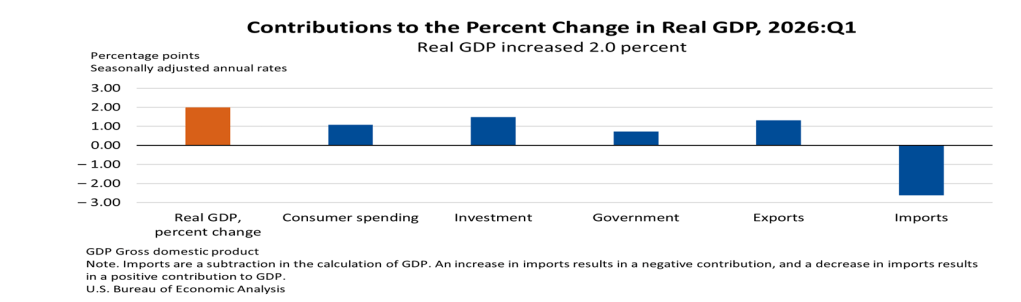
So the question will be can consumers still shop and spend as they did last year, which is why GDP growth of late is surging? Will the level of consumer spending, capital investments, and higher exports hold up unless companies begin to hire more workers?

A lot of consumers are already unhappy with the higher prices in everyday items. This is even though University of Michigan’s first New Year’s gauge of consumer sentiment rose to 54 in a preliminary January reading from 52.9 in the prior month.

It is the second straight gain and the highest level of sentiment since September. Consumers perceived some modest improvement in the economy, the survey found, although sentiment remains nearly 25% below last January’s reading, said MarketWatch’s Greg Robb.

So this year may be a tossup, in spite of the chaos sewn by a President who doesn’t seem to know or care about basic economic truths. There’s a bit of irrational exuberance in this New Year, so that consumers may keep shopping and corporations make record profits.

The question is what they will do with those profits; expand their markets by hiring more employees or buy back stocks to keep elevate their profits and that of their stockholders?

Harlan Green © 2026

Follow Harlan Green on Twitter: https://twitter.com/HarlanGreen
Posted in Consumers, COVID-19, Economy, Politics, Weekly Financial News | Tagged , , , , , , , , , , | Leave a comment

Too Few Jobs

Financial FAQs

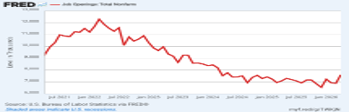
“The number of job openings was little changed at 7.1 million in November, the U.S. Bureau of Labor Statistics reported today. Over the month, hires were little changed and total separations were unchanged at 5.1 million each.” BLS.gov

CalculatedRisk

The Labor Department’s JOLTS survey is the first look at job formation before the official December U.S. unemployment report, and it isn’t pretty. The number of job hires equaled the number of ‘separations’, or those leaving the workforce for various reasons—voluntary or involuntary. (The blue line is Hires and red bars are Layoffs, Discharges, and other in the Calculate Risk graph. The black line is the total number of Job openings. It has fallen from its high of 12,000,000 job vacancies in 2022 after the COVID-19 pandemic.)

This means existing job positions are being replaced but no additional hires. Companies are holding on to their workforce, in other words, replacing those that are leaving for various reasons, but not expanding their workforce.

Trump’s Labor Department doesn’t tell us why but we can surmise that tariffs are the main culprit, since without the Supreme Court decision, companies don’t know if the existing so-called retaliatory tariffs enacted on April 2 are even legal. Imagine the refunds that the Trump administration has promised to return to importers if SCOTUS rules against him!

The number of hires decreased in state and local government, excluding education (-39,000) and in state and local government education (-31,000). Hires increased in federal government (+11,000), said the Bureau of Labor Statistics.

U.S. manufacturing activity fell to 47.9% in December, the Institute for Supply Management said Monday. This is the lowest reading of the year and the 10th straight month of contraction in the factory sector. Any number below 50% signals contraction.

“Looking at the manufacturing economy, 85 percent of the sector’s gross domestic product (GDP) contracted in December, compared to 58 percent in November, and the percentage of manufacturing GDP in strong contraction (defined as a composite PMI® of 45 percent or lower) increased to 43 percent, compared to 39 percent in November,” said Susan Spence, MBA, Chair of the Institute for Supply Management® (ISM®) Manufacturing Business Survey Committee.

ADP, a private payrolls purveyor, has said that just 41,000 jobs were added to payrolls in December. They were mostly in Leisure/hospitality and Education/healthcare, which means the service sector is still limping along.

This is in fact job stagnation, and with the manufacturing sector still in recession and inflation continuing to rise, it’s looking like overall economic stagflation is afoot.

How is a return of stagflation not inevitable with Republicans and Trump continuing to break up the existing world order? He has basically invaded Venezuela and threatened other countries with military intervention, how could it not be otherwise?

Who will want to do business with America at the point of a gun?

Harlan Green © 2026

Follow Harlan Green on Twitter: https://twitter.com/HarlanGreen

Posted in Consumers, COVID-19, Economy, Politics, Weekly Financial News | Tagged , , , , , , , , , , , , , | Leave a comment

Equality Is Good for Everyone–Part II

Popular Economics Weekly

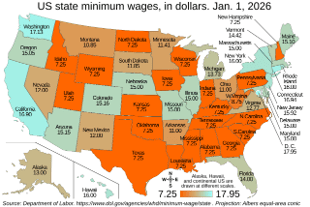
Nineteen states will increase their minimum wages on January 1, boosting earnings for more than 8.3 million workers by a total of $5 billion. In addition, 47 cities and counties will raise their minimum wages, adding to the number of workers likely to get larger paychecks because of lawmakers—or in some cases, voters—taking action to lift state and local wage floors.” EPI.org

FREDdeficits

My Happy New Year’s greeting is to those 19 states that increased their minimum wage, and my condolences to those Republican-run red states that haven’t ever increased their minimum wage but relied on the federal minimum wage of $7.25 per hour that was last increased in 2009.

Minimum wage hikes went into effect in 19 states on January 1, 2026: Arizona, California, Colorado, Connecticut, Hawaii, Maine, Michigan, Minnesota, Missouri, Montana, Nebraska, New Jersey, New York, Ohio, Rhode Island, South Dakota, Vermont, Virginia, and Washington.

Only four are Republican red states. The rest of the red states still have the federal minimum wage that is worth just $5.25 per hour in today’s dollars.

The advocacy group One Fair Wage (OFW) said  “According to the MIT Living Wage Calculator, there is no county in the United States where a worker can afford to meet basic needs on less than $25 an hour. Even in the nation’s least expensive counties, a worker with one child would need at least $33 an hour to cover essentials like rent, food, childcare, and transportation.”

Yes, equality is good for everyone, but can this happen in this New Year 2026? We will have to move out of the second Gilded Age that Donald Trump is touting to support his tariffs that has enriched his robber barons.

We know how we got here; the huge transfer of wealth beginning in the 1980s with massive Republican tax cuts that is obvious in this historical graph of budget deficits from 1980, when Big Business CEOs took over the running of our government.

Ronald Reagan’s Republicans created the first deficits beginning in 1980. The Clinton administration balanced the budget, creating a federal budget surplus in the years 1997 to 2000.

GW Bush then plunged US back into debt in 2000 with additional massive tax cuts while paying for the invasion of Iraq and Afghanistan. The annual deficits plunged further beginning in 2008 with the need to pay for the 2008-09 Great Recession (large gray bar).

Yet the Obama administration paid the annual deficit back down to its 2004 level. The Trump I era then increased it with more massive tax cuts being paid for once again by the American public. The graph portrays the obvious. The largest annual deficits were created during the years of Republican tax cuts.

More than $9 trillion will be added to the public debt in just the two Trump administrations from the renewal of the Trump tax cuts. So it is obvious that Republicans are mainly responsible for the $36 trillion public debt Americans are saddled with today that must be paid for to maintain the good faith and credit of the U.S. government.

Those tax cuts have benefited the few and lowered the living standard of many Americans, especially in those red states that haven’t raised their minimum wage. So it’s time to pay our enormous debt down that was created by those tax cuts. But that can only happen when enough Americans realize what has been stolen from them.

Can the tide begin to turn in this New Year, another Progressive era and a Teddy Roosevelt appear to end this Gilded Age of corruption? What will it take? Let us hope it won’t be another Great Depression to wake us out of our decline as a democracy.

May this be a Happier New Year!

Harlan Green © 2026

Follow Harlan Green on Twitter: https://twitter.com/HarlanGreen
Posted in Consumers, COVID-19, Economy, Politics, Weekly Financial News | Tagged , , , , , , , , , , , , , | Leave a comment

A Better Economy For Whom?

Popular Economics Weekly

“…in going from the Biden Administration to the Trump Administration, we have traded an economy that disproportionately benefited low-income workers to one that disproportionately benefits the well-off (particularly those who own a lot of stocks).” Paul Krugman

FREDgdp

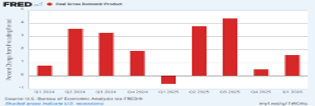
Second and Third quarter Gross Domestic Product growth surged (see graph), mainly due to a jump in consumer spending as shoppers rushed to get ahead of the holiday and rising prices.

But this will only confuse the real economic picture. The third quarter is June to September, before the government shutdown. And it didn’t benefit everyone in this K-shaped economy. Some economists are predicting a coming slowdown and maybe recession next year, despite the good news.

That’s in part because fifty percent of the consumer spending is by 10 percent of American shoppers today, according to Moody’s economist Mark Zandi. Incomes of the middle and low-income earners have lost ground from the higher inflation that has reduced their spending power.

Zandi estimates 22 states plus the District of Columbia are now experiencing enough persistent economic weakness from the federal job cuts and shrinking job market that their economies are close to or in recession, mostly in the Northern and Eastern states. But even New York and California’s economies have slowed and if they follow the trajectory of the 22 states would tip us into an outright recession, says Zandi.

It’s hard to equate this prognosis with the Q3 burst in GDP.Real gross domestic product (GDP) increased at an annual rate of 4.3 percent in the third quarter of 2025 (July, August, and September), according to the initial estimate released by the U.S. Bureau of Economic Analysis. In the second quarter, real GDP increased 3.8 percent.” BEA

That’s why the bulk of the consumers are spending most on necessities such as healthcare, insurance, clothing, car repairs, gas, housing and utilities. And the prices of most of these goods and services have consumers complaining big time.

The alarm bells are ringing that the worse is yet to come, in other words, if we look under the hood of Chevy, as well as Mercedes owners. With record household debt and a sharply reduced workforce due to government firings and immigrant deportations, the K-gap will only grow worse between the well-off and low-income workers from the rising inflation.

The price index for gross domestic (GDP) purchases increased 3.4 percent in the third quarter, compared with an increase of 2.0 percent in the second quarter. The personal consumption expenditures (PCE) price index that the Fed uses to gauge inflation also increased 2.8 percent, compared with an increase of 2.1 percent in Q2.

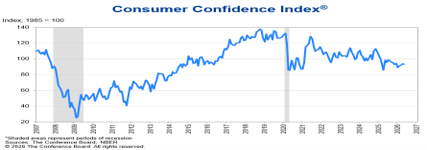
The rising cost of living is also hurting consumer confidence, per the Conference Board’s confidence index; another danger sign. “Consumer confidence weakened for a fifth consecutive month as perceptions of business conditions were negative, and apprehensions about jobs and income deepened,” according to the Conference Board.

Americans blamed their unease on “prices and inflation, tariffs and trade, and politics,” said Dana Peterson, chief economist at the Conference Board.

That is why largest share of consumers—those anticipating that recession is “somewhat likely”—grew again and the small percentage stating that the US is “already in one” crept higher, said Peterson.

Yet the stock indexes are at record highs and the Wall Street rally continues in the hope that AI investments will boost production and bring down the prices of goods and services. Oh goody for the oligarchs!

Many of the low-income workers have only themselves to blame in voting for a man that never intended to improve the lives of workers. His record of bankruptcies to avoid paying investors and workers was well-known before Trump’s first term, so why again?

This administration will soon find out what that means when the other 80 to 90 percent of working Americans realize they have been left behind in this recovery. Actually, maybe the polls are showing they already know.

Harlan Green © 2025

Follow Harlan Green on Twitter: https://twitter.com/HarlanGreen
Posted in Consumers, COVID-19, Economy, Politics, Weekly Financial News | Tagged , , , , , , , , , , , , , | Leave a comment

Equality Is Good For Everyone!

Answering Kennedy’s Call

“And on the tax front, it’s time for rich people like me to pay more.” Mitt Romney

Getty/Bettmann

This quote from a recent NYTimes Mitt Romney Op-ed is my Christmas message: Equal opportunity hasn’t been available to many Americans, even though it is part of the American Dream—America is the land of opportunity that is taught in schools and heard by immigrants.

Why? Because it’s a larger economic truth that not all Americans have accepted. Equality is good for everyone. It should be self-evident, a statement of common sense. The more equality of opportunity among us, the more we can better ourselves, become more productive citizens, which in turn increases our national wealth (and lowers budget deficits).

It was certainly the dream of immigrants, such as my mother, a British citizen born in Jamaica.

But there are times such as today when many Americans don’t believe it is possible, which is why we are living in another Gilded Age with the worst income inequality of the developed world. It is on a par with developing countries in Africa and has been the major cause of recessions and the Great Depression.

Many have bought the counter narrative by those that don’t like equality, such as Donald Trump and his MAGA supporters, part of the privileged few at the top of the income ladder who want us to believe they are the most qualified to create greater wealth for the rest of us.

This Gilded Age was formed like the last Gilded Age of President William McKinley, from a concentration of power among the wealthiest oligarchs. Then it was monopolies in such as the newly created railroad and oil industries.

Today, it is small government policies of Donald Trump that mirror the trickle-down economic policies of President Reagan because enough Americans believed it, believed government was the problem and cutting taxes the solution, believed that equality is not good for everyone because we live in a zero-sum world with limited resources. What is given to one must be taken from another.

The conservative position espoused by 1970s Economist Arthur Okun, for instance, was that greater equality meant less market efficiencies to produce and so fewer incentives for greater wealth, since leveling the playing field meant leveling out the opportunity for large profits. 

But that has never been the case. There has always been copious evidence that the opposite is true; that overly large profits have led to diminished household wealth and breakup of communities.

One can measure inequality with such as the CIA’s World Factbook that ranks inequality among nations. Those with the greatest equality also have less violence, greater freedoms, greater health, and guaranteed vacations!

Richard Wilkinson’s TEDx lecture and book with Kate Pickett, “The Spirit Level” is one of the best studies of the dire effects of income inequality on the quality of life. The most important factor, and a sign of dire consequences when inequality has approached the level of the Great Depression, are the US violent crime and incarceration rates, which Wilkinson discusses at length.

The U.S. is by far the most violent country in the world—worse than any other developed country with the highest incarceration rates. Efforts to reverse such inequality have begun on the local levels, even if congressional conservatives have blocked raising the miniscule national minimum wage of $7.25 per hour that was last set in 2009.

It is worth just $5 per hour today whereas blue states like California and Connecticut have raised their minimum wage to $16.90 per hour in line with rising livings costs.

And there is an increasing awareness of the income disparities, such as the fact that corporate CEOs now earn more than 300 times the income of their employees, and certain hedge fund managers have reported an annual income of $1 billion.

The Center for American Progress launched the Washington Center For Equitable Growth, which aims to deepen the economic critique of inequality. It was set up by Berkeley economist Emmanuel Saez, among others, who is known with his partner Thomas Piketty as the first economists to historically research the history of income distribution over the past 100 years.

The mission statement of the Center explains why it is needed:

“New research suggests that growing inequality in the United States may have broad social and economic effects — by reducing stable demand for goods and services, dampening entrepreneurialism, undermining the inclusiveness and responsiveness of political and economic institutions, limiting access to education, and stunting individual development. Yet our understanding of how these mechanisms interact with the broader economy is limited.”

Mitt Romney’s Op-ed has voiced one of the major issues confronting Americans today—how to fix the overwhelming federal debt load that threatens the ‘full faith and credit’ of the U.S. government.

“The largest source of additional tax revenues is also probably the most compelling for the fairness and social stability. Some call it closing a tax code loophole but the term “loopholes” grossly understates their scale. “Caverns” or “caves” would be more fitting,” said Romney

Donald Trump’s flailing attempts to use higher tariffs to pay down federal debt, when it is in fact another tax on all Americans, is maybe the most important reason to follow Mitt Romney’s advice.

Taxing the wealthiest that haven’t been “paying their fair share”, including Donald Trump’s billionaire supporters, would close one of the largest loopholes that is endangering the U.S. economy, as Senator Bernie Sanders continually reminds us.

Harlan Green © 2025

Follow Harlan Green on Twitter: https://twitter.com/HarlanGreen
Posted in Consumers, COVID-19, Economy, Politics, Weekly Financial News | Tagged , , , , , , , , , , , , , , , , , | Leave a comment

Where is the Inflation?

Financial FAQs

When I took office, inflation was the worst in 48 years, and some would say in the history of our country. President Donald Trump

FREDcpi

No, just a cursory look at the St. Louis Fed’s above graph of the Consumer Price Index dating from 1970 shows that inflation was much worse 48 years ago. The Arab oil embargo of the 1970s spawned the mother of all stagflations sending inflation to 14 percent in 1980.

The Trump administration is crowing about the weaker November inflation numbers cited in the BLS graph, but who will believe the data when he fired the head of the Bureau of Labor Statistics (BLS) that produces the report because he didn’t like the unemployment revisions in September?

Certainly not consumers, as their sentiment index via the University of Washington sentiment survey has fallen steadily from its high of 74.0 last December to 52.9 this December.

The belief problem was most evident in Trump’s recent prime time, 20-minute Oval Office address quoted above, that showed the leader of our government no longer no longer lives in the real world, only his lies and fantasies.

Whereas the Biden administration had brought it down to 3.0% last December. It only began to rise again since Trump’s April 2 retaliatory tariff announcements.

Perhaps Trump’s biggest lie was that “Much of this success has been accomplished by tariffs. My favorite word tariffs, which for many decades have been used successfully by other countries against us, but not anymore.” and that the tariffs are bringing “billions” back to the American economy.

No, tariffs are an import duty taking money out of the pockets of Americans from the higher prices that have resulted. Though, they could be refunded to the importers that paid the duties if most of the tariffs are repealed by the Supreme Court, as expected. But don’t count on prices coming down anytime soon that have become imbedded since then.

The inflation report was deceptive in that though the overall inflation rate fell to 2.7 percent from 3.0 percent most components rose over the year.

“In November, the Consumer Price Index for All Urban Consumers rose 2.7 percent over the last 12 months, not seasonally adjusted. The index for all items less food and energy increased 2.6 percent over the year (NSA).” BLS

The index for all items less food and energy rose 2.6 percent over the past 12 months, but the shelter index increased 3.0 percent over the last year. Other indexes with notable increases over the last year include medical care (+2.9 percent), household furnishings and operations (+4.6 percent), recreation (+1.8 percent), and used cars and trucks (+3.6 percent).

The most harm to American pocketbooks will be skyrocketing energy prices as the massive build out of AI centers will need tremendous amounts of power. That’s why the energy index for electricity increased 6.9 percent over the last 12 months and the index for natural gas rose 9.1 percent.

Maybe the saddest part of Trump’s address was his nonsensical, desperate hyperbole: “We’re doing what nobody thought was even possible, not even remotely possible. There has never, frankly, been anything like it. One year ago, our country was dead. We were absolutely dead.

Yet the U.S. had the fastest economic recovery in the developed world from the pandemic under Joe Biden with full employment and GDP growth in the 2-3 percent range.

No, we are not dead. And recent political surveys are showing that American voters in recent elections are waking up to the damage being done by Trump and his oligarchs in just one year to the many Americans who have lost jobs, and healthcare coverage, and protection from the worsening floods, wildfires, and hurricanes that Trump calls “a hoax”, all in the name of enriching themselves.

Harlan Green © 2025

Follow Harlan Green on Twitter: https://twitter.com/HarlanGreen
Posted in Consumers, COVID-19, Economy, Politics, Weekly Financial News | Tagged , , , , , , , , , , | Leave a comment

Where Are the Jobs?

Financial FAQs

“Total nonfarm payroll employment changed little in November (+64,000) and has shown little net change since April, the U.S. Bureau of Labor Statistics reported today. In November, the unemployment rate, at 4.6 percent, was little changed from September. Employment rose in health care and construction in November, while federal government continued to lose jobs.” BLS

FREDpayrolls

The much delayed ‘official’ U.S. unemployment report for November was actually close to earlier industry predictions from private payroll surveys. A total of 64,000 private payroll jobs were created in November, but just 116,000 jobs have been created since Trump’s April 2 retaliatory tariff announcements—17,000 jobs per month.

More than 200,000 per month were added during the four years of the Biden administration. This is the train wreck that Trump’s economic policies have created from the combination of DOGE government job and spending cuts, and immigrant roundups.

So why have Trump and his Republicans done this much damage to American workers and the American economy? Because the real reason for the tariff wars and government downsizing is to accumulate and centralize all power and wealth to Trump’s oligarchs and the White House.

And Congress hasn’t yet approved any of the tariff agreements that are causing prices to soar on everything.

Healthcare added 46,000 jobs, in line with the average monthly gain of 39,000 over the prior 12 months, construction employment added 28,000 in November, and social assistance continued to trend up in November (+18,000).

But bringing manufacturing home that he touted was one of the main reasons for raising the tariffs, continues to lose jobs.

In November, both the unemployment rate, at 4.6 percent is a four-year high, and the number of unemployed people, at 7.8 million, were higher than last November, when the jobless rate was 4.2 percent, and the number of unemployed people was 7.1 million.

Wall Street’s optimism is keeping stock indexes at record highs because it is betting on next year when consumers see higher tax refunds and corporations higher profits as their new tax benefits (from Big Beautiful Tax Bill) and AI productivity gains kick in.

But who benefits? It’s not hard to guess. It’s the same K-shaped, trickle-down economy once again. A good way to look at it with +3% inflation is that it hurts lower and middle-income folk without assets like homes and stocks that can afford less, while it boosts upper-middle and upper-income folks because rising inflation increases value of the assets they own.

So, the economy will continue to grow, but only for those near the top. Trump is bringing back the Gilded Age of the 1890s that created the corruption and self-dealing of the original robber barons. That is the America he wants to make great again!

“Those at the bottom are living with the cumulative impacts of price inflation,” said Peter Atwater, an economics professor at William & Mary in Virginia cited by MarketWatch. “At the same time, those at the top are benefiting from the cumulative impact of asset inflation.”

When will Americans come to realize what that means and direct their anger at the real thieves?

Harlan Green © 2025

Follow Harlan Green on Twitter: https://twitter.com/HarlanGreen
Posted in Consumers, COVID-19, Economy, Politics, Weekly Financial News | Tagged , , , , , , , , , , , , | Leave a comment

The Great Recession Lesson

Financial FAQs

Irrational Exuberance. Economists who adhere to rational-expectations models of the world will never admit it, but a lot of what happens in markets is driven by pure stupidity – or, rather, inattention, misinformation about fundamentals, and an exaggerated focus on currently circulating stories. Robert J. Shiller

FREDfedfunds

Nobel Laureate Robert Shiller is best known for his book, Irrational Exuberance, that he wrote in 2000 predicting the Dot-com recession. But it applies as well to the Great Recession of 2007-09, the worst world-wide recession since the Great Depression, which was precipitated by the busted housing bubble that in turn was based on the irrational belief housing prices would never fall.

And former Fed Chair Alan Greenspan’s Fed cooperated by pushing its Fed Funds rate to 1% in 2004 per the FRED graph, after which inflation took off. CPI (consumer) inflation ultimately reached 5 percent and Greenspan’s Fed then had to sharply raise its Fed Funds rates to combat it, busting the housing bubble.

The Great Recession that lost more than eight million jobs was ultimately based on President GW Bush pursuing the time-honored Republican agenda of multiple tax cuts and borrowed money while advocating ultra-low interest rates that created the first $1 trillion federal budget deficit.

Sound familiar? Trump is pushing for lower interest rates once again when Chairman Powell’s term at the Fed ends in the spring and his own Fed Chairman takes over with a majority of more inflation-friendly Trump-appointed Governors.

The Great Recession was caused by pure greed, in other words. Republican tax cuts mainly benefited their wealthiest supporters and the higher federal debt was paid for by taxpayers. The Trump administration is running up another $4 trillion to the federal debt from its Big Beautiful Tax Bill renewing the tax cuts enacted during his first term that had already added $5 trillion to the debt.

There were also other lessons from the 2007-09 Great Recession. Bush had championed cutting regulations that ‘freed’ more market speculation and appointed regulators who were in reality foxes in the hen house. They refused to enforce existing regulations, allowing banks to buy and sell junk bonds that were falsely rated as investment grade, causing several investment banks to fail (e.g., Bear Stearns, Lehman Bros).

How close are we to another recession of any kind? The November unemployment report comes out on December 16, as I’ve said, (skipping October’s report) after the Fed’s FOMC meet that decides whether another rate cut is appropriate, so we have only the ‘unofficial’ ADP private payrolls report on employment that showed -32,000 private payrolls were lost in November.

We do have the just out October JOLTS report on monthly hirings and layoffs that said job openings jumped to 7.7 million in October from a 7.2 million reading in August that had been close to a pandemic low.

“Yet the number of people hired in October was basically the same as the number who found jobs in August: 5.1 million. That was the second-lowest number since the pandemic and the lowest since 2015 if the COVID-19 era is omitted,” said MarketWatch’s Jeffry Bartash.

That’s hardly a reason for optimism on future job growth. The fear of higher inflation from the tariffs is causing higher long-term bond and mortgage rates, stopping the housing market from growing at all.

A recession is basically a vote by consumers that they will spend less (because fewer can afford the higher prices, in this case). It’s possible that Republican priorities will fool some of their poorer, MAGA supporters some of the time, but not all Americans.

Yet Donald Trump will continue to pursue more rate cuts when his Fed Governor takes control, telling everyone it won’t cause higher inflation.

This could be the Great Recession scenario all over again, with a deflated AI asset bubble instead of the busted housing bubble. Consumers will know first, even though Trump likes to fire those government statisticians that don’t agree with him and hire incompetents in their place.

There are even more lessons to learn, such as history has a habit of repeating itself when “markets are driven by pure stupidity.”

Harlan Green © 2025

Follow Harlan Green on Twitter: https://twitter.com/HarlanGreen
Posted in Consumers, COVID-19, Economy, Politics, Weekly Financial News | Tagged , , , , , , , , | Leave a comment

Still Flying Blind–Part II

Financial FAQs

“Hiring has been choppy of late as employers weather cautious consumers and an uncertain macroeconomic environment. And while November’s slowdown was broad-based, it was led by a pullback among small businesses.” ADP

wallpaperaccess.com

We know why consumer confidence has plunged to a new post-pandemic low. We have no news of current economic conditions to guide consumers and investors, much less what may happen next, so the U.S. economy is still flying blind.

The November unemployment report comes out on December 16, for instance, (skipping October’s report) after the Fed’s FOMC meet that decides whether another rate cut is appropriate, so we have only the ‘unofficial’ ADP private payrolls report on employment that showed -32,000 private payrolls were lost in November.

The goods sector of the U.S. economy, including Construction and Manufacturing, lost -19,000 jobs. The service sector lost -12,000 overall, though Education, Health and Leisure activities added +46,000 jobs in the sector.

September’s last ‘official’ unemployment report with 119,000 payroll jobs was ok, but that was before the government lock down. And the U.S. economy had averaged just 38,600 new jobs since April and the tariff announcements.

Dr. Nela Richardson Chief Economist, ADP said it best in the survey. Small businesses aren’t hiring because of the uncertain tariffs, since some 90 percent of small businesses import their products that are sold in the U.S.

September retail sales also reported before the shutdown. Retail sales are growing more dependent on a smaller group of consumers. The top 10% of earners in the U.S. accounted for nearly 50% of spending in the second quarter, the highest level it’s been since this data first started being collected in 1989, according to Moody’s Analytics.

And the poor ISM manufacturing index numbers show the manufacturing sector has been contracting for the past nine months.

“A closely followed manufacturing index fell to a four-month low of 48.2% in November from 48.7% in the prior month, the Institute for Supply Management said Monday. Any number below 50% signals contraction,.” MarketWatch

The Federal Reserve will probably lower interest rates another -0.25%, but next year is a rate tossup because of the inflation worries, as almost no tariff agreements have been ratified by congress and signed.

We still have a lot of postponed economic data from the government shutdown, in other words, such as personal consumption and spending data (PCE) that the Fed prefers to measure inflation. We know that annual consumer CPI inflation had jumped to 3% in September, also before the shutdown, and will probably go higher as the tariff costs are passed on to consumers and businesses.

It’s obvious that we are living in uncertain times, and the old Republican playbook of tax cuts combined with DOGE and Project 25 slashing of government benefits are hurting the 90 percent of Americans still living paycheck to paycheck, as I’ve said.

Is that enough to cause a recession, in spite of the stock market’s boost supporting the top 10 percent of Americans that can still afford more than the basic necessities?

It won’t take much to tip US into a recession. The data we need to predict the future will eventually come out. Then we will know if not only the manufacturing sector is contracting—e.g., employment, capital expenditures, and incomes—which are the other major components that determine whether we are in a recession.

Harlan Green © 2025

Follow Harlan Green on Twitter: https://twitter.com/HarlanGreen

Posted in Consumers, COVID-19, Economy, Politics, Weekly Financial News | Tagged , , , , , , , , , , | Leave a comment