Our Inflation Nation

Financial FAQs

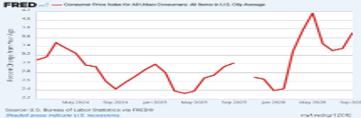
“The Consumer Price Index for All Urban Consumers (CPI-U) increased 0.9 percent on a seasonally adjusted basis in March, after rising 0.3 percent in February, the U.S. Bureau of Labor Statistics reported today. Over the last 12 months, the all items index increased 3.3 percent before seasonal adjustment. BLS.gov

FREDcpi

We knew it was coming. Not just when. The Iran war is in its second month and has already produced the largest supply shock to the global oil market in history, the IEA said last month.

On Tuesday, the head of the group, Fatih Birol, told French newspaper Le Figaro as reported by several news agencies that the current crisis is more severe than the oil shocks of 1973 and 1979, and the 2022 Ukraine-war shock, combined.

There’s no end in sight as the world’s largest economy is making the supply shortages worse. It’s an incredible reversal of our standing in the world.

The high spike in the CPI inflation graph above is a disheartening picture of what happens when mad kings attempt to control economies and countries that have a choke hold on supply chains needed by the world economies.

This is just the latest mismanagement by the Trump administration—and Republican Party also has allowed, let’s not forget—of the American economy. President Trump wanting to pay for his tax cuts with higher tariffs had already snarled supply chains and caused a second post-COVID inflation round.

The Biden administration had wrestled annual CPI inflation below 3 percent in 2024 from the earlier COVID-19 pandemic spike, where it stood until now.

And Trump apparently thought attacking a country that bordered a waterway through which 20 percent of petroleum supplies and products flowed would not do further damage to the world’s economies.

So what was he thinking? The problem is he doesn’t bother to think things through at all. This is the second spike that has raised the cost of living since the tariff induced inflation. So why would polls show a majority of voters believe Republicans are better at economic growth?

Is it because Trump runs the federal government from Mar-a-Lago, or one of his golf courses (That’s a joke.)?

The all-items consumer index rose the most—3.3 percent for the 12 months ending March, after rising 2.4 percent for the 12 months ending February. It rose 2.6 percent less food and energy over the year. The energy index increased 12.5 percent for the 12 months ending March, as a result of the Iran war.

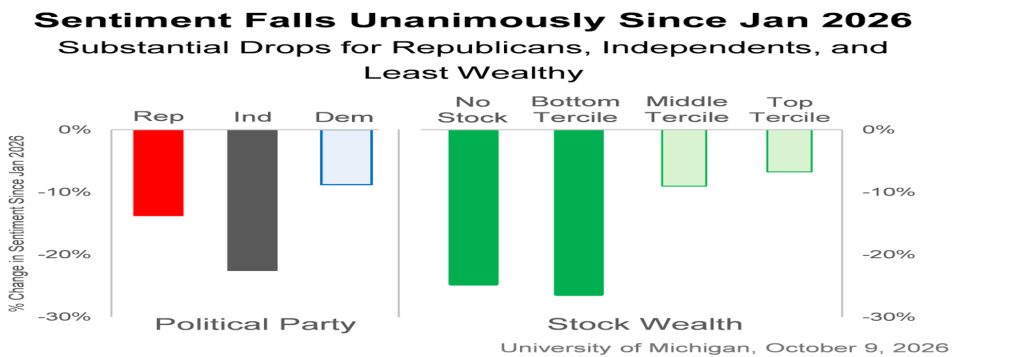
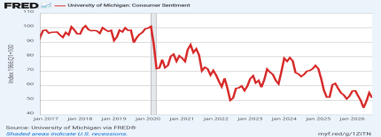
And American consumers are already feeling it. The University of Michigan survey of consumer sentiment fell to a record low of 47.6 in April from 53.3 in the prior month.

“Consumer sentiment sank about 11% this month, extending a decline that began with the start of the Iran conflict, and is currently about 9% below a year ago. Demographic groups across age, income, and political party all posted setbacks in sentiment, as did every component of the index, reflecting the widespread nature of this month’s fall,” said Survey Director Joanne Hsu

It doesn’t mean consumers will shop more once they receive their Trump tax refunds. But inflation is a growth killer, and countries such as Russia or even Turkey that are living through one-man rule have had nothing but double-digit inflation for decades, because their leaders thought they knew better than anyone else how to run their country.

Harlan Green © 2026

Follow Harlan Green on Twitter: https://twitter.com/HarlanGreen
Posted in Consumers, COVID-19, Economy, Politics, Uncategorized, Weekly Financial News | Tagged , , , , , , , , | Leave a comment

Poor Economic Growth Ahead?

Popular Economics Weekly

First-Quarter GDP Growth Estimate Decreased “On April 7, the GDPNow model estimate for real GDP growth in the first quarter of 2026 is 1.3 percent, down from 1.6 percent on April 2.”

AtlantaFed

More warnings of slow economic growth are appearing. And now we have a Gulf War that makes predictions more unpredictable. Who knows what’s to come?

The Atlanta Federal Reserve’s GDPNow estimate of first quarter (Q1) 2026 economic growth that is widely followed by economists has plunged from its high of 3 percent, where it had been sitting since January 2026, to 1.3 percent in the latest revision.

Why was the drop a surprise? Fourth quarter 2025 GDP growth had already plunged from 1.4 percent to 0.7 percent in its latest revision.

Because much higher GDP growth in Q2 and Q3 last year showed that financial markets were buying the Trump message that American taxpayers and businesses would start spending more from the Big Beautiful Tax Bill write-offs this spring.

The latest retail sales and a good March unemployment report (+178,000 jobs) had kept up optimism for a better year. There were also hopes that increased business investment—another component of GDP—would create more jobs.

But in fact the opposite is happening. Most business investment is being spent on AI energy centers, which is causing more joblessness, with wholesale job layoffs being announced as a consequence of AI adoption—at the likes of Amazon, which has announced a total of 30,000 job cuts to date.

And we are seeing imports continuing to flood in, far out distancing exports, which increases the trade deficit and brings down our Gross Domestic Product growth, since GDP measures only what is produced or sold in the U.S.

A recent Wall Street Journal survey says that on average, economists forecast gross domestic product adjusted for inflation to grow 2.1% in the fourth quarter this year from a year earlier. That was down incrementally from 2.2% in January. They expect the unemployment rate will be 4.5% in December, matching their forecast in January, before the war. Last month the unemployment rate was 4.4%.

Economic Growth is difficult to forecast; economists will tell you. And the Atlanta Federal Reserve is one of the few that dare to do it. We don’t even have the final fourth quarter 2025 revision yet, which has shrunk steadily after a much better looking Q3 of +4.4 percent GDP growth.

Besides job, trade deficit, and business investment data, the GDP includes consumer spending. That number hasn’t faltered as badly. So we should be looking at consumer behavior if we want to know what happens next.

I said last week that retail sales picked up in March, so consumers are shopping again and consumer confidence edged up as well.

There is something else that could improve consumers’ attitudes and hence GDP.–lower inflation would increase the demand for goods and services. But how to achieve it with $4 per gallon gas prices for who knows how long? Lower inflation is possible with AI efficiencies that should increase labor productivity and lower product costs. But it takes time, years, as with past technological innovations.

The just-announced two-week ceasefire could certainly bring down oil and gas prices if it holds, and Trump will want it to hold given the Iran War’s unpopularity.

The Federal Reserve is hinting it could go up or down on their interest rate decisions this year. But if the labor market continues to shrink the Fed will also want lower interest rates ahead. And any easing of credit conditions (i.e., lower cost of borrowing) would be good news for better economic growth this year.

Harlan Green © 2026

Follow Harlan Green on Twitter: https://twitter.com/HarlanGreen
Posted in Consumers, COVID-19, Economy, Politics, Uncategorized, Weekly Financial News | Tagged , , , , , , , , , , , , , | Leave a comment

Great Employment Report!

Popular Economics Weekly

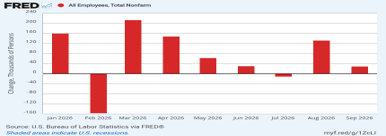
Total nonfarm payroll employment increased by 178,000 in March, and the unemployment rate changed little at 4.3 percent, the U.S. Bureau of Labor Statistics reported today. Job gains occurred in health care, in construction, and in transportation and warehousing. Federal government employment continued to decline,.” BLS

FREDjobs

This was a very good March unemployment report, per the U.S. Bureau of Labor Statistics, a complete reversal of February’s -133,000 payroll (revised) job losses. It was mainly because 31,000 Kaiser healthcare nurses settled their strike, and improved weather brought construction workers out that were building the record number of AI data centers that must generate so much electricity for Artificial Intelligence that could put as much as 30 percent of white-collar workers out of jobs.

It didn’t bring much enthusiasm back to Wall Street because Trump threatened in his national address to continue the Iran War while he ended it and let everyone else deal with the Strait of Hormuz.

It was his usual gobbledygook, in other words, that didn’t make anyone happy and shifted the blame for the closing of the Strait to others, when there had always been free passage until Trump/Hegseth revealed how much they enjoyed killing people.

It was a reprise of the Bush/Cheney Iraq war, in other words, that took eight years to resolve and ultimately led to the Great Recession.

The March unemployment rate fell slightly to 4.3 percent while 400,000 more adults left the workforce. This means our working age population continues to shrink while fewer workers are needed thanks to more use of Claude, Chatgbt, bots, etc., etc., until who knows when??

We should know be looking at consumer behavior if we want to know what happens next. Retail sales picked up in March, so consumers are shopping again and consumer confidence edged up as well. Retail sales comprise some 50 percent of consumer spending and is the main driver of growth for the U.S. economy.

In the 12 months ending in February, retail sales increased a solid but below-trend 3.7% in unadjusted terms, but that was before $4 per gallon gas and the supply disruptions from the Iran war.

And “Consumer confidence ticked up again in March, as a modest improvement in consumers’ views of current conditions outweighed a slight downshift in expectations for the future,” said Dana M Peterson, Chief Economist, The Conference Board. 

We will certainly see higher prices and possibly higher interest rates ahead as the Iran war continues, as we did with the Iraq war. Alan Greenspan’s Federal Reserve raised its Fed Funds rate from 1% in 2003 to 5.25% in 2006 to combat soaring inflation from the $2 trillion plus cost of the ill-fated invasions of Iraq and Afghanistan that created America’s first $trillion budget deficit.

The badly-planned Iran war will cost as much or more while American taxpayers continue to struggle to pay for more federal debt as this war drags on.

I get the feeling we are staring at another economic precipice. It can be for several reasons—another costly war, an energy shortage, President Trump asking allies to bail him out after dissing them, the illegal tariffs, cutting off immigration when there’s a looming shortage of workers, etc., etc…

The list is almost endless.

Harlan Green © 2026

Follow Harlan Green on Twitter: https://twitter.com/HarlanGreen
Posted in Consumers, COVID-19, Economy, Politics, Uncategorized, Weekly Financial News | Tagged , , , , , , , , , , , , | Leave a comment

Job Openings in Decline

Financial FAQs

“The number of job openings was little changed at 6.9 million in February, the U.S. Bureau of Labor Statistics reported today. Over the month, hires decreased to 4.8 million, and total separations changed little at 5.0 million.” BLS.gov

FREDjobopenings

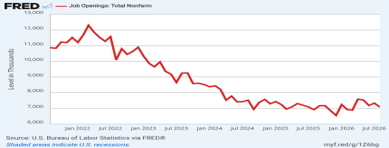
The Labor Department’s Job Openings and Labor Turnover Survey (JOLTS) was bad news for workers, as per the slide in available jobs portrayed in the above graph of monthly job openings.

It has now fallen to just 6.9 million in February 2026, the total of available nonfarm payroll jobs tallied by the Labor Department. Actual job hires fell to 4.8 million while 5.0 million left the workforce, a net loss of 200,000 jobs.

The Iran War will add to the damage that has already been done to the U.S.—and maybe worldwide—economy from the single-minded focus on what is most important to President Trump and his Robber Barons; bringing back another Gilded Age with its ultra-consolidation of wealth that has caused record public debt that is being paid for by American taxpayers. 

Former Clinton Labor Secretary Robert Reich listed the economic damage from Trump’s first term alone. He (Trump) pledged to be “the greatest jobs president that God has ever created.

He’s been the worst jobs president in American history. In his first term, Trump presided over a historic net loss of nearly 3 million jobs, the worst jobs numbers ever recorded under an American president, as tabulated by FactCheck.org.

FactCheck.org showed more the decline in Trump’s first term:

· The international trade deficit Trump promised to reduce went up. The U.S. trade deficit in goods and services in 2020 was the highest since 2008 and increased 36.3% from 2016.

· The number of people lacking health insurance rose by 3 million.

· The federal debt held by the public went up, from $14.4 trillion to $21.6 trillion.

And President Trump month-long war with Iran is adding to the damage with the blocked petroleum supply chain that provides so many necessary byproducts—such as fertilizer, natural gas and helium, for starters.

“After a month, your war has already cost 13 American lives, cost American taxpayers at least $30 billion, cost American consumers at least a dollar more per gallon of gas than they paid a month ago, pushed up food prices and mortgage rates, and pushed down the value of 401(k) retirement plans. It’s mangled supply chains for industries that rely on items such as fertilizer to grow food or helium to make computer chips,” said Professor Reich

So we shouldn’t be looking at the 1970’s era of stagflation for a result from the Iran War because of the damage already done in President Trump’s second term, whether the Strait is closed, or not. It may take longer to materialize but look more like another Great Recession, I said recently, that was caused by the economic mismanagement of another Republican administration involved in a Middle East war.

A key will be watching the employment picture this week, especially the Labor Department’s Friday unemployment report.

Harlan Green © 2026

Follow Harlan Green on Twitter: https://twitter.com/HarlanGreen
Posted in Consumers, COVID-19, Economy, Politics, Uncategorized, Weekly Financial News | Tagged , , , , , , , , , , , , , , , | Leave a comment

Another Gulf War?

Popular Economics Weekly

“So it looks as if the worst and the dumbest are not just at the top of the political leadership. They’re not just on the diplomacy and strategic policymaking end, but even in the cutting edge of the military. And it’s terrifying. America as we knew it may just not exist, even in our military forces.” Paul Krugman

Amazon

Nobel Laureate economist Paul Krugman is concerned about our military because it doesn’t look like President Trump will settle the Iran War any time soon, and Dr. Krugman is fearing the results could be catastrophic for the world economy.

And Nuriel Rubini, another economist, predicted in a recent CNBC interview that Donald Trump would escalate the war on Iran and thereby risk “1970s stagflation.” Dr. Rubini isn’t infallible. He is known for falsely predicting many ‘doomsday’ scenarios, but he did predict the Great Recession.

The U.S. was seemingly caught by surprise over the extensive damage that has already been done on Gulf refineries and U.S. Military bases in the area and almost 200 American casualties killed or wounded.

A JP Morgan commodities analyst Natasha Kaneva with co-authors Artem Fakhretdinov and Lyuba Savinova cited by MarketWatch is predicting trouble ahead if the war is escalated. “Much like during the pandemic, the shock unfolds sequentially rather than simultaneously — a rolling supply disruption moving westward, dictated by shipping times and buffered unevenly by regional inventories.”

Such disruptions are already occurring because so many petroleum products that originate in the Gulf must be transported by ship, and stockpiles are already depleted. In the first three weeks of March, Kaneva discovered a fall of 155 million barrels, mainly triggered by a 211 mbpd drop in oil in transit.

What would another “1970’s stagflation” look like that occurred once before because of another oil embargo—by OPEC—and resulted in multiple recessions? The rising prices of gas, fertilizers, and natural gas are already boosting inflation from the Strait of Hormuz blockade. Stagnating growth is sure to follow, since consumers will save more, consume less, which is the classical response to such conditions.

So why then would Trump even attempt it? He seems to believe the U.S. military could pull off another Venezuela—perhaps by quickly capturing Kharg Island, Iran’s oil shipping hub, and closing the Strait of Hormuz.

That brings us back to Professor Krugman’s prognosis on American military capabilities. “There’s no question that the U.S. has unchallenged superiority in all of the conventional aspects of warfare. There’s no Iranian Air Force for, you know, there’s no Iranian Navy in any conventional sense. Unfortunately, it’s not that kind of war. The failure to have a prepared response to the modern world of drones and inferior powers which nonetheless have the ability to do a lot of damage, has been a bit of a shock.”

But Trump doesn’t seem to be listening to anyone on the economy, either. In giving a recent “A plus plus-plus-plus-plus-plus” grade on the U.S. economy in a recent interview with Politico cited by The Guardian, Trump is living in a fantasy world while he drives the U.S. economy into a possible recession.

The University of Michigan sentiment survey on how consumers currently think about our economy hit a new low in March. “Consumer sentiment fell back 6% this month to its lowest level since December 2025. Declines were seen across age and political party. Consumers with middle and higher incomes and stock wealth, buffeted by both escalating gas prices and volatile financial markets in the wake of the Iran conflict, exhibited particularly large drops in sentiment,” said survey Director Joanne Hsu

Hsu also said year-ahead inflation expectations climbed from 3.4% in February to 3.8% this month, the largest one-month increase since April 2025.

What if our military has been fighting the wrong war? What if Iran has the capability that Ukraine has shown with its drone technology, though vastly smaller than Russia’s military?

The lessons from Vietnam, Iraq, and Afghanistan have already been forgotten if President Trump does escalate another Gulf War; by the “worst and dumbest.”

Harlan Green © 2026

Follow Harlan Green on Twitter: https://twitter.com/HarlanGreen
Posted in Consumers, COVID-19, Economy, Politics, Uncategorized, Weekly Financial News | Tagged , , , , , , , , , , , | Leave a comment

What, Another Great Recession?

Financial FAQs

“The conflict with Iran has already put fresh stress on the U.S. economy, as businesses are reporting rising prices, fewer orders and a decline in employment. A survey of service-oriented companies — the sector that employs most Americans — fell to an 11-month low of 51.1 in March from 51.7 in the prior month, S&P Global said Tuesday.” MarketWatch

FREDpayrolls

Maybe we shouldn’t be looking at the 1970’s era of stagflation for the kind of economic damage from the Iran War and closing of the Strait of Hormuz to oil shipments. There is a short-term spike in oil prices, though oil from other sources than the Gulf can eventually make up the difference in supplies.

The war’s damage may take longer to materialize but look more like the Great Recession, which we shouldn’t forget was a worldwide recession that occurred in 2008-09, the worst since the Great Depression of the 1930s.

We shouldn’t forget that the Great Recession the Bush/Cheney administration and their oil barons ultimately spawned with the ill-planned invasions of Iraq and Afghanistan was based on lies about the weapons of mass destruction that Saddam Hussein didn’t have.

And now Trump and his Robber Barons are taking the Gilded Age dreams of William Mckinley one step further with lies that Iran is preparing nuclear weapons to justify the ill-prepared war with Iran while alienating the allies that would help them succeed.

This is even though Trump’s just-resigned Counterterrorism czar Joe Kent said Iran posed no imminent threat with nuclear weapons.

The Great Recession was caused by more than the Bush wars on terror, of course. It was caused by putting too many regulation-cutting foxes in the Bush/Cheney hen house that literally resulted in the failure of nonbank banks like Bear Stearns and Lehman Brothers.

Trump is following the same playbook by gutting the government’s regulatory agencies that could prevent the blatant fraud occurring with the Trump administration’s Bitcoin investments that have no regulations or backing with assets.

This time negative GDP growth could come from the faltering labor market, which is frozen in place with almost no net new job creation at all in 2015 as highlighted in the above FRED graph. Fed Chair Powell remarked at his latest press conference that they were torn over whether to cut interest rates or raise them because Trump’s immigrant deportations were causing a labor shortage.

Economic growth ground to a halt as well in 2008, even when Fed Chair Greenspan anxiously began to cut interest rates to prevent the near failure of our banking system.

Powell’s Fed Governors also predicted overall GDP growth of 2.4 percent in 2026, even though Q4 2025 Real GDP growth slowed from 1.4 to just 0.7 percent. So I don’t understand the Fed’s optimism over economic growth.

And history has shown that no job growth will ultimately lead to no economic growth,

The frightening truth is that both Republican administrations have made bad decisions for the same wrong reasons.

Harlan Green © 2026

Follow Harlan Green on Twitter: https://twitter.com/HarlanGreen
Posted in Consumers, COVID-19, Economy, Politics, Weekly Financial News | Tagged , , , , , , , , , , , , , , , | Leave a comment

Why Trump 2.0?

Popular Economics Weekly

“According to the latest PISA rankings, which assess 15-year-olds in math, science, and reading, the United States ranks around 13th in reading, 18th in science, and 37th in mathematics out of 79 participating countries. Countries like China, Singapore, Finland, and Canada consistently outperform the US, particularly in STEM (Science, Technology, Engineering, and Mathematics) subjects. World Population Review

Amazon

Why have Americans twice elected a president who is openly hostile to western, participatory democracy and actively supports dictators or wannabe dictators such as Vladimir Putin and Hungary’s Prime Minister Victor Orban?

It is due to the support of a dumbed-down Republican Party, but also an education system that hasn’t changed with the technological times, such as by educating more scientists and engineers.

Republicans have a history of dumbing down their electorate so much so that a powerful minority no longer believes in scientific facts but prefers conspiracy theories.

The Republican party’s support of ignorance is easily documented; from the denial of evolution and support of creative (intelligent) design in the 1970s, to Donald Trump’s attacks on higher education and scientific research today, including the evisceration of public health services that serve all Americans (including Obamacare) and attempt to eliminate the Department of Education.

The dumbing down of Americans has also been reflected in an educational system that no longer serves all Americans, as I said. We developed a universal K-12 education system that is really the foundation of our democracy. By 1930, 48 states had passed laws making education compulsory.

But according to the National Research Council, only 28 percent of high school science teachers consistently follow the National Research Council guidelines on teaching evolution, and 13 percent of those teachers explicitly advocate creationism or “intelligent design,” said Psychology Today in a very damning 2014 article entitled, Anti-Intellectualism and the Dumbing Down of America:

“After leading the world for decades in 25-34 year olds with university degrees, the U.S. is now in 12th place,” said Psychology Today. “The World Economic Forum ranked the U.S. at 52nd among 139 nations in the quality of its university math and science instruction in 2010. Nearly 50 percent of all graduate students in the sciences in the U.S. are foreigners, most of whom are returning to their home countries”

The result has been electing a president who makes a virtue of his ignorance and announces decisions with little homework but worldwide repercussions based on what he “feels in his bones.”

Dana Milbank, a longtime political columnist, documented the modern Republican Party’s history in his book, “The Destructionists: The Twenty-Fived-Year Crack-Up of the Republican Party.”

In May of 2021, a poll by the Public Religion Research Institute found that 23% of Republicans agree that, quote, “the government, media and financial worlds in the U.S. are controlled by a group of Satan-worshipping pedophiles who run a global child-sex trafficking operation,” said Millbank in an NPR interview.

Milbank asserts Republicans drift towards craziness began in 1994 when more than 300 Republicans under the command of “obstructionist and rabble-rouser” Congressman Newt Gingrich stood outside the U.S. Capitol to sign the Contract with America and put bipartisanship on notice.

And “Twenty-five years later, on January 6, 2021, a bloodthirsty mob incited by President Trump invaded the Capitol,” he said.

The American public is getting it. The latest PEW Research poll reports:

· Trump’s approval rating stands at 37%, down from 40% in the fall.

· By more than two-to-one, Americans say the administration’s actions have been worse than they expected (50%) rather than better (21%).

· Only about a quarter of Americans today (27%) say they support all or most of Trump’s policies and plans, down from 35% when he returned to office last year. That change has come entirely among Republicans.

Pundits give other reasons for such a dumbing down of a segment of the electorate–such as social media and television replacing literacy, or education that no longer teaches math and science or even history. Maybe that has enabled the Donald Trumps of the world to shout louder. The danger is that it may drown out any intelligent discourse about the most important issues of our day. It’s driving at least one of our political parties into insanely dangerous positions today.

Harlan Green © 2026

Follow Harlan Green on Twitter: https://twitter.com/HarlanGreen
Posted in Consumers, COVID-19, Economy, Politics, Uncategorized, Weekly Financial News | Tagged , , , , , , , , , , | Leave a comment

Why Start a War?

Financial FAQs

“The Producer Price Index for final demand increased 0.7 percent in February, seasonally adjusted, the U.S. Bureau of Labor Statistics reported today. Final demand prices moved up 0.5 percent in January and 0.4 percent in December 2025. (See table A.) On an unadjusted basis, the index for final demand rose 3.4 percent for the 12 months ended in February, the largest 12- month advance since increasing 3.4 percent in February 2025.BLS.gov

FREDppi

Why start a war when President Trump’s tariffs are already raising the cost of everything? Because “The United States is the largest Oil Producer in the World, by far, so when oil prices go up, we make a lot of money,” Trump said in a post on Truth Social last week.

Who makes a lot of money? Most Americans could be losing a lot of money over the sudden rise in energy prices it is precipitating, but not his family and oil buddies, obviously.

His thoughtless remarks have put him in a bind, which is why he is lashing out at allies and enemies alike because they don’t want to fix the damage it is causing.

Right now it has given a boost to wholesale inflation. The Producer Price Index for wholesale goods, imported goods in the main, is climbing again.

And the tariff question is far from settled with the Trump administration required to pay back much of the $1.4 billion in tariffs that were illegal, according to the Supreme Court.

We add to that the resignation of Joe Kent, Trump’s top counter terrorism appointment, who said Trump attacked Iran because Netanyahu told him to, not because of some imminent danger. The former Director of the National Counterterrorism Center said “I cannot in good conscience support the ongoing war in Iran. Iran posed no imminent threat to our nation”.

So with the Strait of Hormuz closed that is choking off 20 percent of the world’s oil supply from going anywhere, the PPI wholesale cost of things is now the highest since February 2025.

This is probably why Fed Chair Powell announcement after Wednesday’s FOMC meeting that there was little chance of more than one rate cut in 2026, and maybe even a rate hike if Trump can’t stop the bombing and find a way to call the bombing campaign a victory. He must also find a way to open the Strait of Hormuz, of course.

The Federal Reserve stuck to its guns that one interest-rate cut this year was likely, but stressed conflict in the Middle East made its forecast uncertain. The Fed voted 11 to 1 to leave its key rate unchanged in the range of 3.5% to 3.75%.

BEA.gov

The Fed Governors also predicted overall GDP growth of 2.4 percent in 2026, even though Q4 2025 Real GDP growth slowed to just 0.7 percent. So I don’t understand the Fed’s optimism over economic growth.

The real culprit behind slowing GDP growth is less consumer spending. Fewer consumers are holding jobs for starters, and essentials like gas and electricity prices are soaring because of the Iran war as well as the tariffs.

So, the Fed wants to lower rates further to encourage more hires but rising inflation is holding them back. And Powell at his press conference said that conditions would have to be much worse for signs of stagflation such as occurred in the 1970s with the OPEC oil embargo.

Powell and the Fed Governors were surprisingly upbeat about our economic future, which is strange when Trump has started a war he never really planned or adequately prepared for.

Harlan Green © 2026

Follow Harlan Green on Twitter: https://twitter.com/HarlanGreen
Posted in Consumers, COVID-19, Economy, Politics, Weekly Financial News | Tagged , , , , , , , , , , , , , , , | Leave a comment

What Gulf War?

Financial FAQs

From the preceding month, the PCE price index for January increased 0.3 percent. Excluding food and energy, the PCE price index increased 0.4 percent. Excluding food and energy, the PCE price index increased 3.1 percent from one year ago.” BEA.gov

FREDBrentcrude

Oil prices spiked again on Thursday morning (to $94.35 per barrel) per the above graph on Brent crude oil prices, after Iran’s new leader said the crucial Strait of Hormuz should remain closed and that Iran will continue attacks on its Gulf neighbors,.

And the Fed’s favored inflation index, the Personal Consumption Expenditures core rate of inflation, which omits food and energy, rose by 0.4%. The core rate rose 3.1% in the 12 months ended in January, up from 3.0% in the prior month. It’s the highest rate in almost two years and decidedly not what the Fed wanted to see.

So, this is causing all the financial market indexes to plunge once again as it’s becoming increasingly obvious that Trump has no good reason for attacking Iran that is now morphing into another Gulf War.

“The war in the Middle East is creating the largest supply disruption in the history of the global oil market,” said the IEA in its March report released on Thursday that was cited by MarketWatch. Disruptions in the Strait of Hormuz have caused Gulf countries to cut total oil production by at least 10 million barrels per day, the energy body added.

So why shouldn’t President Trump’s new Gulf War repeat the 1970’s Arab Oil Embargo (OPEC) stagflation—slowing economic growth + higher inflation—that caused several recessions and resulted in the double-digit inflation of the era, I said last week.

I’m not the only one bringing up the similarities to 1970’s stagflation. Nobel economist Joseph Stigliz, a Clinton economic advisor who won the Nobel prize for economics in 2001, said in a podcast interview with Jack Farley of “Monetary Matters” released on Wednesday, that “We are facing a risk of stagflation with prices going up because of tariffs and war while growth is slowing.” The 92,000 nonfarm payrolls contraction in February was evidence for the slump in economic activity, he said.

And it’s beginning to show up in slower GDP growth. Real gross domestic product (GDP) barely increased at an annual rate of 0.7 percent in the fourth quarter of 2025, revised downward from 1.4 percent, according to the second estimate released today by the U.S. Bureau of Economic Analysis. In the third quarter, real GDP increased 4.4 percent.

BEA.gov

Oil prices had spiked earlier in June 2025 to $80 per barrel because of the short-lived Israel-U.S. strikes on Iran’s military and nuclear facilities. That should have been a warning of the potential economic damage from a longer war.

The other shoe to drop will be job creation. We are already in a stagnant job market with the loss of -92,000 jobs in February that basically erased the +126,000 job gain in January. Further losses are being hinted at by other indicators, such as the government’s JOLTS report that has shown no net growth in new hires for months.

It’s becoming more obvious that President Trump’s seeming incoherence over the reasons for his new Gulf war is hiding the real reason he started another Gulf War that he blurted out recently:

“The United States is the largest Oil Producer in the World, by far, so when oil prices go up, we make a lot of money,” Trump said in a post on Truth Social.

The sad truth is that Trump and his oil buddies are profiteering from a war that Americans, and much of the world, will end up paying for.

Harlan Green © 2026

Follow Harlan Green on Twitter: https://twitter.com/HarlanGreen
Posted in Consumers, COVID-19, Economy, Politics, Weekly Financial News | Tagged , , , , , , , , , , , , | Leave a comment

Where’s the Housing Recovery?

The Mortgage Corner

Existing-home sales increased by 1.7% month-over-month in February, according to the National Association of REALTORS® Existing-Home Sales report. The report provides the real estate ecosystem—including agents, homebuyers and sellers—with data on the level of home sales, price, and inventory.” NAR

FRED30yrmortgage

It’s been months since I last wrote about the housing market, and why it’s had such a slow recovery. FRED’s 30-year fixed mortgage graph tells us why, which is why we have a housing shortage.

The 30-year average fixed rate mortgage was a level 3% until 2022 during the COVID-19 pandemic when the Fed raised interest rates to combat rising inflation. It’s 6.0% today, after dipping very briefly to 5.98% last month.

It’s this high today because Trump’s Iran war is costing $1 billion per day on borrowed money, according to the Pentagon, which will add to the current $39 trillion in federal debt.

Are we seeing a housing revival with the slight uptick in existing home sales? Hope springs eternal, as the saying goes. Sales have hovered around 4 million residential units since the busted housing bubble and 2008-09 Great Recession. There has never been enough to satisfy the demand since then, because the busted housing bubble restricted new home building for almost 10 years,, and 30-year fixed rate mortgages have hovered above 6% ever since, per the FRED graph.

But, “Housing affordability is improving, and consumers are responding,” said NAR Chief Economist Dr. Lawrence Yun. “Still, there is a long way to go to return to pre-pandemic levels of transaction activity. There are more than 6 million more jobs than in 2019, yet home sales per year are down by one million.”

There isn’t much of a housing supply inventory, and builders aren’t cooperating now with less than a four-month supply of existing home inventory on the market at the current slow sales rate.

This is while privately-owned housing starts in October were punk, at just a seasonally adjusted annual rate of 1,246,000. It is 4.6 percent below the revised September estimate of 1,306,000 and is 7.8 percent below the October 2024 rate of 1,352,000, says Calculated Risk.

Unaffordably high mortgage rates are one reason for the construction shortage, but Trump’s tariffs on building materials are also adding to construction costs.

Higher import taxes on steel, copper, lumber and other materials are lifting construction prices and interrupting some jobs. Immigration enforcement is worsening worker shortages and delaying projects.

“We get so many things thrown at us in the construction industry,” said Tony Rader, the chief relationship officer at National Roofing Partners, a commercial roofing company in Coppell, Texas. “It just seems like every time we turn around, we’ve got something else to fight.”

So, we must throw in the costs of empire building because Republicans are so fond of waging wars. It’s not only the Federal Reserve keeping rates high, but also the huge federal debt has been boosting bond yields. It is the reason we still have a housing shortage of 2-5 million units, depending on who you ask, since the Great Recession and housing bubble.

Harlan Green © 2025

Follow Harlan Green on: https://twitter.com/HarlanGreen

Posted in Consumers, COVID-19, Economy, Housing, housing market, Politics, Weekly Financial News | Tagged , , , , , , , , , , , , , , , , , , | Leave a comment