
The Mortgage Corner
The Harvard Joint Center for Housing Studies has just come out with their rental market report, and it shows very little low rent housing available, due mainly to both increased household formation and those who have lost their homes from the busted housing bubble. Almost all of the 2.7 million abandoned and/or foreclosed homes are gone; most becoming rentals that do not meet the expanding need for rental housing.
Millions of Americans are in precisely that situation, according to a study released today by Harvard’s Joint Center for Housing Studies. The availability of apartments, especially cheaper ones, hasn’t nearly kept up with demand, and the problem has worsened since the 2007-09 recession, the study says.
In 1960, about one in four renters paid more than 30 percent of income for housing. Today, one in two are cost burdened,” according to the study, America’s Rental Housing.
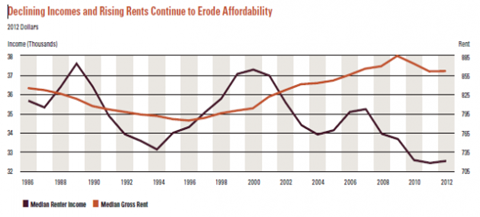
Graph: Harvard Center for Housing Studies
Rick Judson, chairman of the National Association of Home Builders (NAHB), issued the following statement on the rental housing report:
“The report released today by the Harvard Joint Center for Housing Studies highlights serious affordability problems for many of America’s renter households, and NAHB supports many of the policy initiatives outlined in the study to meet this ongoing challenge. Of primary importance, efforts to reform the housing finance system must include a federal backstop to maintain broad liquidity during all economic cycles and ensure that rental housing can continue to be built and preserved.”
Judson and the NAHB have supported maintaining some form of Fannie Mae and Freddie Mac to guaranteed conforming loans that currently cover more than 90 percent of mortgages originated. There have been no viable alternatives proposed to date.
“It is clear that the federal role in ensuring the availability of financing for multifamily rental housing for low- and moderate-income households is critical,” said Judson. “Other ways to reduce the costs of providing affordable housing must be pursued as well, such as strengthening the Low Income Housing Tax Credit program, removing regulatory barriers to construction, providing gap financing to help reduce construction costs, streamlining program rules and allowing agencies to align administrative procedures across programs.”
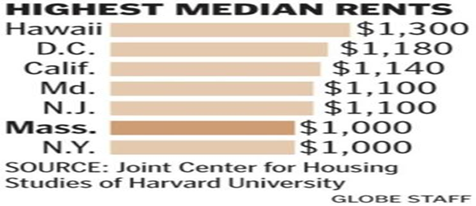
So the real problem is rising housing prices, coupled with very low housing inventories that are putting pressure on affordable housing. The good news is that a lot more rental housing is being constructed with strength in the multifamily component that spiked a monthly 15.3 percent after a 20.1 percent surge in September. The multifamily component is up 22.5 percent on a year-ago basis while the single-family component is up 8.8 percent.
Harlan Green © 2013
Follow Harlan Green on Twitter: www.twitter.com/HarlanGreen


 Populareconomicsblog
Thanks for this post! Here in San Jose, the lack of affordable housing is a real problem that I hope will start to get more attention soon. Just wondering — do you think that the current crunch in low rent housing means that we are likely to see more policies that support affordable housing in the near future?
LikeLike
Thanks, Sara; The only support of affordable housing we have to date are the Federal Reserve policies that keep interest rates low….if Janet Yellen confirmed we will see more multiple family housing. Not much else coming from govt, what with sequester and upcoming budget agreement. Repubs are putting lock on more govt.-sponsored public housing. But if interest rates stay low, then we will see more affordable housing…it is badly needed, as you say.
LikeLike
Sara; I apologize for not responding in a timely manner, but affordable housing is almost always a local/community problem. I would think that San Jose has the means for more affordable housing? Eg, here in Santa Barbara, we have both county and city affordable housing departments that manage hundreds of price-controlled housing units. My advice is to get involved with San Jose’s affording hsg dept., and become more politically active, if that is what you want! H Green
LikeLike