
Financial FAQs
The 10-year benchmark Treasury yield dropped 5.12 points yesterday, the biggest drop in 5 months, according to Marketwatch. It is hovering just above a 2.4 percent yield—which is why one can still obtain a 30-year fixed rate conforming mortgage rate for 3.50 percent, and why the housing market is booming.
But this is ridiculously low, and signals something is very wrong with our economy. The 10-year T yield during normal times of prosperity is usually 1 percent higher, in the 3 to 4 percent range, as are mortgage rates. Why have interest rates and inflation remained so low for so long—since 2009 and the end of the Great Recession?
So little inflation over such a long period shows the sad state of financial affairs for most Americans. We have a record income inequality—the worst in the developed world—that has meant consumers that power most of the demand for goods and services have become financially strapped.
And consumer spending is the main driver of economic growth. It is why GDP growth has averaged just 2.1 percent since the Great Recession that threw so many people out of work.
We rank just above Jamaica, Peru and other small developing countries in income inequality. And that is the major reason for the political polarization and dysfunction of government that can’t provide basic social services to most Americans; which would mitigate some of the income inequality.
The new Republican tax bill takes another $1.5 trillion away from Medicare and Medicaid benefits over the next ten years, according to most analyses, that will further exacerbate their poverty.
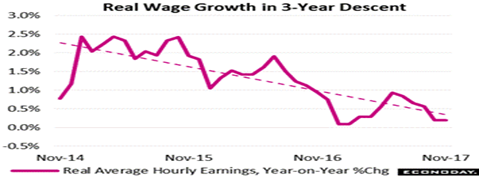
Harold Myerson of The American Prospect recently said, “The United States now has the highest percentage of low-wage workers – that is workers who make less than two-thirds of the median wage- of any developed nation. Fully 25 percent of all American workers make no more than $17, 576 a year.”
Why does all this matter? Because it means America’s middle class has been gutted, and it is our middle class that has provided the political stability between the two parties, and enabled compromise.
Because our middle class has shrunk, our politics have drifted to the right and another gilded age, where the wealthiest control most of the wealth and power, as happened at the beginning of the 20th century in the age of President William McKinley.
The current example of Republicans’ tax reform is the best example of our rightward drift. Democrats weren’t allowed any amendments or hearings, and consequently not a single Democrat in both legislative houses voted for the bill.
This drift towards Oligarchy that last happened more than 100 years ago is also the reason for our growing isolation from the rest of the world, and the loss of democratic values Americans are currently experiencing—such as fairness and equal justice for all races and economic classes.
So, as much as everyone hates inflation and loves low interest rates, these rates have to rise to levels that prevailed before the Great Recession to enable greater prosperity for all, not just the top one percent of income earners. And that won’t happen when one political party can enact a ‘tax reform’ bill that shifts more Americans’ wealth away from the majority of Americans.
Harlan Green © 2017
Follow Harlan Green on Twitter: https://twitter.com/HarlanGreen


 Populareconomicsblog