
The Mortgage Corner
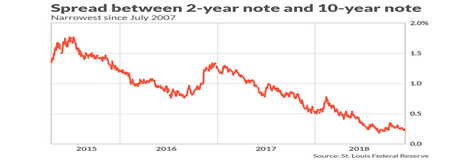
The spread between the 2-year note and the 10-year narrowed 4 basis points to 0.16 percentage point on Monday, its flattest levels since July 2007, according to MarketWatch. The 10-year Treasury yield dropped back below 3 percent, to 2.93 percent for the first time in one year, lowering mortgage rates as well.
This is unheard of in a fully employed economy currently growing at 3 percent when longer term rates should be rising, if there was a rising demand for longer term credit transactions, such a mortgages. So it’s a danger signal that all may not be well in the financial markets. There is the perception, at least, that worldwide growth is slowing. The stock market has become increasingly jittery with huge moves daily, trade wars are in full bloom, and Russia (Ukraine) and North Korea (new missile sites) are acting up again.
Hence investors would rather hold US bonds than stocks at the moment.
A major reason for worldwide slower growth could also be the shrinking volume of US dollars in circulation. The Federal Reserve has been selling off its $4 trillion hoard of securities back into the private sector that was part of its Quantitative Easing program, thus reducing the amount of US dollars in circulation. This is while it is still the world’s reserve currency that is used in a majority of cross-border transactions.
The current Federal Reserve is another culprit in the inversion curve because it is pushing short term rates higher. Its benchmark overnight rate has risen to 2.25 percent, its eighth raise since 2015, and now 2 percent above its post-recession lows, thus increasing the cost of consumer borrowing. Yet inflation is barely rising, which should be reason not to raise rates, since it is another indication that a majority of consumers aren’t aren’t flush with cash. Not when the median income of households has barely budged since the 1980s, after inflation.
There is just not enough demand for goods and services, in other words, which is why inflation is tame. Then what’s causing the economic growth? Corporate profits are at record levels, and automation is speeding up labor productivity. So more is produced, but the income stream doesn’t trickle down to the majority of consumers in what has become a lower-paying service economy of mainly warehouse, restaurant (part of leisure and hospitality sector), healthcare, and retail workers that don’t earn enough money to warrant the Fed’s push for higher short term rates in anticipation that inflation may someday loom on the horizon.
But it ain’t happening, and doesn’t look like it will happen soon, unless what trickles down becomes a real income stream for the middle and lower income earners. There has to be greater access to jobs with fair pay, decent shelter, effective schools, and reliable health care, for starters.
Harlan Green © 2018
Follow Harlan Green on Twitter: https://twitter.com/HarlanGreen


 Populareconomicsblog