
The Mortgage Corner

It looks like consumers came through during the holidays, as retail sales jumped 0.3 percent in December and are up 3.5 percent from a year ago, per the above FRED (St. Louis Fed) graph.
It might be enough to get Q4 GDP back to a 2 percent growth rate, from predictions as low as 0.5-1.5 percent from the Atlanta Federal Reserve.
And now that the Phase I China Trade Agreement is signed, the financial markets should stabilize. But that won’t bring back economic growth in this new year, as much of the damage from the 2-year tariff wars has been done, especially in so-called capital expenditures, the seed-corn of future growth in private-sector companies.
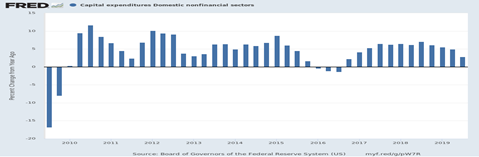
The FRED graph shows how capex spending in plants and equipment soared after the 2007 Great Recession, then leveled to around 5 percent annual increases until 2016, when it actually declined. It picked up again in 2017-18 before beginning its current decline to a 2.8 percent annual increase in Q3 2019.
And there is still real damage to growth coming from the continuing trade wars. The NYTimes and others have documented ongoing damage to the same Midwest states that elected Trump—especially in Wisconsin.
Wisconsin will wind up losing 37,000 jobs because of Trump’s trade war, according to the pro-trade group Tariffs Hurt the Heartland, while the state’s businesses and residents have already paid $598 million in higher costs for goods and services because of U.S. tariffs, per a Huffington Post article.
This is while “Railroads and trucking companies have been cutting jobs, and consumers—at least in the parts of the country most affected by the trade disputes—maybe pulling back as well,” said a recent NYTimes article. “Freight volumes in 2019 had the largest decline since the Great Depression, and transportation and warehouse companies have cut more than 10,000 jobs since December.”
That means it will be up to consumers and the retail sector to maintain U.S. economic growth at its current level. But that means no further declines in capex spending.
And here’s another thought. What if Republicans hadn’t made the draconian 2017 tax cuts to corporate profits that has now created a $1 trillion budget deficit? What if they had instead voted to save those tax revenues to begin reconstructing our ageing infrastructure, or for education, or environmental protection, or more research?
Then we wouldn’t need to have this conversation about declining growth.
Harlan Green © 2020
Follow Harlan Green on Twitter: https://twitter.com/HarlanGreen


 Populareconomicsblog