Financial FAQs
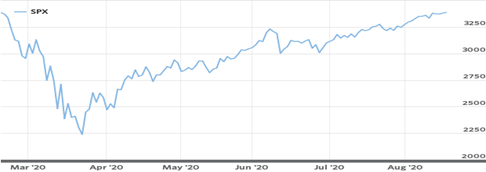
U.S. stocks finished mostly higher Tuesday, with the S&P 500 index notching its first record close since Feb. 19, and marking the quickest recovery from bear-market territory in its history, according to Dow Jones Market Data.
So what happens next with the inevitable surge in COVID-19 cases this fall, school openings and the ordinary flu season? Probably not much to the DOW and stocks, believe it or not. The rest of the economy not owned by the top 10 percent of income owners is another story, however.
The best predictor of what may happen are other pandemics, such as the 1918 Spanish flu pandemic. But there were other 100,000 plus US deaths in the HINI and Bird flu epidemics of 1958 and 1968 as well.
During the 1918 influenza pandemic as with COVID-19, wealthier people had a better chance of survival: Individuals of moderate and higher economic status had a mortality rate of 0.38 percent, versus 0.52 percent for those of lower economic status and 1 percent for those who were “very poor,” economists Brian Beach, Karen Clay and Martin Saavedra wrote in the paper published this week.
“Compared to individuals who lived in one-room apartments, individuals who lived in two-room, three-room, and four-room apartments had 34 percent, 41 percent, and 56 percent lower mortality, respectively,” they added. In 2020, multigenerational households have also faced similar challenges, especially those with elderly inhabitants and younger people who show no symptoms of the virus, experts say.
This will probably be the case today, especially if congress doesn’t’ provide further adequate aid to states as well as extending unemployment insurance.
The financial markets were affected by death rate surges, in particular, but recovered quickly, as the combined Spanish flu-DOW Jones graph shows. The DOW fell slightly during each of the three spikes in death rates. It finally began its rise to new heights in the spring of 1919 only after the third spike, but the recession for most Americans didn’t formally end until 1922, according to the National Bureau of Economic Research (NBER).
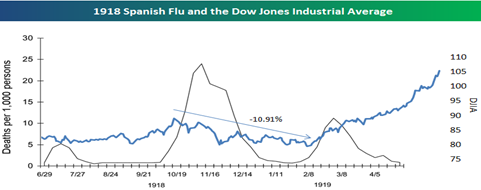
We can draw from this that ordinary consumers held back from spending until the virus had vanished. Americans were recovering from World War I and all the wartime controls, just as they did after World War II. But there was no New Deal in 1919 to help boost ordinary spending, no union regulations to aid organizing, no government-insured mortgage giants like Fannie Mae, FHA and the VA-guaranteed home loans to boost housing, so household spending didn’t pick up until 1922.
We can therefore conclude that we will not see any substantial pickup on GDP growth until next year, at the earliest. Consumers spending has an even larger effect on actual economic growth (70 percent) today than it did post-World War I, but the financial markets, which are still controlled by financially flush banks and major corporations will keep boosting stock and bond prices, as long as money is cheap.
The Fed learned this lesson in December of 2018, when it began to raise short term interest rates and the financial markets momentarily crashed. Ty then abruptly reversed course and began the current easing to bring interest rates in effect to zero, even becoming negative interest rates, when inflation is taken into account.
But this won’t help the majority of Americans, unfortunately, who don’t have the wherewithal to spend or borrow, unless more government financial aid is forthcoming that repeats the $3 trillion CARES Act, as the New Deal did to lift US out of the Great Depression.
Conversely the Fed will have to keep interest rates close to or below zero to keep the financial markets afloat. Not a very healthy state of affairs with a $24 trillion national debt hanging over American heads.
Harlan Green © 2020
Follow Harlan Green on Twitter: https://twitter.com/HarlanGreen


 Populareconomicsblog