
The Mortgage Corner
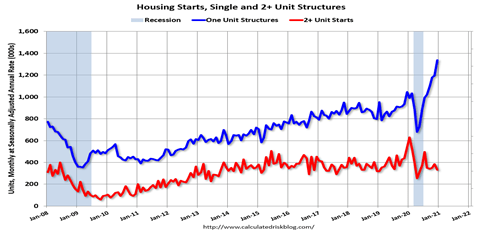
As much housing is being built today as in 2006 at the height of the housing bubble. What is going on? People want to move away from cities, where fear of COVID-19 contagion is highest, and work from home to replace empty offices as the digital economy makes over white collar working places.
This looks like a more permanent transformation because Fifth Generation, 5G networks will begin to kick in with up to 40 times faster transmission speeds for all kinds of AI connections that will ultimately be able to power factories, as well as homes and offices.
Privately-owned housing starts in December were at a huge seasonally adjusted annual rate of 1,669,000, said the Census Bureau. This is 5.8 percent above the revised November estimate of 1,578,000 and is 5.2 percent above the December 2019 rate of 1,587,000.
Building permits were authorized at an even higher rate. Privately-owned housing units authorized by building permits in December were at a seasonally adjusted annual rate of 1,709,000. This is 4.5 percent (±1.4 percent) above the revised November rate of 1,635,000 and is 17.3 percent (±1.8 percent) above the December 2019 rate of 1,457,000.
This is while total existing-home sales, https://www.nar.realtor/existing-home-sales, completed transactions that include single-family homes, townhomes, condominiums and co-ops, decreased 2.5% from October to a seasonally-adjusted annual rate of 6.69 million in November, according to the NAR. But sales in total rose year-over-year, up 25.8% from a year ago (5.32 million in November 2019).
“Home sales in November took a marginal step back, but sales for all of 2020 are already on pace to surpass last year’s levels,” said Lawrence Yun, NAR’s chief economist. “Given the COVID-19 pandemic, it’s amazing that the housing sector is outperforming expectations.”
The demand for more housing will further increase with the expanding 5G networks, as described in a World Economic Forum 2020 White Paper.
“5G will be critical because it will enable unprecedented levels of connectivity, upgrading 4G networks with five key functional drivers: superfast broadband, ultra-reliable low latency communication, massive machine-type communications, high reliability/availability and efficient energy usage. Together, these defining features will transform many sectors, such as manufacturing, transportation, public services and health.”
The WEF estimates that significant economic and social value can be generated by enabling cases activated by 5G. “An IHS Markit study estimates that $13.2 trillion in global economic value will be made possible by 2035, generating 22.3 million jobs in the 5G global value chain alone.”
There is another problem that needs to be tackled, however. The upcoming surge in evictions is on temporary hold until March. Low-income renters are most affected, as a UC Berkeley housing study found more than one million renter households in California alone had lost their jobs. And the US Census Bureau estimated that 1.9 million US tenants were behind on their rents last December.
The moratorium does not cancel out owed back rents, however. But California tenants and landlords are in line to receive some $2.6 billion in rental assistance from the coronavirus aid package approved last month, reports the LA Times. That and the additional unemployment benefits and cash aid will do much to cushion the losses incurred by both tenants and landlords from the pandemic.
Adequate housing will be problem for years to come, in other words, so building new homes will solve only part of the problem.
Harlan Green © 2020
Follow Harlan Green on Twitter: https://twitter.com/HarlanGreen


 Populareconomicsblog