
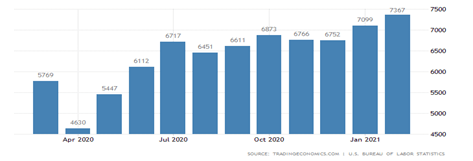
Job openings in the U.S. rose in February to the highest level in more than two years as the economy emerged from a winter slowdown tied to a record increase in coronavirus cases. The number of job openings jumped to 7.37 million from 7.1 million in January, the Labor Department said Tuesday.
“Job openings now top prepandemic levels and aren’t far from the record high of 7.57 million in November 2018,” said MarketWatch’s Jeffry Bartash.. “Many companies are looking to hire more workers in anticipation of the economy strengthening as most of the American populace gets vaccinated.”
This is a further sign (with last Friday’s U.S. unemployment report) that we could return to some form of full employment by the end of this year.
Both US manufacturing and service sectors are expanding faster. American manufacturers’ Institute of Supply Managers (ISM) index hit a 38-year high, another economic indicator pointing to gathering momentum in the U.S. economy.
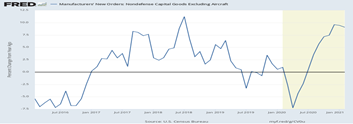
Timothy R. Fiore, CPSM, C.P.M., Chair of the Institute for Supply Management® (ISM®) Manufacturing Business Survey Committee said, “The manufacturing economy continued its recovery in March. However, Survey Committee Members reported that their companies and suppliers continue to struggle to meet increasing rates of demand due to coronavirus (COVID-19) impacts limiting availability of parts and materials.”
The Institute for Supply Management said its manufacturing index jumped to 64.7 percent from 60.8 percent in the prior month. Readings over 50 percent indicate growth, and anything over 55 percent is considered exceptional.
Job openings increased in health care and social assistance (+233,000), accommodation and food services (+104,000), and arts, entertainment, and recreation (+56,000); but declined in state and local government education (-117,000), educational services (-35,000), and information (-34,000).
I close with a short note by Professor James Galbraith, son of John Kenneth Galbraith, the best-selling author and defender of FDR’s New Deal. In speaking of inflation worries over the huge recovery and prosed infrastructure spending of the Biden administration, he said:
“Short of that (an outright war with China), U.S. households are not suffering from a shortage of smartphones, dishwashers, and running shoes. What they lack is confidence and security…Yes, some (of the spending) will be spent on services that were missed over the past year, reviving jobs in those sectors to a degree. Some will be used for housing maintenance, repairs, or upgrades—expenses that were neglected when people feared incurring the extra cost of a plumber, electrician, or painter. And some will go toward building new houses, as is already happening.”
These are all good reasons for spending huge amounts of money on reviving the U.S. economy and jobs, in other words.
Harlan Green © 2021
Follow Harlan Green on Twitter: https://twitter.com/HarlanGreen


 Populareconomicsblog