Are Wall Street investors irrationality exuberant? Former Bond King and CEO of the PIMCO bond fund Bill Gross thinks so.
Irrational exuberance is a term coined by former Fed Chairman Alan Greenspan in 1996 to describe the stock rallies of that decade that pushed stock prices so high that they earned less than one percent annually in capital gains and dividends by 2000, the year his warning come to roost when the Dot-com bubble burst.
Gross has been maintaining that today’s stock market rally that has pushed the S&P and DOW Jones indexes to record highs is due to a similar irrational exuberance.
“It tells me that fiscal deficit spending and AI enthusiasm have been overriding factors and momentum and ‘irrational’ exuberance have dominated markets since 2022,” he said in said in a recent MarketWatch interview.
All this exuberance has been due to several reasons; among them the US government stimulus spending that has pushed growth higher than in all other developed countries.
Americans have now been fully employed for more than two years, with more than 20 million new jobs created during that time. And real GDP growth is surging, as are corporate profits.
Irrational Exuberance may also explain the divergence of Wall Street investors with the current irrational pessimism among Main Street voters that is at odds with actual economic events.
In polls, such as by PEW Research, “About three-in-ten Americans (28%) currently rate national economic conditions as excellent or good, while a similar share (31%) say they are poor and about four-in-ten (41%) view them as “only fair.”
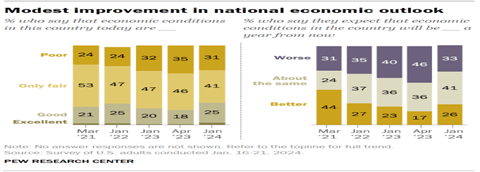
The polls are saying there has been a marked divergence not only between how Main Streeters feel about the economy, but also about their own financial circumstances. Overall, most Americans feel good about their personal finances but not about where the US economy is heading.
PEW added expectations for future economic conditions are more positive than they were last spring: Today, roughly a quarter say that they expect economic conditions will be better a year from now (26%) – up from 17% in April 2023.
I maintain this divergence between irrational exuberance and irrational pessimism is because most of the polled aren’t as knowledgeable about real economic data and business cycles that are published by the government and private providers, so they must rely on their immediate and experience; much of it is due to the trauma caused by the COVID pandemic that killed one million Americans.
Nobel Laureate Robert Shiller won the Nobel Prize in 2013 for his research on the causes of irrational exuberance.
Dr. Shiller said irrational exuberance is about “How errors of human judgment can infect even the smartest people, thanks to overconfidence, lack of attention to details, and excessive trust in the judgments of others, stemming from a failure to understand that others are not making independent judgments but are themselves following still others—the blind leading the blind.”
Can we blame those still hurting from the pandemic, as well as loss of blue-collar jobs in major parts of the Midwest, for not believing how quickly this economy has recovered?
Harlan Green © 2024
Follow Harlan Green on Twitter: https://twitter.com/HarlanGreen


 Populareconomicsblog