
Chapter Thirteen
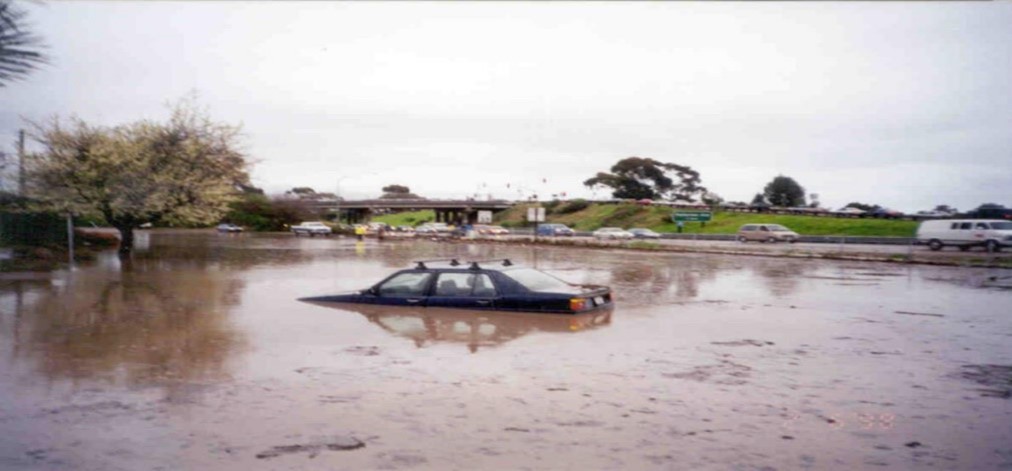
Goleta Old Town 1995 Flood
Many of us believed that a re-design of Old Town Goleta would be an ideal location to practice some of the precepts of True Urbanism, or Smart Planning, that could aid in the design for a new city. These were labels attached to what is now a worldwide movement.
The high crime rate in Old Town had been documented in the Redevelopment District Agency study. Environmental reports showed high traffic counts were causing air pollution, while successive floods following earlier drought periods required greater flood controls as well. We needed change.
We didn’t realize at the time that California’s Environmental Quality Act (CEQA) report would require flood improvements before anything could be done in Old Town.
The first step was to organize a design conference to provide design and planning alternatives for a new town center. We thought it obvious that without a community effort to create a community center with a unique identity that contrasted with neighboring Big Sister city Santa Barbara, Goleta’s cityhood might never succeed.
The American Institute of Architects co-sponsored eight simultaneous Design Charrettes across the country and in Hawaii. According to Wikipedia, Design Charrette is an architectural term that describes a gathering of designers and interested parties to create an innovative atmosphere in which a diverse group of stakeholders can collaborate to “generate visions for the future”. These weekend retreats brought professionals such as architects, designers, and urban planners together to envision and re-design a project area—such as a district or town center. All participants were interconnected via the Internet so we could report results to each other.
Design Charrettes originated with students of Paris’s Ecole des Beaux Arts, France’s major design school, in the 1800s. The students were used to cramming for exams at the last minute while riding in a charrette, or horse cart, to the exams. Our modern-day Design Charrette was an exciting chance for local students, environmentalists, and developers to participate in what might become a template for a future City of Goleta.
We assembled 100 design professionals and civic activists. It was a vehicle to begin the process of envisioning a future for the Goleta Valley community.
That weekend we “locked” ourselves into a large industrial building and broke into eight committees, each tasked to come up with a different design concept. The eight results covered the gamut of design ideas for Old Town, an area of no more than 20 city blocks and population of 5,000. Ideas ranged from a totally pedestrian environment accessible only to public transportation with room for pedestrian-oriented businesses and entertainment, to one that permitted automobile access, (which local business people badly wanted to sustain their businesses), but with more off-street parking and plenty of green landscaping.
Margaret Connell, Goleta’s first Mayor who supported the Old Town revitalization plan and wanted Old Town to be part of a new city center, voiced some of her concerns over the design problems:
. . . So Goleta Old Town feels more embedded than the more recent housing and worksites, and it also suffers from some disadvantages of being “old.” It lacks sidewalks through much of the older residential areas, though the city is taking steps to remedy this. There are many children who live here, but there are very few parks — a pocket park on Nectarine, a larger one on Armitos Avenue, and a four-acre, active-recreation park on Kellogg Street, which is still being developed.
The major environmental concerns were a lack of alternative transportation, such as buses and bike lanes, to manage traffic flow during peak rush hours and still service Old Town residents and businesses.
Flooding was also a major concern, despite periodic droughts. Santa Barbara and the South Coast had suffered several devastating floods during the 1990s that ended a prior 8-year drought.
The flood that broke the drought was called the March Miracle: in March 1991, 23 inches of rain fell, even flooding the Santa Barbara Municipal Airport and closing it for several days.
A second flood in 1995 caused another flooding of Old Town’s main street. A three-foot deep stream of water from a torrential rainfall overflowed San Jose creek at one end of Old Town’s boundaries. A climate scientist later said that the creek would no longer be adequate for containing flooding because the hard paved streets and roof surfaces in the surrounding neighborhoods had replaced the soil that had absorbed excess rainfall. Now the creek carried almost all of the rain’s runoff.
Hence flood control improvements, such as an enlarged creek bed to carry the increased runoff, were required in the CEQA report as the first step in any redevelopment effort.
The droughts and consequential flooding also made everyone aware of the limited water supplies in California, as well as the potentially devastating drought/flood cycle. In fact, California’s latest six-year drought ended with the greatest rainfall totals for Northern California since the 1880s.
Finally, Goleta achieved city status on February 1, 2002. It took four tries and a redrawing (several times) of city boundaries to gather in all of those who wanted to be part of the new city.
The work of the new City of Goleta has just begun. Its new community plan balances environmental with livable concerns, but there was another casualty of the Great Recession that caused an unexpected disruption of Goleta’s future infrastructure upgrades, especially in Old Town.
California, to solve its own budget problems caused by the Great Recession, dissolved all 404 Redevelopment District Agencies in 2011, which removed the tax financing that Old Town was counting on to fix some of its housing problems and relieve the traffic congestion.
Has Goleta become a more livable city? Its residents think so, though affordable housing will continue to be a problem. Most of its growth has been to the west, carefully planned to preserve a more rural atmosphere with numerous bike paths and a new train station to provide more transportation choices.
The Livable Cities movement has evolved into a ranking contest as cities compete to attract the best and the brightest people, as well as jobs for them. The annual rankings of the most livable cities are touted by several well-known lifestyle publications and organizations, including the AARP Livability Index, Monocle’s “Most Livable Cities Index”, the Economist Intelligence Unit’s “Global Livability Ranking”, and “Mercer Quality of Living Survey”.
Unfortunately, not a single U.S. city on the Economist’s list makes the top 10 in a study of the world’s 140 major cities. Melbourne, Australia, topped it in 2016, with Perth and Adelaide, Australia, also in the top ten. Honolulu, Hawaii, is the only American city mentioned at all. It makes the top ten list of most improved cities over the past 5 years.
It is safety of its residents and the threat of violence and terrorism that seems to have knocked American cities off the list and put Australia at the top of Most Livable Cities rankings.
How could Goleta solve the increasing dangers from violent extremism and domestic violence that make so many American cities unsafe?
Becoming a city enabled Goleta to contract with the County Sheriff to provide a neighborhood police service accountable solely to Goleta residents. It not only made Goleta safer for its residents, it was consequently listed as one of the 50 safest American cities in 2017, 15 years after its formation, according to a survey by Safewise, a security firm.
Goleta Old Town’s revitalization is still a work in progress. Goleta gave up on the idea of putting a new City Hall in Old Town. It instead purchased a new City Hall to the west amid commercial office complexes. But the new City of Goleta has adopted the Livable City planning principles that we envisioned in the Old Town Design Charrette.
As a postscript to Goleta’s story, I attended an event in 2019 that confirmed to me what a livable city meant to its residents. The City of Goleta Dam Dinner, a potluck dinner to which everyone contributed to celebrate their love of the city, was held on an earthen dam within the city limits that formed the small Lake Los Carneros. It was the “Love of the City” celebration.
The city described the celebration as “a free community dinner at the local dam where people brought picnics or bought dinner from food trucks and enjoyed their neighbors and the beautiful surroundings.”
It was the fifth annual Dam Dinner, an event Goletans first created in 2013 that was becoming increasingly popular among many cities wanting to honor their sense of community by making their city more lovable, as well as livable.
The happy faces of some 500 residents having a good time with friends and family while sitting side-by-side at tables strung along the length of the earthen dam was something to see.
It was evidence that the difficulties we encountered and obstacles we overcame to build such a community of happy people were worth it.
* * *


 Populareconomicsblog