
Financial FAQs
“The number of job openings was little changed at 7.1 million in November, the U.S. Bureau of Labor Statistics reported today. Over the month, hires were little changed and total separations were unchanged at 5.1 million each.” BLS.gov
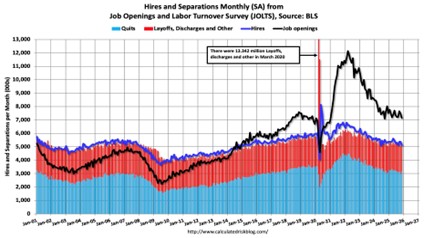
The Labor Department’s JOLTS survey is the first look at job formation before the official December U.S. unemployment report, and it isn’t pretty. The number of job hires equaled the number of ‘separations’, or those leaving the workforce for various reasons—voluntary or involuntary. (The blue line is Hires and red bars are Layoffs, Discharges, and other in the Calculate Risk graph. The black line is the total number of Job openings. It has fallen from its high of 12,000,000 job vacancies in 2022 after the COVID-19 pandemic.)
This means existing job positions are being replaced but no additional hires. Companies are holding on to their workforce, in other words, replacing those that are leaving for various reasons, but not expanding their workforce.
Trump’s Labor Department doesn’t tell us why but we can surmise that tariffs are the main culprit, since without the Supreme Court decision, companies don’t know if the existing so-called retaliatory tariffs enacted on April 2 are even legal. Imagine the refunds that the Trump administration has promised to return to importers if SCOTUS rules against him!
The number of hires decreased in state and local government, excluding education (-39,000) and in state and local government education (-31,000). Hires increased in federal government (+11,000), said the Bureau of Labor Statistics.
U.S. manufacturing activity fell to 47.9% in December, the Institute for Supply Management said Monday. This is the lowest reading of the year and the 10th straight month of contraction in the factory sector. Any number below 50% signals contraction.
“Looking at the manufacturing economy, 85 percent of the sector’s gross domestic product (GDP) contracted in December, compared to 58 percent in November, and the percentage of manufacturing GDP in strong contraction (defined as a composite PMI® of 45 percent or lower) increased to 43 percent, compared to 39 percent in November,” said Susan Spence, MBA, Chair of the Institute for Supply Management® (ISM®) Manufacturing Business Survey Committee.
ADP, a private payrolls purveyor, has said that just 41,000 jobs were added to payrolls in December. They were mostly in Leisure/hospitality and Education/healthcare, which means the service sector is still limping along.
This is in fact job stagnation, and with the manufacturing sector still in recession and inflation continuing to rise, it’s looking like overall economic stagflation is afoot.
How is a return of stagflation not inevitable with Republicans and Trump continuing to break up the existing world order? He has basically invaded Venezuela and threatened other countries with military intervention, how could it not be otherwise?
Who will want to do business with America at the point of a gun?
Harlan Green © 2026
Follow Harlan Green on Twitter: https://twitter.com/HarlanGreen


 Populareconomicsblog