
Popular Economics Weekly
“The number of job openings continued to trend down to 6.5 million in December, the U.S. Bureau of Labor Statistics reported today. Over the month, both hires and total separations were little changed at 5.3 million each. Within separations, quits (3.2 million) were unchanged while layoffs and discharges (1.8 million) were little changed.” BLS
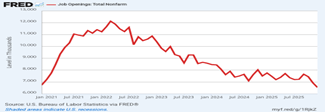
The Labor Department’s JOLTS report is another survey showing little or net job growth. That happens when the number of layoffs equals the number of hires (both hires and total separations—losses—were 5.3 million in December).
Alarm bells are ringing because it was the last this low during the worldwide economic COVID-19 pandemic (January 2021).
So now we must wait for the postponed official U.S. Labor Department unemployment report to know if we are slowly sinking into a job recession.
But workers can already see what is happening with their own eyes rather than listen to White House bromides that the economy must eventually get better. The private outplacement firm Challenger, Gray & Christmas said U.S.-based companies announced 108,435 layoffs in January, up sharply from the prior month. It was the biggest tally for the month of January since 2009.
“Generally, we see a high number of job cuts in the first quarter, but this is a high total for January. It means most of these plans were set at the end of 2025, signaling employers are less-than-optimistic about the outlook for 2026,” said Andy Challenger, workplace expert and chief revenue officer for Challenger, Gray & Christmas.”
It is up 205% from the 35,553 job cuts announced in December. January’s total is the highest for the month since 2009, said JOLTS, when 241,749 job cuts were announced. It is the highest monthly total since October 2025, when 153,074 cuts were recorded.
There’s another reason companies have stopped hiring more workers than they are losing. They are waiting for the Supreme Court decision on whether the tariffs are legal that are making many of their products more expensive.
Trump’s executive orders are not laws, unless approved by congress. And congress has said they can be enacted if there’s a national emergency. A scarcity of strategic metals is an emergency whose imports can be taxed, but not coffee and every other products that Americans use every day because Trump doesn’t like that particular government.
What are the other culprits preventing job creation? Artificial Intelligence (AI) was cited for 7,624 job cuts in January, 7% of total cuts for the month. Companies referenced AI for 54,836 announced layoff plans in 2025. Since 2023, when this reason was first tracked, AI has been cited in 79,449 job cut announcements, 3% of all layoff plans announced in that period.
“It’s difficult to say how big an impact AI is having on layoffs specifically. We know leaders are talking about AI, many companies want to implement it in operations, and the market appears to be rewarding companies that mention it,” said Challenger. Tariffs were cited for 294 job cuts in January, after causing 7,908 cuts in 2025.”
That’s even more sobering news. What will happen to the workers being laid off? Trump has cut back or cancelled many of the infrastructure programs that President Biden enacted in the Infrastructure, Inflation Reduction and CHIPS Acts that would employ these workers in sectors that are intended to modernize our economy.
But no, Trump wants to return to a fossil-fueled economy that is no longer growing (and is in fact losing workers). Republicans don’t seem to have a clue to the horrendous damage he is doing in turning back the clock to a distant era that no longer exists. It was called the Gilded Age and existed in the 1890s.
But the stock market is rallying to record highs with the DOW up 1200 at this writing! Yes, that’s all due to the capital spending for new AI infrastructure. But it’s creating jobs for robots, not humans.
Back to the 1890s? That can’t be done either, of course, and Americans are already seeing the results.
Harlan Green © 2026
Follow Harlan Green on Twitter: https://twitter.com/HarlanGreen


 Populareconomicsblog