
Popular Economics Weekly
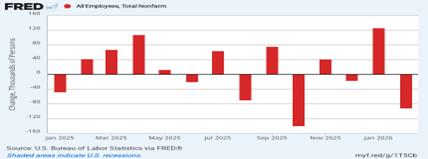
“Total nonfarm payroll employment edged down by 92,000 in February, and the unemployment rate changed little at 4.4 percent, the U.S. Bureau of Labor Statistics reported today. Employment in health care decreased, reflecting strike activity. Employment in information and federal government continued to trend down.” BLS.gov
FREDpayrolls
The U.S. economy lost a total of -92,000 payroll jobs in February and the unemployment rate edged up to 4.4 percent occurred just when President Trump began his Middle East war.
What timing! It will be an unmitigated disaster, not only because the war will be so badly done, but because of its timing. We will soon have soaring inflation, the likes of which we haven’t seen since the 1970’s decade of stagflation, and the American public doesn’t want it, per the latest PEW Research poll:
· Trump’s approval rating stands at 37%, down from 40% in the fall.
· By more than two-to-one, Americans say the administration’s actions have been worse than they expected (50%) rather than better (21%).
· Only about a quarter of Americans today (27%) say they support all or most of Trump’s policies and plans, down from 35% when he returned to office last year. That change has come entirely among Republicans.
The Bureau of Labor Statistics report basically cancelled out the +126,000 job gain in January, which may be a predictor of what’s to come this year with a looming economic stagnation.
Included was the loss of -69,000 healthcare workers employed in December and January, currently the highest job growth sector, because of a Kaiser Health employee strike which has since been settled.
It’s not a pretty picture. Every other sector lost jobs except for social assistance workers in February. So why would President Trump go to war when the U.S. economy is losing so many jobs?
Crude oil prices have risen the fastest on record, according to DOW Jones Market Data, and are at $100 per barrel at this writing and still rising.
The U.S. economy is frozen in place because American businesses also want to see what will happen with the tariffs as Trump’s attempts to use another trade statute that may also be illegal without doing the required analysis that justifies the higher levies.
And the Fed can’t move either. With fewer jobs being created it should be dropping interest rates further to stimulate hiring, but oil prices are driving up inflation so it might have to raise interest rates instead to slow rising inflation.
But he would rather rule by fiat, even start a war because Isreal’s Netanyahu is said to have told him Khomeini and his staff would be in one place above ground last Saturday where they could be bombed to oblivion; and they were. What if it had been a meeting to discuss Trump’s latest proposals for peace?
Trump ran his many failed businesses by declaring bankruptcy when they went under, but he can’t do the same with the U.S. economy because it must pay its bills by law. But there are other effects of such mismanagement—U.S. Dollar devaluation, higher interest rates and investors fleeing U.S. financial markets, which they are already doing.
Reuters reports U.S. investors are pulling money out of their own stock market at the fastest pace in at least 16 years “as Big Tech returns fade and better-performing overseas markets look more attractive.”
“In the last six months, U.S.-domiciled investors have pulled some $75 billion from U.S. equity products, with $52 billion flowing out since the start of 2026 alone, the most in the first eight weeks of the year since at least 2010, according to LSEG/Lipper data.”
He won’t be able hide the signs of his mismanagement style in a slowing economy, in other words. If not congress, it will really be a very unhappy consumer who determines what happens next; at the ballot box or elsewhere.
Harlan Green © 2026
Follow Harlan Green on Twitter: https://twitter.com/HarlanGreen


 Populareconomicsblog