
Popular Economics Weekly
“Total nonfarm payroll employment increased by 178,000 in March, and the unemployment rate changed little at 4.3 percent, the U.S. Bureau of Labor Statistics reported today. Job gains occurred in health care, in construction, and in transportation and warehousing. Federal government employment continued to decline,.” BLS
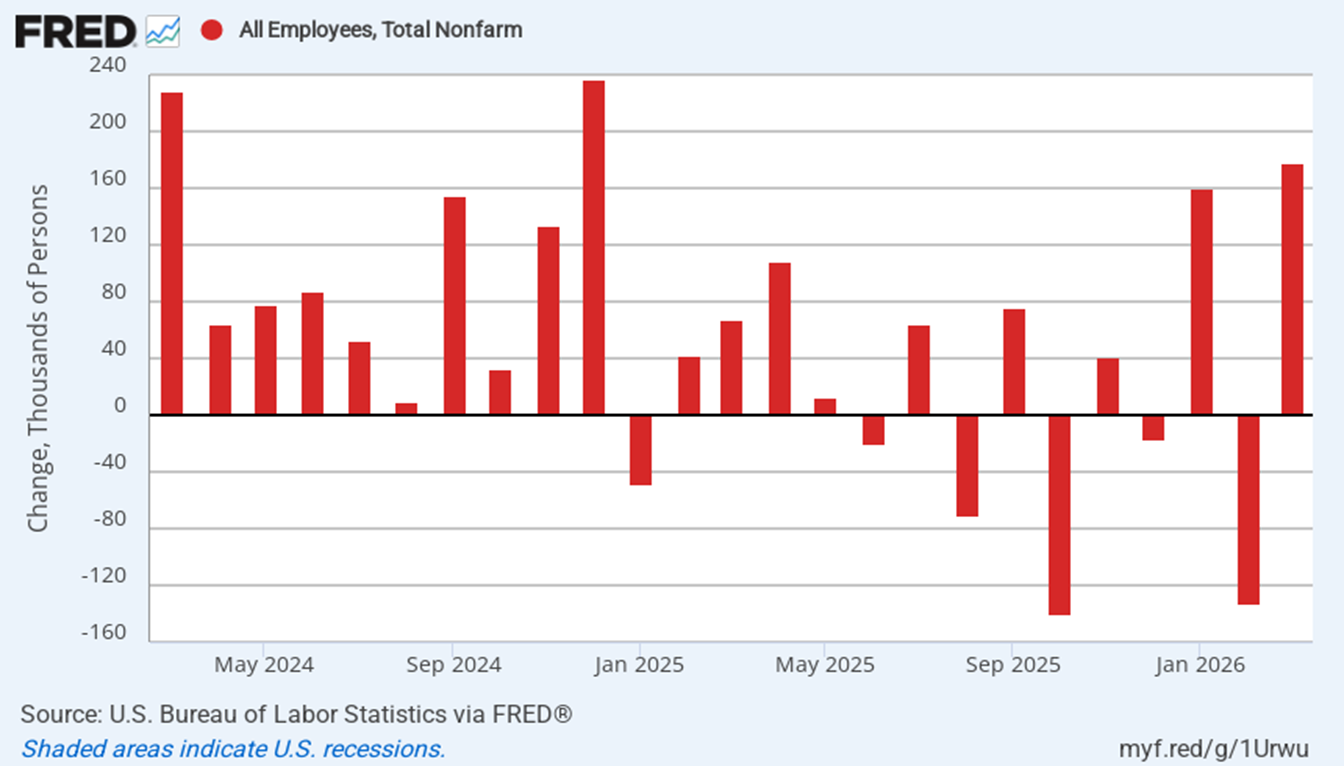
This was a very good March unemployment report, per the U.S. Bureau of Labor Statistics, a complete reversal of February’s -133,000 payroll (revised) job losses. It was mainly because 31,000 Kaiser healthcare nurses settled their strike, and improved weather brought construction workers out that were building the record number of AI data centers that must generate so much electricity for Artificial Intelligence that could put as much as 30 percent of white-collar workers out of jobs.
It didn’t bring much enthusiasm back to Wall Street because Trump threatened in his national address to continue the Iran War while he ended it and let everyone else deal with the Strait of Hormuz.
It was his usual gobbledygook, in other words, that didn’t make anyone happy and shifted the blame for the closing of the Strait to others, when there had always been free passage until Trump/Hegseth revealed how much they enjoyed killing people.
It was a reprise of the Bush/Cheney Iraq war, in other words, that took eight years to resolve and ultimately led to the Great Recession.
The March unemployment rate fell slightly to 4.3 percent while 400,000 more adults left the workforce. This means our working age population continues to shrink while fewer workers are needed thanks to more use of Claude, Chatgbt, bots, etc., etc., until who knows when??
We should know be looking at consumer behavior if we want to know what happens next. Retail sales picked up in March, so consumers are shopping again and consumer confidence edged up as well. Retail sales comprise some 50 percent of consumer spending and is the main driver of growth for the U.S. economy.
In the 12 months ending in February, retail sales increased a solid but below-trend 3.7% in unadjusted terms, but that was before $4 per gallon gas and the supply disruptions from the Iran war.
And “Consumer confidence ticked up again in March, as a modest improvement in consumers’ views of current conditions outweighed a slight downshift in expectations for the future,” said Dana M Peterson, Chief Economist, The Conference Board.
We will certainly see higher prices and possibly higher interest rates ahead as the Iran war continues, as we did with the Iraq war. Alan Greenspan’s Federal Reserve raised its Fed Funds rate from 1% in 2003 to 5.25% in 2006 to combat soaring inflation from the $2 trillion plus cost of the ill-fated invasions of Iraq and Afghanistan that created America’s first $trillion budget deficit.
The badly-planned Iran war will cost as much or more while American taxpayers continue to struggle to pay for more federal debt as this war drags on.
I get the feeling we are staring at another economic precipice. It can be for several reasons—another costly war, an energy shortage, President Trump asking allies to bail him out after dissing them, the illegal tariffs, cutting off immigration when there’s a looming shortage of workers, etc., etc…
The list is almost endless.
Harlan Green © 2026
Follow Harlan Green on Twitter: https://twitter.com/HarlanGreen


 Populareconomicsblog