
Popular Economics Weekly
First-Quarter GDP Growth Estimate Decreased “On April 7, the GDPNow model estimate for real GDP growth in the first quarter of 2026 is 1.3 percent, down from 1.6 percent on April 2.”
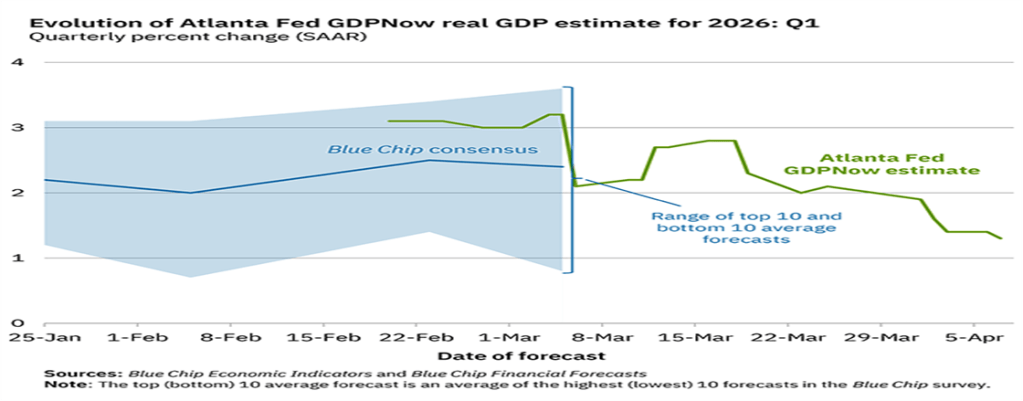
More warnings of slow economic growth are appearing. And now we have a Gulf War that makes predictions more unpredictable. Who knows what’s to come?
The Atlanta Federal Reserve’s GDPNow estimate of first quarter (Q1) 2026 economic growth that is widely followed by economists has plunged from its high of 3 percent, where it had been sitting since January 2026, to 1.3 percent in the latest revision.
Why was the drop a surprise? Fourth quarter 2025 GDP growth had already plunged from 1.4 percent to 0.7 percent in its latest revision.
Because much higher GDP growth in Q2 and Q3 last year showed that financial markets were buying the Trump message that American taxpayers and businesses would start spending more from the Big Beautiful Tax Bill write-offs this spring.
The latest retail sales and a good March unemployment report (+178,000 jobs) had kept up optimism for a better year. There were also hopes that increased business investment—another component of GDP—would create more jobs.
But in fact the opposite is happening. Most business investment is being spent on AI energy centers, which is causing more joblessness, with wholesale job layoffs being announced as a consequence of AI adoption—at the likes of Amazon, which has announced a total of 30,000 job cuts to date.
And we are seeing imports continuing to flood in, far out distancing exports, which increases the trade deficit and brings down our Gross Domestic Product growth, since GDP measures only what is produced or sold in the U.S.
A recent Wall Street Journal survey says that on average, economists forecast gross domestic product adjusted for inflation to grow 2.1% in the fourth quarter this year from a year earlier. That was down incrementally from 2.2% in January. They expect the unemployment rate will be 4.5% in December, matching their forecast in January, before the war. Last month the unemployment rate was 4.4%.
Economic Growth is difficult to forecast; economists will tell you. And the Atlanta Federal Reserve is one of the few that dare to do it. We don’t even have the final fourth quarter 2025 revision yet, which has shrunk steadily after a much better looking Q3 of +4.4 percent GDP growth.
Besides job, trade deficit, and business investment data, the GDP includes consumer spending. That number hasn’t faltered as badly. So we should be looking at consumer behavior if we want to know what happens next.
I said last week that retail sales picked up in March, so consumers are shopping again and consumer confidence edged up as well.
There is something else that could improve consumers’ attitudes and hence GDP.–lower inflation would increase the demand for goods and services. But how to achieve it with $4 per gallon gas prices for who knows how long? Lower inflation is possible with AI efficiencies that should increase labor productivity and lower product costs. But it takes time, years, as with past technological innovations.
The just-announced two-week ceasefire could certainly bring down oil and gas prices if it holds, and Trump will want it to hold given the Iran War’s unpopularity.
The Federal Reserve is hinting it could go up or down on their interest rate decisions this year. But if the labor market continues to shrink the Fed will also want lower interest rates ahead. And any easing of credit conditions (i.e., lower cost of borrowing) would be good news for better economic growth this year.
Harlan Green © 2026
Follow Harlan Green on Twitter: https://twitter.com/HarlanGreen


 Populareconomicsblog