
Housing Starts, Home Sales ‘Yuge’

The Mortgage Corner

Housing starts surged 25.5 percent in October to a 1.323 million annualized rate. This is the best rate of the cycle since August 2007 with the monthly percentage gain the strongest since 1982, says Econoday. It and other recent good news, such as much higher retail sales, could mean something like a 4 percent GDP growth rate in Q4 this year.

But we still have a housing shortage. The jump reflects a 10.7 percent rise to an 869,000 rate for the report’s key component, single-family homes which follows an 8.4 percent surge in September. And multi-family homes snapped back from September’s odd 39 percent decline, rising 69 percent in October to a 454,000 rate, which should mitigate surging rental prices.

image

Graph: Econoday

Actual sales of new homes have also been trending higher all year and would be higher still if not for the lack of supply. The surge in mortgage rates which jumped 18 basis points in the November 11 week to 3.95 percent (for conforming loans $417,500 or less) could begin to restrict sales, however. New home sales for October, which will not have been affected by November’s jump in mortgage rates, will be one of the coming week’s highlights (released Wednesday, November 23).

image

Graph: Econoday

This is while October existing home sales jumped 2.0 percent to an annualized rate of 5.6 million. September’s sales were revised slightly higher to an annualized rate of 5.490 million from 5.470 million. On the year, sales were up 5.9 percent from the same month a year ago. October sales were the highest since February 2007, which could be due to buyers rushing in ahead of a well-publicized, possible Federal Reserve decision to raise short-term rates in December.

image

Graph: Econoday

So how can we mitigate the shortage of available workers and land that is holding back home sales? NAR chief economist Lawrence Yun mused in a recent Forbes article how the Donald Trump Presidency might affect housing over the next 4 years..

“There could be less regulatory land-use and zoning burden for home construction, and thereby lower the cost of building,” says Dr. Yun. “In recent years, newly constructed home prices have been much higher than existing home prices. Homebuilders say that is due to all the extra cost of regulation and not necessarily from higher input cost of lumber, cement, and worker wages.”

And, mortgage standards are too strict, which is restricting first-time homebuyers, in particular that used to be 40 percent of existing-home sales. So Fannie Mae and Freddie Mac, the main guarantors for conventional mortgages, should continue to be supported in some way.

“Washington’s instinct is to eliminate Fannie and Freddie because of their past sins from past managers,” says Yun, “then mortgages will be much more expensive with 30-year fixed rate products disappearing from the market place. We should view supporting Fannie and Freddie in the same way as we view supporting FDIC deposit government guarantee at banks – to help smooth the financial market.”

“Multifamily production bounced back after an unusually weak reading last month while single-family starts exhibited unusually strong growth as well,” said NAHB Chief Economist Robert Dietz. “Though October’s single- and multifamily production rates are clearly unsustainable, we expect continued growth in the housing sector in the months ahead.”

But home supply was down 0.5 percent to 2.02 million or a 4.3 month’s supply in October. We are still not building enough homes, in other words, which is why housing prices continue to rise faster than inflation, and there are fewer affordable, entry-level homes.

Harlan Green © 2016

Follow Harlan Green on Twitter: https://twitter.com/HarlanGreen
Posted in Consumers, Economy, Housing, housing market | Tagged , , , , , , | Leave a comment

Record Retail Sales, Higher Growth Ahead?

Financial FAQs

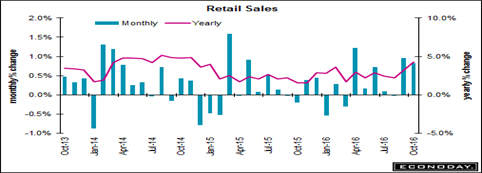
It looks like Q4 GDP could be higher than the Third Quarter’s initial estimate of 2.9 percent growth. That’s because retail sales and wholesale inventories, both major contributors to growth, are surging.

Retail sales jumped 0.8 percent in October with September revised 4 tenths higher to plus 1.0 percent. The consumer started the fourth-quarter better than expected and finished the third-quarter even stronger than that, according to BEA’s revision.

image

Graph: Econoday

The data show wide gains for both months led by the most important component of all, autos which rose 1.1 percent in October on top of September’s 1.9 percent surge. Building materials & garden equipment are also very strong, up 1.1 percent following September’s 1.8 percent gain with both pointing to strength for residential investment. Non-store retailers are also a standout and reflect strength in e-commerce, up 1.5 percent and up 0.9 percent in the two months.

image

Graph: Econoday

And manufacturing activity was also strong, Year-on-year, all vehicle production is up a very solid 5.0 percent and eclipsed only by the 6.7 percent gain for the selected hi-tech component which rose 1.0 percent in October to extend its run of impressive gains, according to Econoday. Another positive is a 0.2 percent gain for business equipment which has otherwise been weak most of the year.

Midwest manufacturing is also doing better. Kansas City Federal Reserve manufacturing activity report said, “This was the second consecutive month of rising factory activity in the Tenth District, the first time that has happened in nearly two years,” according to Kansas Fed chief economist Chad Wilkerson.

But what will happen with rising interest rates and a stronger dollar? Long term bond rates have jumped almost 1 percent since P-Elect Trump announced his very ambitious infrastructure upgrades, but which Fed Chair Yellen threw some cold water on yesterday in congressional testimony. She asked, Where will the workers come from to build it when we are already at full employment?

Another economic indicator reported the U.S. is growing at a moderate pace and is likely to do so through early 2017, according to the Conference Board’s Index of Leading Economic Indicators (LEI). The LEI is an index that measures the nation’s future economic health. It rose 0.1 percent in November after a 0.2 percent gain in the prior month, the Conference Board said Friday.

“Although its six-month growth rate has moderated, the index still suggests that the economy will continue expanding into early 2017,” said Ataman Ozyildirim, economist at the board. Its measure of current economic conditions rose 0.1 percent, the “lagging” index of past activity increased 0.2 percent, meaning current activity has slowed.

We therefore believe that Q4 will shape up to have perhaps 3 percent plus GDP growth. Will this extend into next year? It depends on how extensive and expensive will be the Trump infrastructure plans, because it will certainly boost long term rates and inflation.

But rising interest rates and higher inflation are actually signs of higher economic growth. Fed Chair Yellen seemed to remain cautious about the need to boost Federal Reserve short term rates in her latest congressional testimony, even though higher growth looms ahead.

Harlan Green © 2016

Follow Harlan Green on Twitter: https://twitter.com/HarlanGreen

Posted in Consumers, Economy, Politics, Weekly Financial News | Tagged , , , , , | Leave a comment

Will Prez-Elect Trump Now Settle His Federal Racketeering Charges?

Popular Economics Weekly

Donald Trump, among his many court battles, has three civil lawsuits that accuse him, his eponymous school, the university’s former president, and an LLC behind the venture of fraud, breach of contract, false advertising and racketeering, a pattern of illegal activity — specifically mail and wire fraud — designed to defraud the public.

Judge Gonzalo Curiel, the U.S. judge overseeing two of the lawsuits against President-elect Donald Trump and his Trump University told both sides they would be wise to settle the case “given all else that’s involved,” reports Reuters.

Given that he is now President-elect, some are wondering why he doesn’t settle before the November 28 trial, which would reveal in detail that Trump University was a shell game—literally. It was a university in name only that didn’t confer degrees, for example, and Donald Trump is accused of running a criminal organization under RICO, The Federal Racketeer Influenced and Corrupt Organizations Act.

The latest development from a source familiar with the discussions says the White House-bound mogul’s legal team wants a global settlement that would end all three complaints, including a lawsuit brought by New York Attorney General Eric Schneiderman, according to the New York Daily News.

But “We are not going to settle this case out cheaply,” Patrick Coughlin, an attorney for the plaintiffs, told reporters last Thursday. So Trump’s allegedly fraudulent behavior could seriously damage his pocketbook, as well as he reputation.

The Trump University fraud trials have a 6-year history. Lawyers for the president-elect are squaring off against students who claim they were lured by false promises to pay up to $35,000 to learn Trump’s real estate investing “secrets” from his “hand-picked” instructors. 

Instead, they were lured into maximizing their credit cards in what was characterized as a classic Bait and Switch scheme. Instead of professional courses in real estate investing that were personally supervised by Donald Trump, they were handed materials copied from other courses, and taught by instructors with no record of success, or any other qualifications.

And Donald Trump walked away with $millions. The underlying civil lawsuit names Trump as a defendant and claims his now-defunct Trump University defrauded students out of $40 million in course fees. The case was first filed in 2010 and covers a class of some 7,600 students in New York, Florida and California–that included veterans, retired police officers and teachers–but Trump personally received approximately $5 million of it, despite his claim, repeated in the Time Magazine interview, “that he started Trump University as a charitable venture.”

So Trump has good reason to fear the lawsuits over Trump University: They put a lie to a central plank of his campaign. The disappointed students suing him argue that Trump is not a wildly successful entrepreneur or a canny dealmaker but rather a fraudster who made promises he couldn’t keep, said Time Magazine. The legal proceedings have already revealed the details of the Trump University scam. Thanks to an order from Curiel, they could also reveal a closely guarded secret: Trump’s net worth.

image

Graph: Time Magazine

And now President-elect Trump is asking for Top-Secret clearances for his two sons and son-in-law Jared Kushner, who are being tasked to run his more than 200 business connections. No conflict of interest there? And when President, he will be in a position to appoint the next IRS Director, while his tax returns are being audited.

USA TODAY reports the overall ugly picture of his business practices that emerges goes far beyond Trump’s use of bankruptcy court, where debts can be forgiven or restructured depending on their category and type of federal bankruptcy filing. What’s most provocative about USA Today’s reporting, is how Trump has a longstanding pattern of ignoring his bills and walking away from debts owed contractors and employees.

“At least 60 lawsuits, along with hundreds of liens, judgments and other government filings reviewed by the USA Today Network, document people who have accused Trump and his businesses of failing to pay them for their work,” the newspaper wrote recently. “Among them: a dishwasher in Florida. A glass company in New Jersey. A carpet company. A plumber. Painters. Forty-eight waiters. Dozens of bartenders and other hourly workers at his resorts and clubs, coast to coast. Real estate brokers who sold his properties. And, ironically, several law firms that once represented him in these suits and others.”

It’s almost two weeks before his trial on the RICO charges is scheduled to begin on November 28. Trump probably will attempt to stall it into his Presidency, though Judge Curiel has said he is not inclined to do so. So we will get to see in more detail the sordid portrait of this man that some 60 million have elected to be our next President, or we may not, if he agrees to a settlement before then.

Either way, we hope it provides some justice to the 7,600 plaintiffs—many of whom lost valuable life savings—in chasing his con game.

Harlan Green © 2016

Follow Harlan Green on Twitter: https://twitter.com/HarlanGreen

Posted in Economy, Politics, Weekly Financial News | Tagged , , , | Leave a comment

What Is the Future of Interest Rates?

The Mortgage Corner

The deficit is moving to the back burner with Donald Trump and congressional Republicans in charge of Washington, and that is causing interest rates to rise quickly. Republicans leaders on Capitol Hill are now papering over divisions with Trump and deficit hawks are sounding the alarm, reports Politico.

“There is now a real risk that we will see an onslaught of deficit-financed goodies — tax cuts, infrastructure spending, more on defense — all in the name of stimulus, but which in reality will massively balloon the debt,” said Maya MacGuineas, president of the Committee for a Responsible Federal Budget.

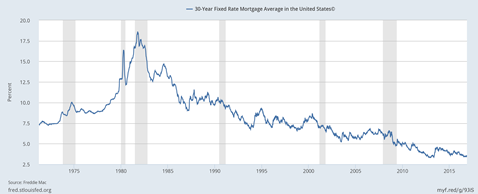
So we should look at Treasury Security yields, such as for the 10-year Treasury Bond to understand the future trajectory of interest rates. And bond yields are rising with the 10-year bond yield now at 2.25 percent, up from 1.71 percent just one week ago. But this is still far below the 4-6 percent yields in mid-2000, when 4 percent inflation and 6 percent fixed rates prevailed.

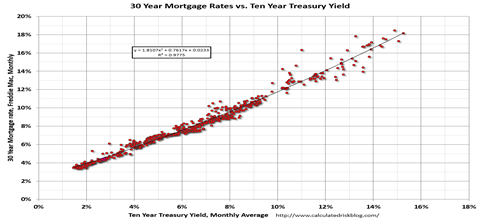
Calculated Risk’s Bill McBride predicts higher mortgage rates ahead, though still at historic lows. “With the ten year yield rising to 2.25 percent today, and based on an historical relationship, 30-year rates should currently be around 4.1 percent,” he said.

The 30-year conforming mortgage rate is already approaching that rate, with 30-year fixed rates @3.625 percent for a 1 pt. origination fee (3.875 percent for 0 pts.), and the Hi-Balance conforming fixed rate now 3.875 percent for 1 pt. origination, up ¼ percent just from last Friday.

image

Graph: St. Louis Fed

What is happening to make the 10-year Treasury rate rise so quickly, after staying below 2 percent for most of this year? It’s partly because we are at full employment while incomes are rising, and rising wages are two-thirds of product costs. Hence companies will raise their prices in response to such rising costs.

But that alone can’t account for such a quick rise. It also has to be because investors and the financial markets are anticipating that President-elect Trump will be able to push through a massive, possibly $1 trillion plus infrastructure rebuilding, which was a campaign promise. And he also wants to cut taxes.

This happened in 2001, when GW Bush pushed through massive spending to pay for his Wars on Terror, while also cutting taxes. His budget deficit therefore increased, and bond markets in particular don’t like large deficits, as it means too many bonds are in circulation to pay for those deficits, which reduces their price—and bond yields rise in inverse proportion to falling bond prices.

image

Graph: Calculated Risk

There’s also the anticipation that this will cause future inflation with so much money flooding into the economy at once. The above Calculated Risk graph shows the historical relationship between the 10-year bond yield and 30-year fixed mortgage rates.

We are therefore lucky at this late stage of a recovery to still see 4 percent fixed mortgage rates. One can see when the 10-year yield returns to a more normal 3.5 to 4 percent yield, fixed mortgage rates could almost double.

That’s why the 30-year fixed rate mortgage rose as high as 6.48 percent in 2006 at the top of the housing bubble. Will this hurt first-time homebuyers in particular? Not if inflation and housing prices don’t rise as fast, and construction can keep up with the rising demand for new homes.

Harlan Green © 2016

Follow Harlan Green on Twitter: https://twitter.com/HarlanGreen
Posted in Economy, Housing, housing market, Politics, Weekly Financial News | Tagged , , , , , , , | Leave a comment

What, Now A Trump Recession?

Popular Economics Weekly

Economists are already warning that if President-elect Trump’s policies are enacted, such as initiating trade wars, or the wrong tax cuts, or even cutting back on social security and Medicare benefits, we could see another recession, similar to the Great Recession that occurred during GW Bush’s term.

Whether his policies can be enacted depends on several things, including his unpredictable behavior, and perhaps the outcome of his November 28 RICO trial in San Diego for running Trump University as a criminal enterprise. Judge Gonzalo Curiel has just ruled that Trump’s inflammatory campaign statements can be admitted as evidence in his trial.

The Bush recession was caused by too lax regulations that caused the housing bubble (by allowing excessive bank leverage), tax cuts that increased the budget deficit while we were fighting two wars, and then Greenspan’s Federal Reserve decision to raise interest rates 16 consecutive times to bust the housing bubble.

It’s terrifying what President-elect Trump will be able to do when he controls all three branches of government (as soon as he appoints a ninth Supreme Court Justice) and carries out his campaign pledges.

Carrying out his pledge to deport all aliens when there is already an outflow of immigrants will devastate agriculture, construction, and any other industry that relies on low-cost labor, for instance.

His promise to ‘fix’ Obamacare (or abolish it outright) will endanger health benefits for the 20 million now covered by it. This makes healthcare much more expensive, since it puts the uncovered back in Emergency Room care for serious illnesses, which puts the cost of their care back on the hospitals.

And as the New York Times reports, “This is going to be a president who will be the biggest regulatory reformer since Ronald Reagan,” Stephen Moore, one of Mr. Trump’s economic advisers said in an interview on Wednesday. “There are just so many regulations that could be eased.”

It could be everything from repeal of Dodd-Frank, the successor to the Glass Steagall Act that protected federally insured depositors from risky investment banking, to repealing environmental regulations that combat global warming, and not only abolishing Obamacare, but the current Medicare system as House Speaker Paul Ryan is threatening to do.

image

Graph: Marketwatch

And we are reaching full employment levels, which will surely mean the Fed will begin to raise short term rates in December. This is happening already in the bond markets, as evidenced by rising longer term interest rates in anticipation of a soaring budget deficit, if Trump’s plan to increase both infrastructure and military spending while cutting taxes is implemented.

The central issue, though, maybe Trump’s misbehavior in dissing those elements that made American great. “Trump’s bigotry, dishonesty and promise-breaking will have to be denounced,” said David Brooks today. “We can’t go morally numb. But he needs to be replaced with a program that addresses the problems that fueled his ascent.

“After all, the guy will probably resign or be impeached within a year. The future is closer than you think.”

But President-elect Trump’s destruction of almost all decency in his grab for overwhelming power has let that Genie of discontent out of the bottle. We know what happened in the 1930s and even earlier when such ruthless tactics were used.

Harlan Green © 2016

Follow Harlan Green on Twitter: https://twitter.com/HarlanGreen
Posted in Economy, Politics, Uncategorized, Weekly Financial News | Tagged , , , , , , | Leave a comment

Full Employment Reached—161,000 Payroll Jobs

Popular Economics Weekly

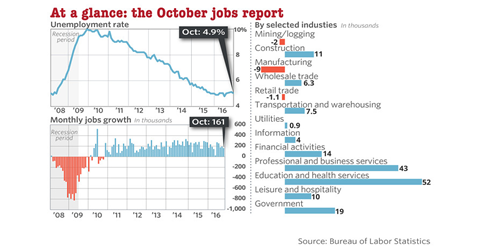
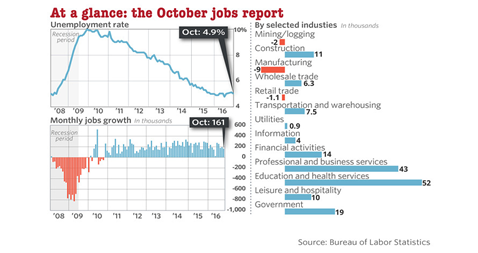
Average hourly earnings are up 2.8 percent annually, a recovery high. Nonfarm payroll growth was up 161,000 with upward revisions adding a net total 44,000 to September (191,000) and August (156,000). The unemployment rate is down 1 tenth to 4.9 percent and, for some, is already signaling full employment for the labor market, said the Bureau of Labor Statistics.

image

Graph: Marketwatch

We are reaching full employment levels, in other words, which will surely mean the Fed raises short term rates in December. Rising wages are two-thirds of product costs, which means the Fed Governors believe higher inflation has to be coming.

But where is it? The overall PCE price index is up just 1.2 percent annually. This is the strongest yearly showing since November 2014 and is 2 tenths closer to the Federal Reserve’s 2 percent target. Yet employment costs aren’t rising with the so-called Employment Cost index, the sum of benefits and salaries, no higher than 2.5 percent in a year.

image

The increase in hiring last month, along with stronger job gains in August and September than previously reported, shows the seven-year-old economic recovery still has plenty of life despite a slowdown in growth earlier in the year, says Marketwatch.

Q3 GDP growth rose to 2.9 percent, and fourth quarter growth looks to be strong, as well. Health care companies, white-collar professional outfits, and financial firms led the way in job creation, all in the service industries, while mining and manufacturing payroll employment declined.

Better news was that a broader measure of unemployment fell to 9.5% from 9.7%, touching the lowest level since May 2008. The so-called U6 rate includes part-timers who can’t find a good full-time position and discouraged jobseekers who’ve recently given up looking for work.

Also 19,000 new government jobs were added. Health care employment rose by 31,000 in October. Over the past 12 months, health care has added 415,000 jobs. Employment in professional and business services continued to trend up in October (+43,000) and has risen by 542,000 over the year. Over the month, a job gain occurred in computer systems design and related services (+8,000). Employment in management and technical consulting services continued to trend up (+5,000).

U.S. Manufacturing is also strong, according to the ISM’s Manufacturing Index. “The October PMI® registered 51.9 percent, an increase of 0.4 percentage point from the September reading of 51.5 percent, “ said Bradley J. Holcomb, CPSM, CPSD, chair of the Institute for Supply Management® (ISM®) Manufacturing Business Survey Committee. . “The New Orders Index registered 52.1 percent, a decrease of 3 percentage points from the September reading of 55.1 percent. The Production Index registered 54.6 percent, 1.8 percentage points higher than the September reading of 52.8 percent. The Employment Index registered 52.9 percent, an increase of 3.2 percentage points from the September reading of 49.7 percent.”

So employment, production and deliveries were up, though new orders dropped slightly. This all has to mean the Fed will shortly (i.e., after the Presidential election) probably raise their short term rates another 0.25 percent, which means the Prime Rate of 3.50 percent that controls revolving credit rates for starters, is due to rise at least 0.25 percent.

Harlan Green © 2016

Follow Harlan Green on Twitter: https://twitter.com/HarlanGreen
Posted in Economy, Macro Economics, Politics, Weekly Financial News | Tagged , , , , , , | Leave a comment

Why is Donald Trump Acting Like A Russian Oligarch?

It’s becoming clear why Presidential Candidate Trump and Russian President Putin have been so chummy with each other. Trump has become dependent on Russian oligarchs to fund his real estate ventures, since U.S. banks no longer will because of his various bankruptcies and history of failure to pay his debts.

One of his sons even admitted so. “Russians make up a pretty disproportionate cross-section of a lot of our assets,” Trump’s son, Donald Jr., told a real estate conference in 2008, according to an account posted on the website of eTurboNews, a trade publication. “We see a lot of money pouring in from Russia.”

And the FBI has nothing to say about the fact that Donald Trump has become so dependent on Russian oligarchs. Yet what looks like blatant collusion in illegal activity between Trump and Russian oligarchs has been documented in lawsuits, and much more since the Donald has been unable to borrow from U.S. banks.

He has had to depend on Russian oligarch monies, many of them either Russian Mafia figures or close associates of Vladimir Putin, to fund his real estate empire. And he has repaid them by adopting their playbook—discredit NATO and U.S. alliances, call for hacking of Hillary’s emails, and lauding Putin as a stronger leader than President Obama..

That is why the latest FBI fiasco—Director Comey’s refusal to discuss their ongoing investigation into Donald Trump’s Russian connections—is so damaging to our national security, even though he had no problem discussing their investigation into Hillary Clinton’s “extremely careless” use of a private email server. It means the FBI has lost credibility as a transparent and impartial institution.

Trump’s Russian connections have been well documented. Let’s ignore the possible link to Vladimir Putin, which he claims to never have met, though he did invite him to a meeting when Trump brought his 2013 Miss Universe pageant to Moscow.

The real connections are with those Russian oligarchs that surround Putin, which number some 120 billionaires that own most of Russia’s assets, according to a former Russian hedge fund manager. Many have invested in Trump properties. The fact that Trump won’t disclose his taxes is almost proof in itself that he doesn’t want those connections revealed.

Why wouldn’t Trump want to reveal the extent of those connections, if legal? Because much of it coould be laundered money that Russia’s plutocrats have stolen from Russians, and their own government.

A Times Magazine article detailed this. As major banks in America stopped lending him money, the Trump organization was forced to seek financing from non-traditional institutions. Several had direct ties to Russian financial interests in ways that have raised eyebrows. What’s more, several of Trump’s senior advisors have business ties to Russia or its satellite politicians, such as former campaign manager Paul Manafort..

It also explains why Russia has been hacking DNC email accounts, including that of Clinton Campaign Chief of Staff John Podesta.

“The Trump-Russia links beneath the surface are even more extensive,” Max Boot, a senior fellow at the Council on Foreign Relations, wrote in the Los Angeles Times. “The Russians have every reason to sabotage the Democratic candidate. Her opponent, Donald Trump, is more pro-Russia than any previous presidential candidate.  As far back as 2007, Trump was telling CNN that Russian President Vladimir Putin was doing a “great job.” In 2013, Trump tweeted: “Do you think Putin will be going to The Miss Universe Pageant in November in Moscow – if so, will he become my new best friend?”

“In 2015, Trump told MSNBC that Putin was a real leader, said Boot, “unlike what we have in this country,” and that reports of Putin killing political opponents didn’t bother him — “Well, I think our country does plenty of killing also,” he said..”

Trump has become so popular with Russian oligarchs because he is willing to aid and abet the laundering of their money, in pother words, mostly obtained by criminal activity.

Bill Browder, CEO of Hermitage Capital Management, has written and testified extensively how President Putin and his cronies have milked the Russian economy in his best-seller, Red Notice, A True Story of High Finance, Murder, and One Man’s Fight for Justice.

In Browder’s case, Putin, et. al. were able to obtain a refund of Hermitage Capital’s last $230 million tax payment to the Russian Government in 2005 by simply raiding their Moscow offices and changing corporate ownership documents, then altering the corporate tax returns for that year so they would show a loss of $230 million, which was then refunded to the new ‘owners’, who were revealed to be members of the FSB, Russia’s FBI and Secret Service, and government officials that aided in the tax fraud.

This was all revealed in testimony before the U.S. Congress and European Parliament, and has resulted in the seizure of foreign assets and travel bans for 38 of those implicated in the scheme.

We therefore have to ask why the FBI won’t reveal details of their ongoing investigation of Donald Trump’s Russian connections that have already been so damaging to our election process, and could cause even more damage to our national security in the future?

Harlan Green © 2016

Follow Harlan Green on Twitter: https://twitter.com/HarlanGreen
Posted in Economy, Politics, Uncategorized | Tagged , , , , , , , , | Leave a comment

Personal Incomes, Manufacturing Remain Strong

Popular Economics Weekly

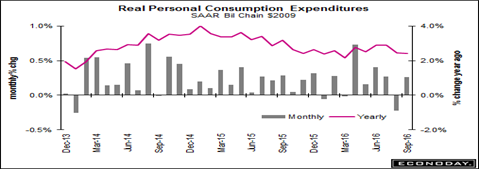
Personal income rose a solid but slightly lower-than-expected 0.3 percent in September, reports the Commerce Department’s Bureau of Economic Analysis (BEA). The wages & salaries component rose 0.3 percent, another sign of rising incomes. That’s why consumer spending was especially solid in September. So-called Personal Consumption Expenditures, a proxy for retail sales, rose an as-expected 0.5 percent and reflecting the month’s strength in vehicle sales.

image

Graph: Econoday

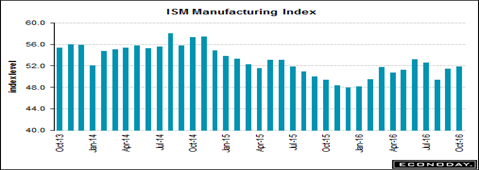
U.S. Manufacturing is also strong, according to the ISM’s Manufacturing Index. “The October PMI® registered 51.9 percent, an increase of 0.4 percentage point from the September reading of 51.5 percent, “ said Bradley J. Holcomb, CPSM, CPSD, chair of the Institute for Supply Management® (ISM®) Manufacturing Business Survey Committee.

The New Orders Index registered 52.1 percent, a decrease of 3 percentage points from the September reading of 55.1 percent. The Production Index registered 54.6 percent, 1.8 percentage points higher than the September reading of 52.8 percent. The Employment Index registered 52.9 percent, an increase of 3.2 percentage points from the September reading of 49.7 percent.

image

Graph: Econoday

In other words, manufacturing employment, production and deliveries were up, though new orders dropped slightly. This tells us, along with the strong auto sales that Friday’s unemployment report should also be solid. The consensus among economists is 175,000 payroll jobs will be added. Today’s ADP private payroll survey estimated a slightly lower total of 147,000, vs. its September 202,000 revised total.

But if the Labor Department’s Friday’s payroll numbers are lower than predicted, it may keep the Fed from raising rates in December, as was just hinted in its policy statement released at the end of today’s FOMC meeting.

“The committee judges that the case for an increase in the federal funds rate has continued to strengthen but decided, for the time being, to wait for some further evidence of further progress toward its objectives.”

Bond and mortgage rates have been rising as a consequence of the expectation that the Fed will eventually raise their rates. The Fed said inflation has been moving up toward its 2 percent target since the beginning of the year.

But is the economy strong enough to warrant a rate increase? GDP growth in the third quarter was 2.9 percent, highest in 2 years. Shouldn’t we wait at least several more quarters to see if this growth rate will continue?

Harlan Green © 2016

Follow Harlan Green on Twitter: https://twitter.com/HarlanGreen
Posted in Consumers, Economy, Politics | Tagged , , , , | Leave a comment

Q3 GDP Growth Fastest In 2 Years

Financial FAQs

Third quarter GDP growth was the fastest in two years, aided by a spike in soybean and other U.S. exports and a rebound in the size of inventories companies keep on hand for sale, reports the U.S. Bureau of Economic Analysis. Critics are saying this can’t last, because soybeans are not a dependable export, and inventories tend to fluctuate wildly. And when exports drop below imports, the difference subtracts from growth.

image

The BEA said gross domestic product, the official scorecard for the economy, expanded at a 2.9 percent annual clip from July through September. That’s a marked improvement from the first half of the year when the U.S. grew just barely over 1 percent.

And mainly because of full employment and rising wages, consumers are spending again and should through the holiday season. So we should see excellent GDP growth prolonged into Q4 as well.

Personal consumption expenditures rose at a solid 2.1 percent annualized rate led by an important durables component which surged at a 9.5 percent rate (i.e., things like autos that last more than 3 years). Personal consumption was the largest contributor in the quarter, adding 1.5 percentage points to the quarter’s GDP rate.

Boosted by foods and specifically soybeans, exports rose at a double-digit 10.0 percent rate, more than offsetting a 2.3 percent rise in imports—which are subtracted from exports, as I said, so that net exports added 0.8 percentage points to the quarter.

Another important positive in the report is a second straight quarter of improvement in what has been low business investment. Contributing 0.2 percentage points to GDP, so-called nonresidential fixed investment rose at a 1.2 percent rate on top of the second-quarter’s 1.0 percent rate. Inventory change was also a positive in the quarter (0.6 point contribution) as were government purchases (contributing 0.1 percentage points). A negative for a second straight quarter was residential investment, falling at a 6.2 percent rate and pulling GDP down by 2 tenths.

image

Graph: Econoday

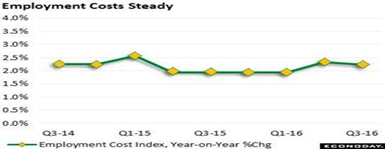
Another number that buttresses higher growth is the Employment Cost Index, a little-known indicator that tracks actual wages and benefit costs. It shows that wages and salaries are rising again, and which means more buying power for consumers.

For the third straight quarter, employer costs rose a quarter-to-quarter 0.6 percent in the third-quarter. Component contributions shifted slightly with wages & salaries down 1 tenth to plus 0.5 percent and benefits up 2 tenths to plus 0.7 percent. Year-on-year, total costs held steady at a moderate plus 2.3 percent with wages & salaries dipping 1 tenth to 2.4 percent and benefits up 3 tenths to 2.3 percent.

This doesn’t really show higher inflation, but since employment costs are two-thirds of product costs, the Fed watches it closely for that reason. But who knows? The stock and bond markets are predicting a near-term hike in short term rates, when Fed Chair Yellen hasn’t yet indicated such hikes are imminent.

Harlan Green © 2016

Follow Harlan Green on Twitter: https://twitter.com/HarlanGreen
Posted in Consumers, Economy, Weekly Financial News | Tagged , , , , | Leave a comment

Housing Sales, Prices Continue Skyward

The Mortgage Corner

The S&P Case Shiller Home Price Index continues to soar, with Seattle and Portland existing-home prices up double digits in a year, while Dallas and Denver are up some 8 percent annually.

Case-Shiller’s national index is within a hair of its 2006 peak — just 0.1 percent below. The smaller 20-City index is 7.2 percent lower. Tight inventory has constrained the housing market for years, driving prices higher. Many analysts have expected to see price gains decelerate in response, especially in overheated metros like San Francisco, but that hasn’t happened yet. San Francisco prices were flat in July but picked up again in August, and are up 6.7 percent in a year.

September existing-home sales are also soaring again, after a slight drop in August. September sales surged 3.2 percent to a 5.470 million annualized rate that exceeds Econoday’s high estimate. The key single-family component leads the report, up 4.1 percent to a 4.860 million rate while condos, where choices are limited and permits for new building are on the rise, fell 3.2 percent to a 610,000 rate.

image

Graph: Econoday

It is possible because mortgage rates are still at record lows, with the 30-year conforming fixed rate still as low as 3.0 percent for those that want to buy down the rate and have excellent credit. Fannie and Freddie offer their best rates to those with 740 plus credit scores.

This has enabled more first-time homebuyers to own homes, with their percentage up to 34 percent of sales. Regionally, September sales were strongest in the West, up 5.0 percent for a year-on-year gain of 1.6 percent, and in the Midwest, up 3.9 percent on the month for a year-on-year plus 2.3 percent. Total year-on-year resales are up but only fractionally, at plus 0.6 percent.

But the existing-home inventory of homes for sale is still at a 4.5 month supply at the current sales rate, hardly enough to supply the rising demand from first-time homebuyers. And so new-home sales have to eventually fill the void.

New-home sales are still struggling in September, up 3.1 percent to a 593,000 annualized rate, though sharp downward revisions to both August (575,000 from 609,000) and also July (629,000 from 659,000) do lower expectations for more solid strength in the new home market. But year-on-year, sales are up 30 percent in what is a sharp contrast to the fractional 0.6 percent gain on the existing-home side.

image

Graph: Econoday

The potential for more inventory is mixed with new-home construction permits higher in what is a deceptively solid housing starts & permits report. Starts plunged what looks like a shocking 9.0 percent in September, to a 1.047 million annualized rate. But the drop is tied entirely to the volatile multi-family component where starts fell a massive 38 percent in the month to a 264,000 rate. The more important single-family component is up sharply in its own right, 8.1 percent higher to a 783,000 rate.

We can therefore see from the graph that starts are still on an upward trend, which is needed if we want housing prices to mitigate their sharp rises of late, and so make housing more affordable to those youngest household-forming adults.

The demand is there as evidenced by the sharp rise in new-home prices nationally, up 6.7 percent in the month to a median $313,500. And further price gains can be expected as the year-on-year gain, in contrast to the surge in sales, is only 1.9 percent, says Econoday, while the existing-home median price is already up 15 percent this year, per the NAR’s affordability index.

Harlan Green © 2016

Follow Harlan Green on Twitter: https://twitter.com/HarlanGreen
Posted in Consumers, Housing, housing market, Weekly Financial News | Tagged , , , , , | Leave a comment