Please Protect US, Mr. President!

Popular Economics Weekly

What has happened to our gun laws—especially the assault rifle ban that expired in 2004? Australians had the courage to pass tougher gun regulations—Australia’s Prime Minister in particular, at the time. It takes political courage, in other words, something U.S. politicians seem to lack.

Conservative Australian Prime Minister John Howard, a close ally of George W. Bush, faced political and public resistance to the laws. After just three months as the country’s leader, Howard wore a bulletproof vest as he addressed a hostile 3,000-strong crowd opposed to the reforms.

How did he do it? The current Australian gun laws were passed after 35 were killed and 23 wounded in a 1996 mass shooting in Port Arthur, Tasmania.  The shooter was able to buy his assault rifle, even though later he was later determined by authorities to have an IQ of 11. There hasn’t been a mass shooting in Australia since then.

Twelve days after the Port Arthur massacre, the Australian prime minister, John Howard, announced a sweeping package of gun reforms in a country where firearms had long been considered an essential prop in the national mythology of life in the bush.

“At that stage the gun lobby was the ruling lobby in Australia,” says Philip Alpers, associate professor at the University of Sydney. “What happened at Port Arthur is that they were outpaced, outflanked and outwitted by a man who had the power to move in 12 remarkable days.”

Tim Fischer was leader of the National party and Howard’s deputy prime minister in the Coalition government, charged with persuading skeptical country voters to support, or at least accept, reforms. “Port Arthur was our Sandy Hook,” he says. “Port Arthur we acted on. The USA is not prepared to act on their tragedies.”

It was called the National Firearms Agreement — legislation that outlawed automatic and semi-automatic rifles, as well as pump-action shotguns. At the heart of the new law was a massive buyback of about one-fifth—640,000—of all firearms in circulation in Australia. The country’s new gun laws prohibited private sales, required that all weapons be individually registered to their owners, and required that gun buyers present a “genuine reason” for needing each weapon at the time of the purchase, as well as a 28-day waiting period while backgrounds were checked. (Self-defense could not be a reason.) In the wake of the tragedy, polls showed public support for these measures at upwards of 90 percent.

“The laws had widespread public support but faced fierce opposition from some rural supporters … because they believed they were unfairly paying a price for the misdeeds of others,” Howard told NBC News in a statement. “This resentment assisted the rise of a new political party which damaged the government at the following election.”

Howard persisted with introducing the laws, and went on to win that election and lead the nation for more than a decade. He considers the reforms as a key part of his legacy. An article published online in July by the NRA claimed there was “growing consensus” that the laws hadn’t made Australians safer.

Howard acknowledges that “major cultural and historical differences” make it difficult to draw comparisons between the gun cultures in the U.S. and Australia. “Although I had not anticipated the need to act on this matter so early in my term of government, I had always believed there was a clear link between the ready availability of guns and gun-related death,” Howard said.

“The national gun control laws enacted after the Port Arthur massacre remain one of the major social reforms … of [my] government,” he added. “All the credible research both in Australia and elsewhere shows that the gun control laws have markedly reduced gun-related deaths.”
image

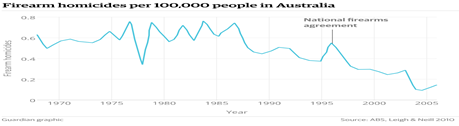
Graph: The Guardian

Total intentional gun deaths fell by half in the decade after the 1996 restrictions were put in place, even as Australia’s population grew nearly 14 percent. The rate of gun suicides per 100,000 people dropped 65 percent from 1995 to 2006, and the rate of gun homicides fell 59 percent, according to a 2010 study by Andrew Leigh of Australian National University and Christine Neill of Wilfrid Laurier University.

“Australia is not like the U.S.” said commentator Michael Pascoe in the  Sydney Morning Herald in response to President Obama’s remarks on last year’s Umpqua Community College killings by a deranged killer, whose mother kept at least 7 guns at home, in addition to the  8 guns plus ammunition carried by the shooter in the slaughter of college students and a teacher.

“We know that other countries in response to one mass shooting have managed to craft laws that almost eliminate mass shootings,” said President Obama. “Friends of ours, allies of ours, Great Britain, Australia, countries like ours.”

In fact, the US now has a gun homicide rate 370 times that of Australia’s. “Unlike the US,” said Pascoe, “we collectively decided to have a decent social safety net, the concept of a living wage and make good education freely available. Most of us are wary of those with extreme views of any kind.”

Our gun problem of course extends beyond mass violence, says the LA Times. In 2014 alone, for example, the Centers for Disease Control and Prevention recorded 11,208 people shot to death, 33,636 injured by gunfire and 21,175 who killed themselves with a gun. That’s a total of 66,019 people who were killed or injured by a gun, which comes out to 1,269 per week, 180 a day or 7.5 per hour.

“The US is too immature a society to be allowed to play with guns,” said the Sydney Morning Herald’s Pasco. “It has never shed its Wild West mythology. Americans still use their courts to kill people, which sends a message in its own way.”

We do not at present have a leader or leaders with enough courage to stand up to the gun lobby, as Australia’s John Howard was able to do. Their most important job should be to protect our citizens, regardless of creed or color.

Harlan Green © 2016

Follow Harlan Green on Twitter: https://twitter.com/HarlanGreen
Posted in Politics, Uncategorized | Tagged , , , , , , , , | Leave a comment

Trump Must Hate the Little Guy

Financial FAQs

The Republican Party may rue the day they didn’t vet their presumptive candidate for President. The vetting can no longer just be about his overt and premeditated racism, or even his xenophobic wall building. His business practices are finally coming under detailed scrutiny, and what we see is very ugly.

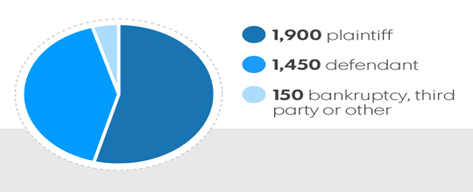
A USA TODAY article catalogues more than 3,500 lawsuits filed for or against Donald Trump over his business career. Many were filed by small business people and firms that Trump refused to pay for work done on his various real estate properties.

The result was that many were driven out of business. It looks like Trump’s main business model was and continues to be preying on those who are least able to defend themselves legally, in order to enrich himself. This smacks of more than predatory business practices.

David Brooks’ latest New York Times Oped this tries to put a handle on his narcissistic behavior. “By one theory, narcissism flows from a developmental disorder called Alexithymia, the inability to identify and describe emotions in the self. Sufferers have no inner voice to understand their own feelings and reflect honestly on their own actions.”

Could this also be defined as sociopathic behavior, since he seems to have no compunction in harming others financially, especially those least able to defend themselves in court?

Psychology Today defines sociopathy as follows; “A sociopath can be defined as a person who has Antisocial Personality Disorder. This disorder is characterized by a disregard for the feelings of others, a lack of remorse or shame, manipulative behavior, unchecked egocentricity, and the ability to lie in order to achieve one’s goals.”

Donald Trump often portrays himself as a savior of the working class who will “protect your job.” But a USA TODAY NETWORK analysis found he has been involved in more than 3,500 lawsuits over the past three decades — and a large number of those involve ordinary Americans, like the Friel family, who says Trump or his companies have refused to pay them.

The Friel’s family cabinetry business, founded in the 1940s by Edward’s father, finished its work in 1984 and submitted its final bill to the general contractor for the Trump Organization, the resort’s builder.

Edward’s son, Paul, who was the firm’s accountant, still remembers the amount of that bill more than 30 years later: $83,600. The reason: the money never came. “That began the demise of the Edward J. Friel Company… which has been around since my grandfather,” he said.

image

Graph: USA Today

This is not to speak of a Florida lawsuit against Trump and his Trump’s Doral golf resort–also embroiled in recent non-payment claims by two different paint firms, with one case settled and the other pending, says USA TODAY. Last month, his company’s refusal to pay one Florida painter more than $30,000 for work at Doral led the Miami Dade Circuit Judge Jorge Cueto (whoops, another Hispanic Judge) to order foreclosure of the resort if the contractor isn’t paid.

Juan Carlos Enriquez, owner of The Paint Spot, in South Florida, has been waiting more than two years to get paid for his work at the Doral. The Paint Spot first filed a lien against Trump’s course, then filed a lawsuit asking a Florida judge to intervene.

“In courtroom testimony, the manager of the general contractor for the Doral renovation admitted that a decision was made not to pay The Paint Spot because Trump “already paid enough,” said USA TODAY. As the construction manager spoke, “Trump’s trial attorneys visibly winced, began breathing heavily, and attempted to make eye contact” with the witness, the judge noted in his ruling.”

It looks like Trump’s attorneys and supporters will continue to wince as more stories of his business practices come out—whatever his personality disorder. Republicans should have definitely vetted him, instead of listening to his hype.

Harlan Green © 2016

Follow Harlan Green on Twitter: https://twitter.com/HarlanGreen
Posted in Politics, Weekly Financial News | Tagged , , , , , , , , , , | Leave a comment

Are Most of US Fully Employed?

Financial FAQs

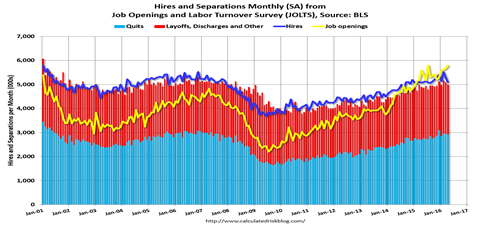
The U.S. Bureau of Labor Statistics reported the number of job openings was little changed at 5.8 million on the last business day of April, in its JOLTS report. (But that’s not exactly true, as it is up from 5.58 million openings in April 2015.) Hires (blue line in graph) edged down to 5.1 million while separations were little changed at 5.0 million. That means there are many more jobs available than workers to fill those jobs. We are approaching full employment, in other words. And who has most benefited?

image

Graph: Calculated Risk

Actually, most Americans. This is most evident in the Labor Department’s weekly initial jobless claims on which the unemployment report is largely based, which is at a record low. New applications for unemployment benefits declined by 4,000 to 264,000 from a revised 268,000 in the prior week, the government said Thursday.

Claims sit near the lowest level in decades and have barely budged even though the pace of job creation has cratered in the past two months. The economy added just 38,000 private payroll jobs in May after a mediocre 123,000 gain in April—another sign that we are nearing full employment, by the way, as the easy to fill jobs are mostly gone.

image

Graph: MarketWatch

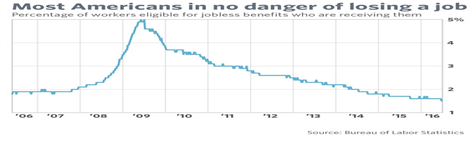
In fact, the average American worker is in less danger of losing a job than anytime in modern history. The percentage of employees who were laid off fell in early June to the lowest level since the government began keeping records in 1949, according to an obscure measure known as the insured unemployment rate buried in the initial claims report. The rate fell to 1.5 percent.

The insured unemployment rate divides the number of people collecting unemployment checks by the number of covered workers who are eligible for benefits if they are laid off. The insured unemployment rate reached a 27-year peak of 5 percent in mid-2009 during the Great Recession, and a record 8.9 percent if workers who were receiving extended emergency benefits are included.

We still have many who aren’t fully employed, however. The U6 category in last Friday’s unemployment report includes people who can only find part-time jobs as well as those who’ve grown too discouraged to keep looking—some 8 million. The rate was about 8 percent shortly before the Great Recession began.

What’s more, a smaller share of Americans are now part of the labor force. The so-called labor-force participation rate has fallen to 62.6 percent from 66 percent at the end of 2007. In other words, only 63 of every 100 able-bodied Americans 16 or older hold a job or are looking for one. The last time the level was that low was in the late 1970s.

We can do better, in other words, and there is so much work to be done with our public infrastructure and investment in new businesses, for starters. That’s when we will truly be fully employed.

Harlan Green © 2016

Follow Harlan Green on Twitter: https://twitter.com/HarlanGreen
Posted in Consumers, Economy, Weekly Financial News | Tagged , , , | Leave a comment

What Happened to Our Economy?

Popular Economics Weekly

The major debate during this campaign season is about economic growth. Who has it benefited and who was left behind? Sanders says we aren’t spending enough to create more jobs, and Trump wants to build walls to keep any more jobs from leaving US.

We know how to create more growth. We have done it before. President Obama in Elkhart, Indiana touted the strong growth of jobs and incomes since the end of the Great Recession where, for instance, the unemployment rate declined from 19.6 percent to 4.3 percent by the end of 2015.

And 14.5 million jobs have been created under Obama’s watch with 9 months left in his term. So he will soon surpass Ronald Reagan’s eight year jobs total and have the second highest job totals behind the 22 million jobs added during President Clinton’s term.

The number of long-term unemployed (those jobless for 27 weeks or more) declined by 178,000 to 1.9 million in May. These individuals accounted for 25.1 percent of the unemployed.

But the number of persons employed part time for economic reasons (also referred to as involuntary part-time workers) increased by 468,000 to 6.4 million in May, after showing little movement since November. These individuals, who would have preferred full-time employment, were working part time because their hours had been cut back or because they were unable to find a full-time job.

Both candidates have a point, in that a 2 percent GDP growth rate is at least 1 percent below the historical average, and the labor force participation rate of the working age population is some 4 percent below its highs, even with the current 4.7 percent unemployment rate. Only 63 percent of working-age adults are working, when it has been as high as 67 percent in 2000.

But Europe and Japan are doing even worse. Europe has had 2 recessions and teetered on the edge of a third since 2008. Japan is still trapped in a deflationary economy where prices don’t rise at all, and its federal debt level has risen to 200 percent of its GDP. So it has to do more with worldwide economic conditions—such as a lower demand for U.S. good and services from trading partners like Japan, Europe and China.

So who is right? The Great Depression took more than 10 years to recover. It only happened due to the full employment and government spending policies of WWII. In fact, it was prolonged because President Roosevelt listened to a Republican-dominated Congress in 1937 and prematurely raised taxes in an attempt to balance the budget. That’s when the economy shrank back into a second recession and it became the Great Depression.

Part of the answer is Bernie’s. Government should be creating far more jobs that it has. We have more than $2 trillion in the deferred maintenance of highways, bridges and other public infrastructure says the American Society of Civil Engineers. These are jobs done at both the federal and state levels.

There was a surge in such jobs due to the $830 billion in ARRA funds enacted in 2009 that saved some 3 million jobs—but temporarily, in turned out. Once the no-compromise Republicans took over Congress, there was a government shutdown, then downgrade of U.S. sovereign debt from AAA, and the sequester agreement that literally cut government spending, including for defense.

image

Graph: Calculated Risk

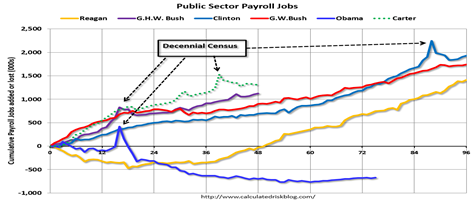
Here is a comparison in government jobs held since the Carter administration. And Republicans then weren’t afraid to create government jobs. The public sector grew during Mr. Carter’s term (up 1,304,000), says Calculated Risk, during Mr. Reagan’s terms (up 1,414,000), during Mr. G.H.W. Bush’s term (up 1,127,000), during Mr. Clinton’s terms (up 1,934,000), and during Mr. G.W. Bush’s terms (up 1,744,000 jobs).

However the public sector has declined significantly since Mr. Obama took office (blue line in graph–down 638,000 jobs in 2015). These job losses have mostly been at the state and local level, but more recently at the Federal level.  This has been a significant drag on overall employment, needless to say.

And we are still in recovery from the Great Recession for a number of similar reasons. Not enough money is circulating in the economy, for starters, due to the 8 million lost jobs during the Great Recession and median household incomes just now returning to pre-recession 2007 levels.

That is why the lack of government spending to fill the void in private-sector pullback has been the central reason this recovery has been held back. The private sector has decided to park their record profits and cash reserves ($4.5 trillion at last count) elsewhere—either overseas, or in Wall Street speculation, or buying back their own stock to increase the record payouts to their CEOs and stockholders.

So we have no New Deal work programs today that created those millions of government jobs during the worst parts of the Great Depression. There is nothing today to compare to those that were employed to create the America we know today—that built not only our dams, roads and major infrastructure, but the writers and artists employed to create the American identity we know today.

We don’t need another world war to bring us back to full employment, in other words.

Harlan Green © 2016

Follow Harlan Green on Twitter: https://twitter.com/HarlanGreen
Posted in Consumers, Economy, Politics, Weekly Financial News | Tagged , , , , , , , | Leave a comment

Should the Fed Raise Rates?

Financial FAQs

It’s incredible that Janet Yellen’s Fed should even be talking about raising interest rates in June, or July. The Fed predicts no more than 2.5 percent GDP growth in Q2, after Q1’s 0.8 percent growth rate. And the May unemployment report was the worst since 2010 with just 38,000 nonfarm payroll jobs created.

“It’s appropriate — and I’ve said this in the past — for the Fed to gradually and cautiously increase our overnight interest rate over time,” Yellen said last Friday during remarks at Harvard University in Cambridge, Massachusetts. “Probably in the coming months such a move would be appropriate.”

image

Graph: Marketwatch

Really? Most industries cut jobs last month, the first time that’s happened in several years. The increase in hiring was also the smallest since the fall of 2010. Economists polled by MarketWatch had predicted an increase of 155,000 nonfarm jobs.

This is though the unemployment rate fell to 4.7 percent from 5 percent to mark the lowest level since the month before the Great Recession began in December 2007. But the decline owed almost entirely to 458,000 people leaving the labor force.

Adults over 25 without a high-school diploma accounted for about two-thirds of the drop in the labor force, about 10 times the impact they should have had given their share of the population. More than half of those who dropped out were people over 55 years old. Most of them were white and likely Trump supporters.

What is the Fed and Yellen thinking? Inflation expectations are way down, as well as consumer sentiment; one of their red flags for incipient, future inflation that Fed hawks love to cite in their push to raise interest rates (read the banking lobby).

image

Graph: Econoday

The expectations component for future business looks better, up 7.3 points from April to 84.9, and that ultimately reflects confidence in the jobs outlook. But the 1-year inflation outlook fell another 1 tenth at month’s end to 2.4 percent for a major decline of 4 tenths from April. Like the decline underway in business investment, the decline in inflation expectations could also derail chances for a June hike.

The real problem is the severe drop in capex, or capital expenditures, due in large part to declining oil production. Without business investment, jobs cannot continue to grow and full employment should be the primary goal of Fed policy, rather than fighting non-existent inflation.

A historical rule of thumb is that 2 percent inflation rate means 2 percent growth, whereas 3 percent inflation usually means 3 percent plus growth, and we should be shooting for a 3 percent plus growth rate, as in past decades.

This is while new orders for core capital goods, a reading that excludes defense goods and commercial aircraft, fell a very sharp 0.8 percent in data for the month of April. It is the third straight decline and the fifth out of the last six months in a string that has taken this reading to a five-year low. Year-on-year, orders are squarely in the negative column at minus 5 percent and are down 12 percent from their cycle peak in September 2014.

We need to encourage a bit more inflation, in other words, which in turn should improve profits and so encourage more job creation.

Harlan Green © 2016

Follow Harlan Green on Twitter: https://twitter.com/HarlanGreen

Posted in Consumers, Economy, Weekly Financial News | Tagged , , , , , , | Leave a comment

What Happened to Tuition-Free College?

Popular Economics Weekly

Senator Bernie Sanders wants it. Until the Vietnam War, most public colleges and universities had it. So what happened to our tuition-free public universities and colleges?

UC Berkeley is perhaps the poster child to what has happened to the idea of tuition-free colleges and universities. It is something most other developed countries have for its citizens but no longer in the U.S. And tuition-free higher education—particularly for taxpayer funded public colleges and universities—was in the founding charters of most higher public educational institutions.

When I entered UC Berkeley as a freshman in the late 1950s my $300 scholarship covered the first year administration fees. There was no tuition. Today UC Berkeley charges a tuition fee of $13, 518 per academic year for California residents. Out-of-state residents have to add an additional $26,682 in tuition fees.

That is why students today have accumulated some $1.2 trillion in student loan debt that averages up to $35,000 per the most recently graduate student in a recent Champlain College panel discussion convened on the subject.

· The total outstanding student loan debt in the U.S. is $1.2 trillion, that’s the second-highest level of consumer debt behind only mortgages. Most of that is loans held by the federal government.

· About 40 million Americans hold student loans and about 70 percent of bachelor’s degree recipients graduate with debt.

· The class of 2015 graduated with $35,051 in student debt on average, according to Edvisors, a financial aid website, the most in history.

· One in four student loan borrowers are either in delinquency or default on their student loans, according the Consumer Financial Protection Bureau.

As late as 1960 The California Master Plan developed under Chancellor Clark Kerr supported keeping the UC system tuition-free. How much has changed since then! It’s almost as if California has been made to pay for being the vanguard for anti-war and anti-establishment protests during the 1960s and 70s; when it was in wholesale rebellion against the policies of the Cold War, or any war.

Why the exorbitant costs for higher education today, and why is it so important to make higher education affordable to most Americans, something that the young people coming to Bernie’s rallies also want? The first answer is that it’s important to have a well-educated public for a functioning democracy.

And Senator Bernie Sanders has made it a central issue in his campaign. “In a highly competitive global economy, we need the best-educated workforce in the world, says Bernie on his website. “It is insane and counter-productive to the best interests of our country and our future, that hundreds of thousands of bright young people cannot afford to go to college, and that millions of others leave school with a mountain of debt that burdens them for decades. That shortsighted path to the future must end.”

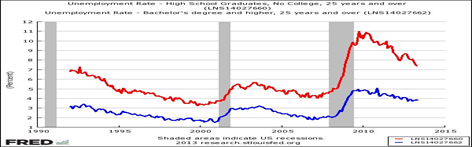
There is also the skills’ shortage employers lament about today. College graduates have the highest employment rate and incomes (blue line in graph)—and the lowest unemployment rate; actually below today’s 5 percent unemployment rate. Whereas high school grads have something like a 7 percent unemployment rate, and comparably lower incomes.

image

It is easiest to blame then California Governor Ronald Reagan, who once inaugurated in 1966 began his attack on higher education. It was the beginning of the Vietnam anti-war protests, and he considered UC Berkeley a hotbed of socialism, and inimical to winning the Cold War.

It was also the beginning of his Reagan Revolution, government-is-the-problem campaign by shifting state resources away from educating California’s students.—firstly, by cutting state funding for higher education, and calling in the National Guard to put down student protests.

But there were other reasons for abandoning The California Master Plan to educate all Californians tuition-free than the growing political polarization from the Vietnam War. Proposition 13 was passed in 1978 that limited property taxes, the main source of state and local education revenues.

Even then annual tuition and fees for Californians was just $630. The big fee increases began in the 1980s, when California enacted the three strikes law to fight the War on Drugs and began to build a record number of prisons. California’s prison population increased 500 percent between 1982 and 2000, according to historian Ruth Wilson Gilmore in her book, Golden Gulag.

The monies went elsewhere, in other words. The expansion of educational institutions stopped, despite the surging student population of baby boomers reaching college age. The result has been that state revenues now pay less than 16 percent of the UC University systems’ costs, and student tuition fees (and debt) now pay for the majority of education costs.

The UC system no longer educates the majority of Californians. This is when a recent McKinsey & Co. report predicts the U.S. workforce will need an additional one million well-educated workers by 2020, when most of the 80 million millennials, children of the baby boomers, have reached college age.

Then where will they be educated? From so-called for-profit colleges, which now make up some 25 percent of post-secondary institutions in the U.S. And they provide a much inferior education, as profit is their bottom line rather than a rounded education.

Bernie is right. That cannot be, if we are to stay competitive with the developed world. It turns out government has to become the solution, the equalizer of opportunity as it once was, if we are to reduce the soaring inequalities of income and opportunity.

Harlan Green © 2016

Follow Harlan Green on Twitter: https://twitter.com/HarlanGreen

Posted in Economy, Politics, Weekly Financial News | Tagged , , , , , , | Leave a comment

Future Home Sales Also Soaring

The Mortgage Corner

It looks like housing sales this year could return to pre-recession levels (though not into bubble territory), as all 3 major housing stats—existing, new, and now Pending-home sales are off to a good start in 2016.

image

Pending home sales increased for the third consecutive month in April, in spite of all the market uncertainties, surging to the highest level in over a decade, according to the National Association of Realtors.

The Pending Home Sales Index, a forward-looking indicator based on contract signings, hiked up 5.1 percent in March and is now 4.6 percent above April 2015. Lawrence Yun, NAR chief economist, says huge gains in the South and West propelled pending sales in April to their highest level since February 2006 (117.4).

“The ability to sign a contract on a home is slightly exceeding expectations this spring even with the affordability stresses and inventory squeezes affecting buyers in a number of markets,” he said. “The building momentum from the over 14 million jobs created since 2010 and the prospect of facing higher rents and mortgage rates down the road appear to be bringing more interested buyers into the market.”

Pending home sales in the South jumped 6.8 percent in April and is 5.1 percent higher than last April, while the index in the West climbed 11.4 percent in April, now 2.8 percent above a year ago. In the Midwest, which posted the only drop, the index declined slightly, but is still 2.0 percent above April 2015.

Although the future of mortgage rates is in question, Yun said, “Even if rates rise soon, sales have legs for further expansion this summer if housing supply increases enough to give buyers an adequate number of affordable choices during their search.”

What is driving the burst in home sales in general? It’s the increase in household formation, as millennials finally leave home or school to move into their own housing. A recent SF Fed paper predicts higher household formation in the next several years, much higher even than predictions by the Harvard Joint Center for Housing Studies of 1 to 1.2m households per year over the next decade.

“To the extent that headship rates among various age groups stabilize, household formation can be expected to more closely follow the growth in adult population…In that baseline projection, older age groups tend to have the highest growth rates. Since the older group also has traditionally higher shares of heads of households, this should mean a higher headship rate overall.”

Given current 12-month annual headship rates by age group, the Census Bureau projections imply household formations averaging on the order of 1.4 to 1.5 million per year through 2020, said the SF Fed. It compares favorably to an average of a little less than 900,000 annually over the past five years.

image

Graph: Econoday

This is huge, folks. If household formation is increasing this much then the real estate industry will help boost overall economic growth. Q1 2016 GDP growth was revised up slightly to 0.8 percent, and spending on residential construction increased at a 17.1 percent rate in the first quarter, the fastest pace since the fourth quarter of 2012. Residential construction added 0.56 percentage point to first-quarter GDP growth, up from the 0.49 percentage point reported last month.

Income at the disposal of households after accounting for taxes and inflation was revised up to show it jumping at a 4.0 percent rate in the first quarter instead of the previously reported 2.9 percent. Savings were revised up to $782.6 billion from $712.3 billion.

This means there should be much higher second quarter GDP growth, needless to say, as retail sales are again booming, and retail sales are again booming. Consumers came back to life in April, driving retail sales 1.3 percent higher. Autos are the key component, up a sharp 3.2 percent to reverse the prior month’s decline. Excluding autos, retail sales rose 0.8 percent, still a strong number.

Harlan Green © 2016

Follow Harlan Green on Twitter: https://twitter.com/HarlanGreen
Posted in Consumers, Economy, Housing, housing market, Weekly Financial News | Tagged , , , , , | Leave a comment

What Happened to Link Between Profits and Productivity?

Popular Economics Weekly

What’s the link between profits and productivity, on which economic growth is based? It has broken down of late, so that profits of many businesses and whole business sectors are no longer used to enhance productivity. And without higher productivity, we see the standard of living for most of US no longer rising.

Labor productivity has to do with the amount of output per worker, which in turn depends on the amount of capital expenditures (capex spending) on plants and equipment. The current tepid economic recovery that has averaged slightly above 2 percent GDP growth has been attributed in large part to lower labor productivity.

So why, with corporations making record profits over the past 2 years as a percentage of GDP (accompanied by today’s comparatively low tax rates and large tax loopholes) aren’t corporations investing more in productivity that would enhance their profits as well?

In fact, such record profits seem to have created a different investment environment, one that is conducive to what Nobelist Robert Stiglitz calls monopolistic behavior last seen during the Gilded Age of the early 1900s.

Monopolistic behavior means that businesses and even whole industries prefer to keep themselves in power by amassing more wealth for their shareholders and executives, rather than invest those profits to also benefit their employees and the public domain.

The result is lower investments in productivity, made mostly via investments in capital, or capex spending. And studies show increased capex spending does boost productivity, as historically higher profits have in the past boosted capex spending.

A 1964 NBER working paper by economist Robert Eisner highlighted that fact. “The historical correlations are indeed indisputable; periods of high capital expenditures have been periods of high profits and periods of low capital expenditures have been periods of low profits.”

(Therefore)“…I would suggest that capital expenditures are undertaken in the pursuit of profits, or perhaps in order to reduce the risk associated with expectations of profits…I would view the rate of investment demand as related to the expected profitability of investment, something which is quite different from past or current profits.”

image

So during this period of the highest corporate profits as a percentage of GDP and GDI in history, corporations have been hoarding their profits. This has to change; firstly, because so many working-age adults are still out of work some 7 years after the end of the Great Recession.

And secondly, a return to another Gilded Age, also warned by economist Thomas Piketty in his epochal Capital In the Twenty-First Century, means another era of high income inequality, and so a period with greater economic instability. This happened during the Great Recession, due in large part to a record income inequality last seen in the run up to the Great Depression.

Both private industry and governments have to invest more in R&D research, for starters. An early reading of the April service-sector PMI Flash Index showed growth in new orders, hit by weakness in investment spending, continues to slow and is among the weakest readings in the 7-year history of this series. Respondents in the sample say clients are unwilling to commit to new projects. 

And though the April Durable Goods orders just out were strong (i.e., goods that generally last more than 3 years), a negative in the report is a sizable 0.8 percent decline in core capital goods orders which ominously is the third straight decline for this reading and the fifth out of the last seven reports. Year-on-year, orders are noticeably in the negative column at minus 5.0 percent. These readings point squarely to stubborn weakness in business investment and uncertainty in the general business outlook, said Econoday.

How does this explain today’s actions of those corporations with huge profits that aren’t investing in their future growth? Actually, it can. For, if businesses find more ways to line their pockets, such as using financial engineering by speculating in markets—i.e., either by hedging commodities or stock buybacks—then they will neglect to make money the old fashioned way by creating new products and services.

A recent Reuters Special Report entitled, The Cannabilized Company, said that in the most recent reporting year, share purchases reached a record $520 billion. Throw in the most recent year’s $365 billion in dividends, and the total amount returned to shareholders reaches $885 billion, more than the companies’ combined net income of $847 billion.

And it confirms the cost; reduced innovation spending in new products that would boost future productivity. “…among the approximately 1,000 firms that buy back shares and report R&D spending,” said Reuters, “the proportion of net income spent on innovation has averaged less than 50 percent since 2009, increasing to 56 percent only in the most recent year as net income fell. It had been over 60 percent during the 1990s.”

Thus, maximizing shareholder value with stock buybacks has “concentrated income at the top and has led to the disappearance of middle-class jobs. The U.S. economy is now twice as rich in real terms as it was 40 years ago, but most people feel poorer,” said Reuters

A good example of this practice is tech icon IBM. CEO Sam Palmisano left in 2011, having received more than $87 million in compensation in his last three years at the company. Meanwhile, revenue declined for the past three years, and earnings have fallen for the past two. The stock is down a third from its 2013 peak, while the S&P 500 has risen 34 percent. To rein in costs, IBM has cut jobs. It now employs 55,000 fewer workers than it did in 2012.

Thus it turns out maximizing stock prices is neither maximizing shareholder value nor longer term profits—since it only benefits the few. Should this be the sad fate of American business? No one likes to give up power—not our major corporations, certainly—power that was built up over the past 40 years of consolidation and reduced regulation.

But such record income and opportunity inequality cannot continue indefinitely. This is what revolutions are made of.

Harlan Green © 2016

Follow Harlan Green on Twitter: https://twitter.com/HarlanGreen

Posted in Economy, Keynesian economics, Macro Economics, Politics, Weekly Financial News | Tagged , , , , , , | Leave a comment

New-Home Sales Also Climbing

Financial FAQs

“Sales of new single-family houses in April 2016 were at a seasonally adjusted annual rate of 619,000, according to estimates released jointly today by the U.S. Census Bureau and the Department of Housing and Urban Development. This is 16.6 percent above the revised March rate of 531,000 and is 23.8 percent above the April 2015 estimate of 500,000.”

We are beginning to see a real recovery in housing inventories with more new home being built, the one element that has been holding back more robust sales, as well as first-timers from entering the housing market.

image

Graph: Calculated Risk

“Rising home sales combined with tight inventory will translate into increased housing production as we move onward in 2016, especially as job creation continues and mortgage rates remain low,” said NAHB Chief Economist Robert Dietz.

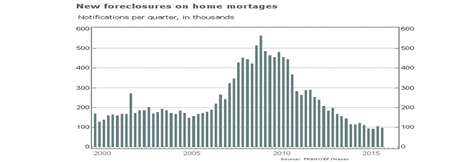
We are also seeing record low mortgage default rates, another sign that more homeowners are free to either move or refinance their homes.  Strong job creation and a seven-year U.S. economic recovery have helped home owners get in the best shape in years. The number of new foreclosures in the first quarter edged near the lowest level in 17 years, the New York Federal Reserve said Tuesday.

image

Graph: Marketwatch

The same was true for other consumer debt. Repayments increased and just 5 percent of all outstanding household debt — student loans, credit cards, auto loans, mortgages, home equity lines of credit – was delinquent in early 2016. That’s the smallest share of delinquencies since 2007, shortly before the onset of the Great Recession.

image

Graph: Calculated Risk

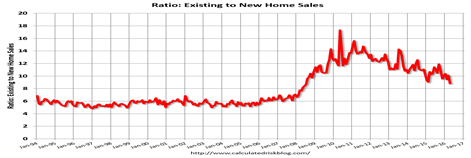
The bottom line is that more new homes have to be built—almost doubled to 1 million per year in order to catch up with historical demand. Historically, the number of new and existing-home sales was a constant ratio of 6 to 1 existing-homes to new-home sales. That means at the current existing-home sales rate of 5.4 million homes, some 900,000 new homes need to be sold. And they have to be in the more affordable price ranges, which means closer to the current median new-home price of $321,100, or below.

Harlan Green © 2016

Follow Harlan Green on Twitter: https://twitter.com/HarlanGreen

Posted in Consumers, Housing, housing market, Weekly Financial News | Tagged , , , , | Leave a comment

Existing-Home Sales Soaring

The Mortgage Corner

There is more news the housing market is recovering—from the Great Recession, that is. But it’s still below pre-recession levels.

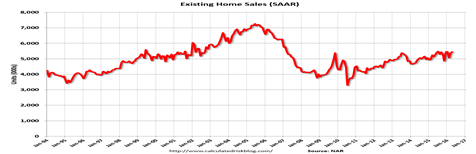
Total existing-home sales, which are completed transactions that include single-family homes, townhomes, condominiums and co-ops, rose 1.7 percent to a seasonally adjusted annual rate of 5.45 million in April from an upwardly revised 5.36 million in March. After last month’s gain, sales are now up 6.0 percent from April 2015, said the NAR.

image

Graph: Calculated Risk

Lawrence Yun, NAR chief economist, says April’s sales increase signals slowly building momentum for the housing market this spring. “Primarily driven by a convincing jump in the Midwest, where home prices are most affordable, sales activity overall was at a healthy pace last month as very low mortgage rates and modest seasonal inventory gains encouraged more households to search for and close on a home,” he said. “Except for in the West — where supply shortages and stark price growth are hampering buyers the most — sales are meaningfully higher than a year ago in much of the country.”

Also good news was the 32 percent that were first time homebuyers, up from 30 percent, but nowhere near the 40 percent during more normal economic times. Alas, pricing and low inventories are the problem. Too many builders are yet building the entry-level affordable housing that has to be below the new $232,000 median price.

And there’s just a 4.7-month supply of available inventory. That’s why the Wells Fargo Market Index is hovering just above 60 percent—i.e., 60 percent of buyers can now afford a median-price home, which shows steady improvement.

“This is the second consecutive quarter that we’ve seen a nationwide improvement in affordability due to favorable home prices and mortgage rates,” said NAHB Chief Economist Robert Dietz. “These factors, along with rising employment, a growing economy and pent-up demand will provide a boost for home sales in the second half of 2016.”

So new home construction has to fill the void in available housing inventories. Nationwide housing starts rose 6.6 percent to a seasonally adjusted annual rate of 1.17 million in April, according to newly released data from the U.S. Department of Housing and Urban Development and the Commerce Department. Overall permit issuance was also up 3.6 percent to a seasonally adjusted annual rate of 1.12 million.

“Though housing construction data is relatively flat for the beginning of 2016, we anticipate a ramping up of housing production during the rest of the year, given a strengthening job market, low mortgage interest rates and favorable demographics,” said NAHB Chief Economist Robert Dietz.

image

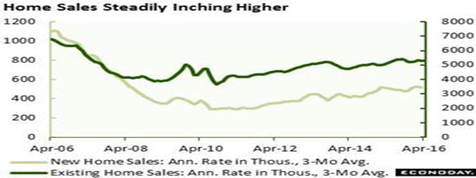
That is sorely needed, as new-home sales in particular have been weak. This graph tracks the relative performance of existing home sales (dark line) and new home sales (light line). Existing home sales have moved from a mid 6 million rate over the span of the graph to a mid 5 million rate, but note the special weakness in new home sales, moving from over a 1 million rate in 2006 to half that now, says Econoday. Weakness in new homes means weakness for the construction sector and less strength for GDP. Watch for the April new home sales report on Tuesday’s calendar, May 24.

Harlan Green © 2016

Follow Harlan Green on Twitter: https://twitter.com/HarlanGreen

Posted in Economy, Housing, housing market, Weekly Financial News | Tagged , , , , , | Leave a comment