Who Will Trump Trump’s Ambitions?

Popular Economics Weekly

Thomas Friedman seems to believe the Donald has sewed up a majority of the Republican Primary delegates and will be a formidable foe for Hillary, assuming she is the Democrat’s candidate. But chances are his past will catch up with him as voters begin to think with their head rather than gut instinct that Friedman seems to believe motivates many voters.

“Donald Trump is a walking political science course,” said Friedman in a NYTimes Op-ed. “His meteoric rise is lesson No. 1 on leadership: Most voters do not listen through their ears. They listen through their stomachs. If a leader can connect with them on a gut level, their response is: “Don’t bother me with the details. I trust your instincts.” If a leader can’t connect on a gut level, he or she can’t show them enough particulars. They’ll just keep asking, “Can you show me the details one more time?”

That may be so for many Republican primary voters, but Trump’s suspect past hasn’t yet been investigated. Thinking Repubs have given him a blank check to date, believing that he will flame out of his own accord.

Even Mitt Romney calling him a con artist last week didn’t seem to hurt Trump in Michigan, though Ohio Governor John Kasich was creeping closer with the final tally of delegate votes, in a defacto tie for second place with Texas Senator Ted Cruz.

image

Graph: Marketwatch

Trump’s sordid business dealings are known to very few. One of his 4 Chapter 11 (business) bankruptcies was for Trump Casinos and Hotels. “For 10 years between 1995 and 2005, Donald Trump ran Trump Hotels & Casino Resorts — and he did it so badly and incompetently that it collapsed into Chapter 11 bankruptcy,” said Marketwatch’s Brett Arends, who has been tracking his business failures for years. “His stockholders were almost entirely wiped out, losing a staggering 89 percent of their money. The company actually lost money every single year. In total it racked up more than $600 million in net losses over that period,” something no other major casino chain did over that term.”

In total, Donald Trump pocketed $32 million in nine years of running Trump Casinos and Hotels, while his public stockholders lost more than $100 million. But much more damaging are the various class action lawsuits filed again Trump and Trump University, which was a university in name only.

Instead of receiving a quality degree, “as good as any from a university”, said Trump, students received a printed certificate and no degree after spending as much as $36,000 on a weekend course that solicited more money, and were given commonly known real estate websites, such as Zillow, and several worthless property referrals.

These are the words of several plaintiffs suing Trump that a San Diego court has elevated to gangster status. Trump is accused of not only fraud, but racketeering, as if he were running a criminal enterprise.

One of the two San Diego cases has been allowed by the judge to be brought under the Racketeer Influenced and Corrupt Organizations Act, or RICO, said Time Magazine’s Steven Brill. “This means that, fairly or unfairly, opponents will be able to say that a large group of everyman voters, many of them elderly, have accused a leading contender for the Oval Office of being a racketeer.”
image

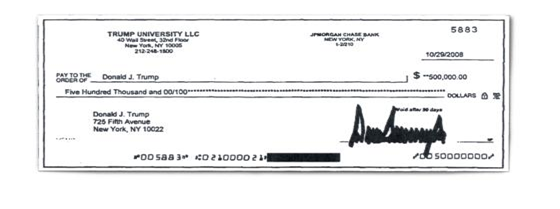
The records indicate, for example, that Trump University collected approximately $40 million from its students–who included veterans, retired police officers and teachers–and that Trump personally received approximately $5 million of it, despite his claim, repeated in our interview, that he started Trump University as a charitable venture.

Trump’s own followers may be able to disbelieve the evidence that is being unearthed of his many business failures in a hyper fervid primary season full of hyperbole. But the facts are only now now coming to light. And the picture is revealing.

The evidence is in plain sight. The Donald always comes first, and very few others have profited thereby.

Harlan Green © 2016

Follow Harlan Green on Twitter: https://twitter.com/HarlanGreen
Posted in Politics, Weekly Financial News | Tagged , , , , | Leave a comment

Why Did Michael Moore Invade Those Countries?

Popular Economics Weekly

The answer is so simple, and sad. Mr. Moore’s latest eye-opening documentary, “Where To Invade Next?” visits countries that have learned from, and adopted our laws and policies, policies that no longer exist in the U.S. of A.; such as tuition-free public colleges (Slovenia), prison systems that rehabilitate rather than punish (Norway), where drug use is not a crime (Portugal), and 8 weeks paid vacation is the law (Italy).

His film shows America on the way to becoming a Third World country, somewhat lost in the last century and falling behind other developed countries and many developing countries, in caring for our citizens.

Perhaps the most moving segment was that on women’s rights. We who were not able to pass the Equal Rights Amendment that prevented discrimination against women in the 1970s, were imitated in countries like Iceland with the first democratically elected President in 1980, and where women’s rights are enshrined in their constitution (Tunisia, a Muslim country).

For some reason, beginning in the 1970s, these countries began to give more rights to their citizens, while America, the world’s oldest democracy, took them away. Germany has enshrined collective bargaining in their corporations, where 50 percent of the governing board has to be made up of its employees, whereas many states in the U.S. have either banned collective bargaining, or the paying of dues to support collective bargaining, in 25 right to work states.

And Icelandic corporations must have at least 40 percent of each gender on their boards, which was made law after 2008 and the collapse of their banking system. The 3 largest banks all filed for bankruptcy, and some of their all-male executives went to jail, the result of “excessive, testosterone-driven risk taking” said a commentator on their trials. The result was a mass revolt by Iceland’s women that demanded a greater role in the running of their own country.

Michael Moore interviewed Iceland’s special prosecutor for financial crimes, Olafur Hauksson, who said he had learned his prosecution techniques from Bill Black, a U.S. special prosecutor who had convicted bank executives resulting from our Savings and Loan scandal. But no U.S. executive has been prosecuted since, much less convicted, for their excessive risk-taking and disregard of financial regulations during the subprime meltdown and Great Recession.

Why have such more modern democracies passed us by? Moore hints that maybe they have learned from their horrific past of religious and world wars to care better for their citizens. But the U.S. hasn’t learned from the biggest stain on our democracy—slavery. We still enslave mostly African Americans in our prisons, thanks to the war on drugs initiated by President Nixon, after President Johnson had signed the Civil Rights Act that finally gave Blacks the same rights as other American citizens.

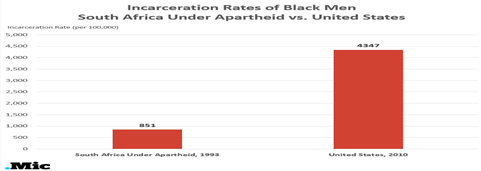
While crime rates have gone down, the number of people incarcerated has gone up in U.S. prisons. According to Human Rights Watch, 2.3 million people were incarcerated as of 2007. The United States has the largest incarceration rate in the world with a staggering 762 per 100,000 residents. Compare this to the U.K. whose rate is 152 per 100,000 residents, or Canada whose rate is 102.

image

Graph: Policy.mic

So many prisoners create a large workforce. According to truth-out and the Left Business Observer, “the federal prison industry produces 100 percent of all military helmets, ammunition belts, bullet-proof vests, ID tags, shirts, pants, tents, bags, and canteens. Along with war supplies, prison workers supply 98 percent of the entire market for equipment assembly services; 93 percent of paints and paintbrushes; 92 percent of stove assembly; 46 percent of body armor; 36 percent of home appliances; 30 percent of headphones/microphones/speakers; and 21 percent of office furniture. Airplane parts, medical supplies, and much more: prisoners are even raising seeing-eye dogs for blind people.”

And why do we no longer have tuition-free public colleges? It perhaps began when Ronald Reagan was elected Governor of California in 1966, UC Berkeley was a hotbed of protests, and tuition-free for California residents.

Governor Reagan didn’t believe such an education should be free for rebellious college students. His most famous action of that time was the firing of the UC Berkeley Chancellor Clark Kerr for not following his orders to ban the student protests. Reagan vowed to “clean up that mess in Berkeley,” warned audiences of “sexual orgies so vile that I cannot describe them to you,” complained that outside agitators were bringing left-wing subversion into the university, and railed against spoiled children of privilege skipping their classes to go to protests, according to Dissent Magazine, describing that time:

“He cut state funding for higher education, laid the foundations for a shift to a tuition-based funding model, and called in the National Guard to crush student protest, which it did with unprecedented severity. But he was only able to do this because he had already successfully shifted the political debate over the meaning and purpose of public higher education in America.”

California was becoming more conservative, in other words. Instead of seeing the education of the state’s youth as a patriotic duty and a vital weapon in the Cold War, Reagan cast universities as a problem in and of themselves—“both an expensive welfare program and dangerously close to socialism”. He even argued for the importance of tuition-based funding by suggesting that if students had to pay, they’d value their education too much to protest.

Reagan’s assault against higher education was only the beginning of the neo-cons attack on our educational system. Their real purpose was an attempt to dumb down the electorate by crippling our public school and university systems. The fewer that were well educated meant the fewer could challenge the power of those that supported the so-called Reagan Revolution.

So there is a reason our educational system ranks lower than 20 or more countries in the world. M Moore visited Finland to learn why they are ranked #1 in the world, according to the Programme for International Student Assessment (PISA), “a standardized test given to 15-year-olds in more than 40 global venues.”

He interviewed teachers, students, and education officials. They all said their students’ welfare came first, and standardized tests should be abandoned. They had learned from our educational system that once upon a time allowed more free time for social interaction, little or no homework, when music and art were an important part of our educational curriculum from elementary school onward.

Perhaps that is the saddest revelation of Michael’s film. How we have come to undervalue the lives of so many American citizens, including our own women and children.

Harlan Green © 2016

Follow Harlan Green on Twitter: https://twitter.com/HarlanGreen
Posted in Consumers, Economy, Politics | Tagged , , , , , , , | Leave a comment

Job Market Grows Stronger

Popular Economics Weekly

Americans are going back to work, though mostly in lower paying jobs at the moment. That’s why those states and cities raising their minimum wage rate are so important for growth.

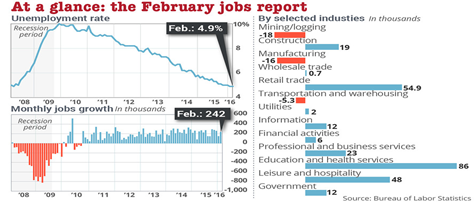
The U.S. added 242,000 new jobs in February, and 30,000 more jobs to payrolls over the past 2 months, with revisions. Why does this confute the naysayers that predicted an oncoming recession? Because consumers are buying again, with retail jobs up 54,900, and governments hiring again with all the public works and infrastructure projects in the works. Hence the 19,000 new construction jobs.

image

Graph: Marketwatch

The increase in jobs last month is a sign the economy is picking up steam despite a rocky start to the year for stocks, mostly because of worries that a global slowdown could undermine growth at home. The jobless rate, meanwhile, was unchanged at 4.9 percent.

This is when the EU jobless rate is stuck at 10.3 percent, with Italy’s jobless rate at 11.5 and Spain’s at 20.9 percent respectively.

Even more remarkable was that the labor participation rate continues upward with 500,000 more workers entering the workforce in February and 2 million since. It really looks like Americans are going back to work; particularly those most discouraged, as more states raise their minimum wage.

Oregon is the latest state jumping on the bandwagon, with its minimum wage rising in increments to $15 per hour over 5 years. Another sign of strength was that temporary help services fell for a second straight month, down 10,000 following a 22,000 decline in January. Government added 12,000 to payrolls while construction, where spending is solid, rose 19,000, as we said. And this is even though mining and manufacturing jobs contracted, down 19,000 and 16,000 respectively.

The U.S. has created 12.7 million new jobs since 2011 and the unemployment rate has fallen below 5 percent. But workers still aren’t getting big pay raises. Though almost seven years into the recovery, wages have barely accelerated. Hourly pay fell in February, reducing the year-over-year increase in wages to 2.2 percent from a post-recession high of 2.6 percent two months ago.

And, the so-called U6 rate that includes people who can only find part-time work or have become too discouraged to look for work dipped to 9.7 percent from 9.9 percent and reached the lowest level since May 2008.

We maintain raising the minimum wage of lowest paid workers is important for several reasons. Firstly, health-care companies and social-assistance providers led the way in hiring, adding 57,000 jobs. Retailers beefed up staff by 55,000, and restaurants took on 40,000 new workers. This means more employed consumers to boost retail sales, which comprise half of consumer spending, and consumers now power some 70 percent of economic activity.

Raising the minimum wage also takes more lower paid workers off the assistance rolls (such as food stamps), and unemployment insurance, and even welfare, which improves our budget deficit, as well.

We may be entering a virtuous cycle of growth, in other words, in spite of the drop in energy prices. It means more money in the pockets of consumers, creating more demand for goods and services, which in turn creates more jobs, and economic growth.

Harlan Green © 2016

Follow Harlan Green on Twitter: https://twitter.com/HarlanGreen
Posted in Consumers, Economy, Weekly Financial News | Tagged , , , | Leave a comment

Fannie-Freddie Debacle Continues

The Mortgage Corner

We are already seeing the results of Obama Administration attempts to kill Fannie Mae and Freddie Mac, the Government Sponsored Entities that guarantee more than 60 percent of all mortgages originated in the U.S. housing market these days. The Mortgage Bankers Association in particular is beginning to worry that taxpayers will have to pick up the tab in the event of another housing bust, since Fannie and Freddie aren’t being allowed to maintain a capital cushion.

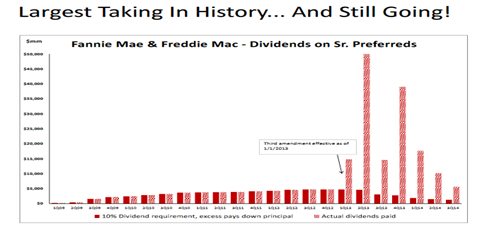
Obama’s Treasury Department has refused to allow Fannie and Freddie to maintain a capital base as their profits decline. Instead, all their profits flow into Treasury coffers due to a 2012 amendment to the government’s conservatorship agreement.

“Once their capital goes to zero, there will be no cushion between the GSEs [government-sponsored enterprises] and the need for additional draws on the remaining Treasury commitment, roughly $250 billion,” said Michael Fratantoni, the MBA’s chief economist and senior vice president of research and industry technology, in an article for The Hill.

The government took over Fannie and Freddie in 2008 to keep them from collapsing under the weight of bad mortgage debt. The two entities have drawn a total of $187.5 billion from the Treasury Department and have repaid $241 billion in dividends, though those payments don’t even count toward their debt, because of Treasury’s decision to commandeer all their profits.

The nominal head of Fannie and Freddie is Mel Watts, head of the Federal Housing and Finance Agency that also controls both FHA and VA mortgage agencies. And he is saying it is up to Congress to fix the problem. But Congress has done nothing, as the tug of war continues over whether the GSEs should be public supported or privately funded organizations.

“I continue to hope that Congress can engage in the work of thoughtful housing finance reform before we reach a crisis of investor confidence or a crisis of any other kind,” he said in a Feb. 18 speech. 

In fact, the U.S. Treasury is really behind the 2012 amended conservatorship agreement that requires each firm’s capital to be reduced from $1.2 billion this year to $600 million next year and then to $0 in 2018, 10 years after the financial crisis. So taxpayers will still be on the hook, unless Congress can make up its mind. But that isn’t happening, and probably won’t happen until after the Presidential election.

Fannie and Freddie hold a combined $5 trillion in mortgage guarantees on their books but face shrinking earnings and a zero-capital predicament — a situation

David Stevens, head of the Mortgage Bankers Association (MBA), called “unheard of.” Stevens called the situation “a terrible predicament” because Fannie and Freddie “are completely critical to our housing system,” in The Hill article.

Stevens said he expects that one of the GSEs will need to take a draw from the Treasury Department’s credit line sometime this year — possibly as early as the first quarter, a move likely to reverberate on Capitol Hill. 

But that may not have to the case, according to documents filed in lawsuits against FHFA and the Treasury Department by holders of Fannie and Freddie stock that have been rendered valueless by the amended conservatorship. For starters, plaintiffs say, Treasury justified the conservatorship of the GSEs via accounting gimmicks since they faced no liquidity issue at the time of the crisis and recession. They note that Fannie Mae’s Cash Net Income, adjusted for non-cash items, was positive throughout entire crisis and recession.

Fannie Mae disclosed they held $36.3 billion cash in the bank on September 30, 2008 with a maximum exposure of roughly $6 billion per quarter. That was enough liquidity to survive over 18 months, assuming it didn’t bring in another dime.

image

Graph: Huffington Post

But due to that last minute (2012) ‘tweak’ to the original conservatorship order by FHFA, all profits went into the Treasury General Fund, which raised suspicions that Treasury was behind the move to capture all profits for its own uses, rather than returning value to preferred stockholders. How is that fair when the GSEs weren’t responsible for the bubble, or subprime loans, or the Great Recession?

We know this because some $16 billion in settlements have already been recovered from those commercial banks and Wall Street entities that submitted fraudulently underwritten mortgages misrepresenting their loan quality to Fannie and Freddie.

Why has the White House resisted calls to unseal their documents in pending lawsuits by preferred stockholders attempting to recoup losses due to the conservatorship? Antonio Weiss,, a Treasury counselor, gave their only response to Bloomberg News.

“Some have suggested the federal government could stop supporting Fannie and Freddie in the near term by allowing the companies to retain their earnings. This overlooks the high level of capital required to adequately cover the risk of the $5 trillion in assets on the GSEs’ books. A recent analysis from Moody’s and the Urban Institute made clear that it could take decades for Fannie and Freddie to build safe and sound levels of capital and that recap and release would ultimately drive up the cost of mortgages.”

So this is the Treasury and White House response–inaction. Let’s keep the taxpayer on the hook for all losses in the event of another downturn, rather than allowing the GSE’s to begin to build their capital base again.

It may therefore be up to the courts to decide who is at fault in the continuing debacle–at a time of record low interest rates and a housing market just beginning to recover.

Harlan Green © 2016

Follow Harlan Green on Twitter: https://twitter.com/HarlanGreen
Posted in Consumers, housing market, Politics, Weekly Financial News | Tagged , , , , , , | Leave a comment

Construction Boosted By Public Works, Offices

The Mortgage Corner

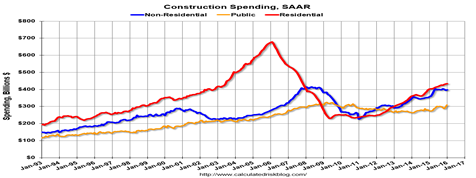
We are already seeing the results of the $1.1T budget agreement, and $305 STIRR Surface Transportation and Highway Trust Fund bill. Construction spending rose a strong 1.5 percent in January due to a surge in highway & street spending as well as gains for manufacturing and on Federal construction projects.

image

Graph: Calculated Risk

This is incredible news, as it is the first time that Repubs and Democrats agreed on federal spending since the great sequester cut spending across the board in 2011. The result will be much needed repairs of our almost century-old infrastructure. Remember those Flint, Michigan lead drinking water pipes?

We may be finally turning the corner on neglect of our public infrastructure, so held back by the austerity policies of one political party. There was an impressive 33.9 percent gain for highways & streets (mostly done by states), and a smaller 9.9 percent increase in the Federal category.

And also in the private sector, private nonresidential components, namely offices, had a 24.8 percent year-on-year gain. This is another sign of increased business investment.

But the housing sector also benefited on the multi-family side, reflecting strength in rental prices. Year-on-year spending on rental housing is up 30.4 percent vs 6.6 percent for single-family homes. Together, residential spending is up a huge year-on-year 7.7 percent.

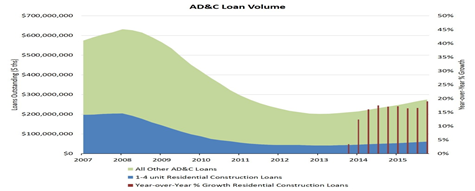
The availability of acquisition, development and construction (AD&C) loans has been a factor holding back a stronger rebound in home construction until now, but easing credit conditions and a growing loan base should help expand the residential building market.

According to the National Association of Home Builders and FDIC analysis, the outstanding stock of 1-4 unit residential construction loans made by FDIC-insured institutions rose by $2.6 billion during the fourth quarter of 2015, raising the total stock of outstanding loans to $60.9 billion.

image

Graph: NAHB.org

“On a year-over-year basis, the stock of residential construction loans is up 18.9%, as indicated by the red bars in the graph above. The current reading is higher than the 16% to 17.5% annual growth rate range that the series had been in for the prior year and a half, says the NAHB. “This change suggests accelerating single-family building growth in 2016, which is consistent with NAHB’s forecast. Since the first quarter of 2013, the stock of outstanding home building construction loans has grown by 49%, an increase of $20.1 billion.”

This is further evidence the housing market is just beginning to recover. Banks are finally lending again, and interest rates are at record lows, with the 10-year TBond yield at 1.76 percent and 30-year conforming fixed rates as low as 3.25 percent in California.

Harlan Green © 2016

Follow Harlan Green on Twitter: https://twitter.com/HarlanGreen
Posted in Consumers, Economy, Housing, housing market, Politics, Weekly Financial News | Tagged , , , , , | Leave a comment

Higher GDP, Consumer Spending Will Boost 2016 Growth

Financial FAQs

Q4 GDP growth was just revised upward to 1.0 percent, from the 0.7 percent first estimate.  This, January’s personal income figures and durable goods orders show consumers and even parts of the manufacturing sector are still expanding, which is a good start for 2016 growth vs. last January, when the severe winter stopped almost all growth in Q1.

image

Graph: Marketwatch

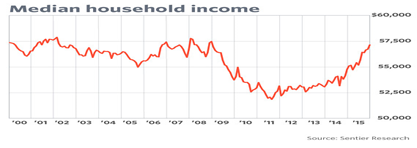
Median annual household income rose 0.7 Percent in November, or $57,173, according to a just released Sentier Research report. It was in November that incomes finally surpassed the $56,698 median seen at the onset of the Great Recession.  Why is this important?

“We have recaptured all of the income losses that have occurred since the beginning of the last recession in December 2007,” said Sentier’s Gordon Green, a former U.S. Census Bureau official. And incomes are now up 0.4 percent from where they stood in January 2000—the month that Sentier Research began tracking this data.

image

Graph: Econoday

Personal income jumped 0.5 percent in January as did consumer spending, both readings higher than expected. Also higher than expected are the report’s inflation readings especially the core PCE which rose 0.3 percent for a year-on-year plus 1.7 percent.

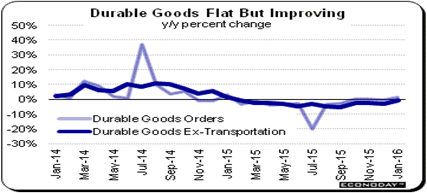
And the factory sector bounced back strongly in January, indicated first by last week’s industrial production report and now by durable goods orders which are up a very strong 4.9 percent. Aircraft did add to the gain but when excluding transportation equipment, durable orders still rose 1.8 percent. And core capital goods orders, which had been weakening, bounced back strongly with a 3.9 percent gain.

Machinery posted big gains in the month especially for new orders as did computers and fabricated metals. Motor vehicles showed strength in both orders and shipments. Total shipments jumped 1.9 percent in the month, though shipments of core capital goods, held down by prior weakness in orders, fell 0.4 percent to open the first quarter on a down note, says Econoday.

But a positive in the report is a 0.1 percent dip in inventories which, together with the rise in shipments, pulls down the inventory-to-shipments ratio to a leaner 1.64 from 1.67. And unfilled orders, after contracting sharply in December, inched 0.1 percent ahead in January.

Wages and salaries are now rising at 4.5 percent year-over-year. It is the most important number to look at in the personal income statistics, because it is the major reason consumers are spending more after a year of saving from lower gas prices. These salary earners make up 80 percent of our workforce, which is sure to boost GDP growth above 3 percent this year, as we have been saying.

Harlan Green © 2016

Follow Harlan Green on Twitter: https://twitter.com/HarlanGreen
Posted in Consumers, Economy, Weekly Financial News | Tagged , , , , , , , | Leave a comment

Why Did Michael Moore Invade Those Countries?

Popular Economics Weekly

The answer is so simple, and sad. Mr. Moore’s latest eye-opening documentary, “Where To Invade Next” visits countries that have learned from, and adopted our laws and policies, policies that no longer exist in the U.S. of A.; such as tuition-free public colleges (Slovenia), prison systems that rehabilitate rather than punish (Norway), where drug use is not a crime (Portugal), and 8 weeks paid vacation is the law (Italy).

His film shows America on the way to becoming a Third World country, somewhat lost in the last century and falling behind other developed countries and many developing countries, in caring for our citizens.

Perhaps the most moving segment was that on women’s rights. We who were not able to pass the Equal Rights Amendment that prevented discrimination against women in the 1970s, were imitated in countries like Iceland with the first democratically elected President in 1980, and where women’s rights are enshrined in their constitution (Tunisia, a Muslim country).

For some reason, beginning in the 1970s, these countries began to give more rights to their citizens, while America, the world’s oldest democracy, took them away. Germany has enshrined collective bargaining in their corporations, where 50 percent of the governing board has to be made up of its employees, whereas many states in the U.S. have either banned collective bargaining, or the paying of dues to support collective bargaining, in 25 right to work states.

And Icelandic corporations must have at least 40 percent of each gender on their boards, which was made law after 2008 and the collapse of their banking system. The 3 largest banks all filed for bankruptcy, and some of their all-male executives went to jail, the result of “excessive, testosterone-driven risk taking” said a commentator on their trials. The result was a mass revolt by Iceland’s women that demanded a greater role in the running of their own country.

Michael Moore interviewed Iceland’s special prosecutor for financial crimes, Olafur Hauksson, who said he had learned his prosecution techniques from Bill Black, a U.S. special prosecutor who had convicted bank executives resulting from our Savings and Loan scandal. But no U.S. executive has been prosecuted since, much less convicted, for their excessive risk-taking and disregard of financial regulations during the subprime meltdown and Great Recession.

Why have such more modern democracies passed us by? Moore hints that maybe they have learned from their horrific past of religious and world wars to care better for their citizens. But the U.S. hasn’t learned from the biggest stain on our democracy—slavery. We still enslave mostly African Americans in our prisons, thanks to the war on drugs initiated by President Nixon, after President Johnson had signed the Civil Rights Act that finally gave Blacks the same rights as other American citizens.

Graph: Policy.mic

While crime rates have gone down, the number of people incarcerated has gone up in U.S. prisons. According to Human Rights Watch, 2.3 million people were incarcerated as of 2007. The United States has the largest incarceration rate in the world with a staggering 762 per 100,000 residents. Compare this to the U.K. whose rate is 152 per 100,000 residents, or Canada whose rate is 102.

So many prisoners create a large workforce. According to truth-out and the Left Business Observer, “the federal prison industry produces 100 percent of all military helmets, ammunition belts, bullet-proof vests, ID tags, shirts, pants, tents, bags, and canteens. Along with war supplies, prison workers supply 98 percent of the entire market for equipment assembly services; 93 percent of paints and paintbrushes; 92 percent of stove assembly; 46 percent of body armor; 36 percent of home appliances; 30 percent of headphones/microphones/speakers; and 21 percent of office furniture. Airplane parts, medical supplies, and much more: prisoners are even raising seeing-eye dogs for blind people.”

And why do we no longer have tuition-free public colleges? It perhaps began when Ronald Reagan was elected Governor of California in 1966, UC Berkeley was a hotbed of protests, and tuition-free for California residents.

Governor Reagan didn’t believe such an education should be free for rebellious college students. His most famous action of that time was the firing of the UC Berkeley Chancellor Clark Kerr for not following his orders to ban the student protests. Reagan vowed to “clean up that mess in Berkeley,” warned audiences of “sexual orgies so vile that I cannot describe them to you,” complained that outside agitators were bringing left-wing subversion into the university, and railed against spoiled children of privilege skipping their classes to go to protests, according to Dissent Magazine, describing that time.

“He cut state funding for higher education, laid the foundations for a shift to a tuition-based funding model, and called in the National Guard to crush student protest, which it did with unprecedented severity. But he was only able to do this because he had already successfully shifted the political debate over the meaning and purpose of public higher education in America.”

California was becoming more conservative, in other words. Instead of seeing the education of the state’s youth as a patriotic duty and a vital weapon in the Cold War, Reagan cast universities as a problem in and of themselves—“both an expensive welfare program and dangerously close to socialism”. He even argued for the importance of tuition-based funding by suggesting that if students had to pay, they’d value their education too much to protest.

Reagan’s assault against higher education was only the beginning of the neo-cons attack on our educational system. Their real purpose was an attempt to dumb down the electorate by crippling our public school and university systems. The fewer that were well educated meant the fewer could challenge the power of those that supported the so-called Reagan Revolution.

So there is a reason our educational system ranks lower than 20 or more countries in the world, in the major subjects. M Moore visited Finland to learn why they are ranked #1 in the world, according to the Programme for International Student Assessment (PISA), “a standardized test given to 15-year-olds in more than 40 global venues.”

He interviewed teachers, students, and education officials. They all said their students’ welfare came first, and standardized tests should be abandoned. They had learned from our educational system that once upon a time allowed more free time for social interaction, little or no homework, when music and art were an important part of our educational curriculum from elementary school onward.

Perhaps that is the saddest revelation of Michael’s film. How the U.S. of A. has come to undervalue the lives of so many American citizens, including our own women and children.

Harlan Green © 2016

Follow Harlan Green on Twitter: https://twitter.com/HarlanGreen
Posted in Uncategorized | Tagged , , , , , , | Leave a comment

Why Did Michael Moore Invade Other Countries?

Popular Economics Weekly

The answer is so simple, and sad. Mr. Moore’s latest eye-opening documentary, “Where To Invade Next” visits countries that have learned from, and adopted our laws and policies, policies that no longer exist in the U.S. of A.; such as tuition-free public colleges (Slovenia), prison systems that rehabilitate rather than punish (Norway), where drug use is not a crime (Portugal), and 8 weeks paid vacation is the law (Italy).

His film shows America on the way to becoming a Third World country, somewhat lost in the last century and falling behind other developed countries and many developing countries, in caring for our citizens.

Perhaps the most moving segment was that on women’s rights. We who were not able to pass the Equal Rights Amendment that prevented discrimination against women in the 1970s, were imitated in countries like Iceland with the first democratically elected President in 1980, and where women’s rights are enshrined in their constitution (Tunisia, a Muslim country).

For some reason, beginning in the 1970s, these countries began to give more rights to their citizens, while America, the world’s oldest democracy, took them away. Germany has enshrined collective bargaining in their corporations, where 50 percent of the governing board has to be made up of its employees, whereas many states in the U.S. have either banned collective bargaining, or the paying of dues to support collective bargaining, in 25 right to work states.

And Icelandic corporations must have at least 40 percent of each gender on their boards, which was made law after 2008 and the collapse of their banking system. The 3 largest banks all filed for bankruptcy, and some of their all-male executives went to jail, the result of “excessive, testosterone-driven risk taking” said a commentator on their trials. The result was a mass revolt by Iceland’s women that demanded a greater role in the running of their own country.

Michael Moore interviewed Iceland’s special prosecutor for financial crimes, Olafur Hauksson, who said he had learned his prosecution techniques from Bill Black, a U.S. special prosecutor who had convicted bank executives resulting from our Savings and Loan scandal. But no U.S. executive has been prosecuted since, much less convicted, for their excessive risk-taking and disregard of financial regulations during the subprime meltdown and Great Recession.

Why have such more modern democracies passed us by? Moore hints that maybe they have learned from their horrific past of religious and world wars to care better for their citizens. But the U.S. hasn’t learned from the biggest stain on our democracy—slavery. We still enslave mostly African Americans in our prisons, thanks to the war on drugs initiated by President Nixon, after President Johnson had signed the Civil Rights Act that finally gave Blacks the same rights as other American citizens.

Graph: Policy.mic

While crime rates have gone down, the number of people incarcerated has gone up in U.S. prisons. According to Human Rights Watch, 2.3 million people were incarcerated as of 2007. The United States has the largest incarceration rate in the world with a staggering 762 per 100,000 residents. Compare this to the U.K. whose rate is 152 per 100,000 residents, or Canada whose rate is 102.

So many prisoners create a large workforce. According to truth-out and the Left Business Observer, “the federal prison industry produces 100 percent of all military helmets, ammunition belts, bullet-proof vests, ID tags, shirts, pants, tents, bags, and canteens. Along with war supplies, prison workers supply 98 percent of the entire market for equipment assembly services; 93 percent of paints and paintbrushes; 92 percent of stove assembly; 46 percent of body armor; 36 percent of home appliances; 30 percent of headphones/microphones/speakers; and 21 percent of office furniture. Airplane parts, medical supplies, and much more: prisoners are even raising seeing-eye dogs for blind people.”

And why do we no longer have tuition-free public colleges? It perhaps began when Ronald Reagan was elected Governor of California in 1966, UC Berkeley was a hotbed of protests, and tuition-free for California residents.

Governor Reagan didn’t believe such an education should be free for rebellious college students. His most famous action of that time was the firing of the UC Berkeley Chancellor Clark Kerr for not following his orders to ban the student protests. Reagan vowed to “clean up that mess in Berkeley,” warned audiences of “sexual orgies so vile that I cannot describe them to you,” complained that outside agitators were bringing left-wing subversion into the university, and railed against spoiled children of privilege skipping their classes to go to protests, according to Dissent Magazine, describing that time.

“He cut state funding for higher education, laid the foundations for a shift to a tuition-based funding model, and called in the National Guard to crush student protest, which it did with unprecedented severity. But he was only able to do this because he had already successfully shifted the political debate over the meaning and purpose of public higher education in America.”

California was becoming more conservative, in other words. Instead of seeing the education of the state’s youth as a patriotic duty and a vital weapon in the Cold War, Reagan cast universities as a problem in and of themselves—“both an expensive welfare program and dangerously close to socialism”. He even argued for the importance of tuition-based funding by suggesting that if students had to pay, they’d value their education too much to protest.

Reagan’s assault against higher education was only the beginning of the neo-cons attack on our educational system. Their real purpose was an attempt to dumb down the electorate by crippling our public school and university systems. The fewer that were well educated meant the fewer could challenge the power of those that supported the so-called Reagan Revolution.

So there is a reason our educational system ranks lower than 20 or more countries in the world, in the major subjects. M Moore visited Finland to learn why they are ranked #1 in the world, according to the Programme for International Student Assessment (PISA), “a standardized test given to 15-year-olds in more than 40 global venues.”

He interviewed teachers, students, and education officials. They all said their students’ welfare came first, and standardized tests should be abandoned. They had learned from our educational system that once upon a time allowed more free time for social interaction, little or no homework, when music and art were an important part of our educational curriculum from elementary school onward.

Perhaps that is the saddest revelation of Michael’s film. How the U.S. of A. has come to undervalue the lives of so many American citizens, including our own women and children.

Harlan Green © 2016

Follow Harlan Green on Twitter: https://twitter.com/HarlanGreen

Posted in Politics | Tagged , , , , , , | Leave a comment

Huge Jump In Existing-Home Sales

The Mortgage Corner

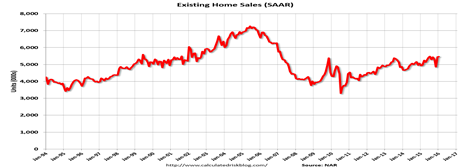
Wow! Total existing-home sales, which are completed transactions that include single-family homes, townhomes, condominiums and co-ops, rose 0.4 percent to a seasonally adjusted annual rate of 5.47 million in January from a downwardly revised 5.45 million in December. Sales are now 11.0 percent higher than a year ago – the largest year-over-year gain since July 2013 (16.3 percent).

image

Graph: Calculated Risk

This is creating a bottle neck for home buyers, as the unsold inventory of homes is down to 4 months, with such a hot sales market. Yet first-time home buyers are hanging in there with 32 percent of sales, up from 28 percent last year, and below the 40 percent during more normal times.

The median existing-home price for all housing types in January was $213,800, up 8.2 percent from January 2015 ($197,600). Last month’s price increase was the largest since April 2015 (8.5 percent) and marks the 47th consecutive month of year-over-year gains.

Lawrence Yun, NAR chief economist, says existing sales kicked off 2016 on solid footing, rising slightly to the strongest pace since July 2015 (5.48 million). “The housing market has shown promising resilience in recent months, but home prices are still rising too fast because of ongoing supply constraints,” he said. “Despite the global economic slowdown, the housing sector continues to recover and will likely help the U.S. economy avoid a recession.”

The S&P/Case-Shiller U.S. National Home Price Index, a more accurate measure of overall existing-home prices because it uses a 3-month average of same existing-home prices, recorded a slightly higher year-over-year gain with a 5.4 percent annual increase in December 2015 versus a 5.2 percent increase in November 2015.

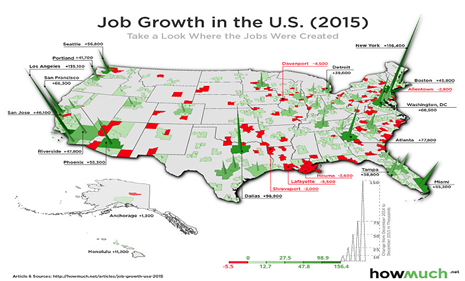
Portland, Denver and San Francisco prices continue to rise the fastest, with more than 10 percent annual increases. But Tampa and Seattle are close behind. These prices reflect the growing prosperity of high growth regions, and are reflected in a recent survey of cities and regions with the most job creation.

image

Graph: Marketwatch

This incredible graph captures where job growth is actually happening—on the coasts for the most part. Marketwatch says cost-estimating website HowMuch.net used data from the Bureau of Labor Statistics to create this three-dimensional representation of the number of jobs added by metro area. It should be no surprise that California with its Silicon Valley led all states with more than 464,000 jobs related.

The Greater New York metropolitan area, which includes Newark and Jersey City, showed the highest increase for any single metro area in the country with 156,400 new jobs. And, the Los Angeles metro area, including Long Beach and Anaheim, was second at 135,100 jobs.

This means more housing is needed and the construction industry is finally beginning to respond, with housing starts now above a 1 million unit rate, and permits for new housing even higher. Why are first-timers able to buy? The medium household income has also risen, up 6.5 percent since 2013, and interest rates are back to historical lows, making home buying more affordable.

But a continuing housing recovery is dependent on more and higher paying jobs. We know the millennial generation, from 18 to 36 years, will be key to this happening. They now make up 53 percent of the work force.

However, their pay is still at the low end, according to data from the Minnesota Population Center’s 2014 “American Community Survey” in the Integrated Public Use Microdata Series. The medians ranged between a low of $18,000 per year in Montana and a high of $43,000 in the District of Columbia. It’s because so many are still teenagers or in school. But that should change in coming years.

Harlan Green © 2016

Follow Harlan Green on Twitter: https://twitter.com/HarlanGreen
Posted in Consumers, Housing, Weekly Financial News | Tagged , , , , , , | Leave a comment

Inflation Is Bringing Back Higher Growth!

Popular Economics Weekly

Consumer prices are on the rise and the Fed’s December rate hike doesn’t look misplaced at all, says Econoday. Year-on-year core prices (without food and energy prices) rose 1 tenth to plus 2.2 percent for the highest rate in more than 3-1/2 years. This rate, as tracked in the line of the accompanying graph, is breaching the 2 percent policy line that isn’t going unnoticed at the Fed.

 image

Graph: Econoday

Yet this is exactly what is needed to presage higher economic growth this year. It has been the lack of inflation that has kept the Fed from raising interest rates sooner. Why? Because inflation leads interest rates, not the reverse. I.e., prices have to rise before banks react by raising their lending rates. Barron’s economist Gene Epstein predicts 3 percent plus GDP growth this year, almost one percent above the consensus of so-called ‘blue chip” economists.

In fact, higher inflation has to accompany higher growth, since profits can’t increase without the ability of businesses to raise their prices at or above the inflation rate. And growing profits are the only circumstance that will cause businesses to expand and create more jobs.

image

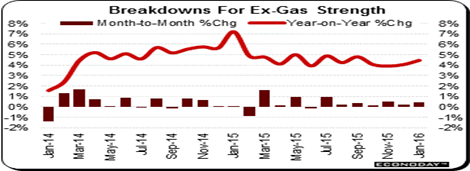
Barron’s Epstein bases his upbeat prognosis on continued healthy consumer spending that will overshadow the drop in manufacturing and exports, in particular. Ex-gas retail sales month-to-month (the dark columns) expanded for seven months in a row which matches the longest streak in five years. Year-on-year, ex-gas sales are at a very respectable plus 4.5 percent and reflect special strength in vehicle sales, up 6.9 percent on the year.

Consumers are less optimistic about their prospects this year, but will still spend more. The Index now stands at 92.2 (1985=100), down from 97.8 in January. “Consumer confidence decreased in February, after posting a modest gain in January,” said Lynn Franco, Director of Economic Indicators at The Conference Board. “Continued turmoil in the financial markets may be rattling consumers, but their assessment of current conditions suggests the economy will continue to expand at a moderate pace in the near-term.”

The housing market and governments also have to contribute some spending to boost growth above the 2.4 percent GDP rate predicted by most economists. Housing starts (ie, construction) are holding above 1 million units per year, and existing-home sales have soared to a 5.47 million annual rate in January. That was the second-highest monthly pace since 2007 and 11 percent higher than the same period a year ago.  But it could also mean a housing shortage, as existing-home inventories dropped to a 4-month supply.

State and local governments have also increased their spending on education and infrastructure upgrades, in particular. And, the federal $305B STIRR transportation highway bill, and $1.1 trillion current year spending agreement should boost federally financed programs that contribute to increased growth. President Obama signed the $1.1 trillion spending package on December 17 to fund the government through next September, averting the risk of a government shutdown. The measure removes the threat of a government shutdown until Sept. 30, about a month before the 2016 elections, and the beginning of the new fiscal year.

What better reason for optimism can there be than removing the threat of a government shutdown? This, and some rising inflation are in fact all good reasons for our optimistic prediction of better growth this year.

Harlan Green © 2016

Follow Harlan Green on Twitter: https://twitter.com/HarlanGreen
Posted in Consumers, Economy, Housing, housing market, Weekly Financial News | Tagged , , , , , , , , , | Leave a comment