High Builder Confidence Signals More Affordable Housing In 2016

The Mortgage Corner

Builder confidence in the market for newly-built single-family homes held steady at 60 in January from a downwardly revised December reading of 60 on the National Association of Home Builders/Wells Fargo Housing Market Index. Any number above 50 says that a majority of builders are optimistic about future new-home construction and sales.

Builder confidence is as good for predicting new-home construction and sales as is the Pending Home Sales Index for existing sales. And it shows builder confidence is back to pre-recession levels.

“January’s HMI reading is right in line with our forecast of modest growth for housing,” said NAHB Chief Economist David Crowe. “The economic outlook remains promising, as consumers regain confidence and home values increase, which will help the housing market move forward.”

And housing starts fell 2.5 percent last month to an annual rate of 1.15 million, the government said Wednesday. For all of 2015 home builders started work on 1.11 million new houses, the largest number since the Great Recession. Starts climbed nearly 11 percent compared to 2014. Requests for new building permits, meanwhile, slipped to an annual rate of 1.23 million in December. But the increase in permits was also the strongest in 2015 since the Great Recession.

image

Graph: Marketwatch

Overall, permits rose 12 percent in 2015 to an estimated 1.18 million units. Permits reflect how many new homes that companies plan to build in the near future. Rising demand for new and existing homes has boosted sales of a wide variety of goods used to furnish them. The housing market was one of the strongest performing parts of the economy in 2015.But more new homes being built will hold down prices, which makes homes more affordable, especially for millennial generation buyers just coming into the market.

So what about those rising prices? Calculated Risk reports that FNC’s Residential Price Index shows housing prices rising at 5 percent per year, as are the Case-Shiller and most other housing price indexes. But that is a leveling off from the peak of 10 percent in 2014, when the housing market first shook off the housing bubble.

Prices are rising moderately, as opposed to faster rising pre-recession prices all the way back to 2000, which gives hope that affordability won’t be such a problem.

image

Graph: Calculated Risk

There is also an optimistic report by Fannie Mae just out. Fannie Mae’s Economic & Strategic Research Group states that it expects further labor market tightening will lead to increased household income and job security amid more relaxed lending standards and easier access to mortgage credit throughout 2016.

But strong home price gains, especially in the lower-end of the market, will continue to outpace household income growth, which, in turn, will negatively affect affordability, Fannie Mae said.

Additionally, Fannie Mae said consumer spending is expected to support economic growth again in 2016, while residential investment and government spending should help drive growth despite some drag from net exports.

Overall, the ESR Group said that it expects the economy to grow 2.2 percent for all of 2016, with China’s deteriorating economic activity, a stronger dollar, geopolitical turmoil, and uncertainty about monetary policy remaining as risks to the outlook.

“We ended 2015 with a positive jobs report, an annual record high for auto sales, and the housing market poised to be the strongest since 2007,” said Fannie Mae Chief Economist Doug Duncan.

“The first Fed funds rate hike since 2006 has had a minimal impact on mortgage interest rates so far, and we believe mortgage rates will edge up only gradually, ending the year around 4.2 percent,” Duncan continued.

We are currently seeing 3.50 percent conforming fixed rates in California, which given nonexistent consumer inflation, makes me believe that Dr. Duncan’s rate forecast is a bit too conservative.

Harlan Green © 2016

Follow Harlan Green on Twitter: https://twitter.com/HarlanGreen
Posted in Consumers, Economy, Housing, housing market, Weekly Financial News | Tagged , , , , , | Leave a comment

Why Has It Taken So Long?

Financial FAQs

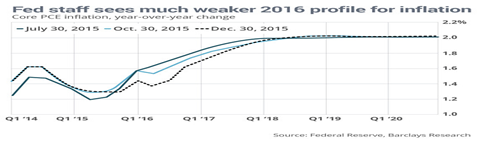
The latest Federal Reserve press releases—firstly, the minutes of last FOMC meeting, and also its reduced projections of expected inflation—tell us the Fed is still in austerity mode due to a fear of non-existent inflation. And it is that unjustified fear that puts the brake on economic growth, since even the fear that the Fed will tighten credit conditions via its control of short term interest rates affects business investment.

image

Graph: Marketwatch

The just released FOMC minutes reveals there was hardly a consensus on raising the Fed Funds rate to 0.5 percent from 0.25 percent. Why? Because many of the Fed Governors don’t believe inflation will rise at all this year from the present 1.3 percent annual Personal Consumption Expenditure index rate it favors.

This is while Nobelist Joseph Stiglitz has been decrying the lack of concern over the slow recovery from the Great Recession; lest we forget has grown more slowly than during the Great Depression. And the Fed hasn’t seemed to notice.

But what can duplicate the conditions that led to President Roosevelt and the New Deal programs (which were created by a woman, Labor Secretary Francis Perkins, by the way) that gave enough benefits to workers and trade unions so they could ultimately negotiate for a living wage and working conditions?

“In early 2010, I warned in my book Freefall, which describes the events leading up to the Great Recession, that without the appropriate responses, the world risked sliding into what I called a Great Malaise,” said Stiglitz. “Unfortunately, I was right: We didn’t do what was needed, and we have ended up precisely where I feared we would.”

We needed another New Deal, in other words, but there was neither a Roosevelt with the experience and political savvy to push through the job creation programs of the 1930s, nor such a loss of faith in capitalism that prevailed then. Let’s not forget that Herbert Hoover lost his job precisely because private industry ran for the exits, refusing to create jobs, so government job programs such as the CCC, and WPA employed those millions left jobless and became the bulwark that saved the US economy during that time.

Now we sadly have history repeating itself. “The economics of this inertia is easy to understand,” continues Stiglitz, “and there are readily available remedies. The world faces a deficiency of aggregate demand, brought on by a combination of growing inequality and a mindless wave of fiscal austerity. Those at the top spend far less than those at the bottom, so that as money moves up, demand goes down. And countries like Germany that consistently maintain external surpluses are contributing significantly to the key problem of insufficient global demand.”

History has repeated itself in several ways. Income inequality was this high in 1929, as well as a stock market bubble. A six-year drought in the Midwest created the Dust Bowl, and made millions homeless. And credit was too easy then as well and consumers spent too much, believing that stock values would never fall.

John Steinbeck described those times the best in A Primer on the ’30s’ by John Steinbeck, 1960, pgs. 17-31: “I remember the Nineteen Thirties, the terrible, troubled, triumphant, surging Thirties. … I remember ’29 very well … the drugged and happy faces of people who built paper fortunes on stocks they couldn’t possibly have paid for. … In our little town bank presidents and track workers rushed to pay phones to call brokers. Everyone was a broker, more or less. At lunch hour, store clerks and stenographers munched sandwiches while they watched stock boards and calculated their pyramiding fortunes. Their eyes had the look you see around a roulette wheel …”

Why is it important that we remember those times? Why is it so important to learn from history, you say? Because the Great Depression led to WWII in direct ways. Hitler rose out of a Germany shamed by its failed economy, and so chose dictatorship.

“[I]n the Thirties when Hitler was successful,” continued Steinbeck, “when Mussolini made the trains run on time, a spate of would-be Czars began to rise. Gerald L.K. Smith, Father Coughlin, Huey Long, Townsend – each one with plans to use the unrest and confusion and hatred as the material for personal power.”

And today we have blatantly racist Republican presidential candidates like Donald Trump and Senator Ted Cruz doing the same.

Professor Stiglitz says we know what to do: “…some of the world’s most important problems will require government investment. Such outlays are needed in infrastructure, education, technology, the environment, and facilitating the structural transformations that are needed in every corner of the earth.

Therefore, “The obstacles the global economy faces are not rooted in economics, but in politics and ideology. The private sector created the inequality and environmental degradation with which we must now reckon. Markets won’t be able to solve these and other critical problems that they have created, or restore prosperity, on their own. Active government policies are needed.”

There is a price we pay for ignoring the lessons of history, in other words.

Harlan Green © 2016

Follow Harlan Green on Twitter: https://twitter.com/HarlanGreen
Posted in Consumers, Economy, Politics, Weekly Financial News | Tagged , , , , , , , , , | Leave a comment

Housing Creating More Jobs In 2016

The Mortgage Corner

We see housing in 2016 continuing to grow the economy. This is mainly because new-home construction should surpass 1 million units again this year, and it is new-home construction (and sales), rather than existing-home sales that adds to economic growth.

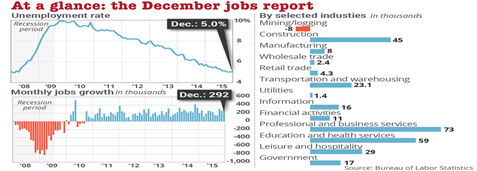
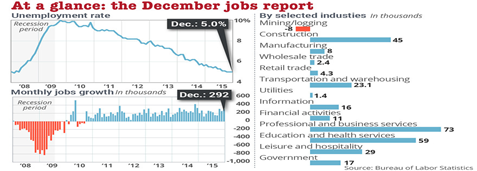
For instance, we see in the December unemployment report that 45,000 new construction jobs were created plus 73,000 jobs in Professional and Business Services, which include attorneys, accountants, insurance agents, architects and designers that work in the real estate industry.

image

Graph: Marketwatch

Much will depend on interest rates this year, of course, but the conforming 30-year fixed rate has barely budged from its record low of 3.50 percent for a one point origination fee. A 3.375 percent fixed rate is even available in California if a borrower wants to buy down the rate further.

The best indicator of future sales is the NAR’s Pending Sales Index, which is based on signed contracts, and consistently in 2015 predicted sales in the range of 5 million to 5.5 million, similar to the level in the early 2000s.

One reason we believe housing has more room to grow is that new-home construction hasn’t fully recovered from the Great Recession, and is the reason for lower sales of new homes. Sales have generally picked up through the year, but are running at half the rate of 2000 and 2001, when nearly 1 million newly built homes were sold. New-home sales rose in November to an annual rate of 490,000, which is far below the peak of around 1.2 million sales in 2005.

More new-home sales will depend on increased household formation, which economists are predicting will return to 1.2 million new households per year. Why? The Millennial generation is beginning to buy as they marry and begin to raise children.

Some 1,071,000 construction jobs have been added since 2011, according to Calculated Risk. And delinquency rates have returned to pre-recession levels—in fact are the lowest in history, according to Black Knight’s Mortgage Monitor Report, reports Calculated Risk’s Bill McBride. This is perhaps the most important statistic for the housing recovery, since it means more borrowers are available to buy homes. Black Knight now calculates that approximately 5.2 million borrowers could likely both qualify for and benefit from refinancing at today’s interest rates.

image

Graph: Calculated Risk

But if mortgage rates rise by even 50 basis points (i.e., 0.5 percent), some 2.1 million borrowers will no longer be eligible for refinancing, or buying another home, says Black Knight.

So does the Fed really want to slow down or even kill the housing market, if it continues to raise their interest rates? That is the real question. This might not affect mortgage rates all that much, however, as mortgage rates depend on longer term interest rates and the bond market, which follows inflation.

But we still have almost no inflation. Higher food prices are balanced by lower gas and commodity prices in general, and which will continue to fall as the oil glut continues this year. We believe that interest rates will therefore remain low throughout 2016.

Why? There is very little growth in the rest of the world, and developing countries like Russia and Brazil are already in recessions, while China’s economy stagnates. That means foreign investors will still flock to the one safe haven in times of uncertainty—U.S. Treasury Bonds—thus keeping our interest rates low.

Harlan Green © 2016

Follow Harlan Green on Twitter: https://twitter.com/HarlanGreen

Posted in Consumers, Economy, Housing, housing market, Politics, Weekly Financial News | Tagged , , , , , , , | Leave a comment

Still Not Enough Jobs!

Popular Economics Weekly

The economy produced 292,000 jobs in the final month of 2015, the Labor Department said Friday. Pundits had predicted a 200,000 plus increase in nonfarm jobs. And because job creation exceeded their predictions, those pundits and some economists will say the Fed has to continue to raise their rates this year. But in spite of the good jobs numbers over the past 3 months—some 2.7 million jobs were created in 2015—there are still more than 7 million job seekers that can only find part time work or no work.

Employment gains in November and October were also considerably stronger, Labor Department revisions show. Some 252,000 new jobs were created in November instead of 211,000. October’s gain was raised to 307,000 from 298,000, marking the biggest increase of 2015.

image

Graph: Marketwatch

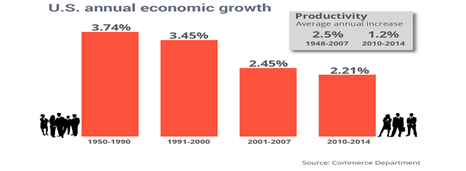
But continuing to raise interest rates will only hurt economic growth, when real GDP growth is still in the 2 percent range. In fact, annual GDP growth has averaged just 2.21 percent since 2010, and been declining since 2000.

image

Why the slow growth? A major reason is the decline in household incomes since the 1970s that have barely kept up with inflation. Hourly pay has risen just 2.5 percent in the past 12 months, matching a six-and-a-half-year high—which isn’t very high. And that has hurt personal consumption—i.e., consumer spending—which hasn’t been able to rise enough to offset the other factors holding back growth—such as almost no government investment in R&D, and public infrastructure, seriously hurting economic productivity.

That’s because most jobs were created in the lower-paying service sector, while millions of higher-paying manufacturing jobs have migrated overseas. So most workers aren’t getting big bumps in their paychecks. Hourly pay usually rises at a 3 percent to 4 percent annual pace when the economy is really humming.

And that is the ‘real’ reason we have had almost non-existent inflation. It is the hourly pay of the 80 percent of non-supervisory workers that contribute two-thirds of product costs, and it is the direction of product costs that determine whether prices are rising (or falling).

In fact, the Fed should be signaling it wants inflation to rise to the 3 to 4 percent range, a sign that wages are finally rising beyond inflation.  Because that would raise market interest rates that savers are calling for, without the Fed having to intervene.

Harlan Green © 2016

Follow Harlan Green on Twitter: https://twitter.com/HarlanGreen
Posted in Consumers, Economy, Politics, Weekly Financial News | Tagged , , , , , | Leave a comment

Why Does Bernie Love Denmark?

Popular Economics Weekly

Presidential candidate Bernie Sanders is breathing fire on the campaign trail these days, including his most recent campaign speech that advocated the breakup of too-big-to fail banks. “We will no longer tolerate an economy and a political system that has been rigged by Wall Street to benefit the wealthiest Americans in this country at the expense of everyone else,” said Sanders.

Then why does Senator Bernie Sanders love Denmark, and has been mentioning it and the other Scandinavian countries as ideal models for a developed country, one he would like the U.S. to emulate?

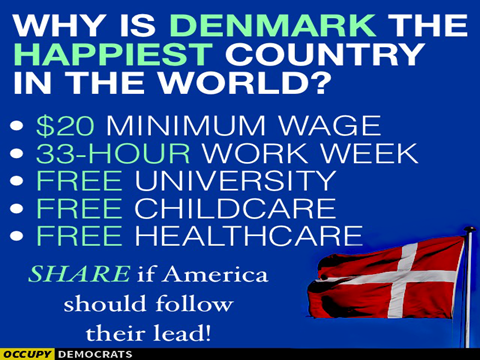
“In Denmark, social policy in areas like health care, child care, education and protecting the unemployed are part of a “solidarity system” that makes sure that almost no one falls into economic despair,” he said in a 2015 Huffington Post article. “Danes pay very high taxes, but in return enjoy a quality of life that many Americans would find hard to believe.”

image

A recent Center For Economic Policy and Research report highlighted the differences between Nordic countries and the United States. The differences are mainly because of their superior social safety nets.

For instance, the U.S. has the lowest average longevity at 78.8 years, vs. Denmark’s 80 years, while citizens of Iceland and Sweden live 82 years. Do their colder climates have something to do with it? No, more likely is the fact that they have to work fewer hours for almost the same income, with better health, educational and retirement outcomes.

image

It’s well-known that U.S. health care costs are double that of all other developed countries, as are infant mortality rates, while homicide rates are more than double of any other developed country. We know, for instance, there are more than 32,000 gun deaths per year in the U.S., with the majority due to suicides—which also tells us the mental toll that comes with an inadequate social safety net that doesn’t support its citizens.

So it should be no surprise the U.S. has the highest income developed world, before and after taxes and transfers. The higher the Gini Coefficient number portrayed in the graph, the higher the inequality. With the exception of the United States, there is a perfect correlation between market inequality and the role of fiscal policy in reducing inequality.

That is to say, western capitalist-oriented economies generate profits that go to the major wealth holders, so fiscal policies need to rebalance this effect. And that is what the Nordic countries in particular, do so well. “Countries with greater levels of market income inequality are more proactive at reducing inequality through their tax and spending systems,” says the CEPR.

image

Graph: CEPR

Then why is there opposition in our Congress, particularly, to U.S. citizens having the same benefits as other developed countries, when we are supposed to be the richest country in the world? It’s the successful opposition to higher taxes by the wealthiest among US. The wealthiest have succeeded in reducing their taxes and tax rates since President Reagan, the first ultra-conservative Republican president.

The result is ugly—and shows the U.S. is not the land of opportunity for many Americans. Instead, we have the result of a largely unregulated financial system–higher death rates, violent crime and incarceration rates, as well as inadequately funded health care, retirement, and educational systems.

Harlan Green © 2016

Follow Harlan Green on Twitter: https://twitter.com/HarlanGreen
Posted in Consumers, Economy, Keynesian economics, Macro Economics, Politics, Weekly Financial News | Tagged , , , , , , , , , | Leave a comment

Our Too Deflationary Times!

Popular Economics Weekly

The answer to the inflation conundrum may be at hand, the conundrum that has kept the Fed pushing down interest rates since the Great Recession and recovery. Why aren’t prices rising with all the QE stimulus programs that have injected literally $billions into the economy?

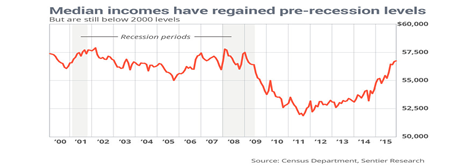
Maybe the answer is that consumers have held back on spending more because it has taken 8 years for Americans’ median incomes to recover the ground lost since the beginning of the Great Recession—8 years. There is no other plausible explanation for why consumers haven’t spent enough to push up prices during the now six year recovery. They are still in a deflationary mentality, brought on by the worst downturn since the Great Depression—which lasted some 10 years, let us not forget.

A report released Tuesday by Sentier Research drew on Census Department data shows what a long, hard climb out of this recession it’s been. And we know what depressed incomes—and job prospects—will do to so-called animal spirits—the term coined by JM Keynes to describe deflationary times as happened during the Great Depression.

image

Graph: Marketwatch

The medium income is just 1.9 percent higher than where it was in June 2009, the beginning of the economic expansion. Perhaps even more discouraging, the median income is 1.1 percent lower than in January 2000, when record-keeping began. Average weekly earnings adjusted for inflation are just 5 percent higher in November 2015 than they were when the recession began, whereas the inflation rate has risen more than 10 percent over that time.

And, such a small increase may be a reason consumers are saving more than they are spending these days. There is almost no inflation with oil and commodity prices in general falling these days. And research shows that consumers tend to spend more when prices rise over the longer term, and conversely wait longer to buy when prices are level or even discounted. This may fly in the face of so-called conventional wisdom. Otherwise, why all the discounts and specials offered these days?

image

Graph: Econoday

The Fed has been most concerned with little or no inflation, rather than higher inflation, because it means less demand for products and services. And demand is a two-edged sword. Consumers may have the means to buy, but not the will when they see prices falling, as they are for many goods and services today.

In other words, if prices go down, conventional wisdom says the situation would likely encourage more buying (Remember Say’s Law, anyone?). But it can actually have the opposite effect. If consumers and corporations expect prices to continue to go down, they will often delay purchases, waiting for a better price—dramatically slowing demand and causing prices to drop further. It leads to a downward spiral that reduces the circulation of money through the economy, which may limit growth—which is the situation today. 

This is well-known to economists such as Paul Krugman and former Fed Chair Ben Bernanke who studied the Japanese 1990’s period of prolonged deflation, and its belated attempt to boost prices. Recent noteworthy efforts to curtail deflation include Japan’s current monetary stimulus program, the European Central Bank’s recent lowering of its interest rate and quantitative easing (QE) programs in the United States.

In the 20th century, there were two main examples of deflation’s effect on economies: The Great Depression of the 1930s, which began in the United States and spread globally, and Japan’s “lost decades,” which began in the early 1990s

So the median annual household income was $56,746 in November. That’s barely above October’s median of $56,688, but it was enough to top the $56,688 reached in December 2007, when the recession began.

Does this mean consumers (and the businesses that serve them) might finally be ready to spend enough to boost the inflation rate high enough to grow the economy again, and shake off the deflationary mentality? We need at least 3 percent GDP growth to pay all the bills, and reduce the federal budget deficit to a manageable level.

The Conference Board’s Consumer confidence index rebounded in December to a reading of 96.5, up from 92.6 in November. The present situation index increased from 110.9 last month to 115.3 in December, while the expectations index improved to 83.9 from 80.4 in November. And the U. of Michigan Sentiment Survey is up 8/10s from the December flash to a higher-than-expected final December reading of 92.6. It may just be higher holiday spirits, of course.

We know from the Great Depression just how long it took for animal spirits to rise, and shake off those deflationary expectations that keep consumers saving more than they are spending. So the return of median incomes to pre-recession levels should be good news for next year growth, since consumers power approximately 70 percent of GDP growth. If only our business interests would understand this, and why consumers hold back, even when they are feeling better! Corporations might then begin to invest more of their record profits in productive enterprises that would create those oh so necessary jobs.

Harlan Green © 2015

Follow Harlan Green on Twitter: https://twitter.com/HarlanGreen
Posted in Consumers, Economy, Keynesian economics, Politics, Weekly Financial News | Tagged , , , , , , | Leave a comment

What Happens in 2016?

Popular Economics Weekly

Even with interest rates rising, we see 2.5 percent plus GDP growth in 2016, because of strong employment and consumer spending. An early sign of this this trend is the Conference Board’s Index of Leading Economic Indicators (LEI) for November, with 8 of the 10 leading indicators that help to predict jobs, housing trends (via permits), interest rates, and stock market movements staying positive.

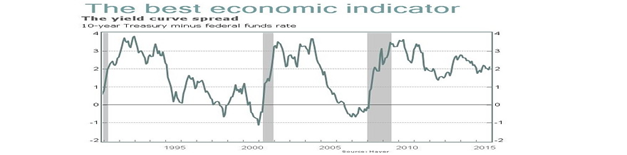
One LEI indicator, the so-called yield curve spread, focuses on the interest rate spread between short and the 10-year Treasury yield. The spread is narrowest (even negative, when short term rates are higher than long term interest rates) during recessions, per the Marketwatch graph, as in 2001 and 2008. The yield curve spread is currently a healthy 2 percent, with the 10-year yield currently at 2.25 percent, indicating good growth.

image

Graph: Marketwatch

Wages and salaries that make up some 80 percent of personal income are rising, but much of it is being saved or used to pay down debt. Still, however, the year-on-year gain for this component, as seen in the Econoday graph, has been slowing to plus 4.5 percent for the lowest reading since March. Nevertheless, growth is still respectable and is being combined with strong savings, which is the light line in the graph. This rate came in at 5.5 percent in November which outside of October’s 5.6 percent is the strongest rate in three years.

image

Graph: Econoday

That means jobs are available, gas prices are low, and consumers are building up their bank accounts. The spending side of the report isn’t so strong, however, up a respectable looking 0.3 percent for the month that includes Black Friday — but compared with no change in October. November’s year-on-year rate was only plus 2.9 percent, which along with October’s 2.9 percent are the weakest showings for spending since January last year.

But consumer sentiment is on the rise going into the final shopping days of Christmas, according to the U. of Michigan Sentiment Survey, up 8/10s from the December flash to a higher-than-expected final December reading of 92.6. The implied level in the final half of the report is in the mid-93 area which would be the strongest pace since way back in June. And in a sign of specific strength for December, the current conditions component is up 1.1 points from mid-month to 108.1 which is nearly 4 points over November.

image

Graph: Econoday

So most signs point to a very robust holiday spending season, which should help early 2016 growth. First quarter growth in the past 2 years was slowed by the severe winters, but the west coast El Nino phenomena has already kicked in, with signs of a much warmer eastern and southern U.S.

In fact, year-on-year retail sales show non-store, online retailers out in front, at plus 7.3 percent. Restaurants are right behind at plus 6.5 percent year-on-year followed by furniture and by sporting goods, both at plus 5.4 percent. Altogether, core retail sales are up a moderate 3.6 percent year-on-year, but the plunge of 19.9 percent in gas prices is making everything cheaper, with Regular gas prices as low as $2 per gallon in many parts of the country.

Harlan Green © 2015

Follow Harlan Green on Twitter: https://twitter.com/HarlanGreen

Posted in Consumers, Economy, Weekly Financial News | Tagged , , , , , , , , | Leave a comment

Can Economy Grow With Higher Interest Rates?

Financial FAQs

The Federal Reserve’s Open Market Committee announced it is raising short term interest rates by ¼ percent. But can this economy continue to grow with higher interest rates, as Fed Chairwoman Yellen has promised?

That depends on several mundane factors, such as cheap gas and energy prices that have been helping to hold down consumer and producer costs. And since most consumer and many producer products are imported, the more expensive dollar exchange rate has made them cheaper. Hence the very low inflation rate these days.

image

Graph: Econoday

An early sign of continued growth is the Conference Board’s Index of Leading Economic Indicators (LEI). The 12 leading indicators it tracks predict “moderate” future growth. And Congress’s new era of cooperation has resulted in the passing of two very important spending bills—the $305 billion Surface Transportation bill, and $1.14 Trillion federal budget.

Boosted by yesterday’s strong showing for housing permits (housing will be another area of strong growth next year), the LEI rose a solid 0.4 percent in November on top of October’s very strong 0.6 percent rise. Other positives include the interest-rate spread, specifically low short-term rates, and also gains for the stock market.

“The U.S. LEI registered another increase in November, with building permits, the interest rate spread, and stock prices driving the improvement,” said Ataman Ozyildirim, Director of Business Cycles and Growth Research at The Conference Board. “Although the six-month growth rate of the LEI has moderated, the economic outlook for the final quarter of the year and into the new year remains positive.”

Congress on Friday passed far-reaching legislation funding the government through next September plus passing tax breaks for business and low-income families. It was a compromise that helped the GOP, also, as the bill lifts a 40-year-old ban on oil exports.

The legislation pairs two enormous bills: a $1.14 trillion government-wide spending measure to fund every Cabinet agency through next September, and a $680 billion tax package extending dozens of breaks touching all sectors of the economy, making several of them permanent and tossing the entire cost onto the deficit.

President Barack Obama is expected to sign the legislation today. The bill cleared both chambers easily, first in the House, which passed it 316-113, followed by the Senate in a 65-33 vote.

The biggest reason this benefits economic growth is that another spending sequester was avoided, a sequester that limited spending across the board, hurting all segments of the economy. There was not even a spending cap, which means governments can function again without the interference of the Austerians, those conservatives that have been trying to restrict government spending on everything, including research and development. The $1.14 trillion spending bill avoids a shutdown next week, when the government’s current funding was scheduled to expire at 12:01 a.m. on Dec. 23.

Refunding the Highway Trust Fund that has run out of funds will be the biggest beneficiary of the $305 billion surface transportation bill. Called Fixing America’s Surface Transportation Act, or the FAST Act, it fixes and replaces badly degraded railroads, highways and bridges, hence it benefits those industries that depend on surface transportation.

One big benefit of the bill is the creation of programs to focus federal aid on eliminating bottlenecks and increasing the capacity of highways designated as major freight corridors. The Transportation Department estimates the volume of freight traffic will increase 45 percent over the next 30 years, which gives a tremendous boost to productivity.

The five-year FAST infrastructure bill is the longest reauthorization of federal transportation programs that Congress has approved in more than a decade, ending an era of stopgap bills and half-measures that left the Highway Trust Fund nearly broke and frustrated local governments and business groups. President Obama will sign the bill into law, as it fulfills his long-running push for lawmakers to pass an infrastructure bill even though it is significantly less than the $478 billion he sought in his own plan earlier this year.

image

Graph: Econoday

Lastly, and perhaps the best reason interest rates won’t have much effect on future growth—at least through next year—is hourly earnings are finally rising above the very low inflation rate, which means we are reaching full employment. That’s why consumers have become more upbeat, hence are spending more. Average hourly earnings in the last unemployment report rose 2.3 percent annually, whereas the core PCE inflation index favored by the Fed has risen just 1.3 percent.

In fact, that is a major reason the Fed raised short term rates at this time, in the teeth of holiday spending. Wages and salaries are finally showing signs of life—of rising faster than inflation. Fed Chair Yellen has said many times it is a precondition for raising short term rates, which mainly influence consumer spending via credit card and auto loan rates.

So as long as inflation stays low and wages continue to increase the U.S. economy will continue to grow. And with Iran about to join the oil markets, energy prices should remain at the low end, with some analysts predicting oil prices could drop as low as $20 per barrel next year. So what’s to worry about? The Fed really can now sit on the sidelines, until and if inflation again catches up with wage and salary growth.

Harlan Green © 2015

Follow Harlan Green on Twitter: https://twitter.com/HarlanGreen

Posted in Consumers, Economy, Housing, housing market, Politics, Weekly Financial News | Tagged , , , , , , | Leave a comment

Housing Starts Surge, Millennials Are Buying

The Mortgage Corner

The Federal Reserve’s Open Market Committee has just announced it is raising short term interest rates by ¼ percent. Its press release said: “Given the economic outlook, and recognizing the time it takes for policy actions to affect future economic outcomes, the Committee decided to raise the target range for the federal funds rate to ¼ percent to ½ percent. The stance of monetary policy remains accommodative after this increase, thereby supporting further improvement in labor market conditions and a return to 2% inflation.”

This is at the same time that privately-owned housing starts in November rose to a seasonally adjusted annual rate of 1,173,000, reports the U.S. Census Bureau. This is 10.5 percent above the revised October estimate of 1,062,000 and is 16.5 percent above the November 2014 rate of 1,007,000. It’s a huge number, and has to be a sign that household formation is picking up from the lows of the Great Recession.

Much of the construction surge is fueled by the millennial generation in particular leaving home and beginning to form new households. The interest rate boost may not affect construction, as longer term rates are set by bonds, such as the 10-year Treasury Bond which remains at historical lows.

image

Graph: Calculated Risk

Single-family housing starts in November were at a rate of 768,000; this is 7.6 percent above the revised October figure of 714,000. The November rate for units in buildings with five units or more was 398,000.

“Single-family production this month has reached levels last seen before the Great Recession, an indicator that we are making gradual headway back to a normal housing market,” said NAHB Chief Economist David Crowe. “As we close out the year, we can see that the housing sector has made headway in 2015, and we expect the recovery to continue at a modest pace.”

Higher household formation among 20-year olds is an early sign that millennials are coming into the housing market in force. Demographic Intelligence, according to the Wall Street Journal, has analyzed the marriage data on millennials. Demographic Intelligence predicts that ultimately about 60 percent of the children of millennials will be born to married parents, up from about 45 percent today.

“The narrative about millennials has been they’re putting parenthood before marriage, never going to get married,” said Sam Sturgeon, president of Demographic Intelligence, based in Charlottesville, Va. “Now that the cohort is in the middle of their 20s, from here on out you’re going to see a lot of millennial marriages and a lot of millennial married births.”

Millennials, those that most demographers say are born between 1980 and 2000, are the largest and most diverse generation in U.S. history. Earlier this year, they became the largest generation in the U.S. labor force, surpassing Generation X, those ages 35 to 50, according to the Pew Research Center.

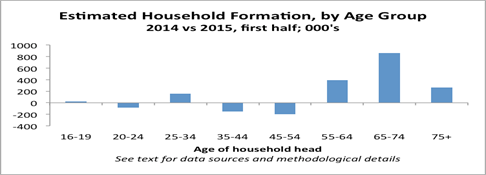
Household formation has picked up at the same time, though UC Berkeley’s Terner Center For Housing Innovation says most of the new households are being formed by seniors. Despite expectations that millennials are the force behind household formation, older adults are driving household formation. Strikingly, age groups younger than 55 collectively had negative household formation between 2014 and 2015, while 65-74 year-olds accounted for more than two thirds (860 thousand) of overall household formation.

image

Graph: UC Terner Center

And privately-owned housing units authorized by building permits in November were also much higher, at a seasonally adjusted annual rate of 1,289,000, signaling higher new-home construction for next year as well,. This is 11.0 percent above the revised October rate of 1,161,000 and is 19.5 percent above the November 2014 estimate of 1,079,000.

Combined single- and multifamily starts rose in the South and West, with respective gains of 21.3 and 6.3 percent. The Midwest was unchanged and the Northeast fell 8.5 percent.

So who is right? The Berkeley study said the seniors are forming more households because 65-74 year-olds are the fastest growing population group at present. But that can’t last as mid-20 year-olds will soon be the largest population segment. And their sample is just through mid-2015, so millennials could begin to show more numbers for the rest of 2015.

Regardless, this will continue to boost housing construction, and Demographic Intelligence maintains that 4 million ancillary jobs are created with every 1 million new homes that are built and sold.

Harlan Green © 2015

Follow Harlan Green on Twitter: https://twitter.com/HarlanGreen
Posted in Consumers, Economy, Housing, housing market, Weekly Financial News | Tagged , , , , , | Leave a comment

What Are Benefits of Paris Accord?

Popular Economics Weekly

PARIS — More than 190 nations have agreed on a plan to limit climate change, said the conference press release, ending a decades long search for an accord requiring the world’s economies to regulate the emission of gases that scientists say are causing the earth to warm.

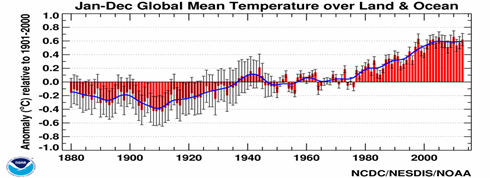
And to reach the goals set by the history-making accord that limit world temperature rises to 1.5 to 2 percent Centigrade, will require massive investments that could spur economic growth worldwide for decades to come. The main beneficiaries will be the new technologies that mitigate fossil fuels and other non-renewable energy sources that have been heating up our atmosphere.

image

Graph: NOAA

Bill Gates has announced his own accord with other billionaires to fund startups that mitigate global warming. The New York Times reported Gates’ role in sealing the deal. It underscores how a handful of the world’s wealthiest people can stand with heads of state to spotlight a social, economic and policy issue on the global stage, said the Times.

Last week, on the opening day of the Paris meeting, Mr. Gates joined Mr. Obama and Mr. Hollande to introduce the coalition. It will commit 20 governments to doubling their renewable energy research budgets to a total of $20 billion over the next five years.

In addition, Mr. Gates and a group of other wealthy businesspeople agreed to invest at least $2 billion in clean-energy start-ups — with half the money coming from Mr. Gates himself. The group plans to finance companies that turn promising clean-energy concepts, some of which will originate in government labs, into viable products. Some of the companies will fail, Mr. Gates warned.

And Wall Street is taking notice. There are “9 entry points for investors wishing to play the climate change and low carbon solutions theme,” said Bank of America-Merrill Lynch equity strategists Sarbjit Nahal, Beijia Ma and Felix Tran in a note released last Tuesday. They say the nine places to get involved are: “1) Energy Efficiency; 2) Wind; 3) Solar; 4) YieldCos; 5) Nextgen Vehicles, Batteries & Storage; 6) Nuclear; 7) Hydro; 8) Diversified Cleantech; and 9) Other Cleantech.”

There are already many new energy efficiency startups, which have had their ups and downs with or without federal subsidies, such as solar power. Bloomberg has listed 25 companies that are either researching or already producing clean-energy alternatives to fossil fuels. They range from boring miles into earth’s crust to produce thermal energy, to cleaner-burning diesel engines that raise gas mileage to 100 miles per gallon, to LED lighting that is already saving electricity, to converting coal efficiently to cleaner-burning natural gas.

The Paris accord requires any country that ratifies it to act to stem its greenhouse gas emissions in the coming century, with the goal of peaking greenhouse gas emissions “as soon as possible” and continuing the reductions as the century progresses. Countries will aim to keep global temperatures from rising more than 2°C (3.6°F) by 2100 with an ideal target of keeping temperature rise below 1.5°C (2.7°F).

The Paris accord will also encourage billions, if not trillions of dollars of capital to be spent adapting to the effects of climate change, as I’ve said—including infrastructure like sea walls and programs to deal with poor soil—and developing renewable energy sources like solar and wind power. The text of the agreement also includes a provision requiring developed countries to send $100 billion annually to their developing counterparts beginning in 2020. That figure will be a “floor” that is expected to increase with time.

The stakes could scarcely be higher. Without urgent action, warming was predicted to reach unprecedented levels, of as much as 5C above current temperatures – a level that would see large swathes of the globe rendered virtually uninhabitable. What is more, infrastructure built today – coal-fired power plants, transport networks, buildings – that entail high carbon emissions will still be operating decades into the future, giving the world a narrow window in which to change the direction of our economies.

This all spells out a massive retooling of national economies, as the new technologies are implemented, which can well be called a post-industrial revolution, one started with the digital and Internet revolution, which makes possible the next revolution; one of a planet that won’t overheat, as have other planets in our solar system.

image

Graph: NASA

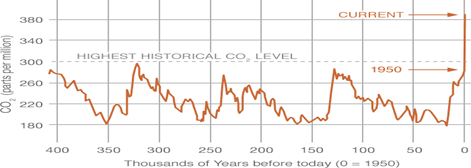
Which planets have the most CO2 in their atmosphere? Venus and Mars have about 95 percent carbon dioxide, which has made them uninhabitable, though the atmosphere of Venus is also much thicker (90 times earth’s at present). Earth has only a small amount of carbon dioxide, but it’s enough to have a “greenhouse effect”, reports NASA.

In fact, there is a precedent for such massive investment: the Marshall Plan that rebuilt Europe after WWII. So there is the best of incentives to sign on to the agreement. It should be in the interest of every country that wants to continue to grow their future economies—rich and poor—to implement the Paris accord on Global Warming.

Harlan Green © 2015

Follow Harlan Green on Twitter: https://twitter.com/HarlanGreen

Posted in Economy, Politics, Uncategorized, Weekly Financial News | Tagged , , , , | Leave a comment