Let’s Recognize The Enormous Economic Benefits of Global Warming

Financial FAQs

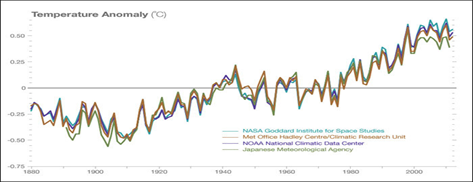
It should now be time to look at the future benefits that will come from the necessity to mitigate global warming, while the Paris climate change conference is in session. We already know the environmental havoc it has wreaked, with the greater frequency of flooding from rising oceans (e.g., via Hurricane Sandy), tornadoes, increased carbon emissions, and the like resulting in $billions in economic losses.
image

Graph: NASA

But no one is looking yet at the benefits to economic growth increased investments will bring to prevent our Earth from overheating, investments that will be needed to mitigate the ongoing damage of rising seas, as well as fund future investments in new technologies that can reduce the increase warming science predicts.

Bill Gates has been one harbinger of these benefits, with his calls to spend more on future technologies. For instance, Gates has invested $1 billion of his own money into startups working on new kinds of batteries and nuclear reactors.

“Honestly, I’ve been a bit surprised that the climate talks historically haven’t had R.&D on the agenda in any way, shape or form,” Mr. Gates, 60, said in an interview last week on the sidelines of the summit meeting, which ends on Friday.

And Gates has just announced a multi-billion dollar, multi-national initiative “intended to forge a global accord to cut planet-warming emissions,” at the Paris conference, according to the New York Times.

“The fund, which one of the people described as the largest such effort in history, is meant to pay for research and development of new clean-energy technologies, says the Times article. “It will include contributions from other billionaires and philanthropies, as well as a commitment by the United States and other participating nations to double their budget for clean energy research and development, according to the people with knowledge of the plans, who asked not to be identified because they were not authorized to discuss the fund.”

China will be one of the major contributors to this fund, for good reason. Air pollution in Beijing on Tuesday reached “hazardous” levels, as rated by international municipal air quality standards, so that the government announced an almost complete shutdown of factories, schools, and auto traffic. This is the result of being the world’s largest user if coal-generated power.

And of immediate benefit to the U.S. economy was final Senate approval of a five-year, $305 billion highway bill Thursday that will refund the Highway Trust Fund. Its passing was spurred in part by the disastrous weather that has damaged our infrastructure, such as some 60,000 bridges badly in need of repair and replacement.

The bill calls for spending approximately $205 billion on highways and $48 billion on transit projects over the next five years. It also reauthorizes the charter of the controversial Export-Import Bank until 2019, which will boost U.S. exports for companies such as Boeing that require loan guarantees to sell its products overseas.

It was sent to President Obama with just one day to spare before the scheduled expiration of the nation’s road and transit spending. The measure passed by a 83-16 tally, hours after sailing through the House on a lopsided 359-65 vote. This bill will be a huge boost to many business sectors. For instance, it will create $13 billion in economic activity related to construction equipment and generate 4,000 jobs at equipment dealerships, according to a new study released by the Associated Equipment distributors.

The Washington, D.C.-based group said Wednesday the new $305 billion highway bill will stimulate approximately 6.4 cents in growth in the equipment industry for every dollar that is spending on infrastructure.

“The new analysis clearly illustrates what AED told lawmakers for almost a decade: restoring certainty to the federal highway program will yield positive economic benefits for equipment distributors, manufacturers and their employees,” AED President Brian McGuire said in a statement.

“After so many near misses and close calls, so many cans kicked down the road and so many cliffs narrowly averted, we finally have long-term, fully funded highway legislation,” Associated Equipment Distributors President Brian McGuire said in a statement about the measure, which is known as the Fixing America’s Surface Transportation (FAST) Act

The Pentagon has been one of the most vocal on the damage from climate change in a well-known report.

“Global climate change will have wide-ranging implications for U.S. national security interests over the foreseeable future because it will aggravate existing problems — such as poverty, social tensions, environmental degradation, ineffectual leadership, and weak political institutions — that threaten domestic stability in a number of countries,” said the Pentagon report.

This is only the tip of the iceberg on benefits of investments to mitigate global warming, needless to say. The $5 billion Tesla battery factory in Carson City, Nevada is just one example of the drive for sustainable energy sources that will power the Tesla electric car.

“This is great news for Nevada,” said Nevada Governor Brian Sandoval in the joint press release with Tesla Motors. Tesla will build the world’s largest and most advanced battery factory in Nevada which means nearly one hundred billion dollars in economic impact to the Silver State over the next twenty years. I am grateful that Elon Musk and Tesla saw the promise in Nevada.”

We can already see the benefits to growth when a $5billion investment is expected to produce nearly $100 billion in future benefits within just one state.

Harlan Green © 2015

Follow Harlan Green on Twitter: https://twitter.com/HarlanGreen
Posted in Economy, Politics, Weekly Financial News | Tagged , , , , , , , | Leave a comment

No Recession Is In the Cards

Financial FAQs

There is a growing consensus among economists that recovery from the Great Recession will continue for several more years. This is in part because there are really no signs of a looming recession. Inflation is still too low, job openings are still plentiful, and housing, the usual predictor of a slowdown, is still in an early stage of recovery.

Jonathan Golub of RBC Capital Markets is one such optimist. ”No two recessions are the same, but they tend to follow a similar pattern. Typically, an accelerating economy burns through existing spare capacity. This leads to inflationary pressure, which forces the Fed to act. As markets anticipate rate hikes, the yield curve inverts. Growth slows and, more often than not, the economy rolls over, taking the market with it.”

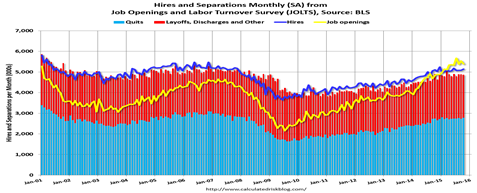
But the Labor Department’s JOLTS report just out signals there are plenty of jobs–in part because hiring picked up: there were 5.14 million hires in October, up from 5.08 million in September.

image

Graph: Calculated Risk

And though there were 5.38 million job openings in October (yellow line in graph), down from 5.53 million in September, some 2.78 million workers left work voluntarily, up from 2.77 million in September (blue bars in graph). This is a sign that workers are gaining confidence in the job market and their ability to find other jobs.

So we are hardly approaching full employment. And Friday’s unemployment report said the number of persons employed part time for economic reasons (sometimes referred to as involuntary part-time workers) increased by 319,000 to 6.1 million in November, following declines in September and October. Their hours had been cut back because they were unable to find a full-time job, said the BLS. (Though over the past 12 months, the number of persons employed part time for economic reasons is down by 765,000, a good sign.)

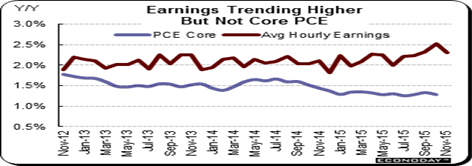
Another telltale sign of continued growth are the low inflation numbers, combined with barely rising incomes. Year-on-year, as seen in the dark line of the graph, average hourly earnings dipped 2 tenths to 2.3 percent, says Econoday. Whereas the Fed’s central inflation gauge, core PCE prices, are up just 1.3 percent. It’s the light blue line in the graph, and has been trending lower for the past year. When energy and food are included, the PCE drops to a year-on-year rate of only plus 0.2 percent.

image

Graph: Econoday

And low inflation (ie, cheap gas, commodities), plus rising incomes are reasons for optimism among consumers. As much as 1 million barrels per day of Iranian oil is about to come back into world markets, per the nuclear arms agreement, which will only bring down energy prices further. And demand in China for all commodities has weakened, as it works through its oversupply problems.

What about housing? The Mortgage Bankers Association just reported that purchase mortgage applications have risen a huge 1.2 percent from the previous week, while its unadjusted Purchase Index increased 36 percent compared with the previous week and was 29 percent higher than the same week one year ago. This means more housing sales, folks.

Its Market Composite Index, a measure of mortgage application volume, increased 1.2 percent on a seasonally adjusted basis from one week earlier.  On an unadjusted basis, the Index increased 43 percent compared with the previous week.  Even the Refinance Index increased 4 percent from the previous week.

This is when both existing-home sales and housing construction are still expanding. A strong housing market depends on mortgage rates staying near current lows, of course, but we believe that Yellen’s Fed dares not raise short term rates more than 0.25 percent in the near term.

In fact, Treasury Bond yields are also at record lows, with slowing worldwide growth. Foreign investors prefer to buy U.S.Treasury securities when other countries aren’t doing well; in comparison to our own better growth prospects.

So any rise in energy prices is just not in the cards, interest rates should stay low, which keeps down so many other costs—including lower household expenses, as well as production costs. These conditions spell future growth, rather than a near term recession.

Harlan Green © 2015

Follow Harlan Green on Twitter: https://twitter.com/HarlanGreen
Posted in Consumers, Economy, Housing, housing market, Weekly Financial News | Tagged , , , , , | Leave a comment

211,000 Payroll Jobs Not Enough

Popular Economics Weekly

Friday’s unemployment report was disappointing for a number of reasons, mainly because we are not yet close to full employment, and there is no sign of inflation. The number of persons employed part time for economic reasons (sometimes referred to as involuntary part-time workers) increased by 319,000 to 6.1 million in November, following declines in September and October.

This is hardly approaching full employment. The report said these individuals, who would have preferred full-time employment, were working part time because their hours had been cut back or because they were unable to find a full-time job. Over the past 12 months, the number of persons employed part time for economic reasons is down by 765,000.

Yet because 211,000 payroll jobs were added to payrolls, the calls are now for the Fed to begin to raise their interest rates.

image

Graph: Marketwatch

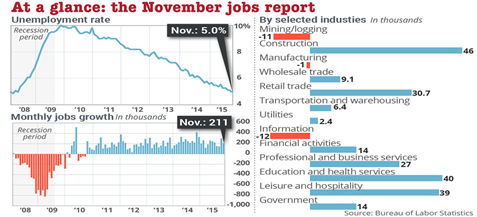
Most companies added jobs in November. Construction firms hired 46,000 people; restaurants added 32,000 employees and retailers beefed up staff by 31,000. The lone exceptions were the energy industry and Hollywood. Cheap oil has stunted business for energy producers, which have cut 124,000 jobs in 2015. The motion-picture industry also shed 13,000 jobs, though there’s been little change in employment over the past year.

But employment among manufacturers was basically flat, because of a strong dollar and weak global economy that’s reduced demand for their exports. In a separate report Friday, the government said U.S. exports fell to the lowest level in three years.

Raising interest rates now will cut back our exports even further (and so manufacturing), which are the bastion of higher income earners. This is while the EU is lowering their interest rates, making their exports more competitive.

ECB Chairman Mario Draghi promised he “would do whatever it takes” to boost economic growth in the Eurozone, and has just lowered their interest rates to a negative -0.3 percent. Mr. Draghi said there was “no particular limit to how we can deploy any of our tools” in terms of what the central bank could do to foster demand and, crucially, fulfill its stated goal of lifting inflation to 2 percent.

The report said the change in total nonfarm payroll employment for September was revised from +137,000 to +145,000, and the change from October was revised from +271,000 to +298,000. Over the past 3 months, job gains have averaged 218,000 per month.

This is hardly robust job growth, when November’s total dropped 87,000, and September’s total was still weak. And the inflation rate isn’t back to their 2 percent target. Nor is the labor market at full employment. We therefore believe such a rate increase would be premature and dampen consumer demand, at a time when consumers are already saving much more than they are spending.

Harlan Green © 2015

Follow Harlan Green on Twitter: https://twitter.com/HarlanGreen
Posted in Consumers, Economy, Macro Economics, Politics, Weekly Financial News | Tagged , , , , , , , , | Leave a comment

Lower Payroll Employment Tomorrow?

Popular Economics Weekly

Will tomorrow’s unemployment report be disappointing, and so cause the Fed to hesitate in raising their overnight interest rate above 0.25 percent, as they’ve been saying they will do this month? The most current economic indicators show that Fed Chair Yellen may be overoptimistic in her predictions for future growth, and so the need for higher rates.

The ADP private payroll report out yesterday is showing strength in Friday’s employment report, at a higher-than-expected gain of 217,000 for payrolls in November. But month-to-month, this report is not always an accurate indicator for the government’s data, forecasting a much lower reading than what turned out for October and a much higher reading than what turned out for September.

image

Graph: Econoday

Another sign that tomorrow’s report may be weaker is the ISM’s non-manufacturing survey index just out that dropped to 55.9 in November from 59.1, which is the lowest rate of monthly growth since May. And service sector activity now accounts for some 70 percent of economic activity.

image

Graph: Calculated Risk

Readings across the report have also edged down to growth levels last seen in the second quarter including new orders (57.5), backlog orders (51.5), and employment (55.5). New export orders, at 49.5, had their first contraction since April, showing a weaker manufacturing sector that is more dependent on exports.

The Employment Index decreased 4.2 percentage points to 55 percent from the October reading of 59.2 percent and indicates albeit slower growth for the 21st consecutive month. This is though the breadth of strength across industries, with 12 showing growth and six in contraction, is positive.

So what might tomorrow’s unemployment report be? The consensus is 200,000 payroll jobs, with a slightly higher unemployment rate of 51 percent. And Calculated Risk reports that Goldman Sachs maintains wages are still too low for longer term growth. “Our wage tracker—which also now includes the Atlanta Fed wage measure—stands at 2.6 percent. Apart from a technical blip in late 2012, this is the highest reading of the recovery, although it is still somewhat below our 3-3.5 percent estimate of the full-employment equilibrium rate,” reports Goldman economist David Mericle.

I therefore believe Fed Chair Yellen is being overly optimistic about future economic growth, when she said recently, “I anticipate continued economic growth at a moderate pace that will be sufficient to generate additional increases in employment, further reductions in the remaining margins of labor market slack, and a rise in inflation to our 2 percent objective.”

These indicators tell us that Fed Chair Yellen is still premature in predicting what may never happen, if they begin to raise interest rates at this time.

Harlan Green © 2015

Follow Harlan Green on Twitter: https://twitter.com/HarlanGreen

Posted in Consumers, Economy, Politics, Weekly Financial News | Tagged , , , , , , , , | Leave a comment

Fed Rate Hike Could Hurt Employment

Financial FAQs

Fed Chair Janet Yellen all but confirmed the Fed was ready to raise interest rates in December. She laid out a case for raising interest rates in a speech on Wednesday at the Economic Club in Washington.

“Ongoing gains in the labor market, coupled with my judgment that longer-term inflation expectations remain reasonably well anchored, serve to bolster my confidence in a return of inflation to 2 percent as the disinflationary effects of declines in energy and import prices wane,” she said.

This is while the latest labor productivity stats show productivity is improving, and wages are finally rising above the inflation rate, which is a necessary condition for continued growth. But a rate hike at this time could make it more difficult for consumers to spend their new found wealth. They might decide to save more instead, at a time when businesses are also saving more and investing less in increased productivity.

The inflation rate isn’t back to their 2 percent target. Nor is the labor market at full employment. We therefore believe such a rate increase would be premature and dampen consumer demand, at a time when consumers are already saving much more than they are spending.

In fact, Yellen said “In October, almost 2 million individuals classified as outside the labor force because they had not searched for work in the previous four weeks reported that they wanted and were available for work. This is a considerable number of people, and some of them undoubtedly would be drawn back into the workforce as the labor market continued to strengthen. Likewise, some of those who report they don’t want to work now could change their minds in a stronger job market.”

image

Graph: EPI

But even her estimate of the unemployed may be low. The Economic Policy Institute estimates some 4 million are neither employed nor looking for work. In fact, if added back into the labor force, they would raise the unemployment rate to 7.4 percent, far above the Fed’s employment target.

The Bureau of Labor Stats said nonfarm business sector labor productivity increased at a 2.2-percent annual rate during the third quarter of 2015, as output increased 1.8 percent and hours worked decreased 0.3 percent. The decline in hours worked was the first decline in this series since a 4.8-percent decline in the third quarter of 2009.

This means that more was produced with less hours worked, hence the productivity increase. But from the third quarter of 2014 to the third quarter of 2015, productivity increased just 0.6 percent, reflecting increases in output and hours worked of 2.5 percent and 1.9 percent, respectively. That means output of goods and services increased 2.5 percent, but hours worked had to increase 1.9 percent to produce it. So if they were equal, there would be no productivity increase.

So why begin to raise interest rates now?? Wouldn’t that cause businesses to borrow less, and hence invest less in capital expenditures, thus hurting future productivity growth? Yellen cautioned against delaying a rate hike for too long, saying it may force the U.S. central bank to tighten “abruptly.” Holding rates at its current level near zero also risks “excessive risk-taking” by investors, she noted.

The Fed may once again be attempting to deflate an asset bubble. But are stock and bond prices, as well as housing, in bubble territory? Businesses are not overleveraged, with corporations hoarding some $5 Trillion in cash and other liquid assets worldwide. The last time the Federal Reserve (with Fed Chair Alan Greenspan) began to deflate a bubble resulted in the Great Recession.

Harlan Green © 2015

Follow Harlan Green on Twitter: https://twitter.com/HarlanGreen

Posted in Consumers, Economy, Politics, Weekly Financial News | Tagged , , , , , , | Leave a comment

Oct. Pending and New-Home Sales Still Rising

The Mortgage Corner

Both new and existing-home sales are still thriving, given that conforming fixed rates are still at almost historic lows, in spite of a looming Fed interest rate hike. Why? It’s mainly investors worried about worldwide growth that are parking their money in safe Treasury bonds and mortgage backed securities that determine mortgage rates. It is one reason the housing market is still growing.

The Pending Home Sales Index, a forward-looking indicator based on contract signings, inched 0.2 percent to 107.7 in October from an upwardly revised 107.5 in September and is now 3.9 percent above October 2014 (103.7). The index has increased year-over-year for 14 consecutive months.

Lawrence Yun, NAR chief economist, says pending sales have plateaued this fall as buyers struggle to overcome a scant number of available homes for sale and prices that are rising too fast in some markets. “Contract signings in October made the most strides in the Northeast, which hasn’t seen much of the drastic price appreciation1 and supply constraints that are occurring in other parts of the country,” he said. “In the most competitive metro areas – particularly those in the South and West – affordability concerns remain heightened as low inventory continues to drive up prices.”  

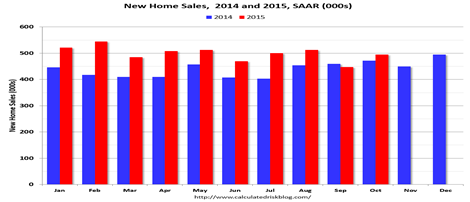
This follows continued growth in last week’s new-home sales report for October by the National Association of Home Builders. Even though the October report was somewhat disappointing, sales are still up solidly year-to-date.  The Census Bureau reported that new home sales this year, through October, were 430,000, not seasonally adjusted (NSA). That is up 15.7 percent from 371,000 sales during the same period of 2014 (NSA). That is a strong year-over-year gain for 2015 through October, said Calculated Risk.

image

Graph: Calculated Risk

But this graph doesn’t show the low inventories—at 5.5 months’ of supply—that means demand is high and builders will continue to build more new homes to fill that demand. The largest segment with the color blue in the graph is homes under construction, while red shows completed homes, and green permits for homes not yet built. It’s therefore easy to see construction is booming, which is adding to economic growth.

image

Graph: Calculated Risk

And, indeed, the U.S. Census Bureau of the Department of Commerce just announced that construction spending during September 2015 was estimated at a seasonally adjusted annual rate of $1,094.2 billion, 0.6 percent above the revised August estimate of $1,087.5 billion. The September figure is 14.1 percent above the September 2014 estimate of $959.2 billion.

And spending on residential construction in particular is up 1.0 percent in October for a seventh straight gain and all of them convincing. Year-on-year, residential construction is up 16.6 percent. Private non-residential spending rose 0.6 percent in October with the year-on-year rate at plus 15.3 percent. Public spending is holding down totals with the educational component unchanged in the month though Federal spending did jump, up 19.2 percent for a year-on-year rate of plus 10.7 percent which leads the public components. This report points to solid fourth-quarter contribution from construction.

Need we say more on the need for additional housing to keep housing prices from rising faster?  This should help prospective homebuyers looking for affordable housing. A conforming 30-year fixed rate mortgage is still available at 3.625 percent for slightly more than one origination point, and Hi-balance fixed conforming is at 3.75 percent for the same cost.

So, mortgage rates are holding, even though markets are expecting the Fed to raise its overnight rate this month, which is a sign that there are no signs of inflation, or an overheated economy anytime soon.

Harlan Green © 2015

Follow Harlan Green on Twitter: https://twitter.com/HarlanGreen

Posted in Consumers, Economy, Housing, housing market, Weekly Financial News | Tagged , , , , , , , , , , | Leave a comment

When Is Faster Growth Coming?

Popular Economics Weekly

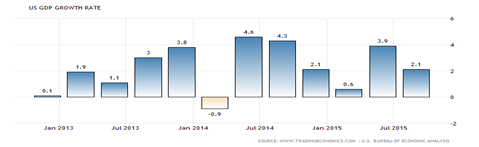
Where is the promised growth, with almost full employment? GDP growth was revised up from 1.5 to 2.1 percent Q2 to Q3, and is up 2.2 percent annually? When, if ever, will it return to the historical norm of plus 3 percent growth, last achieved in 2010, when government stimulus spending from ARRA and TARP helped to save US from another Great Depression?

So why is the Fed now talking about raising their interest rates in December? It won’t do anything for growth—in fact will make goods and services more expensive for lower and middle income earners—those whose incomes have barely risen.

image

Graph: Trading Economics

The latest third-quarter GDP is revised to an annualized plus 2.1 percent, up 6 tenths from the initial estimate but showing less strength by the consumer with final sales now at plus 2.7 from plus 3.0 percent. Higher inventories are a big factor in the upward revision. Rising inventories add to GDP growth, because they measure increased production. In this case, it was still below last quarter’s huge buildup, so this subtracted just 6 tenths from Q3 GDP vs an initial 1.4 percent subtraction.

image

Graph: Econoday

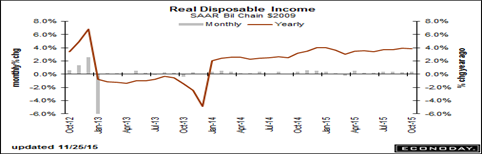
The core Personal Consumption Expenditure Index (PCE) is the Fed’s most important inflation reading and it is not showing rising pressure, even though real disposable income—income after taxes and inflation factored in—is above 4 percent. Why? Because consumers are saving more, with the savings rate up to 5.6 percent. All those cost savings from lower gas prices are being saved at the moment.

So the overall PCE price index remains nearly dead flat, which could give a boost to durable spending during the holidays. But that might depend on what happens to interest rates.  The PCE price index is up only 0.1 percent, vs expectations for a 0.2 percent gain, with the year-on-year rate at a very telling and extremely low plus 0.2 percent.

Net exports pulled GDP down by 2 tenths because the dollar has become more expensive, and raising interest rates will make the dollar even more expensive for foreign buyers. Exports rose only 0.9 percent in the quarter, down 1 percentage point from the initial reading. Readings on residential investment, adding 2 tenths to GDP, and nonresidential fixed investment, adding 3 tenths, are little changed.

Lower exports hurt the manufacturing sector, which is already suffering from lower worldwide demand as evidenced by falling commodity prices. In other words, inflation is much too low for the Fed to raise their rates now. It could hurt both domestic and foreign demand for our goods and services.

Harlan Green © 2015

Follow Harlan Green on Twitter: https://twitter.com/HarlanGreen
Posted in Consumers, Economy, Housing, housing market, Politics, Weekly Financial News | Tagged , , , , , , , , | Leave a comment

Are We Running Out of Homes?

The Mortgage Corner

This isn’t a repeat of the housing bubble, as some pundits would have us believe. In fact, it’s the opposite. Too few homes are being built, and existing inventories of homes for sale have fallen to 2 million homes—whereas more than 4 million existing homes were for sale at its height.

Inventories are literally back to 2001 levels, before Fed Chairman Greenspan engineered record low interest rates for that time that created the incentive for the oversupply of housing and consequent Great Recession. This time we have just 4.8 month’s supply at today’s sales rate.

image

Graph: Calculated Risk

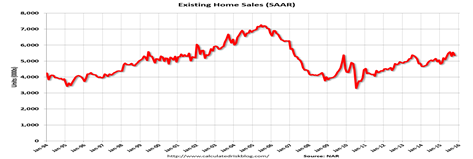
Total existing-home sales, which are completed transactions that include single-family homes, townhomes, condominiums and co-ops, fell 3.4 percent to a seasonally adjusted annual rate of 5.36 million in October from 5.55 million in September, said the NAR. Despite last month’s decline, sales are still 3.9 percent above a year ago (at 5.16 million).

image

Graph: Calculated Risk

The real problem is not enough new homes are being built, with housing starts slightly over 1 million annually, but permits for future homes at 1.2 million plus, a good sign for future growth. Lawrence Yun, NAR chief economist, says a sales cooldown in October was likely given the pullback in contract signings the last couple of months.

“New and existing-home supply has struggled to improve so far this fall, leading to few choices for buyers and no easement of the ongoing affordability concerns still prevalent in some markets,” he said. “Furthermore, the mixed signals of slowing economic growth and volatility in the financial markets slightly tempered demand and contributed to the decreasing pace of sales.”

Builder optimism is still high at 62 percent, as we said last week, which also should mean more new construction. Though builder confidence in the market for newly constructed single-family homes slipped three points to 62 in November from an upwardly revised October reading on the NAHB/Wells Fargo Housing Market Index (HMI), it is still robust with traffic wanting new homes.

“All-cash and investor sales are still somewhat elevated historically despite the diminishing number of distressed properties,” adds Yun. “With supply already meager at the lower-end of the price range, competition from these buyers only adds to the list of obstacles in the path for first-time buyers trying to reach the market.” Weakness in this reading has been reflecting lack of first-time buyers in the market, until now.

So why are builders still optimistic with still low new construction numbers? A tremendous pentup demand, in a word. Over the past seven years, NAHB Chief Economist David Crowe estimates the slow recovery and uncertainty in the job and housing markets resulted in 7.4 million lost home sales.

“While some of these sales will never take place, this does indicate how many sales were lost as fewer households decided to move. We expect at least some of these to return in the form of new home sales as job and economic growth continue to firm.”

He says a key demographic to help jump-start this process should come from the millennials, as we have been noting over the past years (ie, those from 18 to 36 years). The share of first-time home buyers has traditionally averaged around 40 percent, but in the aftermath of the housing downturn it now stands at just under 30 percent. This is while household formation is finally returning to a more normal level of 1 million plus. First-time buyers are expected to provide a boost to the housing market, as the unemployment differential between young people and others is shrinking.

Harlan Green © 2015

Follow Harlan Green on Twitter: https://twitter.com/HarlanGreen

Posted in Consumers, Economy, Housing, housing market, Weekly Financial News | Tagged , , , | Leave a comment

A Huge Employment Report

Popular Economics Weekly

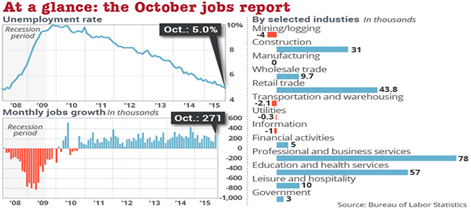
The economy generated 271,000 new jobs last month, with all but 3,000 coming in the private sector, the government said Friday, topping expectations for 190,000 to 240,000 jobs predicted by various economists. Almost every major industry boosted payrolls.

Even bigger news is that on November 5, 2015, the U.S. House of Representatives passed the bipartisan Surface Transportation Reauthorization and Reform Act, a new multi-year transportation authorization bill, by a vote of 363-64. In other words, we are one step closer to a six-year transportation bill that will boost jobs and economic growth for years to come.

image

Graph: Marketwatch

The jobs report showed that a long-awaited acceleration in wages might finally be happening, another plus for economic growth. Hourly pay rose at the fastest year-over-year pace since the U.S. exited recession in mid-2009. Economists have been expecting a faster increase in pay amid a deep drop in unemployment and the creation of millions of new jobs over the past several years.

In October, average hourly earnings for all employees on private nonfarm payrolls rose by 9 cents to $25.20, following little change in September (+1 cent). Hourly earnings have risen by 2.5 percent over the year.

The rebound in hiring in October was driven almost entirely by service sector jobs, such as software design, banking, health care, shopping and restaurants. White-collar businesses added 78,000 profession jobs. Health care added 45,000 positions. Retailers took on 44,000 new workers, and restaurants hired 42,000 people. Builders also beefed up employment by 31,000, reflecting an upturn in construction over the past year, and the new transportation bill will boost more construction jobs, as well as heavy machinery and other industries that feed infrastructure spending.

As background to the just passed House transportation bill, earlier this summer the Senate passed their proposal for the same bill. The next step is the House and Senate must reconcile the differences between their two versions and pass a compromise bill. The most recent extension of the current transportation program expires November 20 so they will have to work quickly.

The Senate passed its long-term highway bill in July, though their work on federal infrastructure funding isn’t over. Senators voted 65-34 to approve the six-year bill, which funds federal highway and infrastructure projects for three years.

The legislation would be used to pay for about $47 billion of funding for the Department of Transportation’s Highway Trust Fund. That funding accounts for only the first three years of the legislation. Under the Senate bill, senators would have to determine by 2018 how to pay for the full six years.

The labor market as a whole is now the healthiest it’s been in years. The U.S. has added an average of 206,000 jobs a month in 2015, in part because the seasonal adjustments were readjusted to add more jobs to past months. This usually happens during the summer months because Labor Department statisticians tend to overcompensate for seasonal hires in the summer. As much as one million more workers were hired this past summer than in past years, which might become the new normal for the next couple of years, if the unemployment rate drops below 5 percent.

The change in total nonfarm payroll employment for August was revised from +136,000 to +153,000, and the change for September was revised from +142,000 to +137,000. With these revisions, employment gains in August and September combined were 12,000 more than previously reported.

As a result, the number of people who can’t find work or who can only get part-time jobs continues to shrink. The so-called U6 unemployment rate that takes these people into account dropped to 9.8 percent in October, the first time it’s fallen below 10 percent since May 2008.

The labor market is still not fully healed, however, says Marketwatch. Some 15.6 million Americans who want a full-time job can’t find one, an unusually high number after more than six years of economic recovery. The percentage of able-bodied people 16 or older in the labor force also sits at a 42-year low. It was unchanged at 62.4 percent in October.

Harlan Green © 2015

Follow Harlan Green on Twitter: https://twitter.com/HarlanGreen
Posted in Economy, Macro Economics, Politics, Weekly Financial News | Tagged , , , , , , , | Leave a comment

Dr. Yellen—Don’t Raise Interest Rates Just Yet.

Popular Economics Weekly

The Consumer Price Index for All Urban Consumers (CPI-U) increased 0.2 percent in October on a seasonally adjusted basis, the U.S. Bureau of Labor Statistics reported today. Over the last 12 months, the all items index increased just 0.2 percent before seasonal adjustment.

image

Graph: Trading Economics

This hardly shows incipient inflation, and is no reason for the Fed to raise their interest rates in December. Year-on-year, the CPI is also up 0.2 percent which is up from zero in September while the core rate is unchanged at plus 1.9 percent, right at the Fed’s general 2 percent goal. Only medical care and housing costs rose, which is understandable with more becoming insured under Obamacare and a shortage of new housing stock.

Why such low inflation? Oil and commodity prices in general have been declining, and energy analysts say this could last for years. Yes, I said for years. So why the hurry to raise interest rates when and if energy prices remain this low, which will continue to lower the costs of goods and services?

image

“A projected marked slowdown in demand growth next year and the anticipated arrival of additional Iranian barrels–should international sanctions be eased–are likely to keep the market oversupplied through 2016“, said the IEA, or International Energy Agency, on Oct 13, 2015.

Oil prices have now declined to almost $40 per barrel of West Texas crude, and the Saudis have said they don’t intend to cut back their oil production, in an attempt to keep Iranian oil from grabbing more market share.

Some slight inflationary pressure is coming from rising rents, which rose 3.7 percent over the past 12 months, the Labor Department said, the same as in September. Yearly rent increases have accelerated steadily since 2010, and are outpacing annual wage growth, which was an inflation-adjusted 2.4 percent in October, according to the October unemployment report.

Household formation has picked up as the economy improves, but supply is lagging demand. The inventory of both new and existing homes has been 5 months’ supply, much lower than the 6 months’ worth of supply considered normal. That’s helping drive up prices of homes for sale, and in turn keeping many renters on the sidelines even as mortgage rates remain historically low.

What should help is more new construction. Though builder confidence in the market for newly constructed single-family homes slipped three points to 62 in November from an upwardly revised October reading on the NAHB/Wells Fargo Housing Market Index (HMI), it is still robust with traffic wanting new homes.

Though future sales are down a sizable 5 points, the HMI is still at 70. Present sales, which is the most heavily weighted component, fell 3 points to 67, also still a very strong level. The positive in the report is a 1 point rise in traffic, a component which, at 48 in the latest report, has been lagging badly but is getting closer to the breakeven 50 mark. Weakness in this reading has been reflecting lack of first-time buyers in the market, until now.

“The November report is pullback from an unusually high October, and is more in line with the consistent, modest growth that we have seen throughout the year,” said NAHB Chief Economist David Crowe. “A firming economy, continued job creation and affordable mortgage rates should keep housing on an upward trajectory as we approach 2016.”

This should also boost the odds of a more prolonged recovery from the Great Recession, as we said last week. A new Goldman Sachs prediction just out says there is a 60 percent chance this recovery could last another four years. This is according to a team of researchers at Goldman Sachs Group, led by Chief Economist Jan Hatzius. Among developed economies, the average length of an economic expansion has been expanding since 1950. The longest U.S. expansion lasted 10 years, from 1991 to 2001. Before 1950, the average expansion lasted about three years, with only a few enduring for 10 years or more.

Harlan Green © 2015

Follow Harlan Green on Twitter: https://twitter.com/HarlanGreen
Posted in Consumers, Economy, Housing, housing market, Politics, Weekly Financial News | Tagged , , , , , , , , | Leave a comment