The Economic Ruination of Greece

Popular Economics Weekly

It is now beyond a reasonable doubt that Germany and its austerity cohorts want to drive Greece out of the Eurozone by insisting that it adhere to its agreement to pass most of its meager budget surplus to service its foreign debt, rather than invest it back into the Greek economy. It is insisting that Greece cut government spending enough so that it carries what is called a huge ‘primary’ budget surplus of 4.5 percent (a surplus before its bills are paid—ie, largely interest to its creditors).

The EU, led by Germany, had crafted several agreements that gave Greece large loans to service that debt, while forcing it to submit to severe austerity and wage cuts.

“The results have been catastrophic, said the Guardian in a 2013 article: “cumulative economic contraction approaching 25 percent, adult unemployment at nearly 30 percent, youth unemployment close to 65 percent, unprecedented poverty, destruction of the welfare state and humanitarian crisis in the urban centres. Greek debt, meanwhile, is currently higher than in 2010, standing at €321bn and, since the economy has collapsed, its ratio to GDP approaches an exorbitant 180 percent. This is the background to the current debate.”

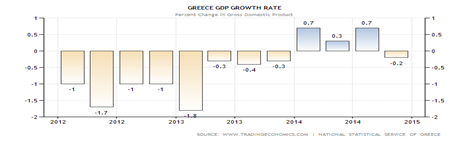
But to do so would in effect drive Greece even further into its depression, since it means lower tax revenues, which means even more debt. The consequence is the layoff of more workers and further reduction of average household incomes. Paul Krugman put up a graph of the cutbacks in spending that in turn have made Greece’s debt burden worse, compared to other countries that agreed to the EU’s austerity terms.

image


Greece has already paid the piper, in other words, while Germany now has the largest budget surplus of all western countries. “Greece has done a lot more austerity than those countries cited as supposed success stories,” says Krugman, “(which is another issue — success being defined as “not total collapse, and slight recovery after years of horror” — but that’s a different story).”
image

Graph: Trading Economics

So Greece has little choice but to exit the euro currency, unless some last minute compromise with the EU is possible. Its unemployment rate is currently 25.8 percent, the worst in the Eurozone (slightly more than Spain’s 23.7 percent), as it has been in a deflationary spiral, further depressing its economic activity.

image

Graph: Trading Economics

Although Greece mostly lived up to the terms of the bailout, the promised growth never materialized. As Greek Prime Minister recently said: “We are not negotiating the bailout; it was cancelled by its own failure.” Calculated Risk tabulated the difference between the forecasted results of its austerity cutbacks and the actual result.

Greece: Annual GDP, Forecast and Actual

Year Promised      Actual

· 2009 -2.0            -4.4

· 2010 -4.0            -5.4

· 2011 -2.6             -8.9

· 2012 +1.1             -6.6

· 2013 +2.1             -3.9

The only choices are to allow Greece to run a smaller primary surplus (currently 1.5 percent), leaving more of its revenues to benefit its own citizens, or for Greece to leave the Eurozone and default on all their debt. What will it be?

Harlan Green © 2015

Follow Harlan Green on Twitter: https://twitter.com/HarlanGreen
Posted in Economy, Keynesian economics, Macro Economics, Politics, Weekly Financial News | Tagged , , , , , , , | Leave a comment

Low Inflation Everywhere Is Shrinking Growth

Popular Economics Weekly

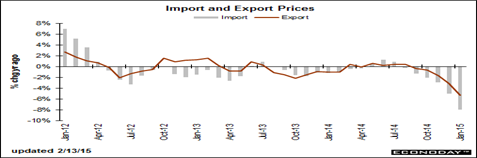
Deflation is a rising risk for the U.S. economy based on import and export price data where contraction is at its most severe since the 2008-2009 recession, as well as for the rest of the world. U.S. import prices fell 2.8 percent in January alone for year-on-year contraction of 8.0 percent. And it’s much more than just the impact of the strong dollar as export prices are also in contraction, at minus 2.0 percent for the month and minus 5.4 percent on the year, reports Econoday.

image

Graph: Econoday

Another sign of deflationary tendencies is that U.S. consumer spending barely rose in January as households cut back on purchases of a range of goods, suggesting the economy started the first quarter on a softer note. Sluggish spending came despite cheap gasoline and a buoyant labor market, leaving economists to speculate that consumers were using the extra income to pay down debt and boost savings.

 image

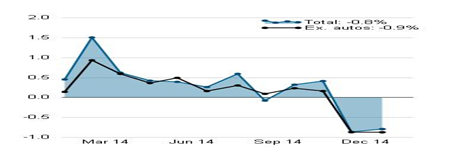
Graph: Thomson-Reuters

The Commerce Department said retail sales excluding automobiles, gasoline, building materials and food services edged up 0.1 percent last month. But overall retail sales slipped 0.8 percent in January, declining for a second straight month as falling gasoline prices undercut sales at service stations. This is after consumer spending, which accounts for more than two-thirds of U.S. economic activity, expanded at its quickest pace since 2006 in the fourth quarter.

image

Graph: Trading Economics

But even falling gas prices are a sign of deflation, as it means there is lower demand for energy products everywhere in the world, as I said. In fact, consumer prices are already falling in the Eurozone, -0.2 and -0.6 percent, respectively, in the past 2 quarters, signaling an outright recession. Paul Krugman has even said the Eurozone is now in their Second Great Depression.

image

Graph: Calculated Risk

So why are consumers paying down debt with their extra pocket money? The preliminary University of Michigan consumer sentiment index for February was at 93.6, down from 98.1 in January. Higher gasoline prices are probably the reason for the decline in February, and that’s enough to make consumers more cautious with their spending.

Harlan Green © 2015

Follow Harlan Green on Twitter: https://twitter.com/HarlanGreen
Posted in Consumers, Economy, Macro Economics, Weekly Financial News | Tagged , , , , , | Leave a comment

Mortgage Refinancings Surge in 2015

The Mortgage Corner

The still record-low interest rates are making a difference. Refinancings jumped 66 percent in January’s first two weeks, according to the MBA. And borrowers who refinanced during the fourth quarter of 2014 were able to reduce their interest rate, on average, by about 1.3 percentage points – a savings of about 23 percent, according to a recent Freddie Macs report. On a $200,000 loan that translates into saving of about $2,500 interest during the next 12 months.

image

Graph: Calculated Risk

Why? Conforming 30-yr fixed rates now are as low as 3.375 percent, and high-balance fixed rate conforming amounts can be found at 3.50 percent for 1 origination point.

“Our latest refinance report shows the refinance boom continued to wind down as the pool of potential borrowers declined over the course of 2014,” says Len Kiefer, Freddie Mac deputy chief economist. “However, because mortgage rates fell in the fourth quarter of last year, we actually saw the share of refinance originations tick up a bit despite volumes being down, a similar trend we expect to see for the first quarter of 2015 as mortgage rates have moved even lower.”

One popular program that in many cases doesn’t even require an appraisal for loan amounts up to 125 percent of value is the HARP 2.0 program for conforming loans originated before June, 2009. Borrowers can reduce their interest rate to today’s market rates. But normal conforming qualification debt ratios and decent credit are required for HARP refinancings.

Home owners who refinanced through the government’s HARP program during the fourth quarter of 2014 saw an average reduction in their interest rate of 1.6 percentage points, according to Freddie Mac, amounting to an average savings of $3,300 in interest during the first 12 months – or about $275 in savings every month.

About 71 percent of those who refinanced their first-lien mortgage maintained about the same loan amount or lowered their principal balance by paying additional money at closing, according to the report.

But 34 percent of refinancers were able to shorten their loan terms, according to the report. This is when the conforming 15-yr fixed rate today is 2.50 percent. Overall, borrowers who refinanced in 2014 saved about $5 billion in interest over the next 12 months.

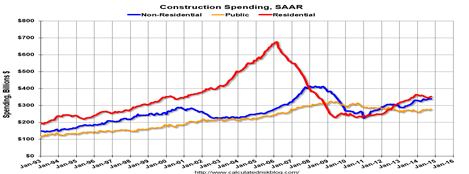
This has to spur home construction as well, since it enables the reduction of so much debt.

image

Graph: Calculated Risk

And sure enough, the U.S. Census Bureau of the Department of Commerce said that construction spending during October 2014 was estimated at a seasonally adjusted annual rate of $971.0 billion, 1.1 percent above the revised September estimate of $960.3 billion.

The latest NAR survey also showed more optimism for 2015 housing sales. An improving job market, low mortgage rates, and recent moves by the government to loosen up mortgage credit is fueling increased optimism among REALTORS®. In particular, real estate professionals are growing more confident about the housing market’s outlook for the next six months, according to the December 2014 REALTORS® Confidence Index, a survey of more than 4,000 Realtors.

So stay tuned, as winter wanes and interest rates stay low. Of course it will be up to the Federal Reserve as well, to maintain low interest rates for the rest of 2015.

Harlan Green © 2015

Follow Harlan Green on Twitter: https://twitter.com/HarlanGreen

Posted in Consumers, Housing, housing market, Weekly Financial News | Tagged , , , , | Leave a comment

The Bernanke-Yellen Led US Recovery

Financial FAQs

Friday’s January unemployment report should close the books once and for all on the debate whether austerity cutbacks in government spending (and debt) such as happened in Europe, or pro-active government policies by the U.S. Federal Reserve Banks has been the prime instigator of growth during recoveries from depressions, large or small.

A total of 257,000 payroll jobs were created in December and with revisions to the past 2 months more than 1 million jobs were created just over the past 3 months. Though the unemployment rate calculated from the separate Household report declined from 5.6 to 5.7 percent, it was because an additional 700,000 new and older folks entered the workforce, surely a sign of rising job availability.

This means what can only be called the U.S. Bernanke-Yellen recovery from the Great Recession is finally reaching its growth potential, thanks to the Fed’s efforts to keep both short and long term interest rates as low as possible with the massive buying of U.S. Treasury and mortgage-backed securities, called Quantitative Easing, among other measures. The U.S. has the best growth rate in the developed world, thanks to the actions of Fed Chairmen Bernanke and Yellen.

image

Graph: Trading Economics

Whereas the Eurozone is declining into negative growth for the third time since 2008, in what Paul Krugman is now calling Europe’s Second Great Depression, as Greece has elected a government that is rebelling against German-inspired austerity measures.

image

Graph: Trading Economics

“… Germany is demanding that Greece keep trying to pay its debts in full by imposing incredibly harsh austerity,” said Krugman in his most recent recent NYTimes Oped. “The implied threat if Greece refuses is that the central bank will cut off the support it gives to Greek banks, which is what Wednesday’s move sounded like but wasn’t. And that would wreak havoc with Greece’s already terrible economy…Beyond that, chaos in Greece could fuel the sinister political forces that have been gaining influence as Europe’s Second Great Depression goes on and on.”

The European Central Bank has begun its own tepid version of QE, but excluded Greek sovereign debt from ECB purchases, which will only make Greece’s situation more dire by increasing its borrowing costs.

It wasn’t long ago that the U.S. might have suffered the same fate. Congressional conservatives had demanded that the U.S. pay down its debts rather than spend more to create jobs, opposition that shut down government briefly and led to a downgrade of U.S. sovereign debt,

But first Ben Bernanke, a student of Japan’s two decade deflationary spiral, and now Fed Chair Janet Yellen have held firm in their resolutions to stimulate growth until Main Street experiences a sustainable recovery.

This is something that Germany, instigator of the eurozone’s austerity policies, has to learn if it wants to bring Europe out of its Second Great Depression, by supporting policies that will unite Europe into a greater union, rather than cause its disintegration.

Harlan Green © 2015

Follow Harlan Green on Twitter: https://twitter.com/HarlanGreen

Posted in Economy, Keynesian economics, Macro Economics, Politics, Weekly Financial News | Tagged , , , , , , , , | Leave a comment

Housing Sales-Construction Continue to Expand

The Mortgage Corner

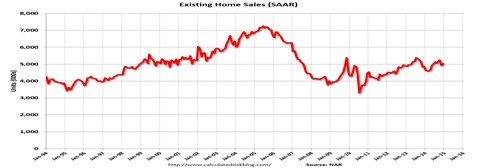
The NAR reports total existing-home sales, which are completed transactions that include single-family homes, townhomes, condominiums and co-ops, rose 2.4 percent to a seasonally adjusted annual rate of 5.04 million in December from a downwardly-revised 4.92 million in November. And December’s sales were 3.5 percent higher by 3.5 percent from last year are now above year-over-year levels for the third straight month.

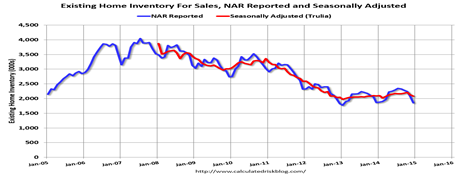
But existing-home inventories at this rather slow sales rate still dropped to 4 months, back to 1980 levels, indicating not enough homes are available for sale. Why, at this stage of the recovery are so few homes on the market?

image

Graph: Calculated Risk

Despite low inventory conditions, existing-home sales bounced back in December and climbed above an annual pace of 5 million sales for the sixth time in seven months, said the National Association of Realtors®. Median home prices for 2014 rose to their highest level since 2007, but total sales fell 3.1 percent from 2013. But for sale inventories have now dropped to 4.4 months, too low to sustain higher sales in 2015.

That means more new-home construction is in the works, much of it probably rentals to meet the demand of rising new household formation. But many of the newer generations can afford to buy a home with rising the employment prospects, as their jobs numbers improve.

image

Graph: Calculated Risk

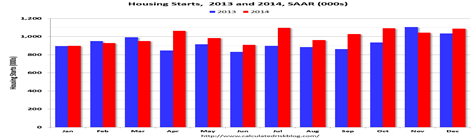
The Census Bureau reports there were 1.006 million total housing starts during 2014, up 8.7 percent from the 925 thousand in 2013.  Single family starts were up 4.9 percent, and multifamily starts up 17.1%.

Calculated Risk is optimistic that new-home construction will continue to uptick in 2015: “Single family starts were at 728 thousand in December, the highest level since early 2008.  If single family starts just hold that level in 2015, annual single family starts would be up about 12 percent over 2014.  With more growth, 20 percent would seem possible. However I think 20 percent is too optimistic (based on lots and pricing), and just like in 2013, we shouldn’t let one month of data influence us too much,” said Calculated Risk’s Bill McBride.

image

Graph: Calculated Risk

But it will take more than new homes to improve availability. There are still some 5 million homes in the so-called shadow inventory of homes with negativity equity, or whose mortgages are in outright default. This graph shows inventory bottomed in January 2013 (on a seasonally adjusted basis), and inventory is now up about 5.5 percent from the bottom. On a seasonally adjusted basis, inventory was down 2.2 percent in December compared to November (meaning below what is normal for the season).

image

Graph: Calculated Risk

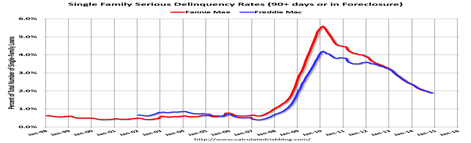
Fannie Mae, the guarantor of the majority of home mortgages, reported that the Single-Family Serious Delinquency rate declined slightly in November to 1.91 percent from 1.92 percent in October. The serious delinquency rate is down from 2.44 percent in November 2013, and this is the lowest level since October 2008. Freddie Mac’s results were similar. With foreclosure rates approaching the historical level of 1 percent, and housing values continuing to increase this year, more for sale inventory should become available this year.

“A drop in housing supply in December raises some affordability concerns in the months ahead as minimal selection and the potential for faster price appreciation could offset the demand from buyers encouraged by a stronger economy and sub-4 percent interest rates,” says NAR economist Lawrence Yun. “Housing costs – both rents and home prices – continue to outpace wages and are burdensome for potential buyers trying to save for a down payment while looking for available homes in their price range.”

Harlan Green © 2015

Follow Harlan Green on Twitter: https://twitter.com/HarlanGreen

Posted in Consumers, Economy, Housing, housing market, Politics, Weekly Financial News | Tagged , , , , , , , , | Leave a comment

The Bully Mentality—Part II

Financial FAQs

NOAA, the National Oceanic and Atmospheric Administration, just announced 2014 the warmest year in recorded history, and 14 of the last 15 years as the warmest in recorded history.

Yet Paul Krugman in his latest NYTimes Oped still seems mystified by conservatives’ opposition to Good Government—such as denying the results of NOAA, the government organization mandated to track global warming (or maybe he isn’t, really):

“And why this hatred of government in the public interest? he writes. Krugman cites political scientist Corey Robin’s explanation that conservatives in particular are “…reactionaries. That is, they’re defenders of traditional hierarchy–the kind of hierarchy that is threatened by any expansion of government, especially when that expansion makes lives of ordinary citizens better and more secure.”

That, of course is the definition of a conservative—preserving the status quo. I would posit there is another, deeper reason for the denial of scientific results—whether it’s climate-related, or the record income inequality that almost all economists agree is real.

It’s called the bully mentality that has been discussed in prior columns. Bullies are those who want to dominate others without regard to reason or even common sense. And they appear periodically when prevailing cultures or societies lack strong leadership—positive leadership, that is.

Wikipedia defines it as, “Bullying is the use of force, threat, or coercion to abuse, intimidate, or aggressively dominate others. The behavior is often repeated and habitual.”

For instance, school bullying is at an all-time high, and has been the reason for many of the school shootings by those who have felt bullied. The NRA is a classic institutional bully—demonizing opponents with falsehoods, such as its campaign of “guns don’t kill people, people kill people,” in wanting to remove all gun controls, even though assault rifles with expanded magazines have been used in all the mass shootings to slaughter dozens, even hundreds before they were stopped.

Political bullying is another example. Republican bullying, particularly the Tea Party types that called compromise a dirty word, began when a very inexperienced Barack Obama became President who had no apparent experience in dealing with bullies.

And that is the point. Bullies have a wholesale disregard for scientific truth, or any other, and only stop bullying when they are opposed. America’s bullies can only be stopped with equal and opposing force, and where are the leaders capable of that?

Senator Elizabeth Warren is popular because she has been willing and able to stand up to the financial bullies. She sees Wall Street and the financial industry as classic bullies that need to be opposed at every turn to reverse the record income inequality. Hence her opposition to the just-passed $1.1 trillion federal budget authorization that extended the deadline for Wall Street institutions to divest themselves of the riskiest derivatives.

"Pretty much the whole Republican Party—and, if we’re going to be honest, too many Democrats—talked about the evils of ‘big government’ and called for deregulation," Warren said at the recent AFL-CIO National Summit on Raising Wages. "It sounded good, but it was really about tying the hands of regulators and turning loose big banks and giant international corporations to do whatever they wanted to do."

“These families are working harder than ever, but they can’t get ahead. Opportunity is slipping away. Many feel like the game is rigged against them—and they are right,” Warren said. “The game is rigged against them…. The world has changed beneath the feet of America’s working families.”

Maybe President Obama finally understands that it’s not in the nature of bullies to compromise as he proposes policies on immigration and reducing carbon emissions (such as rising CO2 levels that even the Pentagon has foretold could result in future wars) that require executive action only, which will benefit all Americans. It doesn’t look like the new Republican Congress wants to compromise, which means they don’t want government to work at all if it will benefit Main Street, rather than Wall Street.

Harlan Green © 2015

Follow Harlan Green on Twitter: https://twitter.com/HarlanGreen
Posted in Consumers, Economy, Politics, Weekly Financial News | Tagged , , , , , , , , , , , | Leave a comment

Europe on Verge of Recession

Popular Economics Weekly

Oil prices are plunging below $50 per barrel, and the European Central Bank is about to announce whether it will begin its own Quantitative Easing program, similar to the Fed’s purchase of government securities that is designed to pump more money into Europe’s lagging economies. So economists are wondering whether this will have a net plus effect on growth, since the oil industry and countries like Norway that depend on oil revenues will lose profits, while the EU is slipping into outright recession.

A Saudi oil Prince has said oil prices will stay down for a long period—years, of necessary to support their market share. “If supply stays where it is, and demand remains weak, you better believe [the price of oil] is gonna go down more. But if some supply is taken off the market, and there’s some growth in demand, prices may go up. But I’m sure we’re never going to see $100 anymore,” said Prince Alwaleed bin Talal, the billionaire Saudi businessman, in an interview with Maria Bartiromo of Fox Business News published in USA Today.

The initial result seems to be that U.S. consumer confidence is soaring as gas prices have fallen more than $1 per gallon in a year, even below $2 per gallon in many regions. But other prices are falling as well, which is worrying economists, who see it as a sign of weakening demand. Weak demand may be elsewhere in the world, such as Europe, but it affects the U.S. economy as well.

image

Graph: Econoday

Such weakness is difficult to reverse as the Japan’s two decade example of outright deflation proved. It knocked them down from second to fourth largest world economy.

Europe is having the same problem, mainly due to its austerity policies that have cut back government spending, and so demand for its goods and services. Switzerland just rang the alarm bells when it very suddenly removed its 1.2 euros to Swiss Franc exchange rate cap, thus causing the SF value to skyrocket. Why did it take the cap off? There is lots of conjecture. The Swiss had been protecting their currency exchange value from rising too rapidly by buying euros, in order to protect their export industry.

But allowing the Swiss Franc to rise as much as 20 percent against the euro also raised the danger of a deflationary spiral such as happened in Japan. Why? A more expensive SF will counteract the upcoming QE purchases of the European Central Bank that are designed to put more euros into circulation in order to ease credit conditions! .

Nobelist Paul Krugman said in a recent blog, “By throwing in the towel on the peg to the euro, the SNB (Swiss National Bank) immediately convinced markets that its previous apparent commitment to do whatever it takes to avoid deflation is null and void. And this expectations effect trumped the concrete, immediate policy of drastically negative interest rates on reserves. It will continue to feed the deflationary trap Europe is falling into.”

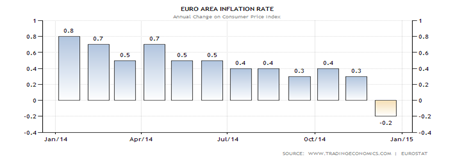
European deflation is happening in a big way. Eurozone annual inflation rate was recorded at -0.2 percent in December, matching preliminary estimates. It is the first fall in consumer prices since September of 2009, due to a drop in energy costs.

image

Graph: Trading Economics

In December 2014, negative annual rates were observed in sixteen Member States. The lowest annual rates were registered in Greece (-2.5 percent), Bulgaria (-2.0 percent), Spain (-1.1 percent) and Cyprus (-1.0 percent). The highest annual rates were recorded in Romania (1.0 percent), Austria (0.8 percent) and Finland (0.6 percent). Compared with November 2014, annual inflation fell in twenty-six Member States, remained stable in Sweden and rose in Estonia.

The U.S. inflation rate is still 1.3 percent, but this month’s Consumer Price Index for retail prices was unchanged, which is hovering very close to deflation. Oil prices are the main culprit here as well.

There is a counterbalancing effect from lower energy costs, of course. Consumers have more to spend and production costs are reduced. So prices could begin to rise again as more jobs are created. But that means no more austerity that has damaged growth in the U.S. as well, and congressional opposition to spending measures that will create more jobs. Who is willing to bet that will happen?

Paul Krugman had the last word yesterday. “So the (EU) market is saying both that there are very few good investment opportunities out there — few enough that paying the German government to protect the real value of your wealth is a good move — and that inflation over the next five years will be around 0.4 percent, not the target of 2 percent.”

Look out below for more falling prices and slowing growth, if Draghi and the ECB can’t stimulate some EU growth with its upcoming QE purchases of sovereign debt.

Harlan Green © 2015

Follow Harlan Green on Twitter: https://twitter.com/HarlanGreen

Posted in Consumers, Economy, Keynesian economics, Weekly Financial News | Tagged , , , , , , , | Leave a comment

Mortgage Applications Increase Incredible 49 percent in January

The Mortgage Corner

Mortgage applications increased 49.1 percent from one week earlier, said the just released Mortgage Bankers Association’s Weekly Mortgage Applications Survey for the week ending January 9, 2015. It was the largest increase since 2008 at the start of the Great Recession, mostly due to record-low interest rates. Some of the increase may also be because rental rates are soaring, making renting more expensive than paying for a mortgage in many areas with such low rates.

The Refinance Index increased 66 percent from the previous week to the highest level since July 2013. The seasonally adjusted Purchase Index increased 24 percent from one week earlier to the highest level since September 2013.

“The US economy and job market continued to show signs of strength, but weakness abroad and tumbling oil prices have led to further declines in longer-term interest rates,” said Mike Fratantoni, MBA’s chief economist.

image

Graph: Calculated Risk

This is while the 30-yr conforming fixed rate dropped ¼ percent in one day to 3.25 percent for a 1.25 pt. origination cost. “Mortgage rates reached their lowest level since May of 2013, and refinance application volume soared, more than doubling on an unadjusted basis, and up 66 percent after adjusting for the fact that the previous week included the New Year’s holiday,” said Fratantoni.

Applications for larger refinance loans increased more than 4 times relative to the previous week. The average conventional refinance application increased to $298,700 from $233,500 the prior week. Although there was a somewhat smaller increase for government refinance volume, VA refinance applications increased by 50 percent. VA loans tend to be larger than FHA and USDA loans, and hence are more responsive to a given rate change.

image

Graph: Marketwatch

And the price to keep a roof over millennials’ heads rushed ahead of overall consumer inflation in 2014 as rents spiked up, according to just released data. The U.S. Labor Department’s gauge of prices for shelter—a broad category that includes items such as apartment rent and hotel stays—showed inflation of 2.9 percent in 2014, the fastest calendar-year result since 2007. Rent inflation reached 3.4 percent, the largest calendar-year growth since 2008.

It may be due to better job prospects, said the the MBA.

“In addition to the drop in rates, and news of improvement in the job market, there was additional positive news for prospective homebuyers with evidence that credit availability has increased somewhat, and with FHA’s announcement of a decrease in their mortgage insurance premiums,” Fratantoni said.

Purchase application volume increased by almost 24 percent, with stronger growth for conventional applications than for government loans. Purchase application volume was at its highest level since September 2013, increased on a year over year basis in the aggregate, and notably increased across most loan size categories, particularly for the conforming, middle of the market loan segments that had been weak for much of the past year. FHA purchase application volume was up by 17 percent for the week on a seasonally adjusted basis.

Harlan Green © 2015

Follow Harlan Green on Twitter: https://twitter.com/HarlanGreen

Posted in Consumers, Housing, housing market, Weekly Financial News | Tagged , , , , , | Leave a comment

CFPB Releases Borrower Guidelines

The Mortgage Corner

The Consumer Protection Financial Bureau, set up as part of the Dodd-Frank Wall Street and Consumer Protection Act, has just published guidelines for mortgage borrowers to help them get the best possible terms.

Knowing mortgage guidelines and regulations may seem a no-brainer for borrowers, but most don’t research their mortgage options with various direct lenders or brokers, according to the CFPB.

Based on new data in the National Survey of Mortgage Borrowers, a voluntary survey jointly conducted by the CFPB and the Federal Housing Finance Agency, almost half of consumers who take out a mortgage don’t shop prior to filling out an application for a mortgage. Three out of four consumers only apply with one lender or broker. CPFB contends most consumers only get their information from lenders or brokers, who have a stake in the outcome. But many such leads come from referrals by satisfied borrowers. That’s why it’s important to get other opinions.

image

Graph: The Housing Wire

“Most consumers put substantial effort into considering their differing housing needs,” CFPB Director Richard Cordray said in a speech at The Brookings Institute. “But they do not seem to be as careful or as confident in weighing the economic aspects of the mortgage decision, such as what down payment they can afford or what mortgage terms fit their unique financial needs.”

There are many reasons for this, including convenience. It is now much easier to shop online for mortgage rates and terms than in the past, as sources such as bankrate.com offer comparisons.

There are also the complexities in applying for a mortgage. So-called conforming mortgages that ‘conform’ to Fannie Mae and Freddie Mac qualification guidelines have the best rates and terms, but the most rigorous qualification standards. That is why their default and foreclosure rates are now close to long term historical trends.

Fannie Mae reported that the Single-Family Serious Delinquency rate declined slightly in November to 1.91 percent. The serious delinquency rate is down from 2.44 percent in November 2013, and this is the lowest level since October 2008, says Calculated Risk. The Fannie Mae serious delinquency rate peaked in February 2010 at 5.59 percent.

Freddie Mac, the other conforming mortgage guarantor, also reported that the Single-Family serious delinquency rate was unchanged in November at 1.91 percent. Freddie’s rate is down from 2.43 percent in November 2013, and is at the lowest level since December 2008. Freddie’s serious delinquency rate peaked in February 2010 at 4.20 percent.

image

Graph: Calculated Risk

The Fannie Mae serious delinquency rate has fallen 0.53 percentage points over the last year, and at that pace the serious delinquency rate will be under 1 percent in late 2016, the long term trend, as we said—although the rate of decline has slowed recently.

So how do we know where, or how to shop for the best possible terms? Alas, some homework is involved. Because interest rates have declined so low, most prospective borrowers will opt for the 30-year fixed rate, which makes it easy to compare rates and terms. And 30-year conforming fixed rates have dropped to 3.50 percent with 0 points in origination fees in California, for the best credit scores.

Credit scores are extremely important to lenders in today’s post-housing bubble m environment. It has to be at or above a so-called mid-score of 740 (that is, the middle score from the 3 major credit agencies—Equifax, TransUnion, and Experian.)

And stable income is a major requirement, which can be difficult to verify for self-employed borrowers, since it requires 2 years’ federal tax returns, which will be cross-checked with the IRS for accuracy.

But this is the best time to buy or borrow. Home prices are still recovering from the housing bubble, and optimism from major surveys, such as Case-Shiller, is rising. Surveys are now showing that consumers believe they will see housing values continue to rise in 2015.

Harlan Green © 2014

Follow Harlan Green on Twitter: https://twitter.com/HarlanGreen
Posted in Consumers, Housing, housing market, Weekly Financial News | Tagged , , , , , , , , , , , | Leave a comment

Republicans Are the Real Socialists

Popular Economics Weekly

The new Republican Congress is exposing a not surprising fact. Its first actions are attempts to water down The Dodd-Frank Wall Street and Consumer Protection Act, and repealing Obamacare—which will pass the risks of financial meltdowns and medical catastrophes back to us, the taxpayers.

In economic parlance, it is socializing the costs of doing business in order to maximize the profits of business. The attempts to weaken financial regulations are “Kicking Dodd-Frank In the Teeth”, said Gretchen Morgenson in her most recent New York Times Sunday Oped.

“The 114th Congress has been at work for less than a week, but a goal for many of its members is already evident: a further rollback of regulations put in place to keep markets and Main Street safe from reckless Wall Street practices.”

The story of Republicans opposition to Obamacare is no different. By attempting to roll back the eligibility of millions of uninsured Americans with the Repubs various challenges to the federal health exchange, Republicans will return the cost of maintaining health care once again to taxpayers; by putting those sickest Americans back in hospital emergency rooms, or on government welfare rolls, thus maximizing health costs (which have been declining since Obamacare kicked in). This is even though medical bankruptcies now outnumber all other bankruptcies.

Why don’t Republicans get that this flies in the face of their own ideals of self-sufficiency? Even more egregious for working Americans are their attempts to lower wages and salaries by weakening unions and the collective bargaining of government employees in states like Wisconsin. The result of Wisconsin Governor Scott Walker’s efforts has been slower growth, a larger budget deficit, and less incentives for government employees to increase productivity.

Even California Republican Ron Unz knew this with his initiative to raise the California minimum wage to $12 per hour, which would take many minimum wage-earners off the welfare rolls, yet California Republicans have even opposed that!

It is socialism in a big way that Republicans have always accused Democrats of—putting the cost of running the U.S. on government, rather than individuals and private industry.

It’s something President Roosevelt knew and voiced during the Great Depression. “The test of our progress is not whether we add more to the abundance of those who have much; it is whether we provide enough for those who have too little.”

And until Republicans understand this, they will continue to be the minority party.

Harlan Green © 2014

Follow Harlan Green on Twitter: https://twitter.com/HarlanGreen
Posted in Uncategorized | Tagged , , , , , , , , , , , | Leave a comment