IMF Report—Europe Is Becoming Japan

Financial FAQs

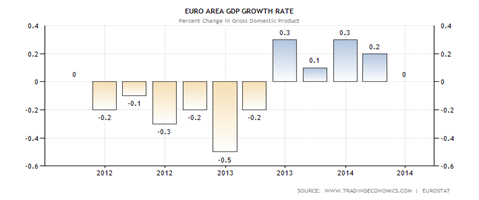
The International Monetary Fund doesn’t want to say it outright, but its latest World Economic Outlook shows more stagnation of the European and Japanese economies, and the possibility of a third EU recession since 2008.

Could the EU become another Japan with its 20 years of downward spiraling deflation and slow economic growth that caused its economy to fall from second to forth in size, behind the U.S., Euro area, and China? We think so, if its austerity policies aren’t reversed. Instead of reducing deficits, more public spending should be allowed when private sector businesses and households are saving more and spending less.

EU GDP growth shrank -0.7 and -0.4 percent in 2012, 2013 respectively and the Euro Area is projected to grow just 0.8 percent in 2014. IMF chief economist Olivier Blanchard said in his blog that “Growth in the euro area nearly stalled earlier this year, even in the core.  While this reflects in part temporary factors, both legacies (ie, debt), primarily in the south, and low potential growth, nearly everywhere, are playing a role in slowing down the recovery.”
image

Trading Economics

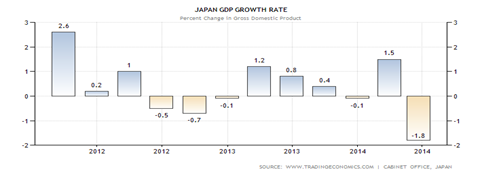
And “Japan is growing, but high public debt inherited from the past, together with very low potential growth going forward, raise major macroeconomic and fiscal challenges,” said Blanchard. Japan’s economy grew 1.5 percent in 2012 and 2013, and is projected to grow 0.9 percent in 2014, according to the IMF. This is when U.S. GDP is projected to grow 2.2 percent in 2014 and 3.1 percent in 2015, according to the IMF.

Why the stagnation when Europe and Japan are now the second and fourth largest economies in the world, as we said? Much of it has to do with their own economic policies that underestimated the depth of their respective asset bubbles causing major recessions when they burst. And so both economies suffered in their own way from misplaced austerity policies.
image

Japan’s malaise has been ongoing since 1995, due in large part to its kieretsu system of interlocking industry ownerships that kept policymakers from writing down bad debts in a timely manner. Good money was thrown after bad debt in an attempt to rescue ailing companies and industries. This resulted in decades of downward spiraling deflation that only now is being addressed by their new Prime Minister Abe with massive public spending that is finally curing the deflation, at least.

Yet the EU has still not reversed their austerity policies of public spending cuts, though EU Central Bank head Mario Draghi has announced a program of Quantitative Easing, much like the Fed’s QE programs.

As Nobelist Paul Krugman said on the Bill Moyers Show ( and many other times),“ “The only obstacles to putting people to work, to having those lives restored, to producing hundreds of billions, probably 900 billion a year or so of extra valuable stuff in our economy, is in our minds. If I could somehow convince the members of Congress and the usual suspects that deficit spending, for the time being, is okay, and that what we really need is a big job creation program, and let’s worry about the deficit after we’ve had a solid recovery, it would all be over. It would be no problem at all… All the productive capacity is there. All that’s lacking is the intellectual clarity and the political will.”

That is of course what happened with the New Deal, though it took World War II to put everyone back to work. But European policymakers seem to have ignored the lessons of the Great Depression, and the truths in Thomas Piketty’s Capital in the Twenty-First Century, in which he opines that the wholesale transfer of wealth to the wealthiest that has been ongoing over the past 30 years is a major reason for the slow recoveries. The top 1 percent spend very little of their record earnings, and wealth taxes have been severely reduced, limiting governments’ ability to spend on public necessities and create more jobs.

The U.S. Federal Reserve is doing the right thing in staying the accommodative path, according to just released FOMC minutes of last month’s meeting. It agreed to keep the wording that interest rates would stay low “for a considerable time” as forward guidance, and sure enough, stocks had a huge rally after the announcement.

As if to echo the IMF report, the Guardian’s Economics Blog also announced that the experiment – German designed, German engineered and German exported – with austerity has failed. “The eurozone is not cutting its way back to prosperity. It is cutting its way towards being the new Japan.”

Harlan Green © 2014

Follow Harlan Green on Twitter: https://twitter.com/HarlanGreen

Posted in Economy, Keynesian economics, Macro Economics, Politics, Weekly Financial News | Tagged , , , , , , | Leave a comment

More Jobs Available, Goldman Upgrades RE Forecast

Popular Economics Weekly

Goldman Sachs economist David Mericle in his research report, “Housing: The Recovery Resumes” says that overall, the message from the broad housing data flow is that the housing market is still at the beginning of a new growth cycle. Real residential investment grew at an 8.8 percent rate in Q2 and is tracking at nearly 15 percent in Q3.

“We continue to see substantial upside for the housing sector in the long run,” said Mericle. “This view is driven by the large gap between the current annual run rate of housing starts, which have averaged about 1 million over the last three months, and our housing analysts’ projection of a long-run equilibrium demand for new homes of about 1.5-1.6 million per year, estimated as the sum of trend household formation and demolition of existing homes.”

Trend household formation has been down since 2008. Given the current size of the adult population as well as current headship rates by age or race/ethnicity, the Harvard Joint Center for Housing Studies estimates that demographic trends alone will push household growth in 2015-25 somewhere between 11.6 million and 13.2 million, depending on foreign immigration. This pace of growth is in line with annual averages in the 1980s, 1990s, and 2000s, and should therefore support similar levels of housing construction as in those decades.

Part of the reason for Goldman’s optimism is the millennial generation of echo boomers, children of baby boomers, are beginning to leave home in larger numbers after being held back by the severity of the Great Recession and busted housing bubble. And they are the largest generation born from 1980 to 1996, outnumbering even their baby boomer parents.

image

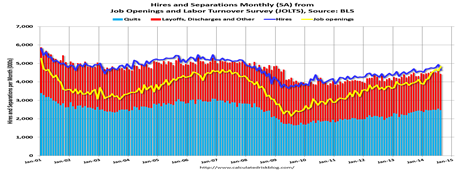
More good news is the jobs picture is getting better. Tuesday’s JOLTS report (Job Openings and Labor Turnover Survey) said Jobs Openings rose to 4.8 million in August, up 23 percent year-over-year. The following Calculated Risk graph shows job openings (yellow line), hires (dark blue), Layoff, Discharges and other (red column), and Quits (light blue column) from the JOLTS report.

image

Graph: Calculated Risk

The number of job openings (yellow) are up 23 percent year-over-year compared to August 2013 and the highest since January 2001. Quits are up 5 percent year-over-year. These are voluntary separations. (see light blue columns at bottom of graph for trend for “quits”), and mean more workers are leaving for better jobs, which means they see better job prospects.

It is a good sign that job openings are over 4 million for the seventh consecutive month – and the highest since January 2001 – and that quits are increasing year-over-year, says Calculated Risk.

So these are good omens for a better housing market. The main problem seems to be supply, and the need for new-home starts that surpass the current 1 million average, thereby boosting new-home sales. But that will depend in large part on those millennials continuing to leave home.

Harlan Green © 2014

Follow Harlan Green on Twitter: https://twitter.com/HarlanGreen
Posted in Consumers, Housing, housing market, Weekly Financial News | Tagged , , , , , , | Leave a comment

Employment Report Won’t Cause Fed to Raise Rates

Financial FAQs

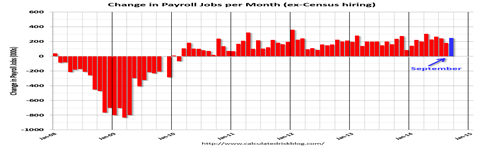
Unemployment falls below 6% for first time since 2008 as U.S. adds 248,000 jobs said today’s MarketWatch headline at the release of the Labor Department’s September unemployment report. But it won’t be enough to push Janet Yellen’s Federal Reserve to begin to raise interest rates sooner until next year, even though the bond vigilantes will be screaming for higher rates sooner.

image

Graph: Calculated Risk

Why? Because wages aren’t rising at all. The Bureau of Labor Statistics said, “Average hourly earnings for all employees on private nonfarm payrolls, at $24.53, changed little in September (-1 cent). Over the year, average hourly earnings have risen by 2.0 percent. In September, average hourly earnings of private-sector production and nonsupervisory employees were unchanged at $20.67.”

Chairperson Yellen has said that stagnant wages are a sign that there are still too many people out of work. According to the BLS, there are 2.954 million workers who have been unemployed for more than 26 weeks and still want a job. This was down from 2.963 in August. This is trending down, but is still very high.

And the number of persons employed part time for economic reasons (sometimes referred to as involuntary part-time workers) was little changed in September at 7.1 million. These individuals, who would have preferred full-time employment, were working part time because their hours had been cut back or because they were unable to find a full-time job.

image

Graph: Calculated Risk

Calculated Risk does an excellent analysis of the underlying reasons wage growth has been so meager. One reason so many are still out of work is the dropoff in government employment. In September 2014, state and local governments added 14,000 jobs.  State and local government employment is now up 143,000 from the bottom, but still 601,000 below the peak.

“Clearly state and local employment is now increasing,” says Calculated Risk’s Bill Mcbride.  “And Federal government layoffs have slowed (payroll decreased by 2 thousand in September), but Federal employment is still down 25,000 for the year.”

As a comparison to other presidential terms, Calculated Risk compared government hiring during both Republican and Democratic administrations.

image

Graph: Calculated Risk

“The public sector grew during Mr. Carter’s term (up 1,304,000),” says Calculated Risk, “during Mr. Reagan’s terms (up 1,414,000), during Mr. G.H.W. Bush’s term (up 1,127,000), during Mr. Clinton’s terms (up 1,934,000), and during Mr. G.W. Bush’s terms (up 1,744,000 jobs).”

However the public sector has declined significantly since Mr. Obama took office (down 710,000 jobs). These job losses have mostly been at the state and local level, but more recently at the Federal level.  This has been a significant drag on overall employment, says Calculated Risk.

Much of government unemployment was due to falling revenues from the Great Recession, but much also from the political opposition to more New Deal type government stimulus spending.

In spite of that, the U.S. has done much better than Europe with its austerity policies that have led the EU into a third recession just since 1980. So we seem to have learned something from the Great Downturns that Europeans have yet to learn. Policymakers cannot weaken government programs and policies that create growth and jobs during Great Recessions, or Depressions.

Harlan Green © 2014

Follow Harlan Green on Twitter: https://twitter.com/HarlanGreen
Posted in Consumers, Economy, Keynesian economics, Politics, Weekly Financial News | Tagged , , , , , , | Leave a comment

Employment Up, Interest Rates Falling Again

Popular Economics Weekly

We are still in the Goldilocks economy—it’s not too hot or too cold. In fact, there is enough geopolitical unrest (now it’s the Hong Kong youth protests against China’s hardliners) to drive down interest rates, and boost U.S. growth. We seem to be the island of calm in a world of storms, where investors are looking for safe havens.

The Automatic Data Processing (ADP) report just out showed private sector payroll employment increased by 213,000 jobs from August to September according to the August ADP National Employment Report. This is the precursor to this Friday’s Bureau of Labor Statistics ‘official’ September unemployment report for both private and public employment, which is expected to be in the same range.

Mark Zandi, chief economist of Moody’s Analytics that puts out the report, said, “Job gains remain strong and steady. The pace of job growth has been remarkably similar for the past several years. Especially encouraging most recently is the increasingly broad base nature of those gains. Nearly all industries and companies of all sizes are adding consistently to payrolls.”

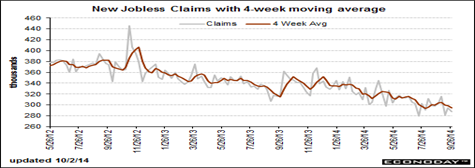
And initial jobless claims continue downward, another sign that the unemployment rate should fall further tomorrow. There are fewer and fewer workers drawing unemployment benefits which points solidly at improvement underway in the labor market. Initial claims fell 8,000 in the September 27 week to 287,000, pulling down the 4-week average by a sizable 4,250 to 294,750 which is nearly 10,000 below the month-ago comparison.

image

Graph: Econoday

This is while interest rates are plunging due to investor flight-to-quality from the worldwide unrest. Conforming 30-year fixed rates are back down to 3.625 percent for a 1 pt. origination fee, 3.75 percent for 0 pts. in origination fees.

It may bring more of the record millennial generation of echo boomers (i.e., children of baby boomers) that outnumber their baby boomer parents into the housing market.

Marketwatch’s Amy Hoak, for one, believes this will happen sooner. Reporting on a National Association of Business Economist conference, she said,“In August 2014, only 29 percent of all buyers of existing homes were first-timers, according to National Association of Realtors data. For comparison, between October 2008 and October 2010, an average 41 percent of all buyers of existing homes were first-timers, David Crowe, chief economist for the National Association of Home Builders, pointed out during the panel discussion.

Still, the purchase activity of home buyers younger than 30 who bought with a mortgage (with the intent to live in the home) rose 8 percent, year over year, in 2012, according to a Zelman & Associates analysis. Purchase activity for this group rose 10 percent, year over year, in 2013. And purchase activity rose 19 percent, year over year, in both 2012 and 2013 for those between the ages of 30 and 39.

The key will be an improving rate of household formation for the millennials.

image

Graph: Business Insider

The improving labor market is helping U.S. household formation among young adults, according to Michael Gapen at Barclays. The employment-to-population ratio for 16-24-year-olds has climbed to 47.7 percent in May, from an average of 46.5 percent in 2013.

In particular, data from the Current Population Survey, which includes extensive information on both the number and characteristics of US households over time, suggest that more young adults are now finding it feasible to move out, said Gapen.

While the employment-to-population ratio for those in the 25-34 bracket has also ticked up, they are already less likely to live at home with their parents. “Only 18.8 percent and 8.9 percent of 25-29 year olds and 30-34 year olds, respectively, live with parents,” writes Gapen.

In 2013, 55.3 percent of 18-24-year-olds lived at home, compared with 56.2 percent in 2012. Since there were estimated to be 30 million 18-24-year-olds in the U.S. last year, according to Current Population Survey estimates, the one percentage point decline suggests that 300,000 young adults were looking to move out.

Tomorrow’s BLS unemployment report should tell us more, but the youngest adults look like they are ready to be on their own.

Harlan Green © 2014

Follow Harlan Green on Twitter: https://twitter.com/HarlanGreen

Posted in Consumers, Housing, housing market, Weekly Financial News | Tagged , , , , , , | Leave a comment

Pending-Home Sales Decline Slightly

The Mortgage Corner

The Pending Home Sales Index, a forward-looking indicator based on contract signings, fell 1.0 percent to 104.7 in August from 105.8 in July, and is now 2.2 percent below August 2013 (107.1). Despite the slight decline, the index is above 100 – considered an average level of contract activity – for the fourth consecutive month and is at the second-highest level since last August.

Lawrence Yun, NAR chief economist, said contract signings are holding steady and fewer distressed sales and less investor activity is likely behind August’s modest decline. “Fewer distressed homes at bargain prices and the acknowledgement we’re entering a rising interest rate environment likely caused hesitation among investors last month,” he said. “With investors pulling back, the market is shifting more towards traditional and first-time buyers who rely on mortgages to purchase a home.”

And the S&P/Case-Shiller U.S. National Home Price Index, which covers all nine U.S. census divisions, recorded a 5.6 percent annual gain in July 2014. The 10- and 20-City Composites posted year-over-year increases of 6.7 percent.

image

Graph: Calculated Risk

Data through July 2014 show a significant slowdown in price increases. Nineteen of the 20 cities saw lower annual returns in July. Las Vegas, Miami and San Francisco were the only cities to report double-digit annual gains. Cleveland’s rate remained unchanged at +0.9% for the 12 months ending July 2014.

Las Vegas rose 12/8 percent, Miami 11 percent, and San Francisco 10.3 percent. The PHSI in the Northeast slipped 3.0 percent to 86.5 in August, but is still 1.6 percent above a year ago. In the Midwest the index fell 2.1 percent to 102.4 in August, and is 7.6 percent below August 2013.

Pending home sales in the South decreased 1.4 percent to an index of 117.0 in August, unchanged from a year ago. The index in the West rose for the fourth consecutive month (2.6 percent) in August to 102.1, but still remains 2.6 percent below August 2013.

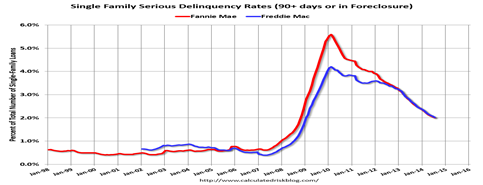
The major reason for less investor demand is the fall in foreclosures and delinquent mortgages, as we said. Fannie Mae reported today that the Single-Family Serious Delinquency rate declined in July to 2.00 percent from 2.05 percent in June. The serious delinquency rate is down from 2.70 percent in July 2013, and this is the lowest level since October 2008.

Freddie Mac also reported that the Single-Family serious delinquency rate declined in July to 2.02 percent from 2.07 percent in June. Freddie’s rate is down from 2.70% in July 2013, and is at the lowest level since January 2009. Freddie’s serious delinquency rate peaked in February 2010 at 4.20%.

image

Graph: Calculated Risk

“The employment outlook for young adults is brightening and their incomes3 finally appear to be rising,” said Yun. “Jobs and income gains will help repay student debt and better position first-time buyers, setting the stage for improved sales growth in upcoming years.” 

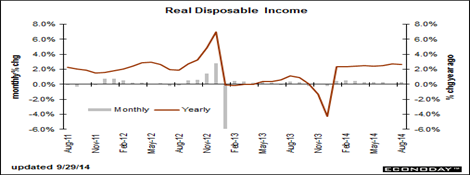
In fact, overall consumer incomes are rising. Personal income growth posted a 0.3 percent gain in August, following a 0.2 percent rise in July. The latest number matched expectations for a 0.3 percent advance. The wages & salaries component was even stronger with a 0.4 percent boost, following a 0.2 percent increase the month before.

image

Graph: Econoday

Personal spending jumped 0.5 percent after no change in July, while there was no increase in the PCE inflation index at all, mainly due to falling gas prices. Strength was in the durables component which jumped 1.8 percent after no change in July. August reflected a jump in auto sales. Nondurable spending declined 0.3 percent after no change in July. Services jumped 0.5 percent in August after being unchanged the month before.

And with interest rates falling again—the 30-yr conforming fixed rate is back to 3.75 percent with 0 origination points—more first-timers in particular can afford to buy homes. We are of course speaking of the 18 to 35-yr olds of the so-called millennial generation who have taken longer to both find jobs and leave their parents’ home.

Harlan Green © 2014

Follow Harlan Green on Twitter: https://twitter.com/HarlanGreen

Posted in Consumers, Housing, housing market, Weekly Financial News | Tagged , , , , , , , , , , | Leave a comment

Existing-Home Sales and Interest Rates

The Mortgage Corner

The National Association of Realtors reported after four consecutive months of gains, existing-home sales slipped in August, as all-cash paying investors retreated from the market. Sales increases in the Northeast and Midwest were outweighed by declines in the South and West. There are fewer bargains that appeal to investors, in other words—such as foreclosures and short sales available.

So it’s now up to genuine home buyers looking for a home to increase sales, and that will happen more frequently as rents continue to skyrocket and vacancies decline. Total existing-home sales, which are completed transactions that include single-family homes, townhomes, condominiums and co-ops, decreased 1.8 percent to a seasonally adjusted annual rate of 5.05 million in August from a slight downwardly-revised 5.14 million in July. Sales are at the second-highest pace of 2014, but remain 5.3 percent below the 5.33 million-unit level from last August, which was also the second-highest sales level of 2013.

sales

Graph: Calculated Risk

NAR chief economist Lawrence Yun says sales activity remains stronger than earlier in the year, but fell last month. “There was a marked decline in all-cash sales from investors,” he said. “On the positive side, first-time buyers have a better chance of purchasing a home now that bidding wars are receding and supply constraints have significantly eased in many parts of the country.” Yun adds, “As long as solid job growth continues, wages should eventually pick up to steadily improve purchasing power and help fully release the pent-up demand for buying.”

The major reason for less investor demand is the fall in foreclosures and delinquent mortgages, as we said. Fannie Mae reported that the Single-Family Serious Delinquency rate declined in July to 2.00 percent from 2.05 percent in June. The serious delinquency rate is down from 2.70 percent in July 2013, and this is the lowest level since October 2008.

Freddie Mac also reported that the Single-Family serious delinquency rate declined in July to 2.02 percent from 2.07 percent in June. Freddie’s rate is down from 2.70 percent in July 2013, and is at the lowest level since January 2009. Freddie’s serious delinquency rate peaked in February 2010 at 4.20 percent. We are therefore closer to the longer term default rates, as shown in the accompanying graph.

lates

Graph: Calculated Risk

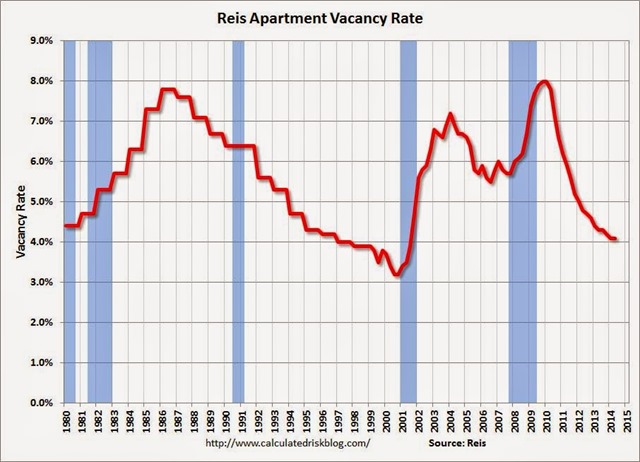
And rental vacancies continue to fall, which means both rising prices, and less available rental units, another incentive for home seekers to buy. The best vacancy survey is by Reis, the apartment info data site. Vacancy was unchanged during the second quarter at 4.1 percent, said Reis, a slight worsening versus last quarter. But over the last twelve months the national vacancy rate has declined by 20 basis points, slightly below the pace of the last few quarters.

“We have been anticipating this slowdown in vacancy compression as demand moderates while supply growth accelerates,” said Reis, but that won’t deter those who study longer term trends from wanting to buy. The national vacancy rate now stands 390 basis points below the cyclical peak of 8.0 percent observed right after the recession concluded in late 2009.

reis

Graph: Calculated Risk

That’s because at 4.1 percent, the national vacancy rate remains low by historical standards. The only time vacancy in the US was lower was during the dot.com boom‐and‐bust days of 1999 and 2000. Asking and effective rents both grew by 0.8 percent during the second quarter. This is an increase from growth during the first quarter which now appears to be just a temporary slowdown, likely due to seasonal factors. Rent growth, though weak by historical standards given such a low vacancy rate, continues to accelerate.

So we seem to have returned to historical levels of mortgage delinquencies and foreclosures, as well as rental vacancies, which means housing sales should also return to more normal levels. The shortage in inventories is the major problem, at present. This also means lots of pent up demand for new housing, which housing construction and new-home sales must eventually fill.

Harlan Green © 2014

Follow Harlan Green on Twitter: https://twitter.com/HarlanGreen
Posted in Consumers, Economy, Housing, housing market, Weekly Financial News | Tagged , , , , , , , | Leave a comment

Yellen’s Fed is Full Speed Ahead

Financial FAQs

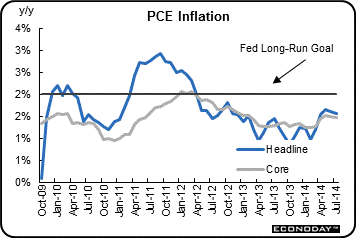
Is it possible? The Federal Reserve is now more interested in creating wealth for the many, rather than fighting inflation for the wealthiest worrying about their bond prices, as it has in the past? This may seem counterintuitive, since inflation hurts everyone. But when there’s so little inflation at present, it makes more sense to focus on building the assets of those who have the least.

pce

Graph: Econoday

The condition of lower-income families in America is “sobering” even as the economy recovers, Federal Reserve Chairwoman Janet Yellen said in a speech she prepared for delivery at a conference sponsored by the Corporation for Enterprise Development.

“We have come far from the worst moments of the crisis and the economy continues to improve, but the effects of the recession are still being felt by many families, particularly those that had very little in savings and other assets beforehand,“ said Yellen.

This followed one day after the release of FOMC minutes from the last meeting, which reiterated their decision to maintain low interest rates “for the forseeable future.”

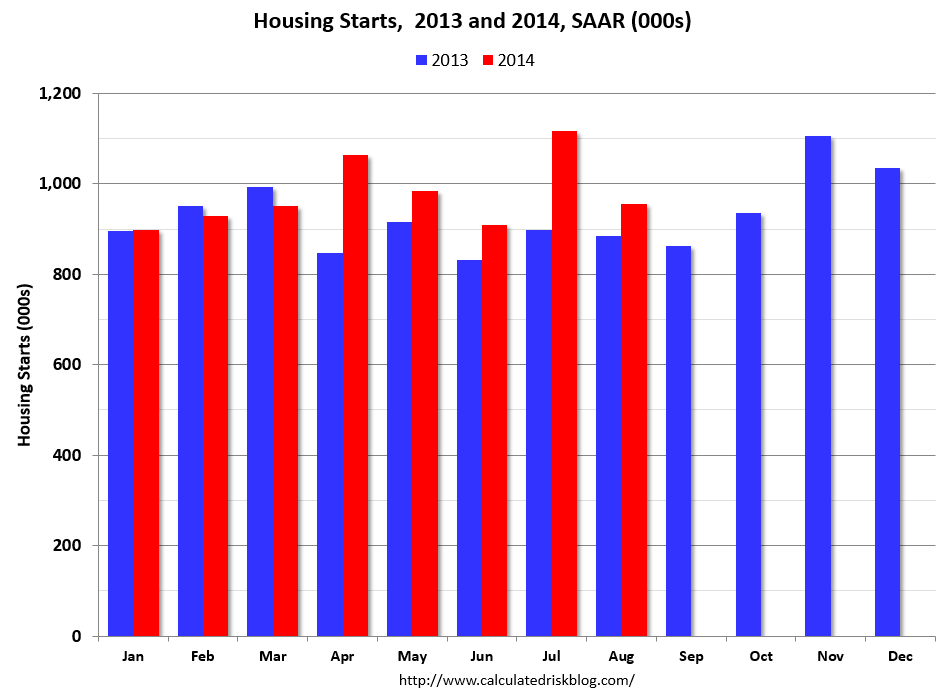
There is another reason for maintaining low interest rates. Housing sales need to pick up. There were 670 thousand total housing starts during the first eight months of 2014 (not seasonally adjusted), up 8.6 percent from the 617 thousand during the same period of 2013 (red column on graph).  Single family starts are up just 3 percent, and multi-family starts up 23 percent, because rental housing is in such demand. There are still too many households that cannot afford to buy in this market, especially new generation millennials and first-timers.

starts

Graph: Calculated Risk

But some good news is that the Federal Reserve just published its Q2 Flow of Funds report that showed total household net worth has surpassed pre-recession levels. Net worth previously peaked at $67.9 trillion in Q2 2007, and then fell to $55.0 trillion in Q1 2009 (a loss of $12.9 trillion). Household net worth was at $81.5 trillion in Q2 2014 (up $26.5 trillion from the trough in Q1 2009).

And even though the Fed estimated that the value of household real estate increased to $20.2 trillion in Q2 2014, the value of household real estate is still $2.3 trillion below the peak in early 2006.

So the Fed must continue its efforts to help Americans build assets, she said. The financial crisis showed that many American families are economically vulnerable, with few assets to fall back on in times of distress. Families with assets are able to deal with unexpected expenses as bumps in the road but “families without these assets can end up, very suddenly, off the road,” Yellen said.

For most Americans building up assets means building up equity in their homes, so with $2.3 trillion in value to make up, it will take more patience by the Fed in holding down interest rates.

Harlan Green © 2014

Follow Harlan Green on Twitter: https://twitter.com/HarlanGreen

Posted in Consumers, Economy, Housing, housing market, Weekly Financial News | Tagged , , , , , , , , , | Leave a comment

Who Are the Real Takers?

Popular Economics Weekly

We have been there before. The Census Bureau reported that the poverty rate fell in 2013, the first drop since 2006. It fell to 14.5 percent, down from 15 percent in 2013, but 45.3 million people are still living at or below the poverty line, which for a family of four was $23,834.

Then who are the real “takers” that have held up economic growth and more jobs? It’s can’t be the 47 percent that conservative polemicists and many of the 2012 presidential candidates maintained didn’t pay federal income taxes. Three-quarters of entitlement benefits written into law in the United States go toward the elderly or disabled. That’s according to the Center on Budget and Policy Priorities.

And it’s more than 90 percent of entitlement benefits when working households are included. Only about 9 percent of all entitlement benefits go toward non-elderly, non-disabled households without jobs (and much of that involves health care and unemployment insurance)

We should really be looking at those whose incomes have soared due to their success in slashing their own tax bills during difficult economic times, while blocking government job creation that would employ more of the 47 percent. The top 1 percent has taken 97 percent of income growth since the end of the Great Recession.

This is the first statistically significant decline in poverty since 2006 (and only the second since 2000). But the rate remained well above its 12.5 percent level in 2007 and even further above its 2000 level of 11.3 percent. At last year’s rate of improvement, we would need to wait until 2018 for it to fall to or below the 2007 pre-recession level, and until 2020 to fall below the 2000 level, according to the Center For Budget and Policy Priorities.

Why do we have such a high poverty rate 5 years after the end of the Greatest Recession since the Great Depression? Who are the real takers that have not only created the greatest income and wealth inequality since the Great Depression that has created such dire poverty, but weakened our economy and power to maintain democratic values in the world?

FDR in his second inauguration speech said, “The test of our progress is not whether we add more to the abundance of those who have much, it is whether we provide enough for those who have too little.”

For starters, the red states controlled by Republicans have fought to downsize almost all government funded programs such as Medicare, food stamps, and Obamacare, yet they receive the largest share of government benefits, says Wallet Hub, a consumer finance blog.

For instance, South Carolina receives $7.87 for every $1 it pays in taxes. Mississippi and New Mexico, two of the most Red states, are ranked 40 out of 50 states in receiving the most in federal benefits, yet consistently vote for conservative policies that seek to limit government spending and benefits. And that includes badly needed spending on education, deteriorating infrastructure, and environmental regulation, all of which would provide more jobs in the underemployed U.S. economy.

This is an issue of our time, as we come severely weakened out of the Greatest Recession since the Great Depression. The takers are those who want it all, and the evidence is there for all to see—a weakened economy and a government lacking the powers to “stop evil and do good”.

“Nearly all of us recognize that as intricacies of human relationships increase,” said FDR in 1936 at the height of the Great Depression, “so power to govern them also must increase—power to stop evil; power to do good. The essential democracy of our nation and the safety of our people depend not upon the absence of power, but upon lodging it with those whom the people can change or continue at stated intervals through an honest and free system of elections.”

And so the real takers are also those who support ALEC, the American Legislative Exchange Council, or the Koch Brothers’ Americans for Prosperity that boilerplate legislation that has restricted voters’ rights by passing voter ID laws, restricting voting hours and anti-union collective bargaining, which are fundamental rights in any democracy.

It is mainly those conservative polemicists and presidential candidates who damn government in order to better their own financial position. And they have succeeded in lowering the maximum marginal tax rates from 92 percent during the Eisenhower presidency to its current low of 39 percent.

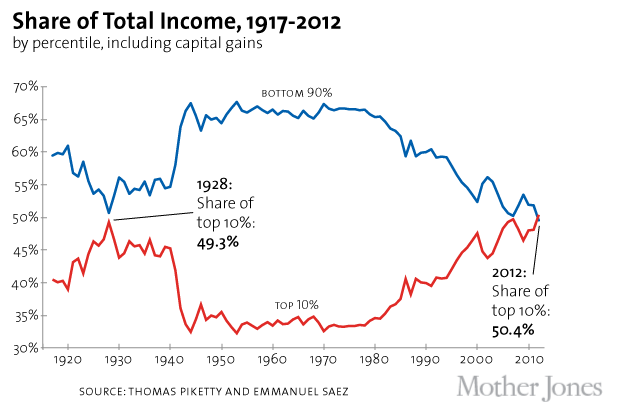
They have been so successful in taking from the wealth created by the many that the richest 10 percent now control some 50 percent of U.S. wealth, and most of the income growth since the end of the Great Recession, as we said.

Thomas Piketty, in his best-seller, Capital in the Twenty-First Century, perhaps said it best in attempting to explain why income and wealth inequality has worsened so much, brought about by lower taxation of the wealthiest.

“…the spectacular decrease in the progressivity of the income tax in the United and States and Britain since 1980, even though both countries had been among the leaders in progressive taxation after World War II, probably explains much of the increase in the very highest earned incomes,” he said.

Why lower taxation? Piketty explains it thusly. “Our finding that skyrocketing executive pay is fairly explained by the bargaining model (lower marginal tax rates encourage executives to bargain harder for higher pay) and does not have much to do with higher marginal productivity.”

There are several ways such record inequality slows growth. Firstly, growth is powered by what is called aggregate demand, the demand for goods and services that consumers, government, and investment generates. And since consumers power some 70 percent of economic activity and governments another 20 percent, when their spending declines, so does economic growth.

top-1

It is this record inequality that was the main cause of both the Great Depression and Recession, as declining incomes and cutbacks in government spending drastically reduced the demand for those goods and services. The years 1929 and 2010 were the years of greatest income inequality and greatest economic instability, according to Piketty and research partner Emmanuel Saez.

And economic growth has been steadily declining over the past 3 decades. It has averaged just 2 percent since the end of the Great Recession in 2009. There are numerous studies, including by the International Monetary Fund and Nobelist Joseph Stiglitz among others, that affirm the negative effect on growth of such inequality.

In fact, a recent IMF report said that “inequality can undermine progress in health and education, cause investment-reducing political and economic instability…which tends to reduce the pace and durability of growth.”

So if we want to preserve our democracy, and help other countries towards greater democracy (instead of breeding more terrorism), we can no longer afford to allow the real takers to continue to take it all. The world has become too dangerous.

Harlan Green © 2014

Follow Harlan Green on Twitter: https://twitter.com/HarlanGreen

Posted in Consumers, Economy, Keynesian economics, Macro Economics, Politics, Weekly Financial News | Tagged , , , , , , , , , | Leave a comment

Retail Sales Much Stronger?

Financial FAQs

The jump in retail sales was huge, plus upward revisions to past months that made more sense with other indicators of a growing economy. It seems the consumer can afford to spend more with lower debt levels and jobs more available. Much of it was back to schools purchases, though, so will it hold up during the holidays when sales are traditionally strongest?

Retail sales jumped 0.6 percent in August after a rise of 0.3 percent the month before. Analysts projected 0.6 percent for August. The July upward revision was significant-previous estimate of zero.

retail

Graph: Econoday

Excluding autos, sales gained 0.3 percent in both August and July, matching expectations. Excluding both autos and gasoline sales were quite healthy, increasing 0.5 percent, following a rise of 0.3 percent in July. Expectations were for 0.4 percent.

autos

Graph: Econoday

Not surprisingly, motor vehicles increased 1.5 percent. Incentives helped feed a record 6.4 percent jump in car and light truck sales to an annual rate of 17.53 million vehicles. Next, building materials & garden equipment gained 1.4 percent-suggesting a large improvement in the housing sector. Food services & drinking places sales were up 0.6 percent, showing healthy improvement in discretionary spending. This is a good sign for the consumer sector, as I said.

construction

Graph: Econoday

And sure enough, housing construction also gained broadly in July. Construction spending rebounded 1.8 percent after a 0.9 percent dip in June. While all broad categories advanced, July’s increase was led by the public sector—up 3.0 percent, following a 1.8 percent decrease in June.  This is a big thing as government spending has been a big drag on growth until now. Private nonresidential spending (i.e., commercial/industrial) rebounded 2.1 percent in July after slipping 0.8 percent the month before.  And private residential outlays gained 0.7 percent, following a 0.4 percent dip in June.

All-in-all, the revisions to retail sales and surge in construction and vehicle sales should confirm a 3 percent plus GDP growth rate for the rest of this year,and maybe into next year, in sharp contrast to Europe and Japan. Europe is slipping back into recession, in large part because of its austerity policies that cut government spending at a time of falling consumer and export demand.

Harlan Green © 2014

Follow Harlan Green on Twitter: https://twitter.com/HarlanGreen
Posted in Consumers, Economy, Housing, housing market, Keynesian economics, Macro Economics, Weekly Financial News | Tagged , , , , , | Leave a comment

Minimum Wages vs. Maximum Profits?

Financial FAQs

Corporate profits are at all-time highs, and workers compensation at all-time lows, as fast food workers continue to strike for higher minimum wages. Yet business interests still maintain maximum profits have to be a corporation’s primary consideration. In fact, it would be breaking their corporate charters to operate otherwise!

Actually, not so. Maximizing corporate profits at the expense of everything else—such as environmental pollution—is no longer allowed. And workers have some protections, such as safety regulations under OSHA, and limitations on the number of work hour’s minimum compensation. Then why has the glorification of profit maximization enriched stockholders and CEOs, but not their employees?

One answer is the resistance of businesses to raising the minimum wage. Some states have raised the minimum wage, such as California, and cities such as Seattle. But it’s still $7.25 per hour for most states. This is even though many studies show that higher wages create greater prosperity overall. For instance, Australia, where the minimum wage for adult, full-time workers is $16.87 per hour, currently has a 3.1 percent annual GDP growth rate, vs. 2.5 percent in the U.S.

Nobelist Joseph Stiglitz, an advocate of greater income equality has said, “Our current brand of capitalism is an ersatz capitalism. For proof of this…we have monopolies and oligopolies making persistently high profits. C.E.O.s enjoy incomes that are on average 295 times that of the typical worker, a much higher ratio than in the past, without any evidence of a proportionate increase in productivity.”

epi

Graph: EPI

The hourly compensation of a typical worker grew in tandem with productivity from 1948–1973. But after 1973, productivity grew strongly, especially after 1995, while the typical worker’s compensation was relatively stagnant. This divergence of pay and productivity has meant that many workers were not benefitting from productivity growth—the economy could afford higher pay but it was not providing it.

A new survey of Harvard Business Alumni by the Harvard Business School entitled A Troubling Divergence in the U.S. Economy highlighted several of the reasons. Business leaders in America are reluctant to hire full-time workers. Instead, many prefer investing in technology to perform work, outsourcing to third parties, or hiring part-time workers. Only 27 percent of respondents reported that their firms engage with institutions like community colleges to prepare students with workforce skills.

And when it comes to updating the public infrastructure that would support greater productivity, forty-two percent of Business School respondents reported that the condition of infrastructure like airports, ports, and roads had declined over the past three years. For every respondent who thought infrastructure had improved, nearly five felt it had worsened.

In fact, private sector growth has been lacking in both job creation and investment in plants and equipment over the past 5 years since the official end of the Great Recession. Private sector capital stock, at 22 years of age, is the oldest it has been since 1958, said economist David Rosenberg, and is strongly suggestive of an upgrade cycle (not to mention the fact that America’s spending on public infrastructure at a 20-year low!).

pubsector

Graph: Calculated Risk

The Calculated Risk graph pictures public sector jobs of both the national and state governments. It grew during Mr. Carter’s term (up 1,304,000), during Mr. Reagan’s terms (up 1,414,000), during Mr. G.H.W. Bush’s term (up 1,127,000), during Mr. Clinton’s terms (up 1,934,000), and during Mr. G.W. Bush’s terms (up 1,744,000 jobs).

However the public sector has declined significantly since Mr. Obama took office (down 682,000 jobs). These job losses have mostly been at the state and local level, but more recently at the Federal level.  Needless to say, this has been a significant drag on overall employment.

Is it all due to the Great Recession? We think not. The voices of wage and salary earners have been drowned out since then, and raising the minimum wage has not been made a priority by either party in Congress, or the White House to date. That is the tragedy, and the real solution to this continuing economic malaise.

The most recent protests are part of a two-year campaign to raise awareness of the plight of the fast-food worker, the latest having taken place in May, says the Guardian. While the demonstrations haven’t led to an increase in the federal minimum wage, some states and localities have upped the minimum wage. Seattle raised the minimum wage to $15 an hour and Massachusetts residents will soon see an $11-an-hour minimum wage, according to NBC News. McDonald’s Corp. is on record saying it supports a federal minimum wage increase, but not to $15 an hour, as demanded by its workers.

Harlan Green © 2014

Follow Harlan Green on Twitter: https://twitter.com/HarlanGreen
Posted in Uncategorized | Tagged , , , , , , , , , , , , , | Leave a comment