What’s Happened to New-Home Sales?

The Financial FAQs

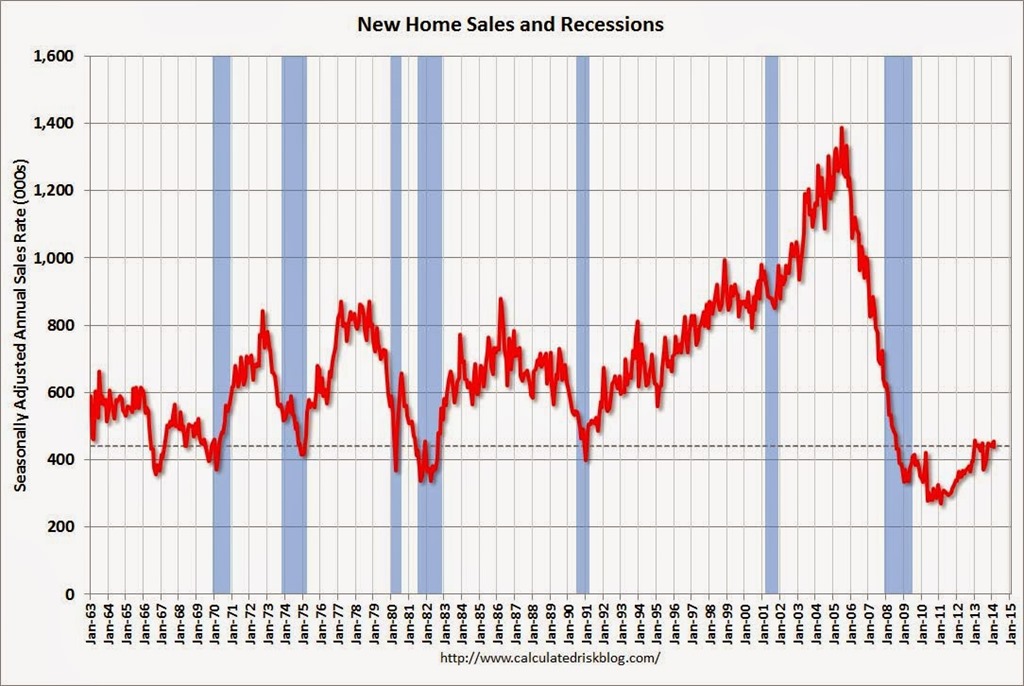
Sales of new single-family houses in February 2014 were at a seasonally adjusted annual rate of 440,000, according to U.S. Census Bureau and the Department of Housing and Urban Development estimates. This is 3.3 percent below the revised January rate of 455,000 and is 1.1 percent below the February 2013 estimate of 445,000.

newhomes

Graph: Calculated Risk

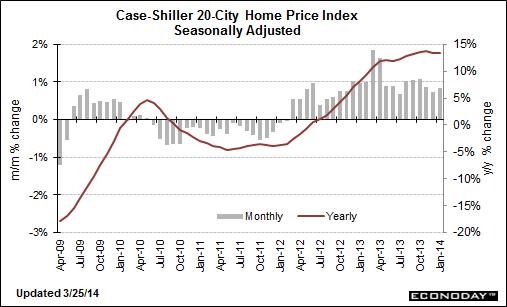
What has happened to new-home sales, with annual housing starts now above 900,000 units? Both housing prices and interest rates have been rising, for starters. And the Case-Shiller Home Price index is still rising annually at 13.2 percent, 0.8 percent in January, using a 3-month average.  And it takes at least 9 months for housing construction to be reflected in completions that would influence new-home sales.

shiller

Graph: Econoday

It could also be the winter weather in two-thirds of the country, and inventories are still low, at 5.2 months’ supply. But more likely it is that home ownership is increasingly difficult for first-time homebuyers, particularly. Tough lending standards for Fannie Mae and Freddie Mac, with higher credit score requirements and fees have made borrowing less attractive.

But that may be changing in 2014, as lenders seem to be easing their credit standards, both because default rates are down and housing prices continue to rise. The average FICO score on all closed loans was 724 in February 2014 compared to 745 in February 2013, or a 21-point decrease, according to a report released by Ellie Mae, a mortgage technology firm. (Under a system devised by Fair Isaac Corp., FICO credit scores run on a scale from 300 to 850.) Last month, 33 percent of closed loans had an average FICO score under 700 compared to 24 percent in February 2013.

“The share of purchase loans jumped four percentage points, representing 57 percent of all closed loans in February 2014,” said Jonathan Corr, president and chief operating officer of Ellie Mae. “This is the first time in four months that the share of purchase loans increased month over month and the largest one-month increase since August 2013, when the share of purchase loans also jumped four percentage points.”

“Credit requirements remained steady month over month, but there has been significant loosening compared to where we were a year ago,” said Corr.

So it may be too early to see a purchase trend in 2014 for new and existing-home sales. Total existing-home sales, which are completed transactions that include single-family homes, townhomes, condominiums and co-ops, declined 0.4 percent to a seasonally adjusted annual rate of 4.60 million in February from 4.62 million in January, and 7.1 percent below the 4.95 million-unit level in February 2013.

Interest rates fluctuations and conforming loan underwriting standards may be the deciding factors, which in turn affect consumer confidence. How much pentup demand is there with new households is another factor. So we will probably have to wait to see how the new selling season fares, taking into account all these factors.

Harlan Green © 2014

Follow Harlan Green on Twitter: https://twitter.com/HarlanGreen

Posted in Consumers, Housing, housing market, Weekly Financial News | Tagged , , , , , , , | Leave a comment

So Fannie and Freddie Weren’t the Problem…

Popular Economics Weekly

We are learning just how much mortgage fraud was committed by 17 national and international banks and other financial entities that the Federal Housing Finance Authority (FHFA) originally sued to recover some $200 billion in losses to the GSEs that it regulates, Fannie Mae and Freddie Mac.

This tells us where the real faults lies for the credit bubble that led to the housing bubble.  The once private stock corporations and now wards of the government, Fannie Mae and Freddie Mac, didn’t precipitate the housing bust.  They weren’t even the main issuers of faulty mortgages that imploded with the Great Recession. It was the federally-supervised commercial banks themselves that misrepresented many of the mortgages it sold to Fannie and Freddie, thereby giving them the cover of AAA rated assets, when they were much closer to junk bond quality.

Fed Chairman Alan Greenspan had lowered short term interest rates below what was the inflation rate at that time—some 3 percent—whereas his fed funds rate was as low as 0.5 percent.  (That meant if money was lent at below the inflation rate, it was basically free money because inflation would eat away at the amount owed so that it was actually worth less when paid off, or sold, than the face amount of the debt.)

And banks jumped into the housing bubble that resulted, almost ignoring the most basic lending safeguards from such ‘free’ money, such as verifying income and assets of the borrowers that Fannie and Freddie required.  In other words, Fannie and Freddie guaranteed that nothing was “stated” on the loan application that wasn’t verified.

The GSEs themselves were also at fault for allowing mortgage banks such as Countrywide Financial (acquired by Bank of America) to package and sell Mortgage Backed Securities to Fannie and Freddie that mainly consisted of negatively amortized ‘liar’ loans with very low initial payment rates, and little or no income and asset verification.  But that was a small portion of the defaulted loans, and in fact Fannie and Freddie guaranteed mortgages have far and away the lowest default rates.

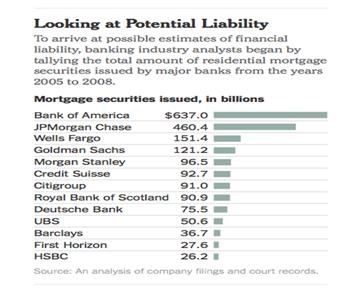
Wall Street insiders now believe that up to $50B could be the tab to settle all the pending cases, according to the New York Times.  Some $1.96 Trillion in so-called private-label mortgages were issued by banks from 2005 to 2008 during the height of the housing bubble, according to the latest figures.

As of January, the FHFA has settled six of the private-label RMBS cases, recovering nearly $8 billion for taxpayers.  Whether due to a lack of adequate supervision, or outright fraudulent misrepresentation of the credit quality of those mortgages, these banks sold Fannie and Freddie mortgages that didn’t meet the strict credit standards of the GSEs.

FHFA

Graph: NY Times

Banks such as JP Morgan Chase ($5.1B), Deutsche Bank ($1.9B) and now Credit Suisse ($885B) have settled, while admitting they had inadequate oversight.  But Bank of America and Goldman Sachs are holding out, so are going to trial sometime in midyear 2014. 

Others that have settled include, GE (Ally Bank), United Bank of Switzerland and Citigroup.  They had failed to prove in federal court that the mortgages underlying their Mortgage Backed Securities sold to Fannie and Freddie were due to the busted housing bubble that caused the loss of some $5 Trillion in real estate values, rather than their faulty underwriting practices.

Twelve of the cases remain, including FHFA’s lawsuits against Barclays Bank (BCS), Bank of America (BAC), Credit Suisse Holdings (CS), First Horizon National Corp., Goldman Sachs & Co. (GS), HSBC North America (HSBC), Merrill Lynch & Co., Morgan Stanley (MS), Nomura Holding America (NMR), SG Americas (Societe Generale), The Royal Bank of Scotland Group (RBS) and Countrywide Financial Corp.

So don’t blame Fannie and Freddie for wanting to expand home ownership, as those who oppose government ownership or regulation of anything have contended, and seem to have convinced the Obama administration.  The GSEs were as much a victim of deceptive lending practices as the borrowers and homeowners who lost out due to the resulting Great Recession.

Harlan Green © 2014

Follow Harlan Green on Twitter: https://twitter.com/HarlanGreen

Posted in Consumers, Housing, housing market, Politics | Tagged , , , , , , , , , , , | 1 Comment

What Did Janet Yellen and FOMC Really Say?

Popular Economics Weekly

The moment that the Federal Reserve’s FOMC meeting ended, and its comments were released, interest rates rose. Why? Because bond-holders and currency traders in particular (the dollar exchange rate rose, also), believed that the Fed could raise interest rate guidance sooner, when in fact Fed Chair Yellen meant just the opposite.

The press release and her press conference were meant to clarify under what conditions interest rates may rise, other than when the 6.5 percent unemployment rate was reached, which should be this year.

“When the Committee decides to begin to remove policy accommodation, it will take a balanced approach consistent with its longer-run goals of maximum employment and inflation of 2 percent,” said the press release. But the key wording was, “The Committee currently anticipates that, even after employment and inflation are near mandate-consistent levels, economic conditions may, for some time, warrant keeping the target federal funds rate below levels the Committee views as normal in the longer run.”

It then added,

“With the unemployment rate nearing 6-1/2 percent, the Committee has updated its forward guidance. The change in the Committee’s guidance does not indicate any change in the Committee’s policy intentions as set forth in its recent statements.”

But the markets took her meaning to be the opposite — that interest rates may rise sooner, since the criteria were no longer anchored to one specific indicator–the unemployment rate. But that was a misread of the Fed’s intentions. Yellen clearly stated that the unemployment rate was a very imperfect indicator of economic health, since the declining ratio of workers employed — due to an older work force, more retirees and the like — meant that it could take much longer to reach full employment.

CPI

Graph: Econoday

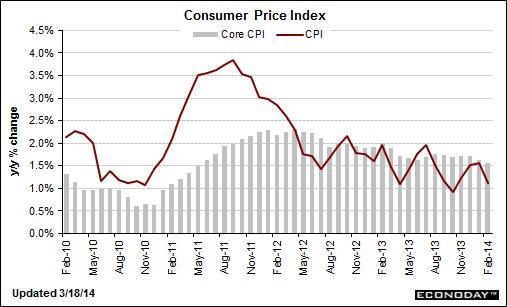
Meanwhile, very low current inflation that is in the one percent range means lots of output slack, since it indicates less demand for goods and services. The inflation rate is therefore as good, or maybe a better indicator of economic health than the unemployment rate.

So Chairperson Yellen and her Fed governors seem now to be focusing much more on the current inflation rate, which has been falling. And that is not a good sign for any industry. Falling inflation means at the very least that companies cannot raise their prices, and may even have to lower them. In which case we are returning to recessionary conditions, needless to say.

And if such a downturn is the greater danger, as Yellen hinted in her comments, then keeping interest rates this low is the more prudent response.

Harlan Green © 2014

Follow Harlan Green on Twitter: https://twitter.com/HarlanGreen

Posted in Economy, Macro Economics, Politics, Weekly Financial News | Tagged , , , , , | Leave a comment

Will Housing Starts Save Inventories?

The Mortgage Corner

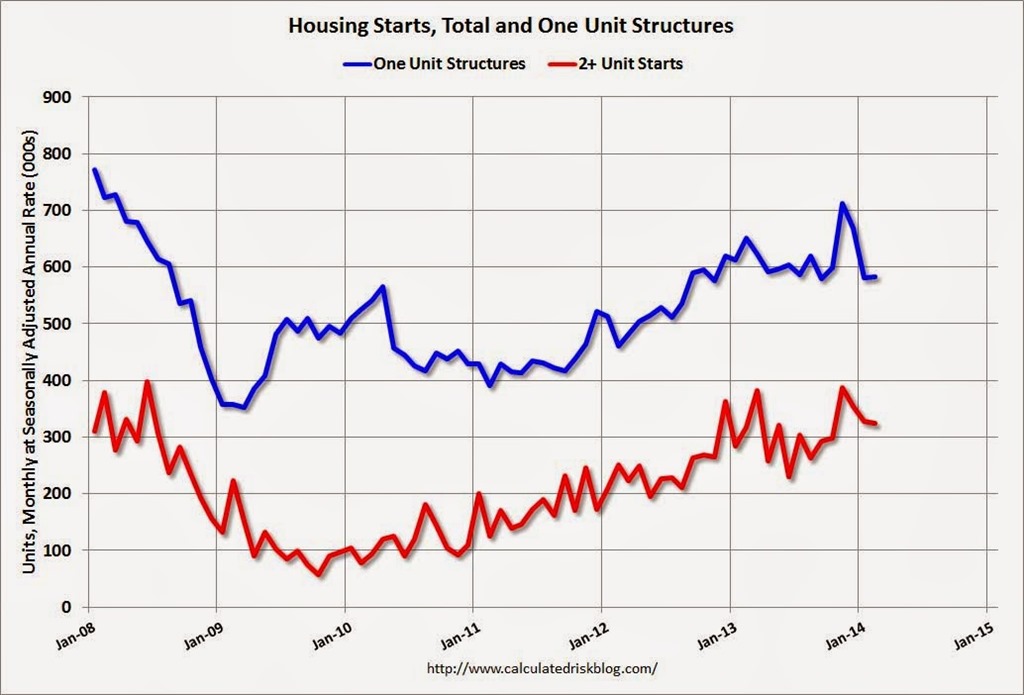
Will new housing construction improve the very low inventory levels that are restricting housing sales? It is hard to know at present if this slowdown is due more to the severe winter weather, lack of inventory, or rising interest rates.

The US Census Bureau reported privately-owned housing starts in February were at a seasonally adjusted annual rate of 907,000. This is 0.2 percent below the revised January estimate of 909,000 and is 6.4 percent below the February 2013 rate of 969,000.

The National Association of Home Builders says it is also due to stricter loan underwriting criteria, but remains optimistic that demand for new homes will be high due to the inventory shortages.

“While housing construction is in a recent lull due to unusual weather conditions, we expect to see an improvement as the winter weather pattern subsides and builders prepare for the spring selling season,” said NAHB Chief Economist David Crowe. “Competitive mortgage rates, affordable home prices and an improving economy all point to a continuing, gradual strengthening of housing activity through the rest of the year. Moreover, building permits, which are less dependent on weather and are a harbinger of future building activity, rose above 1 million units in February.”

housestarts

Graph: Calculated Risk

Single-family housing starts in February were at a rate of 583,000; this is 0.3 percent above the revised January figure of 581,000. The February rate for units in buildings with five units or more was 312,000.

This is a sign that the purchase market should improve for single-family buyers as well. Nationally, affordability is down from 203.7 in October 2012 to 165.4 in October 2013, according to the NAR. Mortgage rates are down from last month and up 25.8 percent from a year ago. Lower rates help affordability but an increase in inventory will help ease the pressure on home prices.

And by region, affordability is up from one month ago in all regions except the Northeast, where there was a 5.0 percent decrease in affordability. The Midwest had the biggest gain in affordability at 2.7 percent. From one year ago, affordability is down in all regions. The West has had the largest price gain at 16.7 percent while the Northeast had the smallest at 7.4 percent.

NAR

Graph: NAR

In fact, the indeterminate status of Fannie Mae and Freddie Mac may also have an effect. Their fees have been rising in an attempt by the US Treasury to push more lending onto private banks that pool their own mortgages for purchase in the secondary market.

But, except for the jumbo market with loan amounts above the Hi-Balance conforming limits, that isn’t happening. Fannie and Freddie are still the only game in town for conforming loans. This means Janet Yellen’s Federal Reserve must continue to keep longer term interest rates as low as possible for the foreseeable future, if real estate is to continue its recovery from the Great Recession.

Harlan Green © 2014

Follow Harlan Green on Twitter: https://twitter.com/HarlanGreen

Posted in Consumers, Housing, housing market, Weekly Financial News | Tagged , , , , , , , , , | Leave a comment

Losing Fannie and Freddie—A Terrible Idea

Financial FAQs

There was a reason Fannie Mae (Federal National Mortgage Association) and Freddy Mac (Federal Home loan Mortgage Corporation) were government created entities, before they became private corporations in the 1970s.  They encouraged homeownership at a time when owning a home was only for the wealthiest.  Though Fannie Mae—the  Federal National Mortgage Association—was created in 1938 as part of the New Deal, it became important after WWII when the most basic 50 percent down payment on a 15-year fixed rate loan was available.  Payments were prohibitively expensive for those just entering the middle class.

Fannie Mae and Freddie Mac, Government-Sponsored Enterprises, or GSEs, filled the void with 30-year fixed rate mortgages, loans that private banks thought too risky.  Banks have always preferred short-term construction loans, or lines of credit that shortened their risk profiles.

And so the federal government created hybrid agencies that set up strict standards for so-called conventional, conforming mortgages.  These were mortgages that conformed to stricter underwriting standards set up by Fannie and Freddie.

And now some in Congress want to abolish them altogether, and replace them with what is basically a privately-funded secondary market mechanism for packaging and selling guaranteed mortgages with sky-high capital requirements that will raise interest rates, putting even more consumers out of the housing market.

Firstly, the only problem with the GSEs in their current form was that they were undercapitalized.  And because they were undercapitalized they suffered the same fate as all the undercapitalized major banks bailed out by TARP funds.  The only difference was that they were made wards of the government, which is what they were prior to the ‘70s, anyway.  And they are now pouring $billions back into the US Treasury, some $203 billion to date since the recovery, when they were lent $188 billion.

So there is no reason to dissolve them and every reason to keep them as viable GSEs.  This is mainly because their underwriting criteria have been the gold standard for borrower qualification, requiring income and asset verification, and assessing the likelihood this condition would continue, as we said.

That is why their default rates have about returned to historical levels, while so-called Private-Label mortgages—those originated by banks that don’t meet the stricter conforming standards—have default rates still in the 6 percent rage, 3 times the Fannie/Freddie rate.

The latest proposal, by committee chairmen, Tim Johnson, a Democrat from South Dakota, and Mike Crapo of Idaho, the ranking Republican, have come up with a compromise that provides an explicit government guarantee for mortgages, but only after private investors have taken the first losses. The plan would set up a new federal regulator, called the Federal Mortgage Insurance Corporation, to provide the guarantee and regulate the system.

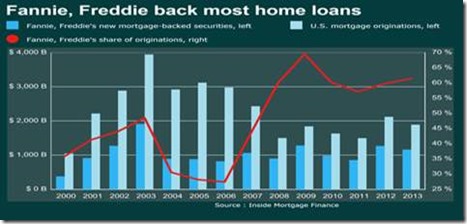
Having private investors take first losses, in lieu of Fannie and Freddie’s current stockholders, is a terrible idea because banks are much more risk averse.  That’s why Fannie and Freddie currently originate some 60 percent of all residential mortgages since the end of the Great Recession.
clip_image001

Graph: WSJ/Inside Mortgage Finance

The new agreement would establish the Federal Mortgage Insurance Corporation as the insurer of last resort, but would require 10 percent private capital reserves, which is the rub. The guarantee, provided for a fee equivalent to 0.1 percent interest, would not kick in until the private reserves were wiped out. Fannie and Freddie would have remained solvent during the housing crisis if they had kept 4 percent of their capital in reserve.

The bill would create a single platform to standardize mortgage-backed securities, which are investment vehicles created by bundling mortgages and then selling off pieces of the bundle to spread the risk of default.

The bill would also set a minimum down payment of 5 percent, except for first-time home buyers, who would have to put down 3.5 percent for the mortgage to qualify for the guarantee. Some advocates have said they would prefer that the down payment amounts be left to the new regulator, who could adjust them in response to economic conditions.

The increased capital requirements and the government guarantee would raise the cost of borrowing for homeowners, said economist Mark Zandi, because the risks of the system would no longer be borne by all taxpayers. He estimated that interest rates would increase by 0.4 to 0.5 percentage points. 

This would put Fannie/Freddie fixed rate conforming mortgages at or above 5 percent at rates that prevailed on the runup to the housing bust, when households hadn’t lost so much income and accumulated record debts.  That is not the case today, for most Americans, needless to say.

The bill could therefore eliminate the affordable housing goals that governed Fannie and Freddie, which required them to make a certain number of loans to people with low incomes but which some advocates said were easily gamed and worked to discourage lending in particularly expensive markets.

John Taylor, president and chief executive of the National Community Reinvestment Coalition, said he had been assured that lenders would be encouraged to offer loans to low-income families through incentive pricing or would be required to do so by the regulator.

Really?  It depends on the types of “encouragement” given to banks.  They don’t have public service goals unless required to, such as the Community Reinvest Act, that combatted red-lining, because lenders tended to avoid lending in lower-income neighborhoods.  This is because they are required to maximize their profits, and affordable loans are by their nature very low profit margin entities.

So if not allowed to return as private corporations with stockholders bearing the risk, then at least keep them under some form of government control—there are many forms this can take, including strict regulations to protect their underwriting standards.  But there has to be enough capital, as is the lesson learned with commercial banks, as well.

Harlan Green © 2014

Follow Harlan Green on Twitter: https://twitter.com/HarlanGreen

Posted in Consumers, Housing, housing market, Politics | Tagged , , , , , , | Leave a comment

Government Is Missing in Job Creation

Popular Economics Weekly

We know now why job creation has been so weak in the recovery from the Great Recession, or Lesser Depression, as some have called it. Governments have lost too many jobs, and that mostly includes public safety and healthcare workers, as well as some 300,000 teaching jobs lost due to the Great Recession.

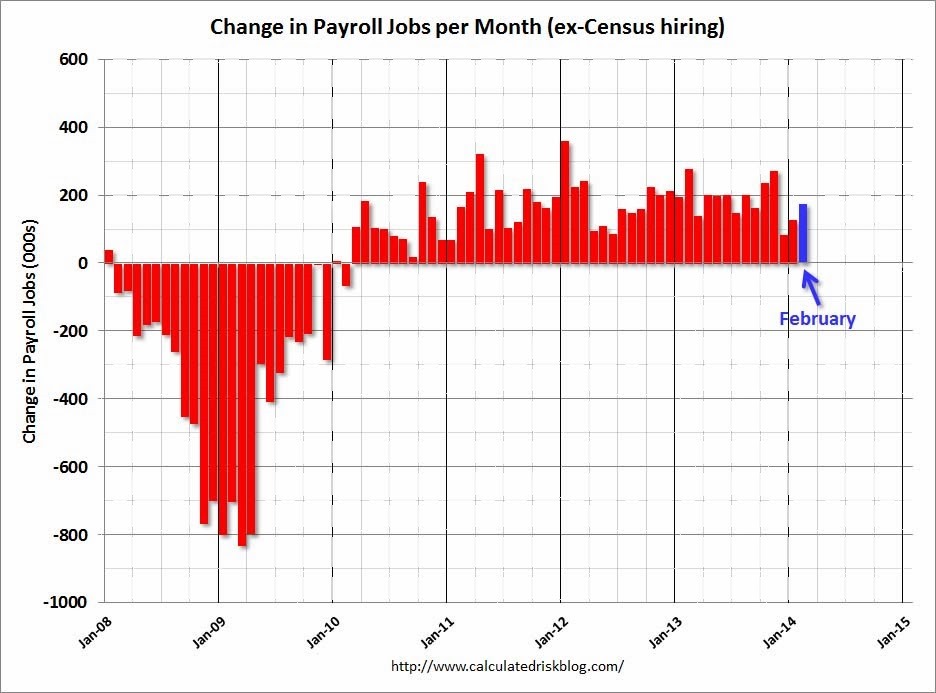
Those wanting smaller government sometimes forget that these jobs enhance present and future productivity—creating a safer and healthier work environment, as well as better educational opportunities. The 175,000 net nonfarm payroll jobs created in February included some of those workers, but only a net 13,000 public sector jobs were created, whereas 16,000 public sector jobs were lost in January.

payjobs

Graph: Calculated Risk

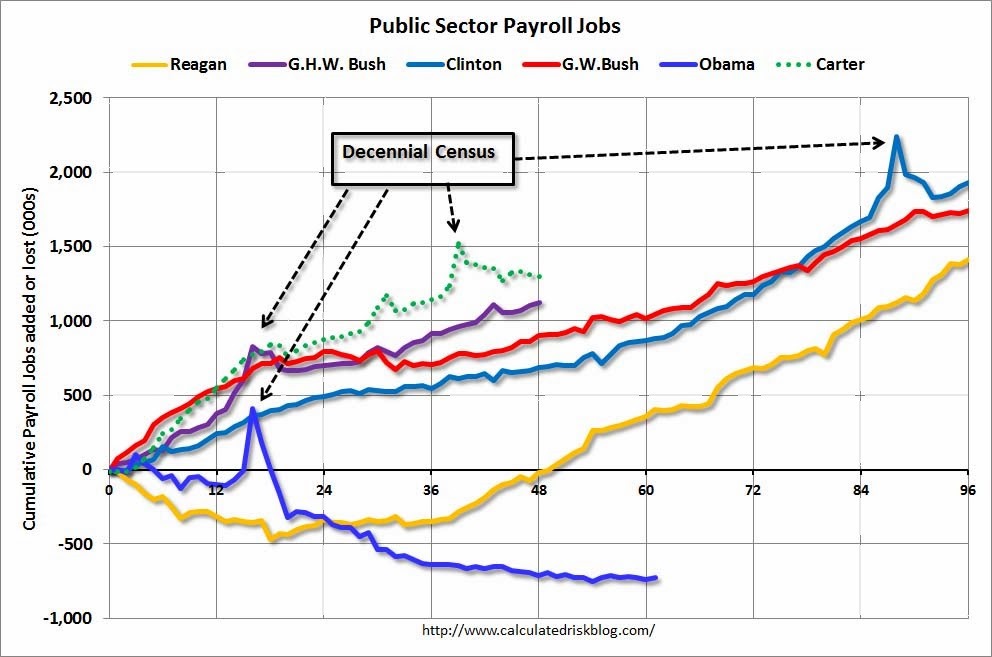
This shouldn’t be a partisan problem. In fact, public sector job creation has been apolitical until the Obama administration with Republican presidents adding as many or more public-sector jobs than the Democrats since 1980.

pubsector

Graph: Calculated Risk

This Calculated Risk graph shows public sector job creation since President Carter, with Carter and HGW Bush leading the way, and Presidents Clinton and GW Bush close behind.

But some 728,000 government jobs have been lost during President Obama’s administration to date. And this has had a very noticeable affect on the unemployment rate, needless to say, as state governments in particular are mandated to balance their budgets annually.

States are beginning to hire back those teachers and public safety workers (i.e., police, fire, health care workers). California, for example, has hired back 70 percent of the 1.3 million public sector employees lost during the Great Recession, though its unemployment rate of 8.5 percent is in 47th place among state unemployment rates.

We can hope that continued overall employment growth in the private sector will increase tax revenues to the states, and so enable them to rehire more of their laid off employees so necessary to protect their own citizens’ interests.

Harlan Green © 2014

Follow Harlan Green on Twitter: https://twitter.com/HarlanGreen
Posted in Consumers, Economy, Macro Economics, Politics, Weekly Financial News | Tagged , , , , , , | Leave a comment

JOLTS and Decline of Household Debt

Financial FAQs

There is a direct correlation between the increase in job openings announced in the Labor Department’s JOLTS (Job Openings and Labor Turnover) report, and declining household debt. How so? The increase in job opportunities—the number of job openings (yellow in graph) is up 7.6 percent year-over-year compared to January 2013, and that is enabling more households to pay down their debts.

JOLTS

Graph: Calculated Risk

This is while the Quits number decreased in January but is up about 3 percent year-over-year. These are voluntary separations, and mean workers are seeing more job opportunities that make them willing to leave their current job. (Light blue columns at bottom of graph is trend for “quits”).

householddebt

Graph: Calculated Risk

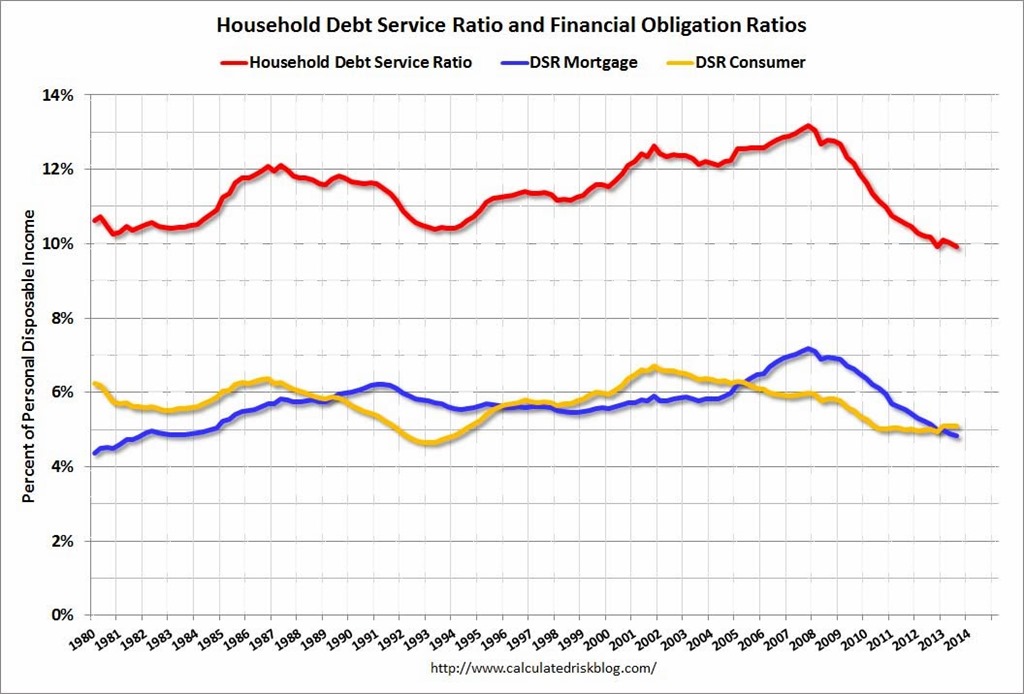
And household debt, as measured by the Federal Reserve’s Household Debt Service Ratio of mortgage and consumer loans to Disposable Income, has been declining steadily, and is now below 1980 levels. This is freeing up consumers’ incomes to spend more, needless to say, and a sign of better economic growth for 2014.

Sure enough, employers added 175,000 jobs to their payrolls last month after creating 129,000 new positions in January, said the Labor Department last Friday. The unemployment rate, however, rose to 6.7 percent from a five-year low of 6.6 percent as Americans flooded into the labor market to search for work.

This is even though 601,000 people could not get to work because of the winter weather, the highest level for February since 2010. Some economists said job growth in February would have been as high as 200,000 if not for the weather.

And the smaller survey of households from which the unemployment rate is derived showed 6.9 million people with jobs reported they were working part-time because of the weather. That was the highest reading for February since the series started in 1978.

So even the winter weather isn’t slowing down appreciable growth. And consumers now have more money to spend. So watch out, trendsetters and economic forecasters, when the Spring thaw sets in!

Harlan Green © 2014

Follow Harlan Green on Twitter: https://twitter.com/HarlanGreen
Posted in Consumers, Economy, Politics, Weekly Financial News | Tagged , , , , , | Leave a comment

Janet Yellen’s Nemesis—The Great Moderation

Popular Economics Weekly

New Fed Chairwoman Janet Yellen has a great task ahead of her. How to combat the results of the Great Moderation, as it was called, that period of low inflation with moderate economic growth that prevailed from 1985 to 2007, according to Paul Krugman. But why, when lots of jobs were created, particularly the 22 million jobs created during Clinton’s presidency?

It was a period, “…that worked in part because the political insulation of central banks also gave them more than a bit of intellectual insulation, too,” said Krugman in a recent column. “If we’re living in a Dark Age of macroeconomics, central banks have been its monasteries, hoarding and studying the ancient texts lost to the rest of the world. Even as the real business cycle people took over the professional journals, to the point where it became very hard to publish models in which monetary policy, let alone fiscal policy, matters, the research departments of the Fed system continued to study counter-cyclical policy in a relatively realistic way.”

Leaving the Federal Reserve to only worry about large cyclical swings, while allowing the markets to largely grow with little regulation or oversight worked too well, in other words. It lulled policy makers into allowing the massive deregulation of financial markets for one, which led to the Great Recession.

And much worse. The result was loss of so much wealth since the Great Recession for the 99 percent that didn’t profit from deregulation. The labor market in particular has suffered most from deregulation, with globalization and free trade agreements allowing even highly skilled jobs to flow overseas, while states restrict collective bargaining for government employees and unions.

ULC

Graph: Econoday

This graph of Productivity and Unit Labor Costs illustrates the damage done to household incomes. So-called unit labor costs (ULC), a measure of incomes and benefits, have not on average grown at all since 2009, the end of the Great Recession.

The result is that The Great Moderation has more than moderated household incomes, reducing income growth for most Americans to zero after inflation, resulting in reduced demand and so slower economic growth that may never return to the 3.2 percent average GDP growth that prevailed since the Great Depression.

As Professor Krugman put it, “…the very success of central-bank-led stabilization, combined with financial deregulation – itself a by-product of the revival of free-market fundamentalism – set the stage for a crisis too big for the central bankers to handle. This is Minskyism: the long period of relative stability led to greater risk-taking, greater leverage, and, finally, a huge deleveraging shock… Also, sooner or later the barbarians were going to go after the monasteries too; and as the current furor over quantitative easing shows, the invading hordes have arrived.”

So it is Chairwoman Yellen’s task to bring growth back to household incomes and the overall economy. She must ignore the maxims and experience of the Great Moderation to do it, however. She must push for more government stimulus programs—whether for infrastructure, education, or Research and Development—to accompany the Fed’s efforts to hold down interest rates as long as possible to encourage moderate inflation. And she must not allow those “barbarians” at the Fed’s gate to prevail that want to reduce its powers to moderate such Great Recessions.

Harlan Green © 2014

Follow Harlan Green on Twitter: https://twitter.com/HarlanGreen
Posted in Economy, Keynesian economics, Macro Economics, Politics, Weekly Financial News | Tagged , , , , , , , , | Leave a comment

2014 Mortgage Volumes (and Delinquencies) Lower

The Mortgage Corner

It looks like the housing market still has to play catch up in 2014. Both mortgage volume and existing-home sales have declined drastically. But new-home sales and housing construction have picked up, even with the Polar weather, which should add to depleted inventories bought up during the ultra-low interest rates in 2013.

But recent higher interest rates are having an effect, so we will have to wait for the spring thaw to know if consumers have the means to continue buying homes.

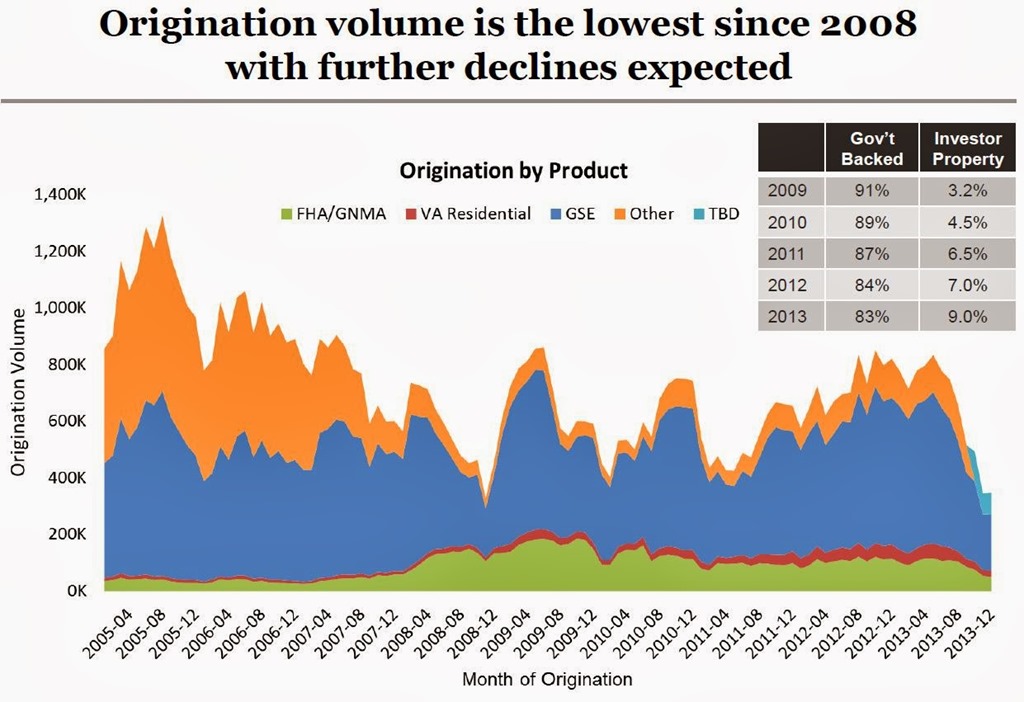
In January, we saw origination volume continue to decline to its lowest point since 2008, with prepayment speeds pointing to further drops in refinance-related originations,” said Herb Blecher, senior vice president of Black Knight Financial Services’ Data & Analytics division, formerly LPS Data & Analytics.

LPSorigs

Graph: LPS/Calculated Risk

One can see from the graph that originations in Q4 2005 were equally divided between Fannie Mae/Freddie Mac conforming and private label mortgages, whereas today Fannie/Freddie originate almost all conventional mortgages. Banks have not begun to originate and sell their own products yet, in other words.

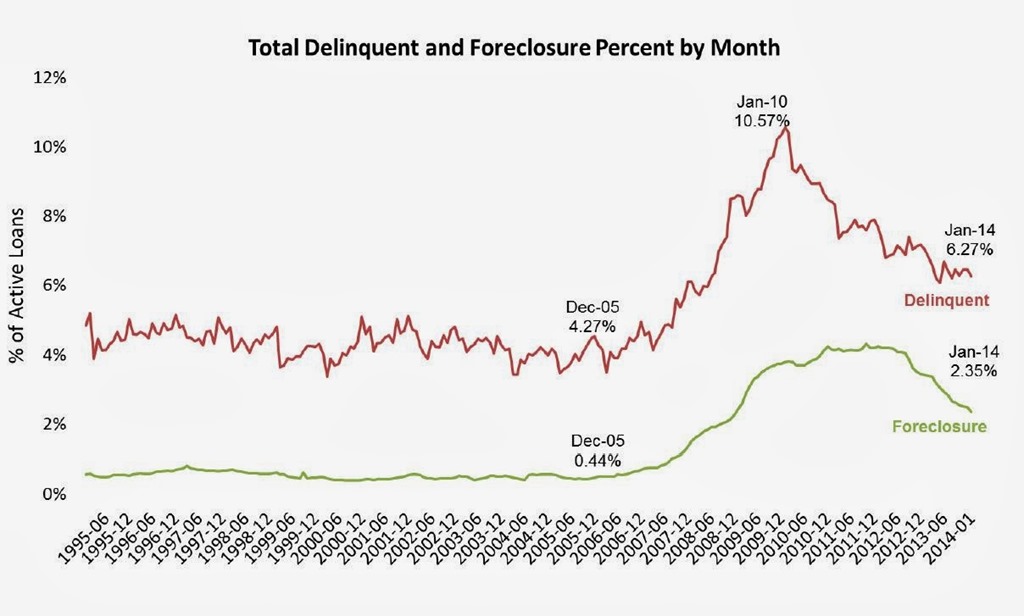
This is while mortgage delinquencies continue to fall. The January 2014 overall delinquency rate fell to 6.27 percent and foreclosure rate to 2.35 percent. This meant 4,315,000 million were still in trouble, down from 5,208,000 in January 2013. That’s still a lot of homes in trouble, folks, and is contributing to the lowered inventories, since these borrowers have a much harder time either refinancing or selling their homes.

Overall originations were down almost 60 percent year-over-year, with HARP volumes (according to the most recent FHFA report) down 70 percent over the same period. (The HARP loan program allows home owners to refinance at today’s rates, even if their loans are underwater, i.e., have negative equity.) These declines are largely tied to the increased mortgage interest rate environment, which is having a significant impact on the number of borrowers with incentive to refinance. A high-level view of this refinancible population shows a decline of about 13 percent just over the last two months,” said Blecher.

LPS

Graph: Calculated Risk

“Of course, in addition to higher interest rates, a good deal of this decline can be attributed to the fact that a majority of those who could refinance at historically low rates in recent years already have, and we see a similar dynamic in terms of HARP-eligible loans,” continued Blecher.. “The volume of HARP refinances over the past year has driven this population down to about 700,000 loans in January 2014, as compared to over 2.3 million at the same time last year. From a geographic perspective, outside of Florida and Nevada, we see the Midwestern states of Illinois, Michigan, Missouri and Ohio have among the highest percentage of HARP eligibility.”

We see, therefore, the need for more new homes, but also housing’s continued price and value appreciation to bring more of those delinquent homes back on the market. And that depends on whether new Fed Chairwoman Janet Yellen will support lower interest rates.

But she continues to maintain QE3 purchases will be lower in months to come, and that is the reason for higher mortgage rates, which are tied to Treasury Bond yields. So she is walking a fine line between deficit hawks and those who believe the housing market is not yet fully recovered. Let us hope she realizes that the housing market still needs such low interest rates to fully recover.

Harlan Green © 2014

Follow Harlan Green on Twitter: https://twitter.com/HarlanGreen
Posted in Consumers, Housing, housing market, Weekly Financial News | Tagged , , , , , , , , , | Leave a comment

Wisconsin’s Austerity Lesson

Popular Economics Weekly

Governor Scott Walker is having his own problems with the ongoing investigation into staffers using public funds for political campaigning as a County Manager, but it doesn’t seem to faze him as he touts the success of his austerity policies.

The only problem is that government austerity policies pushed through in 2010 when he was elected Wisconsin’s Governor (tax cuts plus lower government spending) don’t work. Especially during such difficult times as now when America still needs to recover from the Great Recession. It’s a lesson from the Great Depression that’s been forgotten, when President Roosevelt’s administration hired 8 million workers to build American public works projects from 1935-43 under the Workers Project Administration.

Almost every community in the United States had a new park, bridge or school constructed by WPA. The WPA’s initial appropriation in 1935 was for $4.9 billion (about 6.7 percent of the 1935 GDP), and in total it spent $13.4 billion. Can we imagine what several $trillion in government spending would do today to boost economic growth, instead of the $831billion spent under the 2009 American Recovery and Reinvestment Act?

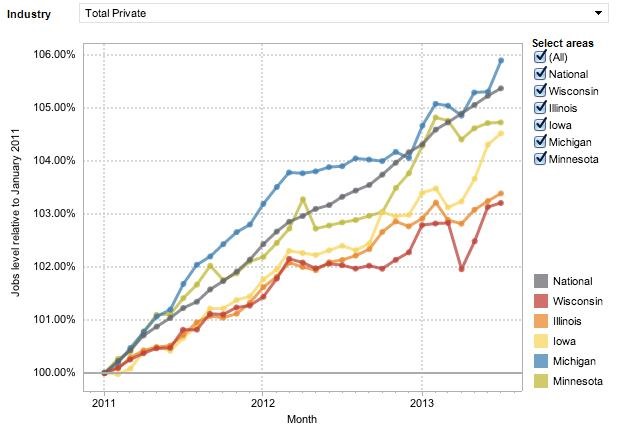
Wisconsin has gone in the other direction, depriving union workers in particular of incomes and jobs at a time when job creation should be Governor Walker’s priority. That’s why Wisconsin has fallen to the bottom of states in job creation, according to the Bureau of Labor Statistics.

Wisconsinjobs

Graph: Capital Times

Its beaten down public unions in particular are the poster children for what happens when governments take away workers’ ability to collective bargain, one of the most fundamental rights in any democratic society. The EPI Capital Times graph compares US job creation with national and other Midwestern states.

There is no other power to counteract the monopoly power of governments and private. Under Wisconsin’s Act 10 enacted in 2010, which eliminated collective bargaining for most public workers, thousands of government workers have seen smaller paychecks as they are forced to pay more for health care and pensions.

And a new report from the Economic Policy Institute also blames the slow pace of the national recovery on cutbacks in the public sector. Unlike in previous recoveries, state and local government austerity has been a major drag on job growth and the broader economy. The number of public-sector jobs fell by almost 3 percent in the three years following the recession, while the number of private-sector jobs grew (albeit anemically). The fact that public-sector wages have lagged behind those in the private-sector exacerbates government’s drag on the economy, said the EPI report by Heidi Shierholz and Josh Bivens.

This is because austerity—cutting government workers’ wages and salaries in the name of reducing government spending—cuts the overall demand for goods and services. And since government doesn’t make things, decreasing their incomes decreases their ability to buy private sector goods and services, therefore cutting private sector jobs.

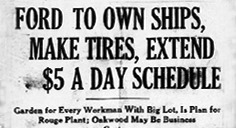
You would think small business people, as well as consumers, would understand this. It should be a no-brainer that even Henry Ford understood in 1914, when he upped his employees’ salaries to $5 per day so they could buy more of his Model Ts.

Ford-5

James Couzens, the Ford treasurer, said: “It is our belief that social justice begins at home. We want those who have helped us to produce this great institution and are helping to maintain it to share our prosperity. We want them to have present profits and future prospects. … Believing as we do, that a division of our earnings between capital and labor is unequal, we have sought a plan of relief suitable for our business.”

We are at a similar juncture in history today with record income inequality that has caused the middle class Henry Ford helped to create greatly lose its purchasing power. Who will help them to bring back a government and economy that works for all, which restores a more equal division of earnings and labor, one of our most fundamental rights?

Harlan Green © 2014

Follow Harlan Green on Twitter: https://twitter.com/HarlanGreen
Posted in Consumers, Economy, Keynesian economics, Politics, Weekly Financial News | Tagged , , , , , , , , , , , , | Leave a comment