January New-Home Sales Soar

Financial FAQs

The Polar Vortexes haven’t stopped everything.  It looks like new-home sales are picking up in midwinter, a sign that existing-home inventories are too low. Sales of new single-family houses in January 2014 were at a seasonally adjusted annual rate of 468,000, according to estimates released jointly today by the U.S. Census Bureau and HUD. This is 9.6 percent above the revised December rate of 427,000 and is 2.2 percent above the January 2013 estimate of 458,000.

newsales

Graph: Calculated Risk

It was the highest sales rate since 2008, the end of the housing bubble. But inventories are still too low, which means new-home sales will continue to increase as more housing construction comes on line, with close to 1 million units already in the construction pipeline. The months of supply decreased in January to 4.7 months from 5.2 months in December.

existsupply

Graph: Calculated Risk

The problem is obvious from this graph. Inventories have returned to levels that prevailed from 1997 to 2005, a prolonged period of pent up demand for housing that, along with prolonged easy credit conditions, caused the housing bubble.

January’s data show a big 10.4 percent gain in the South which is by far the largest region for new home sales. The West, which is a distant second behind the South, shows an 11.0 percent gain.

A plus for sales has been recent price concessions as the median price is down 2.2 percent to $260,100. The year-on-year sales gain, which spent most of last year in the double digits, is now modest, at 3.4 percent and in line with the 2.2 year-on-year gain for sales.

This is while total existing-home sales, which are completed transactions that include single-family homes, townhomes, condominiums and co-ops, dropped 5.1 percent to a seasonally adjusted annual rate of 4.62 million in January from 4.87 million in December, and are 5.1 percent below the 4.87 million-unit pace in January 2013.

So new-home sales are surging, and will continue to surge, as long as existing inventories are so low. Last month’s existing-home activity was the slowest since July 2012, when it stood at 4.59 million, and signals the effect of low inventories and rising interest rates that have cut mortgage applications to their lowest level in a year.

Harlan Green © 2014

Follow Harlan Green on Twitter: https://twitter.com/HarlanGreen

Posted in Consumers, Housing, housing market | Tagged , , , , , | Leave a comment

Existing-Home Sales Slow in January

The Mortgage Corner

Total existing-home sales, which are completed transactions that include single-family homes, townhomes, condominiums and co-ops, dropped 5.1 percent to a seasonally adjusted annual rate of 4.62 million in January from 4.87 million in December, and are 5.1 percent below the 4.87 million-unit pace in January 2013.

Last month’s level of activity was the slowest since July 2012, when it stood at 4.59 million, and signals the effect of low inventories and rising interest rates that have cut mortgage applications to their lowest level in a year.

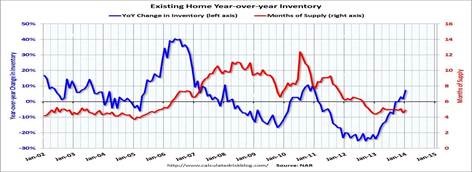
Total housing inventory at the end of January rose 2.2 percent to 1.90 million existing homes available for sale, which represents a 4.9-month supply at the current sales pace, up from 4.6 months in December. Unsold inventory is 7.3 percent above a year ago, when there was a 4.4-month supply.  But both rates are far below the  6-month inventory level in more normal times.

existhome

Graph: Calculated Risk

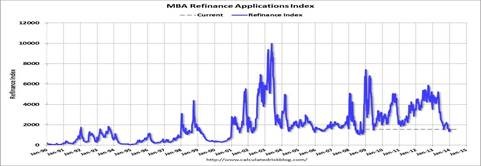
Meanwhile, mortgage applications are down for the year.  The MBA’s weekly mortgage applications refinance survey is down 70 percent since May, and its purchase index is down 8 percent in a year.

MBAapplics

Graph: Calculated Risk

This is even though 30-year fixed conforming rates are down to 4.0 percent since the latest signs of slowing factory activity and job creation over the past 2 months.

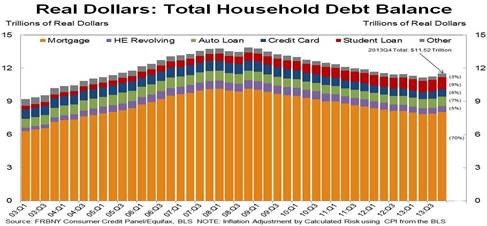
But the slowdown may be temporary, as the NY Fed’s just released Q4 Household Debt and Credit Report said consumers are paying down their debts while spending more.  The report showed that total household debt is 9.1 percent below the Q3 2008 peak. Mortgage debt is down 13.4 percent from the peak, and Home Equity revolving debt is down 25.9 percent.

householddebt

Calculated Risk

Does this mean the household deleveraging of debt that has held down consumer spending since the Great Recession is over?  Are consumers opening up their wallets finally, and will this boost 2014 housing sales? 

We believe so, because of the tremendous pent up demand generated by 5 years of subpar housing construction that has reduced inventories, much lower delinquency rates, and a growing population that is boosting housing demand.

Harlan Green © 2014

Follow Harlan Green on Twitter: https://twitter.com/HarlanGreen

Posted in Consumers, Economy, Housing, housing market, Politics, Weekly Financial News | Tagged , , , , , | Leave a comment

Consumer Debts Returning to ‘Normal’

Popular Economics Weekly

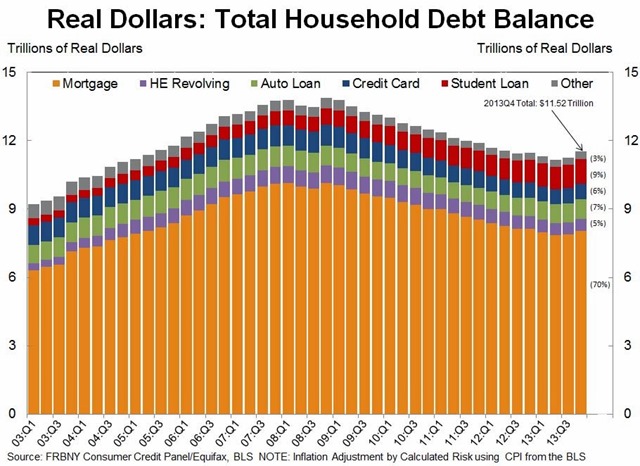
The NY Fed released their 2013 Q4 Household Debt and Credit Report. The report showed that total household debt is 9.1 percent below the Q3 2008 peak. Mortgage debt is down 13.4 percent from the peak, and Home Equity revolving debt is down 25.9 percent.

This is even though aggregate consumer debt increased by $241 billion in the fourth quarter, the largest quarter-to-quarter increase since 2007, said the NY Fed report. More importantly, between 2012:Q4 and 2013:Q4, total household debt rose $180 billion, marking the first four-quarter increase in outstanding debt since 2008.

condebt

Calculated Risk

Does this mean the household deleveraging of debt that has held down consumer spending since the Great Recession is over? Are consumers opening up their wallets finally, and will this drive increased consumer spending and so GDP growth this year?

Barron’s Gene Epstein and Applied Global Macro Research (AGMR) economists believe so. AGMR projects 4 percent in economic output this year and next, arguing that future demand for housing will also boost consumer spending by creating jobs in the many ancillary industries that service housing. This is far above the Fed’s FOMC prediction of 2.8 to 3.4 percent GDP growth through 2015. It also means unemployment has to fall below 6 percent, and the Fed will begin to raise their overnight rate to 0.25 percent from its current 0 percent.

But AGMR’s report doesn’t take into account the sharp decline in federal and local government spending, which has been a drag on growth since 2009. It would have to pick up as well, in my opinion. This is happening in states like California, whose budget is now in surplus, but not at the federal level, in spite of the $1.1 trillion budget agreement for the rest of this fiscal year.

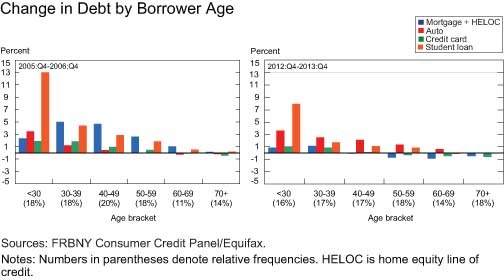
As net household borrowing resumes, it is interesting to see who is driving these balance changes, and to compare some of today’s patterns with those of the boom period. This will help to determine how sustainable is such consumer spending, and so economic growth and job creation.

Auto and student loans have led the way and been growing for some time, while overall debt continued to fall. But in 2013, the increased credit card and mortgage debt among the young and the riskless has led to a turnaround in the trajectory of overall debt. This was the case in the comparison in debt with 2005, and is still the case today. It is the under 30-year olds that are borrowing and spending the most.


blog_charts_template

Graph: NY Federal Reserve

And we believe it is the below-30 cohort that will comprise most of the increased demand for housing, as household formation is predicted to pick up above 1 million per year for the rest of this decade, according to the 2013 Harvard Joint Center for Housing Studies’ State of the Nation’s Housing report.

“With rising home prices helping to revive household balance sheets and expanding residential construction adding to job growth, the housing sector is finally providing a much needed boost to the economy,” says Eric S. Belsky, Managing Director of the Joint Center for Housing Studies. “But long-term vacancies are at elevated levels in a number of places, millions of owners are still struggling to make their mortgage payments, and credit conditions for homebuyers remain extremely tight.”

So as always, the key will be pent-up demand for housing and consumer goods that has been constrained since 2009, due mainly to the mountain of debt that has now been reduced to more manageable levels. But government has to be included in any growth projections, and any boost in government spending is still in question.

Harlan Green © 2014

Follow Harlan Green on Twitter: https://twitter.com/HarlanGreen

Posted in Consumers, Economy, Weekly Financial News | Tagged , , , , , | Leave a comment

Hoorays For New Fed Chair Janet Yellen

Financial FAQs

Fed Chairwoman Janet Yellen’s congressional testimony proved that she is more than qualified to steer the US economy back to health. She is the economists’ economist, in a word, willing to explain the most basic economic truths in her first marathon session (7 hours) in front of the House Committee on Financial Services.

For instance, when asked why did we need QE3 purchase of securities, she responded that the Fed had taken seriously Congress’s twin mandates of maximum employment with stable inflation. And since inflation was in fact still falling (far below what is normal for healthy growth) and employment weak, keeping interest rates as low as possible at this stage of the recovery was the best way to boost the continued growth of jobs.

She also said the Fed would continue to taper their monthly QE3 purchases. But stocks and bonds rallied this time, rather than fell as in the past on the fear that higher rates might stifle growth. The markets took her remarks instead as a sign that economic growth was strong enough to be able to accommodate higher interest rates.

But her testimony was most important, because she instilled confidence that she knew what she was talking about. She was the Vice-Chairman that had created the current Fed policies with former Chairman Bernanke, after all.

 JOLTS

Graph: Calculated Risk

The best indicator re job creation is the Labor Department’s JOLTS report that tracks the number of ‘quits’, those that voluntarily leave their jobs because of better prospects. Therefore, the quits rate can serve as a measure of workers’ willingness or ability to leave jobs. The number of quits (not seasonally adjusted) increased over the 12 months ending in December for total nonfarm and total private and was little changed for government.

The above graph, compliments of Calculated Risk, shows job openings (yellow line), hires (dark blue), Layoff, Discharges and other (red column), and Quits (light blue column) from the JOLTS.

Notice how the yellow line of job openings has been rising since 2009, the end of the Great Recession. Hires (dark blue) and total separations (red and light blue columns stacked) are pretty close each month. This is a measure of turnover.  When the blue line is above the two stacked columns, the economy is adding net jobs – when it is below the columns, the economy is losing jobs.

Jobs openings decreased slightly in December to 3.990 million from 4.033 million in November. But the number of job openings (yellow) is up 10.5 per openings year-over-year compared to December 2012, and almost double 2009 2.2 million openings, while quits increased in December and are up about 12 percent year-over-year.

This is the employment picture Fed Governors are seeing, and the reason there is still a long way to go to achieve full employment. After all, there were more than 5 million job openings in 2000 alone, and 22 million jobs created from 1992 to 2000. That was a different era, but one that the Federal Reserve is mandated to recreate.

Harlan Green © 2014

Follow Harlan Green on Twitter: https://twitter.com/HarlanGreen

Posted in Consumers, Economy, Keynesian economics, Macro Economics, Politics, Weekly Financial News | Tagged , , , , , | Leave a comment

Housing Inventories Continue Increase

The Mortgage Corner

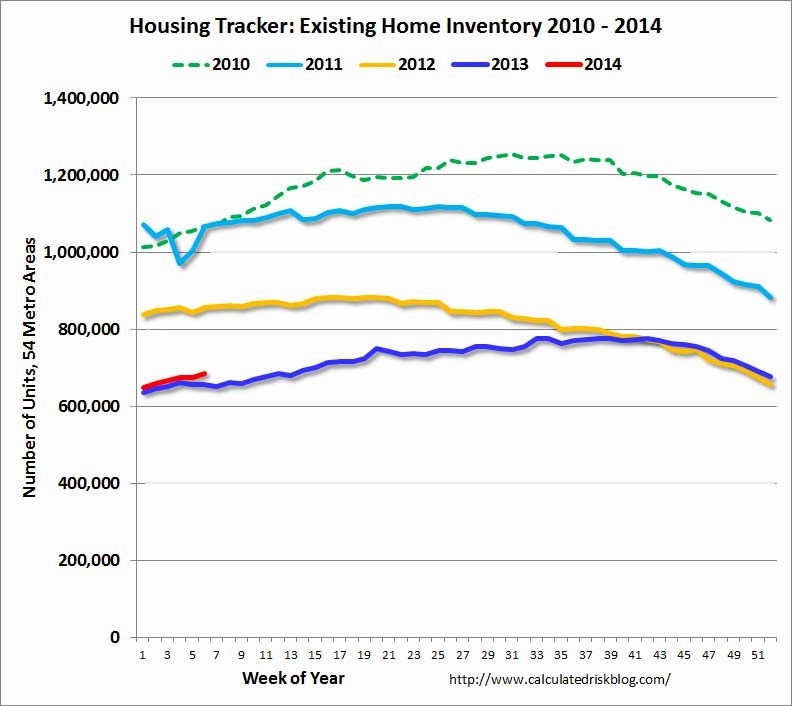
Calculated Risk and Housing Tracker report that existing-home for sale inventories have increased 4.7 percent in February. It is good news for those who worry that the lack of inventory will hold back existing-home sales this year.

inventories

Graph: Calculated Risk

The red line denotes 2014 inventory from Housing Tracker’s Department of Numbers. California cities led the increases, with San Francisco inventory up 7.1 percent, San Jose + 8.6 percent, and Sacramento + 8.8 percent. And as of February 10, San Francisco had the highest weekly price increase of 4.9 percent. Thank you, Silicon Valley, as such high-tech startups as Twitter are headquartered in San Francisco.

This should mean price increases will slow, however, as more supply comes on the market, and default ratios continue to decline. The median asking price for homes in the US peaked in June 2006 at $319,459 and is now 21.1 percent lower. From a low of $211,844 in January 2011, the median asking price in the US has increased by $40,327 (19.0 percent), says Housing Tracker.

Tracking total distressed sales is the best way to determine how quickly housing is recovering from the Great Recession. And California’s distressed sales have dropped sharply in a year, down to 22.2 percent of sales in December 2013, vs. 42.5 percent in December 2013, according to Calculated Risk. Sacramento, noted for overbuilding even in good years, had the sharpest drop with total distressed sales down to 22.2 percent of sales in Dec. 2013, vs. 51.5 percent in December 2012.

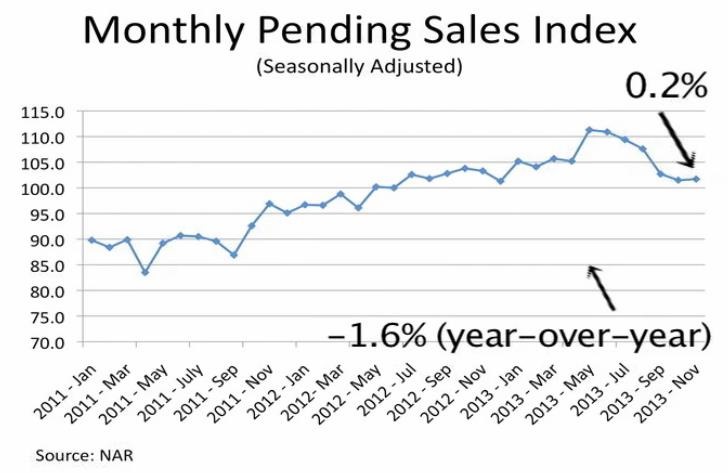
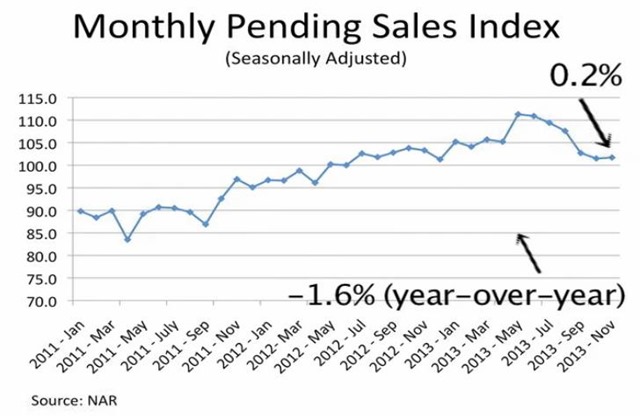
However, the NAR’s Pending Home Sales Index, a forward-looking indicator based on contract signings, fell 8.7 percent to 92.4 in December from a downwardly revised 101.2 in November, and is 8.8 percent below December 2012, as we said last week. The data reflect contracts but not closings, and are at the lowest level since October 2011, when the index was 92.2.

pendingsales

Graph: NAR

But we believe with the percentage of conventional (vs. distressed) sales’ inventories increasing, existing-home sales will pick up in 2014. And if not, then new-home sales will take up the supply slack, with new-home building permits issued increasing close to 1 million annually.

Sales of newly built, single-family homes fell 7 percent to a seasonally adjusted annual rate of 414,000 units in December, according to newly released figures from the U.S. Department of Housing and Urban Development and the U.S. Census Bureau. Despite the monthly drop, home sales in 2013 were up 16.4 percent over the previous year. But several factors seem to be slowing down new-home sales.

Some of the slowdown is due to winter weather, but also household formation has to pick up from its current 600,000 per year to a more normal 1 to 1.2 million new households being formed. This will happen as employment picks up and more young adults are able to leave home and live on their own.

Harlan Green © 2014

Follow Harlan Green on Twitter: https://twitter.com/HarlanGreen

Posted in Consumers, Economy, Housing, housing market, Weekly Financial News | Tagged , , , , , , | Leave a comment

Weak Employment–American Austerity at Work

Popular Economics Weekly

Is economic growth grinding to a halt, even as pundits predicted better growth in 2014? Nonfarm payrolls have advanced just 188,000 over the past 2 months, when this was the average montly increase in prior months. It does look like economic growth is slowing.

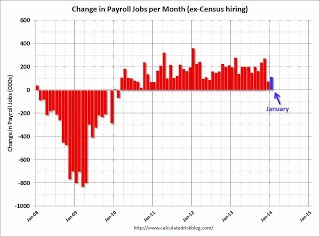
As in Europe, the U.S. is seeing the results of 4 years of austerity policies in the January unemployment report. Total nonfarm payroll employment rose by just 113,000 nonfarm payroll jobs in January, instead of the 180-200,000 predicted by the pundits, and the unemployment rate was little changed at 6.6 percent, the U.S. Bureau of Labor Statistics reported today.

This follows the change in total nonfarm payroll employment for November, revised from +241,000 to +274,000, and the change for December was revised from +74,000 to +75,000. With these revisions, employment gains in November and December were 34,000 higher than previously reported. This is not a good report, needless to say.

jobs2014

Graph: Calculated Risk

So what could have been with the initial $831 billion American Recovery and Reinvestment Act that stopped the Great Recession from becoming another Great Depression, ended when government gridlock set in after the 2010 election. The banks were saved with GW Bush’s $300 billion in TARP spending, but Main Street was left to fend for itself. Instead of more government stimulus, government spending was drastically cut when it came to stimulating job growth outside of Wall Street and the financial sector.

Instead, government employment in particular sank, losing some 700,000 jobs. And because so much government spending was cut, what followed was the most severe contraction in spending and investment since the 1930s.

The lessons from the New Deal was lost. When private investment and employment shrink, it’s up to governments to spend more to create those jobs and public projects that employment the unemployed, as was done in the 1930s with the Works Progress Administration and CCC Corps.

GDP

Graph: Econoday

Almost every community in the United States had a new park, bridge or school constructed by WPA. The WPA’s initial appropriation in 1935 was for $4.9 billion (about 6.7 percent of the 1935 GDP), and in total it spent $13.4 billion. Between 1935 and 1943, the WPA provided almost eight million jobs.

The 6.7 percent of today’s GDP would equal some $1 trillion, and it doesn’t take much to imagine what 8 million additional jobs would do to stimulate growth today, instead of the 700,000 government, or government-financed jobs lost.

During the course of the Great Recession, about 7.5 million jobs were lost in the nonfarm business sector. Job losses did not end until February 2010, by which point total jobs lost stood at about 8.7 million. Since then and after four years of growth in the aggregate economy, employment recovered by some 6 million, still short of the sharp decline we experienced.

Debt never become a problem, even with WWII, because the additional growth that such programs stimulated more than paid down that debt. The preoccupation with debt that occurred after 2010 was because those Republicans and conservative Democrats that helped GW Bush to create the huge deficits during his 8-year term would no longer support such spending. They now opposed anything that smacked of government aid.

The unemployed were suddenly lazy bums, and it was the middle class who foolishly created the housing bubble by buying homes with overinflated prices. (So they now had to pay the piper.)

It’s that kind of attitude that creates gridlock, of course. This is not how to recover an economy—especially when everyone but the top 1 percent has to pay the piper.

Harlan Green © 2014

Follow Harlan Green on Twitter: https://twitter.com/HarlanGreen

Posted in Consumers, Economy, Macro Economics, Politics, Weekly Financial News | Tagged , , , , , , , , | Leave a comment

Pending Home Sales Show Weakness

The Mortgage Corner

Where is a housing bubble? Some pundits have been saying that housing prices, up some 13 percent in a year, may have been rising too fast. This is mainly because too few homes on the market, and also the pent up demand from 5 years of recession. But the pundits could be wrong about a price bubble. A slowdown in sales is now showing up in the NAR’s Pending Home Sales’ Index that has been declining steadily over the past few months—since last June, basically—and that should slow down the price rises.

pendsales

Graph: NAR

The Pending Home Sales Index, a forward-looking indicator based on contract signings, fell 8.7 percent to 92.4 in December from a downwardly revised 101.2 in November, and is 8.8 percent below December 2012 when it was 101.3. The data reflect contracts but not closings, and are at the lowest level since October 2011, when the index was 92.2.

Lawrence Yun, NAR chief economist, said several factors are working against buyers. “Unusually disruptive weather across large stretches of the country in December forced people indoors and prevented some buyers from looking at homes or making offers,” he said. “Home prices rising faster than income is also giving pause to some potential buyers, while at the same time a lack of inventory means insufficient choice. Although it could take several months for us to get a clearer read on market momentum, job growth and pent-up demand are positive factors.”

The disruptive weather wasn’t reflected in personal consumption, up 3.3 percent in the initial 4th Quarter GDP estimated growth of 3.2 percent. So there has to be more at work.

Bill McBride of Calculated Risk listed more possible causes for the decline: “My view is there were several reasons for the decline in this index: weather in some areas, fewer distressed sales, less investor buying, fewer “pending” short sales, and low inventories.  I think fewer distressed sales, fewer “pending” short sales, and less investor buying are all signs of a healthier market – even if overall sales decline.”
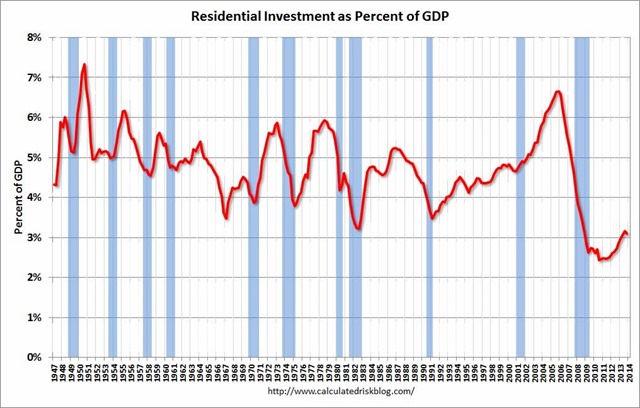
The 3.2 percent Q4 GDP growth was also heartening for 2014 growth prospects. In particular, the share due to real estate investment is growing again after plunging sharply before and during the Great Recession. Residential investment (RI) includes new single family structures, multifamily structures, home improvement, broker’s commissions, and a few minor categories.

The graph shows that 4-5 percent is the normal range vs. the current 3 percent, and that would mean real estate investment has more room to grow to return to normal levels.

RIinvest

Graph: Calcuated Risk

The Great Housing Bubble busted during the Great Recession is probably a once-in-a-lifetime event. Although the late 1980’s Savings & Loan crisis caused prices to fall, overall housing prices recovered quickly because there were no recessions at the time. The so-called Gulf War recession of 1991-92 occurred as housing prices were already recovering.

In fact, 1991 was really the beginning of the Great Housing Bubble that ultimately burst in 2007-08. So we know that housing prices rise and fall with business activity, as well as inflation rates. And we are still at the beginning of this recovery cycle with very low inflation. These are the signs of a “healthier” housing market as distressed sales decline, and we return to a more normal housing mix.

Harlan Green © 2014

Follow Harlan Green on Twitter: https://twitter.com/HarlanGreen

Posted in Consumers, Economy, Housing, housing market, Weekly Financial News | Tagged , , , , , , , , | Leave a comment

New-Home Sales In Seasonal Decline?

The Mortgage Corner

Sales of newly built, single-family homes fell 7 percent to a seasonally adjusted annual rate of 414,000 units in December, according to newly released figures from the U.S. Department of Housing and Urban Development and the U.S. Census Bureau. Despite the monthly drop, home sales in 2013 were up 16.4 percent over the previous year.  But several factors seem to be slowing down new-home sales.

This is while November sales were revised down from 464 thousand to 445 thousand, and October sales were revised down from 474 thousand to 463 thousand, raising fears that rising interest rates were crimping new-home sales. But prices were still rising. So this probably meant that new homes were becoming less affordable, maybe the reason for slower sales.

newhomes

Graph: Calculated Risk

“December’s decline in new-home sales follows elevated levels in the previous two months and means the fourth quarter was still much stronger than the third,” said Rick Judson, chairman of the National Association of Home Builders (NAHB). “While we expect sales to gain strength in 2014, builders still face considerable constraints, including tight credit conditions for home buyers, and a limited supply of labor and buildable lots.”

“Consumers are getting used to more realistic mortgage rates, which still remain favorable on a historical basis,” said NAHB Chief Economist David Crowe. “As household formations and pent-up demand continue to emerge, we anticipate that 2014 will be a strong year for housing.”

Regionally, new-home sales activity fell 36.4 percent in the weather-battered Northeast, 7.3 percent in the South and 8.8 percent in the West. The Midwest posted a gain of 17.6 percent. So much of the sales’ decline could also be due to the polar vortex and other abnormal weather factors.

And then we have the problem of lower inventories, as builders aren’t completing new homes fast enough. The inventory of new homes fell to 171,000 units in February, which is a five-month supply at the current sales pace. Although this is an increase over the previous month, it is due to the slower sales pace in December.

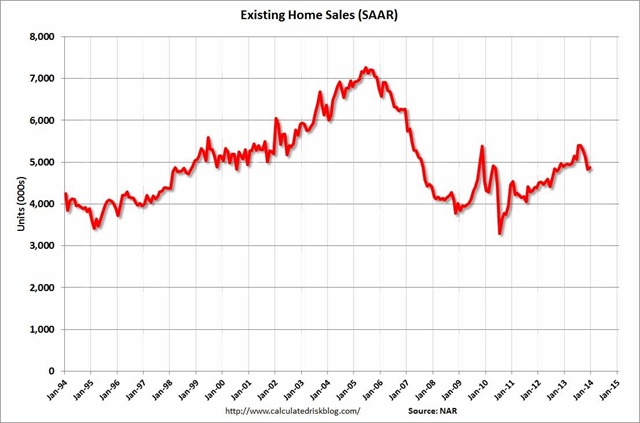
The good news is that the National Association of Realtors (NAR) had reported there were 5.09 million existing-home sales for all of 2013, which is 9.1 percent higher than 2012. It was the strongest performance since 2006 when sales reached an unsustainably high 6.48 million at the close of the housing boom, and is now back to the 2000 sales rate at the beginning of the housing bubble, but existing-home inventories have declined there, also.

Total existing-home inventories at the end of December fell 9.3 percent to 1.86 million existing homes available for sale, which represents a 4.6-month supply at the current sales pace, down from 5.1 months in November. This will create even more demand for new-homes.
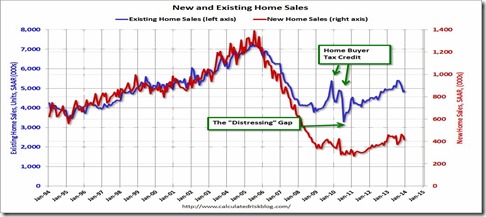
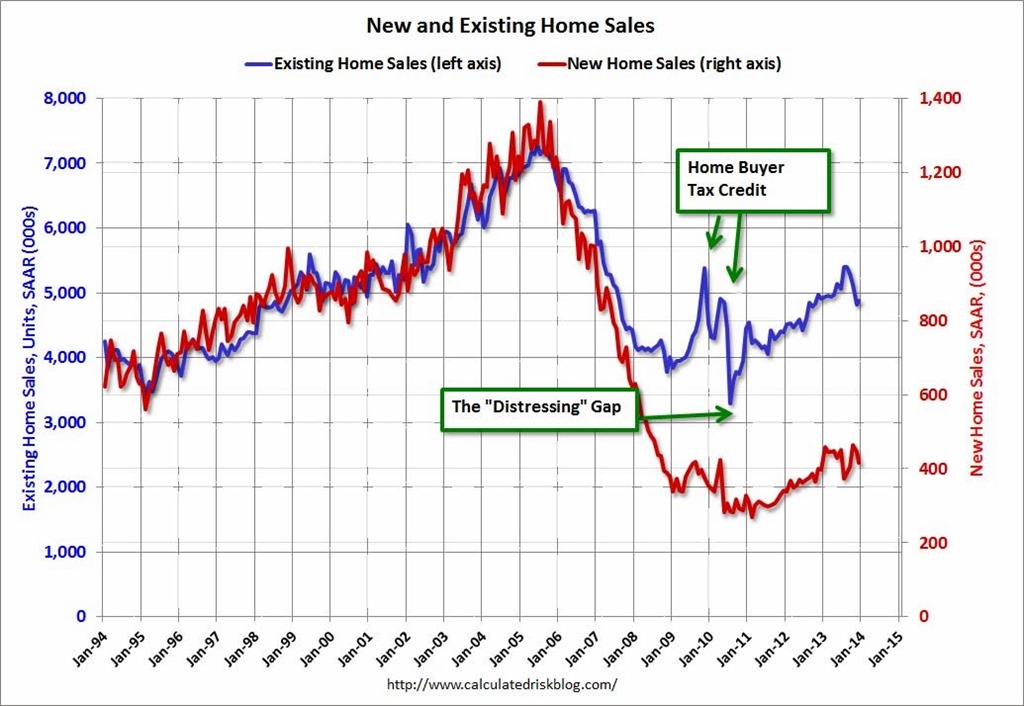
salesgap

Graph: Calculated Risk

So there is still a huge gap between new and existing-home sales, which should mean that with housing starts rising above 900,000 in 2013, new-home sales have to increase substantially this year.

The biggest question left, other than the effects of rising interest rates and low inventories on sales, is whether household formation will recover. Housing economists and the U.S. Census Bureau predict more than 1 million new households per year will be formed over the next 10 years, at least, says the 2013 Harvard Joint Center For Housing Studies report. After holding near 600,000 for the previous five years, household growth picked up to almost 1.0 million in 2012. Stronger immigration helped to boost the pace of growth, with the foreign-born population registering its largest increase since 2008.

Based on the Census Bureau’s latest population projections and recent estimates of headship rates, demographic drivers support household growth of approximately 1.2 million a year over the remainder of the decade—similar to the rates in the 1990s as well as in the years preceding the Great Recession. And that should further boost sales, as 50 percent of new households usually buy a home, according to past history.

Interest rates will also play a big part on home sales this year, but probably not rise much above current rates, even with higher economic growth. This is in large part because incomes are rising just 2 percent per year, after inflation. It makes both new and existing homes much less affordable. The 30-year conforming fixed rate has declined of late, and is averaging 4.0 percent in California for a 0.5 point origination fee, and high-balance 30-year conforming is averaging 4.125 percent for a 1 point origination fee, but that is still higher than earlier in the year.

And with both Fannie Mae and Freddie Mac charging higher fees, and imposing stricter qualification requirements, results are still out on whether current sales’ rates can be maintained.

Harlan Green © 2014

Follow Harlan Green on Twitter: https://twitter.com/HarlanGreen

Posted in Consumers, Economy, Housing, housing market, Weekly Financial News | Tagged , , , , , , , | Leave a comment

Where Are The Brave Ones?

Popular Economics Weekly

Now that China has replaced 1980s Japan as the economy that might surpass us, can we find one brave policy maker, (including President Obama), that’s willing to sound the alarm? China now has a robot roaming the moon, and various predictors say it could surpass the U.S. as the world’s largest economy in a matter of years. China is even predicted to lead the world in technological innovation within 40 years.

Yet no one in Washington seems to be concerned. We would rather obsess over debt than the main reason the U.S. is falling behind—the huge cutback in government research and infrastructure spending that would keep us competitive in world markets, as well as remain the world’s most sustainable democracy. And sustaining our democracy is really the main job of government, which means protecting the welfare of its citizens at home should be at the top of the policy list.

Government cutbacks are also the main reason for our soaring inequality and social immobility, as domestic austerity policies have endangered the social safety net while conservative state governments inhibit collective bargaining, voters’ and women’s rights.

There is no question that government research and development is the main driver of technological innovation; from the moon landing to development of the Internet to genome discoveries, yet research spending has been declining for years. It’s a sad picture, highlighted by what was really a worldwide Great Recession. Because we sneezed, the rest of the world caught our cold.

Harvard economist Jeff Sachs is one of a small number of economists brave enough to sound the alarm, and pronounce ways to increase government’s role in bringing back sustainable economic growth in a recent New York Review of Books article:

“A majority of public opinion favors action on the issues I have outlined: more taxation of the very rich, and more spending on education, clean energy, and job training. The public wants a smaller military and less meddling overseas. The problem is not with public opinion but with the narrow self-interest and social outlook of powerful corporations, interest groups, financial lobbyists, and large investors.

He also excoriates President Obama for allowing those very same lobbyists and special interests to vitiate his own progressive goals of creating jobs and alleviating poverty.

“Rather than taking on the problem of inflated health care costs, he (Obama) brought in the health care industry to support the expansion of health coverage. Rather than taking on the egregious tax abuses of the corporate sector and the very rich, he settled in January 2013 for an almost symbolic rise in taxes for those with incomes above $400,000. Rather than reforming the budget, he pursued a deficit-financed two-year stimulus that provoked the Republicans, piled up public debt, and achieved next to nothing for the long term.”

One can say that Republicans would have been provoked, no matter what he proposed, but certainly maintaining a strong economy and more progressive taxation policies (that would have reduced the record inequality) wasn’t at the top of President Obama’s goal list until now. But the hope is it will become a center piece in his upcoming State of the Union speech on Tuesday.

An American University blog piece catalogues China’s growth in research spending. By 2011, China had already become the world’s second highest investor in R&D. Government research funding has been growing at an annual rate of more than 20 percent. At the end of 2012, for example, 7.28 billion yuan was spent on promoting life and medical sciences, nearly 10 times the 2004 level. Even more troubling (for the United States), in 2011, 21 percent of the applications were supported, and for young scientists, the application success rate was 24 percent, both of which were higher than the U.S. level. It was predicted that if the U.S. federal government R&D spending continues to languish, China may overtake the U.S. to be the global leader in R&D spending by 2023.”

Need we say more about the priorities that are not at all conflicting? Less income and wealth inequality leads to stronger economic growth, higher tax revenues, and lower budget deficits. It even led to 4 years of budget surpluses under President Clinton. And the paths to more opportunity are now well-known. So where are the brave policy leaders that will show the rest of U.S. how to get there?

Harlan Green © 2014

Follow Harlan Green on Twitter: https://twitter.com/HarlanGreen

Posted in Consumers, Economy, Keynesian economics, Macro Economics, Weekly Financial News | Tagged , , , , | Leave a comment

2013 Home Sales Highest Since 2006

The Mortgage Corner

The National Association of Realtors (NAR) just reported that for all of 2013, there were 5.09 million sales, which is 9.1 percent higher than 2012. It was the strongest performance since 2006 when sales reached an unsustainably high 6.48 million at the close of the housing boom, and is now back to the 2000 sales rate at the beginning of the housing bubble.

existsales

Graph: Calculated Risk

Lawrence Yun, NAR chief economist, said housing has experienced a healthy recovery over the past two years. “Existing-home sales have risen nearly 20 percent since 2011, with job growth, record low mortgage interest rates and a large pent-up demand driving the market,” he said. “We lost some momentum toward the end of 2013 from disappointing job growth and limited inventory, but we ended with a year that was close to normal given the size of our population.”

But for sale inventories have declined and are putting upward pressure home prices. The national median existing-home price for all of 2013 was $197,100, which is 11.5 percent above the 2012 median of $176,800, and was the strongest gain since 2005 when it rose 12.4 percent.

The is in large part because total housing inventory at the end of December fell 9.3 percent to 1.86 million existing homes available for sale, which represents a 4.6-month supply at the current sales pace, down from 5.1 months in November. Unsold inventory is 1.6 percent above a year ago, when there was a 4.5-month supply.

The median existing-home price for all housing types in December was $198,000, up 9.9 percent from December 2012. Distressed homes – foreclosures and short sales – accounted for 14 percent of December sales, unchanged from November; they were 24 percent in December 2012. The shrinking share of distressed sales accounts for some of the price growth.

Ten percent of December sales were foreclosures, and 4 percent were short sales. Foreclosures sold for an average discount of 18 percent below market value in December, while short sales were discounted 13 percent.

Interest rates will play a big part on home sales this year, needless to say, but will probably not rise much above current rates, even with higher economic growth. This is because of the tremendous cash hoard of businesses that obviates their need to borrow, as well as consumers that are borrowing much less than in the past. The 30-year conforming fixed rate is averaging 4.0 percent in California for a 0.5 point origination fee, and high-balance 30-year conforming is averaging 4.125 percent for a 1 point origination fee.

Harlan Green © 2013

Follow Harlan Green on Twitter: https://twitter.com/HarlanGreen
Posted in Consumers, Economy, Housing, housing market, Weekly Financial News | Tagged , , , , , , | Leave a comment