So-called Qualified Mortgages Are a Problem

The Mortgage Corner

The new rules coming into effect in January 2013 for most conforming loans—i.e., those guaranteed by Fannie Mae and Freddie Mac will cause a definite drop in mortgage lending. The Consumer Protection Financial Bureau, created under Dodd-Frank has labeled such mortgages as Qualified Mortgages.

Financial institutions in the business of originating mortgages that they plan to resell on the secondary market to government-sponsored mortgage buyers Fannie Mae and Freddie Mac will have to raise their standards for approving loans. That is likely to have the biggest impact on working-class families, many of whom are struggling with consumer debt and are living paycheck to paycheck.

Two of the most important new rules created by the Consumer Financial Protection Bureau related to housing are the Ability-to-Repay rule and the 3 percent test rule.

The Ability-to-Repay rule, also known as the Qualified Mortgage rule, says borrowers’ total debt liability — including housing — should not exceed 43 percent of income. A Qualified Mortgage is one that would be qualified for resale on the secondary mortgage market.

Yet borrowers with up to 50 percent total debt liability (DTI), excellent credit and savings that qualify today, would be excluded. And other rules, such as no interest only programs, no more than 30-year amortizations, lower debt-to-income qualification levels, and perhaps lower maximum loan to value amounts, will severely restrict homeownership.

So the regulations also could have the unintended effect of making it more difficult for many working-class families to qualify for mortgage loans offered by major banks, as an example. This is because higher income is required, hence such families will qualify for lower-priced homes.

The 3 percent test rule says 3 percent of the mortgage amount is the maximum amount of fees that banks can charge a borrower in order for the home loan to be classified as a Qualified Mortgage that can be resold in the secondary market.

“If you are a bank that pretty much originates and sells your mortgages, you are now playing under these rules,” said Ernie Hogan, executive director of Pittsburgh Community Reinvestment Group. “If you are a bank that originates mortgages but keeps them and holds them for 30 years, you can vary from some of these rules.”

Mr. Hogan believes this rule will make lower-priced homes more expensive for banks because they will not make as much money on that kind of business.

“It will hurt working-class families buying homes for $75,000 or less,” he said. “Those loans will be classified as a high-cost loan. You are going to lose people in the mortgage industry looking at that segment. That’s what we think will happen. Banks will make a better spread on higher-priced homes.”

Don Frommeyer, president of the National Association of Mortgage Brokers, said the 3 percent rule also will be a problem for mortgage brokers. He said brokers will have a harder time collecting their fee on homes priced below $160,000 because every cost to the customer in the home buying process goes toward the 3 percent. For a mortgage of $100,000, for example, all origination fees — including the mortgage broker fee — would be limited to a total of $3,000.

This will also mean a step backward in the incipient housing recovery, as qualification standards were already tightened by the Federal Reserve last year for conventional loans guaranteed by Fannie and Freddie, in an attempt to lessen mortgage fraud and predatory lending practices.

But predatory lending wasn’t much of a problem before subprime loan programs were introduced in early 2000 that were basically liar loans, with little or no attempt to verify incomes and assets. Conversely, loans underwritten to Fannie Mae and Freddie Mac standards have never had this problem, with default rates not much higher than historical averages since the housing bubble.

So there is conjecture that a major reason for even more restrictive rules is an attempt to get Fannie and Freddie, now wards of the government, completely out of the mortgage purchase and guarantee business. But who then would be left, since they have been guaranteeing more than 90 percent of all mortgages originated since the end of the Great Recession. Need we say any more restrictions on them could step this real estate recovery in its tracks?

Harlan Green © 2013

Follow Harlan Green on Twitter: www.twitter.com/HarlanGreen
Posted in Consumers, Housing, housing market, Politics, Weekly Financial News | Tagged , , , , , , | Leave a comment

Econ Robert Shiller’s Nobel Prize a Big Win

Popular Economics Weekly

Although much of what Yale economist Robert Shiller writes is about the importance of financial markets, he won the Nobel Prize in Economic Sciences for studying how financial markets misbehave. He is a pioneer in the new field of Behavioral Economics, or behavioral finance, as he has sometimes calls it.

“Mr. Shiller, 67, later introduced an important caveat to the idea that markets operate efficiently, finding that stock and bond prices show greater predictability over longer periods,” said the New York Times, in commenting on the award to Dr. Shiller, Eugene Fama, and Lars Peter Hansen. “Mr. Shiller and other economists see evidence that these movements cannot be entirely explained by rational decision-making, and instead reflect the irrational behavior of market participants.”

His recognition will ultimately swing the pendulum of economic thought away from the so-called Austrian school of free market economics that conservatives have long worshipped to justify their belief that small government and little taxes were the most “efficient” way to distribute wealth. We know the result of those theories—Inequality For All, to paraphrase Robert Reich’s latest book and film now in theatres.

He also boosted Keynesian economics with Animal Spirits: How Human Psychology Drives the Economy, and Why It Matters for Global Capitalism, written with Nobelist George A. Akerlof in 2009, which documented how financial behavior is tied to the vagaries of human nature, a clear tribute to John Maynard Keynes and his theory of animal spirits—today termed a greater or lesser confidence in an unknown future.

His biggest claim to fame comes from his 2000 book, since revised, Irrational Exuberance, which predicted the dot-com bubble bust. In it he looked at the empirical behavior of stock prices over the past 100 years. It showed that S&P price-to-earnings ratios had soared to unsustainable levels—as much as 44 to 1, almost double that of the Black Monday stock market collapse at the beginning of the Great Depression.

“The high recent valuations in the stock market,” said Shiller in Irrational Exuberance, “have come about for no good reasons. The market level does not, as so many imagine, represent the consensus judgment of experts who have carefully weighed the long-term evidence. The market is high because of the combined effect of indifferent thinking by millions of people, very few of whom feel the need to perform careful research on the long-term investment value of the aggregate stock market, and who are motivated substantially by their own emotions, random attentions, and perceptions of conventional wisdom.”

He also specialized in real estate and wrote books such as The Subprime Solution: How Today’s Global Financial Crisis Happened, and What to Do about It, and with Karl Case set up the S&P Case-Shiller Home Price Index that tracks national same-home sale prices for 10 and 20 metropolitan districts.

But I predict that he will become known for an even greater contribution to economic thought. It is for his book, The New Financial Order, Risk in the 21st Century, Princeton U. Press (2003). In it, he uses his empirical knowledge and Big Data to tell us how to create hedging and insurance mechanisms that protect against major risks that have pummeled the financial markets.

“…the insights of finance have been applied in only a limited way,” says Professor Shiller in his introduction. “Finance has substantially neglected the protections of our ordinary riches, our careers, our homes, and our very abilities to be creative as professionals. We need to democratize finance and bring the advantages enjoyed by the clients of Wall Street to the customers of Wal-Mart”.

And that will continue to be is his real contribution to a world where equality is good for everyone. Understanding how markets misbehave will rip the shroud away from those who have been able to profit from the public’s lack of knowledge about how financial markets actually perform.

Harlan Green © 2013

Follow Harlan Green on Twitter: www.twitter.com/HarlanGreen
Posted in Consumers, Housing, Keynesian economics, Macro Economics, Politics, Weekly Financial News | Tagged , , , , , , , | Leave a comment

Fed Chairman Yellen Will Boost Economic Growth

Financial FAQs

If we need any more evidence that Janet Yellen should be the next Federal Reserve Chairperson, it was the decision by the Fed Governors to continue their easing at the conclusion of their September 18 FOMC meeting, just 3 days after Larry Summers withdrew his candidacy for Fed Chairman.  Their action was basically an endorsement of Yellen’s policies as the Fed’s current Vice Chairperson that confounded the pundits who were sure the Fed would begin it’s ‘taper’ of bond purchases in September. 

In a word, Dr. Yellen has always been pro-job creation, and that is the big change in economic policymaking that should make this economic recovery self-sustaining, as opposed to Republican Paul Ryan’s latest budget proposal that is in fact anti-jobs. Instead, he wants to focus on reducing the budget deficit by cutting entitlement benefits for the elderly in return for lifting some of the sequester (i.e., Budget Control Act) spending cuts. 

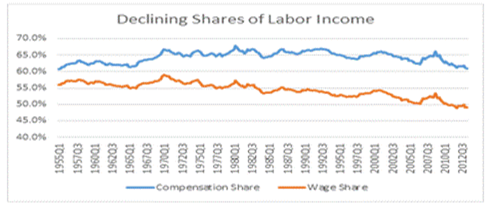
But that doesn’t reduce the current debt or boost hiring directly, although lifting spending cuts and ending the government shutdown will bring back all those furloughed workers.  Labor’s share of national income has been steadily falling, which reduces the buying power of consumers who power 70 percent of economic activity, and so the overall demand for goods and services.

image

Graph: Economix

           Economist Jared Bernstein said as much in a recent New York Times column, illustrated in the Economix graph from 1995 to Q3 2012:  “In fact, as many inequality watchers have noticed, profits as a share of income are at or near record highs while the compensation share is around a 50-year low.” And as Robert Samuelson also reported in the Washington Post, “…labor’s share has plunged in the past decade. In 2013, it’s 57 percent (vs. 63 percent in 2000). This shifts about $750 billion annually from labor to capital.” 

The so-called supply-side policies of smaller government and lower taxes that have favored producers over employees are out of touch with the real economic problems today.  It is mainly a lack of demand, rather than the supply of goods and services that has stunted this recovery.  We are in fact awash in cheap goods produced globally.

The best sign that we have a demand problem that no longer requires lowest taxes for the producers and corporations is almost no sign of inflation and record low worldwide interest rates.  These indicators signal the sluggish circulation of money and so reduced demand.  Most of it is being saved, or hoarded.  Banks have almost $1 trillion in excess reserves that would normally be loaned out or invested, while corporations have more than $2 trillion in cash and cash ready reserves not being invested.

Why?  Because labor has been left out of the recovery as almost everyone knows.  Thomas Piketty and Emmanuel Saez have documented that 95 percent of the wealth created since 2009 have gone to the top 1 percent, while household incomes have fallen.  That is why debt is even a problem.  Simply put, debt can’t be paid down unless tax revenues increase.  Paul Ryan and the Tea Party stalwarts have it all wrong.  Cutting back on government spending directly translates to fewer jobs and less tax revenues, as the current shutdown illustrates.

How to right the imbalance in order to boost growth?  Raise the minimum age for starters, as I’ve said in past columns, and raise some of the tax rates. Or, close those tax loopholes that have the wealthy such as Mitt Romney and Warren Buffet with lower tax rates than their employees. Our policymakers and politicians have enough choices, if they choose to act.

But until such happens, we have only the newly nominated Janet Yellen to rely on to keep interest rates low enough to create a sustainable recovery.

Harlan Green © 2013

Follow Harlan Green on Twitter: www.twitter.com/HarlanGreen
Posted in Consumers, Economy, Politics, Weekly Financial News | Tagged , , , , , , , , | 1 Comment

Is This A New Civil War?

Popular Economics Weekly

The New York Times stated in a 2010 poll that the 18 percent of Americans who identify themselves as Tea Party supporters tend to be Republican, white, male, married and older than 45. History tells us the last time white males were willing to destroy the economy and maybe country. It was the United States Civil War, of course. Then it was about such men attempting to preserve slavery and state rights. Today, it is about not giving more rights to minorities and the poor.

Then it was about the south, desperate to preserve their privileges, today those Tea Party Republicans are desperate to preserve their traditions of power—low taxes and small government—even though our modern economy can’t function without an effective government that makes the rules that allow financial markets as well as our overall society to function smoothly.

So they are now desperate enough to use the debt ceiling as their Weapon of Mass Destruction. Not okaying an increase means the government is shut down, as well as the U.S. financial system that depends on debt to finance operations. And there are those on the right, such as Tea Party Republican Ted Cruz that would like to see this happen.

“The debt ceiling historically has been among the best leverage that Congress has to rein in the executive,” said Cruz to CNN’s Candy Crowley recently. “There’s great historical precedent. Since 1978 we’ve raised the debt ceiling fifty-five times. A majority of those times, twenty-eight times, Congress has attached very specific and stringent requirements, many of the most significant spending restraints, things like Gramm Rudman [i.e. the Gramm-Rudman-Hollings Balanced Budget Act], things like sequestration, came through the debt ceiling.”

The last Civil War cost some 600,000 lives. If prolonged, this civil war would cost millions of jobs. In a new report, the Treasury Department studied the economic fallout from a similar debt ceiling impasse in 2011 — when the nation came within days of defaulting on its obligations — and said that the country could see similar effects this year if lawmakers wait until the final hours to raise the debt ceiling.

“A default would be unprecedented and has the potential to be catastrophic: credit markets could freeze, the value of the dollar could plummet, U.S. interest rates could skyrocket, the negative spillovers could reverberate around the world, and there might be a financial crisis and recession that could echo the events of 2008 or worse,” the report said.

Yet as the New York Times reported, a loose-knit coalition of conservative activists led by former Attorney General Edwin Meese III and leaders of more than three dozen conservative groups put together a plan to defund Obamacare in 2012.

“It articulated a take-no-prisoners legislative strategy that had long percolated in conservative circles: that Republicans could derail the health care overhaul if conservative lawmakers were willing to push fellow Republicans — including their cautious leaders — into cutting off financing for the entire federal government.”

Yet this hasn’t sunk in to the general public, apparently. The 18 percent of the electorate, those Tea Party males, are willing to fight another civil war they cannot win, but could cause great damage to all of U.S.

So how long might this civil war last? “You’re here because now is the single best time we have to defund Obamacare,” declared Mr. Cruz, at a recent fundraiser. “This is a fight we can win.”

Will we need another Abe Lincoln to save the Union?

Harlan Green © 2013

Follow Harlan Green on Twitter: www.twitter.com/HarlanGreen

Posted in Economy, Keynesian economics, Macro Economics, Politics, Weekly Financial News | Tagged , , , , , , | Leave a comment

It’s Not About Obamacare!

Financial FAQs

We know the federal government’s shutdown isn’t really about Obamacare. We know this because Tea Party Republicans have been trying to shut down government since the 2010 election, as MSNBC’s Rachel Maddow and others have pointed out. The uncertainties around such a major new social program as Obamacare has become the issue they are using to shut it down.

It’s even in their campaign promises. “We’re very excited,” Rep. Michele Bachmann (R-Minnesota), one of their leaders, told the Washington Post after the shutdown. “It’s exactly what we wanted, and we got it.”

“President Obama can’t wait to get Americans addicted to the crack cocaine of dependency on more government health care,” she said. “All they want to do is buy love from people by giving them massive government subsidies.”

Who are the Tea Partiers? The New York Times stated in a 2010 poll that the 18 percent of Americans who identify themselves as Tea Party supporters tend to be Republican, white, male, married and older than 45.

So why shut down all of the federal government then? Many of its constituents live in those Red States with lower incomes that depend so much on government programs like social security, Medicare, and now the Affordable Care Act for insurance coverage. In fact, the 26 states who have rejected the Medicaid expansion for poorest Americans have about half of the population, but 60 percent of the uninsured, says the New York Times. These are the so-called ‘have-not’, mostly Republican-led states in the Midwest and south.

Wikipedia states the Tea Party is not a political party, but a movement named after the Boston Tea Party. “It is an American decentralized political movement that is primarily known for advocating a reduction in the U.S. national debt and federal budget deficit by reducing U.S. government spending and taxes.”

This is the Adam Smith philosophy from his The Wealth of Nations, written in 1776, of all years. And that has been the credo of conservatives since then. The problem is that most of the national debt and budget deficit was caused by Republican administrations who espoused Adam Smith’s philosophy of lower taxes without cutting government spending.

The resultant record income inequality that helped to cause the Great Recession has left the rich and powerful free to accumulate as much wealth as they can, but not pay for the services that enabled them to do so, as was so clearly said by Senator Elizabeth Warren in a famous campaign talk.

“You built a factory out there? Good for you,” she says. “But I want to be clear: you moved your goods to market on the roads the rest of us paid for; you hired workers the rest of us paid to educate; you were safe in your factory because of police forces and fire forces that the rest of us paid for. You didn’t have to worry that marauding bands would come and seize everything at your factory, and hire someone to protect against this, because of the work the rest of us did.”

“…you built a factory and it turned into something terrific, or a great idea? God bless. Keep a big hunk of it. But part of the underlying social contract is you take a hunk of that and pay forward for the next kid who comes along.”

So it is really about a much earlier economic system I’ve called medieval economics in past columns, which had a very different social contract. It was the philosophy that protected the privileged who were thought to be divinely protected in Adam Smith’s day. The less privileged were to be protected by an “invisible hand” of enlightened self-interest. That is, it should be in the interest of the powerful to take good care of their constituents. But that hasn’t happened with the Tea Partiers, at least, who don’t want to finance programs that aid the under privileged.

This is also the core Tea Party philosophy that believes the U.S.Constitution protects those privileges. Indeed, during its formation, this country was governed by the privileged who wrote the Constitution—those albeit enlightened white males who owned land. And that is the medieval system the Tea Party wants to restore, whether they realize it or not.

Harlan Green © 2013

Follow Harlan Green on Twitter: www.twitter.com/HarlanGreen

Posted in Consumers, Economy, Keynesian economics, Macro Economics, Politics, Weekly Financial News | Tagged , , , , , , , , , | Leave a comment

Mortgage Delinquencies Continue Decline

The Mortgage Corner

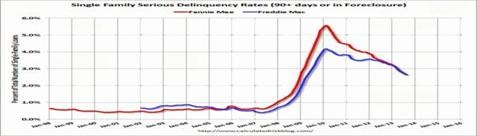
Freddie Mac reported that the Single-Family serious delinquency rate declined in August to 2.64 percent from 2.70 percent in July.   This has in large part to do with lower interest rates, which have declined again because the Fed decided not to begin to end its QE3 purchase program.

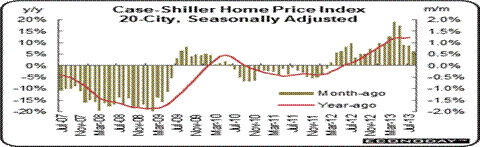
But it is also because housing prices are still rising strongly, with the Case-Shiller index up some 12.3 percent annually, and FHFA housing price index for conventional loans insured by Freddie Mac or Fannie Mae up 8.8 percent annually. This leaves about 5 million homes still with underwater mortgages, and so susceptible to serious delinquencies and outright foreclosure. But if economic activity continues to improve, then so will housing prices.

But rising housing prices are a two-edged sword, because though this helps existing home owners, it could become more difficult for homebuyers, since household incomes aren’t rising as well.

clip_image002

Graph: Econoday

Freddie’s serious delinquency rate is down from 3.36 percent in August 2012, and this is the lowest level since April 2009. Freddie’s rate peaked in February 2010 at 4.20 percent. These are mortgage loans that are three monthly payments or more past due or in foreclosure, said Freddie Mac.

clip_image004

Graph: Calculated Risk

Mortgage rates for a 30-year fixed conforming mortgage have declined to approximately 4.125 percent for 0 origination points in some California areas, from as high as 5 percent 2 weeks ago.  This still keeps the MBA Housing Affordability Index at its most recent low of 155 percent, which means households with a $62,868 annual median income can buy a home that is 155 percent higher than the national median price for existing-homes, or $331,700. The national median existing-home price has risen to $214,000, an increase of 25 percent from its 2012 low, which is why the Affordability Index isn’t rising.

clip_image006

Graph: Calculated Risk

Even if fewer prospective homebuyers are eligible to purchase, rental housing construction will benefit as rental vacancies are shrinking nationally and rents are rising. Reis, the commercial real estate research company, reported that the apartment vacancy rate declined in Q3 to 4.2 percent from 4.3 percent in Q2.  While in Q3 2012 (a year ago) the vacancy rate was at 4.7 percent. The rate peaked at 8.0 percent at the end of 2009.

The question is now where will those forming new households live with rising rents and rising home prices? This will in large part be dependent on the employment picture, as household incomes can’t rise, unless households are more fully employed. And we won’t see much improvement in employment, as long as the Federal Reserve is the only government entity providing stimulus by keeping interest rates at historic lows.

Harlan Green © 2013

Follow Harlan Green on Twitter: www.twitter.com/HarlanGreen
Posted in Consumers, Economy, Housing, housing market, Politics, Weekly Financial News | Tagged , , , , , , | Leave a comment

Debt Ceiling, Obamacare Debates Will Boost Government’s Role

Popular Economics Weekly

Tea Party Republicans apparently aren’t aware of the damage they inflict on their own party and constituents in attempting to shut down the federal government, if Obamacare isn’t delayed or repealed. For a shutdown will prove once and for all the importance of government, that institution feared and loathed in equal parts by Tea Partiers.

For starters, government spending and contracts contribute about 20 percent to economic activity, while consumers contribute some 70 percent. This is not just defense contracts, social security and Medicare, but up to $2.2 trillion in deferred infrastructure improvements such as ancient bridges and unpaved roads estimated by the American Society of Civil Engineers, in education programs and private research and development.

In fact, without the impact of federal cuts and higher taxes already passed, Mesirow Financial economist Diane Swonk estimates annual economic growth would be close to 4 percent, above the 2.5 percent pace she is expecting in 2013. Like most economists, Ms. Swonk says she does not think the economy will fall back into recession or experience a pronounced rise in unemployment, unless the shutdown is prolonged.

But we have an example of what could happen with the 1995 shutdown engineered by then House Speaker Newt Gingrich, says Ms. Swonk. In late 1995, the government closed for five days in November and again from mid December to early January 1996. If this happens again, all government employees are vulnerable to furloughs (forced, unpaid leave).

Essential workers in national security, public health and safety, including air traffic control workers, may be forced to work without pay. That would mean a hit to employment and income as we approach the critical holiday season. Social security and other transfer checks were also delayed 18 years ago, as those few left in government offices to work without pay couldn’t process the volume necessary to cut the checks.

image

Graph: Business Insider

And Chicago Fed President Charles Evans provided this chart to show the sharp drop in government consumption that has largely been responsible for subpar economic growth after the Great Recession.

Yet Obamacare will proceed on October 1, because it’s funding is already mandated and outside the province of Republicans to obstruct.

The New York Times said it best in a recent editorial. “That means the country will be stuck with the sequester-level cuts for the foreseeable future. It means more than 57,000 students will not get their Head Start seats back, and 140,000 low-income families who lost their federal housing assistance will be stuck in unaffordable or substandard homes. Thousands of scientists have been laid off and vital medical research projects have stalled. More than 85 chief Federal District Court judges signed a letter last month saying their cuts have been so deep that public safety is now at risk.

“A continued sequester will force unnecessary and damaging furloughs of all F.B.I. employees, and of 650,000 civilian employees of the Defense Department. And it means the economy will continue to sputter. The Congressional Budget Office estimated that ending the sequester could create up to 1.6 million jobs.”

It was conservative stalwart President Reagan who first lamented the fact that Republicans and Democrats couldn’t compromise in earlier budget battles, when he posited that it might take another war or alien invasion to get them to work together. Then he realized he could win the Cold War by out-arming Russia, and government spending came to the rescue once again.

Harlan Green © 2013

Follow Harlan Green on Twitter: www.twitter.com/HarlanGreen
Posted in Consumers, Economy, Keynesian economics, Macro Economics, Politics, Weekly Financial News | Tagged , , , , , , | Leave a comment

Are Excessive Corporate Profits Hurting Growth?

Popular Economics Weekly

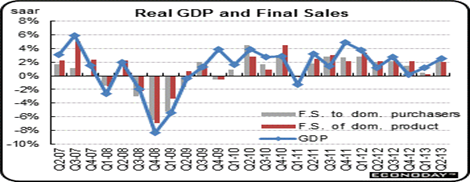
The third estimate for real GDP growth for the second quarter was left unchanged at an annualized rate of 2.5 percent compared to the second estimate and compared to a first quarter rise of  1.1 percent. But even 2.5 percent growth is not enough to increase job creation or bring down the unemployment rate further.

image

Graph: Calculated Risk

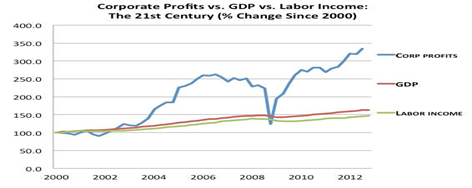
Full employment has always been associated with 3 percent plus growth. It has averaged 3.2 percent over the last 75 years, so there is a growing concern that the segment of economic growth that has expanded, corporate profits, may be the culprit. For though corporate profits have expanded to record levels, household incomes as well as wage and salary growth, have stagnated. Various studies verify income growth has not even kept up with inflation since the 1970s, or the productivity growth that is the reason for much of corporate profit growth.

image

Graph: The Atlantic

Above all, there is concern that too much of the taxation burden will fall on individuals. Going forward, the Obama administration predicts that Washington will rely more on individual income taxes and less on corporate taxes, yet corporations are investing less of their profits on expansion, more on CEO salaries and dividends for their shareholders. This hasn’t expanded economic growth since 2000, at least.

Between fiscal 2010 and fiscal 2018, individual income taxes will rise from 41.5 percent of federal revenues to 49.8 percent, an increase of 8.3 percentage points, the president’s proposed fiscal 2014 budget shows. Corporate income taxes – assuming current statutory rates – are expected to grow by only 2.4 percentage points from 8.9 percent in 2010 to 11.3 percent of federal revenues in 2018.

As a percentage of national income, corporate profits stood at 14.2 percent in the third quarter of 2012, reports the New York Times, the largest share at any time since 1950, while the portion of income that went to employees was 61.7 percent, near its lowest point since 1966. In recent years, the shift has accelerated during the slow recovery that followed the financial crisis and ensuing recession of 2008 and 2009, said Dean Maki, chief United States economist at Barclays.

Corporate earnings have risen at an annualized rate of 20.1 percent since the end of 2008, he said, but disposable income inched ahead by 1.4 percent annually over the same period, after adjusting for inflation. “There hasn’t been a period in the last 50 years where these trends have been so pronounced,” Mr. Maki said.

No, but there was a period before that—the Great Depression—when wealth was so concentrated. Instead of looking at the income inequality of the 1 percent, we need to look at corporate dominance of the American economy that has basically stopped domestic economic growth, while U.S. corporations invest and grow overseas. 

Raising the federal minimum wage above $7.25 per hour would be a starter.

Harlan Green © 2013

Follow Harlan Green on Twitter: www.twitter.com/HarlanGreen

Posted in Consumers, Economy, Macro Economics, Weekly Financial News | Tagged , , , , , , | Leave a comment

Case-Shiller Home Prices Take Off

The Mortgage Corner

The July S&P Case-Shiller home price index shows home prices are in full recovery mode. Over the last 12 months, prices rose 12.3 percent and 12.4 percent as measured by the 10- and 20-City Composites in the major cities and metro areas, which are a 3-month average of same-home increases. And because the Fed still in full credit easing mode with its September decision to maintain QE3 securities’ purchases at $85 billion per month, interest rates are beginning to decline

clip_image002

Graph: Calculated Risk

Data through July 2013, released today by S&P Dow Jones Indices for its S&P/Case-Shiller Home Price Indices showed increases of 1.9 percent and 1.8 percent from June for the 10- and 20-City Composites. For at least four months in a row, all 20 cities showed monthly gains. Phoenix posted 22 consecutive months of positive returns. Although home prices in all the cities increased, 15 cities and both Composites those increases slowed in July versus June.

“Home prices gains are holding their 12 percent annual rate of gain established by the two Composite indices in April,” says Chairman David M. Blitzer, of the S&P Dow Jones Indices. “The Southwest continues to lead the housing recovery. Las Vegas home prices are up 27.5 percent year-over-year; in California, San Francisco, Los Angeles and San Diego are up 24.8, 20.8 and 20.4 percent, respectively. However, all remain far below their peak levels.”

The result of lower mortgage rates is mortgage applications are also increasing, after falling sharply in May when the Fed first hinted it would begin to tighten credit in the fall. Mortgage applications increased 5.5 percent from one week earlier, according to data from the Mortgage Bankers Association’s (MBA) Weekly Mortgage Applications Survey for the week ending September 20, 2013.

The Refinance Index increased 5 percent from the previous week. The seasonally adjusted Purchase Index increased 7 percent from one week earlier. The Purchase Index was at its highest level since July 2013.

clip_image004

Graph: Calculated Risk

The HARP share of refinance applications increased to 41 percent from 40 percent the week before, and is the highest since MBA started tracking this measure in early 2012. So there is the feeling that many home owners with negative home equity are only now taking advantage of refinancing their underwater mortgages at current interest rates. The HARP program allows mortgage holders to refinance when debt can be as much as 150 percent of their home’s value.

So the Federal Housing Finance Authority has stepped up its campaign to encourage more homebuyers to apply for HARP refinancing. Acting FHFA Director Edward J. DeMarco said that 2.8 million homeowners have refinanced through HARP but with mortgage rates still historically low and HARP eligibility requirements expanded, other qualified homeowners could reduce their monthly mortgage payments or build their equity faster with a shorter term mortgage through the program.

DeMarco told Bloomberg News in an interview this weekend that FHFA used focus groups to find out why borrowers with high rates hadn’t yet tried to refinance through HARP. They found many didn’t realize they were eligible. They thought they had to be delinquent on their mortgages before the government would help them. DeMarco said he hoped the educational outreach would bring in an additional 2 million HARP borrowers.

This is while total existing-home sales, which are completed transactions that include single-family homes, townhomes, condominiums and co-ops, rose to a seasonally adjusted annual rate of 5.48 million in August from 5.39 million in July, and are 13.2 percent higher than the 4.84 million-unit level in August 2012, reported the National Association of Realtors.

Harlan Green © 2013

Follow Harlan Green on Twitter: www.twitter.com/HarlanGreen

Posted in Consumers, Economy, Housing, housing market, Politics, Weekly Financial News | Tagged , , , , , | Leave a comment

Why Didn’t Fed Reduce QE3?

Popular Economics Weekly

Chairman Ben Bernanke attempted to answer that question at his post-FOMC press conference last Wednesday.  He said economic growth has slowed and so the Fed has reduced its growth projection to 2.0 to 2.30 percent for the year.  But the real reason is much of the country is still in recession, with elevated unemployment rates and the lowest labor participation rates since World War II.

Another reason may be that Janet Yellen is now Bernanke’s heir apparent as Fed Chairman, since Larry Summers is out of the running.  And Dr. Yellen has been his strongest supporter of the QE programs as Vice Chairman.  Professor Bernanke looked relieved at his press conference with a 9-1 vote supporting the decision to maintain QE3 purchase levels, referring several times to the success of QE3 and earlier easing programs that have boosted the real estate and the automotive industries, in particular.

image

Graph: Calculated Risk

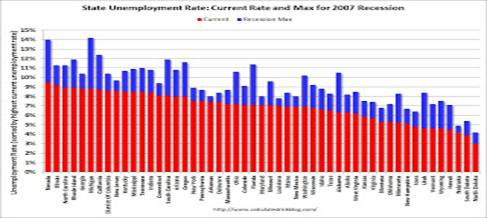
Basically, 21 of the 52 states are still above the national 7.3 percent unemployment rate, according to the U.S. Census Bureau.  In fact, twenty-eight states and the District of Columbia had unemployment rate increases, 8 states had decreases, and 14 states had no change, the U.S. Bureau of Labor Statistics reported today.

Nevada had the highest unemployment rate among the states in July, 9.5 percent. The next highest rate was in Illinois, 9.2 percent. North Dakota continued to have the lowest jobless rate, 3.0 percent.

The Fed now predicts inflation will remain under 2 percent until 2016, well below its 2.5 percent threshold, as measured by the PCE index.  In its latest economist forecast, the Fed predicts an inflation rate of no higher than 1.2 percent in 2013, rising to a range of 1.7 percent to 2 percent by 2016, said Bernanke.   

Bernanke also gave another reason to maintain QE3; in response to a question whether such programs had harmed emerging market economies with such cheap U.S. dollars fuelling some of their own asset bubbles.  But he said that boosting U.S. growth would boost growth worldwide, since a healthy U.S. economy was still the main engine of growth for the world economy, while the White House and Congress were doing nothing to boost growth or create jobs. So he and the Fed had no choice to continue as the only engine of U.S. growth.

Harlan Green © 2013

Follow Harlan Green on Twitter: www.twitter.com/HarlanGreen
Posted in Economy, Macro Economics, Politics, Weekly Financial News | Tagged , , , , , | Leave a comment