Existing Home Sales Take Off

The Mortgage Corner

Existing-home sales have finally taken off, a sign that real estate might now be leading the economic recovery. Real estate has historically led past recoveries, by employing so many construction workers and professional services, but not this one to date due to the busted housing bubble.

Total existing-home sales, which are completed transactions that include single-family homes, townhomes, condominiums and co-ops, rose 1.7 percent to a seasonally adjusted annual rate of 5.48 million in August from 5.39 million in July, and are 13.2 percent higher than the 4.84 million-unit level in August 2012, reports the National Association of Realtors.
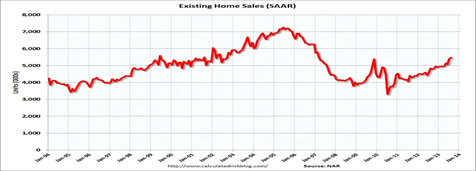
image

Graph: Calculated Risk

And total housing inventory at the end of August increased 0.4 percent to 2.25 million existing homes available for sale, which represents a 4.9-month supply at the current sales pace, down from a 5.0-month supply in July. So the very low inventory is causing housing prices to soar, which will ultimately cure much of the negative home equity still existing. Unsold inventory is 6.3 percent below a year ago, when there was a 6.0-month supply.

Lawrence Yun, NAR chief economist, said the market may be experiencing a temporary peak.  “Rising mortgage interest rates pushed more buyers to close deals, but monthly sales are likely to be uneven in the months ahead from several market frictions,” he said.  “Tight inventory is limiting choices in many areas, higher mortgage interest rates mean affordability isn’t as favorable as it was, and restrictive mortgage lending standards are keeping some otherwise qualified buyers from completing a purchase.”

But that may not be so with the Federal Reserve’s decision to put off tapering QE3 purchases. Conforming 30-year fixed mortgage interest rates plunged one-quarter percent on Wednesday to 4.25 percent for zero points origination fee in California, when the Fed announced its decision to continue the $85 billion in purchases.

The national median existing-home price for all housing types was $212,100 in August, up 14.7 percent from August 2012.  This is the strongest year-over-year price gain since October 2005 when the median rose 16.6 percent, and marks 18 consecutive months of year-over-year price increases, said the NAR.

Even more importantly, distressed homes – foreclosures and short sales – accounted for 12 percent of August sales, down from 15 percent in July, and is the lowest share since monthly tracking began in October 2008. They were 23 percent in August 2012.  Ongoing declines in the share of distressed sales are responsible for some of the growth in median price.

Granted much of the boost in home sales and rising interest rates comes from the fear that QE3 would end. But with interest rates again falling, both home purchases and mortgage refinancing will be boosted. So it looks like the Fed is maintaining it commitment to reviving the housing market, as well as economic growth in general.

Harlan Green © 2013

Follow Harlan Green on Twitter: www.twitter.com/HarlanGreen
Posted in Consumers, Economy, Housing, housing market, Weekly Financial News | Tagged , , , , , , , | Leave a comment

What is a Real Minimum Wage?

Financial FAQs

The debate on how to boost this economic recovery has now shifted to the federal minimum wage standard, now at $7.25 percent per hour. This is in part because the latest Census Bureau report shows 46.5 million Americans living below the poverty line—15 percent of all Americans.  Raising the minimum wage should be a no-brainer, as such a wage is nowhere near even the income level that sustains a household working normal hours.  For instance, the current minimum wage comes to $15,080 per year with a 40-hour week vs. $23,492 as the official poverty level for 4 in 2012, reports the U.S. Census Bureau.

But there is an even more important reason.  Higher wages translate to higher spending.  And it is consumer spending in the main that drives the demand for goods and services, with government lending a helping hand.  Higher wages also lowers debt levels, since consumers and government then borrow less. So-called capital investments, the third leg of GDP growth, accounts for much less activity.

The main argument against a raise in the minimum wage from conservatives is that it hurts job creation because fewer workers would be hired due to higher labor costs.

Really?  It’s true that labor costs generally average some two-thirds of product costs, but unit-labor costs are at all-time lows, while corporate profits are at an all-time high, as a percentage of Gross Domestic Product. 

Even MacDonald’s has given their employees advice on how to live within their means on their ‘minimum’ wage of $8.25/hr. But the recommended budget posted on their website includes no money for food, clothing, healthcare, or gas-transportation expenses, but leaves room for a second job.  And, rent can only be $600 per month, which will rent just one room in a California home.

clip_image002

Graph: MilesCorak

It’s also true that the U.S. minimum wage is in 9th place of the developed countries with minimum wage standards led by Australia with its $16.37 minimum wage for fulltime working adults over 20 years of age.  The Australians are near full employment with their unemployment rate currently in the 5 percent range, by the way, lowest in the developed world.

clip_image003

Graph: Econoday

            The so-called Employment Cost Index put out by the Bureau of Labor Statistics really shows how little American wage and salary workers are earning, vs. during more prosperous times. It is up just 1.8 percent year-over-year.

So why isn’t the importance of a higher minimum wage understood? Much of the misinformation has to do with the advent of Reaganomics, or supply-side economics theory in 1980, which says that a greater share of wealth should be diverted to investors and producers of goods and services over government and the wage and salary workers. This all in the name of new product innovation and greater growth.

But that has been proven wrong in many ways.  For instance, businesses didn’t invest more domestically in the early years of the Reagan administration with their lower tax rates and extra profits.

And though some 15 million jobs were created during President Reagan’s term with lowered tax rates, 21 million jobs were created during President Clinton’s term, when tax rates were raised again.  And just over 1 million net jobs were created during GW Bush’s 8 years, with even more draconian tax cuts while fighting 2 wars.

            The result of policies that have favored ‘supply-side’ policies since then is the top 10 percent of earners took more than half of the country’s total income in 2012, the highest level recorded since the government began collecting the relevant data a century ago, according to an updated study by Saez and Piketty.  And 95 percent of all income growth since 2009 has been garnered by the top 1 percent of income earners.

            So actual results show the need for a higher minimum wage. The 1 percent have not increased production or created jobs in the face of declining real incomes, so it is time to shift some resources back to those who actually produce the wealth.

California is doing that with its just passed raise of the minimum wage to $10 per hour phased in with $1 in 2014 and another $1 by 2016. This still comes to just $20,800 per year with a 40-hour week. So even that amount doesn’t reach the poverty level for for a family of 4 today.

Harlan Green © 2013

Follow Harlan Green on Twitter: www.twitter.com/HarlanGreen

Posted in Consumers, Economy, Keynesian economics, Macro Economics, Politics, Weekly Financial News | Tagged , , , , , , | 3 Comments

Deflation is the Danger

Financial FAQs

The Federal Reserve is about to announce their decision on when to begin tapering their purchases of securities at next Tuesday’s FOMC meeting. Among other issues is whether there is any danger of future inflation from continuing the $85 billion per month in purchases. The taper talk is not making many economists happy, needless to say, with the Fed admitting growth is not even up to their previous forecasts.

“As a central bank, you are lowering your growth forecast, inflation is running low, and hiring is slowing and you are going to taper your asset purchases?” said Julia Coronado, chief economist for North America at BNP Paribas in New York and a former member of the Federal Reserve Board’s forecasting staff. “That is a communications challenge.”

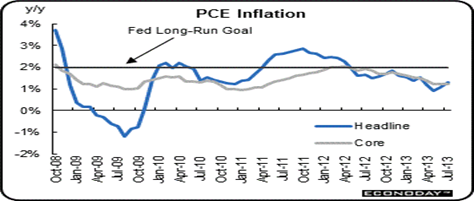
In fact, deflation is the danger to economic growth at present, not inflation. For inflation is a sign of economic growth, yet prices have barely risen if one looks at the major inflation indexes, like the CPI or Personal Consumption price index. The so-called PCE price index is the main inflation indicator liked by the Federal Reserve, and it is running far below the Fed’s preferred target of 2 to 2.5 percent.

clip_image002

Graph: Econoday

Only an increased demand for goods and services will push up prices longer term, outside of short-term bottle necks in supply chains. So without some inflation, the gap cannot be closed between debt loads and income levels, and the economy cannot grow out of its debt hole.

We have not had an inflationary environment since the 1970s, and that was ‘cured’ by then Fed Chairman Paul Volcker with his double-digit interest rates that brought down double-digit inflation but caused double-digit unemployment and the 1981, 1983 recessions.

That also brought the era of lower taxation and double-digit federal budget deficits during the 1980s. And the emphasis on holding down inflation—resulting in 2 decades of low inflation that was called the “Great Moderation”—has meant slower economic growth, and less productive investment since then, as well as 2 further recessions in the last decade, including the Great Recession.

clip_image004

Graph: Econoday

And it has meant less income for the 80 percent of consumers who are wage earners. Real Personal Disposable income growth, particularly since the Great Recession, has been basically non-existent. And that has meant consumers had less money to spend, hence the slow-growth ‘new normal’ economists have been talking about.

It also means that little progress was seen in PCE inflation getting to the Fed’s goal of 2 to 2.5 percent, as we said. Year-on-year, headline prices were up 1.4 percent in July versus 1.3 percent in June. The core held steady at 1.2 percent compared to June.

The result is still-depressed consumer confidence. The latest University of Michigan sentiment survey showed recession-level worries, four years after the end of the Great Recession. Consumer sentiment so far this month has fallen to its lowest level since early in the year, to 76.8 vs. 82.1 for final August and vs. 80.0 at mid-month August.

The cause of the noticeable weakness has to be flat income growth, in spite of increased hiring. Most of the jobs increase has been in the lower-paying retail and health care sectors.

clip_image006

Graph: Calculated Risk

Why such non-existent income growth for Main Street, and why do we need more inflation? The answer has to be that very few are benefitting from this economic recovery with heavy debt loads still holding back both government and consumer spending. The top 10 percent of earners took more than half of the country’s total income in 2012, the highest level recorded since the government began collecting the relevant data a century ago, according to an updated study by Saez and Piketty.

“These results suggest the Great Recession has only depressed top income shares temporarily and will not undo any of the dramatic increase in top income shares that has taken place since the 1970s,” Mr. Saez, an economist at the University of California, Berkeley, wrote in his analysis of the data.

The income share of the top 1 percent of earners in 2012 returned to the same level as before both the Great Recession and the Great Depression: just above 20 percent, jumping to about 22.5 percent in 2012 from 19.7 percent in 2011, said their study. And that is the real problem. Consumers cannot spend what they cannot earn.

Harlan Green © 2013

Follow Harlan Green on Twitter: www.twitter.com/HarlanGreen

Posted in Uncategorized | Tagged , , , , , , , | Leave a comment

More Home Equity, Fewer Defaults In Q2

The Mortgage Corner

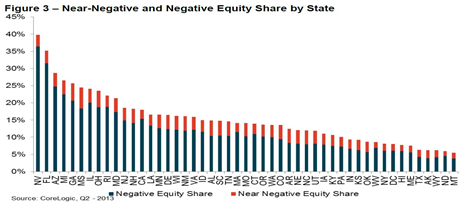
CoreLogic, a Southern California real estate data firm, also released new analysis showing approximately 2.5 million more residential properties returned to a state of positive equity during the second quarter of 2013, and the total number of mortgaged residential properties with equity currently stands at 41.5 million. The analysis shows that 7.1 million homes, or 14.5 percent of all residential properties with a mortgage, were still in negative equity at the end of the second quarter of 2013. This figure is down from 9.6 million homes, or 19.7 percent of all residential properties with a mortgage, at the end of the first quarter of 2013.

image

Graph: Calculated Risk

Nevada was the highest percentage of mortgaged properties in negative equity at 36.4 percent, followed by Florida (31.5 percent), Arizona (24.7 percent), Michigan (22.5 percent), and Georgia (20.7 percent), per Calculated Risk’s graph. Montana had the lowest percentage of mortgaged properties. The top five states combined account for 34.9 percent of negative equity in the U.S.

“Equity rebuilding continued in the second quarter of this year as the share of underwater mortgaged homes fell to 14.5 percent,” said Dr. Mark Fleming, chief economist for CoreLogic. “In just the first half of 2013 almost three and a half million homeowners have returned to positive equity, but the pace of improvement will likely slow as price appreciation moderates in the second half.”

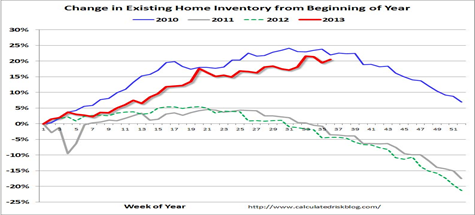
Meanwhile existing-home for sale inventories climbed to 20.6 percent, according to Housing Tracker. The Calculated Risk graph show that 2013 inventories are almost back to 2010 levels, as housing prices continue to improve. The actual inventory level is still 4 percent below 2012, says Calculated Risk, but it’s still rising vs. last year.

image

Graph: Calculated Risk

The reality is that with existing-home prices up some 12 percent year over year per Case Shiller, more homes are expected to come onto the market and continue the housing recovery. Western cities like San Francisco and Las Vegas prices are up some 24 percent in a year.

The one caveat that could limit further price increases is that the Federal Housing Finance Authority, ruler of Fannie Mae and Freddie Mac, just announced they would be lowering the conforming loan limits.

“FHFA has been analyzing approaches for reducing Fannie Mae and Freddie Mac loan limits across the country, and any such change would be announced with adequate advance notice for implementation on Jan. 1,” the agency said in a statement Monday. It could be as soon as next month, according to the LA Times.

Most pundits are conjecturing that just the conforming limit would be lowered, and the so-called Hi-Balance conforming limits would remain unchanged at $625,500 for the higher-priced California counties. The upper limit for Fannie and Freddie loans in high-priced areas was increased in 2008 to $729,750 to support the collapsing housing market. That limit was reduced to $625,500 in October 2011, although the $729,750 cap is still in place for loans insured by the Federal Housing Administration.

Harlan Green © 2013

Follow Harlan Green on Twitter: www.twitter.com/HarlanGreen

Posted in Economy, Housing, housing market, Politics, Weekly Financial News | Tagged , , , , , | Leave a comment

Bad Jobs Report, Another New Deal Needed

Financial FAQs

We now know why this economic recovery has been so weak 4 years after the end of the Great Recession. The government has been taken out of the jobs market. Government spending has been cut, rather than increased to make up for the lack of private sector job creation.

The unemployment dropped to 7.3 percent from 7.4 percent, but that was because some 312,000 stopped looking for work, according to the Bureau of Labor Statistics Household report. It was a very weak report at this stage of an economic recovery, and should mean the Federal Reserve won’t act to taper their QE3 purchases in September.

It also means the economy cannot improve without further stimulus from the government sector, since the private sector isn’t creating enough jobs to even keep up with population growth. It means instead of a debate about cutting social security and Medicare spending, as well as defunding Obamacare, Republicans should be debating how much to spend to simulate more economic growth, if they want seen as a friend to business. Otherwise, they will continue to be seen as the no-growth party.

clip_image002

Graph: Calculated Risk

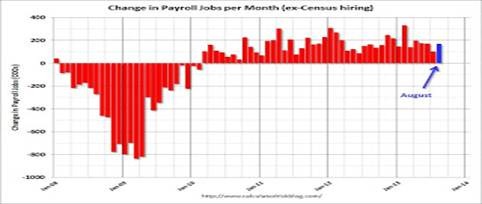
The change in total nonfarm payroll employment for June was revised from +188,000 to +172,000, and the change for July was revised from +162,000 to +104,000. With these revisions, employment gains in June and July combined were 74,000 less than previously reported. This is while most of the new jobs were in the auto sector for manufacturing, and retail, health care and social services in the service sector, which are lower paying jobs.

And so we still have the problem of high unemployment, when 5 percent or lower is considered full employment, with lost productive output some $1.76 trillion below potential GDP growth if we had remained at full employment, according to the Congressional Budget Office.

clip_image004

Graph: EPI

In a word, we need the urgency of another New Deal. Though we don’t have a World War to boost government spending, as in WWII, the Iraq and Afghanistan wars on terror should have generated a national emergency. But the Bush/Cheney presidency decided that we should all go shopping after 9/11, while they fought the wars on limited budgets and tax cuts with borrowed money.

But we can boost government spending without adding much to government debt. In fact, the boost to economic growth and tax revenues would cancel out most of the additional debt, while keeping many millions more employed, according to numerous studies.

How? Begin government-sponsored infrastructure repairs that could boost construction spending by as much as $2.2 trillion, says the American Society of Civil Engineers. And this would be spent in the private sector. Most of it is deferred maintenance, which will only become more expensive if we wait any longer. This certainly is of some urgency. How many more bridges have to fail before we realize this?

Nobelist Paul Krugman lamented such lost economic activity in a recent blog: “With the benefit of hindsight, we do know roughly how depressed the economy has been; we have reasonably good estimates of the effects of government spending; so we can put together an estimate of what would have happened if we had, in fact, pursued a policy of government spending sufficient to keep output at potential.”

The Congressional Progressive Caucus has already put together a “Back to Work” fiscal 2014 budget alternative (BTWB), which would invest $2.1 trillion in job creation measures over 2013-2015.

“The Back to Work budget would sharply accelerate economic and employment growth; it would boost gross domestic product (GDP) by 5.7 percent and employment by 6.9 million jobs at its peak level of effectiveness (within one year of implementation), while ensuring that fiscal support lasts long enough to avoid future fiscal cliffs that could throw recovery into reverse,” said EPI’s analysis of the budget proposal.

Or, instead of labeling government-sponsored work as another New Deal, why not says it’s a “good deal” for American jobs and workers?

Harlan Green © 2013

Follow Harlan Green on Twitter: www.twitter.com/HarlanGreen
Posted in Economy, Keynesian economics, Macro Economics, Politics, Weekly Financial News | Tagged , , , , , , , , , , | Leave a comment

Mortgage Delinquencies Down, Equity Higher

Financial FAQs

According to the second quarter Zillow Negative Equity Report, the national negative equity rate continued to fall in the second quarter, dropping to 23.8 percent of all homeowners with a mortgage from 25.4 percent in the first quarter of 2013. The negative equity rate has been continually falling for the past five quarters.

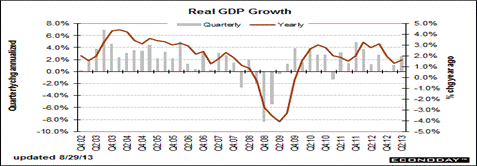
More good news was that real GDP growth for the second quarter was raised to an annualized rate of 2.5 percent compared to the initial estimate of 1.7 percent and compared to a fourth quarter rise of 1.1 percent. Expectations were for 2.2 percent.

clip_image002

Graph: Econoday

Final sales of domestic product showed a revised gain of 1.9 percent versus the advance estimate of 1.3 percent. This series increased 0.2 percent in the first quarter. Final sales to domestic producers (which exclude net exports) was nudged down to 1.9 percent versus the initial estimate of 2.0 percent. This followed a 0.5 percent gain in the first quarter.

In the second quarter of 2013, more than 805,000 American homeowners were freed from negative equity. However, more than 12 million homeowners with a mortgage remain underwater. Moreover, the effective negative equity rate nationally — where the loan-to-value ratio is more than 80 percent, making it difficult for a homeowner to afford the down payment on another home — is 41.9 percent of homeowners with a mortgage.

While not all of these homeowners are underwater, they have relatively little equity in their homes, and therefore selling and buying a new home while covering all of the associated costs (real estate agent fees, closing costs and a new down payment) would be difficult. Of all homeowners – roughly one-third of homeowners do not have a mortgage and own their homes free and clear – 16.7 percent are underwater.

clip_image004

Graph: Zillow

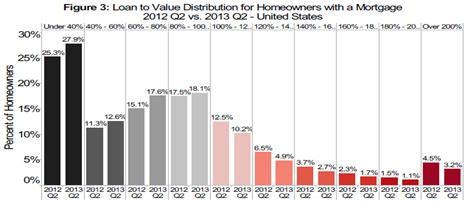
Figure 3 shows the loan-to-value (LTV) distribution for homeowners with a mortgage from 2012 Q2 to 2013 Q2. Even though many homeowners are still underwater and haven’t crossed the 100 percent LTV threshold to enter into positive equity, they are moving in the right direction. The good news is that with these high rates of appreciation negative equity has been reduced at a fast pace in the near-term (this will change as home value appreciation moderates later on this year and into the next, as the current rates are not sustainable).

Over the last year Phoenix’s negative equity rate dropped by 20.4 percentage points, Las Vegas’ dropped by 20.1 percentage points and Sacramento’s dropped by 17.7 percentage points (Q2 2012-Q2 2013). However, nationally the effective negative equity rate remains very high at 41.9 percent. In a move-up market, homeowners with less than 20 percent equity will effectively still be “locked” into negative equity. On average, a U.S. homeowner in negative equity owes $74,700 more than what their house is worth, or 42.3 percent more than the home’s value. While roughly a quarter of homeowners with a mortgage are underwater, 92 percent of these homeowners are current on their mortgages and continue to make payments.

Almost half of the borrowers with negative equity have a LTV of 100 percent to 120 percent (the light red columns). Most of these borrowers are current on their mortgages – and they have probably either refinanced with HARP or the loans are well seasoned (most of these properties were purchased in the 2004 through 2006 period, so borrowers have been current for eight years or so). In a few years, these borrowers will have positive equity.

The key concern is all those borrowers with LTVs above 140 percent (about 8.7 percent of properties with a mortgage according to Zillow). It will take many years to return to positive equity … and a large percentage of these properties will eventually be distressed sales (short sales or foreclosures).

Harlan Green © 2013

Follow Harlan Green on Twitter: www.twitter.com/HarlanGreen
Posted in Consumers, Economy, Housing, housing market, Weekly Financial News | Tagged , , , , | Leave a comment

Labor’s Day Remembered

Popular Economics Weekly

As we celebrate another Labor Day, a national holiday, how do we remember it? I would like to remember it as some other developed countries celebrate it. France, for instance, has enshrined the one-hour lunch, whereas a 2012 survey of North American workers by Right Management found that only one in five reported taking a real break for lunch. Thirty-nine percent even reported they take lunch at their desks in the survey cited by columnist Robyn Blumner in the Tampa Bay Times.

The French don’t have to worry, for they work less and actually produce more per worker. A new survey touted by The Business Insider from UBS has shown that the French continue to work the least amount of hours per year in the world. Once again, the French have blown away the competition. Nationmaster ranks France as #18 in terms of GDP per capita, at $36,500 per person, yet France works much less than most developed nations.

France, for instance, with $36,500 GDP/Capita and works 1,453 hours per year, said the UBS study. This equates to a GDP/Capita/Hour of $25.10. Americans, on the other hand, have $44,150 GDP/Capita but work 1,792 hours per year. Thus Americans only achieve $24.60 of GDP/Capita/Hour.

And a recent visit to Amsterdam in The Netherlands, floored me. Stores can only stay open from 10-5pm, except for Thursday when they are allowed to be open to 9pm, and this in one of the commercial capitals of Europe!

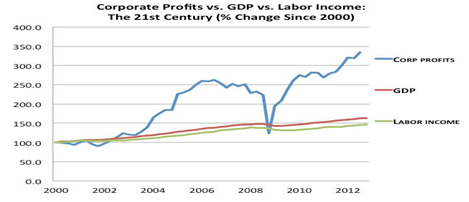
Many economists and policy experts blame the loss of workers’ income on globalization, the exporting of jobs overseas to cheaper climes. But there is a much simpler explanation for the loss of workers’ incomes—record corporate profits that have enabled corporations to suppress their workers’ incomes, mostly via legislative and judicial means

As a percentage of national income, corporate profits stood at 14.2 percent in the third quarter of 2012, the largest share at any time since 1950, while the portion of income that went to employees was 61.7 percent, near its lowest point since 1966, according to the New York Times. In recent years, the shift has accelerated during the slow recovery that followed the financial crisis and ensuing recession of 2008 and 2009.

image

Graph: EPI

The legislative means are clear. Some 24 right-leaning Republican state legislatures have enacted right-to-work laws that actually prevent unions from either organizing, or requiring them to pay union dues, even though they receive all the benefits of unionization. This is not to mention the outright voter suppression tactics of ALEC, the American Legislative Exchange Council, a lobbying organization that has written many of those state laws

Judicially, we know that the Supreme Court’s decision in Citizens vs. United allowed corporations to contribute unlimited amounts to elections, and with their record profits they have not hesitated to back those right-to-work laws.

So who is the richest country in terms of human capital? Perhaps, France that has the best health care and pension systems in the world, or The Netherlands with 10 to 5 working hours, or the country that diverts most of its profits to corporations, their CEOs and investors?

Harlan Green © 2013

Follow Harlan Green on Twitter: www.twitter.com/HarlanGreen
Posted in Consumers, Economy, Politics, Weekly Financial News | Tagged , , , , , , , | Leave a comment

Martin Luther King Worried About Economic Injustice

Popular Economics Weekly

Martin Luther King said the basis of disparities between the races had as much to do with income inequality as outright racism in his book, Why We Can’t Wait.  “Many white Americans of good will have never connected bigotry with economic exploitation. They have deplored prejudice but tolerated or ignored economic injustice.” 

In other words, discrimination has as much to do with socio-economic status as the color of one’s skin today.  This is the 50th anniversary of his “I have a dream” speech, and income inequality is the highest for Americans since 1929, not just for African-American and other minorities. In fact, most economists now agree such record income inequality has been the root cause of both the Great Recession, and Great Depression.

Nobelist Joseph Stiglitz highlighted why the fight for equality was so important:  “Listening to Dr. King speak evoked many emotions for me,” said Dr. Stiglitz. “Young and sheltered though I was, I was part of a generation that saw the inequities that had been inherited from the past, and was committed to correcting these wrongs. Born during World War II, I came of age as quiet but unmistakable changes were washing over American society.”

As of 2010, white families, on average, earned about $2 for every $1 that black and Hispanic families earned, said the Urban Institute in a recent report, a ratio that has remained roughly constant for the last 30 years.

And when it comes to wealth — as measured by assets, like cash savings, homes and retirement accounts, minus debts, like mortgages and credit card balances —non-Hispanic white families, on average, were about four times as wealthy as nonwhite families, according to the Urban Institute’s analysis of Federal Reserve data.

Why has this happened? The Great Recession is the easy answer because it hit blue collar and union workers hardest, but economic policies since the 1970s have tilted incomes away from wage earners towards corporate profits.

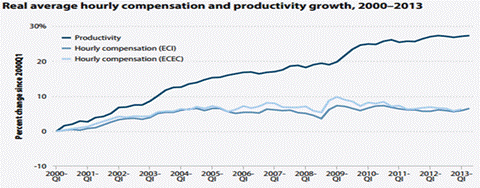
Economic Policy Institute economist and vice-presidential advisor Jared Bernstein highlighted this in a recent study. “The arithmetic of national income accounting is such that when average compensation lags behind productivity growth, as has been the norm in recent years, income is redistributed from paychecks to profits. That’s a characteristic of growing inequality and flows quite simply from the observation that the economy’s growth has to be going somewhere.”

And where have corporate profits gone during that time? That’s a topic for another column, but according to the Federal Reserve, as of the third quarter of 2012 nonfinancial corporations in the United States held $1.7 trillion of liquid assets – cash and securities that could easily be converted to cash.

clip_image002

Graph: EPI

His and many other such graphs highlight how much of the productivity gains in the past decade have been lost to workers with hourly compensation. The EPI report he cites by Lawrence Mishel and Heidi Shierholz said, “Between 2002 and 2012, wages were stagnant or declined for the entire bottom 70 percent of the wage distribution. In other words, the vast majority of wage earners have already experienced a lost decade, one where real wages were either flat or in decline.

Nobelist Paul Krugman also remarked on King’s economic injustice.  “Yet if King could see America now, I believe that he would be disappointed, and feel that his work was nowhere near done. He dreamed of a nation in which his children “will not be judged by the color of their skin but by the content of their character.” But what we actually became is a nation that judges people not by the color of their skin — or at least not as much as in the past — but by the size of their paychecks.”

In fact, we have become a nation divided by income and wealth opportunities, even more than ethnicity or race. In fact, if current rates of national population change trend as they have for the past 20 years, by 2035, (non-Hispanic) whites will be outnumbered by minorities, say demographers. In fact, Hawaii, California, New Mexico, and Texas already have minority non-Hispanic white populations. And that can only mean those minorities will be in a position to fight for a larger share of the wealth, such as higher minimum wage, in spite of the vested interests that oppose it.

What is true economic justice and a living wage should be the question for US. The answer should be as obvious.  It is the wage that enables a family to support itself and give their children the chance to succeed.

Harlan Green © 2013

Follow Harlan Green on Twitter: www.twitter.com/HarlanGreen
Posted in Economy, Keynesian economics, Macro Economics, Politics, Weekly Financial News | Tagged , , , , , | Leave a comment

Case-Shiller Home Prices, Consumer Confidence Continue Rise

The Mortgage Corner

Housing prices continue to climb, but not as fast in the hardest hit areas of Las Vegas and some Florida cities. This is probably because mortgage rates have already risen 1 percent. But rates are no longer rising, as the bond market seems to have already digested the possibility of Fed QE3 ending.

The price appreciation is very strong but has slowed from early in the year. Case-Shiller’s 20-city adjusted index is up 0.9 percent in the June report vs an average monthly gain of 1.4 percent from January to May. But the year-on-year adjusted gain, at a very sizable 12.0 percent, is just off its best level of the recovery which is May at plus 12.2 percent.

clip_image002

Graph: Econoday

Monthly declines have been popping up in the data for the first time this year but are still isolated and mostly marginal. The West had the highest gains, around the 20 percent area led by Las Vegas at 24.8 percent and San Francisco at 24.4 percent. Note that West coast cities posted some of the sharpest declines during the 2008 meltdown. Cities showing the least gains this year are New York, at a year-on-year plus 3.2 percent, and Cleveland at 3.4 percent.

“Overall, the report shows that housing prices are rising but the pace may be slowing. Thirteen out of twenty cities saw their returns weaken from May to June. As we are in the middle of a seasonal buying period, we should expect to see the most gains. With interest rates rising to almost 4.6 percent, home buyers may be discouraged and sharp increases may be dampened,” said David M. Blitzer, Index Committee Chair at S&P Dow Jones Indices.

Meanwhile, the Conference Board’s consumer confidence index improved, but mainly in future wage growth, believe it or not. The report’s composite headline index showed a slight increase, to 81.5 this month from July’s revised 81.0.

But consumers’ expectation took a big jump in income, believe it or not. The expectations component rose to 88.7 for a 2.7 point gain. And it was mostly their outlook on income which, after sliding at the beginning of the year in reaction to the hike in payroll taxes, is now at a 2-1/2 year high. The consumer’s outlook on business conditions and the jobs market are also up.

clip_image004

Graph: Econoday

This is huge, needless to say, as consumers have been spending less because of the higher payroll tax rate until now. In fact, if interest rates do hold at, say, 4.50 percent with zero origination points in California, at least, then housing prices should continue to climb this year with such higher confidence.

Harlan Green © 2013

Follow Harlan Green on Twitter: www.twitter.com/HarlanGreen

Posted in Consumers, Economy, Housing, housing market, Weekly Financial News | Tagged , , , , , | Leave a comment

What’s The Fed To Do?

Popular Economics Weekly

Why the debate over who should be the next Federal Reserve Chairman? There is a tug of war going on between inflation ‘doves’ and ‘hawks’ within the Fed. The debate is whether inflation is or will be a problem because of the $3 trillion plus in money the Fed has injected into the economy, which means will QE3 end sooner or later and in turn when interest rates should be allowed to rise.

And that debate really has little to do with who will succeed Fed Chairman Bernanke next year. Both Vice-Chairman Janet Yellen and Harvard economist Larry Summers are basically doves who advocate the Fed’s purchase of securities to support low interest rates until the economy recovers.

Though Larry Summers sojourn as President of Harvard was a disaster with his seeming lack of administrative abilities, and derogatory remarks against women faculty members. Whereas Dr. Yellen has been groomed to become the first female Federal Reserve Chairperson with her many years serving on the Fed’s Board of Governors.

In fact, even the debate between budget doves and hawks is artificial. The problem is that interest rates (and budget deficits) are driven by many factors, including the cost of money. And the demand (and cost) of money only goes up (while budget deficits decline) when there is a growing economy. This is not the case today, when first quarter GDP grew just 1 percent, while Q2 GDP was barely higher at a 1.7 percent growth rate. This is uncomfortably close to recession levels, even though Bernanke’s Fed has continued to buy $85 billion per month in securities.

image

Graph: Econoday

So there is little demand for money’s use at present, as mirrored by consumer loans, for instance. Even with record low interest rates, helped by the Fed’s bond purchases, consumers can only borrow so much when their incomes haven’t even risen as fast as inflation since 2000.

Chairman Bernanke explained it best in his latest congressional Q&A, as we said last week. “There’s a distinction between prices being high and prices rising…(cost of living) isn’t going up, it’s high, it’s not going up. In other words, real wages are going down because even though inflation is very low wages have been growing slower than inflation.

image

Graph: Econoday

So what is the Federal Reserve to do with household incomes still on the decline, and no inflation? Keeping interest rates as low as possible serves two purposes. It makes credit cheaper and keeps prices lower for consumers. It also makes investing in new plants and equipment cheaper, which encourages more investment in plant expansion and hiring.

Unfortunately, the other branches of government are locked in paralysis, with Republicans only interested in programs that reduce household income, rather than increasing it, by blocking employees’ collective bargaining in Republican-held states and food stamps for needy families. This has a direct effect on consumers’ real disposable incomes, which in turn reduces the very demand for goods and services that would encourage economic growth.

So the fears of asset bubbles and runaway inflation are really distractions at the present. Small government conservatives use the fear of inflation as a camouflage from their real agenda of smaller government. Conservative economists don’t like debt, period, in the belief government borrowing will crowd out private debt. But that can only happen with fuller employment and booming growth.

So the real debate is how much power should the Federal Reserve wield, if any. And that is not a debate we should be having at present. With no one else providing aid to this recovering economy, the Fed is all we have at present to prevent inflation declining further, and another recession.

Harlan Green © 2013

Follow Harlan Green on Twitter: www.twitter.com/HarlanGreen
Posted in Consumers, Economy, Macro Economics, Politics, Weekly Financial News | Tagged , , , , , , , , , , , | Leave a comment