Our Poor Inflation Record

Popular Economics Weekly

Inflation has fallen so low that it threatens this economic recovery. Why? Producers can’t charge more for their products, therefore can’t increase profits unless they use fewer workers and greater automation to replace them.  So there is no incentive to hire more workers, which would increase the demand for their products, and so increase economic growth.

The median household income declined some 10 percent from 2000, after inflation because of less need for highly skilled workers.  And the unemployment rate is still above 7 percent, some 4 years after the end of the Great Recession.

clip_image001

Chart: Trading Economics

That’s because with automation and the Global Information Age, things can be produced more cheaply anywhere in the world where things are cheapest to produce, which puts pressure on workers’ incomes everywhere.  So we know there can’t be as much inflation with unemployment remaining so high. 

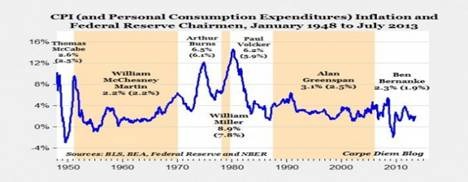
In fact, it is remarkable how closely disinflation (falling inflation) has tracked historical unemployment rates in these charts that begin in 1948, the beginning of the modern consumer economy.  For instance, inflation began its steep decline after 1980 when Fed Chairman Volcker pushed interest rates as high as 16 percent, causing the 1981 and 1983 recessions, and a jobless rate of more than 10 percent. The result of the Great Recession has been the same—high joblessness with too low inflation.
clip_image002

Chart:  Financial Times

            So Fed Chairman Bernanke basically inherited an almost deflationary economic environment in 2006, with the Great Recession that began December 2007 and ended June 2009.  That is why the Fed has been keeping interest rates so low, and why the Fed Governors aren’t yet ready to end the QE3 purchase of securities.  Without QE3, we could be in deep trouble with real estate still in the doldrums.
clip_image003

Chart: Calculated Risk

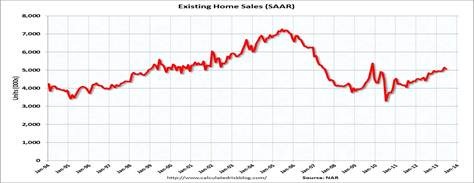
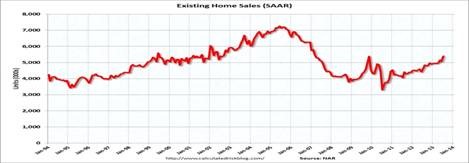
            The good news is that July existing-home sales rose to the highest level in 4 years, since the end of the Great Recession.  The consensus is that most of these homes were put into contract before the recent rise in interest rates, and that the current rise in mortgage rates since then will slow down sales.

            Total existing-home sales, which are completed transactions that include single-family homes, townhomes, condominiums and co-ops, increased 6.5 percent to a seasonally adjusted annual rate of 5.39 million in July from a downwardly revised 5.06 million in June, and are 17.2 percent above the 4.60 million-unit pace in July 2012, said the National Association of Realtors. 

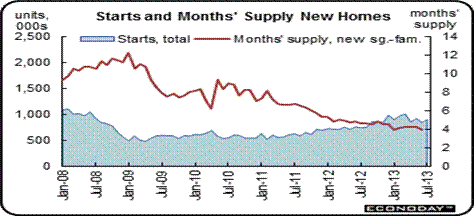
But with just a 5.1-month supply, inventory levels are historically low during this sales season.  That means values haven’t raised enough to allow more homes with positive equity on the market that would create a sustained recovery.  With such a low inventory level there is no danger of either a new housing bubble (meaning too many homes for sale), or inflationary pressures.

Harlan Green © 2013

Follow Harlan Green on Twitter: www.twitter.com/HarlanGreen
Posted in Consumers, Economy, Macro Economics, Weekly Financial News | Tagged , , , , , | Leave a comment

Housing Starts, Builder Confidence Improve

Popular Economics Weekly

Housing made somewhat of a comeback in July and taking into account wet weather on the East coast should be taken as stronger than face value.  Housing starts in July rebounded 5.9 percent after falling 7.9 percent in June, according to the National Association of Home Builders.  The July starts annualized level of 0.896 million units was up 20.9 percent on a year-ago basis.

And builder confidence in the market for newly built, single-family homes rose three points to 59 on the National Association of Home Builders/Wells Fargo Housing Market Index (HMI) for August, released today. This fourth consecutive monthly gain brings the index to its highest level in nearly eight years.

clip_image002

Graph: Econoday

“Builders are seeing more motivated buyers walk through their doors than they have in quite some time,” said NAHB Chairman Rick Judson. “What’s more, firming home prices and thinning inventories of homes for sale are contributing to an increased sense of urgency among those who are in the market.”

“Builder confidence continues to strengthen along with rising demand for a limited supply of new and existing homes in most local markets,” noted NAHB Chief Economist David Crowe. “However, this positive momentum is being slowed by the ongoing headwinds of tight credit and low supplies of finished lots and labor.”

Nationwide housing starts rose 5.9 percent to a seasonally adjusted annual rate of 896,000 units in July as multifamily construction rebounded from a dip in the previous month, according to newly released figures from HUD and the U.S. Census Bureau. Meanwhile, single-family construction recorded a modest decline from a rate that was upwardly revised for the previous month.

“Builders are making every effort to keep up with the rising demand for new homes and apartments, and construction in both sectors is running well ahead of the pace we saw at this time last year,” noted Rick Judson. “However, ongoing issues with accessing credit and limited supplies of finished lots and labor are making it tough to do that, particularly for single-family builders.”

“Today’s report is in line with our forecast for continued, gradual strengthening of housing starts and permit activity through the rest of the year,” said NAHB Chief Economist David Crowe. “The double-digit bounce-back on the multifamily side was in keeping with typical month-to-month volatility in that sector,” he noted, “while the sideways movement in single-family was a result of unusually wet weather in the South and West.”

Regionally, combined housing starts activity posted solid gains of 40.2 percent in the Northeast, 25.4 percent in the Midwest and 7.2 percent in the West, respectively, in July, while the South posted a 7 percent decline.

Issuance of building permits, which can be an indicator of future building activity, rose 2.7 percent to a seasonally adjusted annual rate of 943,000 units in July. Single-family permits dipped 1.9 percent to 613,000 units from a strong pace in the previous month, while multifamily permits gained 12.6 percent to 330,000 units.

Interest rates will help determine if home construction continues to improve, however. They are up more than 1 percent, with 30-year fixed rate mortgage rates now 4.25 percent with a 1 point origination fee, and 30-year fixed High Balance conforming rates at 4.375 percent for 1 point.

Harlan Green © 2013

Follow Harlan Green on Twitter: www.twitter.com/HarlanGreen
Posted in Consumers, Economy, Housing, housing market, Weekly Financial News | Tagged , , , , | Leave a comment

How To Lower That Household Debt?

Financial FAQs

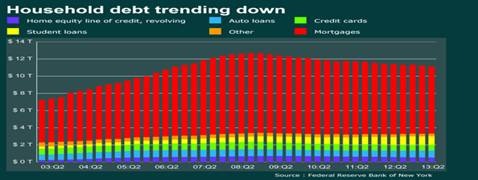
Here is the underlying reason our economy isn’t growing faster, hence creating more jobs. Household debt hasn’t even declined to early 2000 levels, mainly because household incomes haven’t risen above 2000 levels, after inflation is factored in.

Mortgage debt in particular still totals some $8 trillion, for example, whereas it was some $5 trillion in 2003 before housing prices really took off. Then how can households adequately service that debt, and increase their overall spending? They can’t, and so there is very little increase in the demand for goods and services, hence little increase in growth and jobs.

clip_image002

Graph: WSJ Marketwatch/Federal Reserve NY

Household debt is declining, but ever so slowly. In Q2 2013 total household indebtedness fell to $11.15 trillion; 0.7 percent lower than the previous quarter and 12 percent below the peak of $12.68 trillion in Q3 2008, said the New York Federal Reserve in its latest Household Debt and Credit Report.  Mortgages, the largest component of household debt, fell $91 billion from the first quarter.

“Although overall debt declined in the second quarter, households did increase non-housing debt, led by rising auto loan balances,” said Andrew Haughwout, vice president and research economist at the New York Fed.  “Furthermore, households improved their overall delinquency rates for the seventh straight quarter, an encouraging sign going forward.”

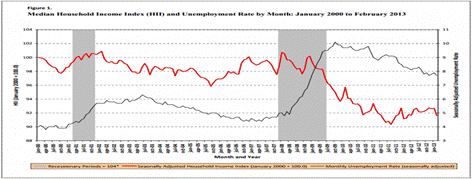
This graph from Ezra Klein’s WaPo blog illustrates how much household incomes have fallen, as well. Back in 2007, for instance, median household income was $55,438. That’s declined to $51,404 in February 2013. Those numbers are pretax and adjusted for inflation and seasonal factors. The red line is median household income and blue line the unemployment rate, which is still 7.4 percent.

clip_image004

Graph: Ezra Klein

We can also understand why lowering the budget deficit has been such a problem. It’s not only because government unemployment benefits increase during recessions and their aftermath, but government tax revenues decline precipitously. Even there the effects of reduced household income is obvious. Private sector businesses don’t see increasing demand, so it’s hoarding some $2 trillion plus in cash from record profits, but isn’t hiring many new workers. Meanwhile, banks hold $1 trillion plus in excess reserves, rather than increasing lending.

That leaves only one way to increase household incomes; by borrowing from those excess funds held by the private sector to create more public sector jobs, such as in infrastructure repair, better educational programs, and research and development of new products. The consequent increase in tax revenues then pays down that debt, as it did in the 1950s to 1070s after the record 120 percent World War II federal deficit. So we can see that until more jobs are created, household incomes can’t growth; or households even begin to pay down their debts to pre-recession levels.

Harlan Green © 2013

Follow Harlan Green on Twitter: www.twitter.com/HarlanGreen
Posted in Consumers, Economy, Macro Economics, Politics, Weekly Financial News | Tagged , , , , , | Leave a comment

Will Interest Rates Continue to Rise?

The Mortgage Corner

We think not.  Interest rates are rising, mainly due to some Fed Governors saying they may begin to end the QE3 purchase of securities later this year. But that is based on overly optimistic growth projections by mostly deficit hawks who don’t like the Fed to borrow so much money.

Therefore, we also want to know how this affects real estate sales, with rates already up 1 percent since Bernanke sounded off on the possibility of slowing down purchases this year. The effect will not be good, as RE sales are already slowing.

I believe initial ‘tapering’ of securities in QE3 might not even happen this year because of slowing economic growth, and less than full employment.  Both are stuck at the low end of a recovery, with GDP growth less than 2 percent this year to date, and the unemployment rate still above 7 percent, when 5 percent is closer to full employment.

A key indicator of future sales is mortgage volume, and it has been slowing since the rate rise.  Although the 4-week average of the Mortgage Bankers Association purchase index has generally been trending up over the last year, it has been down over the last couple of months.  However, the 4-week average of the purchase index is still up about 7 percent from a year ago, as the graph shows.

clip_image001

Graph: Calculated Risk

But the refinance index is down some 59 percent, and refinance volumes tend to affect future sales.  The last time the index declined this far was in late 2010 and early 2011 when mortgage rates increased sharply, with the Ten Year Treasury rising from 2.5 percent to 3.5 percent, says Calculated Risk.  The Ten Year Treasury yield is up from 1.6 percent to over 2.7 percent today, but with such slow economic growth we don’t anticipate mortgage rates rising much further.

Santa Barbara and South Coast sales are slowing a bit from the spring, per Gary Woods’ monthly MLS report, but are still better than last year. Single Family and PUD sales are up 4 percent in a year, and the median price up 16 percent. 

“There have been a significant number of new home listings coming on the market,” said Gary in his report, “and with the escrows declining slightly the overall inventory has started to climb. With sales starting to cool the median sales price should continue to rise because available properties in the overheated $600,000 to $900,000 have declined while homes on the market priced above $1 million have become more plentiful.”

Nationally, existing-home sales finally reached its more normal 5 million unit annual rate over the past 2 months, and new-home sales are some 500,000 annually, vs. 1.2 million at the height of the housing bubble, as we said last week. So RE sales and prices have room to grow if economic growth does pick up in the fall, as the more optimistic Fed Governors predict. 

clip_image003

Graph: Econoday

However, the best place to look for interest rate trends is not Wall Street speculators betting on what Bernanke’s Fed will do. It is the actual demand for money, and that is still low for all but student and auto loans. Consumer credit reported by the Commerce Dept. has been strong for so-called installment loans, but not revolving credit card debt.

Consumer credit growth was held down in June to $13.8 billion versus May’s revised $17.5 billion. Revolving credit, which had jumped a revised $6.4 billion in May, contracted $2.7 billion. Revolving credit has been up and down for the whole recovery, reflecting consumer caution and tight lending standards. So excluding autos, June was a weak month for retail sales as reflected in the revolving credit component of this report.

So who knows what the future will bring, with all the political uncertainty? That is probably what the Wall Street speculators are counting on—more uncertainty equals more volatility and so greater profits for the day traders.

Harlan Green © 2013

Follow Harlan Green on Twitter: www.twitter.com/HarlanGreen

Posted in Consumers, Economy, Housing, housing market, Politics, Weekly Financial News | Tagged , , , , , | Leave a comment

Economic Growth Still Too Slow

Popular Economics Weekly

Part of the debate over whether the Fed’s QE3 purchases of securities should end is based on economic growth.  I.e., why isn’t U.S. Gross Domestic Product growing faster than the average annual 2.2 percent rate? Actually, Q1 and Q2 2013 growth is even lower—1 and 1.7 percent, consecutively.

Part of the problem is that the unemployment rate is still 7.4 percent, of course, whereas the historical full employment rate is below 5 percent, which means at least another 2 million need to be employed.  Also current consumer spending seems to be maxed out, with household incomes rising less than inflation, as Fed Chairman Bernanke has been pointing out.  And so hopes are pinned on a housing recovery this year, which is still tentative.

For instance, existing-home sales finally reached its more normal 5 million unit annual rate the past 2 months, and new-home sales are some 500,000 annually, vs. 1.2 million at the height of the housing bubble. So the debate ought to be comparing current GDP growth to its full employment potential output.  In fact, the U.S. economy has lost more than $4 trillion in output from the Great Recession.

clip_image001

Graph:  EPI.org

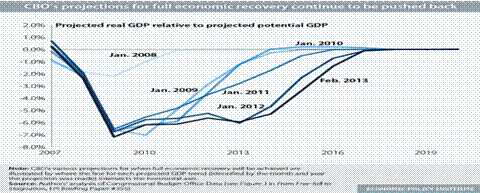
The Congressional Budget Office recently released its updated Budget and Economic Outlook, which highlighted a key theme that recurs in many economic policy discussions: a rapid recovery is projected to begin relatively soon and to reliably deliver the economy back to full health in about four years. The problem is that this full recovery has generally been forecast to be four years away since the Great Recession began five years ago, says the Economic Policy Institute.

The output gap for 2012 was $995 billion, or roughly 5.9 percent of potential output. CBO’s latest economic forecast shows a rapid recovery starting in late 2013 and the full output gap now closing by 2017.   So it seems no one really has an idea when the economy can return to historical growth and employment.  That is a measure of just how ‘great’ was the Great Recession and its aftermath.

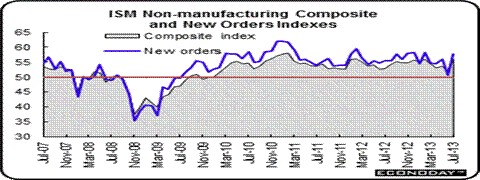
The latest economic data show a possibility of pickup in the fall, which is what the Fed’s deficit hawks are counting on to justify their call for an early end to QE3.  Specifically, both the Institute of Supply Management’s service and manufacturing surveys rose sharply in July.  The ISM’s non-manufacturing report showed the largest surge that drove the composite index up a very substantial 3.8 points to 56.0 for the best reading since February. New orders, the key component in the report, rose nearly 7 points to 57.7 for its best reading since December. And overall business activity really took off, up more than 7-1/2 points to 60.4, also the best reading since December.

clip_image003

Graph: Econoday

            But from what level? It would have to remain above 50, which signals growth, for a considerable period before it is a reliable trend after last month’s dip to no growth in activity. Retail sales also remain healthy.  July’s numbers show an almost 6 percent annual growth rate, close to pre-recession levels.  Within the core, excluding more volatile auto and gasoline sales, gains were widespread with increases in food & beverage stores, health & personal care, clothing, sporting goods & hobbies & music, and general merchandise.  But furniture & furnishings, electronics & appliances, and building materials & garden equipment purchases.

So bottom line seems to be that economic conditions are still very uncertain; especially with the debt ceiling debate about to be repeated in the fall and many of the sequester spending cuts yet to take effect.  There should be no rush to end the Fed’s low interest rate program with such high unemployment levels and congressional gridlock that could even contribute to a further downgrade of federal debt.

Harlan Green © 2013

Follow Harlan Green on Twitter: www.twitter.com/HarlanGreen

Posted in Consumers, Economy, Housing, housing market, Macro Economics, Politics, Weekly Financial News | Tagged , , , , | Leave a comment

Why Is QE3 So Important For Housing?

The Mortgage Corner

Alas, it does look like the Fed’s Governors are about to slow down the $85 Billion in monthly purchases of Treasury Bonds and Mortgage Backed Securities that have been holding down long term interest rates since last September. Even deficit ‘dove’ Chicago Fed President Charles Evens believes it can happen as early as September. And that is not a good thing for either real estate or economic growth in general.

First and second quarter GDP growth has been 1 percent and 1.7 percent so far this year, which is near recession levels. So contrary to what Chairman Bernanke has been saying, Evans and other Governors who are giving timelines seem to be saying the QE3 tapering could begin whether or whether not economic data continues to improve.

Evans says he expects growth in the second half of the year to accelerate to a 2.5 percent annual growth rate, from a 1 percent rate over the past three quarters, and reach over 3 percent growth rate in 2014, but how can that be with the draconian budget cuts that have reduced GDP growth by some 1.5 percent annually per the CBO and upcoming budget ceiling debate?

So what is wrong with at least some of the Fed Governors that they see growth where there isn’t any? How in fact can they even predict the future, when Republicans are threatening to shut down the government again over raising the debt ceiling?

They must clearly believe in asset “bubbles”, which have been proven only after the fact, as even former Fed Chairman Greenspan has admitted. Or, some Fed Governors have to believe stock and housing prices are rising too fast!

But that can’t be the case, when we have not yet caught up to 4 years of weak household formation, as we said last week. Home prices have been held down from a combination of government austerity policies and private sector hoarding since the Great Recession that has kept most homebuyers on the sidelines until this year.

There has been a huge drop in household formation, so much so that the Cleveland Federal Reserve Bank says the growth rate in the number of households was cut by two-thirds between 2007 and 2010, compared to the previous 10 years.

“This slowing in household formation reflects the overall weak economy,” says the Cleveland Fed, “but it has also negatively impacted the housing market, as lower household formation rates reduce housing demand.”

clip_image002

Graph: WSJ Marketwatch

But the real culprit is income growth. The combination of Bush tax cuts and 2 recessions resulting in the largest budget deficits since WWII have suppressed employee income growth to the lowest level since WWII. So 2013 will not be the year of the housing recovery if the Fed continues to allow long term interest rates to rise, that have already risen1 percent since April and Bernanke’s first attempt to talk up interest rates.

Trulia.com reports that asking home prices are already starting to lose steam in June as mortgage rates rise, inventory expands, and investor demand declines. Nationally, asking prices dropped 0.3 percent in July – the first month-over-month (M-o-M) decline since November 2012. Seasonally adjusted, prices rose 3.3 percent quarter-over quarter (Q-o-Q), down from a peak of 4.2 percent in April. Year-over-year (Y-o-Y), prices are up 11 percent nationally; however, this change is an average over the past 12 months and is therefore slower to show changes than monthly and quarterly numbers.

In 64 out of 100 U.S. metros, reports Trulia, the quarterly asking home price gain was lower than in the previous quarter. This slowdown was most apparent in the West Coast where prices have rebounded strongly already. Among housing markets where asking prices rose sharply Y-o-Y, price gains dipped the most Q-o-Q in Las Vegas, Oakland, and San Francisco.

So it really looks like the Fed deficit ‘hawks’ are controlling the Fed’s agenda at present, with no proof of either a housing bubble, or that budget deficits are a danger. In fact, due to the already enacted budget cuts the deficit has been shrinking.

Harlan Green © 2013

Follow Harlan Green on Twitter: www.twitter.com/HarlanGreen
Posted in Consumers, Economy, Housing, housing market, Macro Economics, Politics, Weekly Financial News | Tagged , , , , | Leave a comment

What’s The Fed To Do?

Popular Economics Weekly

Why the debate over who should be the next Federal Reserve Chairman? There is a tug of war going on between inflation ‘doves’ and ‘hawks’ within the Fed. The debate is whether inflation is or will be a problem because of the $3 trillion plus in money the Fed has injected into the economy, which means will QE3 end sooner or later and in turn when interest rates should be allowed to rise.

And that debate really has little to do with who will succeed Fed Chairman Bernanke next year. Both Vice-Chairman Janet Yellen and Harvard economist Larry Summers are basically doves who advocate the Fed’s purchase of securities to support low interest rates until the economy recovers. Larry Summers sojourn as President of Harvard was a disaster with his seeming lack of administrative abilities, and derogatory remarks against women faculty members.

Dr. Yellen has been groomed to become the first female Federal Reserve Chairperson with her many years serving on the Fed’s Board of Governors.

The problem is that interest rates are driven by many factors—but mainly by the cost of money. And the demand (and cost) of money only goes up when there is a growing economy, not when it is barely growing, as now. First quarter GDP grew just 1 percent, while Q2 GDP was barely higher at a 1.7 percent growth rate. This is even though Bernanke’s Fed has continued to buy $85 billion per month in securities.

image

Graph: Econoday

So there is little demand for money’s use at present, as mirrored by consumer loans, for instance. Even with record low interest rates, helped by the Fed’s bond purchases, consumers can only borrow so much when their incomes haven’t even risen as fast as inflation since 2000.

Chairman Bernanke explained it best in his latest congressional Q&A, as we said last week. “There’s a distinction between prices being high and prices rising…(cost of living) isn’t going up, it’s high, it’s not going up. In other words, real wages are going down because even though inflation is very low wages have been growing slower than inflation.”

image

Graph: Econoday

So what is the Federal Reserve to do with household incomes still on the decline, and no inflation? Keeping interest rates as low as possible serves two purposes. It makes credit cheaper and keeps prices lower for consumers. It also makes investing in new plants and equipment cheaper, which encourages more investment in plant expansion and hiring.

Unfortunately, the other branches of government are locked in paralysis, with Republicans only interested in programs that reduce household income, rather than increasing it, by blocking employees’ collective bargaining in Republican-held states and food stamps for needy families. This has a direct effect on consumers’ real disposable incomes, which in turn reduces the very demand for goods and services that would encourage economic growth.

So the fears of asset bubbles and runaway inflation are really distractions at the present. Small government conservatives use the fear of inflation as a camouflage from their real agenda of smaller government. Conservative economists don’t like debt, period, in the belief government borrowing will crowd out private debt. But that can only happen with fuller employment and booming growth.

So the real debate is how much power should the Federal Reserve wield, if any. Yet with no one else providing aid to this recovering economy, the Fed is all we have to prevent further deflation, and another recession.

Harlan Green © 2013

Follow Harlan Green on Twitter: www.twitter.com/HarlanGreen
Posted in Consumers, Economy, Keynesian economics, Macro Economics, Politics, Weekly Financial News | Tagged , , , , | Leave a comment

New Home Sales Surging—First-timers Being Priced Out?

Financial FAQs

New-home sales are surging, reports the U.S. Census Bureau. But who is buying them with interest rates up 1 percent since Chairman Bernanke made his infamous remark that QE3 bond buying could begin to slow in September? The damage has already been done for middle-income buyers with mortgage applications plunging, though interest rates have moderated. The conforming fixed rate is back to 4.25 percent with zero origination points cost in California. This has caused housing affordability to decline for many buyers, though still up for the year.

Sales of new single-family houses in June 2013 were at a seasonally adjusted annual rate of 497,000, according to estimates released jointly today by the U.S. Census Bureau and the Department of Housing and Urban Development. This is 8.3 percent above the revised May rate of 459,000 and is 38.1 percent above the June 2012 estimate of 360,000.

clip_image002

Graph: Calculated Risk

Months of supply is also shrinking, with the seasonally adjusted estimate of new houses for sale at the end of June just 161,000. This is a supply of 3.9 months at the current sales rate.

clip_image004

Graph: NAR

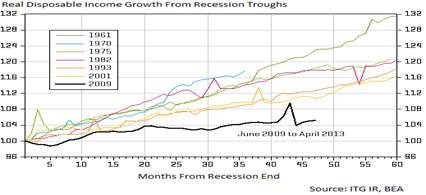
This is while mortgage applications have been falling, as we said, although purchase applications are up for the year. The culprit is that real incomes have not been rising enough to overcome higher mortgage rates. In fact, incomes have been rising at the slowest rate since World War II. Average household incomes have declined 10 percent just since 2000.

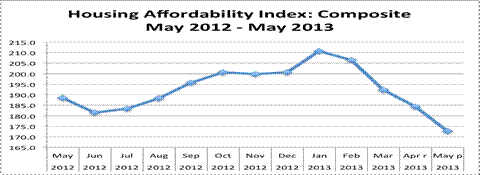
The National Association of Realtors, reports that affordability has declined 18 percent since January, hitting 172.7 in May, but is 17 percent above its average over the past decade. A reading of 100 means that a household with median income would have exactly enough income to qualify for buying a median-priced existing single-family home

NAR chief economist Lawrence Yun said many areas are experiencing a seller’s market.  “The supply/demand balance is clearly tilted toward sellers in a good portion of the country,” he said.  “Inventory conditions are expected to remain fairly constrained this year, so overall price increases should be well above the historic gain of one-to-two percentage points above the rate of inflation.  If home builders can continue to ramp up production, then home price growth is expected to moderate in 2014.”

So the question is will mortgage rates continue to climb, or has Chairman Bernanke realized his mistake in prematurely talking rates higher without any real evidence that the overall economy is recovering?

Harlan Green © 2013

Follow Harlan Green on Twitter: www.twitter.com/HarlanGreen
Posted in Economy, Housing, housing market, Macro Economics, Weekly Financial News | Tagged , , , , , | Leave a comment

Inflation Is Not The Problem

Popular Economics Weekly

All the talk that QE3 is about to end centers on when the Fed believes inflation will become a problem. Fed Chairman Bernanke doesn’t believe inflation will be a problem, as long as wages aren’t growing. And wages can’t even keep up with inflation at present, as he said in his latest congressional Q&A.

“There’s a distinction between prices being high and prices rising…(cost of living) isn’t going up, it’s high, it’s not going up. In other words, real wages are going down because even though inflation is very low wages have been growing slower than inflation.”

clip_image002

Graph: Econoday

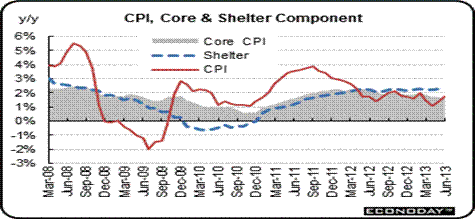
The consumer price index is substantially below the Fed’s target inflation rate of 2 to 2.5 percent, which is the level that shows sustained economic growth, according to the Fed. The reason for the spike in monthly CPI was energy prices, and the summer driving season. By major components outside the core, energy spiked 3.4 percent, following a partial rebound of 0.4 percent in May.  Gasoline surged 6.3 after no change in May.  The food component rebounded 0.2 percent, following a dip of 0.1 percent in May.

The Conference Board’s Index of Leading Economic Indicators (LEI) also mirrors the ongoing weak economic growth. The weak portions were in stagnant stock prices and building permits, while the positive contributors were higher long term interest rates (which predicts future growth), the leading credit index (more debt), lower average weekly initial claims for unemployment insurance, higher average consumer expectations for business conditions and manufacturers’ new orders for consumer goods and materials.  The factory workweek was a zero contribution.

clip_image004

Graph: Econoday

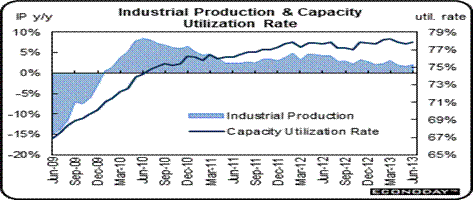
Right now, therefore, industrial production seems to be the main culprit, rather than the service sector, because of subdued exports. The Empire State and Philly Fed manufacturing surveys were slightly positive, but overall production has trended downward.

clip_image006

Graph: Econoday

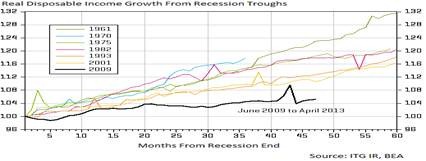
So we can say that inflation should not be a problem for some time. Real inflation could even be years away, given that overall household incomes have shrunk 10 percent since 2000.  That means the decline in wages and salaries is the real problem holding back sustainable domestic growth.  Then the question becomes how to gain back some of that wealth?

Harlan Green © 2013

Follow Harlan Green on Twitter: www.twitter.com/HarlanGreen

Posted in Consumers, Economy, Macro Economics, Politics, Weekly Financial News | Tagged , , , , , , , , | 4 Comments

Are Home Prices Rising Too Fast?

The Mortgage Corner

No, they are just catching up to 4 years of weak household formation and even weaker income growth. Home prices have been held down from a combination of government austerity policies and private sector hoarding since the Great Recession that has kept most homebuyers on the sidelines until this year.

Trulia chief economist Jeff Kolko estimates home prices are still 7 percent undervalued, as compared to pre-bubble levels.

“We estimate that national home prices are 7 percent undervalued in the second quarter of 2013 (2013 Q2),” said Kolko. “During last decade’s bubble, prices were as high as 39 percent overvalued in 2006 Q1, then during the bust, fell to 15 percent undervalued in 2011 Q4. Therefore, even with the recent price increases, home prices nationally remain undervalued relative to fundamentals and much lower than in the last bubble. That’s why today’s price gains are actually still a rebound, not a bubble.”

clip_image002

Graph: WSJ Marketwatch

But the real culprit is income growth. The combination of Bush tax cuts and 2 recessions resulting in the largest budget deficits since WWII have suppressed employee income growth to the lowest level since WWII.

clip_image004

Graph: WSJ Marketwatch

There has been a huge drop in household formation, so much so that the Cleveland Federal Reserve Bank reports compared to the previous 10 years, the growth rate in the number of households was cut by two-thirds between 2007 and 2010.

“This slowing in household formation reflects the overall weak economy,” says the Cleveland Fed, “but it has also negatively impacted the housing market, as lower household formation rates reduce housing demand.”

So 2013 is finally looking like a recovery year for housing. June existing-home sales are back above 5 million unit annually for only the second month since the 2009 first-time homebuyer tax break. Total existing-home sales, which are completed transactions that include single family, townhomes, condominiums and co-ops, dipped 1.2 percent to a seasonally adjusted annual rate of 5.08 million in June from a downwardly revised 5.14 million in May, but are 15.2 percent higher than the 4.41 million-unit level in June 2012.

clip_image006

Graph: Calculated Risk

And inventory levels are improving, which will slow down price rises in some areas. Total housing inventory at the end of June rose 1.9 percent to 2.19 million existing homes available for sale, which represents a 5.2-month supply at the current sales pace, up from 5.0 months in May. Listed inventory remains 7.6 percent below a year ago, when there was a 6.4-month supply.

An interesting sidelight is that the percentage of distressed California sales is down sharply, reports DataQuick, an RE research company. Of the existing homes sold last month, 10.0 percent were properties that had been foreclosed on during the past year – the lowest level since foreclosure resales were 9.4 percent of the resale market in August 2007. Last month’s figure was down from a revised 11.3 percent in May and 24.9 percent a year earlier. Foreclosure resales peaked at 58.8 percent in February 2009.

And Short sales – transactions where the sale price fell short of what was owed on the property – made up an estimated 16.0 percent of the homes that resold last month. That was down from an estimated 16.8 percent the month before and 24.3 percent a year earlier. The key is the percentage of distressed sales is down significantly – while the number of conventional sales are up about 40 percent year-over-year, per DataQuick

Harlan Green © 2013

Follow Harlan Green on Twitter: www.twitter.com/HarlanGreen

Posted in Consumers, Economy, Housing, housing market, Politics, Weekly Financial News | Tagged , , , , , | Leave a comment