Builder Confidence Soaring

The Mortgage Corner

The National Association of Home Builders just announced that home builder confidence soared to the highest level since 2006, the height of the housing bubble.  This can only mean more new-home construction to fill the pent up demand for housing after 4 years of housing depression.

Builder confidence in the market for newly built, single-family homes rose six points to 57 on the Association of Home Builders/Wells Fargo Housing Market Index (HMI) for July, released today. This is the index’s third consecutive monthly gain and its strongest reading since January of 2006.

“Builders are seeing more motivated buyers coming through their doors as the inventory of existing homes for sale continues to tighten,” noted NAHB Chief Economist David Crowe. “Meanwhile, as the infrastructure that supplies home building returns, some previously skyrocketing building material costs have begun to soften.”

clip_image002

Graph: Calculated Risk

That brings up the subject of inflation, as building material prices are bound to rise with the increase in demand for new homes. And the Consumer Price Index is rising, but it also means housing prices are rising, a good thing. Housing prices tend to rise with inflation—in fact, are a sign of rising inflation—as do interest rates. So it will be a race for homeowners to get in on any bargains left with Bernanke’s Federal Reserve determined to slow down QE3 purchases this year.

clip_image004

Graph: Calculated Risk

Year-on-year, overall CPI inflation jumped to 1.8 percent from 1.4 percent in May (seasonally adjusted). The core rate posted at 1.6 percent, compared to 1.7 percent. By major components outside the core, most of the rise was in energy, up 3.4 percent. Gasoline surged 6.3 after no change in May. Advances for shelter, medical care, and apparel accounted for most of the rise in the core measure, with increases in the indexes for new vehicles and household furnishings and operations also contributing.

A major reason for the surge in builder confidence is also the lean inventory of existing home sales. The home resale market is surging, up 4.2 percent to an annual sales rate of 5.18 million which is the highest since the home stimulus credits of late 2009. The gain is centered in the key single-family home category which is up 5.0 percent in the May report.

This is while the median price is up 8.4 percent in May alone, to a recovery best $208,000. The average price, at $255,300, is up 5.6 percent in the month. Year-on-year gains are 15.4 percent for the median price and 11.2 percent for the average.

Lack of supply is a key factor behind the price surge, as we said, and the reason for so much builder optimism. More supply did come into the market in May, totaling 2.22 million homes for sales vs 2.15 million in April, but declined relative to the surging sales rate. Supply measured against sales is at 5.1 months vs 5.2 months in April in a reading that points to further price strength for housing construction and new home sales, as well.

Harlan Green © 2013

Follow Harlan Green on Twitter: www.twitter.com/HarlanGreen

Posted in Economy, Housing, housing market, Weekly Financial News | Tagged , , , , , , | Leave a comment

Shadow Inventory of Bad Loans Still Too High

Financial FAQs

The shadow inventory of troubled homes fell to about 2 million in April, down 18 percent from the same period in the prior year, and down 34 percent from a peak of 3 million in early 2010. But that is still too many homes in trouble for the Fed to begin to reduce its asset purchases.

Shadow home inventory includes properties with seriously delinquent mortgages, in foreclosure or held by mortgage servicers, but not yet listed, according to CoreLogic, an Irvine, Calif.-based analysis firm. Bad loans are working their way out of the system, and new mortgages for borrowers with better credit are taking their place. Also, rising home prices and low interest rates are helping troubled owners sell or refinance their homes, reducing the pipeline of foreclosures.

clip_image002

Graph: WSJ Marketwatch

This is when interest rates have risen to 2-year highs. A gauge of mortgage applications has contracted almost every week since mortgage rates started climbing more than two months ago, according to data released Wednesday. For the week that ended July 5, the Mortgage Bankers Association’s barometer of mortgage loan application volume fell 4 percent as rates hit the highest level in two years.

clip_image004
Graph: WSJ Marketwatch

Interest rates have risen some 1 percent since April, which means some consumers will have a tougher time affording monthly mortgage payments. With a $417,000 conforming loan, that 1 percent rise means either a borrower needs 8.6 percent more income, or a home worth 8.6 percent less. With 20 percent down and a $417,000 loan, that would mean a reduction of $41,000 in what a prospective buyer could afford.

This will not encourage middle class buyers who now have to earn some $74,664 per year to afford a home in that price range. This has to slow down housing activity to some extent, which is another reason for the Fed to stand pat at present.

Harlan Green © 2013

Follow Harlan Green on Twitter: www.twitter.com/HarlanGreen

Posted in Consumers, Economy, Housing, housing market, Weekly Financial News | Tagged , , , , , , , , , | Leave a comment

No Tapering By Fed This Year

Popular Economics Weekly

Fed Chairman Bernanke once more ‘clarified’ his remarks, saying there is no way the Fed will even begin to raise their (short term) interest rates when the unemployment rate falls to 6.5 percent.

“There will not be an automatic increase in interest rates when unemployment hits 6.5 percent,” said Bernanke. “And, given the weak labor market and low inflation, “it may well be sometime after we hit 6.5 percent before rates reach any significant level,” the Fed chief added.

So there is also good reason to believe the Fed won’t begin to ‘taper’ purchases of QE3 securities this year, either. Why? The labor market is even weaker, and the real unemployment rate is much higher, than the current 7.6 percent.

Calculated Risk and many others have noted a significant portion of the decline in the unemployment rate from 10.0 percent in October 2009 to 7.6 percent in June 2013 was related to a decline in the employment-to-participation rate from 65.0 percent in Oct 2009 to 63.5 percent in June 2013.  If the participation rate had held steady, the unemployment rate would be 9.7 percent (assuming an increase in the participation rate with the same employment level).

clip_image002

Graph: Calculated Risk

Some 2 million discouraged workers have been sitting on the sidelines for more than 6 months and the labor participation rate was as high as 67 percent until the Great Recession, which tells us why this recession was so deep. Most of the unemployed are now the 24 to 55 year-olds of prime working age, which is a tremendous loss of the most productive workers.

The June 195,000 non-farm payroll increase was a good number, though not the 300,000 per month that prevails during a healthy economy. The change in total nonfarm payroll employment for April was revised from +149,000 to +199,000, and the change for May was revised from +175,000 to +195,000. With these revisions, employment gains in April and May combined were 70,000 higher than previously reported.

clip_image004

Graph: Calculated Risk

Another reason QE3 may not end soon is the downgrading of GDP growth estimates. The IMF just downgraded its prediction of U.S. GDP growth to 1.8 percent in 2013. The Fed now has the most optimistic growth projection of 2.3 to 2.6 percent in 2013.

So who do we believe? It looks like the Fed wants have its cake and eat it, too, as they say. It wants to tell the markets that the outright purchase of $85 billion per month in securities has to end eventually, because economic growth will pick up. But when? It is in effect trying to boost what is called the yield curve of longer term interest rates, without any signs that growth is increasing.

So once again the Fed is playing the expectations game. But that can be a two-edged sword, as we’ve said in the past, because right now the markets are betting that higher rates mean slower growth ahead.

Harlan Green © 2013

Follow Harlan Green on Twitter: www.twitter.com/HarlanGreen

Posted in Economy, Macro Economics, Weekly Financial News | Tagged , , , , , , , | Leave a comment

Mortgage Delinquencies Continue Decline

The Mortgage Corner

Mortgage delinquencies and foreclosures continue to decline. According to Lender Processing Services (LPS), 6.08 percent of mortgages were delinquent in May, down from 6.21 percent in April, while 3.05 percent of mortgages were in the foreclosure process, down from 4.12 percent in May 2012.

This was the largest drop in delinquencies in 11 years, and gives a total of 9.13 percent delinquent or in foreclosure. It breaks down as:
• 1,708,000 properties that are 30 or more days, and less than 90 days past due, but not in foreclosure.
• 1,335,000 properties that are 90 or more days delinquent, but not in foreclosure.
• 1,525,000 loans in foreclosure process.

clip_image002
Graph: Calculated Risk

Delinquencies are down more than 15 percent since the end of December 2012, coming in at 6.08 percent for the month. As LPS Applied Analytics Senior Vice President Herb Blecher explained, much of this improvement is supported by the fact that new problem loan are approaching the pre-crisis average.

“Though they are still approximately 1.4 times what they were, on average, during the 1995 to 2005 period, delinquencies have come down significantly from their January 2010 peak,” Blecher said. “In large part, this is due to the continuing decline in new problem loans — as fewer problem loans are coming into the system, the existing inventories are working their way through the pipeline. New problem loan rates are now at just 0.73 percent, which is right about on par with the annual averages during 2005 preceding.

It has to be why consumer spending is in effect soaring. Consumers were out in force in May as consumer credit rose a huge $19.6 billion. Revolving credit jumped $6.6 billion for the largest gain since May last year and the second largest of the recovery. The gain points to a jump in credit card use which, if extended, would be a big plus for retailers. It hasn’t increased at all for most of the year, until now.

clip_image004

Graph: Econoday

Non-revolving credit also jumped in the month, up $13.0 billion for yet another outsized gain that reflects both strong car sales but also gains in the student loan component that are tied in part to ongoing government acquisitions of student loans from private lenders, acquisitions that do not necessary reflect current student borrowing.

So the wealth effect from more jobs and rising housing prices seems to be taking hold. That is why delinquencies have been declining, in the main. This is while the Labor Department’s Job Openings and Labor Turnover Survey (JOLTS) showing some 3.828 million new job openings in June, and 4.4 million new jobs created.

clip_image006

Graph: Econoday

Both hires and separations are oscillating upward with hires running a little higher than separations. In May, there were 4.441 million hires versus 4.395 million the month before. There were 4.323 million total separations in the month of May-slightly up from 4.287 million in April. The separations rate was 3.2 percent. Total separations include quits, layoffs and discharges, and other separations.

Harlan Green © 2013

Follow Harlan Green on Twitter: www.twitter.com/HarlanGreen

Posted in Consumers, Economy, Housing, housing market, Weekly Financial News | Tagged , , , , , | Leave a comment

QE3 Works, So Please Don’t Mess With It!

Financial FAQs

Dear Federal Reserve Governors; Please don’t mess with QE3 just yet! Not in September, or even December. There are still too many reasons not to begin to taper the $85 billion per month in purchases that have kept interest rates so low, though rates are already rising rapidly. You are doing your job in raising expectations for higher growth and higher inflation.

You are also doing your job in encouraging more workers to look for work with 177,000 more entering the workforce. But part time jobs have jumped 322,000 to 8.2 million employed, more than the 177,000 additional entering the workforce, so more fulltime workers may have become part timers.

You are doing your job in putting 1.1 million older workers back to work of the 1.6 million jobs created over the past year, but there were only 355,000 jobs added in the 25 to 55 year age group, who are our prime workers, says WSJ Marketwatch’s Rex Nutting.

Your QE3 program is also doing its job in boosting wages. The June report reported that hourly and weekly wages increased 0.4 percent in June, and hourly wages are now up 2.2 percent over the last year. But that means employers are working their employees harder with longer hours, rather than hiring many new workers.

clip_image002

Graph: Calculated Risk

This well-known graph shows it best. It reveals just how far the U.S. is from returning to normal employment, and how long this recovery has taken. The longest post WWII recession until the Great Recession lasted some 22 months under GW Bush.

Yet employment from the Great Recession is still -1.6 percent below peak employment 40 months later! This has to be an intolerable situation, and the reason the Fed began its $85 billion per month drive to keep interest rates so low last September.

And then there’s the Labor Department’s U-6 total of unemployed that jumped from 13.8 percent to 14.2 percent in June. It is defined as “all persons marginally attached to the labor force, plus total employed part time for economic reasons, as a percent of the civilian labor force plus all persons marginally attached to the labor force.”

This is not the America we should want to live in, so please Fed Governors and Chairman Bernanke, above all. Stick to your monetary guns! QE3 works, but the economy isn’t yet working well enough to put down those guns.

Harlan Green © 2013

Follow Harlan Green on Twitter: www.twitter.com/HarlanGreen

Posted in Consumers, Economy, Keynesian economics, Macro Economics, Politics, Weekly Financial News | Tagged , , , , , , , | Leave a comment

Managing Expectations—The Fed’s Two-Edged Sword

Popular Economics Weekly

It does look like the results of Fed Chairman Bernanke’s push for greater transparency in Federal Reserve policy deliberations are coming home to roost. Stock and bond prices have been whipsawed since Bernanke made the seemingly offhand remark that QE3 security purchases could be cut back by the end of the year.

Just what did Bernanke’s Fed expect, in their crusade to manage expectations for greater growth with the printing of so much money? Its seems to have backfired, at least for the moment. The market plunges that resulted from his remarks are testament to the fact that investors believed any hint of higher interest rates could slow down or even halt the recovery. The markets obviously believe the recovery isn’t yet strong enough to tolerate higher interest rates, contrary to the Fed’s own expectations for growth.

Paul Krugman said it best in a recent blog post: “What went wrong? The Fed grossly misunderstood the nature of the relationship between its statements and market expectations. It believed that the market was listening closely to the details of what it said. In fact, the market doesn’t — and probably shouldn’t…what the Fed conveyed with the tapering talk was a sense that its heart really isn’t in this stimulus thing.”

So Bernanke’s crusade for greater transparency can be a two-edged sword, in that the underlying reason for greater transparency was to test how well the Fed could manage expectations for greater growth—by pushing both short and long term interest rates to record lows—thus telling consumers and businesses they could borrow cheaply with overly optimistic projections for future growth.

But as former Fed Chairman Alan Greenspan once said; “Human nature being what it is, the vast majority of us are disinclined to offer half-thought-through, but potentially useful, policy notions only to have them embarrassingly dissected in front of a national television audience. When undertaken in such a medium, deliberations tend toward the less provocative and less useful…The undeniable, though regrettable, fact is that the most effective policymaking is done outside the immediate glare of the press.”

Fed Governor Jerome Powell was one such example, when he tried to mitigate Bernanke’s remarks. “The reaction of the forward and futures markets for short-term rates appears out of keeping with my assessment of the [Federal Open Market] Committee’s intentions, given its forecasts,” Mr. Powell said. “To the extent the market is pricing in an increase in the federal funds rate in 2014, that implies a stronger economic performance than is forecast either by most FOMC participants or by private forecasters.”

And that is what happened. The Fed Governors attempts at greater transparency have come out as conflicting statements and speeches—maybe well thought out, but nevertheless confusing.

Then came the revision of Q1 GDP growth downward from 2.4 percent to 1.8 percent, largely on downward revisions to consumer spending. So right away we see that Bernanke’s basis for his optimism was being cut away. Faster growth may not be with us, as least not in the foreseeable future. So maybe it’s not such a good idea to attempt to ‘manage’ expectations. Or maybe the Fed doesn’t have a good read on what those market expectations are, which can be a sword that cuts both ways!

Harlan Green © 2013

Follow Harlan Green on Twitter: www.twitter.com/HarlanGreen

Posted in Consumers, Economy, Keynesian economics, Macro Economics, Weekly Financial News | Tagged , , , , , | Leave a comment

Pending Home Sales Soaring As Well

The Mortgage Corner

Watch out, homebuyers! There may be few homes left on the market if the National Association of Realtors’ May Pending Home Sales Index is any predictor of future sales. This is even though mortgage rates have risen almost 1 percent in 3 weeks, as I said last week.

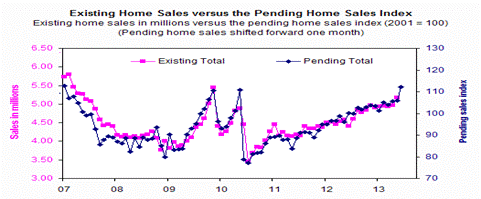
The pending home sales index surged 6.7 percent in May to its highest level since 2006. This has to be because of those rising mortgage rates as prospective buyers want to act before rates could move even higher. The index posted double-digit percentage increases in the Midwest and West. The index level of 112.3 is the highest since the boom days of 2006. The year-on-year gain for the index is 12.1 percent, which is interestingly right in line with double-digit gains for many home-price readings.

clip_image002

Graph: Wrightson ICAP

To the extent that the surge reflected fence sitters jumping into action, there might be some payback in future months, says Wrightson ICAP. “Also, the big increase could partly reflect seasonal adjustment difficulties, as this is the third consecutive year of May gains in the 5-to-7 percent range. Nevertheless, this is a strong report, and it suggests that existing home sales could rise to around 5.5 million in June, which would be the strongest showing since 2007.”

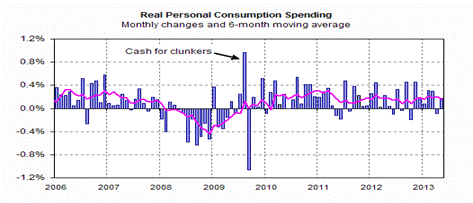
Another reason for the burst in pending home sales is the consumer sector made a comeback in May with income and spending improving. Personal income gained 0.5 percent after a 0.1 percent rise in April. Expectations were for a 0.2 percent increase. The wages & salaries component advanced 0.3 percent, following a 0.1 percent increase.

The latest inflation numbers contained in the PCE report confirm Fed officials concern that inflation is running too low. Year-on-year, PCE headline prices were up only 1.0 percent in May versus 0.7 percent in April, with the core was up just 1.1 percent. These numbers are well below the Fed’s inflation target of 2.0 to 2.5 percent. And the savings rate increased to 3.5 percent, which means consumers are still holding on to much of their income, out of caution, no doubt.

clip_image004

Graph: Wrightson ICAP

It has to be why consumer confidence is in effect soaring. The Conference Board’s Director of Research Lynn Franco said why: “…Consumers are considerably more positive about current business and labor market conditions than they were at the beginning of the year. Expectations have also improved considerably over the past several months, suggesting that the pace of growth is unlikely to slow in the short-term, and may even moderately pick up.”

Expectations are also at a recovery best, up nearly 9 points to 89.5 and reflecting rising confidence in the long-term outlook for the jobs market. The outlook for income is likewise climbing with more now seeing an increase ahead vs. those seeing a decrease. This is an important indication that hints at gains for consumer spending including discretionary spending.

There could be a housing hiccup if mortgage rates continue to climb. But we don’t believe they will. There is no inflation, and interest rates did soften a bit this week after several Fed Governors, such as new Fed Governor Jerome Powell indicated the markets had overreacted.

“The reaction of the forward and futures markets for short-term rates appears out of keeping with my assessment of the [Federal Open Market] Committee’s intentions, given its forecasts,” Mr. Powell said. “To the extent the market is pricing in an increase in the federal funds rate in 2014, that implies a stronger economic performance than is forecast either by most FOMC participants or by private forecasters.”

The economy isn’t growing fast enough to cause the Fed to begin downsizing it QE3 program, in other words, particularly with the huge downward revision just reported of first quarter GDP growth to 1.8 percent from 2.4 percent.

Harlan Green © 2013

Follow Harlan Green on Twitter: www.twitter.com/HarlanGreen

Posted in Consumers, Economy, Housing, housing market, Weekly Financial News | Tagged , , , , , , | 1 Comment

New-Home Sales Up, Delinquencies Down

The Mortgage Corner

Lots of news today. New-home sales are surging, while mortgage delinquencies and foreclosures continue to drop. Consumer sentiment is also up sharply, maybe because housing prices are soaring according to both the S&P Case-Shiller and FHFA (for conforming loans) housing price indices.

This is even though mortgage rates have risen almost 1 percent in 3 weeks—or maybe housing is booming because buyers are rushing to buy before rates go up any higher!  In fact, homes are being purchased faster than they can be built.

Anyway, the Census Bureau just reported new-home sales in May were at a seasonally adjusted annual rate (SAAR) of 476 thousand. This was up from 466 thousand SAAR in April (April sales were revised up from 454 thousand). February sales were also revised up from 429 thousand to 445 thousand, and March sales were revised up from 444 thousand to 451 thousand, which are very strong upward revisions, needless to say.

clip_image002

Graph: Calculated Risk

This is while inventories shrank to a 4.1 month supply—why prices are rising so fast, and the reason for the surge in housing construction as builders strain to fill the demand for new homes. The U.S. Census Bureau had already reported privately-owned housing starts in May were at a seasonally adjusted annual rate of 914,000. This is 28.6 percent above the May 2012 rate of 711,000, as we said last week.

Also thanks to Calculated Risk, the First Look report for May released today by Lender Processing Services (LPS) reported the percent of loans delinquent for loans 30 or more days past due, but not in foreclosure, decreased to 6.08 percent from 6.21 percent in April. Note: the historical rate for delinquencies of all loans has been in the 4 percent range.

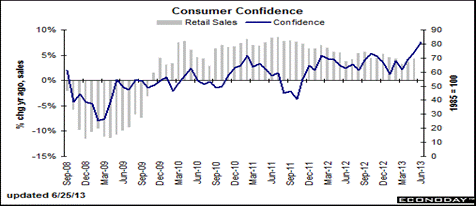
It has to be why consumer confidence is in effect soaring. Consumer confidence is at a recovery best, reports Conference Board, at 81.4 in June and up nearly 7 points from a revised 74.3 in May for the third straight strong gain. The assessment of the present situation is also up at a recovery best 69.2 which hints at general strength for the June economic indicators.

Director of Research Lynn Franco said, “Consumer Confidence increased for the third consecutive month and is now at its highest level since January 2008 (Index 87.3). Consumers are considerably more positive about current business and labor market conditions than they were at the beginning of the year. Expectations have also improved considerably over the past several months, suggesting that the pace of growth is unlikely to slow in the short-term, and may even moderately pick up.”

clip_image004

Graph: Econoday

Expectations are also at a recovery best, up nearly 9 points to 89.5 and reflecting rising confidence in the long-term outlook for the jobs market. The outlook for income is likewise climbing with more now seeing an increase ahead vs. those seeing a decrease. This is an important indication that hints at gains for consumer spending including discretionary spending.

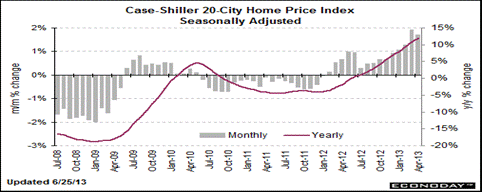
And the S&P Case-Shiller 10 and 20-city Home Price Indexes, boosted by lack of supply and perhaps a sense of urgency if not panic among buyers, are shooting straight up. Case-Shiller’s adjusted month-to-month gain for its 20-city index is up 1.7 percent in April alone and follows a 1.9 percent jump in March. The year-on-year rate is exceptionally strong, at plus 12.0 percent.

clip_image006

Graph: Econoday

Gains are sweeping across all cities without exception with strength centered out West where monthly gains are nearing 3 percent with year-on-year gains reaching 20 percent.

But what happens if mortgage rates continue to rise? The 30-year conforming fixed rate is now up to 4.0 percent with a 1 point origination fee in California, 4.25 percent with no origination fee. The so-called High Balance Conforming rate is one quarter percent higher. That might slow the price increases, as borrowers find it harder to qualify for larger loan amounts. And the Fed is now saying they will slow bond purchases by the end of this year; one more reason that buyers are flocking to the housing market.

Harlan Green © 2013

Follow Harlan Green on Twitter: www.twitter.com/HarlanGreen

Posted in Consumers, Economy, Housing, housing market, Weekly Financial News | Tagged , , , , , , | Leave a comment

Managing Fed’s Expectations—Why Austerity Now?

Popular Economics Weekly

It seems that Ben Bernanke’s Federal Reserve has lost its nerve. Last week’s FOMC meeting confirmed that its Open Market Committee has decided to end the monthly QE3 security purchases sooner rather than later. We already see the damage it has done to both stocks and bonds—worldwide. It also solves the puzzle about why President Obama basically fired him in a Charlie Rose interview when Obama said, “He’s already stayed a lot longer than he wanted or he was supposed to.” Obama must have known the Fed Governors’ decision in advance.

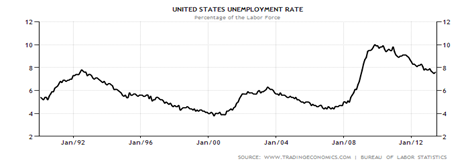
If not a loss of nerve, why would the Fed in effect reverse course? It had been trying to manage expectations that its easy money policies would lead to higher future growth and slightly higher inflation by saying that the U.S. unemployment rate had to drop to 6.5 percent before it would begin to raise interest rates.

Was the economy heating up? No. Was inflation out of control? No, it was still falling. Even 6.5 percent was an unemployment rate that would never have been tolerated in the past for long. But it is being tolerated now, and so is the agony of prolonged unemployment.

image

Graph: Trading Economics

Instead the Bernanke’s abrupt announcement showed how easy it is to change the course of expectations by one press conference—on a dime, even. The markets’ reaction is telling the Fed that expectations have been reversed, that growth is not yet strong enough to warrant taking the foot off the gas pedal, to use Bernanke’s own metaphor.

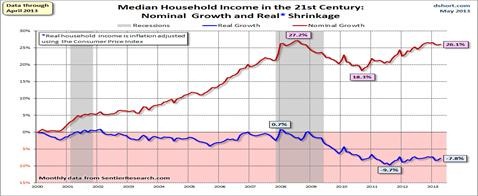
Time will tell, of course, but with median household incomes still depressed—down some 7.8 percent since 2000 after inflation—there was the hope that Bernanke would stick to his word. Now he is saying even if the unemployment rate fell to 7 percent, they could begin to taper their security purchases later this year.

clip_image004

Graph: dshort.com

That is what we heard. It can only mean that even the Federal Reserve is now locked in the grasp of what Paul Krugman and others have called the “monopolists”; those who espouse higher interest rates over higher employment. They are the money managers and owners who would rather pad their own pockets than that of their employees.

“So what’s really different about America in the 21st century,” asks Krugman? “The most significant answer, I’d suggest, is the growing importance of monopoly rents: profits that don’t represent returns on investment, but instead reflect the value of market dominance.”

The massive selloff of debt and equities means the markets must envision a massive slowdown in growth, as investors withdraw from the markets. And so the safest solution is hoard their cash, as was done during the Great Recession. Cash, after all, is the best recession hedge of all. It is the ultimate flight to quality when the odds increase for another downturn, which the Fed may inadvertently now be encouraging rather than preventing.

Harlan Green © 2013

Follow Harlan Green on Twitter: www.twitter.com/HarlanGreen
Posted in Consumers, Economy, Keynesian economics, Macro Economics, Weekly Financial News | Tagged , , , , , , , , , | Leave a comment

Whither Mortgage Rates?

The Mortgage Corner

Ok, the fats in the fire now with the Fed saying it will begin to taper its QE3 purchases that have been holding down mortgage rates by the end of 2013. Rates have been surging since then. The 30-year conforming fixed rate guaranteed by Fannie Mae and Freddie Mac is up almost 1 percent in 1 month.

clip_image002

Graph:  WSJ Marketwatch

So how much will this crimp the housing recovery, just now gathering steam? The all important single-family housing starts in May (that helps to determine whether the homeownership rate will increase) was at a rate of 599,000, according to the National Association of Home Builders and has been rising since January 2011, up some 33 percent from its most recent low.

This is why builder confidence in new-home construction has increased, as we said. But with 30-year conforming fixed rates now 4.25 percent, up from 3.50 percent as recently as the week before Bernanke’s first pronouncement that QE3 would be on the wane by year end, the rising costs will hit those in the lower income brackets.

For instance at the $208,000 national median home price the monthly payment would increase just $49/mo with a 20 percent down payment, a 6 percent increase. But the result is magnified in the debt to income ratio requirement for qualification, which is 43 percent. The qualification income would have to be approximately 5 percent higher, or housing price 5 percent lower, equal to $197,600, a $10,400 reduction in buying power, assuming other debts are equal.

So this would affect entry-level, first time homebuyers for the most part. But that is about 40 percent of home purchases during normal times. So in effect the Federal Reserve is cutting loose first-time homebuyers from the possibility of purchasing anything but so-called “affordable” housing with mandated price controls. And we know how few affordable units are built even during normal times.

Of course should Fannie Mae and Freddie Mac return to the private sector from government conservatorship, entry-level home buying could continue, since their interest rates have historically been lower than that of commercial banks. Critics have said this is because of the “implicit” government guaranteed to bail them out, and their thin market capitalization.

But their profits have been boosted by record-low interest rates, a booming housing market, and Fannie and Freddie’s very low default rates; the result of strict underwriting guidelines that require excellent credit, adequate income and assets.

There is in fact no reason banks can’t return to the mortgage market on their own, rather than rely on Fannie and Freddie, who now guarantee some 90 percent of mortgages originated. Renown banking analyst Richard Bove predicts banks are at the beginning of a record run in profits that could last 14 years.

“”What I’m suggesting is for the next 14 years — you’ll have some setbacks, some recessions — (but) bank earnings will do what they did from 1992 to 2006,” he said. “They’re going to go straight up.”

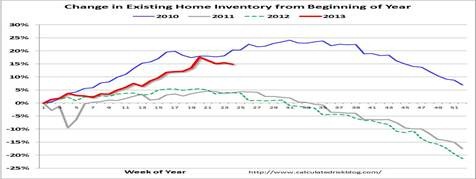
Even better news is that inventories of existing homes continue to increase from record lows as banks continue to decrease their holdings of distressed homes. So far in 2013, inventory is up 14.9 percent, according to Housing Tracker. But inventory is still very low, down 15.8 percent from the same week last year according to Housing Tracker. 

clip_image004

Graph: Calculated Risk

Calculated Risk’s Bill McBride opines that inventory is well above the peak percentage increases for 2011 and 2012, which suggests that inventory is near the bottom. I believe it can only go up from now, as I said last week. The reason is housing values continue to increase, up as much as 25 percent from their lows in Florida, California, and Nevada, states hardest hit by the housing bust.

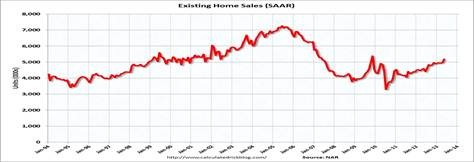
The bottom line is activity in the housing sector is heating up with existing-home sales rising 4.2 percent to a seasonally adjusted annual rate of 5.18 million in May from 4.97 million in April, and is 12.9 percent above the 4.59 million-unit pace in May 2012.

clip_image006

Graph: Calculated Risk

Total housing inventory at the end of May rose 3.3 percent to 2.22 million existing homes available for sale, which represents a 5.1-month supply at the current sales pace, down from 5.2 months in April. Listed inventory is 10.1 percent below a year ago, when there was a 6.5-month supply.

The only fly in this ointment is whether mortgage rates will continue to rise. This might also slow price increases as borrowers find it harder to qualify for larger loan amounts.

But rates can’t go much higher for the moment, unless and until we approach fuller employment and economic growth really takes off. It would trigger the end of QE3 altogether and perhaps the Fed beginning to raise shorter term rates. But that is the best of all worlds and means a return to more normal times, at last. For rising rates means a greater demand for money, due to a faster growing economy, something we all want.

Harlan Green © 2013

Follow Harlan Green on Twitter: www.twitter.com/HarlanGreen
Posted in Uncategorized | Tagged , , , , , , , , | Leave a comment