Did Bernanke Change His Tune?

Financial FAQs

As we all know by now, Fed Chairman Bernanke seems to have abruptly switched sides in the stimulus debate. He said the purchases of $85 billion in bonds and mortgage securities could begin to be ‘tapered’ by the end of the year, if unemployment continues to fall—maybe to 7 percent.

Of course stock and bond prices plunged as they did 3 weeks ago, when he first mentioned the possibility, because there are few indications that employment will improve that much, and inflation reverse its downward plunge. Many, such as Nobelist Paul Krugman, believe he is wrong in making that pronouncement at the latest FOMC meeting and press conference afterward.

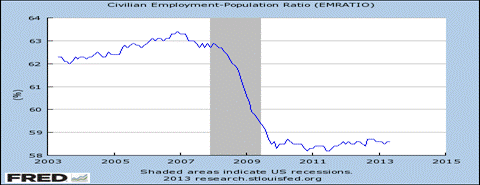
“My (initial) reaction is, this is not good. They might get away with it, but there’s also a serious chance that this will end up looking like a historic mistake. Bear in mind, first, that the US economy is still deep in the hole, which is especially obvious if you look at employment rather than unemployment:”
clip_image002

Graph: St Louis Fed

“Aging of the population accounts for some but not much of the fall in the employment ratio; the fact is that we are still a very long way from acceptable employment levels,” said Krugman. “Meanwhile, inflation remains below the Fed’s target. Maybe the Fed believes that the situation will improve — but as everyone points out, the Fed has been consistently over-optimistic since the crisis began. And for now the economy still needs all the help it can get.”

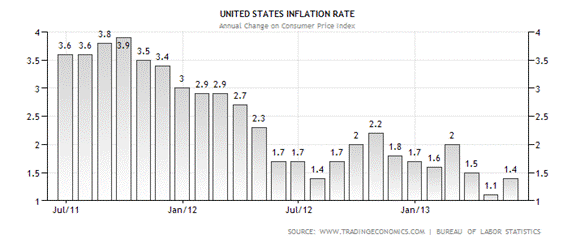
So why is Bernanke suddenly so optimistic about growth? Bond guru Bill Gross, for one, thinks the markets are misreading Bernanke, because Bernanke said at the same press conference that inflation now at 1.1 or 1.4 percent (depending on which indicator is used) has to approach its 2-2.5 percent target range, and unemployment has to come down to 6.5 percent from its 7.6 percent rate before the Fed will stop its QE3 purchase of securities.

So this tells us the importance of low interest rates during this recovery, when household incomes are still stagnant, mainly due to almost no growth in wages and salaries—the income earned by most households (therefore consumers), as I said in my last column.
clip_image004

Graph: Trading Economics

Meanwhile, inflation is still declining, not a good sign, so Bernanke must be attempting to manage expectations that economic growth is more robust that we know at present. I.e., he wants us to believe that in fact the economy is recovering faster than at present. I hope he is right in seeing better growth in the tea leaves—that the rest of us don’t yet see.

He might be right. Real estate at least is showing a better recovery. Existing-home sales rose 4.2 percent in May to a seasonally adjusted annual rate of 5.18 million — the highest rate since November 2009, when a buyer tax credit deadline approached — pointing to a continuing recovery, the National Association of Realtors reported Thursday. Sales of existing homes in May were 12.9 percent higher than during the same period in the prior year.

Harlan Green © 2013

Follow Harlan Green on Twitter: www.twitter.com/HarlanGreen
Posted in Consumers, Economy, Housing, housing market, Macro Economics, Weekly Financial News | Tagged , , , , , , | Leave a comment

Economic Growth Stronger Than Predictions?

Popular Economics Weekly

There are signs that economists have underestimated GDP growth this year. The New York Times surveyed economists in a recent Sunday front page article, that said growth could increase to 3 percent from the 2 percent norm of the past 3 years. “That is the surprising new view of a number of economists in academia and on Wall Street, who are now predicting something the United States has not experienced in years: healthier, more lasting growth,” said the Nicholas D. Schwartz article.

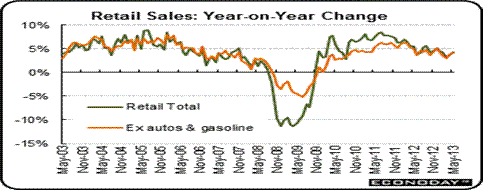
And consumers are spending more. May retail sales surprised on the upside and increased 0.6 percent on the month and were up 4.3 percent from a year ago. Retail sales excluding just autos and excluding both autos and gasoline were up 0.3 percent from April, much as expected. On the year, they were up 2.8 percent and 4.1 percent respectively.

clip_image002

Graph: Econoday

This is reflected in consumer confidence numbers. Consumer sentiment has been oscillating upward slowly since the mid-2011 plunge. Consumer spirits have been on a climb the last couple of months, but dipped back mid-June to 82.7 versus May’s 84.5.

The consumer’s fundamental outlook for the economy is little changed with the expectations component rising nearly 1 point to 76.7 which is near a recovery high. In fact, the current conditions outlook is almost back to 2006 levels.

The nonpartisan Congressional Budget Office also sees relatively fast growth of 3.4 percent next year, and 3.6 percent between 2015 and 2018. A few other private economists are even more bullish, according to the New York Times article. Jim Glassman, senior economist at JP Morgan Chase’s commercial bank, estimates the economy could expand by 4 percent in both 2014 and 2015. If that were to come to pass, it would be the strongest back-to-back annual growth since the late 1990s.

There are many ingredients that could boost economic growth. The U.S. could become a net exporter of oil and gas in the coming decades. Health care costs are declining thanks to Obamacare, or the Affordable Care Act, according to many analysts. And housing may now be leading the recovery, while household net worth has increased some $3 trillion in Q1 2013, according to the Federal Reserve’s Flow of Funds report.

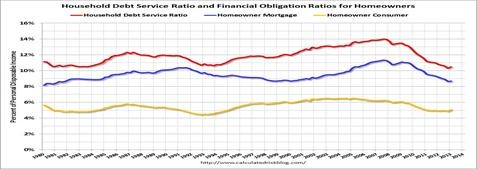
In fact, household debt continues to decline, also making consumers more optimistic about their future. The Calculated Risk graph shows the Debt to Service Ratio for both renters and homeowners (red), and the homeowner financial obligations ratio for mortgages (blue) and consumer debt (yellow).

clip_image004

Graph: Calculated Risk

Almost all of the ratios are down to levels that prevailed in the1990s (graph begins in 1980). This is both because of historically low interest rates, rates that we haven’t seen since World War II, and the large number of foreclosures and short sales that have reduced mortgage debt by as much as one-third in some regions.

That tells us the importance of low interest rates during this recovery, when household incomes are still stagnant, mainly due to almost no growth in wages and salaries—the income earned by most households (therefore consumers).

In fact, real, after inflation household incomes have declined 7.8 percent since the end of the Great Recession, which is the ‘real’ reason this recovery has been so painfully slow.

clip_image006

Graph: dshort.com

As Doug Short says in his excellent blog column, “The stunning reality illustrated here is that the real median household income series spent most of the first nine years of the 21st century struggling slightly below its purchasing power at the turn of the century.”

Harlan Green © 2013

Follow Harlan Green on Twitter: www.twitter.com/HarlanGreen
Posted in Consumers, Economy, Keynesian economics, Macro Economics, Weekly Financial News | Tagged , , , , , , | 1 Comment

Housing Construction Key to Economic Recovery

The Mortgage Corner

Any doubts that housing is leading the economic recovery should be dispelled by now. Existing-home sales are projected to top 5 million units per year, as the so-called shadow inventory of distressed homes continues to fall due to pent up demand and sharply rising housing prices.

Even more telling is the surge in housing construction as builders strain to fill the demand for new homes. The U.S. Census Bureau just reported privately-owned housing starts in May were at a seasonally adjusted annual rate of 914,000. This is 6.8 percent above the revised April estimate of 856,000 and is 28.6 percent above the May 2012 rate of 711,000.

clip_image002

Graph: Calculated Risk

The all important single-family housing starts in May that determines whether the homeownership rate will increase were at a rate of 599,000; this is 0.3 percent above the revised April figure of 597,000. The May rate for units in buildings with five units or more was 306,000.

This is why builder confidence in the resurgence in housing construction has increased, boosting housing stocks. Builder confidence in the market for newly-built single-family homes hit a significant milestone in June, surging eight points to a reading of 52 in the just released National Association of Home Builders/Wells Fargo Housing Market Index (HMI). It is a poll of home builders, so that any number over 50 percent indicates that more builders view sales conditions as good than poor.

“This is the first time the HMI has been above 50 since April 2006, and surpassing this important benchmark reflects the fact that builders are seeing better market conditions as demand for new homes increases,” said NAHB Chairman Rick Judson. “With the low inventory of existing homes, an increasing number of buyers are gravitating toward new homes.”

Even better news is that inventories of existing homes continue to increase from record lows as banks continue to decrease their holdings of distressed homes. So far in 2013, inventory is up 14.9 percent, according to Housing Tracker. But inventory is still very low, and is down 15.8 percent from the same week last year according to Housing Tracker. 

clip_image004

Graph: Calculated Risk

Calculated Risk’s Bill McBride opines that inventory is well above the peak percentage increases for 2011 and 2012, which suggests that inventory is near the bottom. I believe it will continue to increase. The reason is housing values continue to increase, up as much as 25 percent from their lows in Florida, California, and Nevada, states hardest hit by the housing bust.

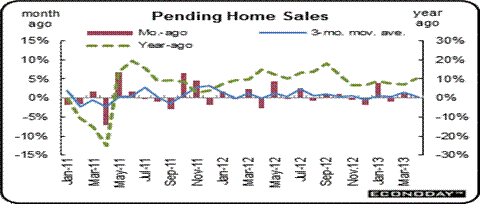
We reported last week that Pending Home Sales Index, a forward-looking indicator based on contract signings, rose 0.3 percent to 106.0 in April from 105.7 in March, and is 10.3 percent above April 2012 according to the National Association of Realtors. The data reflect contracts but not closings.

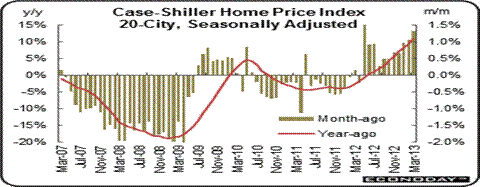
And the S&P Case-Shiller Home Price Index reported the year-on-year increase of 10.9 percent is the first double-digit gain since May 2006.

The bottom line is activity in the housing sector is heating up with April existing-home sales rising 0.6 percent to an annual rate of 4.97 million. Supply, which had been very tight, poured into the market during April with 230,000 units added to lift the months supply to 5.2 from 4.7 months. The median time for a house on the market fell dramatically, to 46 days vs 62 days in March.

The only fly in this ointment is whether mortgage rates will continue to rise. The 30-year conforming fixed rate is up to 3.75 percent with a 1 point origination fee in California, 4 percent with no origination fee. That might slow the price increases, as borrowers find it harder to qualify for larger loan amounts. But they can’t go much higher if the Fed maintains it QE3 bond purchases for at least the rest of this year, which it has said it will do. We will see.

Harlan Green © 2013

Follow Harlan Green on Twitter: www.twitter.com/HarlanGreen

Posted in Consumers, Economy, Housing, housing market, Weekly Financial News | Tagged , , , , , , | Leave a comment

Housing Recovery Is For Real

The Mortgage Corner

Those who doubt the real estate recovery aren’t paying attention to the latest sales’ data. We reported last week the Pending Home Sales Index, a forward-looking indicator based on contract signings, rose 0.3 percent to 106.0 in April from 105.7 in March, and is 10.3 percent above April 2012 according to the National Association of Realtors. The data reflect contracts but not closings.

And Southern California home sales were the highest since May 2006, reports DataQuick, The median price paid for all new and resale houses and condos sold in the six-county Southland was $357,000 last month, up 23.1 percent from $290,000 in April 2012, and the highest since June 2008, when the median was $360,000. “What seems obvious is that if prices keep rising fast they’ll cause many more people to list their homes for sale,” said DataQuick President John Walsh, “and that increase in supply should at least slow the rate of price appreciation,” he said.

The doubters are mainly those who believe the Federal Reserve is artificially stimulating home sales by keeping interest rates so low, such as Barron’s conservative economist Gene Epstein. “Why barely one cheer, then (for the housing recovery)? Because this housing recovery has been so stuffed with government steroids, you wonder if it could make it on its own if these drugs were withdrawn.”

But lower interest rates are necessary when consumers buying power has shrunk so badly due to the Great Recession. That is to say, such low interest rates make housing more affordable for the majority of home buyers. Rates will rise of their own accord when incomes (and so inflation) begins to rise, and business activity heats up. Interest rates are really controlled by the demand for money, which increases when spending increases.

Home contract activity is at the highest level since the index hit 110.9 in April 2010, immediately before the deadline for the home buyer tax credit.  Pending sales have been above year-ago levels for the past 24 months.

clip_image002

Graph: Econoday

Lawrence Yun, NAR chief economist, said a familiar pattern has developed.  “The housing market continues to squeak out gains from already very positive conditions.  Pending contracts so far this year easily correspond to higher closed home sales in 2013,” he said.  Total existing-home sales are expected to rise just over 7 percent to about 5 million this year.”

This is huge, and though inventories are rising, it’s not enough to keep prices from continuing to rise. “Because of inventory shortages, higher home sales will push up home values to the highest level in five years,” Yun said.  The national median existing-home price should increase close to 8 percent and exceed $190,000 in 2013.

And the S&P Case-Shiller Home Price Index reports the year-on-year increase of 10.9 percent is the first double-digit gain since May 2006.

clip_image004

Graph: Econoday

The bottom line is activity in the housing sector is heating up with April existing-home sales rising 0.6 percent to an annual rate of 4.97 million. Supply, which had been very tight, poured into the market during April with 230,000 units added to lift the months supply to 5.2 from 4.7 months. The median time for a house on the market fell dramatically, to 46 days vs 62 days in March.

And sellers are getting their price based on the report’s price data. After jumping 6.2 percent in March, the median price rose another 4.8 percent in April to $192,800 which is the highest level of the recovery. We should note that price data in this report, which are not based on repeat transactions, are often volatile. But who can argue with a double digit year-on-year median gain at 11.0 percent?

Harlan Green © 2013

Follow Harlan Green on Twitter: www.twitter.com/HarlanGreen

Posted in Consumers, Economy, Housing, housing market, Weekly Financial News | Tagged , , , , , , | Leave a comment

Fannie Mae/Freddie Mac Dilemma Won’t End Soon

Popular Economics Weekly

The U.S. Treasury is in a bind. Everyone seems to agree that Fannie and Freddie, wards of the government should be downsized, but how to do it without damaging the housing recovery? Extreme conservatives even want to abolish them, along with the Federal Reserve, Departments of Commerce, Education, etc., etc. That isn’t practical, of course—especially abolishing Fannie and Freddie because they currently supply more than 90 percent of all mortgages!

That is one reason even a hint by Fed Chairman Bernanke and others that the Fed might “taper” QE purchases has caused interest rates to rise sharply. Because former Goldman Sachs chief economist Jim O’Neill and others have trumpeted that bond interest rates could reach 4 percent, if and when the Fed slows its QE purchases, returning to “more normal valuations” when the economy does recover.

This in turn means that mortgage rates would return to their recent 6 percent range for conforming 30-year fixed rates, from today’s 4 percent. But that would be devastating to a recovering housing market. Household incomes are still stagnant—in fact have been for the past 30 year, when accounting for inflation.

Keeping interest rates so low has made housing more affordable at these lower income levels. That is the major reason for the Fed’s QE3 buying program.

The Fed has also said unemployment has to fall further, as we have said, and there are few signs that GDP growth will be more than 2 percent this year.

Bond investors also watch inflation, and right now inflation is falling. The Personal Consumption Expenditure Index favored by the Fed is currently 1 percent, which is 1 percent below the Fed’s target of 2 percent. So why would the Fed even begin to “taper” their $85 billion per month in security purchases when neither is happening; and real estate is at the beginning of its recovery?

And sure enough, the Fed has just hinted in a recent Wall Street Journal Op-ed by John Hilsenrath that they aren’t in a hurry to taper their QE3 purchases—just yet. “The Fed, he (Bernanke) said in his March press conference and again at testimony to Congress last month, expects a “considerable” amount of time to pass between ending the bond-buying program and raising short-term rates. He seems likely to press that point at his press conference next week, given that the markets are telling him they don’t believe it.”

“In recent years, the search for yield has gone wider and deeper,” said O’Neill in his bond article. “The resulting deviation from normal valuations has been amplified by the shift of pension funds and insurance companies out of equities into fashionable bonds, and by the lingering effects of the great financial crisis of 2008 and 2009. It seems inevitable that some version of the shock of 1994 is going to happen again.”

What “shock of 1994”? That was when Orange County went bankrupt because then Fed Chairman Greenspan boosted interest rates abruptly in the spring of 1994, after holding them at record lows in 1992-93, to cure the 1991 recession. But Greenspan did it without any warning, which is why Orange County lost so much money betting that interest rates would continue to fall.

So, really the panicked selling of stocks and bonds, and recent rise in interest rates are a sign that economic growth is still fragile, so that even a hint of credit tightening will depress markets. It is the Federal Reserve that is goosing growth, after all, especially in the real estate sector.

As if to corroborate the Fed’s efforts, Southern California home sales were the highest since May 2006, reports DataQuick, The median price paid for all new and resale houses and condos sold in the six-county Southland was $357,000 last month, up 23.1 percent from $290,000 in April 2012, and the highest since June 2008, when the median was $360,000. “What seems obvious is that if prices keep rising fast they’ll cause many more people to list their homes for sale,” said DataQuick President John Walsh.

But that can’t happen if interest rates continue to rise as quickly—and certainly not if they return to more “normal valuations”. So government shouldn’t be in a hurry to downsize Fannie and Freddie, either, since it doesn’t look like Wall Street or the banks are willing to support the housing market without Fannie and Freddie’s help.

Harlan Green © 2013

Follow Harlan Green on Twitter: www.twitter.com/HarlanGreen

Posted in Consumers, Economy, Housing, housing market, Politics, Weekly Financial News | Tagged , , , , , , , , , | Leave a comment

Pending Home Sales, Prices Continue to Rise

The Mortgage Corner

Those who doubt the real estate recovery aren’t paying attention to the latest sales’ data. We reported last week the Pending Home Sales Index, a forward-looking indicator based on contract signings, rose 0.3 percent to 106.0 in April from 105.7 in March, and is 10.3 percent above April 2012 according to the National Association of Realtors. The data reflect contracts but not closings.

The doubters are mainly those who believe the Federal Reserve is artificially stimulating home sales by keeping interest rates so low, such as Barron’s conservative economist Gene Epstein. “Why barely one cheer, then (for the housing recovery)? Because this housing recovery has been so stuffed with government steroids, you wonder if it could make it on its own if these drugs were withdrawn.”

But lower interest rates are necessary when consumers buying power has shrunk so badly due to the Great Recession. That is to say, such low interest rates make housing more affordable for the majority of home buyers. Rates will rise of their own accord when incomes (and so inflation) begins to rise, and business activity heats up. Interest rates are really controlled by the demand for money, which increases when spending increases.

Home contract activity is at the highest level since the index hit 110.9 in April 2010, immediately before the deadline for the home buyer tax credit.  Pending sales have been above year-ago levels for the past 24 months.

clip_image002

Graph: Econoday

Lawrence Yun, NAR chief economist, said a familiar pattern has developed.  “The housing market continues to squeak out gains from already very positive conditions.  Pending contracts so far this year easily correspond to higher closed home sales in 2013,” he said.  Total existing-home sales are expected to rise just over 7 percent to about 5 million this year.

This is huge, and though inventories are rising, it’s not enough to keep prices from continuing to rise. “Because of inventory shortages, higher home sales will push up home values to the highest level in five years,” Yun said.  The national median existing-home price should increase close to 8 percent and exceed $190,000 in 2013.

And the S&P Case-Shiller Home Price Index reports the year-on-year increase of 10.9 percent is the first double-digit gain since May 2006.

clip_image004

Graph: Econoday

The bottom line is activity in the housing sector is heating up with April existing-home sales rising 0.6 percent to an annual rate of 4.97 million. Supply, which had been very tight, poured into the market during April with 230,000 units added to lift the months supply to 5.2 from 4.7 months. The median time for a house on the market fell dramatically, to 46 days vs 62 days in March.

And sellers are getting their price based on the report’s price data. After jumping 6.2 percent in March, the median price rose another 4.8 percent in April to $192,800 which is the highest level of the recovery. We should note that price data in this report, which are not based on repeat transactions, are often volatile. But who can argue with a double digit year-on-year median gain at 11.0 percent?

Harlan Green © 2013

Follow Harlan Green on Twitter: www.twitter.com/HarlanGreen
Posted in Consumers, Economy, Housing, housing market, Politics, Weekly Financial News | Tagged , , , , , | Leave a comment

What Will the Federal Reserve Do??

Popular Economics Weekly

Now the fat’s in the fire. Both stocks and bond prices have been falling of late, due to the fear that the Fed will end its $85 billion per month QE purchases of Treasury and mortgage securities too soon. Fed Chairman Bernanke had said that if employment continued to improve, the Fed might begin to “taper” its purchases as soon as its June FOMC meeting.

And today the Bureau of Labor Statistics reported the May unemployment report rose from 7.5 to 7.6 percent because 420,000 more people are looking for work, though 175,000 more payroll jobs were created in May! So what’s the Fed to do? On the face of it, the Fed can’t begin to end QE purchases because its stated goal of 6.5 percent unemployment isn’t close to being reached.

image

Graph: Calculated Risk

And both inflation indexes and consumer incomes show there is still insufficient demand for more goods and services that would cause the U.S. economy to grow closer to its normal longer term GDP growth rate of 3.5 percent. It grew just 2.2 percent last year, and predictions for 2013 are not much better.

This graph of personal consumption expenditure prices illustrates the problem. Prices have been falling, and when prices fall, so do profits. Hence wages and so employment remains stagnant, stuck where it has essentially been over the past 3 years. Then why are we worried?

image

Inflation hasn’t been running at the 2 to 2.5 percent average that prevailed before the Great Recession, in other words. Hence those calling for an early exit from QE are doing the country a disservice. It means fewer new jobs and therefore more remaining unemployed. The Bureau of Labor Statistics said some 13.6 million are “marginally attached” to the labor force and still looking for full time work. The unemployment rate for them is an even larger 13.8 percent — down from 13.9 percent in April — if everyone who wants a full-time job but can’t find one is included. Millions of Americans still cannot find work nearly four years after the recession ended.

So who is calling for an early end to QE? No less than Former Fed Chairman Alan Greenspan, for one. “Bond prices have got to fall. Long-term rates have got to rise. The problem, which is going to confront us, is we haven’t a clue as to how rapidly that’s going to happen. And we must be prepared for a much more rapid rise than is now contemplated in the general economic outlook.”

But interest rates generally rise and fall in tandem with inflation, and inflation is still falling. That means getting closer to full employment, which is when inflation historically becomes a problem. So we have a long way to go before worrying about interest rates rising too fast.

Harlan Green © 2013

Follow Harlan Green on Twitter: www.twitter.com/HarlanGreen
Posted in Consumers, Economy, Keynesian economics, Politics, Weekly Financial News | Tagged , , , , , , , , , , | Leave a comment

Housing Prices Rise as Foreclosure Rates Fall

The Mortgage Corner

Home prices are continuing to rise, in part because foreclosure rates continue to fall. Fannie Mae reported that the Single-Family Serious Delinquency rate declined in April to 2.93 percent from 3.02 percent in March. The serious delinquency rate, covering loans 90 days or more delinquent or in foreclosure, is the lowest level since January 2009.The Fannie Mae serious delinquency rate peaked in February 2010 at 5.59 percent.

Foreclosed homes tend to sell for 33 percent less than normal market prices, which depresses housing values. So the drop in foreclosures means fewer homes are sold at under market prices.

Freddie Mac reported that the Single-Family serious delinquency rate declined in April to 2.91 percent from 3.03 percent in March. Freddie’s rate is down from 3.51 percent in April 2012, and this is the lowest level since June 2009. Freddie’s serious delinquency rate peaked in February 2010 at 4.20 percent.

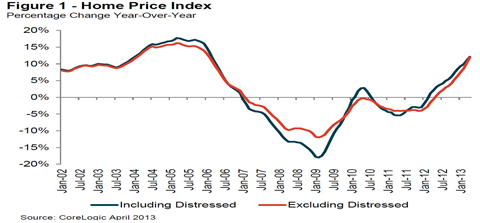
This is while CoreLogic reported home prices nationwide, including distressed sales, increased 12.1 percent on a year-over-year basis in April 2013 compared to April 2012. This change represents the biggest year-over-year increase since February 2006 and the 14th consecutive monthly increase in home prices nationally. On a month-over-month basis, including distressed sales, home prices increased by 3.2 percent in April 2013 compared to March 2013.

image

Graph: Calculated Risk

Excluding distressed sales, home prices increased on a year-over-year basis by 11.9 percent in April 2013 compared to April 2012, but longer-term housing prices will rise faster when excluding distressed sales, says CoreLogic. This is because CoreLogic’s distressed sales include short sales and real estate owned (REO) transactions, which could boost overall prices over the short term due to the high demand by investors who are buying up many in bulk.

More evidence that the lack of homes on the market has been driving up prices is pending home sales, or homes under contract but not yet closed, which rose only 0.3 percent in April, following a 1.5 percent boost the month before.

image

Graph: Econoday

The National Association of Realtors Pending Home Sales Index reports home contract activity was at the highest level since the index hit 110.9 in April 2010, immediately before the deadline for the home buyer tax credit.  Pending sales have been above year-ago levels for the past 24 months.

And Econoday reports “a regional look shows the effect of tight inventory which is most severe in the West and where pending home sales fell 7.6 percent. Price data from the West, in reports such as Case-Shiller, have been showing the very sharpest gains. Home-price appreciation is a very big story right now in the economy and this report points to continued upward pressure.”

The bottom line is activity in the housing sector is heating up with April existing-home sales rising 0.6 percent to an annual rate of 4.97 million, according to the National Association of Realtors. Sales of single-family homes, the most important component in the report, rose 1.2 percent in the month

Supply, which had been very tight, poured into the market during April with 230,000 units added to lift the months supply to 5.2 from 4.7 months. The median time for a house on the market fell dramatically, to 46 days vs 62 days in March.

And sellers are getting their price based on the report’s price data. After jumping 6.2 percent in March, the median price rose another 4.8 percent in April to $192,800 which is the highest level of the recovery. We should note that price data in this report, which are not based on repeat transactions, are often volatile. But who can argue with a double digit year-on-year median gain of 11.0 percent?

Harlan Green © 2013

Follow Harlan Green on Twitter: www.twitter.com/HarlanGreen

Posted in Uncategorized | Tagged , , , , , , , , | Leave a comment

Social Security Isn’t Dead

Popular Economics Weekly

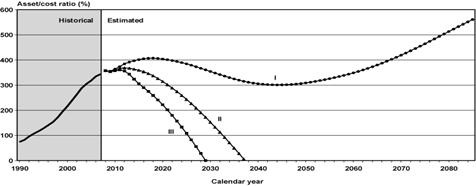
Social Security isn’t dead, or even dying, in spite of the prediction by the Social Security Trustees that it will no longer be able to pay full benefits by 2033. That’s because the Trustees use what are called ‘intermediate’ assumptions of income and tax growth that have prevailed since the huge shift in wealth upward beginning in the 1970s, depressing incomes of the middle and lower income earning brackets.

clip_image002

The Trustees base their projection on growth rates of population, wages and employment that comprise the Gross Domestic Product, and not wanting to be overly optimistic, pick what they believe to be a medium GDP growth rate over the next 75 years in the mid-2 percent range, rather than the longer term historical rate of 3.5 percent over the past 75 years.

There are reasons for optimism, in other words, if employment and wage growth can be brought back to historical levels, instead of assuming more recent growth rates that are result of 5 recessions since 1980, which in turn were the result of experiments with so-called supply-side economics that emphasized lower tax rates for investors and and reduced government spending. This ‘experiment’ resulted in tremendous economic upheavals and $trillions in productive output lost.

clip_image004

Graph: US Social Security Admin

The Social Security Trustees own Alternative I, the “lower cost” estimate, would in fact never run out of funds. Hence the need to focus on what creates economic growth. It’s really a no-brainer.  More growth requires more jobs that pay a living wage for starters, which means more collective bargaining power and the strengthening of labor laws that have been weakened over the past 30 years.

There has been very little research, other than historical, on the ingredients of robust growth. But history does show that the continued transfer of wealth away from the consuming public to the wealthiest, while keeping corporate and high income tax rates as low as possible, hurts overall economic growth.

How? By the outright suppression of collective bargaining of wage and salary earners, either via such corporation backed groups as ALEC, the American Legislative Exchange Council, or Republican majorities in the right to work states that inhibit union organizing efforts, for starters. And those Republican majorities are due in part to blatant voter suppression laws in those states, again supported by the likes of ALEC.

Economists such as Thomas Piketty and Emmanuel Saez have shown that this has been going on for decades—since the 1970s, really, when high income tax brackets began to be lowered under the rationale that it would boost economic growth. But alas, the opposite has happened.

We need another New Deal to bring back the middle and lower class earning potential, real jobs paying wages real wages, in other words. Then we won’t have to worry about social security, worry less about Medicare, and stop the impoverishment of the majority of Americans who actually produce the wealth that should guarantee them a comfortable retirement.

Harlan Green © 2013

Follow Harlan Green on Twitter: www.twitter.com/HarlanGreen

Posted in Consumers, Economy, Macro Economics, Politics, Weekly Financial News | Tagged , , , , , , | 1 Comment

A Greater Recession, if Fed QE Ends Too Soon

Financial FAQs

The stock and bond markets are sinking because of Fed Chairman Bernanke’s seemingly offhand remark that the Fed could slow down its QE purchases of securities as early as its June FOMC meeting. Now Organization for Economic Development and Cooperation (OECD) economists are saying that could hurt worldwide growth! Of course it will, since the U.S. is leading the worldwide recovery from the Great Recession, while our own economy is only beginning to recover. And we know from past history it takes many years to recover from such a severe downturn.

Why? The huge transfer of wealth upward has to be reversed, as it was after the Great Depression when income inequality was as bad as it is today. And that takes time. It took 10 years plus a World War in the case of the Great Depression, after Roosevelt tried to prematurely balance the federal budget in 1937, plunging the U.S. economy back into depression, hence making it the Great Depression.

There is a danger this could be repeated. Already the second Q1 2013 estimate of Growth Domestic Product growth revised growth downward to 2.4 percent from its 2.5 percent initial estimate. Even though consumer spending was revised up to 3.4 percent from 3.2 percent, it didn’t offset the reduction in government spending. The 2.4 percent rate is certainly ok, but it’s not enough to lower the unemployment rate that is currently 7.5 percent with 18 million workers still looking for full time work.

This is because consumers aren’t earning enough money to boost the demand for what is being produced. This is something that so-called Austerians, those who don’t like debt of any kind, can’t seem to understand. Because they believe that high debt is always the problem. Even during a time when borrowing isn’t the problem. That is to say, during a time when not enough is being purchased in the private sector to stimulate higher growth.

And we know why incomes have been stagnant or falling for most consumers. The collective bargaining of most employees has been severely weakened, or even banned in the case of public workers in states like Wisconsin. Pro-labor laws have been rolled back over the past 30 years that has resulted in record corporate profits and record income inequality not seen since the 1929 Black Market crash.

This is while tax rates for the wealthiest have been slashed, creating more income flowing away from most consumers. A recent National Bureau of Economic Research paper in fact shows that the more top tax rates are cut, the greater the share of national income is diverted to the wealthiest citizens.

image

Graph: Krugman NYTimesBlog

Nobelist Paul Krugman said it best in disputing the Austerians. Inflation is almost nonexistent, having dropped to 1 percent in the GDP revision. Why is low inflation a problem, he asks? “One answer is that it discourages borrowing and spending and encourages sitting on cash. Since our biggest economic problem is an overall lack of demand, falling inflation makes that problem worse. Low inflation also makes it harder to pay down debt, worsening the private-sector debt troubles that are a main reason overall demand is too low.”

This is at the heart of the Austerians misconception. Money is hoarded rather than spent when demand is low and inflation falling. And households won’t spend more if they are intent on paying down debts.

The banks are holding some $1 trillion in excess reserves, while corporations are sitting on almost $5 trillion in cash, according to the Federal Reserve Bank of St. Louis. So why is inflation falling? Krugman says “The answer is the economy’s persistent weakness, which keeps workers from bargaining for higher wages and forces many businesses to cut prices. And if you think about it for a minute, you realize that this is a vicious circle, in which a weak economy leads to too-low inflation, which perpetuates the economy’s weakness.”

And that is our current problem that could lead us back into a Greater Recession. Government spending has been cut back due to the Sequester agreement, while taxes have been raised on must of US. There is really only one solution to weak demand.  Less money has to flow to the top income earners, whether through rising taxes on maximum income tax brackets, or closing corporate tax loopholes, or a combination of both.

Otherwise, we once again will be doomed to repeat a historic mistake—not putting our wealth where it will do the most good, whether that is repairing our obsolete infrastructure, in education, protecting the environment, or even saving social security .

Harlan Green © 2013

Follow Harlan Green on Twitter: www.twitter.com/HarlanGreen

Posted in Consumers, Economy, Macro Economics, Politics, Weekly Financial News | Tagged , , , , , , , , , , , | Leave a comment