HARP 2.0 Leads Mortgage Refinance Higher

The Mortgage Corner

There is growing optimism that the real estate bust is finally at an end. The cause is a combination of record low interest rates leading to more refinance activity and increasing confidence of consumers in the economic recovery. For the first five months of 2012, more than 78,000 homeowners who owe more than 105 percent of their property’s value have refinanced using the government’s Home Affordable Refinance Program, or HARP. That was up from about 60,000 in all of 2011, the Federal Housing Finance Agency said in a recent report.

Much of it is due to HARP 2.0 that removed loan to value caps on mortgage amounts higher than the property value. The removal of the 125 percent LTV cap and certain risk-based fees for refinancing enabled more underwater borrowers to access refinancing through HARP 2.0. HARP volume represented 20 percent of total refinance volume in May, the highest percentage reported since the inception of HARP. One in five refinanced loans in May was originated through HARP, according to the FHFA.

Borrowers with LTV greater than 105 percent accounted for 32 percent — or almost one third — of HARP volume, up from 15 percent in 2011. In addition, an increasing number of underwater borrowers chose shorter-term 15- and 20-year mortgages, which build equity faster than traditional 30-year mortgages.

clip_image002

Graph: Calculated Risk

Interest rates in California have dropped as low as 3.375 percent for conforming 30-year fixed to $417,000 and 3.625 percent for jumbo conforming fixed rates to $625,500 for owner-occupied single units with zero points origination fees.

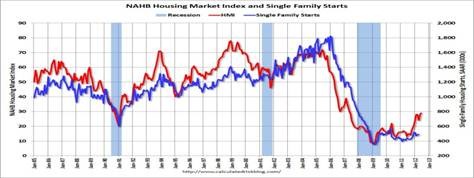
This is why the MBA’s Refinance Index increased 22 percent from the previous week and is at the highest level since mid-June. The seasonally adjusted Purchase Index decreased 0.1 percent from one week earlier, though builder optimism jumped another 6 points to 35, the highest level since March 2007, according to the National Association of Home Builders.

“Combined with the upward movement we’ve seen in other key housing indicators over the past six months, this report adds to the growing acknowledgement that housing – though still in a fragile stage of recovery – is returning to its more traditional role of leading the economy out of recession,” noted NAHB Chief Economist David Crowe. “This is particularly encouraging at a time when other parts of the economy have begun to show softness, and is all the more reason that the challenges constraining housing’s recovery – namely overly tight lending conditions, poor appraisals and the flow of distressed properties onto the market – need to be resolved.”

Calculated Risk reports that “Refinance application volume increased last week to near peak levels for the year as mortgage rates dropped to a new low, driven down by growing concerns about the health of the US economy,” said Mike Fratantoni, MBA’s Vice President of Research and Economics. “Applications for HARP refinance loans accounted for 24 percent of refinance activity last week, in line with the HARP share for the past few weeks.”

Consumers seem to be doing fine, as I said last week, in spite of their worries about jobs, the economy and budget deficits (their own more than governments’). Consumer credit jumped $17.1 billion in May for the largest increase since the $19.1 billion boost seen in November 2011. Gains for the latest month were seen in both revolving and nonrevolving credit.

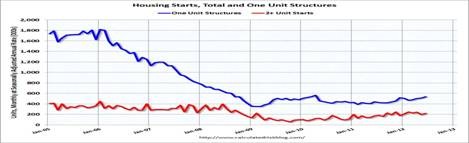
And the U.S. Census Bureau reports that Privately-owned housing starts continued their monthly increase in June, at a seasonally adjusted annual rate of 760,000, the highest rate since October 2008. This is 6.9 percent above the revised May estimate of 711,000 and is 23.6 percent above the June 2011 rate of 615,000. Single-family housing starts in June were at a rate of 539,000; this is 4.7 percent above the revised May figure of 515,000. The June rate for units in buildings with five units or more was 213,000.
clip_image004

Graph: Calculated Risk

Why have interest rates continued downward to the lowest levels since World War II? We can thank the nervousness of foreign investors worrying about recessions in Europe and China that are parking their money in U.S. Treasury Bonds. The 10-year benchmark bond yield has dropped to 1.5 percent, which sets the level for mortgage rates. So where else are investors looking to make money? In real estate, it seems.

Harlan Green © 2012

Posted in Consumers, Economy, Housing, housing market, Weekly Financial News | Tagged , , , , , | Leave a comment

Consumers Becoming Healthier—Part II

Financial FAQs

Consumers seem to be doing better, as I said last week, in spite of their worries about jobs, the economy and budget deficits (their own more than governments’). Consumer credit jumped $17.1 billion in May for the largest increase since the $19.1 billion boost seen in November 2011, which means they are spending more. Gains for the latest month were seen in both revolving and nonrevolving credit.

clip_image002

Graph: Econoday

Nonrevolving credit, which is being driven higher by strong demand for student loans including in the latest month, rose $9.1 billion.  Auto loans also played a supporting role. Revolving credit jumped a giant $8.0 billion which is by far the strongest gain of the recovery. A key question is why revolving credit rose so much. Are consumers more confident about jobs and are more willing to spend?  Are consumers using credit cards to fill in for slumping income? 

The data do not directly answer those questions, says Econoday.  Odds are it is a combination of both.  Consumers with jobs are less worried about a layoff.  And consumers that are underemployed may be resorting to credit cards.  But on a clearly positive note, credit card issuers indeed have returned to the practice of extending credit.  Overall, the boost in credit outstanding is helping to sustain the recovery.

One big mystery is why retail sales have been falling, but once again the Commerce Department is using a seasonal adjustment factor, which means sales may actually be rising, but not as fast as in past summers.

clip_image004

Graph: Calculated Risk

The U.S. Census Bureau said that advance estimates of U.S. retail and food services sales for June, adjusted for seasonal variation and holiday and trading-day differences, but not for price changes, were $401.5 billion, a decrease of 0.5 percent from the previous month, but 3.8 percent above June 2011. The press release also said that the monthly estimate has a ±0.5 error range, and the annual estimate could be off by as much as ±0.7 percent. And we know unit auto sales are surging, so retail sales estimates are notoriously volatile and subject to revisions.

But there is another adjustment that may be skewing the retail numbers, which don’t adjust for price changes, as we said. That is plunging prices that are putting us into deflationary territory.

clip_image006

Graph: Econoday

Though the producer price index in June edged up 0.1 percent, it followed a sharp 1.0 percent plunge the prior month.  And it had been following sharply since February 2012. This can be attributed to falling demand, of course, but that might be from other parts of the world, like Europe that is falling back into recession, or China that recently lowered its interest rates to boost domestic demand. In April, China’s producer price index (PPI) was negative, and this contraction has since gathered steam. In June, prices fell 2.1 percent year-on-year, suggesting a large part of the economy is already in deflation.            .

But though job worries for the unemployed are paramount, their prospects may also improve in coming months, according to the latest JOLTS report. There were 3.6 million job openings on the last business day of May, little changed from 3.4 million in April, said the U.S. Bureau of Labor Statistics. But what is little about the fact that it is way up from 2.4 million openings at the end of the recession in June 2009?

clip_image008

Graph: Calculated Risk

Jobs openings increased in May to 3.642 million, up from 3.447 million in April. The number of job openings (yellow) has generally been trending up, and openings are up about 18 percent year-over-year compared to May 2011. Quits increased slightly in May, and quits are now up about 6 percent year-over-year. These are voluntary separations and more quits might indicate some improvement in the labor market (see light blue columns at bottom of graph for trend for “quits”).

We will have more to report on industrial production, retail and housing sales later in the week. They may show that although the economy has slowed during the summer months, growth should pick up in the fall.

Harlan Green © 2012

Posted in Consumers, Economy, Weekly Financial News | Tagged , , , , , | Leave a comment

Consumers Are Doing Fine

Financial FAQs

Consumers seem to be doing fine, in spite of their worries about jobs in the latest University of Michigan sentiment survey, the economy and budget deficits (their own more than governments’). June average hourly earnings improved to a 0.3 percent boost from 0.2 percent in May, in the latest unemployment report.  And two leading indicators for hiring were up.  First, the average workweek edged up to 34.5 hours from 34.4 in May.  Second, temp worker hirings were up 25,000 after a 19,000 boost in May.  This should presage more job creation in the fall.

clip_image002

Graph: Calculated Risk

Even though job creation was sluggish in June so that the unemployment rate didn’t change at 8.2 percent, there are some positive signs for manufacturing and personal income. Strength was in the goods-producing sector. Employment in this sector rebounded 13,000 after a 21,000 decline in May.  Manufacturing increased 11,000 after a 9,000 rise in May.  Construction posted a modest 2,000 gain after dropping 35,000 the month before.

Either consumers are little more optimistic about the economy than they admit in confidence surveys or cars are getting too old and need replacing or some of both.  Regardless, demand picked back up in this portion of the consumer sector in June.

clip_image004

Graph: Econoday

Unit new motor vehicle sales rebounded 2.2 percent to a 14.1 million annual rate from May’s rate of 13.8 million.  Strength was in domestic cars which jumped 5.5 percent and in domestic light trucks, up 3.6 percent, for combined domestic units of 11.1 million annualized versus 10.6 million in May.

So personal expenditures are still increasing, up almost 2 percent, which is why Gross Domestic Growth is also up 1.9 percent this year to date. It means consumers are still cautious, as not enough jobs are yet being created.

Lastly, the surest sign of consumer health is the Federal Reserve’s monthly Consumer Credit report, which totals all consumer borrowing. Borrowing is up a whopping 8 percent in May, most of it revolving, credit card debt. This is the highest total since 2007, before the Great Recession, and double recent borrowing, which means consumers are feeling confident enough to actually increase their spending. Consumer borrowing had averaged 4 to 5 percent increases since 2007.

We will have more to report on industrial production, retail and housing sales next week. They may show that although the economy has slowed during the summer months, growth should pick up in the fall.

Harlan Green © 2012

Posted in Consumers, Economy | Tagged , , , , , , , , | Leave a comment

What Do June Jobs Numbers Mean?

Financial FAQs

Is history repeating itself? Once more the June jobs numbers don’t look so good, but once more they will probably be misleading. Because, once more, it looks like the so-called seasonal adjustments (SA) are overestimating the summer jobs totals that would be normal with a robust economy, but not this one.

The June employment numbers weren’t much better than May, which was “horrible,” according to Ian Shepherdson, chief economist at High Frequency Economics, if you remember. The unemployment rate held at 8.2 percent, with just 80,000 payroll jobs created, vs. the 77,000 created in May, revised up from an initial 69,000 May payrolls increase.

But once again, we may see more upward revisions to job creation in coming months. Why? Because the ‘seasonal adjustments’ seem way out of wack. For instance, June nonfarm payrolls actually rose 391,000 before their seasonal adjustment. And the actual adjustment was a subtraction of 1,028,000 from actual jobs created, the estimate of ‘normal’ increases from summer employment of students and the like. In other words, the SA only counts the number above what should be normal job formation for June.

The Household Survey that includes self-employed fared no better with the seasonal adjustment. Actually 475,000 more jobs were created in June than May before the adjustment, and just 128,000 was the net increase afterward. The total seasonal adjustment was a subtraction of 787,000 jobs, meaning 787,000 jobs were subtracted from the actual job total for June.

clip_image002

Graph: Calculated Risk

We have been here before, as I’ve said. Last summer’s scare came when the Bureau of Labor Management had to revise from 0 to 57,000 jobs created in August, and added an additional 42,000 payroll jobs in July when revised. This was because the so-called seasonal adjustments were overestimated then, also. This recovery has been tepid at best. There was another first quarter spurt in hiring as last year, then not much job creation in summer. So once again, the seasonal adjustment seems excessive, and will surely be scaled back as with last year, adding more jobs after the fact.

One concrete reason I believe jobs numbers will be revised upward is June average hourly earnings improved to a 0.3 percent boost from 0.2 percent in May, in the Establishment Survey.  And two leading indicators for hiring were up.  First, the average workweek edged up to 34.5 hours from 34.4 in May.  Second, temp workers were up 25,000 after a 19,000 boost in May.

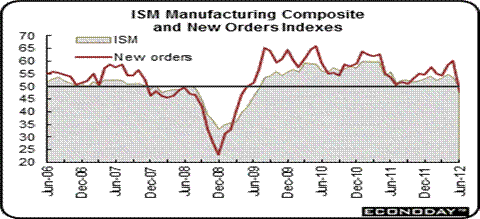
Meanwhile, both the industrial and service sectors were basically unchanged. The ISM non-manufacturing composite headline index slipped to 52.1 versus 53.7 in May but it’s still safely above the 50 level under which monthly contraction is indicated. The new orders index is the most important component and it posted at 53.3, compared to 55.5 the prior month, probably because May had a large surge in new orders. Export orders fell in the month which is no surprise given troubles in Europe and China, as did total backlog orders, said Econoday.

clip_image004

Graph: Econoday

However, the ISM’s manufacturing index showed contraction in June for the first time since July 2009, declining to 49.9 (breakeven at 50) from 53.5 in May. Forward momentum hit the wall at the new orders index, at 47.8 in June versus a huge 60.1 the month before. It showed contraction for the first time since April 2009 and the degree of the decline was the steepest since October 2001, but the large drop is suspicious, as the factory orders component rose more than expected.  For what it’s worth, said Econoday, the October 2001 drop in orders was followed by an almost equal rebound the next month and was above the pre-drop level the second month afterwards.

clip_image006

Graph: Econoday

What to make of all this? Consumer Credit jumped 8 percent in May, the largest rise in borrowing since 2007 and the boom years, according to the Federal Reserve.  So consumer spending will rise in coming months, the main engine of growth in our economy. That may be why construction spending is surging, another indicator that real estate is finally on the recovery.

clip_image008

Graph: Econoday

Construction spending jumped 0.9 percent in May, following a 0.6 percent gain in April. The increase in May was led by private residential outlays which increased 3.0 percent after a 1.7 percent boost in April.  The new multifamily subcomponent showed the greatest strength but the new single-family subcomponent also was notably positive.  On a year-ago basis, overall construction stood at up 7.0 percent in May.

So because the seasonally adjusted numbers are notoriously inexact, we cannot be sure that an economic slowdown is even happening. It could be the seasonal fluctuations that are normal for any business cycle, as we said last month.  I would venture that we might see upward revisions of some 50,000 per month in nonfarm payrolls, if precedent holds and history repeats itself.

Harlan Green © 2012

Posted in Economy, Housing, housing market, Weekly Financial News | Tagged , , , , | Leave a comment

Obamacare–What Loss of Freedom?

Popular Economics Weekly

Hallelujah. The Supreme Court of our land has given Obamacare a clean constitutional bill of health, thanks to its Chief Justice, who says government does have the power to tax those who can afford to buy health insurance, but won’t.

Republicans have framed Obamacare, or the Affordable Care Act, as a loss of individual freedom. But the only freedom lost is the freedom to be treated without having to pay for it, which is what the uninsured do when they have to go to emergency rooms. Most of us have health care, of course, if we have family and children to care for. Individual responsibility really means one should have to pay for their own health care, rather than taxpayers or the already insured.

So why are Republicans so adamantly against it, when they claim to believe in individual responsibility, and the constitution? It is because they might be taxed more, and of course all taxes are fundamentally evil. They say they abhor any kind of government aid or regulation as if they lived 100 years ago, when everyone had to take care of themselves—or suffer the consequences. But that was when birth and death rates were far worse than today, and we lived shorter lives. Are there any Republicans who would like to return to those days? Please stand up!

More Americans will be healthy, both physically and financially, since medical bankruptcies will become rarer and serious disease rates should drop, since preventative health care will be encouraged. And simple math tells us that with some 30 million more insured due to the mandate requirement, health care costs will be spread among more users of health care.

So know that health care premiums will drop, since as with Medicare, administrative costs will be severely restricted—85 percent of premiums have to be spent on health care—so that providers cannot as they currently use 25 percent of their premiums just for marketing, which means overselling all those medicines (like erectile dysfunction aids) that choke our daily television screens.

Actually, the real results of what is not yet a universal health care system with 20 million are not being openly discussed, at least yet. It should release a surge of consumer spending, for instance, according to economists such as Robert Shiller. Consumers will no longer have to put so much aside for those sick days because they no longer have to worry so much about budget busting medical bills. They might even enjoy more vacation days to spend with their families, if they take advantage of available preventative care measures for such things as obesity and bad diets.

Yale Economist Shiller has been advocating just such universal insurance for years in books such as The New Financial Order, Risk in the 21st Century, and Finance and the Good Society. It is part of his thesis that with the new information age ability to collate huge amounts of information we can level the playing field against risky outcomes, such as loss of income, or value in one’s home, or even serious illness, by insuring against such outcomes.

“If firms and individuals cannot insure themselves against bad outcomes, they will be necessarily cautious; the economy will grow more slowly than it should,” says a New York Times book review of Finance and The Good Society. “A company will not invest in a new factory if it cannot hedge against swings in exchange rates that might render its investment unprofitable. An individual will not consume to the full extent of his capacity if he cannot insure his house or health.”

So now we at least will have a better health care system. It’s a start.

Harlan Green © 2012

Posted in Consumers, Economy, Politics | Tagged , , , , , , | Leave a comment

The Corporate Fallacy

Popular Economics Weekly

The dust is settling on the U.S. Supreme Court’s decision to nullify Montana’s 99-year old law that banned political contributions by corporations. But the controversy is not settled, since the majority Justices’ interpretation in what has been called Citizen’s United II is that since corporations are ‘persons’ in law, they should be protected by First Amendment free speech, regardless of its affect on the functioning of our democracy.

Corporations are not persons by any standard definition of personhood. Corporations are not even mentioned in the Constitution. They in fact more closely fit the socialist model, with a ruling hierarchy comprised of its CEO, a compliant Board of Directors that is owned by the public at large. And that ‘hierarchy’ wields much more power for good or harm that an individual ‘person’.

Although dictionaries define a person as a “human being or organization with legal rights or duties”, a corporation is really a state-within-a-state, since it is really a socialist system in which “producers possess both political power, and the means of producing and distributing goods”. And now corporations have almost unlimited means to increase their political power.

It even more closely resembles an oligarchy, as current law and usage enshrines control not with shareholders, but its executives who make the day-to-day decisions and long term plans. This is exactly the model of such socialist states as Russia and China, with their single-party rule.

So under what definition should corporations be protected by First Amendment freedom of speech? Persons are not protected by the so-called Free Speech Amendment if they cause damage to other persons. The 99-year old Montana law just struck down by this Supreme Court protected free speech by curtailing what corporate power was doing to their state.

Specifically, it was holding all the political power, without any responsibilities towards either its employees or Montana’s citizenry at large. Montana’s 99-year old law upheld by its State Supreme Court was meant to limit corporate power, when it literally owned state politicians.

“Even if I were to accept Citizens United,” said Justice Breyer’s dissenting opinion in Citizen’s United II, “this court’s legal conclusion should not bar the Montana Supreme Court’s finding, made on the record before it, that independent expenditures by corporations did in fact lead to corruption or the appearance of corruption in Montana. Given the history and political landscape in Montana, that court concluded that the state had a compelling interest in limiting independent expenditures by corporations.”

Chief Justice Mike McGrath of the Montana Supreme Court, writing for the majority in its 5-to-2 ruling, stressed that the state’s experience of having its political system corrupted by corporate interests early in the 20th century justified the ruling.

“At that time,” Chief Justice McGrath wrote in the New York Times article, “the state of Montana and its government were operating under a mere shell of legal authority, and the real social and political power was wielded by powerful corporate managers to further their own business interests. The voters had more than enough of the corrupt practices and heavy-handed influence asserted by the special interests controlling Montana’s political institutions.”

In other words, there is good reason that such corporate power has to be curtailed in a democracy. Quite simply the one-voice, one-vote principle that makes a democracy work is nullified. That is why Montana had continued to enforce its Corrupt Practices Act. It had robber barons of the first magnitude with unlimited financial resources that could buy almost any politician.

Before a referendum banned corporate contributions in 1913, Butte copper barons openly bought officer holders with massive bribes. One corporate bigwig, W.A. Clark, flagrantly handed out gobs of cash to state lawmakers, who then in turn, elected him to the United States Senate, said a history of the subject, according to the small-town Montana Havre Daily News.

“In a refreshing break from the stately language used in court decisions, Montana Chief Justice McGrath quoted humorist Mark Twain as saying Clark "has so excused and so sweetened corruption in Montana that it no longer has an offensive smell."

“Sick of this skulduggery, in 1913, voters approved a referendum banning corporations from making donations and barring politicians from accepting them. They then changed the law to demand that people, not the state legislature, would elect U.S. Senators. The rest of the country followed suit in seven years.”

So, the U.S. Supreme Court is in essence decreeing a return to the old system of political patronage, where corporations and their wealthy supporters elect our representatives, instead of ordinary citizens. But instead of looking out for the welfare of all Americans, it will be their richest, profit-seeking supporters who benefit.

Harlan Green © 2012

Posted in Politics, Uncategorized | Tagged , , , , | Leave a comment

Home Prices Up, New-Home Sales Surging

The Mortgage Corner

Sales of newly built, single-family homes rose 7.6 percent to a seasonally adjusted annual rate of 369,000 units in May, according to newly released data from HUD and the U.S. Census Bureau. Why are new-home sales important? Because they indicate lower housing inventories, as fewer distressed homes enter the market. Consequently home prices are beginning to rise with the Case-Shiller Home Price Index the latest to show improving housing values.

The S&P/Case-Shiller 20-city composite existing-home index for same-home sales gained 1.3 percent with 19 out of 20 cities registering gains, to take the year-on-year drop from 2.6 percent to 1.9 percent.

clip_image002

Graph: Calculated Risk

Of the 20 cities measured, only Detroit took a step backward, with a 3.6 percent reversal. Even Atlanta, where prices were 17 percent below year-ago levels, enjoyed a 2.3 percent monthly increase. Where are prices increasing the fastest? In Florida, Arizona, and California, the heart of the housing bubble.

“It’s been a long time since we enjoyed such broad-based gains,” said David Blitzer, chairman of the index committee at S&P. “While one month does not make a trend, particularly during seasonally strong buying months, the combination of rising positive monthly index levels and improving annual returns is a good sign.”

New-home sales are 19.8 percent higher compared to one year ago. Still, the sale of new homes remains far below its pre-recession peak and reflects an industry trying to dig out from its worst slump in modern times, mainly the huge inventory of unsold existing homes. But the good news is that existing-home inventories are declining to more historical levels, which boosts both prices and new-home construction, as we said.

clip_image004

Graph: Calculated Risk

“May’s sales report is a welcome sign that the market has returned to a more solid growth path following lackluster reports in March and April, and is in keeping with our expectations for continued, steady improvement through the end of this year,” said NAHB Chief Economist David Crowe. “While the current sales rate remains low by historical standards and continues to be constrained by challenges related to credit availability for builders and faulty appraisals, the ongoing decline in the month’s supply of new homes will necessitate additional construction in certain markets going forward.”

Regionally, new-home sales were mixed in May. While the Northeast and South posted solid gains of 36.7 percent and 12.7 percent, respectively, the Midwest and West showed respective declines of 10.6 percent and 3.5 percent.

Harlan Green © 2012

Posted in Economy, Housing, housing market, Weekly Financial News | Tagged , , , , , | Leave a comment

Builder Confidence Highest Since 2007

The Mortgage Corner

Builder confidence in the market for newly built, single-family homes gained one point in June from a slightly revised level in the previous month to rest at 29 on the National Association of Home Builders/Wells Fargo Housing Market Index (HMI), released today. This is the highest level the index has attained since May of 2007.

“This month’s modest uptick in builder confidence comes on the heels of a four-point gain in May and is reflective of the continued, gradual improvement we are seeing in many individual housing markets as more buyers decide to take advantage of today’s low prices and interest rates,” said Barry Rutenberg, chairman of the National Association of Home Builders (NAHB).

clip_image002

Graph: Calculated Risk

Those low interest rates are spurring South Coast existing-home sales, according to Gary Woods’ May MLS report. May marked the third month in a row that sales of homes topped 100 going up to over 130 for the Home Estate/PUD market. The median sales price also shot up to about $825,000 for the month, rising from $756,300 in April. The numbers of escrows also rose in May to about 170 from 142 in April with the median list price on those approximately 170 opened escrows going up from $789,000 in April to about $840,000 in May.

Annual South Coast sales are up from 340 to about 475, a 40 percent rise in a year while the median sales price is down a little from $810,000 last year to about $795,000 for a 2 percent drop. Even more impressive is the surge in escrows, up from 405 to about 605 for a 50 percent upswing with the median list price on those escrows going down 10 percent from $879,000 to about $800,000.

Why? It’s no secret that interest rates have dropped below 4 percent for several months now, and that makes housing all the more affordable.

clip_image004

Graph: Calculated Risk

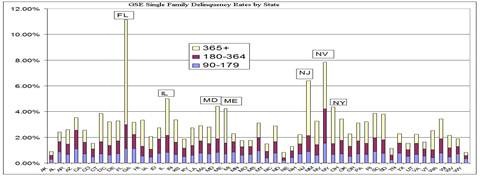
But there is still a serious backlog of delinquent mortgages, according to the Federal Housing finance Authority’s Q1 report. It’s no surprise that Florida and Nevada lead the pack in delinquent loans, but the fact that New Jersey, Illinois, and New York homeowners are in difficulty is surprising. The largest backlog of foreclosures is in the states with judicial foreclosures, which can take up to one year to complete. Trust Deed states like California avoid the courts for the most part in foreclosure proceedings.

Harlan Green © 2012

Posted in Housing, housing market, Weekly Financial News | Tagged , , , | Leave a comment

Why Our Declining Safety Net?

Popular Economics Weekly

Why are the fears of a declining social safety net for social security and Medicare increasing? Barron’s Gene Epstein recently warned of dire consequences for future generations as some 78 million baby boomers begin to retire. .

“In short, the future has arrived, and it doesn’t look pretty,” said Epstein. The boomers in their 60s and the legions after them will put pressure on federal programs that support the elderly for years to come, according to projections by the nonpartisan Congressional Budget Office. The surge will fuel a process that eventually renders these programs too expensive to sustain. More ominously, the federal budget’s burden of eldercare will get heavier, not lighter, even after the boomers leave the scene completely.”

But Epstein’s cure is really a veiled push for Republican Paul Ryan’s budget plan, which is more of the same ideology—tax and spending cuts that redistribute even more wealth from taxpayers to the wealthiest. It is part of their austerity agenda, which will continue to increase the budget deficit, as is happening in Europe.

We know when the current worries over baby boomers retirement impacting social security and Medicare began. It’s told in The Price of Loyalty, Bush Treasury Secretary Paul O’Neill’s book with Ron Suskind. G W Bush and Karl Rove decided to use the four years of Bill Clinton’s budget surpluses to fund tax cuts and the two wars GW and Dick Cheney were planning, instead of protecting social security and Medicare.

The problem is that it also ‘funded’ the largest budget deficits since World War II, when we add in costs of the Wars on Terror and Great Recession. Suskind’s book documents the discussions that led to the second tax cut that mainly benefited corporations and stockholders, when President Bush had second thoughts about it. “He asks, ‘Haven’t we already given money to rich people? This second tax cut’s gonna do it again,'” said Suskind.

“He (Bush) says, ‘Didn’t we already, why are we doing it again?’ Now, his advisers, they say, ‘Well Mr. President, the upper class, they’re the entrepreneurs. That’s the standard response.’ And the president kind of goes, ‘OK.’ That’s their response. And then, he comes back to it again. ‘Well, shouldn’t we be giving money to the middle, won’t people be able to say, ‘You did it once, and then you did it twice, and what was it good for?'”

It’s all there in The Price of Loyalty, and was the reason O’Neill was relieved as Secretary of the Treasury in 2002. He objected to returning the hard-won surpluses to GW’s richest supporters, whether individuals or Cheney’s Military-Industrial buddies such as Halliburton or Kellogg, Root and Brown that would most benefit from the Iraq invasion (i.e., oil and military supplies).

And Republicans are planning more of the same if the so-called Ryan budget plan, recently passed by the House of Representatives, becomes law according to the Center for Budget Policies and Priorities.

“The CBO report, prepared at Chairman Ryan’s request, shows that Ryan’s budget path would shrink federal expenditures for everything other than Social Security, Medicare, Medicaid, the Children’s Health Insurance Program (CHIP), and interest payments to just 3¾ percent of the gross domestic product (GDP) by 2050.  Since, as CBO notes, “spending for defense alone has not been lower than 3 percent of GDP in any year [since World War II]” and Ryan seeks a high level of defense spending — he increases defense funding by $228 billion over the next ten years above the pre-sequestration baseline — the rest of government would largely have to disappear.”

The Clinton surpluses, the result of a record 10 years of uninterrupted economic growth that was the longest growth cycle in U.S. history, had been projected to ultimately pay off all government debt accumulated since World War II. President Clinton predicted the increase in the expected surplus—some $1.9 trillion—meant the government could be debt-free by 2010. But that depended on a whole lot of assumptions, such as continuing his cutbacks in military and other government spending. But the dot-com recession followed, causing some $4 trillion in stock losses alone.

In fact, all of the Bush tax cuts cost taxpayers $1.85 trillion while government spending was boosted 23 percent in his first four years, according to Brookings economist William Gale, who worked on the Council of Economic Advisers under President George H.W. Bush. And just 3 million net jobs were created during the Bush years.

But there is an alternative that will help to save our safety net. It is to return to Clinton-era policies that created so much wealth in the 1990s—raising tax brackets to their prior levels, cutting back on military and other government spending, and putting back the pay-as-you-go rules of that era that didn’t allow Congress to spend more than it taxed. So it turns out Republicans have been the biggest spenders.

Harlan Green © 2012

Posted in Uncategorized | Tagged , , , , , , | Leave a comment

Housing Recovery Has Begun

The Mortgage Corner

This may be the brashest of predictions. Can residential real estate prices actually be recovering? Yes, as housing inventories decline. The National Association of Realtors just reported on the national level, inventory of for-sale single family homes, condominiums, townhouses and co-ops declined by -20.7 percent in May 2012 compared to a year ago, and declined in all but two of the 146 markets covered by REALTOR.com.

This is while the median age of the inventory fell -9.78 percent on a year-over-year basis last month, and the median national list price increased 3.17 percent last month compared to May 2011.

clip_image002

Graph: Calculated Risk

“Signs of recovery are evident in a growing number of markets that were once the epicenter of the housing crisis, and older industrialized areas in the Northeast and the Midwest are showing emerging signs of weaknesses,” said NAR’s press release. “For example, the recovery process that began in Florida approximately one year ago has since spread to Phoenix and most recently California. At the same time, markets such as Reading, PA, Allentown, PA and Milwaukee, WI continue to lag behind the rest of the market.”

Another sign of the housing recovery is that Mortgage applications increased 18.0 percent from one week earlier, according to data from the Mortgage Bankers Association’s (MBA).  This is part because of the new Fannie Mae/Freddie Mac HARP 2.0 loan modification program, which Fannie Mae predicts could affect as many as 9 million mortgage holders.

clip_image004

Graph: Calculated Risk

“Mortgage application volume increased sharply last week. The increase was accentuated due to the comparison to the week including Memorial Day, but the level of refinance and total market activity is the highest since the spring of 2009,” said Michael Fratantoni, MBA’s Vice President of Research and Economics. “Refinance volume increased as borrowers were able to lock in at mortgage rates below 4 percent, and purchase application volume was its highest level in over six months. HARP volume has been steady in recent weeks at about 28 percent of refinance applications.”

The average contract interest rate for 30-year fixed-rate mortgages with conforming loan balances ($417,500 or less) increased to 3.88 percent from 3.87 percent, with points decreasing to 0.43 from 0.46 (including the origination fee) for 80 percent loan-to-value ratio (LTV) loans. But rates are actually lower in states like California, where the 30-yr fixed conforming rate has fallen to 3.50 percent, with zero points origination fee.

According to the MBA, HARP activity is increasing at the same rate as overall refinance activity, which means long waiting periods for refinances in particular. Some lenders are saying it takes up to 16 days for underwriting approval.

The so-called echo boomer generation, children of baby boomers are beginning to provide some of the increased purchase activity. There are approximately 62 million echo boomers in the U.S. Also called “millennials,” echo boomers are currently ages 17-31. According to the 2011 National Association of Realtors Profile of Home Buyers and Sellers, younger home buyers – those ages 18-34 – represent 31 percent of all recent home purchases.

In other words, it looks like 2012 is the year real estate will begin to recover. With 4.5 million jobs created or retained since 2009, the demand for jobs growing, according to the Bureau of Labor Statistics JOLTS report (with 3.5 million job openings), and affordability never higher, housing might be finally leading us out of the Great Recession.

Harlan Green © 2012

Posted in Economy, Housing, housing market, Weekly Financial News | Tagged , , , , | Leave a comment