What Do the Latest Jobs Numbers Mean?

Financial FAQs

The May employment report showed the economy slowing, but pundits may be jumping to conclusions. For though the unemployment rate rose to 8.2 percent in May from 8.1 percent the prior month, that was because 642,000 more began looking for work in the Household Survey that includes the self-employed.  This is while there was a 422,000 jobs increase in the same Household Survey when seasonally adjusted.

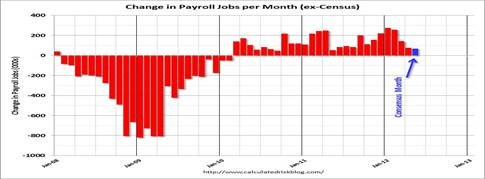
However payroll jobs in the separate Establishment Survey (i.e., nonfarm payrolls only) rose just 69,000, following increases of 143,000 in March and 77,000 in April, when seasonally adjusted. But that was because 718,000 additional hires were subtracted in the seasonal adjustment, and governments lost another 13,000 jobs.
clip_image002

Graph: Calculated Risk

We have been here before. Last summer’s scare came when the Bureau of Labor Management had to revise from 0 to 57,000 jobs created in August, and added an additional 42,000 payroll jobs in July when revised. This is because of the so-called seasonal adjustments. They are an attempt to figure out what is above or below the normal seasonal hiring rate for that time of year, as we have said in the past. Students usually flood the jobs market during summers increasing payrolls, for instance. But it is not an exact science, needless to say.

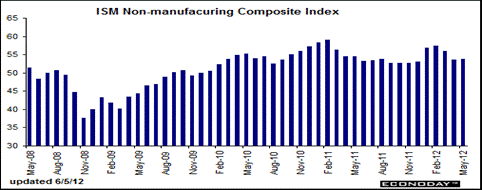
Meanwhile, both the industrial and service sectors are expanding robustly, and the Institute for Supply Management (ISM) surveys say they will hire more workers. The ISM non-manufacturing overall composite activity component, though held down by slowing employment growth, still came in slightly higher than expected at 53.7. New orders rose 2 points to 55.5 to indicate accelerating monthly growth. Monthly growth in backlogs is the same as in April, at 53.0 which is a solid rate for this reading, said Econoday.
clip_image004

Graph: Econoday

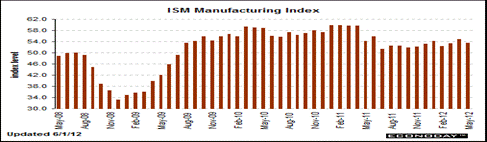
Even better news was the ISM Manufacturing Survey. The ISM’s new order index is also up nearly 2 points to 60.1 for the strongest rate of monthly growth since April last year. New orders will trigger wider activity in the months ahead. For May, production growth slowed but remains healthy while employment growth in the factory sector is steady and healthy. Inventories are coming down even as new orders pick up, a combination that points to the need for inventory building which is a solid positive for hiring as well.
clip_image006

Graph: Econoday

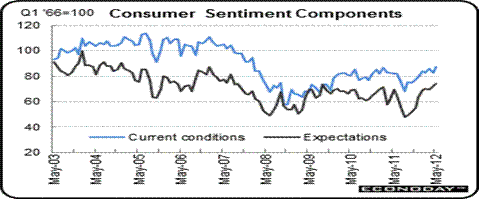
Lastly, the recent sell-off in the stock market and rising problems in Europe are not rattling the U.S. consumer whose sentiment is clearly stronger than it has ever been during the recovery. The U. of Michigan consumer sentiment index jumped to 79.3, up nearly 3 points from April and up 1.5 points from the mid-month reading. This last comparison, which puts the index at an implied 80.8 over the past two weeks, indicates that the rise in optimism is now picking up intensity, according to Econoday.
clip_image008

Graph: Econoday

But does all this mean more jobs? Both ISM surveys showed a slight drop in those planning to hire more workers, but both employment components of the surveys were still above 50 percent, meaning the majority of supply managers reported increased hiring.

So because the seasonally adjusted numbers are notoriously inexact, we cannot be sure that an economic slowdown is even happening. It could be due to seasonal fluctuations that are normal for any business cycle.

Harlan Green © 2012
Posted in Economy, Macro Economics, Weekly Financial News | Tagged , , | Leave a comment

What to Do With Lowest Mortgage Rates in History?

The Mortgage Corner

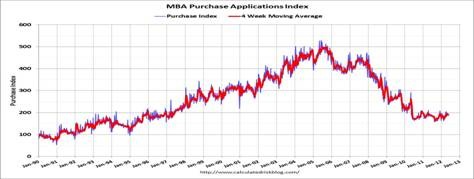
Mortgage rates are the lowest since the Mortgage Bankers Association survey began in the 1970s, at 3.91 percent for the conforming 30-year fixed rate, but actually lower with many lenders. I am seeing rates as low as 3.25 percent for the conforming 10-year fixed ARM that is adjustable for the remaining 20 years, with 0 origination points.

clip_image002

Graph: Calculated Risk

This hasn’t boosted mortgage applications much, however, as the MBA’s Pending Home Sales Index, a forward-looking indicator based on contract signings, declined 5.5 percent but is 14.4 percent above April 2011.  The data reflects contracts but not closings.

NAR chief economist Lawrence Yun, said a one-month setback in light of many months of gains does not change the fundamentally improving housing market conditions.

“Home contract activity has been above year-ago levels now for 12 consecutive months. The housing recovery momentum continues,” he said. Existing-home sales seem to show momentum, as existing sales rebounded in April, helping to set aside some of the worries about upwardly skewed seasonally adjusted data during the atypically warm winter. Sales posted a 3.4 percent increase, following a 2.8 percent decrease in March.  Gains were solid across regions.”

clip_image004

Graph: Calculated Risk

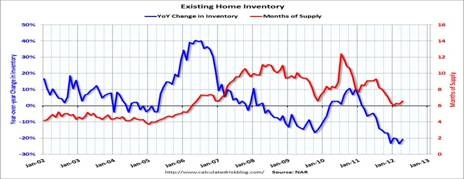
The median price of existing homes shot up 10 percent in April as well, as housing inventories have declined to 6.6 months. And that is at the current slow sales pace. Should it pick up this year, inventories could decline to their historical low of 4 percent giving a further boost to prices.

clip_image006

Graph: Calculated Risk

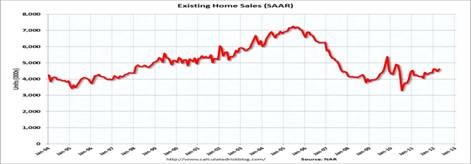
This is because total existing-home sales, which are completed transactions that include single-family homes, townhomes, condominiums and co-ops, increased 3.4 percent to a seasonally adjusted annual rate of 4.62 million in April.

And we are seeing larger price rises in the FHFA price index of homes with Fannie Mae/Freddie Mac owned mortgages. Home prices climbed 1.8 percent on a seasonally adjusted basis in March, said the Federal Housing Finance Agency. Year-on-year, prices rose 2 percent. For the first quarter as a whole, prices rose 0.6 percent from fourth-quarter levels. “Increased affordability and a somewhat smaller inventory of homes for sale are positively impacting house prices,” said Andrew Leventis, FHFA principal economist. The FHFA is a purchase-only index based on transactions bought or guaranteed by Fannie Mae or Freddie Mac, as we said.

Lastly, default rates continue their decline, meaning fewer REO (bank-owned) properties are coming on the market. As far as delinquencies, MBA Chief Economist Jay Brinkmann says we are “halfway back” to normal of around 5 percent historically, though this does not include the “in foreclosure” bucket; loans in foreclosure are still near record highs. We anticipate further declines in both default and foreclosure rates, as HARP 2.0 Fannie/Freddie loan modification activity that ignores negative equity is going through the roof. Some lenders are reporting up to 18 days to initial underwriting of submissions, because of the huge backlog.

The Mortgage Banker Association’s National Delinquency Survey (NDS) covers about “42.9 million first-lien mortgages on one- to four-unit residential properties” and is “estimated to cover around 88 percent of the outstanding first-lien mortgages in the market,” said the press release. This gives about 5.8 million loans delinquent or in the foreclosure process.

So increased affordability, combined with declining inventories seems to be finally spurring homebuyers to come out of their rentals (or parents’ households) to make that most important of investments—a home of their own.

Harlan Green © 2012

Posted in Economy, Housing, housing market, Weekly Financial News | Tagged , , , , | Leave a comment

What Happened to the Bush Tax Cuts?

Popular Economics Weekly

The debt ceiling debate is about to begin again, and House Speaker Boehner has said he will continue to press for more tax cuts without raising additional revenues, reviving the possibility of more budget gridlock and credit downgrades. “I believe that raising taxes at this point in our recovery is a big mistake,” Boehner told reporters. “At a time when we’re trying to help small businesses create jobs, this proposal would kill jobs.”

But it is a mistake to cut taxes without raising revenues. We know GW Bush’s tax cuts enacted in 2001 and 2003 to revive an economy flattened by the dot-com bubble bust have cost plenty. And we know what happened to all that money saved by corporations and individuals.

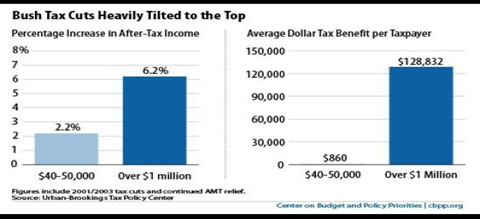
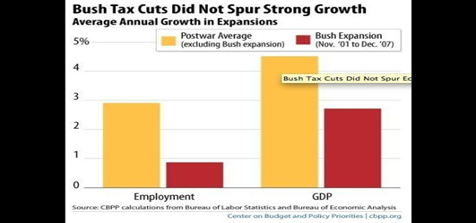
Not much. Just 3 million jobs were created during Bush’s 8 years, household incomes did not even keep up with inflation, and yet corporate profits are up more than 14 percent as a percentage of GDP—the highest in history.

So most of the money flowed to corporations—who are currently hoarding more than $2 trillion in cash—and the top 1 percent income earners who benefited most from the tax cuts. And since the top 1 percenters spend less of their money than the 99 percenters, much of it is being held in banks that have almost $1 trillion in excess ‘zero sum’ deposits that aren’t being put to work to revive this economy.

image

Graph: CBPP

Then what would really put all that cash back to work to grow jobs and the economy? We know the answer is to invest more money to grow the future, but how without even more debt? Dr. Robert Shiller of Irrational Exuberance fame, and Cornell Professor Robert Frank have written wonderful New York Times Op-eds on just how to do it.

It’s almost absurdedly simple in principle. Dr. Shiller says that William Salant, then a member of President Franklin D. Roosevelt’s White House staff, and Nobelist Paul Samuelson, then of M.I.T., developed a “balanced-budget theorem.

“It asserts that if a country raises taxes and expenditures by the same amount in a time of high unemployment, and if monetary policy is accommodating, the national income grows by exactly the amount of the tax, so that after-tax income is unchanged.”

And Professor Frank disputes austerity proponents who say governments can’t spend beyond their means indefinitely, any more than businesses or families can. He says “It’s a fair statement if we’re talking about the long run. But in the short run, it’s utterly false…Consider an indebted family that must decide whether to borrow $5,000 to install additional insulation in its attic, a project that would reduce its utility bills by an average of $100 a month and require loan payments of $50 a month. In the short run, obviously, the project would increase the family’s indebtedness. But can there be any doubt that the family would be better off, in both the short and the long run, by going ahead with it?”

In other words, one must spend money to make money, and it can be done in a balanced way. That also means it can be done with either public or private monies that gives a public benefit, such as making up the $2 trillion deficit in infrastructure repairs. And if private business won’t invest sufficient funds, as at present, then public monies must be used.

image

Graph: CBPP

We also know that tax cuts don’t create jobs or spur growth by themselves. The Bush tax cuts are the most current example; in fact helped to cause the Great Recession. For much of the excess profits were spent on market speculation—especially in subprime loans and payday lending to the poorest among us—that caused the housing bubble.

An excellent book by Gary Rivlin, Broke, USA: From Pawnshops to Poverty, Inc. — How the Working Poor Became Big Business, documents that “Poverty Inc. was a roughly $150 billion-a-year industry at its peak, Rivlin calculates, after totting up revenue at pawnbrokers, payday lenders, money-wirers, rent-to-own operators, tax preparers who offer instant tax “refunds,” subprime credit-card providers, subprime-mortgage lenders and all the rest”, according to a Bloomberg News review.

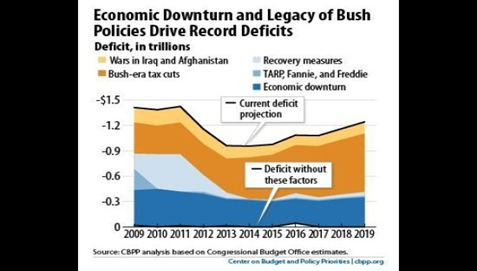
We also know the cost of the Bush tax cuts, which had to be paid for with taxpayer dollars, since they were one of the major causes of the deficit due to the lost revenues at a time we were paying for 2 wars.

image

Graph: CBPP

It’s more than $3 trillion to date, according to the CBPP, and would cost taxpayers another $3.6 trillion if extended over the next 10 years. In fact, if the Bush tax cuts were allowed to ‘sunset’ this year, the federal budget deficit would stabilize. So it makes no economic sense to advocate tax cuts without revenue enhancers, and there are plenty, from closing loopholes, to certain interest exemptions. So austerity is not the answer—neither here nor in Europe.

Harlan Green © 2012

Posted in Economy, Keynesian economics, Macro Economics, Weekly Financial News | Tagged , , , , , , , | Leave a comment

Home Prices Finally Rising!

The Mortgage Corner

Even the S&P Case-Shiller Home Price Index, a 3-month average of all existing-home prices that lags all other indexes—such as FHFA and CoreLogic—says home prices are finally showing signs of life. Why? Inventories are declining as investors in particular are picking up the best bargains. Also, prices have fallen faster than incomes, so that housing is cheaper than ever.

image

Graph: Calculated Risk

Case-Shiller home prices were up 0.1 percent in March for the adjusted composite 20 index and up 0.2 percent in February. This is the first back-to-back monthly gain since the spring of 2010, said Econoday. The year-on-year rate of minus 2.6 percent is the best reading since December 2010. Phoenix is really on the rebound with Miami, Tampa, Minneapolis and Dallas all showing a run of stand-out strength. Phoenix had the largest increase, showing that cities with the biggest price busts continue their boom and bust ways.

image

Graph: Calculated Risk

The median price of existing homes shot up 10 percent in April as well, as housing inventories have declined to 6.6 months. And that is at the current slow sales pace. Should it pick up this year, inventories could decline to their historical low of 4 percent giving a further boost to prices.

image

Graph: Calculated Risk

This is because total existing-home sales, which are completed transactions that include single-family homes, townhomes, condominiums and co-ops, increased 3.4 percent to a seasonally adjusted annual rate of 4.62 million in April.

And we are seeing larger price rises in the FHFA price index of homes with Fannie Mae/Freddie Mac owned mortgages. Home prices climbed 1.8 percent on a seasonally adjusted basis in March, said the Federal Housing Finance Agency. Year-on-year, prices rose 2 percent. For the first quarter as a whole, prices rose 0.6 percent from fourth-quarter levels. “Increased affordability and a somewhat smaller inventory of homes for sale are positively impacting house prices,” said Andrew Leventis, FHFA principal economist. The FHFA is a purchase-only index based on transactions bought or guaranteed by Fannie Mae or Freddie Mac, as we said.

Lastly, default rates continue their decline, meaning fewer REO (bank-owned) properties are coming on the market. As far as delinquencies, MBA Chief Economist Jay Brinkmann says we are “halfway back” to normal of around 5 percent historically, though this does not include loans in foreclosure, which are still near record highs. We anticipate further declines in both default and foreclosure rates, as HARP 2.0 Fannie/Freddie loan modification activity that ignores negative equity is going through the roof. Some lenders are reporting up to 18 days to initial underwriting of submissions, because of the huge backlog.

The Mortgage Banker Association’s National Delinquency Survey (NDS) covers about “42.9 million first-lien mortgages on one- to four-unit residential properties” and is “estimated to cover around 88 percent of the outstanding first-lien mortgages in the market,” said the press release. This gives about 5.8 million loans delinquent or in the foreclosure process.

So increased affordability, combined with declining inventories seems to be finally spurring homebuyers to come out of their rentals (or parents’ households) to make that most important of investments—a home of their own.

Harlan Green © 2012

Posted in Housing, housing market, Weekly Financial News | Tagged , , , , | Leave a comment

Some Institutions Are Too Big To Succeed

Financial FAQs

The conversation may change with JP Morgan Chase’s latest $2 plus billion faux pas. Instead of being too big to fail, we may find that the Wall Street behemoths in particular have become too big to succeed. That is to say, the literal size of corporations like Citibank, JP Morgan, Bank of America, and even AIG, all the products of banking deregulation, may have outgrown any manageable size and so have become a danger to themselves as well as the U.S. economy overall.

Whether out of ignorance or not understanding the ramifications of such high risk derivative hedges, CEOs such as JP Morgan Chase’s Jamie Dimon apparently have little control over the trades such as caused the $2 billion loss. “Top investment bank executives raised concerns about the growing size and complexity of the bets held by the bank’s chief investment office as early as 2007, according to interviews with half a dozen current and former bank officials”, said the New York Times article.

In fact, it now has been reported that Chief Investment Officer Gina Drew in charge of their risk management department had Lyme’s Disease and so was incapacitated during this period, which led to “shouting matches” between subordinates in the New York and London offices.

We know since 2000 that banks have made huge profits since the repeal of Glass-Steagall allowed them to make such risky bets. The down side has been their overleveraging that caused Greatest Recession since the Great Depression. And now we see that the excessive profits generated since then have only caused them to take even more chances.

Then there is the too-big-to-manage syndrome: “What is more, said another senior former executive, Mr. Dimon had other fires to put out, and the chief investment office wasn’t a “problem child” for either top managers or the board of directors, despite its rapid expansion,” according to the New York Times article. “Gigantic losses were piling up from bad mortgages, and new regulations were threatening the profitability of traditional banking, among other pressing matters.”

The record has not been good for large financial institutions, in particular. For with rising profits as a share of the national income pie, have been declining employee incomes, benefits, and a diminished social safety net. This is in part because the too-big-to-manage entities have used their economic muscle to divert more resources to themselves—whether as extravagant CEO salaries, less progressive tax rates that endanger new research and development, major infrastructure improvements, and rising inequality that is creating a permanent underclass of the less privileged.

What size is too big to manage? Any institution that breeds market panics, endangers other institutions, and so has to be regulated. Paul Krugman probably said it best in a recent blog. “The point, again, is that an institution like JPMorgan — a too-big-to-fail bank, not to mention a bank whose deposits are already guaranteed by U.S. taxpayers — shouldn’t be engaged in this kind of speculative investment at all. And that’s why we need a return to much stronger financial regulation, stronger even than the Dodd-Frank regulations passed back in 2010.”

So why not judge our institutions on the basis of whether they are too big to succeed? Should they even be attempting to diversify into high risk areas with federally insured deposits without limits? It looks like CEOs like JP Morgan’s Jamie Dimon are able to fool some of the people—including their investors—much of the time. It might prevent a few financial disasters.

Harlan Green © 2012

Posted in Economy, Macro Economics, Weekly Financial News | Tagged , , , , , , , | Leave a comment

Housing Affordability at Record High

The Mortgage Corner

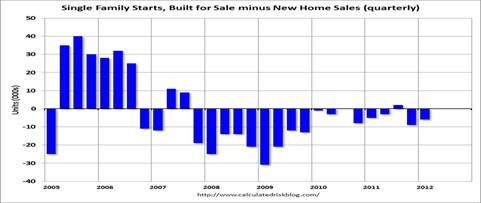
Nationwide housing affordability hit a new record high for a second consecutive quarter in the first three months of this year, according to the National Association of Home Builders/Wells Fargo Housing Opportunity Index (HOI).  So much so, that new-home sales are exceeding housing starts, which is dropping new-home inventories, reports Calculated Risk.

clip_image002

Graph: Calculated Risk

“For the last 2+ years, the builders have sold a few more homes than they started, and inventory levels are now at record lows,’ says Calculated Risk. “In Q1 (2012), builders started 6 thousand fewer homes than they sold.” Yet tight lending conditions continue to pose a major obstacle to many prospective home buyers.

“Homes in this year’s first quarter were more affordable than they have been at any time in more than 20 years, yet many potential sales are not happening because of overly tight lending conditions that are keeping hardworking families from obtaining a suitable mortgage,” said Barry Rutenberg, chairman of the National Association of Home Builders (NAHB). “Without this significant hurdle, the housing and economic recovery could be proceeding at a much stronger pace.”

The latest Housing Opportunity Index data reveal that 77.5 percent of all new and existing homes that were sold in this year’s first quarter were affordable to families earning the national median income of $65,000. This beats the previous record set in the final quarter of 2011, when 75.9 percent of homes sold were affordable to median-income earners.

The main problem is either lack of equity for existing homeowners, where more than 30 percent are ‘underwater’ with a mortgage worth more than the property, or problems with credit or income standards, which Fannie and Freddie have made more restrictive. But both the Fannie Mae/Freddie Mac HARP 2.0 loan modification programs are helping, which allow unlimited loan-to-values. Fannie estimates some 9 million homeowners could be helped with that program, alone.

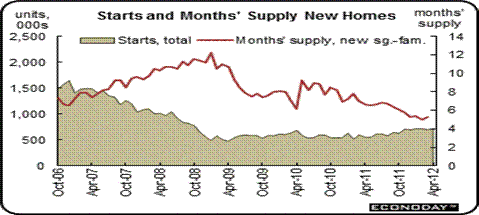
In fact, housing starts rebounded 2.6 percent in April after declining 2.6 percent in March. The April pace of 0.717 million units posted higher than analysts’ forecast for 0.690 million and is up 29.9 percent on a year-ago basis. In April, the comeback was led by the multifamily component but single-family also was healthy.

clip_image004

Graph: Econoday

The $25 billion National Mortgage Settlement that we summarized in a past column will also help those with non-Fannie or Freddie loans. It is an agreement with 5 of the largest mortgage holders; including Bank of America, Citibank, Wells Fargo, Ally/GMAC, and JP Morgan/Chase Banks to not only drop mortgage interest to current mortgage rates, but reduce principal as well. But it could take up to 9 months to implement, since the banks have to comb through their records to find eligible borrowers.

South Coast, California real estate is also being helped by the increased affordability, and it is spurring sales. Santa Barbara Realtor Gary Woods reported for the Santa Barbara MLS that escrows continued to surge in April with about 145 Home Estate/PUDs starting the buying process. But, just like with sales, the median list price on those escrows slid from $816,750 in March to $789,000 in April. “With the inventory way down and a substantial number of sales drawing multiple offers I would expect prices to start rising but at this point that phenomenon has not occurred,” said Gary.

And so we have a window of opportunity for buyers that many are taking advantage of. Lenders are being deluged with mortgage applications, as mortgage rates are the lowest since the Mortgage Bankers Association has been surveying them. And as a mortgage broker myself, I am seeing underwriting turnaround times of as much as 18 days.

Harlan Green © 2012

Posted in Economy, Housing, housing market, Weekly Financial News | Tagged , , , , | Leave a comment

Builder Confidence Rises Five Points in May

The Mortgage Corner

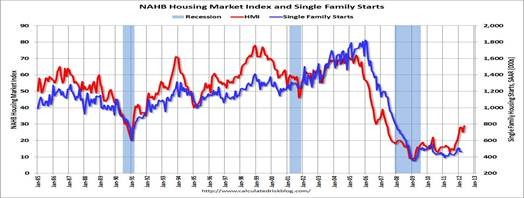
It may not seem like much in such a depressed real estate market, but builder confidence in the market for newly built, single-family homes gained five points in May from a downwardly revised reading in the previous month to reach a level of 29 on the latest National Association of Home Builders/Wells Fargo Housing Market Index (HMI). This is the index’s strongest reading since May of 2007. And that will give a boost to several other industries, including construction and finance.

clip_image002

Graph: Calculated Risk

“Builders in many markets are reporting that buyer traffic and sales have picked back up after a pause this April,” said Barry Rutenberg, chairman of the National Association of Home Builders (NAHB). “It seems we have resumed the gradual upward trend in confidence that started at the beginning of this year, as stabilizing prices and excellent affordability encourage more people to pursue a new-home purchase.”

More good news is that mortgage delinquencies continue to decline, reports the Mortgage Bankers Association. “The delinquency rate for mortgage loans on one-to-four-unit residential properties decreased to a seasonally adjusted rate of 7.40 percent of all loans outstanding as of the end of the first quarter of 2012, a decrease of 18 basis points from the fourth quarter of 2011, and a decrease of 92 basis points from one year ago”, according to the MBA’s National Delinquency Survey. “The non-seasonally adjusted delinquency rate decreased 121 basis points to 6.94 percent this quarter from 8.15 percent last quarter.”

And Realtors in some markets are reporting multiple offers, reports Calculated Risk.

Jon Lansner at the Orange Country, California Register: O.C. homes draw multiple-offer ‘avalanche’ (an excerpt from Steve Thomas’ report) “Below $500,000 range is NUTS. Homes priced at or near their market value are generating an avalanche of multiple offers. A home in this range is placed on the market and, within moments, cars filled with buyers are touring the home. …Upon writing an offer, buyers quickly find that they are one of many, sometimes over ten, offers on the home. Suddenly … In the end, the seller factors the highest price with the largest down payment. I know, you are thinking, “What about the appraisal?” In many instances, shrewd sellers and Realtors are leveraging the competition to drop the appraisal contingency and require the buyer to make up the difference between the appraisal price and the purchase price, IF there is an appraisal problem. … Supply has dropped to levels not seen since June 2005. … The expected market time for all of Orange County is 1.5 months, or six weeks.”

So, “While home building still has quite a way to go toward a fully healthy market, the fact that the HMI has returned to trend is an excellent sign that firming home values, improving employment and low mortgage rates are drawing consumers back,” said NAHB Chief Economist David Crowe. “The pace of this emerging recovery could be stronger were it not for the significant impediments that the market continues to face with regard to builder and consumer access to credit, inaccurate appraisals, and more recently, rising materials prices.”

Harlan Green © 2012

Posted in Economy, Housing, housing market, Weekly Financial News | Tagged , , , , , | Leave a comment

The War on Workers

Popular Economics Weekly

We are seeing what can only be called a war on workers by Tea Party Republicans in particular. Who are workers? The 80 percent of consumers who are wage and salary earners. And they have not done well since the 1970s while corporations have made record profits, as I have been saying.

clip_image002

Graph: EPI

It is the current crop of conservative Republicans, such as Wisconsin Governor Scott Walker, who has even been caught on video declaring Republicans’ strategy of “divide and conquer” on public service workers and teachers, that have declared outright war. Their campaign would essentially wipe out the middle class by blocking all attempts to raise workers’ incomes in both the private and public sectors, and so their standard of living. Yet in doing so, Republicans will destroy the very foundation of our economic strength. Governor Walker’s efforts in particular have put Wisconsin at the bottom of Midwestern states’ job creation list.

Employers have always tried to maximize profits by limiting workers’ pay, but wage suppression today because of Republican efforts to limit collective bargaining is as bad as it was during the Great Depression. And the result has been disastrous for both jobs and economic growth.

For instance, the 40 years from 1961 to 2000, when the White House was shared equally by Republican and Democratic presidents (20 years each), pro-labor rights Democrats had the far superior record both for economic growth, and jobs. This can be found in numerous government data, but summarized by the Currency Thoughts blog. Bush 43’s record (GW Bush) was even worse.

% Per Annum      Democrat      Republican      Bush43

GDP Growth      4.1 percent      2.9 percent      2.2 percent

Employment      2.9 percent      1.7 percent      0.5 percent

Even more convincing proof that Republicans’ ideological war on workers will prolong this recession is their record on job creation. The Wall Street Journal has run articles on this fact. Since Harry Truman, 57.5 million jobs were created during Democratic Administrations, vs. 36.2 million jobs created during Republican Administrations.

President Clinton is the winner with 23.1 million jobs created during his 8 years, whereas President Reagan leads Repubs with 16 million created during his term. There are pundits who say these job totals are not totally accurate because policies created in one administration will affect job formation in the next. But that would have to work both ways, cancelling out any effects of one administration’s policies over another.

We aren’t even counting President Obama’s almost 4 million jobs created to date after our Greatest Recession that followed on the heels of GW Bush’s worst track record of just 3 million jobs created 2000-2008.

Why? This is one of the most basic economic truths, yet conservative Republicans in particular don’t seem to care. They want to believe that lower taxes will stimulate more jobs by transferring more revenue to the private sector. But that hasn’t happened—historically their policies have depressed the jobs and incomes of wage and salary earners that would stimulate more demand for their products.

And this is in spite of record corporate profits, which belies the ideology that greater tax cuts (even abolishing corporate taxes) will bring greater prosperity. In fact, as corporate profits have risen over the past 30 years, workers’ incomes have fallen. A recent New York Times’ article highlighted recent revisions of 2010 and 2011 Department of Commerce data. The new figures indicate that corporate profits accounted for 14 percent of the total national income in 2010, the highest proportion ever recorded. The previous peak, of 13.6 percent, was set in 1942 when the need for war materials filled the order books of companies at the same time as the government imposed wage and price controls, holding down the costs companies had to pay.

‘Employees have always received more than half the total national income, until now,” said the New York Times. (But) “In 2010, the percentage of national income devoted to wages and salaries fell to 49.9 percent, and it slipped a little more to 49.6 percent in the first quarter of this year. That continued decline may help explain the economic worries of many Americans who have jobs but still fear they are falling behind.”

clip_image004

Graph of wages/benefits vs. profits: New York Times

The private sector war is being waged by conservative states with their Right-to-Work laws that say though it can’t be illegal to organize into unions (because it’s federal law), it can make it illegal for workers in individual states to have to join and pay dues to support the unions. Twenty four states in the Midwest and South now have such laws.

This should be a no-brainer, in other words, which is why in not heeding the most basic economic truths—one cannot create demand without more income to support it—Republicans have declared a defacto war on workers. It is the worst kind of blindness. Republicans are also destroying their own economic homeland, the U.S. economy, and our competitiveness in the ever more worldwide economy.

Harlan Green © 2012

Posted in Consumers, Economy, Keynesian economics, Macro Economics, Weekly Financial News | Tagged , , , , , | Leave a comment

Ryan Budget Punishes the Poorest—A Return to ‘Les Miserables’?

Popular Economics Weekly

We know Victor Hugo’s message is alive and well when Paul Ryan’s latest budget proposal continues to punish the poorest for the sins of the wealthiest who caused the Great Recession, and have yet to be punished. Les Miserables’ Jean Valjean is punished for stealing a loaf of bread while the French aristocracy refused to share their wealth. Then came the French Revolution, of course

And Republican Paul Ryan’s latest budget proposal punishes the poor to pay for the excesses of the wealthiest that created the worst budget deficit since WWII. “We propose to stop fraud in the food-stamp program by ensuring that individuals are actually eligible for the taxpayer benefits they receive,” said Ryan at a recent press conference.

Yet congressional Republicans will do nothing to return the fraudulently obtained $trillions of the wealthiest beneficiaries of the burst housing bubble by raising their taxes. The fraud of those like Goldman Sachs who benefitted most has been well-documented by Chairman Philip Angelides’ Financial Crisis Inquiry Commission, which was set up to determine the causes of the financial meltdown that led to the Great Depression, among them criminal fraud.

“The bipartisan panel appointed by Congress to investigate the financial crisis has concluded that several financial industry figures appear to have broken the law and has referred multiple cases to state or federal authorities for potential prosecution, according to two sources directly involved in the deliberations,” said the Huffington Post.

“Though civil charges appear a more likely outcome should prosecution result, one source familiar with the panel’s deliberations said criminal charges should not be ruled out. The commission’s decision to refer conduct for prosecution underscores the severity of the activities it has uncovered and plans to detail in its widely anticipated final report, the sources said.”

One-quarter of the House GOP spending cuts come from programs directly benefitting the poor; such as Medicaid, food stamps, the Social Services Block Grant, and a child tax credit claimed by working immigrants.

“This plan hits the food and nutrition programs but totally exempts all the agricultural subsidies,” said House Democrat Chris Van Hollen. Republicans would also eliminate Social Services Block Grants, a $1.7 billion a year program that gives states money for Meals on Wheels, day dare, adoption assistance and transportation help for the elderly and disabled.

And the Bureau of Labor Statistics in its latest JOLTS report  said the number of job openings in March (not seasonally adjusted) increased over the year for total nonfarm, total private, and government. Job openings increased over the year for durable goods manufacturing, nondurable goods manufacturing, retail trade, health care and social assistance, and state and local government. Job openings in the Midwest and South regions increased over the year. The total number of job vacancies jumped 172K from an upward-revised level in February. The 3.737 million job openings for March 2012 is the highest since July 2008.

Lastly, the NFIB Small Business Confidence Survey shows both increased hiring and income.  It outperformed expectations in April, rising two full points to a level of 94.5, and thereby matching the recovery high set in February 2011. The employment-related measures improved as had been previously reported, and there were some pleasant surprises among the other components.

clip_image002

Graph: NFIB

We can therefore say those who want to punish the poor, without punishing those who caused the Great Recession for their misdeeds has a historical precedent, thanks to Victor Hugo. Do we really want to repeat the mistakes of the French aristocracy?

Harlan Green © 2012

Posted in Economy, Weekly Financial News | Tagged , , , , , , , , , | Leave a comment

We Can’t Stall the Recovery!

Financial FAQs

It is really disgusting that there isn’t the political will to grow more jobs, both here and in Europe. And creating more jobs is the key to bringing us out of the deep hole of the Great Recession, of course. For if we don’t climb out soon, the U.S. could become just another Third World country—not only in terms of income inequality, but other indicators of national well-being, such as health care.

Why isn’t more being done, both here and in Europe? Paul Krugman’s piece on the death of the confidence fairy explains the fallacies behind the German’s belief that cutting back on government spending and benefits would cause interest rates to fall and employers to hire because they would have more confidence in the future.

“What’s wrong with the prescription of spending cuts as the remedy for Europe’s ills,” asks Krugman? “One answer is that the confidence fairy doesn’t exist — that is, claims that slashing government spending would somehow encourage consumers and businesses to spend more have been overwhelmingly refuted by the experience of the past two years. So spending cuts in a depressed economy just make the depression deeper.”

The confidence fairies in the U.S. are led by extreme right wing conservatives who continue their attempts to divert wealth to the wealthiest by reducing government spending enough "to shrink it down to the size where we can drown it in the bathtub", as Grover Norquist once famously said, architect of the no tax increase pledge signed by more than 200 Republican legislators, or Ron Paul, who wants to turn the clock back 150 years when the U.S. was a rural economy and there was less need for an effective national government that would benefit the majority of citizens.

The U.S. has done much better with the various fiscal stimulus plans, including the 2 percent payroll tax and GW Bush tax cuts, both due to expire this year. But since conservatives have not allowed additional stimulus measures, 2012 doesn’t look as favorable, says the Congressional Budget Office,  in a Bloomberg Marketwatch article.

“Since the stimulus began to wane in late 2010, real sales in the private sector have grown at a 2.8 percent annual rate, while government consumption expenditures and investment (goods and services the government buys directly) have fallen at a 2.8 percent annual rate, according to the Bureau of Economic Analysis. The other big category of government spending — transfer payments to individuals in the form of Social Security, Medicare, unemployment, food stamps and the like — has also turned negative, falling at a 0.9 percent annual rate after jumping nearly 17 percent in late 2009.”

So if Republicans succeed in preventing more stimulus spending, it could stall the U.S. recovery, not to speak of our standing among developed countries. As an example, the New York Times highlighted how far the U.S. has fallen behind in health care in a recently released World Health Organization study of premature births.  This is on top of many other studies that show the U.S. falling further behind in longevity, and even average heights, as our health care system continues to deteriorate.

It is no coincidence all developed countries have universal health care that Republicans continue to attack as too much government. That is why one of the largest casualties of the enormous diversion of wealth from the middle class to the wealthiest one percent has been affordable health care. Minnesota is just one battleground, where Republicans are attempting to block insurance exchanges that would make health insurance more affordable.

And we know why. “The exchange is the centerpiece of the new health care system envisioned by Mr. Obama,” said the New York Times article. “In the exchange, people who do not have insurance from employers will be able to get comparative information on health plans, insurers will compete on price and benefits, and the federal government will offer subsidies to lower- and middle-income people buying insurance.”

Can there be anything more important than improving the overall health of Americans? Improving their health care system is the first step taken by underdeveloped countries on their path to entering the modern world, while U.S. conservatives seem bent on returning the U.S. to a less-developed status to enhance their already wealthy supporters.

Harlan Green © 2012

Posted in Economy, Keynesian economics, Macro Economics, Weekly Financial News | Tagged , , , , | Leave a comment