Housing Picture is Better Than We Know

The Mortgage Corner

There have been some developments that tell us housing prices could stabilize and new home construction pick up in the New Year. This is even thought the continuing fall in housing prices has stymied any growth prospects, as well as the foreclosure mess that has kept banks from loosening their credit standards enough to encourage more home buying.

For instance, a recent press release from the National Association of Homebuilders said the number of improving housing markets continued to expand for a third consecutive month in November, rising from 23 to 30 on the latest National Association of Home Builders/First American Improving Markets Index (IMI).

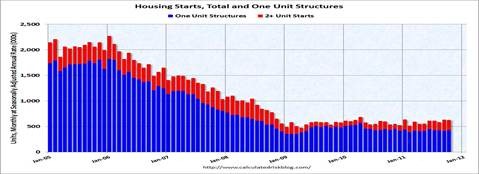
And single-family housing starts rose 3.9 percent to a seasonally adjusted annual rate of 430,000 units in October, according to the U.S. Commerce Department. This is while single-family permits also posted a measurable gain of 5.1 percent to 434,000 units in the latest report, which is their fastest pace since December of 2010.

clip_image002

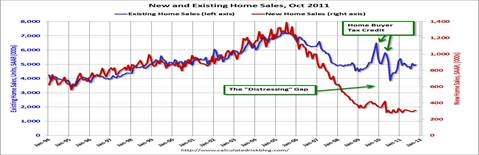
Sales of new single-family houses in October 2011 also rose slightly, to a seasonally adjusted annual rate of 307,000 … This is 1.3 percent above the revised September rate of 303,000 and is 8.9 percent above the October 2010 estimate of 282,000.

clip_image004

The flood of distressed sales has kept existing home sales elevated, and depressed new home sales since builders can’t compete with the low prices of all the foreclosed properties. And so we still have the ‘distressing gap’ between new and existing-home sales, according to Calculated Risk.

clip_image006

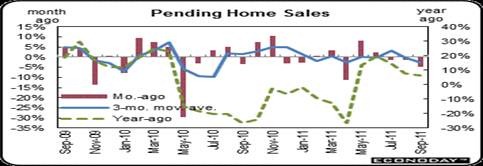
Low prices and low interest rates appear to be creating traction in the housing market with pending home sales the latest report to show strength. The pending home index, which is a measure of contract signings for sales of existing homes, jumped 10.4 percent in October to 93.3, according to the National Association of Realtors. This is after pending home sales index fell 4.6 percent in September with declines split about evenly across regions. September’s decline was unusually steep, following declines of 1.2 percent in August and 1.3 percent in July.

The gain points to strength in final sales of existing homes for November and December though cancellations, tied to low appraisals that keep buyers from selling their own homes and to restrictions to credit access, have been cutting into the proportion of contracts that make it to closing.

Harlan Green © 2011

Posted in Economy, Housing, housing market, Weekly Financial News | Tagged , , , | Leave a comment

Consumers Feel Better

Popular Economics Weekly

Black Friday, or the day after Thanksgiving, was an eye-opener. Sales jumped 7 percent, a record, and Monday’s cyber-sales followed its lead. How can consumers be spending so much with incomes that aren’t rising as much?

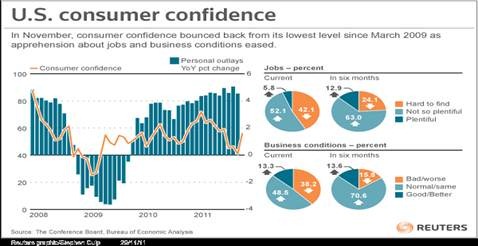
One clue is that consumers have paid down so much debt, while disposable income, as well as wages and salaries, have been growing at 2 percent—not great, but enough to keep things bubbling. In fact, it’s been enough to boost the Conference Board’s consumer confidence survey, at least, about future conditions. For instance, those seeing better job prospects in 6 months increased from 5.8 to 12.9 percent, while the proportion that sees jobs as hard to find dropped from 42.1 to 24.1 percent.

clip_image002

Graph: Inside Debt

Consumer confidence has surged this month, in other words, with improvement centered in employment. The Conference Board’s measure jumped more than 15 points to 56.0 from an upward revised 40.9 in October. November is the best reading since the debt-ceiling debacle and cut of the US credit rating in August.

This is while consumer credit expanded $7.4 billion in September benefiting once again from strength in nonrevolving credit. Nonrevolving credit outstanding, reflecting strong vehicle sales, rose $8.0 billion in the month to $1.66 trillion.

September brings in third quarter data which shows consumer credit expanding at a 1.6 percent annual rate, down from the second-quarter rate of 3.5 percent. Revolving credit during the quarter contracted at a 3.2 percent annual rate, more than reversing the second-quarter rate of plus 1.5 percent, said Econoday.

clip_image004

Another eye-opener was the surge in ADP private payrolls employment. ADP today reported that employment in the U.S. nonfarm private business sector increased by 206,000 from October to November on a seasonally adjusted basis. The estimated advance in employment from September to October was revised up to 130,000 from the initially reported 110,000. The increase in November was the largest monthly gain since last December and nearly twice the average monthly gain since May when employment decelerated sharply.

clip_image006

So, can it be true that consumers’ optimism is well-grounded? The Conference Board’s survey said those saying jobs are currently hard to get fell nearly five percentage points to 42.1 percent. Another key reading is a sharp improvement in income expectations over the next six months with more, 14.9 percent, seeing an increase and fewer, 13.8 percent, seeing a decrease. This is the first time since April that optimists have outnumbered pessimists.

Other positives in today’s report include an improvement in buying plans for both homes and appliances and a three percentage point decline in 12-month inflation expectations to 5.5 percent. It is of course the holiday season when shoppers like to shop, but this could be a turning point. Optimism leads to increased consumer spending, and we know it is consumer spending that drives economic growth.

Harlan Green © 2011

Posted in Consumers, Economy, Macro Economics, Weekly Financial News | Tagged , , , , | Leave a comment

What Decline of Western Civilization?

Financial FAQs

It’s hard to know whether Harvard Historian Niall Ferguson means what he says in his new book, “Civilization: The West and the Rest”; that the Western World’s 500 years of predominance are over, thanks to growing debt problems in the U.S. and Europe, and dwindling populations.

It’s true that the rest of the world is catching up to the developed West, and want what we have. For instance, the U.S. with 5 percent of the world’s population can no longer count on corralling 25 percent of its resources. Our military—a major source of budget deficits—is already stretched thin, for one thing, and can’t afford to invade another Iraq for its oil resources.

It’s also true that the U.S. has declined—not as a military power, but in almost all the measures of social and economic well-being. This is reflected in studies just now coming out by sociologists and psychologists, as well as economists. Richard Wilkinson is one such researcher who has managed to bring together a huge amount of research—especially on how income inequality affects citizens’ well-being.

We have discussed how this has affected individual states in past blogs, but never misery at the national level. The list is long. The U.S. has highest prison incarceration rate of any county, combined with the highest per capital income rate, with an income inequality level next to Bulgaria.

But does he really believe that the United States and Europe “will tip over from weakness to outright collapse”? It’s true that U.S. public debt has doubled over the last 10 years, but that is due to a very ill-advised shift of wealth to the top-most income brackets by conservative administrations over the past 30 years. It was epitomized by GW Bush’s attempt to fund 2 wars and a Medicare drug program without any public sacrifice—i.e., by borrowing the monies while lowering taxes.

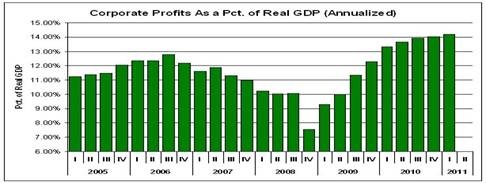
And we know from the #OccupyWallStreet protests and economic historians that the growth in income inequality has reached its limit. It turns out most Americans did have to sacrifice—the 99 percent whose incomes stagnated because they didn’t benefit from the tax cuts, loopholes and such that have also elevated corporate profits as a share of GDP to the highest in history.

So Professor Ferguson really means the West will continue to decline if we continue on the path of Oligarchy, where a few at the top have most of the wealth, and the rest of us have to borrow to maintain our standard of living. Then wealth will continue to be transferred to the developing giants who are willing to lend us money—China, India and Brazil with their young and growing populations.

But Dr. Ferguson’s theme isn’t new. Root causes of the rise and fall of western civilizations were earlier explored by UCLA Professor Jared Diamond in his books “Guns, Germs, and Steel”, and “Collapse” in far more convincing fashion. Our technological superiority was enabled by having major resources such as oil, benign climates that allowed cultivation of the major foodstuffs, and domesticated animals that gave us immunity to the major diseases that have wiped out native populations where such animals didn’t exist.

It follows then that the major reason for the huge debt loads isn’t too much government. Governments can easily pay for public services if sufficient growth is kept up. But there has been a steady decline in economic growth rates in the U.S. since the 1970s, at the same time as wealth was being transferred upward, due mainly to those tax breaks given to the wealthy.

Such a wealth transfer also meant diminished income growth for the majority of Americans—the wage and salary earners who make up 80 percent of consumers. And so overall aggregate demand, which is the willingness of consumers and businesses to spend, is diminished. And we know that higher corporate profits have in fact created greater market instability, and so retarded economic growth rates. In his New York Times Op-ed, “It’s Consumer Spending, Stupid”, and various blogs, economic historian James Livingston says what has been known to most modern macro economists—consumer and government spending have driven economic growth over the past century, not corporate profits.

“So the “underlying cause” of the Great Depression, (as well as the Great Recession),” says Dr. Livingston, “was a distribution of income that, on the one hand, choked off growth in consumer durables—the industries that were the new sources of economic growth as such—and that, on the other hand, produced the tidal wave of surplus capital which produced the stock market bubble of the late-1920s.  By the same token, recovery from this economic disaster registered, and caused, a momentous structural change by making demand for consumer durables the leading edge of growth.”      


Therefore, said underlying causes of decline may not be at all what Professor Ferguson contends, since the cure must be a redistribution of wealth back to those who generate it, the middle and lower working classes.

Harlan Green © 2011

Posted in Consumers, Economy, Keynesian economics, Weekly Financial News | Tagged , , , , , , , , , | Leave a comment

Let’s Put Americans Back to Work

Financial FAQs

It’s becoming evident that rather than political gridlock, such as the congressional supercommittee’s obsession with spending cuts, we need to worry about economic growth and jobs. And there are some very good ideas on how to do that, such as in President Bill Clinton’s newest book, “Back to Work”.  And economists such as Christina Romer, former Chairman of Obama’s Council of Economic Advisors, in a recent New York Times Op-ed are pleading with the Fed’s Ben Bernanke to actually target a growth rate that will both create jobs and keep inflation within a manageable range.

What? You mean the Federal Reserve’s QE-1, 2, and 3 buying of securities wasn’t doing just that? Well, no. It has accomplished the goal of keeping both short and long term interest rates low, but that hasn’t done anything for setting expectations of higher growth. In fact, the Fed just downgraded its own predictions of future growth. If anything, such low interest rates reflect deflationary expectations, which is the real problem. Companies won’t hire if they can’t raise prices, while consumers’ incomes fall in such an environment, stifling demand.

Dr. Romer and other major economists are beginning to insist the Fed should actually set what is called ‘nominal’ (i.e., before inflation accounted for) Gross Domestic Product growth target at the long term growth rate of around 5 percent. That way, expectations are raised for economic growth, without abandoning an inflation target of say, 2 percent, the current Fed inflation target.

How else can we boost demand for goods and services that is the actual driver of economic growth? We have discussed in a prior column how necessary it is for consumers—who power 70 percent of growth—to spend more, which in turn creates greater demand, which in turn creates more jobs in a virtuous circle. But they won’t if their confidence remains low, which surveys show causes them to spend less.

Former President Clinton has much more to say in “Back to Work” that directly addresses how to put Americans back to work, and he should know. “..during my administration we had four surplus budgets and began to pay down the national debt,” he says; we eliminated sixteen thousand pages of federal regulations; we cut taxes on the middle class, working families of modest means, and income from capital gains; we reduced the size of the federal workforce to its lowest level since 1960, and the economy produced 22.7 million new jobs.”

How did he do it? By emphasizing cooperation rather than competition between government and the private sector. “I believe the only way we can keep the American Dream alive for all Americans and continue to be the world’s leading force for freedom and prosperity, peace and security,” said Clinton, “is to have both a strong, effective private sector and a strong, effective government that work together to promote an economy of good jobs, rising incomes, increasing exports, and greater energy independence.”

Why is strong government so important? It is what engenders both business and consumer confidence, which are still at record lows. And without that confidence, consumers won’t spend to keep up demand, as we said, and businesses won’t hire in anticipation of higher growth.

clip_image002

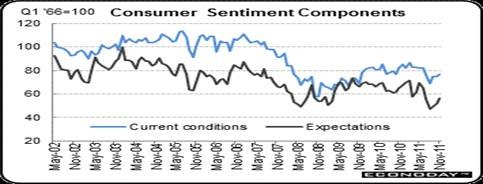
Confidence from both the Conference Board and University Michigan surveys has remained at recession levels since 2008, really. And we know it a major reason for such low confidence is both political gridlock, and the S&P downgrade of U.S. Treasury bonds to AA+. This is what it means to lose confidence in our institutions, readers. Also, the subprime debacle that brought on the housing bubble caused a major loss of confidence in our Too Big To Fail financial institutions, which were allowed to gamble with their investors’ monies, and then be bailed out by taxpayer money.

But the confidence measures have stood in contrast to strength in consumer spending. If recent gains for confidence can be extended in the weeks ahead, the economic outlook as well as expectations for holiday shopping will improve. Some thawing in the jobs market may be helping with sentiment, says Econoday.

So confidence has to be restored in all of our institutions if we want to bring back economic growth. “What’s the smart, effective way to do that?” asks Clinton. “With a strong economy and a strong government working together to advance shared opportunity, shared responsibility, and shared prosperity? Or with a weak government and powerful interest groups who scorn shared prosperity in favor of winner take all until it’s all gone?”

Studies have shown that only by sharing prosperity can we really create strong economic growth. And right now we rank near the bottom in income inequality, according to the much cited CIA World Factbook. So there is a lot of work to be done to restore confidence in Americans’ future.

Harlan Green © 2011

Posted in Consumers, Economy, Macro Economics, Weekly Financial News | Tagged , , , , , , , , , | 1 Comment

Employment Report Means Holiday Cheers!

Popular Economics Weekly

Not only were the employment numbers for the past 3 months much higher than originally estimated, but job openings are growing. All we need now is for consumers’ credit conditions to ease to bring back their confidence.

Much of the pessimism and predictions of a second recession were based on faulty data, and that has caused lenders to pull back. For instance, instead of 0 job growth in August that scared the markets, more than 104,000 jobs were created after ‘revisions’ to the seasonal adjustments that we have discussed in past columns. In fact, payroll jobs in October posted a gain of 80,000 after rising a revised 158,000 in September (originally 103,000).  So revisions for August and September were up net 102,000.

In fact, consumers are spending for the holidays as if the Great Recession is finally over, in spite of still uncertain income and credit conditions. The caveat: It took 23 months for consumption per person to return to its pre-recession level in earlier recessions. At 42 months, personal consumption has not yet returned to 2007 pre-recession levels, though some of that consumption was fueled by the housing bubble and may not be desirable, says Kevin Lansing of the San Francisco Federal Reserve.

clip_image002

Graph: Calculated Risk

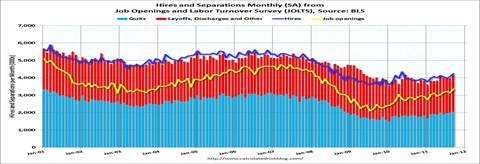
Firstly, the number of job openings in September was 3.4 million, up from 3.1 million in August. Although the number of job openings remained below the 4.4 million openings when the recession began in December 2007, the level in September was 1.2 million higher than in July 2009 (the most recent trough for the series). The number of job openings has increased 38 percent since the end of the recession in June 2009, which tells us growth is picking up. We should therefore see 3 percent plus GDP growth for the rest of this year, at least, contrary to the Federal Reserve’s downwardly revised forecasts.

clip_image004

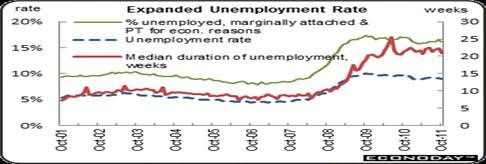
The consensus expected unemployment to be stuck at 9.1 percent instead of dropping to 9 percent in the Labor Department’s October household report, which tracks self-employeds as well.  The unemployment rate declined largely on a sizeable 277,000 boost in household employment which has posted significant increases for three months in a row.  The increases in August and September were 331,000 and 398,000, respectively.

And there is additional favorable news in the household survey.  Part-time employment for economic reasons is down and the duration of unemployment declined in October.  In nonagricultural industries, the number of those employed part time instead of full time for economic reasons dropped 328,000, says Econoday.

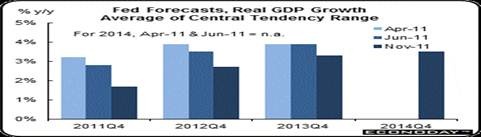
By downgrading its growth estimates, the Fed is leaving the door open for additional ease with the emphasis on significant downside risks remaining. For real GDP, the central tendency forecast for 2011 is now a 1.6 to 1.7 percent versus the prior range of 2.7 to 2.9 percent.  The large downgrade likely is due to a large downside miss to second quarter growth.  (But we believe growth will also be upgraded in coming months.) For 2012, forecast growth is 2.5 to 2.9 percent versus June’s 3.3 to 3.7 percent.   For 2013, forecast growth is 3.0 to 3.5 percent versus June’s 3.5 to 4.2 percent.   The Fed doesn’t see sustained growth until 2014—a range of 3.0 percent to 3.9 percent.

clip_image006

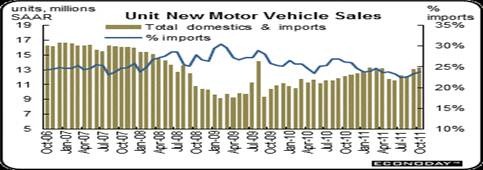
And early data for October on actual purchases by consumers indicate that this sector is doing better than suggested by surveys on the consumer mood, as we said.  Thanks to the one area where credit is easing, unit new motor vehicle sales rose 1.2 percent in October after surging 8.0 percent the month before. October’s sales pace was 13.3 million units annualized, compared to 13.1 million in September.

clip_image008

The bottom line is that credit is still being tightened in most areas, according to the Federal Reserve’s October 2011 Senior Loan Officer Opinion Survey on Bank Lending Practices. Fewer domestic banks eased standards and terms on commercial and industrial (C&I) loans over the third quarter compared with recent quarters, particularly on loans to large and middle-market firms, said the survey. And all of the domestic and foreign respondents that reported having tightened standards or terms on C&I loans cited a less favorable or more uncertain economic outlook as a reason for the tightening.

And so consumers will have to be patient, if they want to see credit standards easing for such as home loans. We hope the HARP II loan modification program that allows lowered payments and shortened payoff terms Fannie Mae and Freddie Mac-owned mortgages, though no principal reduction, will spur refinances and thus many to move out of their homes to find new jobs to be helpful.

The bottom line is that consumers are borrowing again, but for longer term purchases and still reducing their credit card debt, in part because banks are still restricting credit card use. Consumer credit expanded $7.4 billion in September benefiting once again from strength in nonrevolving credit, said the Federal Reserve’s latest Consumer Credit report. So-called installment loans outstanding, reflecting strong vehicle sales, rose $8.0 billion in the month to $1.66 trillion. This offsets another contraction in revolving credit, down $0.6 billion to $789.6 billion outstanding.

Harlan Green © 2011

Posted in Economy, housing market, Macro Economics, Weekly Financial News | Tagged , , , , , , , , | Leave a comment

Dear Supercommittee: “It’s Consumer Spending, Stupid!”

Financial FAQs

“With only about a month remaining before its recommendations are due, lawmakers on the congressional supercommittee charged with finding savings from the federal budget wrestled with cuts to defense, foreign aid and other programs on Wednesday”, said Bloomberg Marketwatch.

But the historical record tells us that finding “savings” in government spending will shrink, not expand economic growth. And so finding savings that aren’t spent elsewhere on stimulus programs won’t in fact reduce the federal deficit, which depends on increased growth. So once again as Paul Krugman has said, “And those who are determined to forget the past run a high risk of reliving it — which is why we’re in the state we’re in.”

At the risk of stealing the title from a New York Times Op-ed by economic historian and Rutger’s Professor James Livingston, “It’s Consumer Spending, Stupid”, we now have historical data verifying that consumers and government spending have driven economic growth over the past century, not corporate profits. This should not be surprising given that consumer spending now makes up 70 percent of economic activity.

Professor Livingston’s apostasy is letting us in on the “best kept secret of the last century: private investment—that is, using business profits to increase productivity and ouput—doesn’t actually drive economic growth. Consumer debt and government spending actually do”.

This is blasphemy to the classical orthodoxy, needless to say, but a truth that the #OccupyWallStreet protests recognize. Livingston says, in fact “…corporate profits are…just restless sums of surplus capital, ready to flood speculative markets at home and abroad. In the 1920s, they inflated the stock market bubble, and then caused the Great Crash. Since the Reagan revolution, these superfluous profits have fed corporate mergers and takeovers, driven the dot-com craze, financed the “shadow banking” system of hedge funds and securitized investment vehicles, fueled monetary meltdowns in every hemisphere and inflated the housing bubble.”

clip_image002

Graph: Congressional Budget Office

This also tells why this recovery has been so frustratingly anemic. It isn’t consumer debt, as much as the lack of income that has prevented consumers from spending enough to boost economic growth. There has been almost no household income growth above inflation since the 1970s, mainly because so much wealth was siphoned off to the wealthiest via tax loopholes and less progressive tax rates, according to the latest CBO study on income inequality.

It should no longer be a surprise to anyone that the share of income going to higher-income households rose, said the CBO study, while the share going to lower-income households fell. But it’s nice that the CBO is also providing more evidence, to whit:

  • The top fifth of the population saw a 10-percentage-point increase in their share of after-tax income.
  • Most of that growth went to the top 1 percent of the population.
  • All other groups saw their shares decline by 2 to 3 percentage points.

How do we know that it isn’t corporations reinvesting their profits that spurs growth? After all, between 1900 and 2000, real gross domestic product per capita (the output of goods and services per person) grew more than 600 percent.

We know because net business investment declined 70 percent as a share of G.D.P. over that century, says Professor Livingston. In 1900 almost all investment came from the private sector — from companies, not from government — whereas in 2000, most investment was either from government spending (out of tax revenues) or “residential investment,” which means consumer spending on housing, rather than business expenditure on plants, equipment and labor.

In other words, over the course of the last century, net business investment atrophied while G.D.P. per capita increased spectacularly. In other words, corporations decided to spend their profits elsewhere. “The architects of the Reagan revolution tried to reverse these trends as a cure for the stagflation of the 1970s, but couldn’t, said Livingston. In fact, private or business investment kept declining in the ’80s and after. Peter G. Peterson, a former commerce secretary, complained that real growth after 1982 — after President Ronald Reagan cut corporate tax rates — coincided with “by far the weakest net investment effort in our postwar history.”

So even cutting corporate taxes, the cry of conservatives today, hasn’t encouraged corporations to invest in future growth. Professor Livingston has done a great service in what may be a first—actually exploding the myth that profits drive growth. It also explodes the myth that corporations have their customers’ best interests at heart. For their customers are consumers in the main, and consumers’ incomes have not even kept up with inflation. The huge jump in labor productivity has not been shared by their employees, in other words.

On the other hand, it is the investor class that profited immensely from the myth that business investment creates jobs. Even though the historical record shows it merely bloated the financial sector from 8 percent to more than 20 percent of GDP over the past decade, which led to excessive speculation. It was excessive investments in new technology, for instance, that caused the dot-com bubble and market crash in 2000. Then came the housing bubble that resulted from overbuilding of housing, fuelled by too easy credit conditions.

“Consumer spending is not only the key to economic recovery in the short term; it’s also necessary for balanced growth in the long term,” says Professor Livingston. “If our goal is to repair our damaged economy, we should bank on consumer culture — and that entails a redistribution of income away from profits toward wages, enabled by tax policy and enforced by government spending. (The increased trade deficit that might result should not deter us, since a large portion of manufactured imports come from American-owned multinational corporations that operate overseas.)”.

We don’t need the traders and the C.E.O.’s and the analysts — the 1 percent — to collect and manage our savings. Instead, we consumers need to save less and spend more in the name of a better future. We don’t need to silence the ant, but we’d better start listening to the grasshopper, says Professor Livingston. 

So when will consumers—you and I, that is—wake up to the fact that the future is ours for the taking? 

Harlan Green © 2011

Posted in Economy, Keynesian economics, Weekly Financial News | Tagged , , , , , , , , , | Leave a comment

Third Quarter Growth Will Be Better

Popular Economics Weekly

We now know the reasons for this summer’s growth pause. The Japanese earthquake and Tsunami disrupted a fragile recovery at the same time as Europeans found out they had a fragile banking system. And several stimulus programs had expired—such as the housing tax credits while much of the ARRA $800 billion had been spent. Top that off with congressional gridlock and U.S. credit downgrade, with consumers and businesses still paying down their debt, and we can see why many pundits were calling for a second recession.

clip_image002[6]

But that ain’t happening, folks, as I’ve said. In part, because of all the cash being held by corporations with record profits, and banks in excess reserves. Economic growth for the second quarter ended up stronger than previously estimated but remained anemic, as I’ve said. The Commerce Department’s final estimate for second quarter GDP growth rose 1.3 percent annualized.

But we will see better third quarter economic growth—in the 2 to 3 percent range—as the steady increase in consumer spending (read retail sales) means more businesses will be hiring, while Obama’s new push on allowing more homeowners to refinance—up to 1 million by some estimates—can breathe new life into the housing market.

Expansion of his Home Affordable Refinance Program (HARP) will streamline the refinance process by eliminating appraisals and extensive underwriting requirements for most borrowers, as long as homeowners are current on their mortgage payments, said President Obama at his Las Vegas unveiling. Fannie and Freddie have also agreed to waive some fees that made refinancing less attractive for some.

Pricing details won’t be published until mid-November, and lenders could begin refinancing loans under the retooled program as soon as Dec. 1, according to Calculated Risk. Loans that exceed the current limit of 125 percent of the property’s value won’t be able to participate until early next year. HARP is only open to loans that Fannie and Freddie guaranteed as of June 2009.

It seems that businesses have chosen to get the most out of their current workforce rather than hire new workers. It shows in the flagging productivity numbers and rising unit labor costs (ULC) seen in Econoday’s graph, which means their existing employees cannot produce much more per worker.

clip_image004[7]

This means businesses aren’t hiring more workers because they don’t’ see increasing demand for their products. But the recent pickup in exports, capital goods orders and retail sales are telling us that the Third Quarter will look better.

clip_image006[7]

One reason is industrial production. Manufacturing data point to a stronger third quarter—and no recession. Manufacturing—especially autos—continues to lead industrial production.  In September, industrial production advanced 0.2 percent, following no change the month before and a 1.1 percent jump in July. Manufacturing is outpacing growth for the overall economy over the past year. On a seasonally adjusted year-on-year basis, overall industrial production was up 3.2 percent in September, compared to 3.3 percent in August.  Through the second quarter, real GDP growth was 1.6 percent on a year-ago basis.  Basically, manufacturing is leading the recovery and at the national level is running stronger than implied by manufacturing surveys.

clip_image008

And the excuse given by no-growthers who want to shrink government—that additional stimulus spending will cause inflation—is a canard. We are currently in a deflationary cycle, as Krugman, et. al., have been saying ad nauseum. It is called a liquidity trap when businesses and consumers hold onto their savings rather than spend or invest out of the fear that conditions can worsen again. What will loosen their wallets is some confidence in their future.

Harlan Green © 2011

Posted in Consumers, Economy, Weekly Financial News | Tagged , , , , , , , , | Leave a comment

What will Boost Real Estate?

The Mortgage Corner

Never in my 30 years as a Mortgage Banker did I think I would see interest rates this low—as low as during Harry Truman’s Presidency. Yet very few homeowners are able to take advantage of those rates, which have dropped more than 2 percent since 1997, the beginning of the market crash. And we know why; whether it was the loss of a job, health insurance, or equity in their home with housing values down as much as 50 percent in some states.

This is while the foreclosure backlog is so great it could take more than 60 years in some states to work through, according to New York Times reporter David Streitfeld.

So when two Presidents—President Obama in his new jobs plan, and former President Clinton on the Sunday TV talk shows touting his Clinton Global Initiative—say that real estate has to recover for our economy to recover, it should take precedence in discussions on how to boost economy growth.

And there are concrete steps we can take now to cure much of the housing malaise of vacant homes and deteriorating neighborhoods. Obama’s inclusion of $15 billion in his new jobs plan to rehabilitate depressed neighborhoods is one such. But much more can be done if he can convince Fannie Mae and Freddie Mac to cooperate in loosening some of their almost draconian qualification requirements for both purchase and refinance transactions made more restrictive after the housing crash.

Credit scores, for instance, do not have to be 680 or better, if there are other so-called compensating factors, such as long term employment, or good assets. Or, the almost set-in-stone 45 percent maximum overall debt-to-income ratio could be more flexible with good job security and assets.

And much more can also be done with HARP, the Housing Affordable Refinance Program that was touted to help millions of homeowners, but has helped just 838,000 to date. Hence President Obama’s pronouncement that loan modifications would be allowed for “responsible applicants” can mean that compensating factors should be considered when qualifying borrowers.

But there is another restriction keeping many homeowners from refinancing or buying—the declining equity in their current home. Whereas just 10 years ago average equity was 61 percent, it is now just 38.6 percent, according to the Federal Reserve’s latest Flow of Funds report. If Fannie and Freddie would qualify someone with good credit and assets that is, say, 50 percent underwater, the case in many neighborhoods, then they should be allowed a haircut—meaning a reduction in their principal balance—that would enable them to refinance at today’s record low rates with a new loan that brought it back to 100 percent of current value. The 30-year conforming fixed rate today is hovering at 4 percent.

What is holding Freddie and Fannie back from offering this now, which could in fact refinance an additional 2.9 million homes without significantly increasing tax payers’ liability, according to a recent CBO report? Once again, it seems to be Republicans’ opposition to any more government liabilities, and the fact that an independent agency, the Federal Housing Finance Authority is Fannie and Freddie’s administrator, charged with limiting their losses now that they are government-owned.

But the CBO study showed that it could save homeowners about $7.4 billion in just the first year and help about 111,000 homeowners avoid default with just a net cost of $600 million. What’s not to like about this program?

Harlan Green © 2011

Posted in Economy, housing market, Weekly Financial News | Tagged , , , , , , , , , | Leave a comment

Don’t Accept ‘New Normal’ of Slower Growth

Popular Economics Weekly

There is no reason to accept what pundits and some economists are telling us we have to accept—a ‘new normal’ for economic growth that is some kind of growth recession. Because we have the means to spur sufficient economic growth, if only we will reject an insidious disinformation campaign that discredits all scientific and factual reality, a campaign that can only work if we listen to those who would blame others for the Great Recession—and who would blame immigrants, the budget deficit, too much government, or too high taxes in order to justify further spending cuts.

A growth recession is what the Japanese have experienced ever since their twin real estate and stock bubbles burst circa 2000, because they didn’t cure the ills that caused their bubbles, or spend what it took to revive their economy until it was too late to prevent more than a decade of deflation and poor economic growth.

Japan

Graph: Trading Places

So don’t believe the scapegoaters for a minute. We need more job creation programs, not tax and spending cuts, because corporations are holding onto their record profits generated by laying off domestic workers while sending jobs overseas, so that 50 percent of S&P 500 corporation profits now come from overseas operations. And consumers aren’t spending enough to cause domestic expansion because their incomes aren’t rising, even though they produce more per worker.

The ‘new normal’ of growth we are currently seeing is really a product of the so far successful Republican campaign to oppose any kind of stimulus spending. But they can only do this by dumbing down the electorate or (at least their own constituency) that believes austerity is more important than job creation, that cutting taxes for the richest is more important than repairing our aging infrastructure, or protecting the environment, or even maintaining social security and Medicare.

The Republicans answer to Obama’s $447 billion job formation bill was predictable. House Majority Leader Boehner said long term tax hikes should not pay for short term stimulus, which is not being truthful. The tax hikes are paying for long term jobs—in infrastructure, education and environmental protection. And the tax hikes on itemized deductions for the wealthiest 2 percent would cut some $400 billion from the deficit over the next 10 years, since those tax breaks are being paid for with borrowed money. Another $62 billion of the deficit would be cut by eliminating the various tax breaks on oil and gas, private equity partners, and corporate jets.

Republicans are, in a word, trying to convince us what is in effect a ‘new normal’ of ignorance, a wholesale ignorance of reality based facts—whether economic or scientific. For instance, how can anyone believe Republicans who maintain Obama’s stimulus spending created zero jobs, when the CBO says it created or preserved 1.4 to 4 million “Full Time Equivalent jobs to date? Or Rick Perry’s blatant untruths about social security being a “Ponzi scheme”, global warming not having a scientific consensus when his own Texas is burning because of a record drought, and evolution is just one competing theory?

Their campaign is insidious, as the discounting of facts does appeal to their base of support on the extreme religious right. They have to keep their electorate ignorant, if they want to transfer even more wealth to Wall Street by privatizing social security while advocating deregulation when that is what caused the market crash.

Republican House Whip Eric Cantor tries to justify his opposition to paying for the jobs bill by saying it’s a tax on the “job creators”. But the only job creators will be government tax dollars returning to the private sector to create more private sector jobs, when the private sector isn’t hiring.

And social security and Medicare are really only in danger of running out of funds if Republicans and their conservative backers won’t support the actual reduction of federal debt, rather than keep the tax cuts and loopholes that have transferred so much wealth to the wealthiest, and continue to oppose regulations that would lower health care costs. As a result corporate profits are now highest in history as a percentage of GDP, as we have said.

A growth recession is not what we want. The Japanese are bedeviled by debt that is now 200 percent of GDP, as they have allowed deflation and a cheap currency to facilitate exports, but has suppressed domestic demand—mainly because such a deflationary spiral means their citizens’ wealth continues to decline.

There are other reasons for Japan’s economic decline—reacting too slowly to the bubbles and so choosing austerity instead of pump priming (sound familiar?), static population growth (because of immigration restrictions), and a keiretsu economic system of interlocking ownerships that has banks owning aging corporations they kept afloat too long rather than putting money into new growth opportunities.

But there is no reason we should follow Japan’s example. Instead, we have to turn back 30 years of conservative attempts to shrink government with a vengeance that has not really transferred wealth to the private sector—except to their wealthiest supporters. But it will take the growing anger of the unemployed and under-employed to accomplish it—such as happened with Wisconsin’s public workers—rather than angry Tea Partiers blaming welfare immigrants and the lazy jobless for budget deficits that are only growing because of the disinformation campaign that attempts to dumb down voters.

Harlan Green © 2011

Posted in Economy, Macro Economics, Weekly Financial News | Tagged , , , , , , , , , | Leave a comment

Labor’s Day—Have We Forgotten What It Means?

Popular Economics Weekly

It’s officially the end of summer, start of school, fall colors, and Obama’s upcoming September 8 joint congressional State of the Jobs Market. With the labor market in dire straits, what can we say about this year’s Labor Day Holiday?

Former French Finance Minister and new IMF Managing Director Christine Lagarde gave a highly regarded speech at the Fed’s Jackson Hole conference that said in effect this was the wrong time to implement more austere, budget cutting policies with labor in such trouble. “In the United States, policymakers must strike the right balance between reducing public debt and sustaining the recovery—especially by making a serious dent in long-term unemployment,” she said.

But the latest data on record corporate profits tells us something alarming. Because of the globalization of technology, businesses know how to expand without hiring more employees—at least in this country. About 83 percent of S&P 500 companies have beat second quarter 2011 analyst estimates according to data compiled by Bloomberg News. This is while S&P recently reported that in 2010, 46.3 percent of all S&P 500 company sales originated outside of the US.

“If we look at the last 10 years, the divergence between the corporate profits of S&P 500 companies and domestic GDP growth is astonishing,” said GC Mays, an Independent / boutique research firm analyst in his Seeking Alpha blog. “Between the first Quarter of 2001 and 2006, a simple correlation showed that corporate profits explained 98.4 percent of domestic GDP growth. However, the most recent five years beginning with the first quarter of 2006 the correlation between corporate profits and domestic GDP growth breaks down as corporate profits only explain 10.1 percent of domestic GDP growth.”

clip_image002

Graph:  The Mays Report

Why is it necessary to increase jobs when we now know we can have economic growth without job growth? Well, beside the obvious voter anger if politicos don’t take the lead in creating more jobs, it means taking away the demand that can grow the domestic economy. Corporate profits have risen to the highest level as a percentage of Gross Domestic Product since the Great Depression—14 percent—but much of the profit comes from overseas’ sales of U.S. companies, as we said.

clip_image004

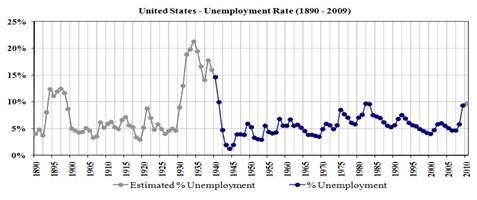
And that doesn’t augur well either for decreasing the record income inequality for most wage earners or growing domestic jobs. Since World War II the unemployment rate has twice reached 10 percent—during the 1981-82 and just ended 2007-09 recession. But because of the housing and financial crashes that accompanied the Great Recession—or Small Depression, as Krugman has christened it—consumers are not spending and employers not hiring domestically as they have in past recoveries.

That means corporate profits are no longer dependent on domestic demand, so are not going to help reduce the various deficits—both household and governmental—without explicit policies to create more domestic jobs. It’s a straightforward equation. Decreasing domestic unemployment means decreasing domestic deficits, and growing household incomes means growing domestic businesses. But since corporations are no longer dependent on growing domestic jobs to sell their products, what policies will? Director Lagarde says it best:

“First—the nexus of fiscal (budget) consolidation and growth. At first blush, these challenges seem contradictory. But they are actually mutually reinforcing. Credible decisions on future consolidation—involving both revenue and expenditure—create space for policies that support growth and jobs today. At the same time, growth is necessary for fiscal credibility—after all, who will believe that commitments to cut spending can survive a lengthy stagnation with prolonged high unemployment and social dissatisfaction?”

We can hope that Labor Day will be a cause for celebration; an international coming together of Big Business and dueling politicians on the need for concrete job creation policies. Make no mistake that as the public becomes better informed on the causes of the current employment malaise, they will seek out leaders who can implement the reforms necessary to correct the imbalance between growing corporate profits and declining payrolls.

“In sum,” concludes Lagarde, “risks to the global economy are rising, but there remains a path to recovery. The policy options are narrower than before but there is a way through. There are lingering uncertainties, but resolute action will help to dispel doubts.”

Harlan Green © 2011

Posted in Economy, Macro Economics, Weekly Financial News | Tagged , , , , , , | Leave a comment