The Fed’s Paralysis—Who Will Do the Right Thing?

Popular Economics Weekly

I actually agreed with Fed Chairman Bernanke in his latest Jackson Hole speech, when he said the Fed can’t grow the economy without some help. The weak growth of late has panicked markets, and Fed policy doesn’t seem to do the trick. Its record low interest rates aren’t helping at the moment, though that is keeping the housing market from dying completely.

So who is setting our monetary and fiscal policy these days? No one, at the moment. The White House is always one step behind events—worrying about deficit reduction when it can’t shrink the deficit without more job growth. And Congress is obsessing about the size of government, when government employment and spending have been shrinking faster than in the private sector.

“The country would be well served by a better process for making fiscal decisions,” was Bernanke’s understatement of the year, signaling it was fiscal policy that should now take the lead in growing the economy. So is Bernanke is throwing up his hands at the moment, in refusing to even hint at what other stimulus policies might come from the Fed until after a special 2-day September convocation of the FOMC? He was putting the policy ball back in the politicians’ court. It’s up to them to settle their differences if they want growth.

It’s of course obvious our ‘lack of a policy’ is now being set by the right wing of the Republican Party, who oppose all forms of stimulus. The downsizing of government has been their agenda since Ronald Reagan, and their only way seems to be by creating recessions. In fact, there have been 5 recessions during the last 3 Republican administrations. Two occurred during Reagan’s presidency (1980, 1981-82), one during Bush I (1991) and two during GW Bush’s presidency (2001, 2007).

Bernanke has been a strong advocate for an active Fed in stimulating economic growth in the past, which is why Nobelist Paul Krugman in effect called him craven for caving in to the Republican extreme right wing. “Now just imagine the reaction if the Fed were to act on the…arguably more important parts of the Bernanke 2000 agenda—more purchases of long term debt (i.e., a QE3), an announcement that short term rates would stay low for an extended period, to further reduce long term rates; and an announcement that the bank was seeking moderate inflation, “setting a target in the 3-4 percent range for inflation, to be maintained for a number of years.”

Bernanke himself actually accused the Bank of Japan at that time of a “self-induced paralysis” in not providing more stimulus to their sputtering economy, according to Krugman. “Well now, the Fed is suffering from externally induced paralysis,” he concludes.

At a time when growth has slowed drastically through the first 2 quarters of 2011 after soaring above 4 percent for several quarters last year, the fears of a double-dip recession is depressing financial markets at the moment. But the outcome is more likely a “growth recession”, defined as slow growth amid rising unemployment that the Japanese have been experiencing for the last 20 years.

clip_image002[6]

Bernanke’s scholarly treatise on the causes of the Great Recession comes at the same time that GDP Q2 growth had just been revised downward to 1 percent from 1.3 percent. “Unfortunately, the recession, besides being extraordinarily severe as well as global in scope, was also unusual in being associated with both a very deep slump in the housing market and a historic financial crisis,” said Bernanke.

Well, duh. How is that new news? He actually pins most of the blame for the current slowdown on the euro debt crisis and S&P downgrade. “It is difficult to judge by how much these developments have affected economic activity thus far, but there seems little doubt that they have hurt household and business confidence and that they pose ongoing risks to growth.” But then he goes on to discuss the need to cure the long term deficit, and only at the end of his speech does he mention the necessity for more job creation to cure the short term deficit due to the Great Recession.

“In the short term, Bernanke said, “putting people back to work reduces the hardships inflicted by difficult economic times and helps ensure that our economy is producing at its full potential rather than leaving productive resources fallow. In the longer term, minimizing the duration of unemployment supports a healthy economy by avoiding some of the erosion of skills and loss of attachment to the labor force that is often associated with long-term unemployment.”

Why so much emphasis on debt, rather than recovery? It is because of timidity on all sides, from the White House and Congress. Even Europe is suffering from the same paralysis in not providing enough aid to Greece, a paralysis that is now spreading through several other countries, says Krugman

“The fiscalization of the crisis story — the insistence, in the teeth of the evidence, that it was about excessive public borrowing — has become an article of faith on both sides of the Atlantic. And that faith has done and will do untold damage.”

So in effect the current slowdown is due to a paralysis of will from our leaders, not lack of monetary and fiscal tools to bring about a sustained recovery.

Harlan Green © 2011

Posted in Economy, Macro Economics, Weekly Financial News | Tagged , , , , , , , | Leave a comment

Our Psychological Depression

Popular Economics Weekly

The plunging financial markets are telling us something depression, but it is more about crowd psychology, than actual events. Americans are very depressed about their financial prospects. Duh, says Paul Krugman, given the congressional deadlock. So why is it causing such market turmoil? I maintain it is because of the unfounded downgrade by Standard & Poors of U.S. Treasury securities to AA+ from AAA. This event has to be almost as shocking as 9/11 to our collective psyches. For just as Bin Laden meant the 9/11 attack to be an attack on our economy, the S&P downgrade means we are no longer the world’s only economic superpower.

So will the downgrade, which hasn’t been matched by either Fitch or Moody’s bond rating services, have an effect on real economic growth is the question. Yale Professor Robert Shiller and other behavioral economists maintain that consumer confidence, or ‘animal spirits’, affects consumers’ behavior. Professor Shiller also says that much of how people judge the economy doesn’t come from facts or economic fundamentals, but the stories they hear, as well as the degree of optimism or pessimism they feel about their own circumstances. For instance, surveys by Professors Shiller and Karl Case in their Macro Markets LLC, show that the housing bubble was fueled in large part by hearsay and media stories that housing values had always risen, and would continue to do so.

clip_image002

So confidence is only one factor that economists look at for their predictions. It’s a good thing, because we are seeing moderate economic growth at the moment and jobs being created. Even retail sales are surging 8 percent annually at the same time that consumer confidence measured by the Conference Board and University of Michigan surveys is at recession-levels.

So it may be that plummeting confidence in financial markets is causing the extreme market volatility of late, rather than economic fundamentals. For instance, the rise in the Consumer Price Index showing some inflation was the reason given for the stock market plunge, along with very negative Empire State and Philadelphia Fed industrial sentiment surveys.

clip_image004

But inflation is also a sign of increasing demand, and prices must rise for businesses to expand. The core CPI index without food and energy fluctuations is up just 1.8 percent annually, while industrial production is still healthy, according to the Federal Reserve. On a year-on-year basis, overall industrial production is rising at 3.7 percent in July. Overall capacity utilization in July also improved to 77.5 percent from 76.9 percent the prior month, signaling that businesses are expanding.

Then why were the Philly and Empire State surveys so pessimistic? It may be that since both surveys are a consensus of managers’ predictions about future prospects, they could also have been affected by the S&P downgrade, which is radiating outward as hedge funds and retirement funds with extensive holdings of Treasury securities also risk being downgraded by S&P, who has decided that it has to make up for allowing AAA ratings on subprime mortgage securities during the housing bubble, thus prolonging it.

clip_image006

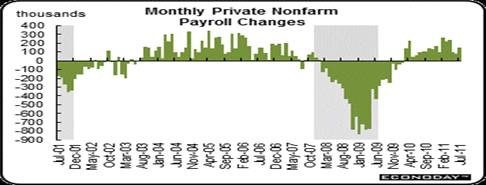
There are also other indicators that show sentiment doesn’t match behavior. Imports are surging, the reason for the larger trade imbalance, which corroborates the higher retail sales’ numbers. And weekly initial unemployment insurance claims continue to fall. Though there was a slight uptick in last week’s claims, the four-week average fell for the seventh straight week, down 3,500 to a 402,500 level that is nearly 20,000 lower than the month ago comparison. In fact, private sector nonfarm payrolls grew 154,000 in July, following an 80,000 rise in June and 99,000 increase in May.

clip_image008

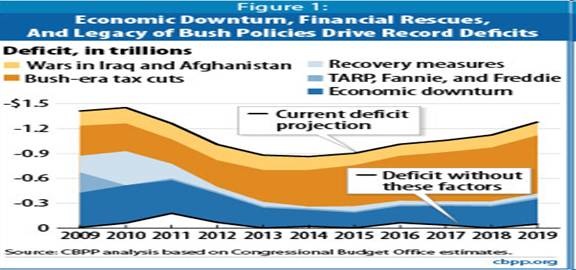
S&P has admitted their downgrade wasn’t really about the numbers, but about their judgement that the political situation could be gridlocked for years to come. This is because the numbers aren’t that bad. Most of the deficit is short term; caused by the Bush tax cuts, ywo unpaid wars and lost revenues from the Great Recession. The wars will end, so defense budgets will shrink, and revenues rise as economic activity continues to pick up. Politicos might also realize that most of those Bush tax breaks should probably be allowed to expire in 2012, rather than be renewed. This in itself would save some $3.8 billion over the next 10 years, according to the Center for Budget and Policy Priorities.

So S&P wasn’t making a judgment about the near term deficit, which they had overestimated by $2 trillion, but about what the federal deficit may look like in 10 years. Yet how can anyone know about events so far into the future? Though given the post-recession frayed nerves of consumers and investors, even the slightest ‘aftershock’ can cause an outsized response.

Harlan Green © 2011
Posted in Economy, Keynesian economics, Macro Economics, Weekly Financial News | Tagged , , , , , , , , | Leave a comment

Don’t Blame Our Democracy…

Popular Economics Weekly

Please don’t blame our Democracy, old as it is—in fact, the oldest in the modern world—for the slowness of this recovery. Winston Churchill on hearing his Labor Party had been defeated in 1947, said in the House of Commons, “Democracy is the worst form of government, except for all those other forms that have been tried from time to time.”

In fact, our Democracy is working, as economic growth is predicted to rise above 3 percent for the rest of the year, and job growth will get better, in spite of the worst downturn since the 1930s. Even real estate is showing signs of life with new housing construction up 14 percent in June.

clip_image002

The Conference Board’s index of leading indicators rose 0.3 percent in June on top of May’s outsized gain of 0.8 percent, which equates to approximately 3 percent growth for the rest of the year. The top factor for June was an increase in money supply with the second factor once again the yield spread between long rates and short rates with the latter being kept near zero by the Federal Reserve. And the larger the spread between short and long term rates—a so-called ‘steep’ yield curve—the more profit for banks and other lenders willing to extend credit.

clip_image004

Housing construction is continuing to move up—but from near rock bottom, says Econoday.  Housing starts jumped 14.6 percent in June, following no change in May.  And this actually helps growth, since it means more jobs. June’s annualized pace of 0.629 million units came in higher than the consensus projection and is up 16.7 percent on a year-ago basis. The boost in June was led by a 30.4 percent surge in the multifamily component.  The single-family component rose 9.4 percent after gaining 0.7 percent the prior month.

Sure, Republicans and Democrats are locked in a struggle that mirrors the eternal struggle between the old and the new. Republicans want every tax break they can get for their wealthiest constituents, while Democrats want every benefits’ break for all the other income classes plus the elderly. And this is preventing both the private and public sectors from stimulating more than tepid growth, in spite of record corporate profits since the end of the Great Recession.

The problem is neither party can agree how to pay for those benefits. Democrats want to close tax loopholes, while Republicans believe putting more money into the pockets of investors and the largest corporations by lowering tax rates further will somehow generate more growth, without spelling out how that might happen. The tax cuts in fact increased the federal deficit in both the Reagan and Bush Administrations

And preserving those Bush tax cuts has increased the deficit some $3 trillion, and will increase it another $7 trillion by 2017, according to the non-partisan Center for Budget Policies and Priorities, if not allowed to lapse.

Even “Read My Lips: No New Taxes” Grover Norquist, leader of those Republicans who have signed his Taxpayer Protection Pledge—which says that he or she will vote against all tax increases—said in a recent New York Times’ Op-ed it doesn’t mean opposing sunset clauses that allow the Bush tax cuts to expire in 2012. “If there were no vote in Congress and taxes rose automatically,” said Norquist, “then no politician would have voted for higher taxes, and no elected official would have broken his or her pledge.”

New York Times Op-ed columnist Charles Blow cited a recent Pew Research poll that said a thin majority of whites are now registered Republicans, while a majority of minorities such as Blacks and Hispanics are registered Democrats. So the line between the past and future is being drawn ever more sharply for the upcoming 2012 presidential election.

As we now know, the debate isn’t really about the deficit, as we said last week, which occurred largely under GW Bush. Else Republicans would be interested in paying down the deficit, which can only be done by closing tax loopholes that have increased the deficit. The federal deficit has been broken down by many, including the non-partisan Center for Budget and Policy Priorities.

clip_image006

New Bush Administration policies accounted for $5.07 trillion of the $14 trillion in Federal debt, while Obama Administration policies such as ARRA accounted for $1.44 trillion. The rest has come from lost revenues of the 2 recessions since 2001. We are now at the lowest level of revenues as a percentage of Gross Domestic Product since WWII.

That is why the debt ceiling agreement has to be ‘balanced’ between cost-cutting and deficit-cutting—i.e., slowing the growth of government programs while closing the tax loopholes that are taking monies away from projects that would stimulate higher growth rates.

Harlan Green © 2011
Posted in Economy, Macro Economics, Weekly Financial News | Tagged , , , , , | Leave a comment

Don’t Blame Fannie and Freddie…

The Mortgage Corner

Please don’t blame Fannie Mae and Freddie Mac, guarantors of most of the housing market’s conventional mortgages and reason the housing market continues to function at all, for the housing bust. The bust was caused by the oversupply of housing built during the bubble, and aggravated by almost all commercial banks and hedge funds cooking up every kind of ‘liar’ loan they could think of to sell to Wall Street securitizers—including to themselves.

Sure, Fannie/Freddie had to be taken over by the federal government and are being subsidized with approximately $167 billion to date, but that is because banks and other commercial lenders then withdrew from financing the housing market, leaving government to clean up the mess. So the government subsidy is a very cheap price to pay to keep housing from collapsing completely.

Credit was too cheap in early 2000, as Fed Chairman Alan Greenspan’s Federal Reserve kept short term interest rates below the inflation rate to pay for the Bush tax cuts and wars. I.e., when short term interest rates were 1-2 percent and inflation in the 3 percent range at the time, it was borrowers who actually profited since inflation deflated the value of the debt. This meant it was interest free money!

Economists have estimated that below inflation interest rates were probably also responsible for the double digit housing price rises during the height of the bubble. Don’t take my word for it. Almost everyone, including the nonpartisan Government Accountability Office, the Harvard Joint Center for Housing Studies, the Financial Crisis Inquiry Commission majority, the Federal Housing Finance Agency, and virtually all academics, have rejected the argument of conservative think tanks such as the American Enterprise Institute that it was federal affordable housing policies designed to make housing available to a broader public, that created so many high risk loans.

Fannie and Freddie created and have always maintained the gold standard of mortgage qualification standards, with the highest income, credit, and ability to pay requirements. As a mortgage banker/broker for 30 years, I have never originated or underwritten a conforming mortgage that didn’t meet those standards.

So why do conservatives hate Fannie and Freddie so much? Because of their ties to the Democratic Party, mainly. As Gretchen Morgenson and Joshua Rosner detail in their book, Reckless Endangerment, Fannie Mae and Freddie Mac grew hugely under Democratic Administrations eager to encourage more affordable housing. And they did buy subprime mortgages from Countrywide Financial that were not underwritten to their conforming underwriting standards, thus fattening their portfolios in a bid to play catchup to the issuers of so-called ‘private label’ mortgages. But the subprime purchases were a drop in the bucket; just $60.8 billion for Freddie Mac, according to David Min of the Center for American Progress, with borrowers who had FICO scores under 620, a common definition of subprime mortgages.

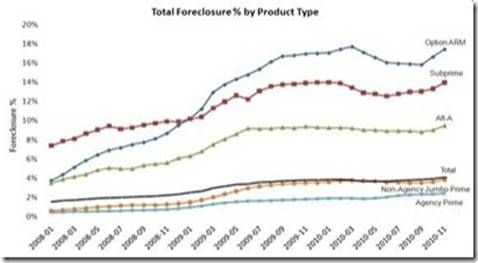
In fact, current delinquency and foreclosure rates of Fannie and Freddie, guarantors of Agency Prime mortgages, are close to the historical norm. Fannie Mae reported that the serious delinquency rate decreased to 4.27 percent in March, close to the long term historical average. This is down from 5.47 percent in March 2010. The Fannie Mae serious delinquency rate peaked in February 2010 at 5.59 percent. Freddie Macclip_image001 reported that the serious delinquency rate decreased to 3.57 percent in April. (Note: Fannie reports a month behind Freddie). This is down from 4.06 percent in March 2010 and Freddie’s serious delinquency rate also peaked in February 2010 at 4.20 percent.

clip_image003

And their foreclosure rates are approaching the 1 percent historical average of all conventional loans. The Calculated Risk graph shows the latest foreclosure rates for all mortgage categories. It may not be surprising that Option ARMs (those with negative amortization that caused the principal loan balance to increased substantially in many cases) have the highest foreclosure rates, even above the Subprimes.

Sadly, Lender Processing Services, Inc. (NYSE: LPS) Mortgage Monitor report shows the number of mortgages 90 or more days delinquent, combined with the foreclosure inventory at the end of June, still totaled 4,073,00 down very slightly from its May 4,084,557 total. It looks like without additional government help, which doesn’t seem likely (see Renae Merle at Washington Post: Obama administration not planning another big housing program), most of those units will be added to the existing home inventory over the next 2 years.

So why doesn’t the Obama Administration spend more of the reportedly $11 billion set aside for the HAMP loan modification program? It may be because Timothy Geithner’s Treasury Department isn’t requiring banks holding the delinquent loans to get them off their books more quickly. And that means not much upside potential for housing prices until when, maybe 2014?

Harlan Green © 2011
Posted in Economy, housing market, Weekly Financial News | Tagged , , , , , , , , , , , , | Leave a comment

It’s Basic Economics, Stupid!

Popular Economics Weekly

What was the reason for Fed Chairman Bernanke’s almost pathetic plea to understand real world economics, in his latest speech at the Atlanta IMF Conference? He said in essence that the Fed is caught between worries about inflation and an economy that is sputtering along. But in fact he was really calling for help!—that he needed help from Obama and Congress to keep economic growth going, because there is still a great danger of deflation than inflation.

If politicians want to obsess over the possibility of future inflation, in other words, then let them tackle the longer term entitlement problems—like Medicare, or foreign wars. But instead they are doing all the wrong things, as are the Europeans. They keep advocating drastic austerity measures while cutting taxes, when that will only depress growth further and expand the deficit (via less tax revenues), not shrink it.

Economic growth has slowed at the moment. But much of this is because of geopolitical uncertainty—the Arab Spring, Mideast oil, the euro bailouts of Greece, Portugal and Ireland, and maybe even our own debt ceiling problem.

But the Federal Reserve’s Beige Book report says most of the U.S. is still growing, retail sales are getting better, consumers and homeowners are paying down debt, and service sector activity in general that provides up to 70 percent of our growth is expanding faster.

Then why the obsession with inflation when it is just gasoline prices that are boosting the CPI index at the moment? Without gas prices the CPI has risen just 1.2 percent in a year. It is the classic battle between creditors and debtors that heats up during recessions. Creditors hate any inflation, since it devalues existing debt. And right now creditors—bankers and other holders of debt on Wall Street—seem to control the agenda. That is why we are hearing cries of austerity and budget cutting–all deflationary measures. Such policies drive down prices, all right, into deflationary spirals such as caused the Great Depression if done at the wrong time—like during this weak recovery.

clip_image002

The best weekly news was the jump in the Institute of Supply Management non-manufacturing (i.e., service-sector) index, which now makes up 70 percent of economic activity. The ISM reported broad month-to-month acceleration in the non-manufacturing economy. The report’s composite headline index rose 1.8 points to 54.6 with strength centered where it should be, that is in new orders which rose more than four points to 56.8.

The ISM employment index also accelerated nicely, up 2.1 points to a 54.0 level that for this report is very strong. In other readings, deliveries lengthened, which is a sign of strength, and backlog orders rose at a healthy pace. Given that this report is based on a broad sampling of the nation’s purchasers, says Econoday, it indicates that economic momentum is headed back up, albeit moderately.

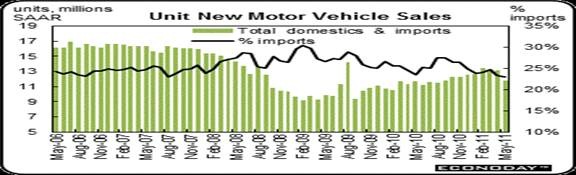
One reason for what looks like a temporary slowdown, is that sales of combined North American-made vehicles and imports dropped to an annualized 11.8 million units from 13.2 million in April.  The North American component declined to 9.1 million from 10.1 million. 

clip_image004

The North American component includes Japanese brands assembled in the U.S. and parts shortages limited supply of many models significantly.  Lack of available Japanese brands pushed up related prices.  This may have convinced many car buyers to wait for the desired model to become available and/or for a lower price, according to analysts.

What is the help that Bernanke’s Fed needs? It can’t do all the heavy lifting, if more fiscal stimulus isn’t forthcoming. A good place to start is forgiving some of the $trillions in delinquent real estate debt incurred during the Great Recession. Real estate is hurting so much because it is estimated 25 percent of home loans are under water—i.e., have more loan than equity in their property. So the quickest way to bring down their debt load—which is holding back consumers spending—is to forgive some amount of the underwater mortgage principal, with some kind of loan modification.

The first quarter 2011 Federal Reserve so-called Flow of Funds report shows just how much is already “forgiven”, in some sense. Much of homeowners’ equity has been lost with so many foreclosures and short sales, of course. But homeowners are also paying down debt in record amounts.

The Fed estimated that the value of household real estateclip_image005 fell $339 billion in Q1 to $16.1 trillion in Q1 2011, from just under $16.5 trillion in Q4 2010. The value of household real estate has fallen $6.6 trillion from the peak – and is still falling in 2011.

In Q1 2011, household percent equity (of household real estate) declined to 38.1 percent as the value of real estate assets fell by $339 billion. A note by Calculated Risk says something less than one-third of households have no mortgage debt. So the approximately 50+ million households with mortgages have far less than 38.1 percent equity – and 10.9 million households have negative equity.

clip_image007

But banks are reluctant to modify loans unless urged by the White House, banking regulators, and/or Congress, even though it is also in their interest to take the delinquent mortgages off their books. And there has been no requirement that mortgage holders/servicers do so, even with the HAMP loan modification program.

Creditors—or rentiers in Europe—were also calling the tune at the beginning the Great Depression in the Hoover Administration. Roosevelt understood this, and instituted inflationary measures by increasing government spending, with regulations that controlled the banking speculation that caused the credit bubble—i.e., highly leveraged bank loans with no regard to risk. It took some inflation to get the economy growing again. In other words, it was the debtors turn to recover, which ultimately brought us out of the Great Depression.

The Roosevelt Administration actually refinanced more than 1 million homes under the Home Owners’ Loan Corporation from 1933-35, with bonds sold to the banks. It also bought many homes lost to foreclosure and rented them back, until they could be sold into the private market. Can we imagine what could be done today with that same political will? One million homeowners then would translate to at least 5 million today, when it is estimated there are no more than 8 million homes in various stages of delinquency. That is, if there is the political will to clean up the real estate mess.

Harlan Green © 2011
Posted in Economy, housing market, Macro Economics, Weekly Financial News | Tagged , , , , , , , | Leave a comment

Where are the Jobs?

Popular Economics Weekly

We know that economic growth has slowed in the first quarter—falling from 3.1 percent growth to 1.8 percent in the second estimate of Q1 GDP growth. But even with slower growth, all sectors are still hiring. And we know there are 3.1 million job openings per the Labor Department’s April JOLT Survey, vs. just 2 million in 2009.

clip_image002

So should we worry about the sharp drop in the Bureau of Labor Statistics’ May unemployment report that said just 54,000 nonfarm payroll jobs were created? Although economists are dismissing seasonal factors such as Tsunamis and tornados; motor vehicles lost 3,400 jobs from the Japanese shutdown of parts factories, 13,000 jobs were lost in ‘nondurable’ goods (retail products, mostly) which could also be attributed to weather factors, and governments shed another 28,000 jobs. State and local governments have now shed 446,000 jobs since September 2008 because of reduced tax revenues.

Calculated Risk gives us the reasons that job creation has slowed but is still growing.

Initial weekly unemployment claims have averaged 425,500 per week in May, about the same as in December 2010 and January 2011. The BLS reported an average of just over 100 thousand payroll jobs added during those two months (although there were some weather issues in January).
• The ISM manufacturing index slowed sharply in May, however the Institute for Supply Management noted: “Manufacturing employment continues to show good momentum for the year, as the Employment Index registered 58.2 percent, which is 4.5 percentage points lower than the 62.7 percent reported in April.” This suggests manufacturers were still expanding their payrolls in May (the regional manufacturing surveys also showed payroll expansion).

As if to counteract the weak jobs report and ISM manufacturing index, the May ISM service sector index just reported broad month-to-month acceleration in the non-manufacturing economy. The report’s composite headline index rose nearly two points to 54.6 with strength centered where it should be, that is in new orders which rose more than four points to 56.8. Employment, in contrast to this morning’s jobs report, accelerated nicely, up more than two points to a 54.0 level that for this report is very strong. In other readings, deliveries lengthened, which is a sign of strength, and backlog orders rose at a healthy pace.

clip_image004

So the jobs picture is still bad for those still looking for jobs, but wages and hours worked are rising. This means more hiring on the horizon. A few examples of regional reports from Calculated Risk: The Chicago PMI reported: “Breadth of EMPLOYMENT expansion softened but remained strong.” The employment index decreased to a still strong 60.8 from 63.7 (above 50 is expansion). And the Philly Fed reported: “Firms’ responses continue to indicate overall improvement in the labor market despite weaker activity …” and the Empire State survey showedThe index for number of employees inched up to 24.7, indicating that employment levels expanded over the month, and the average workweek index rose thirteen points to 23.7, a multi-year high.” (above 0 is expansion).

WSJ Marketwatch also saw a silver lining in the job numbers. Job demand for different sorts of workers is not the same, so certain jobs and industries are more heavily weighted in some markets than others. Meanwhile, with all of the cuts to state and local governments, public-sector openings are lagging private-sector openings, as we said.

The Monster jobs online jobs index also weakened. But “In San Francisco, we have seen robust private-sector hiring, with IT certainly being huge,” said Monster Worldwide Spokesperson Matthew Henson, according to Marketwatch. “When you look at markets like Pittsburgh and Seattle, there’s a healthy mixture of blue-collar and white-collar jobs. Kansas City is seeing large demand for creative and marketing.”

The 10 ‘hottest’ job markets, according to Monster, are:

1. Washington

2. San Francisco

3. Baltimore

4. Minneapolis

5. Cleveland

6. Boston

7. Seattle

8. Orlando

9. Pittsburgh

10. Kansas City

Harlan Green © 2011

Posted in Economy, Macro Economics, Weekly Financial News | Tagged , , , , | Leave a comment

Jobs Create More Growth (Not Tax Cuts)

Popular Economics Weekly

Neither party seems to want to tackle the unemployment problem head on. Why? Conservatives have succeeded in shifting the debate to taming the budget deficit, when any improvement in the deficit depends on creating more jobs. It is not enough to shrink government spending, in other words, because that results in more lost jobs. Nor can the debt load shrink without growing tax revenues—either in absolute terms or as a percentage of Gross Domestic Product— and tax revenues do not grow unless employers hire more employees.

The lack of focus on job creation is unfortunate, as more than 15 million are still looking for some kind of full time work, and the labor participation rate of eligible workers has dropped below 60 percent, 6 percent below the norm. What has created more jobs to date? It has mostly been the manufacturing sector exporting to other countries due to the cheaper dollar exchange rate, and the dollar won’t remain so cheap once U.S. growth kicks into high gear.

Yet domestic spending is finally beginning to grow this year, even though banks are still reluctant to lend and wages and salaries are growing less than 2 percent, as opposed to more than 4 percent during good times. Auto companies have been the biggest booster to domestic spending as they continue to sell more vehicles, which has brought retail sales close to pre-recession levels. And that only happened with the government aid to GM and Chrysler. Government spending has never been the problem, in other words, with trillions of dollars being hoarded in corporations and banks that are not being put to use.

Although a large part of retail sales come from higher gas and food prices, overall retail sales on a year-ago basis in April were steady at 7.6 percent. Excluding motor vehicles, sales were up a year-ago 6.9 percent, compared to 6.8 percent in March. Strength was led by food & beverage stores (up 1.2 percent), nonstore retailers (up 1.0 percent), and miscellaneous store retailers (up 0.9 percent). Leading on the down side were electronics & appliance stores (down 2.2 percent), sporting goods, hobby, book & music stores (down 1.9 percent), and furniture & home furnishing (down 1.1 percent).

clip_image002

Another sign that consumer demand is increasing was the drop in business inventories which lag business sales, indicated by the stock-to-sales ratio which fell another tenth to what is a new record low of 1.23. This reading indicates that inventories are too low. But rising sales point ahead to rising production, rising inventory build, and rising employment as well.

clip_image004

In fact, the softer growth in the first quarter was largely due to a sharp upturn in imports, says Econoday (Import totals are deducted from exports as part of the GDP calculations.), some deceleration in personal consumption, a larger decrease in federal government spending, and decelerations in nonresidential fixed investment and in exports. They were partly offset by a sharp upturn in private inventory investment, as businesses seem to be anticipating more demand growth.

The Bureau of Labor Statistics’ monthly JOLT Survey gives us the best employment picture. It shows a steady increase in Job openings (yellow line in graph) from the low of 2 million in 2009 to 3.1 million in April 2011. The total number of monthly Hires is also above 4 million. It is the positive 200,000 plus average monthly difference in Hires vs. Layoffs plus Quits this year that tells us payroll jobs have been trending up.

clip_image006

In fact, consumer spending, which makes up almost 70 percent of GDP spending, is now leading the recovery as we said last week. This is because personal income is growing again (thanks in part to those manufacturing jobs), up 0.5 percent, following a 0.4 percent gain in February.  And the wages & salaries component also rose a moderate 0.3 percent, softening a little from 0.4 percent in February. 

 clip_image008

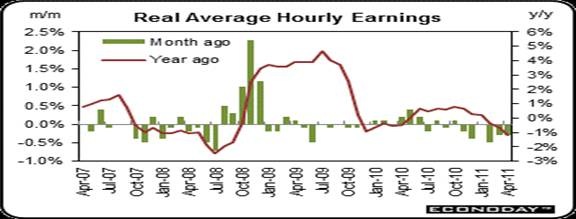
Consumers are seeing some erosion in spending power because of higher food and energy prices—the main reason for higher import totals.  Real hourly earnings are average hourly earnings deflated by the Consumer Price Index. On a year-ago basis, real hourly earnings were down 1.2 percent, compared to down 0.7 percent in March.  Indeed, real wages swing significantly as energy costs rise or fall sharply.  We saw a large gain in real wages in 2008 on the plunge in oil prices but the reverse is currently true.  In recent months, basically, consumer spending has been driven by pent up demand and job growth.  Individual spending power has fallen on average but aggregate earnings are up on higher employment.

The good news may be that as the dollar is appreciating again, consumer spending continues to pick up. So a higher dollar exchange rate while crimping exports, will moderate retail prices—especially oil and gas prices. Will this embolden the private sector to start spending some of their hoarded $trillions? There will be no significant deficit reduction until private investment picks up further. Since the focus on cutting government spending is in full swing, we have to hope that energy and food prices continue to soften, so that consumers can continue to recover.

Harlan Green © 2011

Posted in Economy, Weekly Financial News | Tagged , , , | Leave a comment

The Wrong Budget Debate

Financial FAQs

We are having the wrong budget debate. Washington is not talking about paying down the federal debt, which now totals some $9.5 trillion held publicly. Budget deficits are created when revenues don’t equal spending. So when the focus is only on cutting taxes and public spending by downsizing government and so public services—such as in protecting our health, the financial markets, the environment, education—and not increasing those revenues, then it doesn’t cure our budget problem. In fact, it just aggravates the problem, while putting more people into poverty.

The best example is the last time we had a balanced budget—in 1999. It was a time when Congress agreed to the Pay-as-you-go rules. Spending increases had to be balanced with revenue increases. And only when our economy was booming—21 million jobs were created during those years, and the highest income tax bracket was raised to 39 percent—were there enough revenues to pay down the debt. The debt that had been built during the 1980s by cutting taxes didn’t disappear by cutting spending, in other words.

This is obvious to the average household. Consumers know that, unless they pay down their debts the debt doesn’t go away. They are careful not to accumulate more debts, of course. But the real problem is how to shrink the debt by putting more of their income into paying it down, while spending less. Shrinking their incomes to pay down the debt doesn’t work, period.

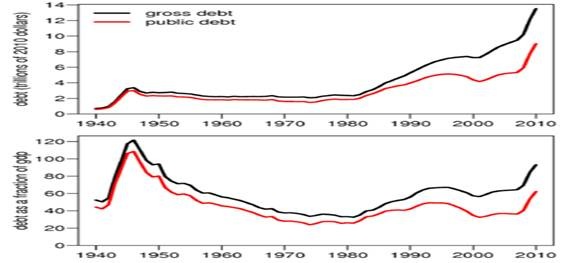
Governments have had to do the same. Our largest public debt as a percentage of the economy was the 120 percent of GDP accumulated from WWII. It took the massive spurt in growth during the 1950s and 60s to pay it down to below 40 percent of GDP in the 1970s. It was accompanied by massive public spending on infrastructure (e.g., highways, education) that raised everyone’s standard of living—not just the wealthiest.

This was paid for by taxing the wealthiest among us, whose top tax bracket was 91 percent under Republican President Dwight Eisenhower. And by raising everyone’s standard of living, our economy prospered since prosperous consumers meant more demand for goods and services, hence more jobs.

The 1920s were a similar period of inequality as we have today. The top 1 percent income bracket controlled 23.5 percent of national income as now, when there was no unemployment insurance, deposit insurance, and social security to protect the savings of average consumers and the elderly.

Roosevelt’s New Deal corrected that problem and brought on the post-war prosperity by guaranteeing that most Americans could prosper.

clip_image002

As of January 2011, foreigners owned $4.45 trillion of U.S. debt, or approximately 47 percent of the debt held by the public of $9.49 trillion and 32 percent of the total debt of $14.1 trillion (that includes the social security trust fund). The largest holders were the central banks of China ($1.1 trillion) and Japan ($885 billion). The share held by foreign governments has grown over time, rising from 25 percent of the public debt in 2007 before the Great Recession.

One would think, therefore, that paying down debt should be the first priority of any U.S. administration. But the debate has been skewed by those who profit most from cutting taxes, without growing public revenues—Big Business, Wall Street, and their investors who have corralled 40 percent of the wealth of this country. It is obvious they care little about the debt, since they advocate cutting public spending without raising revenues needed to pay down the debt.

clip_image004

We know how the current federal debt was accumulated since 2000. The largest percentage—more than $3 trillion—came from the Bush tax cuts of 2001 and 2003, which reduced not only the highest income tax brackets from the Clinton era 39 percent to 35 percent, but reduced long term capital gains and dividend taxes that mainly benefit the wealthy to a maximum 15 percent. Then the Iraq and Afghanistan wars cost another $1 trillion of borrowed money. The Great Recession accounts for most of the rest of the deficit. So all this happened while reducing the income needed to pay for that debt.

Curing the budget deficit is really a common sense matter. We must grow our economy by boosting everyone’s income, in other words, not just that of the wealthiest, while holding our expenses. We did it in the 1990s. That can only happen with increased job formation, and a fairer tax code. Just cutting taxes that funnels money into the pockets of the wealthy, but cuts funding for research and development, programs that develop new talent by nurturing educational opportunities, and a regulatory environment that prevents excessive risk-taking by Wall Street, can only lead to more debt, not less.

Harlan Green © 2011

Posted in Economy, Macro Economics, Weekly Financial News | Tagged , , , , | Leave a comment

The Real Employment Picture

Popular Economics Weekly

Nonfarm payroll employment increased by 216,000 in March, and the unemployment rate was little changed at 8.8 percent, the U.S. Bureau of Labor Statistics reported today. It is a start, but we have a long way to go to have a sustainable recovery. The economy is in recovery mode—both manufacturing and the service sectors are expanding, in other words—but with lots of slack demand and empty facilities yet to fill.

clip_image002

Overall Gross Domestic Product is now back to producing what it did in 2007—that is, with 7.1 million fewer workers. Those unemployed mainly belong to the 80 percent of wage and salary earners who are actually earning less than before the Great Recession—if they even have jobs. The most difficult task will be to find decent jobs for the part timers and long term unemployed—those out of work for more than 6 months—if we are to bring back the sectors still lagging; real estate, construction and their corollary industries (insurance, building supplies, mortgages, etc). Real estate itself has shrunk to about 2 percent of GDP, when it averaged 7 percent over the last decades.

The last three months of job creation averaged about 160,000 payroll jobs per month. That is more than enough to keep up with the growth in the labor force, but it will only push the unemployment rate down slowly. Private payrolls were a little better at an average of 188,000 per month, as state and local governments continued to lay off workers.

In fact, economists say even if we are to maintain a 200,000 per month net job gain, it will still take until 2016 to get us back to anywhere near full employment. The decline in the unemployment rate from 8.9 to 8.8 percent was good news, though the participation rate was unchanged at 64.2 percent. This is the percentage of the working age population in the labor force, and is still below the 67 percent participation rate over the past 20 years.

clip_image002[4]

And so we still have to rely on manufacturing and booming exports for any growth at all. New orders, export orders and backlog orders slowed during March in an otherwise solid ISM manufacturing report. The composite headline index, which got a big lift from a slowing in supplier deliveries and from continued strength in production and employment, edged back only two tenths to a still very strong 61.2 that indicates month-to-month growth in overall activity at roughly the same level as February.

Government jobs fell 14,000, following a 46,000 drop in February.  For the latest month, state & local government declined 15,000 with 9,200 in local government education. The biggest negative in the employment report was for wages. The earnings picture in March is disappointing as average hourly earnings for all workers were flat, matching February. On a year-ago basis, wages were up only 1.7 percent, equaling the February pace, when earnings expand at 3 percent during good times.  Earnings clearly are lagging headline retail (CPI) inflation.

clip_image006

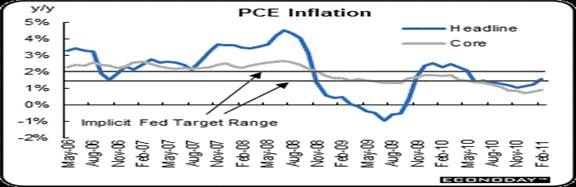
But we are seeing very little overall inflation in overall Personal Consumption Expenditures, even with exploding oil and food prices, which have more to do with the Mideast worries and droughts than longer term demand factors. On a year-ago basis, PCE prices are up just 1.6 percent in February—up notably from 1.2 percent the month before.  Core inflation nudged up to a 0.9 percent year-on-year pace versus 0.8 percent in January, still below the Fed’s target range of 1.5 to 2 percent.

Why so little inflation? Because two-thirds of product costs are labor costs, and incomes are barely keeping up with living expenses, as we said. We will know when there is sufficient demand to push up overall prices, when consumers stop looking for bargains and are willing to pay for higher prices in other than the necessities. And that won’t happen until most of those 7.1 million have found work again.

Harlan Green © 2011

Posted in Economy, Macro Economics, Weekly Financial News | Tagged , , , | Leave a comment

What to do with 30-year Mortgages?

The Mortgage Corner

Are 30-year mortgages a thing of the past? If so, too bad. Much of the debate over the future of Fannie Mae and Freddie Mac revolves around whether their main product—the 30-year mortgage—will disappear if Fannie and Freddie in their current form are dissolved. That would increase the costs (and decrease affordability) of home ownership.

Why the debate? Because 30-year mortgage are considered very risky extensions of long term credit, say privatization advocates, which require some kind of either explicit or implicit government guarantee and regulatory oversight. In other words, banks and other financial entities without those guarantees would want to offer shorter term fixed rate mortgages—say, with 15 to 20 year terms.

This is because shorter term mortgages have less risk, which is why loans tied to the Prime Rate—which can change overnight, and is now at 3.25 percent—offer the lowest rates for home equity mortgages, commercial lines of credit, etc.

The problem, however, is that 30-year amortized fixed rate mortgages provide the least risk to homeowners. A 30-year amortized payment is more affordable versus a shorter amortization term, and borrowers can rely on its fixed 30-year payment schedule to pay down their debt,. Though, in fact, the average life of a 30-year mortgage is seven years due to the mobility of American households.

Everyone agrees that 30-year fixed rate mortgages have made housing more affordable, and has boosted both the homeownership rate, and housing market in general. So the real debate is what to do with Fannie and Freddie, who have become government wards because of the Great Recession. Fannie guarantees some $1 trillion in mortgages, and holds $1.5 trillion in its own portfolio that has not been sold into the secondary market of mortgage-backed securities.

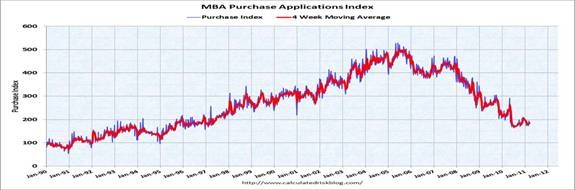
Treasury Secretary Timothy says we must be cautious in winding down their assets—maybe over a ten year period—so as to not flood the markets with too many mortgages, thus devaluing them. Mortgage activity is still low because of the housing bust, and Fannie and Freddie are its main conduits. The four-week moving average of the Mortgage Bankers Association purchase index is still at 1997 levels, and even with the large percentage of cash buyers recently, this still suggests fairly weak home sales through April.

clip_image002

Harvard economics’ Professor Ed Gleaser believes Fannie and Freddie should remain public entities, because if they were privatized, government would step in again, anyway, as they are entities ‘too big to fail’. “I support the public option not out of blind faith in the public sector, but out of profound skepticism toward mixed public-private models, like Fannie and Freddie,” said Gleaser. “The free-market friends of privatizing those entities envision a bold new world where the government no longer stands behind their debt. But if the last three years have taught us anything, it is that the government is not going to sit by and let a major part of the financial system fail.”

Barron’s Magazine has taken the privatization side of the argument in an August 28, 2010 article: “Today, Fannie (ticker: FNMA) and Freddie (FMCC) own or insure some $5.7 trillion of the $11 trillion U.S. mortgage market. Moreover, they provided around 75 percent of the funds flowing into the mortgage market in the past year.

“In a housing conference hosted by Secretary Geithner, there was some agreement that the government should either offer back-stop, catastrophic insurance on all residential mortgage securities, whether bundled by the GSEs, banks and other financial intermediaries,” said Barron’s, “or, perhaps, get out of the insurance game entirely except for affordable-housing investment pools. In other words, there would be no home-field advantage for Fannie or Freddie.“

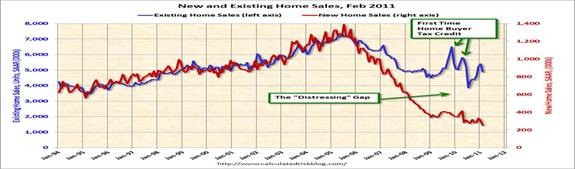
“The reason for their extreme caution? Both new and existing-home sales continue to decline, dropping 16.9 and 9.6 percent, respectively, in February. New-home sales are at a record low in part because of the large number of foreclosures flooding the market.

clip_image004

Whatever happens to Fannie and Freddie, Geithner asserted, they will have a much smaller footprint in the future so as to not pose a systemic risk. Among other things, the Government Sponsored Entities (GSEs) could lose the implicit government backstop on their corporate debt at some point so as to curb any future buccaneering. Or, perhaps, the GSEs would be restricted to buying mortgages or other securities merely for warehousing purposes, in anticipation of creating new mortgage-backed securities.

Harlan Green © 2011

Posted in Economy, housing market, Weekly Financial News | Tagged , , , , | Leave a comment