The Japanese Lessons

Popular Economics Weekly

The Japanese twin disasters—an earthquake plus Tsunami—have highlighted both why Japan’s economy has basically sputtered since its real estate and stock bubbles burst in 1989-91, and why ours is taking so long to recover—we were not prepared for the shocks.

Japan, the country best prepared for natural disasters, wasn’t prepared for a disaster of this magnitude, just as Wall Street believed in a free market ideology that said banks knew enough to avert financial disaster in policing themselves without adequate regulatory oversight.

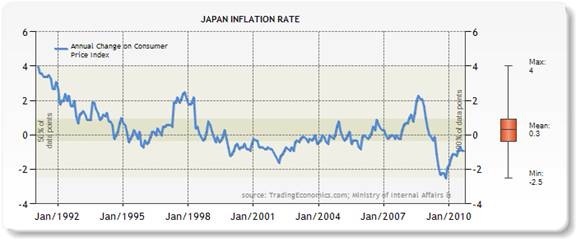
Just so, Japan wasn’t prepared for the bursting of its twin asset bubbles—in real estate and the stock market, when a single property in Tokyo briefly had a higher value than all of Manhattan. The result was real deflation, with prices falling for decades. And both Japan and U.S. wouldn’t put adequate resources to make up for the lost output, which is why our economy continues to sputter along.

In Japan’s case, it was because it chose to spend its monies trying to prop up failed institutions—rather than writing them off—because of the interlocking ownership of banks with corporations with real estate assets (called Keiretsu). So it couldn’t muster enough yen to stimulate more spending by its populace, who did what people instinctively do during recessions, they hoarded their assets in an attempt to keep them from losing value.

Deflation seems to be a puzzle that eludes even many economists. As Nobelist and former World Bank Chief Economist Joseph Stiglitz said recently in a Barron’s interview, “Money that isn’t spent lowers global aggregate demand”—i.e., can’t spur economic growth and so job creation.

And that is exactly what needed to be done. Dr. Stiglitz has called it Hoover economics, in memoriam of our President Herbert Hoover who tightened credit conditions at the beginning of the Great Depression, when he should have made credit easier.

clip_image002

“I am surprised that so many European leaders and some Americans, having seen the disaster of Hoover economics, are still going ahead with austerity,” he said, referring to the push by Germany and Great Britain to pay down their budget deficits. “The evidence is overwhelming that it will lead to an economic slowdown.”

The result for Japan has been an extended Great Recession, with falling prices and wages that has put it now in third place in GDP, according to the IMF, behind the U.S. and Chinese economies. We do know that deflation makes consumers more cautious. They tend to wait for prices to fall further (i.e., be discounted) before buying, whereas during inflationary times consumers react more quickly, thinking prices will be higher if they hesitate. And it is the money they spend, and not save, that circulates throughout an economy that increases aggregate demand.
clip_image004

Deflation, in a word, has been the great fear of Fed Chairman Ben Bernanke, a student of the Great Depression. And so he did not want a repeat of Hoover economics, which is why he has been pumping so much money into the U.S. economy via his various Quantitive Easing (QE) programs that have brought down interest rates on both Treasury Bonds and mortgages.

We have yet to learn the lessons of both the Japanese disasters and our own burst bubbles, according to Dr. Stiglitz. “Bernanke and Greenspan have to bear some responsibility for that ideology that bubbles don’t really exist, and they clearly do.” They weren’t prepared for the financial shocks, in other words. The lesson from Japan’s more recent disasters is that earthshaking events can happen, whether natural or manmade.

Harlan Green © 2011
Posted in Consumers, Economy, Keynesian economics, Weekly Financial News | Tagged , , , , | Leave a comment

More Jobs in 2011!

Popular Economics Weekly

The jobs market is in full recovery mode this spring. March seems to be the month when shoppers begin to shop in earnest and employers are hiring again. Both the service and manufacturing sectors of the economy are surging, labor productivity is high, and retail sales have shot up.

Nonfarm payroll employment increased by 192,000 in February, and the unemployment rate fell to 8.9 percent from 9.0 percent, the U.S. Bureau of Labor Statistics reported today.

clip_image002

December and January payrolls were also looking better. The change in total nonfarm payroll employment for December was revised from +121,000 to +152,000, and the change for January was revised from +36,000 to +63,000. The only real weakness was in government employment, which fell by 30,000. Local governments, many struggling with budget pressure, have cut 377,000 jobs since September 2008.

Retailers cut 8,000 jobs. Payrolls in goods-producing industries rose by 70,000 last month, including 33,000 in manufacturing. The sector has added 195,000 jobs since December 2009.

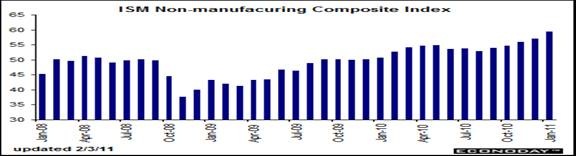
Activity for the bulk of the economy accelerated further in February from an already strong pace, according to the ISM’s non-manufacturing report where the composite index rose three tenths to 59.7. This reading is important because the service sector is two-thirds of U.S. economic activity. Anything above a reading of 50 shows month-to-month growth and because it was above January also shows month-to-month acceleration.

clip_image004

February’s strength is centered in output readings including acceleration for business activity (akin to a production reading on the manufacturing side) and in employment which came in at 55.6 for a more than one point gain and the best reading of the recovery, according to Econoday.

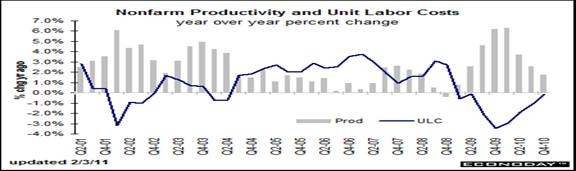
The 2.6 percent increase in Q4 labor productivity also signaled that employee costs are at an all time low (so no inflation danger), while workers productivity is maxed out (why hiring is picking up).

clip_image006

Year-on-year, productivity was up 1.9 percent in the fourth quarter-down from 2.9 percent in the third quarter. This is the most obvious sign that worker productivity—output per worker-hour—is maxed out. It is taking more hours for a single worker to increase output further, in other words.

Overall, the productivity and cost numbers have been favorable toward corporate profits as companies have squeezed more out of workers not laid off during the recent downturn. However, many economists doubt this pattern can continue and firms soon will have to boost hiring to maintain output and revenue gains.

The best sign of increased hiring is in fact state filings of weekly initial claims for unemployment, which has been plunging. Pointing strongly to month-to-month acceleration for payroll gains, initial jobless fell a substantial 20,000 in the February 26 week on top of a 25,000 decline in the prior week. The number of claims, at 368,000, is the third sub 400,000 reading in the last four weeks (note the February 19 week was revised 3,000 lower to 388,000). The four-week average, down 12,750 to 388,500, is the first sub 400,000 reading of the recovery, according to Econoday.

clip_image008

Lastly, though the 4th Quarter GDP economic growth estimate was revised down slightly to 2.8 from 3.2 percent, final demand, its major component including all sales by domestic producers, jumped 6.7 percent. This is a combination of domestic sales and exports, which have also been surging.

clip_image010

We can therefore say that combined with ballooning retail sales—annualized motor vehicle sales have climbed above 13 percent with U.S. companies like GM showing 40 percent sales’ increases, that we are finally in full recovery mode.

Harlan Green © 2011
Posted in Economy, Uncategorized, Weekly Financial News | Tagged , , , , | Leave a comment

Mortgage Delinquencies are Falling

The Mortgage Corner

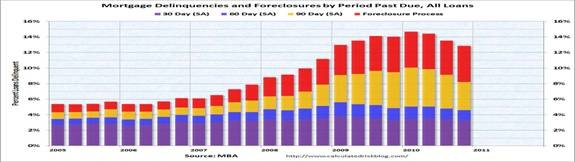
Mortgage delinquencies are declining—the kind that tell us we may be seeing an end to falling real estate prices. That is, there are fewer 30-day late payments, which are the first indicator of trouble leading to short sales and foreclosures. Most 30-day lates do get cured, as it may have been a payment oversight. Payments are usually 60-90 days late before the lender takes notice and may file a Notice of Default; signaling that the 90-day period has started before said lender publishes its Notice of a Foreclosure proceeding.

The delinquency rate for mortgage loans on one-to-four-unit residential properties decreased to a seasonally adjusted rate of 8.22 percent of all loans outstanding as of the end of the fourth quarter of 2010, a decrease of 91 basis points (almost 1 percent) from the third quarter of 2010, and a decrease of 125 basis points from one year ago, according to the Mortgage Bankers Association’s (MBA) National Delinquency Survey.

clip_image002

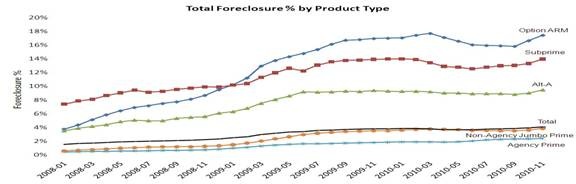
We are really talking about all the liar loans done from 2005 to 2007—the teaser rate Option ARMs, Subprime and Alternative documentation (Alt-A) loans that didn’t require income and maybe asset verification. The so-called Agency Prime (Fannie Mae and Freddie Mac) delinquency rate has always been less than 1 percent, as their qualification requirements have been the gold standard for underwriting mortgages. Not only do income and assets get verified, but also the likelihood of continued employment.

clip_image004

Jay Brinkmann, MBA’s chief economist said “These latest delinquency numbers represent significant, across the board decreases in mortgage delinquency rates in the US.  Total delinquencies, which exclude loans in the process of foreclosure, are now at their lowest level since the end of 2008.  Mortgages only one payment past due are now at the lowest level since the end of 2007, the very beginning of the recession.  Perhaps most importantly, loans three payments (90 days) or more past due have fallen from an all-time high delinquency rate of 5.02 percent at the end of the first quarter of 2010 to 3.63 percent at the end of the fourth quarter of 2010, a drop of 139 basis points or almost 28% over the course of the year.  Every state but two saw a drop in the 90-plus day delinquency rate and the two increases were negligible.”

clip_image006

Unfortunately, Reo, bank-owned properties are still making up 30 percent of home sales. But banks seem to be cooperating more with homeowners in trouble, as the short sales’ percentage of total sales has risen to 5 percent (i.e., those sales where existing lender agrees to cut mortgage principal to make the sale), which has brought down the percentage of foreclosure sales.

“While delinquency and foreclosure rates are still well above historical norms,” said Brinkman, “we have clearly turned the corner.  Despite continued high levels of unemployment, the economy did add over 1.2 million private sector jobs during 2010 and, after remaining stubbornly high during the first half of 2010, first time claims for unemployment insurance fell during the second half of the year.  Absent a significant economic reversal, the delinquency picture should continue to improve during 2011.”

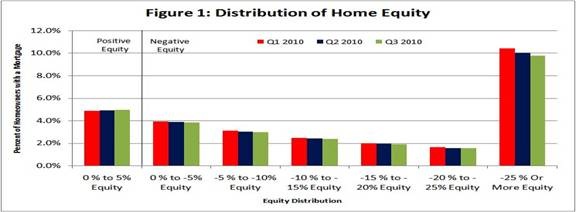
An interesting graph put out by Calculated Risk shows that up to 24 percent of all homeowners with mortgages are underwater, with 10 percent having mortgages which are more than 125 percent of their home’s value. It is this number that has to continue to decline, before the foreclosure rate declines substantially.

clip_image008

We know that it is ultimately the amount of available housing that determines whether housing prices will improve. And the huge number of distressed sales has added to the supply. Though prices have risen from their ‘double-dip’ lows in early 2010, there has to be a substantial drop in that supply—read drop in both foreclosures and short sales—for prices to begin a longer term rise.

clip_image010

So it may take the rest of this year for housing inventory to drop sufficiently to stop the decline in housing prices. Why? It takes a better jobs market to bring down the foreclosure rate, and so housing supply. This is turn boosts housing prices.

Harlan Green © 2011

Posted in housing market, Weekly Financial News | Tagged , , , | Leave a comment

When is Inflation a Problem?

Financial FAQs

Does it seem like the price of everything is rising these days—particularly food and gas prices? It really depends on who you talk to, and this is reviving the age-old debate between deficit hawks and doves. The old saw that inflation is first and foremost a monetary phenomenon was coined in the 1950s. Thank you, Milton Friedman, for the most simplistic formula ever to come out of academia.

Of course, he meant that inflation depended on the amount of money in circulation vs. the amount of goods available to purchase—the most basic Law of Supply and Demand. Wars tend to be more inflationary, because employment is high while much of production is tied up in making guns instead of butter. During recessions such as we just experienced, on the other hand, there is a surplus of goods and deficit of money in circulation. Fewer people are working, in other words, so they can’t buy as much.

And right now we are in a disinflationary trend—which means prices are falling, but there is still some inflation—vs. outright deflation such as Japan is still experiencing, where wages and prices are actually shrinking.

clip_image002

What is making the deficit hawks nervous is that headline inflation—i.e., overall inflation including food and energy prices—has been steadily rising since July, 2010. This is using the Personal Consumption Expenditure price index, which is the best overall measure of domestic prices. But the core rate without food and energy prices hasn’t budged. Why? Because consumers aren’t buying enough of the products and services affected by food and energy prices—such as motor vehicles (though demand for vehicles is rising).

clip_image004

Therefore, the overall inflation trend is still downward. The core rate came in unchanged after edging up 0.1 percent in November. On a year-ago basis, headline PCE prices are up 1.2 percent, compared to 1.1 percent in November. Core inflation eased to 0.7 percent year-on-year versus 0.8 percent in November.

clip_image006

What is happening to interest rates? Longer term rates are rising in tandem with the rising loan demand from consumers and businesses, as evidenced by the Treasury Yield Curve. Employment is picking up, in other words. Approximately 1 million jobs were created last year, of the more than 8 million jobs lost during the recession, and the unemployment rate has dropped to 9 percent from its 9.8 percent high.  But short term rates that control the Prime Rate and mortgage ARM indexes are still close to zero because of the Fed’s QE2 program of buying back Treasury Bonds.

So inflation is still way below the Fed’s ‘implicit’ target range of 1.5 to 2 percent. That is why the Fed wants to continue with QE2. Right now, the emphasis has to be on creating jobs, and keeping the inflation rate from falling further. For, falling prices mean lower profits for employers, which mean shedding jobs rather than adding them.

Then why are food and energy prices rising, if inflation is still low? Firstly, food prices have been rising because of major droughts in Russia, China and parts of Africa; major bread baskets of the world. And energy prices are rising because of rising energy us from the developing countries—including major population centers like China, India, and Brazil.

This means those prices are totally out of Federal Reserve control. In fact, some energy inflation is good because it speeds up incentives to convert to alternative fuels, which means cleaner energy use and less dependence on Middle East oil.

What about our soaring budget deficit? That is the other reason the Fed is pushing down interest rates. Right now, the costs of borrowing are at record lows. Something like just 10 percent of the federal budget goes to interest payments. So raising interest rates would only increase the budget deficit.

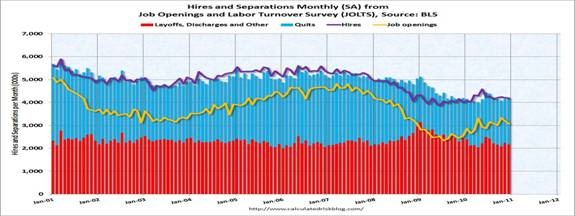
There is more good news on the hiring front. The Labor Department’s latest Job Openings and Labor Turnover Survey (JOLTS) said the number of job openings in December was 3.1 million (yellow line on graph), which was little changed from 3.2 million in November. Since the most recent series trough in July 2009, the level of job openings has risen by 0.7 million, or 31 percent. In December, about 4.162 million people lost (or left) their jobs, and 4.184 million were hired (this is the labor turnover in the economy) adding 20 thousand total jobs. Even with the decline in December, thought, job openings (yellow) are up significantly over the last year.

clip_image008

So there is a connection between inflation and interest rates. Rising interest rates are a sign that more money is in circulation—i.e., the demand for its use is rising. And that is a good thing at present. But inflation is more closely connected to employment, and past history says that inflation only becomes a problem when we get close to full employment—which is in the 6 percent range. That last happened in 2006 at the top of the housing and credit bubbles. And we are a long way from that place today.

Harlan Green © 2010

Posted in Macro Economics, Weekly Financial News | Tagged , , , | Leave a comment

Productivity Soaring–Where Are the Jobs?

Financial FAQs

In spite of Mideast unrest (when was it restful?), and the massive snow job hitting most of the U.S. (the biggest storm of the century?) the output of goods and services continues to improve. Businesses through the fourth quarter made the most of the workers already on payrolls, while resisting any temptation to add new employees to their payrolls. At some point, however, businesses will have to boost hours and hiring to grow, says Econoday, of the latest Labor Dept. release on labor productivity.  Where are those jobs coming from?

clip_image002

Unit labor costs—which make up two-thirds of product costs—are at record lows, which is why corporate profits are soaring while wages and salaries are basically stagnant. Businesses are still keeping a rein on labor costs, in other words. Workers are again producing as much as prior to the recession, but with approximately 7.2 million fewer jobs, according to Barron’s. This is while real compensation per hour adjusted for inflation actually fell 0.6 percent.

Nonfarm business productivity itself rose an annualized 2.6 percent in the fourth quarter after gaining 2.4 percent in the prior quarter. This gain in productivity reflects increases of 4.5 percent annualized in output in the nonfarm business sector and 1.8 percent in hours worked. Annual average productivity is up a whopping 3.6 percent, the highest in this decade.

Meanwhile initial jobless claims, the best predictor of job growth, continued to edge downward offering some hope to the unemployed, but remained above the crucial 400,000 weekly number that signals enough jobs are being created to absorb new entrants to the labor force. A weather-related pile up of claims in the South unwound in the January 29 week which saw initial claims fall a very steep 42,000 to 415,000 (prior week revised 3,000 higher to 457,000).

clip_image004

Alabama, Georgia, North Carolina and South Carolina posted some the biggest declines after the four states posted big increases in the prior week due to snow effects. Distortions always put the emphasis on the four-week average which, unfortunately, is signaling trouble for tomorrow’s monthly employment report. The four-week average is up 1,000 to 430,500 to show a roughly 15,000 rise from a month ago.

So the employment component of the ISM’s non-manufacturing (service sector) survey, a reading that offers a broad measure of labor demand, is more closely watched than ever since the service sector makes up two-thirds of our economic activity. This index jumped nearly two points in January to 54.5, by far the best reading of the recovery and pointing to a positive surprise for tomorrow’s big employment report.

clip_image006

January’s ISM non-manufacturing results are very similar to its report on the manufacturing side released on Tuesday. Gains are wide and convincing led by a nearly 2-1/2 point jump in the headline composite index to 59.4, also a recovery best. Details show especially strong monthly acceleration for new orders, a reading that points to greater acceleration for the broad economy in the months ahead.

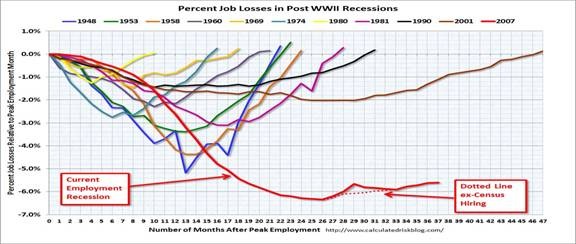
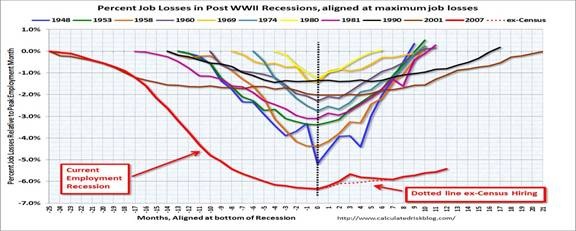
The pace of monthly job losses have slowed dramatically soon after President Obama and Congress enacted the Recovery Act in February 2009, as we have said, but is lagging past recoveries when job growth was as high as 6 percent, vs. the current paltry 2 percent growth rate. The trend in job growth this year has been difficult to discern because of the rapid ramp-up and subsequent decline in government hiring for the 2010 Census (which is now largely over), but private employers added a total of 1.3 million jobs to their payrolls in 2010, an average of 112,000 jobs a month.

clip_image008

The latest unemployment report showed the jobless rate dropping to 9 percent, with 600,000 more jobs added in the Household survey.  The payroll survey said most of those jobs were in manufacturing, in part due to the horrible winter.  Producers are only hurting themselves by hoarding their profits as they are now doing (to the tune of $2 trillion in cash on their books) instead of hiring more workers, as greater employment also means more demand for their products.

Harlan Green © 2010

Posted in Macro Economics, Weekly Financial News | Tagged , , , | Leave a comment

How Do We Boost Economic Growth?

Popular Economics Weekly

There is a tremendous misunderstanding of how to boost economic growth, and this is hurting the recovery. Conservative politicians want to cut taxes and government services, while progressives want to use government to boost growth. Yet it really doesn’t matter who does the boosting. The results are the same.

The best way to understand growth is with a concept used by economists, aggregate demand, that we have mentioned in past columns. Aggregate demand can be thought of as income and assets earned by consumers, private business, the financial sector and government. And it can be either hoarded in mostly MZM accounts (Money at Zero Maturity—i.e., earning 0 interest), as it is now, spent on things, or invested in facilities that produce more things.

Our economy has become seriously skewed during the past 10 years because corporate profits zoomed, while household incomes have not even kept up with inflation.

This is not the column to discuss the whys, including why so much income has migrated to the top 1 percent income bracket. But the result has been that most corporations haven’t invested in their employees. Which is why aggregate demand—the source of economic growth—has suffered mightily.

We know that consumers make up 70 percent of GDP growth, for example. So because their incomes were stagnant, they had to borrow to maintain their standard of living. And because they indebted themselves so heavily while their incomes remained stagnant, most have not been able to boost their spending during the recovery.

So business spending, which makes up the other part of aggregate demand (along with government spending) hasn’t been expanding because of so much excess industrial capacity. We know that excess capacity is still a problem today, as evidenced by the latest industrial production numbers.

Overall capacity utilization is improving, rising to 76.0 percent in December from 75.0 percent in November.  It is at its highest since a reading of 77.9 percent for August 2008, but is still far below the 82 percent long term average.

clip_image002[6]

Industrial production posted a healthy 0.8 percent gain in December, following a 0.3 percent rebound in November.  However, the boost was led by a monthly 4.3 percent surge in utilities output, following a 1.5 percent increase in November.  By market groups, strength was widespread.  Production of consumer goods increased 1.0 percent in December; business equipment, 0.6 percent; nonindustrial supplies, 0.1 percent; and materials, 1.0 percent.

clip_image004[6]

And because most profits have not been flowing back to average consumers, employers are not producing enough to warrant hiring more workers. That is the major reason for the entire government stimulus—to boost aggregate demand. The $787 Billion American Recovery and Reinvestment Act (ARRA) was in fact not enough to bridge the so-called lost output gap between potential and actual GDP growth over the past 2 years. The Fed’s purchase of government securities has held down interest rates, enabling businesses to borrow cheaply, and preventing real estate values from going into free fall.

Then what is the answer on how to create sustainable aggregate demand? The major push should be reestablishing the middle class that has been so decimated by loss jobs and much of its wealth—both in stocks and real estate. New York Times’ David Leonhardt is one of the few pundits to voice this concern in his most recent column, “In Wreckage of Lost jobs, Lost power,” in which he laments the loss of labor’s bargaining power.

Whereas employment in most other developed countries, including Japan and Russia, is much higher than in the U.S., corporate profits are lower. This is because U.S. domestic workers’ bargaining power has been severely diminished, in part because of laws that give employers the advantage in hiring and firing. And Germany and Canada, who barely had a recession, encourage companies to cut work hours for all during slowdowns—called ‘short work’—rather than lay off some, so that the pain of reduced incomes is spread over the entire workforce.

There are many other ways to cure insufficient aggregate demand, such as more progressive taxation. For instance, the top income tier during the Eisenhower years had a 95 percent tax rate on its top income bracket. This had the effect of siphoning off money from the wealthiest who spend the least percentage of their income, and putting it into the more productive use of building infrastructure, such as the interstate highway system, or education, or into more research and development.

Also, a better-run health care system would reduce health costs, which are double per capita in the U.S. vs. other developed countries. This would have several benefits, including increasing the competitiveness of U.S. made products, while boosting workers’ benefits and incomes.

clip_image006[6]

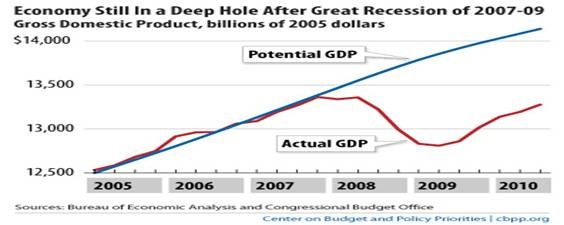
There is still almost $3 trillion in lost output—the difference between actual and potential GDP growth caused by the recession, as we said. But unless we get over the conservative-progressive divide on how to bridge that gap, we won’t be able to generate sufficient aggregate demand that will bring back the jobs and salaries lost during the worst downturn since the Great Depression. U.S. workers don’t care which sector generates their jobs, so neither should politicians.

Harlan Green © 2011

Posted in Macro Economics, Weekly Financial News | Tagged , , , | Leave a comment

Which Deficit is Most Important?

Popular Economics Weekly

All the talk of budget deficits really focuses on the wrong deficit. It is the output deficit of goods and services lost because of the Great Recession that is most important, not the state and federal budget deficit(s), since budget deficits will only be paid down with increased tax revenues that come from increased production.

clip_image002

The Center on Budget and Policy Priorities (CBPP.org) has been tracking the output deficit since the beginning of the downturn, and it shows that overall production (GDP) has now returned to its 2007 level, hence the end of the recovery cycle we have been discussing. But for significant deficit reduction GDP now has to continue to expand to its potential above $14 trillion.

With the latest congressional compromise, analysts are predicting a higher GDP growth rate in 2011—which if true might boost growth to that $14 trillion plus level. The legislation’s extensions of federal unemployment insurance and Obama-era tax cuts for low-income households (i.e., the 2009 improvements in the Child Tax Credit, Earned Income Tax Credit, and college tuition tax credit) — all policies insisted upon by the White House — are a big reason for the increased estimate.

Economist Mark Zandi of Moody Analytics gave the best analysis of the compromise. “The deal’s surprisingly broad scope meaningfully changes the near-term economic outlook. Real GDP growth in 2011 will be nearly 4 percent, approximately 1 percentage point greater than previously anticipated. Job growth will be more than twice as strong, with payrolls growing by 2.6 million. Unemployment will be more than a percentage point lower; instead of hovering near 10 percent through the year, it will end 2011 well below 9 percent.”

In fact, economic growth has been subpar since 2000, with just 5 million jobs created 2000-08 and another 1 million jobs added since January 2010, after the loss of 8 million jobs during the Great Recession.

clip_image004

Most of the budget shortfall has been due to the lost revenues of the Bush tax cuts during the last decade, with military spending adding another $1 trillion, whereas the output deficit comes mainly from lost jobs—8 million from this recession alone, as we said. So the best revenue enhancer would of course be more robust growth. In fact, if GDP growth exceeded 3.5 percent longer term as it has over the last 75 years (i.e., including the Depression), social security would never be in danger of running out of funds. The current projections are based on a long term forecast 2.6 percent GDP average growth rate, which has never happened.

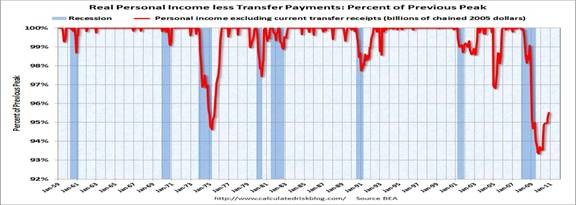
The bottom line is that higher GDP growth increases personal incomes, which began their most recent decline at the beginning of the Great Recession and only started upwards again after it ended in July 2009. Real, after inflation, personal incomes are currently 95.5 percent of the last peak, so demand can’t pick up substantially until consumers’ financial health is restored.

clip_image006

In sum, the best bang for the buck is boosting incomes of the middle and lower classes who were most affected by the Great Recession. Unemployment insurance has been the most effective boost for the 15 million unemployed, followed by the current one year-2 percent income tax cut for all wage and salary earners. Since consumers will no longer be able to rely on massive borrowing from their homes, they will only be able to spend money the old fashioned way, by earning it.

Harlan Green © 2010

Posted in Consumers, Macro Economics, Weekly Financial News | Tagged , , | Leave a comment

Is The Great Stimulus Debate Over?

Financial FAQs

The stimulus debate over what form government aid should take to the recovery is only over for the moment. The headlines tell us both the rich and poorer among us will receive various tax breaks under the Democratic-Republican Party compromise, while businesses will have their research and development (R&D) tax credits extended. This is bound to lead to more hiring, say most of the pundits.

What was the debate about? A hint was the House Democratic majority’s unsuccessful attempt to cut the inheritance tax exemption from $5m to $3.5 million. If the goal is over what gives the most bang for the buck, then it is important to know who will benefit. Economic growth is already back to its pre-recession level (See my Popular Economics Weekly column of this week.).

So the real debate yet to be settled is who will receive most of the benefits of the recovery. The Bush II recovery was fueled by tax cuts for the wealthiest, which brought us a wealth distribution that matched 1928 before the Great Depression. The theory being was that the investor class was in the best position to boost growth.

Alas, that didn’t happen, as just 5 million jobs were created from 2000-08 after the Bush II tax breaks, the lowest since WWII, vs. 22 million jobs created during the Clinton Administration (when tax rates were higher). Why? Incomes were much more eqalitarian then, creating much more demand from the income brackets that do most of the spending.

The solution really isn’t such a puzzle; more like common sense. The wealthiest tend to spend less of their incomes, whereas the middle and lower brackets spend almost all of their incomes. So simple math tells us the more income that flows to the lower income brackets, the more of it gets spent. And it is overall spending that fuels growth in our 70 percent consumer-driven economy.

What do the top income brackets do with their wealth, other than conspicuous consumption? They invest it, in part by lending it back to the rest of us. That happened from 2000-08. The record low interest rates engineered by Chairman Greenspan’s Fed created easy money that allowed the 90 percent income earners to borrow from the wealthiest 10 percent in record amounts. But, as Roosevelt’s Fed Chairman Marriner Eccles said during the Depression, the game ended once those players ran out of borrowed chips.

Though leaving the Bush tax cuts in place for those earning more than $250,000 per year benefits the highest income earners most, the other 90 percent also benefits somewhat with the temporary payroll tax reduction. Adding the 2 percent payroll tax cut lowers revenues to social security, however. The maximum tax drops to 12.2 percent from 14.2 percent, shared equally by employer and employee for salaried workers.

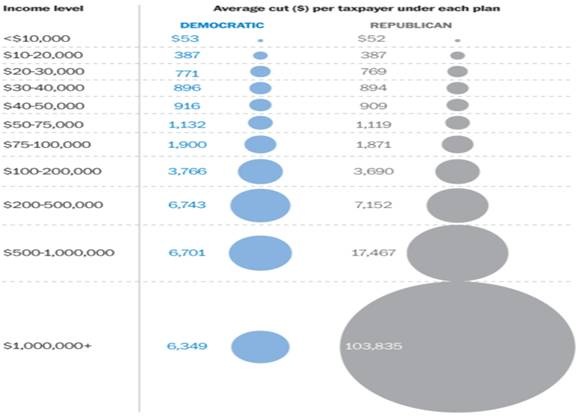
It is basically above the $500,000 annual income level that the Democratic and Republican Parties’ tax proposals differ. Preserving all the Bush II tax cuts boosts tax savings of the $500k to $1million incomes from $6,701 to $17,467 and for $1 million plus incomes from $6,309 to $103,835, a huge jump.

clip_image002

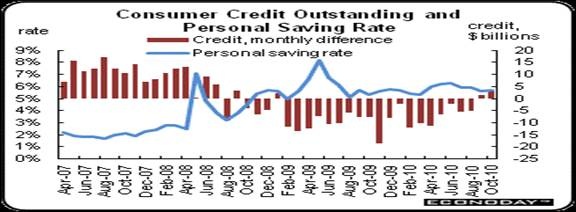
So the tax cut compromise doesn’t give as much bang for the buck as we would like. The strong retail sales report for November points to consumers feeling wealthier in certain areas, however. The latest (October) Federal Reserve consumer credit report showed consumer credit expanded $3.4 billion in October, following a $1.2 billion rise in September.  Outstanding credit has not risen for two consecutive months since mid-2008.  The latest rise was led by a $9.0 billion boost in non-revolving credit, following a $10.1 billion jump in September.  Both months reflect healthy motor vehicle sales.

clip_image004

Revolving credit, a category centered in credit cards, continues to contract, down $5.6 billion in October following September’s $8.8 billion drop. The decrease in revolving credit means consumers are not pulling out the plastic for purchases—disappointing news for retailers.   It also likely is due to continued charge offs by banks of bad loans, conjectures Econoday. 

Basically, consumers are still cautious about spending, maintaining a relatively high saving rate.  With so many of the tax benefits still going to the wealthiest, this means only a moderate pickup in overall consumer spending is sustainable. So it looks like the U.S. public will have to wait longer for a more egalitarian tax structure that both benefits most Americans, and pays our bills.

Harlan Green © 2010

Posted in Weekly Financial News | Tagged , , | Leave a comment

Redistributing Great Wealth (is) The Path to Recovery

Popular Economics Weekly

We are in the deepest economic malaise since the Great Depression. And there is a good reason for it. We also have the greatest maldistribution of wealth since 1928. Researchers are finding that the two—the greatest inequality and greatest downturns—are intimately connected. So restoration of what is in effect our Middle Class, where at one time the majority of wealth resided, would restore both the jobs and financial health to an economy sorely out of balance.

This will not be easy. Witness the vociferous opposition to any restoration of equality—which conservatives label the redistribution of wealth to those less worthy, in their eyes. The current example is Republicans refusal to give up the Bush tax cuts for the wealthiest, which would restore tax rates of the Clinton era when 22 million jobs were created.

The sad fact is that unless we do begin to level the economic playing field, we are fated to experience more boom and bust cycles that will only debilitate the U.S. economy further, and so our standing in the world. And history will continue to repeat itself. Roosevelt’s Federal Reserve Chairman, Marriner Eccles, understood in 1933 the main cause of the Great Depression.

“… a giant suction pump had by 1929-30 drawn into a few hands an increasing portion of currently produced wealth. This served them as capital accumulations. But by taking purchasing power out of the hands of mass consumers, the savers denied to themselves the kind of effective demand (my italics) for their products that would justify a reinvestment of their capital accumulations in new plants. In consequence, as in a poker game where the chips were concentrated in fewer and fewer hands, the other fellows could stay in the game only by borrowing. When their credit ran out, the game stopped.”

Thomas Piketty and Emmanuel Saez among others have documented the disappearance of Middle Class wealth (See Feb. 2003 Quarterly Journal of Economics). The Center for Budget and Policy Priorities (CBPP), a non-partisan think tank, using Piketty and Saez data, verify that income and asset inequality has risen to levels last seen in the 1920s (see graphs).

clip_image002[6]

Income disparities before that crisis and the recent one were the greatest in approximately the last 100 years, according to Harvard Professor David Moss, who is among a small group of economists, sociologists and legal scholars trying to discover if income inequality contributes to financial crises. In 1928, the top 10 percent of earners received 49.29 percent of total income. In 2007, the top 10 percent earned a strikingly similar percentage: 49.74 percent. In 1928, the top 1 percent received 23.94 percent of income. In 2007, those earners received 23.5 percent.

There is no good reason for such wealth disparity, in spite of the severity of this Great Recession. It was a problem that began in the 1970s and only now is catching public attention. An estimated 43.6 million Americans in 2009 were living off incomes below the federal poverty line, or around $11,000 for an individual under 65 or $22,000 for a family of four. The total number, an increase of 3.7 million over 2008, is the largest in 51 years, since the government first started tracking poverty data.

And that is the main reason for the slowness of this recovery. “It’s no coincidence that the last time income was this concentrated was in 1928,” wrote former Labor Secretary Robert Reich in a recent Op-ed. Professor Reich hedges his bets, however. “I do not mean to suggest that such astonishing consolidations of income at the top directly cause sharp economics declines. The connection is more subtle.”

This debate goes back to the Great Depression, as we have said. By effective demand, Eccles was referring to what economists today define as aggregate demand. Eccles was maintaining that the growth in income inequality created a credit bubble that burst and so led to an sharp diminishment in aggregate demand, which is measured today by our Gross Domestic Product.

The relationship is intuitively simple, yet was hard to verify before Piketty and Saez, et.al., did their research. As more income flowed to the top income brackets, middle and lower income classes had to borrow more to keep up their consumption patterns. And the easy credit available with the housing bubble accelerated that borrowing, to the tune of $2.3 trillion extracted from housing in the last decade. But then the excess of supply produced during the bubble caused housing values to crash, losing more than $4 trillion and counting of the $11 trillion in housing assets.

Professor Reich says we have to find ways to raise the wages of working people—the 90 percent who have suffered stagnant wages since the 1970s. Lowering payroll taxes for the lowest income earners who spend most of their incomes, while restoring the Clinton era taxes on those earning more than $250,000 is the most discussed remedy for such income disparity.

In fact, the underlying effects of such income inequality hasn’t been researched at all. But a new book by Professors Jacob Hacker and Paul Pierson, “Winner Take-all Politics”, is beginning to give us a picture of its results.

Publisher Simon & Schuster’s advertising blurb succinctly describes their thesis: “Winner-Take-All Politics—part revelatory history, part political analysis, part intellectual journey— shows how a political system that traditionally has been responsive to the interests of the middle class has been hijacked by the superrich. In doing so, it not only changes how we think about American politics, but also points the way to rebuilding a democracy that serves the interests of the many rather than just those of the wealthy few.”

There is some good news on the wealth redistribution front. Forty billionaires led by Warren Buffet and Bill Gates have pledged to donate one-half of their wealth to philanthropic causes. From Ted Turner to George Lucas, these 40 billionaires joined Warren Buffett and Bill Gates in making the pledge as part of their The Giving Pledge, a campaign launched earlier this year “to urge wealthy individuals to give the majority of their money to charities of their choice either during their lifetime or after their death,” said one headline. If only more of the superrich would follow their example.

Why would they do so? Because it not only helps to build their wealth, but the wealth of those who have lost so much to the wealthiest since the 1970s. This is an economic fact—that greater wealth equality creates more wealth for all—that is increasingly difficult to deny. We are only now becoming aware of the damage that such unequal wealth has wrought to our economy via the excesses of Wall Street and deregulation. It is something that economists weren’t really aware of until Piketty and Saenz did their groundbreaking research.

Harlan Green © 2010

Posted in Keynesian economics, Macro Economics | Tagged , , | Leave a comment

Why Such a Mortgage Mess?

The Mortgage Corner

What is causing the mortgage ‘mess’ to continue, in this case the controversy over ownership of mortgages that is embroiling Wall St. and Washington? Much of it is exaggerated by the media and attorneys for the plaintiffs suing various banks to take back those mortgages packaged and sold as mortgage backed securities. So it is not easy to understand the underlying facts, especially when real estate values have yet to stabilize.

The beginning of the mortgage origination process is fairly straightforward. When a bank, mortgage bank, or other entity originates a mortgage, it is either held by that lender in its “portfolio”, or sold to someone else. Many commercial banks still hold onto their shorter term loans—such as for businesses or construction projects. These are usually due within 5, and so don’t tie up a bank’s capital reserves for a longer period.

But most mortgages are permanent, meaning not due for 15-30 years. These are usually sold onto the secondary market—Wall Street firms who bundle them into mortgage pools that are sold to investors as mortgage backed securities (MBS). Some such securities for the VA/FHA, Fannie Mae, and Freddie Mac (the GSEs), are considered AAA rated, because either guaranteed or insured by the Federal Government. So someone holding a ‘Ginnie Mae’ Certificate knows it has an ownership share in a pool of AAA rated FHA/VA loans on which it receives a percentage yield.

The main ownership problem is that banks in particular may hold on to servicing the loan, even though it has been sold to investors. This means that said bank still collects the payments and passes them on for a fee of usually 3/8 to ½ percent of the loan amount. So if the ownership papers weren’t properly documented to the MBS investors, either servicers or investors may not have clear title to sell or auction the underlying property held as security if the property is foreclosed on.

Another ‘mess’ is if there was fraud involved—i.e., the loan originators didn’t follow their own underwriting guidelines when funding the mortgages. It is hard to believe that is the case, as lenders know they must buy back a loan if fraud—i.e., misrepresentation—is involved. But given the huge number of foreclosures—more than 2 million this year—so-called foreclosure mills in those 22 states who have judicial foreclosures may have taken shortcuts in not verifying all the documentation, or even faking lost documents.

Meanwhile, the delinquencies have declined substantially in 2010, and consumers incomes are improving–indicators that say real estate values may be stabilizing. And that is the bottom line in improving the foreclosure rate. Lenders tend to panic when housing values are falling, and so are quicker to foreclose in order to recoup as much as possible of loan principal.

Calculated Risk cites a report by LPS Applied Analytics that foreclosures leveled off at 3.92 percent, from a 1 percent historical rate and delinquencies at 9.29 percent in October, up from its historical 4 percent rate. So there is a long way to return to normal. Delinquencies began to take off at the beginning of 2007 (i.e., 3+ years ago), so it should take another 3 years to return to historical levels.

clip_image002

Home prices are coming under weakness again due to distressed sales adding to housing supply and tighter credit standards cutting demand, but that may be mainly to seasonal factors. Fewer homes are put on the market and sold during the winter months. The Federal Housing Finance Authority purchase only house price index for homes with conforming loans slipped 0.7 percent in September after no change the month before.

On a year-on-year basis, the FHFA HPI is down 3.4 percent, compared to down 2.8 percent in August. This index is based on resale prices for homes financed or bundled by federal housing agencies (i.e., the GSEs).

clip_image004

The price weakness is reflected in lower new and existing-home sales in October, down 2.2 and 14 percent, respectively. The National Association of Realtors also said the sales drop was mostly due to seasonal factors and tightened lending standards.

“A review of recently originated loans suggests that they have overly stringent underwriting standards, with only the highest creditworthy borrowers able to tap into historically low mortgage interest rates. There could be an upside surprise to sales activity if credit availability is opened to more qualified home buyers who are willing to stay well within budget,” said NAR chief economist Lawrence Yun.

The consumer is making a moderately strong comeback in October in both income and spending. Meanwhile, core inflation is subdued and still too low for Fed comfort. Personal income in October posted a healthy 0.5 percent gain, following no change in September. Income growth topped analysts’ forecast for 0.4 percent increase. Importantly, the wages & salaries component jumped 0.6 percent, following a 0.1 percent improvement the month before.

clip_image006

Household spending also showed strength. Personal consumption expenditures rose 0.4 percent, following a 0.3 percent increase in September. For the latest month, strength was led by a 1.9 percent monthly spike in durables. Nondurables advanced 0.8 percent while services edged up 0.1 percent.

The bottom line? If consumers continue to consume as much as during this holiday season, employers will hire more employees, which leads to more housing sales and higher prices. So we see slow and steady improvement and a return to normalcy in real estate sales and values over the next 3 years.

Harlan Green © 2010

Posted in Consumers, Weekly Financial News | Tagged , , | Leave a comment