The Fed Has Two Mandates—Growth + Price Stability

Financial FAQs

Why has there been so much debate over the Fed’s monetary policy of so-called Quantitative Easing? The simplest answer is that it pits those countries and ideologies that see the world as a zero-sum game—the I Win, You Lose crowd—vs. those who see the world as having enough wealth for everyone, if we would only share more equitably.

In fact, both sides of the debate mirror the Federal Reserve’s twin mandates—encourage maximum growth without excessive inflation. Among the I Win, You Lose crowd are those foreign countries who want to protect their export surpluses—read China, Germany, and Japan primarily—and the wealthiest individuals and creditors (read banks) who want to protect their wealth—i.e., don’t like deficits of any kind because it cheapens the value of their holdings.

Quantitative easing is the Fed’s policy of pushing down interest rates to encourage spending, instead of hoarding. We know that both consumers and businesses are holding onto their cash because of their loss of confidence in those financial institutions that almost brought down Wall Street. Household deposits held in such as banks and money market accounts are up 38 percent to $7.5 trillion over the past six years, according to the Federal Reserve, while banks have excess reserves they are not lending, and corporations more than $1.8 trillion in cash they are not investing.

Bernanke and the Fed Governors are with the Win-win crowd. They maintain that unless we all cooperate, so that the major exporting countries allow their currencies to appreciate, then everyone will be poorer. The U.S. will continue to lose jobs to the cheaper overseas wages of exporting countries, and the exporters won’t divert the resources necessary to develop their own domestic economies.

If China, for example, allowed its yuan to appreciate, goods would be cheaper for its own people, thus raising their standard of living. As it stands today, almost all that is made in China is exported, so China has to worry about inflation, since not enough is produced to satisfy its domestic demand for goods.

“Currency undervaluation by surplus countries is inhibiting needed international adjustment and creating spillover effects that would not exist if exchange rates better reflected market fundamentals,” Bernanke said in a recent speech to the EU.

Chairman Bernanke’s timing may be right. Economic indications have been strengthening going into QE2, gains reflected by two strong back-to-back 0.5 percent gains for the Conference Board’s index of leading economic indicators (September revised from plus 0.3 percent). A wide yield spread continues to be the biggest positive though to a smaller degree given declines underway in long rates, declines triggered and furthered by QE2. A rise in money supply, also related to QE2, is an increasingly significant plus. Another central positive is the factory workweek, strength that is likely to continue given the uplift underway in the manufacturing sector.

clip_image002

A rise in the M2 money supply, meaning money that is actually circulating in the economy, is what fuels growth. Because unless this money is put back into circulation—whether as investments in plants and equipment, or consumer goods and services—economic growth stagnates, as we have said.

But right now the M2 supply has risen just 2.8 percent since April, which is why some inflation indexes are at their lowest level in 50 years—since the Labor Dept. has kept records. And the Fed considers this level to be dangerously close to deflation.

clip_image004

The slow growing money supply is probably why the Personal Consumption Expenditure price index rose just 0.1 percent in September after rising 0.2 percent in August.  The core rate was flat after nudging up 0.1 percent in August.  Year-ago headline PCE inflation held steady at 1.4 percent.  Year-ago core PCE inflation fell to 1.2 percent from 1.3 percent the prior month.  Both series are below the Fed’s implicit inflation target of 1.5 to 2 percent, hence the deflation worries.

So is the Win-Win crowed right? Is there enough wealth for everyone, if we would only learn to share? Dr. Bernanke maintains that those countries who keep their currencies devalued harm their own people, by not allowing them access to a better life. While the developed countries have to increase growth to pay off their debt and find employment for their citizens.

Leaving aside politics, economists such a Robert Shiller believe there is enough wealth for everyone. In his groundbreaking book, The New Financial Order (2003, Princeton U. Press), Dr. Shiller postulates that though incomes are never guaranteed, they can be insured against ones profession. In fact, social security and unemployment insurance are limited examples. If insurance underwriters can calculate the rate of fires for fire insurance, or life expectancy for life insurance, why not that for professions? It is just a matter of accumulating sufficient data, which modern computer technology is now capable of doing. So that an policy can be taken out on one’s earning potential. When it falls below a certain level, insurance payments kick in, as with unemployment insurance.

We even have something that resembles it—the Earned Income tax credit for those earning annual incomes of less than $10,000. European Union countries have developed it even further. We know that enough is produced in the world to feed itself. The question is how to distribute it.

Harlan Green © 2010
Posted in Macro Economics, Weekly Financial News | Tagged , , , , | Leave a comment

QE2 Will Stimulate Economic Growth

Popular Economics Weekly

In a bid to stimulate banks to lend more by increasing their reserves, the Federal Reserve announced QE2 (Quantitative Easing 2). It will be buying up to $600 billion in Treasury securities from banks who hold them. We have no doubt this will kick start economic growth for several reasons. Not least, because there are signs of an additional pickup in both investment and hiring among small businesses.

In a New York Times’ column by Gretchen Morgenson, Ian Shepherdson of High Frequency Economics—noted for predicting the housing bust—sees growth increasing in the small business sector that creates the most jobs, because of a pickup in commercial and industrial bank lending.

And as commercial and industrial lending expands, Shepherdson maintains, it will unleash a pent-up demand among smaller companies for capital equipment, software, vehicles and other goods:

“The depression in small business pretty much explains everything in the weakness of this cycle,” he said. “I reckon in the last cycle they accounted for two-thirds of all new job creation. Not only are they big, they are better job-creation engines than big companies, which are more inclined to do their new hiring offshore.”

The deficit hawks maintain this will stimulate inflation down the road, because it puts too much money in circulation. But in fact buying back securities that banks have purchased from the U.S. Treasury doesn’t directly put money in the pockets of the consumers who spend it. It builds up banks’ cash reserves, which enables them to lend to small, as well as large businesses, as we have said.

Fed Chairman Bernanke downplayed the inflation danger in a recent Washington Post Op-ed: “Our earlier use of this policy approach (QE1) had little effect on the amount of currency in circulation or on other broad measures of the money supply, such as bank deposits. Nor did it result in higher inflation. We have made all necessary preparations, and we are confident that we have the tools to unwind these policies at the appropriate time. The Fed is committed to both parts of its dual mandate and will take all measures necessary to keep inflation low and stable, he said.”

The big news was that October private nonfarm payrolls (excluding government jobs) jumped by 159,000, and September was revised upward to 107,000. With wages and hours worked also increasing, it looks like credit is already expanding. In fact, the $30 billion small business credit bill passed recently will also inject additional liquidity into small businesses.

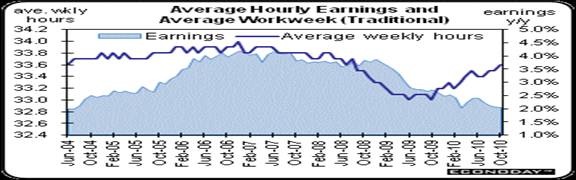
Average hourly earnings gained 0.2 percent in October after rising 0.1 percent in September, while the average workweek for all workers edged up to 34.3 hours from 34.2 hours in October. The workweek has been on a rebound since mid-2009.  Between the gains in temp workers and the average workweek, one should expect a pickup in hiring as these two series typically rise before overall employment.

clip_image002

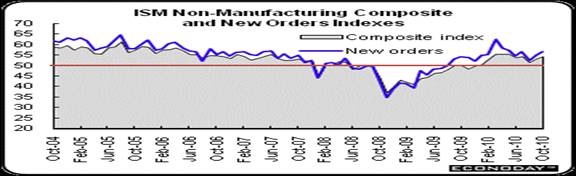
Service sector activity in October —which accounted for 154,000 of the 157,000 private payroll pickup—followed the manufacturing sector surge. So the bulk of the economy picked up steam in October, according to the ISM’s non-manufacturing index which rose 1.1 points in October to 54.3.  This survey of ISM members covers services, construction, mining, agriculture, and forestry.

clip_image004

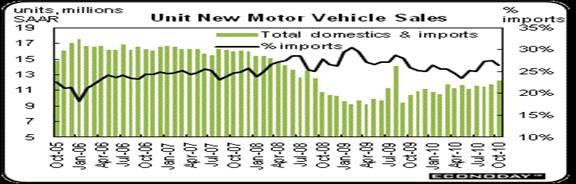
And lastly, motor vehicles sales continued to surge, as all 3 Detroit automakers reported surging profits, with GM on track to pay back its government bailout with an upcoming IPO. Combined domestic and import nameplate autos and light trucks (includes minivans, vans, and SUVs) jumped 4.2 percent to an annualized pace of 12.3 million units. While still below the cash for clunkers recent peak of 14.2 million in August 2009, the October number represents nearly steady growth from the recession low.

clip_image006

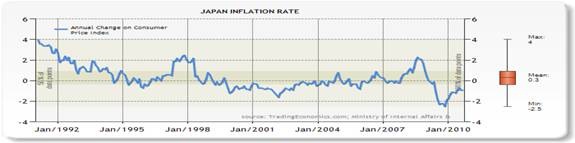
Deficit hawks tend to forget that some inflation is necessary for an economy to grow. The Japanese deflationary experience is crucial to understanding this. That is why the Fed is still in effect easing credit conditions by adding to bank reserves. And why small businesses should be the biggest beneficiaries of QE2.

Harlan Green © 2010

Posted in Consumers, Weekly Financial News | Tagged , , | Leave a comment

Rock Bottom Mortgage Rates Increase Sales

Financial FAQs

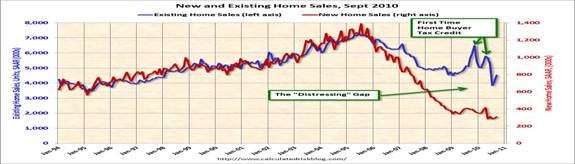
It seems that the lowest mortgage rates since the 1950s are making a difference. New-home sales rose 6 percent and existing-home sales increased 10 percent in September, “affirming that a sales recovery has begun”, said the National Association of Realtors. This can mean interest rates have finally come down to levels that match consumers’ diminished incomes—a vindication of the Fed’s efforts to lower interest rates in their fight against deflation.

Housing starts and construction spending are also beginning to rise, which means housing prices are in the affordable range, in line with lower reduced personal incomes.

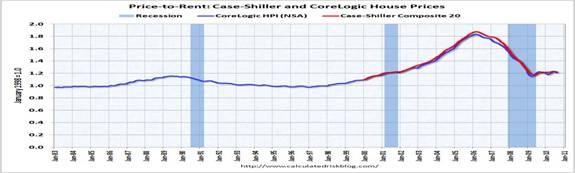
One measure of housing prices not usually reported is the housing price-to-rent ratio that we have discussed in past columns. It is a good measure because rents are more closely tied to actual incomes—and so what households can actually afford—whereas housing prices can fluctuate wildly based on irrational expectations, as we know. So its ratio is a measure of how much prices rise or fall in relation to rents. Today, that ratio has almost declined to historical levels, indicating that housing prices are bottoming out.

clip_image002

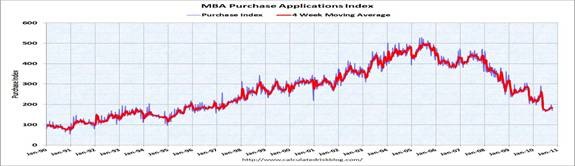
Mortgage purchase applications increased in the latest week, according to the Mortgage Bankers Association, another sign that record low interest rates are spurring purchases. Conforming 30-yr fixed rates are at 4 percent with a 1 point origination fee. The Refinance Index increased 3.0 percent; the seasonally adjusted Purchase Index increased 3.9 percent from one week earlier.

clip_image004

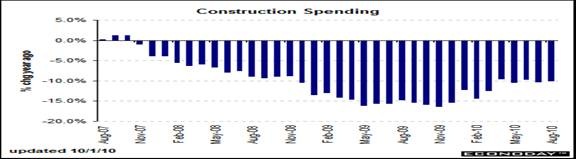
And construction outlays rebounded 0.4 percent, mostly in the public sector, following a revised 1.4 percent decrease in July. The August number was much better than the consensus forecast for a 0.4 percent decrease.

clip_image006

The comeback in August was led by a 2.5 percent boost in public outlays. Meanwhile, private residential spending dipped another 0.3 percent in August, though this number should improve with the uptick in housing starts. On a year-ago basis, overall construction outlays improved to minus 10.0 percent in August from down minus 10.3 percent in July, which means we will probably have to wait until next year’s selling season before construction spending actually turns positive.

clip_image008

Calculated Risk gives us a reason for the decline in construction spending. The tremendous oversupply of existing homes on the market, including bank-owned foreclosures, are depressing prices and undercutting new home sales.

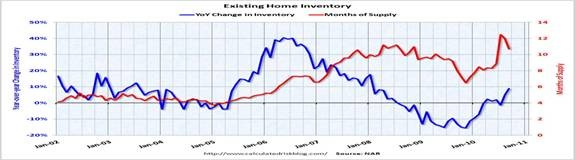
The existing-home overhang increased 8.9 percent in the month, even though months of supply dropped to 11 percent, due to the higher sales rate. “The year-over-year increase in inventory is very bad news because the reported inventory is already historically very high (around 4 million)”, said Calculated Risk, “and the 10.7 months of supply in September is far above normal.”

“Vacant homes and homes where mortgages have not been paid for an extended number of months need to be cleared from the market as quickly as possible, with a new set of buyers helping the recovery along a healthy path,” said NAR chief economist Lawrence Yun. “Inventory remains elevated and continues to favor buyers over sellers. A normal seasonal decline in inventory is expected through the upcoming months.”

clip_image010

And housing affordability conditions today are 60 percentage points higher than during the housing boom, so it has become a very strong buyers’ market, especially for families with long-term plans. “The savings today’s buyers are receiving are not a one-time benefit. Buyers with fixed-rate mortgages will save money every year they are living in their home – this is truly an example of how homeownership builds wealth over the long term,” said NAR President Vicki Cox Golder.

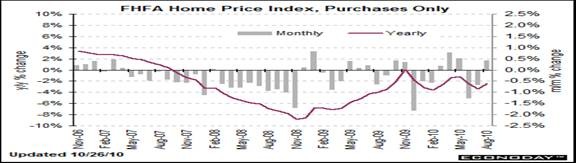
The latest Federal Housing Finance Authority same-home prices for Government agency financed homes—confirm that prices are firming at the lower price levels. The FHFA purchase index actually rose 0.4 percent, after a long string of declines.

clip_image012

The Mortgage Bankers Association asserted that fixed mortgage rates wouldn’t go lower at its annual conference, and in fact predicted they would rise above 5 percent next year, mainly because the MBA sees sales rising—with new-homes sales up 20 percent in 2011 and 40 percent in 2012 to make up for the current lack of new-home inventory.

But this will only happen if the Fed keeps downward pressure on interest rates, such as with their proposed QE2 purchase of more Treasury securities, to keep mortgage rates at such low levels that they conform with consumers’ reduced buying power.

Harlan Green © 2010

Posted in Consumers, Weekly Financial News | Tagged , , , , | Leave a comment

Zero Inflation Won’t Help Economy Grow

Financial FAQs

Fed Chairman Ben Bernanke in his most recent speech said that more Quantitative Easing may be necessary, in order to comply with the Fed’s longer-run sustainable rate of unemployment and the mandate-consistent inflation rate. The longer-run sustainable rate of unemployment is the rate of unemployment that the economy can maintain without generating upward or downward pressure on inflation. .

Bernanke maintained, “The longer-run inflation projections in our Summary of Economic Projections (SEP) indicate that FOMC participants generally judge the mandate-consistent inflation rate to be about 2 percent or a bit below. In contrast, as I noted earlier, recent readings on underlying inflation have been approximately 1 percent. Thus, in effect, inflation is running at rates that are too low relative to the levels that the Committee judges to be most consistent with the Federal Reserve’s dual mandate in the longer run.”

Why such a fear of too low inflation? Because it stymies growth. If prices are stagnant, then so are wages. And stagnant wages mean stagnant consumer spending, which leads to job layoffs in the highly competitive global economy.

clip_image002

Bernanke’s fears are well-known on this subject, as he has studied the lost decades of the Japanese economy, as well as our Great Depression. The Japanese recession and deflationary spiral was caused by the bursting of both its stock market and real estate bubbles. And it has never recovered from the resultant deflation.

clip_image004

U.S. Headline inflation at the consumer level since 2008 is eerily similar. Although September’s positive retail sales report should have made the Fed happy, the CPI numbers will have the Fed still worried about inflation being too low. Year-on-year, overall CPI inflation slipped to 1.1 percent (seasonally adjusted) from 1.2 percent in August. The core rate in September edged down to 0.8 percent from 1.0 percent the prior month. The core year-ago pace is the lowest since February 1961 when it stood at 0.7 percent.

clip_image006

The downtrend in the core has been heavily dependent on low inflation or even deflation for the shelter component as fallout from the depressed housing market. On an unadjusted year-ago basis, the headline number was up 1.1 percent in September while the core was up 0.8 percent.

A good sign for growth is that overall retail sales in September advanced 0.6 percent, following a 0.7 percent gain in August (revised up from 0.4 percent) and a 0.5 percent increase in July (previously 0.3 percent). Although auto sales led a September gain, strength is broad based.

clip_image008

The gain in September was led by motor vehicle sales and electronics & appliance stores, up 1.6 percent and 1.5 percent, respectively.  On a positive note, there actually has been notable improvement in housing related components with furniture & home furnishings and building materials & garden equipment rising for three consecutive months.

The bottom line is that rising inflation is a sign of rising demand, whereas falling inflation—or deflation—is a sign of stagnation, or recession. The Fed is accomplishing two immediate objectives by keeping interest rates at rock bottom. The cheaper dollar stimulates exports and so jobs in domestic export industries such as aircraft, at the same time subsidizing record low mortgage rates, thus stabilizing home prices. We hope that businesses get the message. It is better for them to invest in the potential for growth than sit on hoards of cash earning zero interest.

Harlan Green © 2010

Posted in Consumers, Weekly Financial News | Tagged , , , | Leave a comment

When Will Hiring Improve?

Financial FAQs

All eyes are focused on the jobs market as September’s unemployment report showed progress in private hiring, but a loss of 50,000 education jobs, as states and local governments sliced more than 159,000 jobs off their payrolls. When will it get better?  On the positive side, national private nonfarm employment continued to rise, advancing 64,000 in September, following a revised increase of 93,000 the prior month.

Private service-providing jobs gained 86,000 after an 83,000 increase in August.  The rise was led by a 38,000 boost in leisure & hospitality jobs.  Other increases were scattered by category.  Temp help services advanced another 17,000 after gaining 18,000 in August.  This category typically is a leading indicator for permanent job hires or layoffs but companies are still more skittish than usual about adding permanent positions.

clip_image002

The jobs deficit from this recession is much larger than those in previous recessions.  The economy would have to create an average of over 300,000 jobs a month for two years just to return to the December 2007 level of employment — and even more to restore full employment, since the population and potential labor force are now larger. Most forecasters expect the economy to grow much more slowly than that, especially as the stimulus from the Recovery Act winds down.

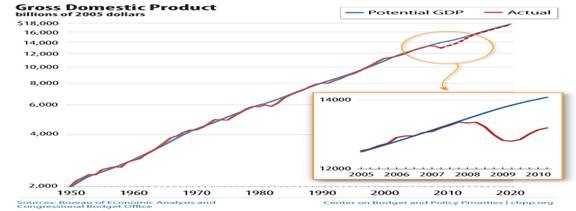
Why is job formation so slow, when record corporate profits and a stock market rally pushing the DOW above 11,000? It has to do with the so-called “output gap” between potential and actual economic growth (measured as Gross Domestic Product, or GDP), which can be self-perpetuating without fiscal or monetary stimulus. The Great Recession has the greatest output gap since the 1930s, in part because of the busted asset bubbles, which reduced asset values without reducing debt.

clip_image004

In the second quarter of 2010, the demand for goods and services (actual GDP) was about $890 billion (7 percent) less than what the economy was capable of supplying (potential GDP) said the nonpartisan Center on Budget and Policy Priorities. This large output gap, which is manifested in a high rate of unemployment and substantial idle productive capacity among businesses, is the legacy of the Great Recession. Congressional Budget Office projections show the gap closing slowly over the next several years as actual GDP grows only moderately faster than potential GDP.

The real issue is how to stimulate that demand, which is the sum of consumer spending, private and public investments and net exports, as we have said in past columns. Since many consumers are tapped out, and businesses are waiting to see if there is any demand for their goods and services, government has to step in with investments—either by hiring more people, or investing in infrastructure, or in education and research.

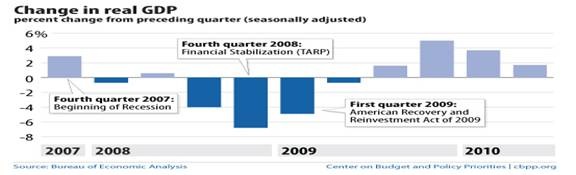
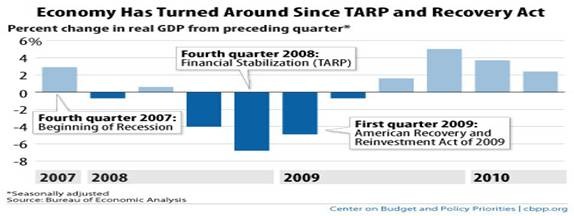
And stimulus spending does work. The problem is there isn’t enough of it to bridge the $trillions in lost output since 2008. Paul Krugman once estimated that up to $6 trillion in stimulus spending was needed. Government has maybe $3 trillion to date in direct spending, including ARRA and TARP programs, along with total Federal Reserve securities’ purchases to keep interest rates at record lows. The Congressional Budget Office estimates the stimulus has created or saved up to 3 million jobs to date, which means it has kept the unemployment rate from climbing even higher.

clip_image006

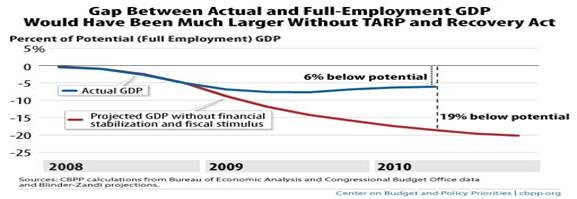
It is not possible to know for sure what would have happened if policymakers had not responded to the economy’s problems with significant financial stabilization and fiscal stimulus measures. However, Former Federal Reserve Vice Chairman Alan Blinder and Mark Zandi of Moody’s Economy.com have done an econometric analysis which finds it would have been far worse with no policy response.

clip_image008

Blinder and Zandi say, the government’s policy response “probably averted what could have been called Great Depression 2.0.” They estimate that without TARP and the Recovery Act, GDP would have been nearly $1.4 trillion (in 2005 dollars) lower in the second quarter of 2010 than it actually was.

clip_image010

The question still is when that gap will be closed. One clue is the behavior of consumers. They are saving more while paying down debt in record amounts, so that debt-to-household income levels have dropped substantially. And, with wages and salaries increasing—which make up 80 percent of personal incomes—this should mean better growth and hiring prospects in the New Year.

Harlan Green © 2010
Posted in Weekly Financial News | Tagged , , | Leave a comment

Pending Sales Show Housing Improvement

The Mortgage Corner


The NAR’s Pending Home Sale Index, a forward-looking indicator of existing-home sales, rose 4.3 percent to 82.3 based on contracts signed in August from 78.9 in July. The data reflects contracts and not closings, which normally occur with a lag time of one or two months.

The NAR’s chief economist Lawrence Yun said the latest data is consistent with a gradual improvement in home sales in upcoming months. “Attractive affordability conditions from very low mortgage interest rates appear to be bringing buyers back to the market,” he said. “However, the pace of a home sales recovery still depends more on job creation and an accompanying rise in consumer confidence.”

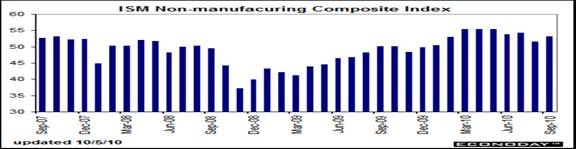
Job creation was helped by the latest Institute of Supply Management’s service sector index, which showed month-to-month strength in September, an important indication for second-half economic growth. The ISM’s non-manufacturing composite rose more than 1-1/2 points to 53.2, right in line with the year’s trend which is 53.6. New orders had been slowing but picked up nicely, 2-1/2 points to 54.9.

clip_image002

The employment index in particular picked up 2 points as did supplier deliveries, while both new export and import orders soared, with export orders up a whopping 12 points in the index. A significant slowing in delivery times is a definitive sign of strength in this report, at 55.0 for the highest reading in more than two years. The non-manufacturing sector shows plenty of activity, in other words, news that should boost September’s employment report.

clip_image004

Another boost could come from consumers. Despite sluggish job growth, the combination of modest growth in average hourly earnings, private employment, and steady or firming weekly hours is gradually boosting wages and salaries—at least in the private sector.  Personal income in August advanced a healthy 0.5 percent, as we said last week, following a 0.2 percent rise the month before and beating the market estimate for a 0.3 percent rise.

Does the increase in pending home sales mean prices will stabilize? The S&P Case-Shiller (same) Home Price Index was still positive, but not as positive as in the spring, before the April expiration of the homebuyers’ tax credit.

clip_image006

The unadjusted data show strength, up 0.8 percent for the composite 10 for a fourth straight solid gain. But seasonal patterns play a big role in home prices and summer is a seasonally a busy time for the market with higher demand providing some lift for unadjusted prices.

The Pending Home Sale Index declined 2.9 percent in the Northeast to 60.6 in August, while it rose in all other regions. It rose 2.1 percent in the Midwest increased 6.7 percent in the South to an index of 90, and rose 6.4 percent in the West.

Will an improving economy boost employment? The signs are there, with falling labor productivity in Q2 indicating the existing workforce cannot produce more, and real estate showing a bit of life, in spite of the foreclosure backlog. It really looks like RE prices have bottomed out—in fact have been stuck in a range for more than one year—since May 2009, according to Case-Shiller.

So there is no reason for homebuyers to put off buying. It looks like employers are at least willing to boost the incomes and benefits of those 90 percent who are employed, in return for their longer hours.

Harlan Green © 2010

Posted in Weekly Financial News | Tagged , , , | Leave a comment

The Recession is (Really) Over

Popular Economics Weekly

The Great Recession is officially over. We really can breathe a sigh of relief—even though job formation is just now picking up, while major segments are still stagnating; such as real estate, and motor vehicle production. But stocks continue to rally, manufacturing is recovering, and exports are soaring.

The National Bureau of Economic Research (NBER), a non-profit panel of leading economic professors, said it actually ended in June of 2009, which is where this columnist saw it ending, as that was when overall output began to pick up.  But that is small comfort to those still out of work.

The announcement is still good news, as it may cancel out the pessimists who say we are still in a recession, or those who say we must begin to cut the deficit when the private sector isn’t yet creating enough jobs. And that will make a difference to consumers, most of who know little about economic signs, and so have to rely on their basic optimism or pessimism about future prospects in making their financial decisions.

The NBER said its determination of the recession’s end does not mean the U.S. is now healthy.

“In determining that a trough occurred in June 2009, the committee did not conclude that economic conditions since that month have been favorable or that the economy has returned to operating at normal capacity, NBER said. “Rather, the committee determined only that the recession ended and a recovery began in that month.”

It was an 18-month recession, the longest in fact since the 1929-33 first Great Depression, which lasted 43 months. This is why the economy is taking so long to recover. In other words, it began to contract in December 2007, the official beginning of the recession, and the contraction ended in June 2009.

That is probably the reason the press release of the Fed’s Open Market Committee (FOMC) latest meeting hinted at more credit easing in the fall, as it sees a danger of actual deflation, rather than lower inflation. Deflation is the danger most feared by economists at present, since lower prices also mean stagnant economic growth as well.

“Measures of underlying inflation are currently at levels somewhat below those the Committee judges most consistent, over the longer run, with its mandate to promote maximum employment and price stability”, said the release.

The “somewhat below” language is in contrast to “measures of inflation have trended lower” in the previous statement, said Econoday. With inflation below the Fed’s implicit inflation target, the Fed appears to be stating that inflation is too low, which was the case in 2002, when the Fed was faced with the same dilemma. So the Fed is saying that the deflation risk is higher than the re-inflation risk and the door is now open to additional quantitative easing.

Why is some inflation important? It would mean there is sufficient demand for products and services to warrant expanding production, which means consumers are willing to increase their spending, in a word. Decades-long deflation is why the Japanese economy is no longer the Asian Tiger, with China taking its place as the world’s second-largest economy behind the U.S.—at least on paper.

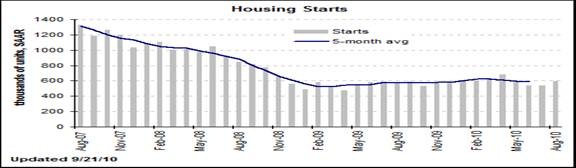
There was some good news on the housing front, which could signal that the housing bubble is finally bottoming out. Housing starts in August jumped 10.5 percent after rising a modest 0.4 percent in July. The August annualized pace of 598,000 units clearly topped analysts’ expectations for 550,000 units and is actually up 2.2 percent on a year-ago basis. The gain in August was led by a 32.2 percent surge in multifamily starts, following a 36.0 percent increase in July. The single-family component rebounded 4.3 percent after dipping 6.7 percent in July.

clip_image002

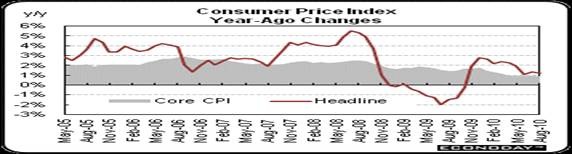
The August Consumer Price Index reading confirms why the Fed is concerned about deflation. Year-on-year, overall CPI inflation slipped to 1.2 percent (seasonally adjusted) from 1.3 percent in July. The core rate in August was steady at 1.0 percent. These numbers are well below the bottom of the Fed’s implicit target range for inflation of 1-1/2 to 2 percent for the PCE price index, which this writer believes should be raised to 2-1/2 to 3 percent to encourage higher salaries—which are two-thirds of product costs, as we have said.

clip_image004

So will the latest news lift consumers’ spirits? Firstly, prices have to stop falling, so that employers will be encouraged to hire. That is why further stimulus measure are so important. We cannot afford to repeat Japan’s experience, and so lose our place as the world economic leader.

Harlan Green © 2010

Posted in Weekly Financial News | Tagged , , , | Leave a comment

The Jobs Are Coming

Popular Economics Weekly

The August unemployment report supported both sides of the stimulus debate. Democrats said it showed more stimulus was needed, while Republicans said employers were holding back because of too much government—too many regulations and a soaring deficit meant higher taxes down the road.  Yet jobs are returning, in spite of the political gridlock. But with all the doom and gloom, one has to look closely at the numbers to see this.

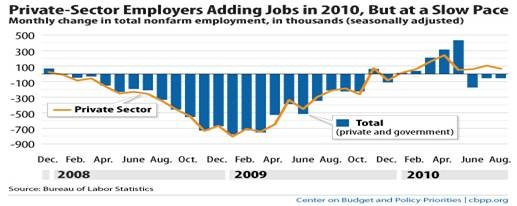
Overall payroll employment fell 54,000 for the third straight month in August, though there was a moderate gain in the private sector, with private job hiring rising 67,000. Also on the positive side, wages were up. And the companion Household Data survey that actually computes the unemployment rate (9.6 percent) showed 886,000. additional “private wage and salary workers in all nonagricultural industries except private households”. And the May-August monthly average of 285,000 was only slightly down from the January-April average of 328,000. It tracks the self-employed as well as payroll workers, hence may be a more accurate measure of employment.

In fact, there is no evidence that a fear of higher taxes (for the wealthiest) deters employers or consumers. More than 23 million jobs were created during the Clinton years, when tax rates for the wealthiest were higher.  This brought the unemployment rate below 5 percent and the first budget surplus in a generation by 1998. Everyone is hewing to their ideological lines during this election year, in other words, regardless of the realities.

clip_image002

The realities are that employers are trying to squeeze maximum profits from their existing workforce, but that is no longer working. The best evidence for this is the latest labor productivity report that indicated very little additional output was coming from the existing workforce while labor costs were rising. Ergo, workers want more pay and benefits for even a small additional increase of output. And so employers must begin to hire more workers, if they want to keep their productions costs down.

Average hourly earnings improved to 0.3 percent from up 0.2 percent in July. The August number topped the market estimate for a 0.1 percent gain. The average workweek for all workers was unchanged at 34.2 hours in July. The market forecast was for 34.2 hours.

clip_image004

But incomes are still barely rising, which is hurting demand for more goods and services. Due to the slowdown in output and businesses already having cut labor costs to the bone, productivity fell notably in the second quarter. Nonfarm business productivity declined an annualized 1.8 percent in the second quarter after a 3.9 percent advance in the prior quarter.

Unit labor costs (i.e., costs per worker) rebounded an annualized 1.1 percent in the second quarter, following a drop of 4.6 percent in the first quarter. Year-on-year, productivity was up 3.7 percent in the second quarter-down from 6.3 percent in the previous quarter. This is still a good number, and way above the longer term 2.5 percent productivity growth average.

So where and when will employers hire enough workers to begin to bring down the current 9.6 percent unemployment rate? They would have to more than double current numbers—to 125-150,000 new payroll jobs per month just to keep up with new workers entering the jobs market, according to the Establishment payroll survey.

Both the manufacturing and service sectors are still expanding, per the Institute of Supply Management (ISM), with manufacturing activity up most in the August survey. Private service providing jobs rose 67,000 after a 70,000 boost in July, with a 45,000 boost in education & health services, and health care is up 40,000. Goods-producing jobs were unchanged in August after a 37,000 advance in July, but that will probably also rise next month, with the new ISM data.

So we know that employers will begin hiring again, with the continued growth in both sectors, but without rising wages it won’t boost economic growth. More stimulus is needed, such as better social safety net programs for those who have to accept jobs for lesser pay during recessions—which is one reason demand has fallen so sharply during this recession?

One suggestion from former Labor Secretary Robert Reich is an “earnings insurance” that will pay the difference between old and new salaries for 2 years, similar to Germany’s, which has kept their unemployment rate around 8 percent. It would be cheaper than extended unemployment insurance, he maintains, and put more people back to work.

The bottom line is as Professor Reich says in his most recent New York Times op-ed—income inequality today equals that of 1928. And in both 1928 and 2008, the richest 1 percent of American households took in 23.5 percent of total income, whereas it was just 9 percent in the 1970s. The median (i.e., middle class) male worker earns less today when adjusted for inflation that he did 30 years ago. No economy can grow unless we bring back the middle class, in other words.

Harlan Green © 2010
Posted in Uncategorized, Weekly Financial News | Tagged , , | Leave a comment

When Will Real Estate Recover?

The Mortgage Corner

Ah, that is the $64,000 question we have been asking since 2008, when housing imploded. Where are conditions improving, if anywhere? The Fed announced it would continue to hold down interest rates, and loan modifications are helping to cut into the foreclosure inventory, which has declined slightly from its highs.

The S&PCase-Shiller same-home price index, the best measure of price changes, rose in 19 of its 20 metropolitan areas in May, with San Francisco,San Diego, Minneapolis, and Los Angeles most improved. Prices in its 10-city index rose 5.4 percent, and 4.6 percent in its 20-city index. But in spite of 3 consecutive monthly increases, S&P said prices were still moving sideways—which probably means they expect prices to decline in June and July after expiration of the tax credit deadline.

clip_image002

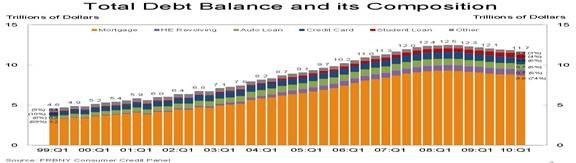
Prices have stabilized, in other words, but consumers are not yet convinced that the jobs picture will improve. So consumers continue to pay down mostly mortgage debt, says a New York Fed quarterly report on household debt and credit.

“Aggregate consumer debt continued to decline in the second quarter, continuing its trend of the previous six quarters,” said the report. “As of June 30, 2010, total consumer indebtedness was $11.7 trillion, a reduction of 6.7 percent from its peak level at the close of 2008Q3. Excluding mortgage and HELOC balances, consumer indebtedness fell 1.5 percent in the quarter and, after having fallen for six consecutive quarters, stands 8.4 percent below its 2008Q4 peak.”

clip_image004

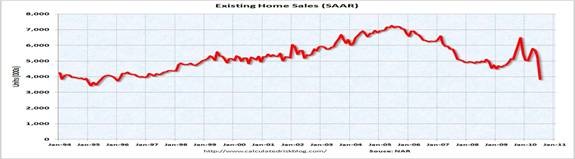
This has not helped new and existing-home sales, also recovering from expiration of the first-time homebuyer’s tax credit. Existing-home sales, which are completed transactions that include single-family, townhomes, condominiums and co-ops, dropped 27.2 percent to a seasonally adjusted annual rate of 3.83 million units in July from a downwardly revised 5.26 million in June, and are 25.5 percent below the 5.14 million-unit level in July 2009.

Sales are at the lowest level since the total existing-home sales series launched in 1999, and single family sales – accounting for the bulk of transactions – are at the lowest level since May of 1995, but actual totals are still lower than one year ago.

clip_image006

To put that number in perspective, according to the NAR, existing-home inventories increased to 3.98 million units in July from 3.89 million in June, piling up because of the lower sales rate. But the all time record high was 4.58 million homes for sale in July 2008, so inventories have actually declined 1.9 percent year-over-year. Inventory is therefore very much dependent on the sales’ rate.

clip_image008

So there are some signs of improvement. The latest Federal Reserve survey of Senior Loan Officers also indicated an easing of credit requirements for both residential and commercial loans over the past quarter, the first easing since 2008.

And delinquency rates are declining, according to the Q2 Mortgage Banker’s Association report. The seasonally adjusted delinquency rate stood at 5.98 percent for prime fixed loans (which make up some 60 plus of outstanding loans), 13.75 percent for prime ARM loans, 25.19 percent for subprime fixed loans, 29.50 percent for subprime ARM loans, 13.29 percent for FHA loans, and 7.79 percent for VA loans.

clip_image010

What is obvious is that the percentage of 90 day-late payments and foreclosures is increasing as a share of total delinquencies as lenders speed up the process of modifications and foreclosures to get delinquent loans off their books. The percentage of loans on which foreclosure actions were started during the second quarter was 1.11 percent, down 12 basis points (0.12 percent) from last quarter and down 25 basis points from one year ago.

The delinquency rate includes loans that are at least one payment past due but does not include loans in the process of foreclosure.  The percentage of loans in the foreclosure process at the end of the second quarter was 4.57 percent, a decrease of six basis points from the first quarter of 2010, but an increase of 27 basis points from one year ago.

“Consumers rationally jumped into the market before the deadline for the home buyer tax credit expired, said NAR economist Lawrence Yun. “Since May, after the deadline, contract signings have been notably lower and a pause period for home sales is likely to last through September,” he said. Even with sales pausing for a few months, annual sales are expected to reach 5 million in 2010 because of healthy activity in the first half of the year. To place in perspective, annual sales averaged 4.9 million in the past 20 years, and 4.4 million over the past 30 years,” Yun said.

Since sales’ statistics are notoriously imprecise (with ± 15 percent error), we can say that real estate sales have been treading water after an initial sales spurt in 2009, though existing-home prices actually increased 0.7 percent in July, indicating that expiration of the tax credits caused most of the sales’ decline in the lower-end of the market.

The bottom line is that banks seem to be finally committed to cleaning the bad loans off their books. This will probably keep prices from rising in the short term. But it will also enable them to reduce their loan loss reserves and so ease credit conditions for home buyers further, thus reducing inventories and boosting sales further.

Harlan Green © 2010
Posted in Uncategorized, Weekly Financial News | Tagged , , | Leave a comment

Beware of Extraordinary Times

Popular Economics Weekly

Yes, Beware of Extraordinary Times is a much used saying these days.  It also applies to the extraordinary polarization of ideas in the economics profession at present. This is an election year, of course, which has distorted the debate on economic recovery.

We know that debt is bad, for instance, but borrowed debt is worse, says Alan Greenspan. So allowing some of the Bush-era tax cuts to expire may be a good thing, since those tax cuts reduced revenues while increasing the budget deficit. And the truism that one has to spend money to make money applies to government as well as the private sector. The just-ended Great Recession required government to borrow huge sums of money to make money—i.e., just to keep the U.S. economy afloat.

Government stepped in because the private sector downsized, shedding more than 8 million workers and shutting down whole sectors of the economy—both small businesses and large, from autos to airlines.

So it should be a no-brainer that government and the private sector need to find better ways to work together, rather than participating in the demonization that has caused such an extraordinary polarization of ideas—all government is inept, for instance, and all capitalists selfish and greedy. One area that both sectors should agree on is how to stimulate the demand that grows an economy. And right now there is little agreement on how to simulate economic growth.

Conservatives maintain we must pay down debt, and decrease government spending to stimulate economic growth—private business lives in eternal fear of debt and so won’t choose to expand when they worry about higher debts and future inflation, they say. While so-called liberals (who were at one time Eisenhower Republicans) believe that without government intervention during recessionary times, economies will stagnate and unemployment remain unacceptably high.

But in fact both government and the private sector are a part of what is called aggregate demand, the demand that stimulates economic growth. It is a relatively simple formula:

clip_image002

Where aggregate demand is AD,

    • clip_image001is Investment,
    • clip_image002is Government spending,
    • clip_image003[4]is Net export,
      • clip_image004[4]is total exports, and
      • clip_image005[4]is total imports = am + bm(YT).

    Notice there is no mention of debt in the formula. Our Gross Domestic Product is its closest approximation, and the classical definition of a recession/depression is when GDP shrinks for at least 2 quarters. It shrank more than 4 quarters during this Great Recession, which is the main reason these are such extraordinary economic times.

    The fact that we are fighting two wars with borrowed money, while recovering from a credit crisis and housing bubble that resulted from too much borrowed money, means that extraordinary measures are required. We must bury the hatchet between government and the private sector—doing nothing is not an option.

    Historical hindsight tell us it was too little government regulation—both due to outmoded laws and lax oversight—and a private sector obsessed with profit over prudence that caused the Great Recession.

    This has resulted in some $6 trillion in lost output of GDP, which could have been worse, if government had not come to the rescue.

    clip_image010

    Zero interest rates are scary during ordinary times, certainly. It is scary to savers and lenders, because it reduces their incomes. And it is scary to consumers because it signals falling prices, with lead to falling wages and fewer jobs.

    But unless said aggregate demand begins to grow again, stagnation will continue. At present there is very uncertain growth, mainly because banks, investors and corporations are hoarding their assets. Corporations are hoarding their cash from a decade of record double-digit profits, investors from their stock and bond losses, banks because they are reluctant to lend until their capital base has been restored, while consumers continue to restore their wealth and wait for businesses to hire again.

    It has been left to government to provide some stimulus during these times to satisfy the most basic human needs of shelter and food, by borrowing from the almost $1 trillion in excess bank reserves held by the Federal Reserve (that banks are not using) and $1.8 trillion in cash that corporations are hoarding.

    In other words, when I + C + X-M falters, then the G of government has to provide the stimulus. That was the lesson of the Great Depression. It began in 1929 when the Hoover Administration’s tightened credit to combat inflation, and lasted until 1933 when Roosevelt instituted the modern government safety net—including social security, unemployment insurance, and the various government work projects that directly employed millions of the young and old.

    clip_image012

    The key is to find ways to unlock that demand. It makes sense that since consumers make up some 70 percent of economic activity at present, putting more money into consumers’ pockets is a must. But if in the form of tax breaks, it must flow to those in the lower income brackets, where it gets spent. Most of the tax benefits to date have gone to the upper 1 percent in the form of investor benefits—such as lower capital gains and dividends taxes—i.e., to the investor class who tend to save rather than spend most of their income.

    Another remedy is bond trader Bill Gross’s suggestion of spending more on infrastructure. California is building its first high-speed rail service with federal stimulus money. This would employ more blue-collar construction workers who have been hardest-hit by this recession.

    Also, homeownership is down from 70 percent to approximately 66 percent of households, with somewhere between 5 to 10 million of those households’ loans in danger of default, government can do more to support housing. Roosevelt during the 1930s actually took ownership of homes and rented them back to former homeowners, until they were able to buy them back. Today’s various loan modification programs are pale imitations of what was done then.

    Yet government can only do so much to stimulate growth. The private sector must step up and find ways to stimulate greater demand for its products. Madison Avenue has always found ways to stimulate both wanted and unwanted consumer needs that result in an excess of choices. With corporations once again making record profits, there is no reason for them to resist hiring more workers. Labor productivity is at record highs because corporation continue to push their existing workforce to produce more.

    That should also be the lesson of the Great Recession. Extraordinary times call for extraordinary measures.

    Harlan Green © 2010
    Posted in Uncategorized, Weekly Financial News | Tagged , , , | Leave a comment