Consumers Financial Health Improving

Popular Economics Weekly


Consumers’ financial health continues to improve. They are managing to both save and spend more, in spite of worries about both federal and state deficits. In fact, deficits don’t seem to matter to consumers, at least, as the latest consumer sentiment surveys show consumers’ spirits improving with better job prospects and increasing income.

A little known economic indicator—the Federal Reserve’s monthly report on consumer credit (i.e, outstanding revolving and installment debt, but not mortgages)—shows that consumers are still paying down their credit card debt, but borrowing money for larger loans, like auto and appliances that require a standard monthly payment.

clip_image002

The year-over-year debt to household income measure has fallen from 23.5 to 21.5 percent, while total outstanding credit is still contracting at slightly less then 4 percent per year. Consumer credit rose $1.0 billion in April in a gain far offset by a $7.4 billion downward revision to March which now shows a $5.4 billion contraction. Non-revolving credit, reflecting strong car sales, jumped $9.4 billion in April but was offset by a nearly as large of a fall in revolving credit.

clip_image004

Though retail slowed in May, thanks to a huge drop in building supplies and materials, consumer sentiment rose to 75.5 in the mid-June reading vs. 73.6 at month-end May. The nearly two-point gain is sizable and puts the index at its best level of the year. Gains were posted for both the expectations and current conditions components. Another plus is a definitive fading in inflation expectations, falling an unusually steep 5 tenths in the 12-month outlook to 2.7 percent. Today’s report, because of its strength, hints at underlying improvement in the jobs market and should offset the sting from the May retail sales report.

clip_image006

Higher vehicle sales were a pleasant surprise that reinforces strong overall retail sales. Car and truck sales proved very solid in May, at an annual adjusted rate of 11.6 million surpassing April’s 11.2 million and ranking alongside March’s incentive-driven spike of 11.8 million. Strength was centered in domestic-made trucks which jumped 8.6 percent to a 5.1 million unit pace.

The other pleasant surprise was the continued rise in pending home sales. Already, February and March had spiked with help from last minute buyers wanting to ensure time to close before May 1. But apparently, many buyers decided to push their luck and buy during April in hopes of expedited paperwork by mortgage lenders. Pending home sales extended their surge through April, jumping 6.0 percent, following a 7.1 percent spike in March.  Year-on-year, pending home sales are up 22.4 percent.

clip_image008

Harlan Green © 2010

Posted in Consumers, Weekly Financial News | Tagged , , , | Leave a comment

The Great Stimulus Debate

Financial FAQs

It is called the Great Debate, because it began during the Great Depression. Should government stimulus be used to bring an economy out of recession-depression? Or, should private business play it out, and the weakest fall while the strongest survive to start anew?

A 25 percent jobless rate and closing of 9,000 banks during the decade of the Great Depression was horrific, and the reason no one wants a repeat performance. That is why President Obama pushed for ARRA, the American Reinvestment and Recovery Act. And it succeeded in stopping what could have been a second Depression.

Christina Romer, Obama’s chief economist and an economic historian of the Great Depression, told us why it was so important at a recent William and Mary College graduation. “The economic situation facing the new Administration was unlike any we had seen since the Depression. In January 2009, the economy was losing more than three-quarters of a million jobs per month. Output was plummeting and businesses were closing their doors at an alarming rate. The financial system was seized with fear and key flows of credit, the lifeblood of our economy, virtually evaporated. Though not a depression, this truly was a Great Recession.”

It is interesting who has taken sides on this debate—a debate really between the haves and have nots. Creditors—mainly banks and other holders of debts—don’t want their debts devalued, so they advocate letting the weak fall, which can cause deflation and so enhance the value of debt. The debtors on the other hand, want any stimulus they can get to ward off failure and preserve what equity they have left.

So demand and prices fall, and businesses cut back on production and jobs—unless government steps in. The signature trait of a serious recession is some form of hoarding—by consumers who stop spending to pay down their debts, and investors seeking safe investment havens like U.S. Treasury securities.

“The signature action to fight the recession was the American Recovery and Reinvestment Act. This was simply the boldest countercyclical fiscal stimulus in American history,” said Dr. Romer. “It was unquestionably bolder than the fiscal actions pursued in the New Deal. The Recovery Act included tax cuts and expenditures equal to more than 4 percent of GDP spread over two years. At its largest, the fiscal expansion under Roosevelt was just 1½ percent of GDP. And, that did not occur until the Depression had been going on for six years, and it was counteracted by an equally large fiscal (i.e., spending) contraction the very next year.”

The Congressional Budget office has estimated that up to 3.7 million jobs will be saved or created as a direct result of ARRA, and more as a result of the Federal Reserve holding down interest rates that stopped real estate prices from falling further. This is a veritable drop in the bucket compared to the estimated $4-5 trillion in lost output during this recession that cost 8 million jobs.

clip_image002

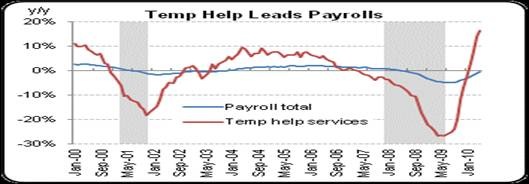
Despite the disappointing headline number for payroll jobs (just 41,000 of the 413,000 jobs created were non-governmental), there actually was some favorable news.  The gains in temps and workweek point to future hiring.  Personal income should be strong for May.  The aggregate hours jump for manufacturing suggests a robust increase in industrial production for the month.  Yes, the underlying trend in jobs is less than hoped, but recovery is still underway.  And we are getting some “fiscal stimulus” from the Census hires, says Econoday.

clip_image004

Construction spending also improved after a winter slump. The April boost was led by a jump in private residential outlays which gained 4.4 percent after no change the prior month.  Public outlays increased 2.4 percent in the latest month while private nonresidential construction also rebounded 1.7 percent after a sustained drop.

clip_image006

Another positive economic indicator was that car and truck sales proved very solid in May, at an annual adjusted rate of 11.6 million surpassing April’s 11.2 million and ranking alongside March’s incentive-driven spike of 11.8 million. Strength was centered in domestic-made trucks which jumped 8.6 percent to a 5.1 million unit pace. Why is the jump in truck sales important? Because trucks are used by businesses, which points to more economic activity!

So the recovery is not so sluggish, considering the obstacles it still faces with the $1 trillion drain of 2 wars being fought and Wall Street still looking for ways to evade regulation.  Spending and production are running ahead of jobs numbers.  These point to continued moderate improvement in the recovery—and a recession that is certain to be shorter than the Great Depression.

Harlan Green © 2010

Posted in Macro Economics, Weekly Financial News | Tagged , , , , , | Leave a comment

The Debt Fallacy

Financial FAQs

The European debt crisis has re-triggered the debate over budget deficits, and even whether Europe’s problems could trigger a ‘double-dip’ return to recession in our own economy. The contention is that Europe will be burdened with debt for years to come, which slows their economic growth.

What has Europe to do with our own economy? It is mainly the relationship between currencies. When the euro is high, then our exports are cheaper, helping manufacturing employment in particular. So the reverse case boosts European exports and reduces ours. And the euro’s value has plunged as investors fled to dollar denominated investments.

But a more general debate is whether governments should incur additional debts to cure such financial crises as we are now weathering. So-called Keynesian economists say that government stimulus spending is crucial to any recovery, since it boosts demand for new products and services. But that only happens if it is directed to consumers—who account for up to 70 percent of economic activity.

So-called supply-side policies boost the producers by giving tax cuts directly to investors and businesses, in the hopes that it will induce businesses to expand and create more jobs. However that didn’t happen during the last recovery. The 5 million jobs created from 2000-08 was the lowest total since WWII.

Nobelist and columnist Paul Krugman came up with an interesting conclusion on just that subject. Were we better off under the supply-side policies of President Reagan in the 1980s who wanted to funnel more money to the supply-side, or of Clinton in the 1990s who wanted it to go to consumers, was his question.

“Here’s what I think,” said Krugman, “inflation did have to be brought down — and Paul Volcker, not Reagan, did what was necessary. But the rest — slashing taxes on the rich, breaking the unions, letting inflation erode the minimum wage — wasn’t necessary at all. We could have gone on with a more progressive tax system, a stronger labor movement, and so on.”

Our debt-incurred stimulus spending is definitely working. The Congressional Budget Office reported the latest results of the $787 billion American Recovery and Reinvestment Act (ARRA) under this headline:

New CBO Report Finds ARRA has Preserved or Created up to 2.8 Million Jobs

While the report focuses primarily on the first quarter of 2010, CBO also includes new projections of the Recovery Act’s jobs impact through 2012. It finds that in the current quarter (the second quarter of 2010), there are 1.4 million to 3.4 million more jobs in the economy because of ARRA, and it predicts that ARRA’s jobs impact will peak this fall, when there will be 1.4 million to 3.7 million more jobs because of the legislation.

This is in line with the latest unemployment report, which showed 290,000 payroll jobs created in April, following a revised 230,000 advance in March, and 39,000 rise in February. April’s boost topped the market estimate for a 200,000 gain. Net

combined revisions for March and February were up a 121,000-including turning February from negative to positive. But the key number is private payrolls as Census hiring added 66,000 to April’s jobs, compared to adding 48,000 the prior month. Private nonfarm employment increased 231,000, following a 174,000 rise in March.

clip_image002

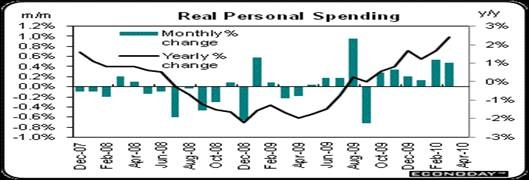
The real key to refuting the ‘debt fallacy’ is the benefit government stimulus does for consumers’ pocketbooks, and that is also looking better. Consumers are getting healthier— at least financially, as income gains enable them to spend and save more, with inflation almost non-existent. The headline PCE price index was unchanged in April-easing from up 0.1 percent in March. The core rate also was soft, gaining only 0.1 percent and matching both March and the consensus forecast.

clip_image004

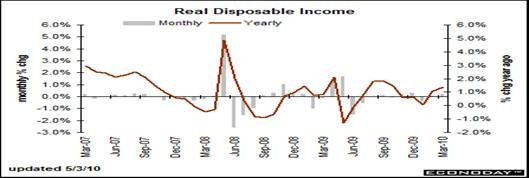
Personal income posted a solid 0.4 percent increase for April, matching the gain the month before. The April figure came in slightly lower than the market forecast for a 0.5 percent boost. Importantly, the latest increase is in what really counts as the wages & salaries component advanced 0.4 percent after rising 0.3 percent in March.

The good news is that consumers are finding more greenbacks in their wallets and this should support additional spending and the recovery. The consumer on average is now pulling its weight in the recovery, while inflation remains benign.

What about paying back the $11 trillion in public debt? We can follow the post-WW II scenario, when it was 120 percent of GDP. That debt was paid down to its lowest level by 1980 in the post-war recovery. Today it is approaching 90 percent of GDP, because this was the worst downturn since the Great Depression. So once again the key to a recovery is keeping consumers healthy, which leads to more jobs and higher incomes.

clip_image006

Among ARRA’s most effective provisions for saving and creating jobs, according to CBO’s estimates, are direct purchases of goods and services by the federal government, transfer payments to states (such as extra Medicaid funding), and transfer payments to individuals (such as increased food stamp benefits and additional weeks of unemployment benefits). CBO’s estimates indicate that tax cuts are less effective job producers, and tax cuts for higher-income people and corporations have very low bang for the buck.

Harlan Green © 2010
Posted in Uncategorized | Tagged , , , , , , , | Leave a comment

Is Risk a 4-letter Word?

Financial FAQs

Barron’s columnist Alan Abelson asked just that question this week after the general decline in stocks, and 900 plus point drop in the DOW. Have investors become so cautious because of Europe’s debt problems and the uncertainty of our recovery that they no longer are willing to invest in this recovery? Banks are holding record amounts of deposits because investors are investing little and consumers spending less.

Actually risk comes from the French risqué, to be daring, according to Larousse—so that nothing ‘risqué’ is nothing gained. In fact, the French expression for Dare-devil is Risque-tout (or being totally risqué).

So being risqué is taking a chance in a dare-devil way. Hence periodically wild gyrations in stock prices should come as no surprise—at least to those in for the long haul, like marching towards retirement. Risk = both the potential for gains and losses, but any uncertainty lowers the tolerance for risk.

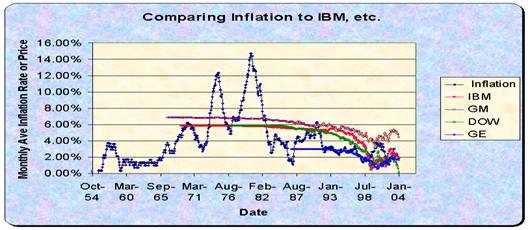
The good news is that stock prices do behave according to certain parameters. One such is inflation. To paraphrase Milton Friedman’s dictum that inflation is always and everywhere a monetary phenomenon, economists generally maintain stock (and bond) prices are always and everywhere inversely related to inflation. Robert Thibadeau is one such economist. His historical graph of stock prices vs. inflation shows that stock prices tend to fall with high inflation, as happened in the 1980s, and rise with low inflation, as happened after 1998.

clip_image002

So it is good news that inflation has fallen in past months. Economist Paul Krugman fears it could fall further, however, which might give us something like Japan’s so-called ‘lost decade’ of no growth. But stock prices have been rising in this low inflation environment, which might counteract that tendency to slower growth.

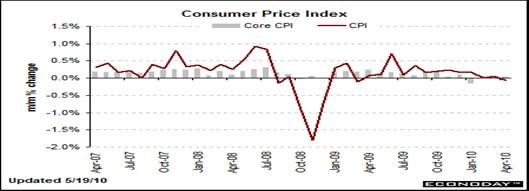
In April, overall CPI inflation dipped 0.1 percent after edging up to 0.1 percent the month before. Core CPI inflation was flat for two months in a row. Year-on-year, overall CPI inflation eased to 2.2 percent (seasonally adjusted) from 2.4 percent in March. The core rate slipped in April to 1.0 percent from 1.2 percent the prior month.

clip_image004

One may argue with the CPI, but the Fed also looks at the Personal Consumption Expenditure deflator, which measures overall prices. And even though year on year, personal income growth for March rose to 3.0 percent, rising from 2.2 percent in February, annual headline PCE inflation in March is 2.0 percent, while annual core PCE inflation was steady at 1.3 percent. This has helped to increase real, after inflation, disposable income.

clip_image006

So the combination of lower inflation and higher personal incomes should keep consumers spending and stocks rallying that will prevent a ‘double-dip’ recession. Recessions are always and everywhere a deflationary phenomenon. I.e., prices fall because of a fall in demand, which means a slack economy, which leads to higher unemployment. But why do stocks tend to rally with low inflation? It is a sign that investors appetite for risk is returning, in anticipation of a recovery.

clip_image008

And the latest signs are that investors are again investing and consumers spending. This is the major reason stocks have recovered. And as we reported last week, based on analysts’ 2010 earnings estimate, the ‘forward’ price-to-earnings ratio of the S&P 500 has slipped to 13.7 percent from 15.3 percent less than one month ago, below the historical 100-year average for stock prices—another reason to be daring.

Harlan Green © 2010
 
Posted in Macro Economics, Weekly Financial News | Tagged , , , , , , | Leave a comment

No More ‘Double-Dip’ Talk

Popular Economics Weekly

“Irrational Exuberance” author Robert Shiller in an eye-opening Sunday NYTimes op-ed maintains there is still chance of a double-dip recession. But it could happen over years, rather than months. “I use the definition of a double-dip recession that doesn’t emphasize the short term,” he says. “I see it as beginning with a recession in which unemployment rises to a high level and then falls at a disappointingly slow rate.”

The problem with such a definition is that only the Great Depression fits his description. The double-dip occurred in 1937, 4 years after the 1929-1933 depression, when most economists say President Roosevelt prematurely attempted to balance his budget! So is Professor Shiller guilty of his own irrational pessimism?

There is little likelihood of a double-dip for several reasons. Hiring is picking up in the wake of record corporate profits over the past 2 quarters, the huge amount of stimulus spending—some $3 trillion plus is just now taking effect and, confidence levels are not falling in spite of the current stock market correction.

clip_image002

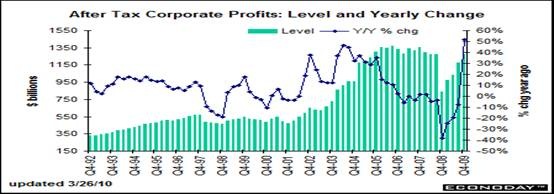
Corporate profits in the fourth quarter surged to an annualized $1.270 trillion from $1.174 trillion the prior quarter, as we reported last week. Profits in the fourth quarter were up an annualized 37.0 percent, following a 68.0 percent jump the prior quarter. Profits are after tax but without inventory valuation and capital consumption adjustments. Corporate profits are up 51.8 percent on a year-on-year basis.

This is the major reason stocks have recovered. The New York Times’ Paul Lim says there are rising expectations for corporate profits among Wall Street analysts (i.e., their ‘animal spirits’ are rising, not falling). So based on their 2010 earnings estimate, the ‘forward’ price-to-earnings ratio of the S&P 500 has slipped to 13.7 percent from 15.3 percent less than one month ago. And Dr. Shiller maintains in his book, Irrational Exuberance, a price-to-earnings ratio of 13-14 percent increases the odds 15 percent that stock prices will increase rather than decrease.

It is true unemployment has remained high compared to past recessions, as we said last week. But payroll jobs in April grew a healthy 290,000, following a revised 230,000 advance in March, and 39,000 rise in February.  And net combined revisions for March and February were up a 121,000—including turning February from negative to

positive.  Do we have to repeat the fact that payrolls have risen for four consecutive months and in five of the last six?  April’s boost was the largest in four years, by the way.

clip_image004

It’s hard to argue that we are still in recession with this string of gains, as we have said, even though the gains are mostly on Wall Street to date, with corporate profits soaring. Of course consumers don’t yet feel they are sharing in it, which is the basis for Shiller’s pessimism.

“From 2007 to 2009, there was widespread concern about the risk of an economic depression, but that scare has been abating”, he continues. “Since mid-2009, it has been replaced by the milder worry of a double-dip recession, as a count of Web searches for those terms on Google Insights suggests. And with that depression scare still fresh in our minds, sensitivity to the possibility of another downturn remains high.”

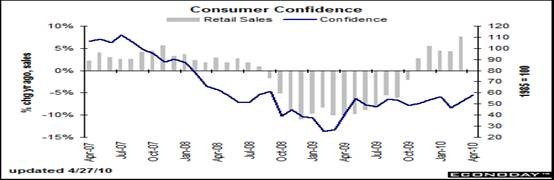
The Conference Board’s consumer confidence report rose strongly for a second straight month, up about 5-1/2 points in April to 57.9. The gain is centered in expectations which jumped 7 points to 77.4, reflecting rising optimism over the outlook for business conditions and easing pessimism on the outlook for employment and income.

clip_image006

The assessment of the present situation also improved with the index rising more than 3-1/2 points but to a still severely depressed level of 28.6, reports Econoday. Pessimism is easing with fewer describing current business conditions as bad and fewer describing jobs as hard to get (45.0 percent vs. March’s 46.3 percent). Other details show a jump in buying plans for cars and major appliances though buying plans for homes are still under water. Inflation expectations, despite the month’s rise in gasoline prices, eased slightly.

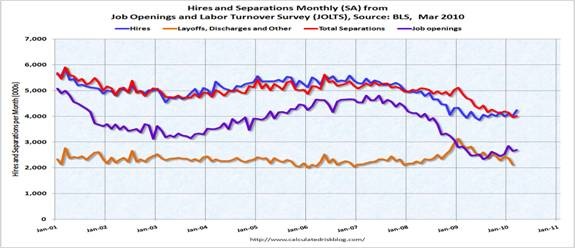
So the recovery is finally beginning for Main Street. I like Calculated Risk’s chart on this. According to the Labor Department’s JOLT report (Job Openings and Labor Turnover Summary), there were 4.242 million hires in March (Seasonally Adjusted), and 4.016 million total separations, or 226 thousand net jobs gained. Notice that total job separations have been dropping since January ‘09, while the number of both job openings and hires has been rising since mid-2009, the probable end of this recession.

clip_image008

So even though the unemployment rate is declining slowly, it is already a long term trend, folks. And though the median duration of unemployment rose to 21.6 weeks from 20.0 weeks in March and the percentage of unemployed, marginally attached and part time is still above 16 percent of the workforce, it is mainly because more people are optimistic about finding a job (805,000 actually rejoined the workforce in April).

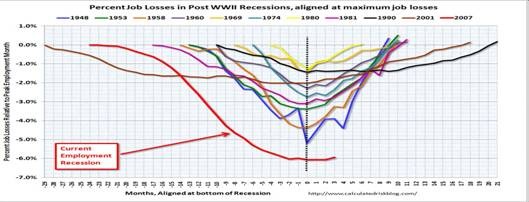
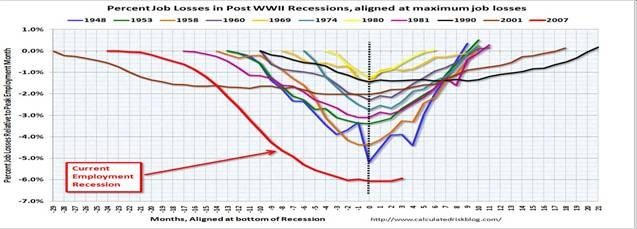
It’s true that short-term attitudes can change on a dime, as the DOW’s 900 point drop proves. But the longer term trend of “public thinking”, as Shiller calls it, seems to be greater optimism rather than pessimism. Just look at comparisons to other post-WWII recessions done by Calculated risk. It shows that the two longest jobless recoveries were during Republican administrations—Bush I &II—which were ruled by an ideology that opposed government stimulus spending. The Obama Administration has taken the opposite attack—pump as much government stimulus as possible into the economy to speed up the recovery. And it seems to be working.

Harlan Green © 2010
Posted in Macro Economics, Weekly Financial News | Tagged , , | Leave a comment

Why the Housing Bubble?

The Mortgage Corner

Historical hindsight is always 20-20, but why didn’t economists and the Fed act sooner to deflate the housing bubble? By waiting until 2006 to tighten credit, the Federal Reserve allowed overbuilding of the housing sector that resulted in the current oversupply of some 1 million homes.

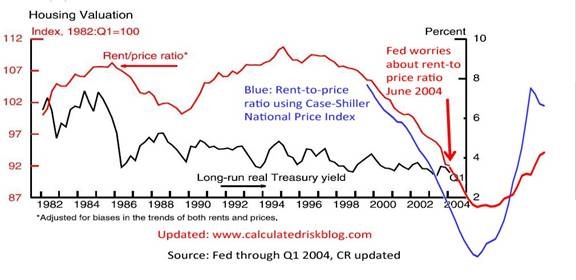
Housing bubbles can be detected and treated if Fed officials and others had heeded their own research. One measure they looked at was the housing rent-to-price ratio, or ratio of housing rents to prices. When prices rise much higher in relation to rents, then we know those rises are not sustainable, but speculative.

The Federal Reserve was worried about a housing bubble as far back as 2004, according to Calculated Risk. But nothing was done about it under Alan Greenspan’s chairmanship. We now know why. Greenspan didn’t believe housing prices could rise to bubble heights. He maintained housing wasn’t as ‘liquid’ as other investments, and so subject to the same speculation as stock and bond values that created the dot-com bubble. But that proved not to be true when the Fed changed its monetary policy that brought in the low interest rates and easy credit lasting from 2002 to 2006.

clip_image002

The Fed was looking at a ratio calculated by one of its researchers that saw rents had plunged to less than 2 percent of housing prices in 2004, due to soaring home prices. I don’t want to leave the impression that we think there’s a huge housing bubble,” said the Fed’s associate director of research. “We believe a lot of the rise in house prices is rooted in fundamentals. But even after you account for the fundamentals, there’s a part of the increase that is hard to explain”.

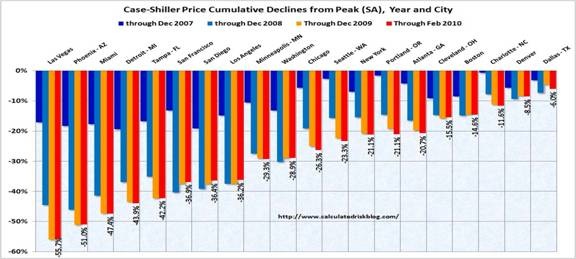
But economists such as Robert Shiller saw the housing bubble, as we reported last week. He told the Fed in 2005 that housing prices could plunge as much as 50 percent in some regions. And that has happened in cities like Las Vegas and Phoenix, with Detroit, Miami and Tampa, Florida not far behind.

clip_image004

Homeownership rates have also plunged from 69 to 67 percent of households, according to the U.S. Census Bureau, as more households return to renting. Could the exodus of homeowners that become renters turn into a flood? The homeownership rate was as low as 64 percent in 2004, and the historical average seems to hover around 65 percent. Is that the actual percentage of households who can truly afford to own? Time will tell.

clip_image006

First quarter GDP growth was 3.2 percent, the third consecutive quarter of economic growth. Both residential and non-residential investment are still a drag on growth, so that equipment and software investment are pulling us out of the recession. But it looks like housing construction (i.e., residential investment) is poised to become a positive factor. Note that the recession probably ended in mid-2009, according to Calculated Risk.

clip_image008

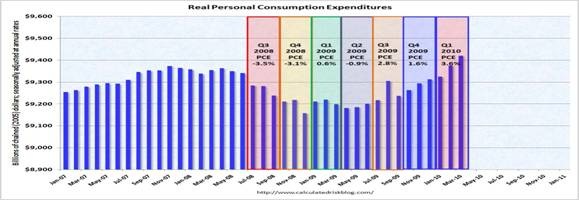
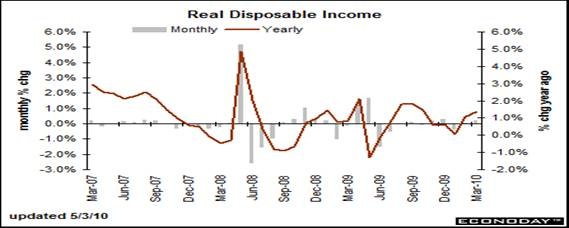
The consumer sector is helping the recovery gain traction. Not only did income improve but spending accelerated. Personal income strengthened in March, gaining 0.3 percent, following a 0.1 percent rise the prior month. The heavily-weighted wages & salaries component increased 0.2 percent in March after edging up 0.1 percent in February.

clip_image010

Consumer spending rose at a faster pace due to a jump in motor vehicle sales. Overall, personal consumption posted a 0.6 percent boost in March, following a 0.5 percent jump the month before. The March figure equaled expectations but February spending was revised up from a 0.3 percent initial estimate. By components, durables spiked 3.6 percent in March, nondurables advanced 0.3 percent, and services rose 0.2 percent.

Subdued is still the word on inflation-keeping the Fed happy and loose for now. The headline PCE price firmed to up 0.1 percent after no change in February. The core rate also edged up 0.1 percent in March after no change the month before. The market forecast was for no change in the core.

clip_image012

Personal income growth for March rose to 3.0 percent over last year, rising from 2.2 percent in February. Year-ago headline PCE inflation firmed to 2.0 percent from 1.8 percent in February. The so-called core PCE inflation without energy and food prices was steady at 1.3 percent.

The Fed was caught up in the ‘group think’ of that time, which said that freeing markets to run their own course was the path to greater prosperity. Greenspan, et. al., wanted to foster faster economic growth without heeding the warning signs, in other words.

Surprise, surprise, it turns out that asset bubbles can be detected. Ideology cannot trump reality, as much as Greenspan’s Federal Reserve attempted to overturn it. We also see that the rent-to-price ratio has returned to historical levels, more evidence that housing prices have finally stabilized.

Harlan Green © 2010

Posted in Weekly Financial News | Tagged , , , , , , | Leave a comment

Inequality and Recessions

Has greater income equality in the United States since the 1970s, as documented by Thomas Piketty and Emmanuel Saez; (Feb. 2003 Quarterly Journal of Economics), led to greater financial instability of the financial markets, and perhaps precipitated the ‘Great Recession’ of December 2007 we are just now recovering from?

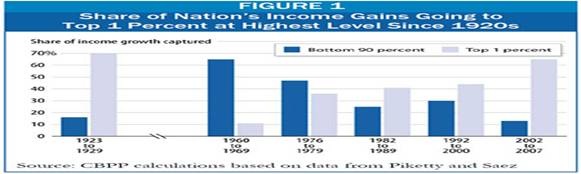
The Center for Budget and Policy Priorities (CBPP), using Piketty and Saez data, documents that income and asset inequality since the 1970s has risen to levels last seen in the 1920s (see graphs).

clip_image002

clip_image004

The amount such inequality contributes to recessions has not been well documented. Birdsall, Pinckney, and Sabot in a March 1996 Inter-American development Bank Working Paper 327 maintain that higher levels of income inequality “appear to be a constraint on growth”. But there has been no research on what level of inequality might lead to two consecutive quarters of negative GDP, the common definition of a recession.

This debate goes back to the Great Depression, when Roosevelt’s Federal Reserve Chairman Martin Eccles maintained that income inequality was a major cause of the Great Depression:

“… a giant suction pump had by 1929-30 drawn into a few hands an increasing portion of currently produced wealth. This served them as capital accumulations. But by taking purchasing power out of the hands of mass consumers, the savers denied to themselves the kind of effective demand (my italics) for their products that would justify a reinvestment of their capital accumulations in new plants. In consequence, as in a poker game where the chips were concentrated in fewer and fewer hands, the other fellows could stay in the game only by borrowing. When their credit ran out, the game stopped.”

By effective demand, Eccles was referring to what economists today define as aggregate demand. Eccles was maintaining that the growth in income inequality created a credit bubble that burst and so led to diminishment in aggregate demand, which economists express as a formula:

clip_image006

where aggregate demand (Yd) is the sum of all personal consumption (C) + private investment (I) + government expenditures (G) + any net of exports over imports (X-M). There was a precipitous drop in all 4 components of aggregate demand at the beginning of the Depression. Consumers in particular cut back spending 10 percent by mid-1930, in response to their stock market losses and reluctance to add new debt.

It was JM Keynes who tied aggregate demand to aggregate output, and Robert Samuelson who refined it: “The equilibrium level of output is potentially any level up to the full employment level. Which level of output actually happens to be the equilibrium depends entirely upon aggregate demand – hence aggregate demand is the primary determinant of the equilibrium level of output. This is indisputably the central message of Keynes’s theory: given any level of aggregate demand, producers will try to meet that demand and thus aggregate output will rise or fall to equate the given aggregate demand.”

Murat Iyigun and Ann Owen in the April 2004 issue of Economic Journal, “Income Inequality, Financial Development and Macroeconomic Fluctuations” maintain that in more developed economies, an increase in inequality means that there are more poor households, and so a decrease in aggregate demand.

Because poor households do not have the same ability to borrow as the rich, when they fall on hard times, they must reduce their spending, say Iyigun and Owen. Rich households, however, are able to borrow and do not have to reduce their consumption when their income is temporarily low. As a result, when there are more poor people in an economy, consumer spending will be more variable. Because consumption accounts for such a large portion of GDP (or national income), more variable consumption leads to greater GDP volatility as well.

Iyigun and Owen’s conclusion is that “the distribution of income can affect an economy’s ability to adapt to external shocks when the ability to obtain credit depends on income”.

The Great Recession of December 2007 began with such a shock—the collapse of the housing market. It precipitated a sharp drop in consumer spending, and so caused the plunge in GDP growth. This led to a “bank panic”, according to Yale economist Gary Gorton.

In a February 20, 2010 report to the U.S. Financial Crisis Inquiry Commission, Professor Gorton maintained that our most serious financial crises of the nineteenth and twentieth centuries were caused by bank panics. Whereas the 1929-30 panic was due to a run on bank deposits (due to a lack of deposit insurance), the current bank panic began on August 9, 2007 in the unregulated ‘repo’ market for sale and repurchase agreements, conducted within the highly leveraged ‘shadow’ banking system of non-bank financial entities that had escaped regulators’ scrutiny.

The discovery of links between income inequality and recessions may therefore lie in more historical research that measures the factors that lead to extreme volatility in aggregate demand. The large increase in income inequality that happened since 2000 in conjunction with the housing and credit bubbles probably raised household debt-to-income ratios to historic highs and decreased the personal savings rate to a historical low, as middle and lower-income households struggled to maintain their standard of living with declining income. High credit usage with low savings rates creates tremendously unstable financial markets, and so could have been the ultimate cause of the Great Recession.

We do have some current research that shows “credit booms gone wrong”, are a major cause of recurrent episodes of financial instability, per a recent NBER Working Paper No. 15512 by Moritz Schularick and Alan Taylor. In “Credit Booms Gone Bust: Monetary Policy, Leverage Cycles and Financial crises, 1870-2008”, Schularick and Taylor maintain that the huge growth in the use of credit and increasingly complex forms of leverage led to an unprecedented level of risk throughout the credit system up to 2008.

The existing evidence seems to imply that the bank panics of 1929-30 and 2007-08 (that burst their respective credit bubbles) were caused by such an unequal distribution of income, as the historical record implies.

Harlan Green © 2010

Posted in Keynesian economics, Macro Economics | Tagged , , , | Leave a comment

Why Financial Reform?

“. . . It is critical to understand that the recent financial crisis was not a natural disaster. It was a man-made economic assault. People did it. Extreme greed was the driving force. It will happen again unless we change the rules,” stated the Chairman of the Senate Permanent Subcommittee on Investigations Carl Levin, Democrat of Michigan.
Congress and the Financial Crisis Inquiry Commission are beginning to understand the dimensions of the financial meltdown of 2008 that almost caused another Great Depression. And crimes have been committed, with only Goldman Sachs being charged with fraud to date for misrepresenting the Collateralized Debt Obligations that it sold to clients.
The just-disclosed SEC fraud case against Goldman is a perfect example of a “man-made economic assault”. On one side, Goldman marketed subprime loan-backed securities to their clients, while on the other side structuring a deal with another client—hedge fund Paulson & Co.—without revealing that Paulson was betting against it and helped to structure the deal, which is omission of at least one “material fact” and so illegal under securities’ laws.
Why the difficulty in pinning down who was responsible, is the question we asked last week. A major source of the problem is the claim the players weren’t responsible for any consequences. Even Alan Greenspan had said the Federal Reserve wasn’t able to detect asset bubbles—the major cause of most financial meltdowns—so how could anyone else detect them? And if not detectable, than how could anyone be held responsible for causing them, and the losses when they burst?
But behavioral economists such as Robert Shiller, et. al., show that the irrational exuberance that creates bubbles is detectable, and preventable with the right regulation. It is true that no one can predict the future, which is why investors have to be able to trust in the institutions that peddle financial investments before investing in them.
And that is the ‘snake oil’ component of financial markets, says 2001 Nobelist George Akerlof in a recent Cambridge University, UK conference. Much of the marketing of investments doesn’t reveal all the facts. The playing field isn’t really level, in other words, and markets are never 100 percent transparent. There are always those—either buyers or sellers—who know more about their products, and may have hidden agendas.
The rating agencies are another example. They caused much of the problem by not downgrading some of the most toxic securities, when they were paid by clients who needed the ratings—a direct conflict of interest.
India’s experience is an example of good regulations. Its Central Reserve Bank did not deregulate derivatives’ trading, and required much higher capital requirements for those who did trade in exotic instruments. Therefore no credit bubble was created, and India was not affected by the worldwide credit bust.
By now, the consequences of the financial meltdown are visible to all—the loss of 8 million plus jobs, $11 trillion in wealth, and a real estate market that will take years to recover in the U.S.. The real estate bubble is just the starkest example. As late as 2007, 2 million new homes per year were being built—much more than were needed even then, driven by easy credit and the irrational exuberance of homebuyers who thought that home prices could only go up. Today the number being constructed is little more than 600,000 units, mostly because the excess supply of the boom years hasn’t yet been sold off.
And the inventory of new homes is still above 9 months supply at current sales’ rates, when the longer term inventory backlog has averaged 6 months.
Whereas, existing home sales are doing better. What Calculated Risk calls the “distressing gap” between new and existing-home sales still exists, because of the tremendous oversupply of homes still on the market—more than 8 months supply at current sales’ rates.
In fact, bubbles can be predicted. No less than Robert Shiller in his 2000 book, “Irrational Exuberance”, predicted the implosion of the dot-com bubble. In the 2005 second edition, he also predicted the bursting of the housing bubble. And it didn’t take sophisticated math.
In the case of stocks, the price-to-earnings ratio had soared to 44 to 1, almost double the 26 to 1 ratio that existed on 1929’s Black Friday. In the case of housing, Shiller saw that housing prices had far outdistanced some fundamental indicators—rising in double digits in mid-2000 when construction costs and population growth rose less than 2 percent per year.
And, in a paper he presented to a Federal Reserve Board economic symposium in August 2007, Shiller warned, “The examples we have of past cycles indicate that major declines in real home prices—even 50 per cent declines in some places—are entirely possible going forward from today or from the not-too-distant future.”
There were numerous others who read the signs, including Bill Gross, Managing Director of PIMCO, the world’s largest bond fund. He criticized the credit ratings of the mortgage-based Collateralized Debt Obligations (one type of insurance derivative) now facing collapse:

“AAA? You were wooed, Mr. Moody’s and Mr.Poor’s,”, he said, “by the makeup, those six-inch hooker heels, and a “tramp stamp (tattoo).  Many of these good-looking girls are not high-class assets worth 100 cents on the dollar… [T]he point is that there are hundreds of billions of dollars of this toxic waste… This problem [ultimately] resides in America’s heartland, with millions and millions of overpriced homes”, said Gross as quoted in Nouriel Rubini’s Global Economics blog.

Many experts predicted both the housing and derivatives collapse, in other words, which was the result of the unregulated derivatives market that operated worldwide. And because unregulated, many of the derivatives had little or no capital backup, which created a domino effect. The collapse of one, caused the collapse of others in a chain reaction.
So the main feature of regulation put forward by both House and Senate bills is greater transparency and more capital to back the transactions. In particular, derivatives, which are bets on the future value of an asset—or even ‘CDO insurance’ (which is really another derivative in this case) that guarantees the derivative, will be reported through a public clearing house just as futures are traded today. And those offering derivatives must have at least 5 percent of their own money in the transaction.
This will not eliminate the greed that is a basic ingredient of human nature, but should discourage excessive greed by making it much more expensive. Taking responsibility means being aware of the consequences to others in the larger economy, not just to oneself.

Harlan Green © 2010

Posted in Keynesian economics, Weekly Financial News | Leave a comment

The Case for Sustainable Economics

Behavioral Economist Robert Shiller said in a recent New York Times Op-ed said, “We need to invent financial institutions that take into account the kinds of communities we want to build. And we need to base this innovation on an approach to economics that captures the richness of human experience—and not efficient-market economics.”
Dr. Shiller is one of many economists decrying the lack of sustainable financial institutions that have led to so many recessions, including the current Great Recession—sustainable institutions that build communities rather than destroy them. Their lack has been mainly because they targeted the wrong economic goals—productivity over sustainability, or efficient markets (i.e. markets with minimal oversight) over markets that attempt to sustain longer-term economic growth.
We seem to have mastered the means of production, as economist John Maynard Keynes predicted in his 1930 treatise, “Economic Possibilities for our Grandchildren”, yet not how to put such growth on a sustainable path that benefits future generations rather than indebting them. As the originator of an economic theory that advocated government support during the Great Depression, Keynes believed that markets did not cure themselves without widespread suffering. The “animal spirits” of a populace that was discouraged by prolonged unemployment had to be boosted by governmental job creation measures in order to boost economic growth, if private sector employers weren’t hiring.
In other words, most modern economic theory has concentrated on producing the maximum amount of goods and services (hence emphasis on efficient markets), but ignoring their social welfare aspects. I.e., how sustainable is such a system that venerates individual effort (i.e., self-interest), but ignores its results? When whole communities are destroyed by a succession of bursting asset bubbles—it was first the dot-com bubble in 2000, then real estate bubble, and now the credit bubble bursting that has almost destroyed our banking system—then it is time to begin looking for a more sustainable economic system that preserves assets for our grandchildren.
Economists, sociologists and psychologists in particular are beginning to look at systems that capture the “richness of human experience” advocated by Dr. Shiller. One pioneer is economist Hazel Henderson, who helped to found the Calvert family of eco-friendly mutual funds. She also created the Calvert-Henderson Quality of Life Indicators (at http://www.calvert-henderson.com) that helps to measure what makes up a better quality of life. Its education component highlights why U.S. elementary education has flagged—the U.S. is ninth in the list of eighth grade math and science scores, for instance—behind nos. 1 and 2 Singapore and Taiwan, and what should be done to remedy it.
The research of behavioral economists such as Dr. Shiller are also debunking the efficient markets’ economists who generally advocate privatization (and deregulation) of financial institutions in the belief that individuals are the best regulators of their own behavior. Behavioral economists find that most people either do not have the time or knowledge to make intelligent financial decisions without some regulation to govern errant behavior. Former Fed Chairman Alan Greenspan once famously said,

“It is not that humans have become any greedier than in generations past. It is that the avenues to express greed had grown so enormously.”

Though private enterprise is the foundation of capitalism, and its source of wealth, we now know it only enriches the few without adequate regulation and governmental oversight.
And so Lord Keynes concludes, “The strenuous purposeful money-makers may carry all of us along with them into the lap of economic abundance. But it will be those peoples, who can keep alive, and cultivate into a fuller perfection, the art of life itself and do not sell themselves for the means of life, who will be able to enjoy the abundance when it comes.”

Harlan Green © 2010

Posted in Uncategorized | Leave a comment

Hello world!

Harlan Green is Editor/publisher of PopularEconomics.com, and contents provider of 3 weekly syndicated columns–Popular Economics Weekly (weekly financial news and analysis), Financial FAQs (readers’ frequently asked financial questions), and The Mortgage Corner (real estate news and issues).  All questions and comments can be directed to:  editor@populareconomics.com.

Posted in Uncategorized | 1 Comment