U.S.Economy Adds Jobs in September

Popular Economics Weekly

                                    “…while the economy is growing thanks to AI spending, it’s a K-shaped expansion: People who were already affluent are becoming more so, but the less well-off are under severe pressure.Paul Krugman   

FREDnonfarmpayrolls

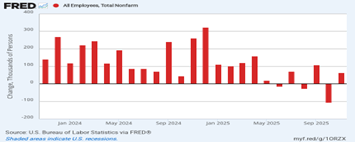
The delayed U.S. unemployment report for September was good old news. It showed 119,000 nonfarm payroll jobs were created, though the unemployment rate edged up to 4.4%. But that was before the government shutdown.

And the U.S. had already lost -13,000 nonfarm payroll jobs in June and -4,000 jobs in August. The U.S. economy has averaged just 38,600 new jobs per month through September since Trump announced the April 2 retaliatory tariffs, as employers haven’t been hiring while they wait see what the final tariff rates (and therefore costs) might be.

The October employment report has been canceled because of the government shutdown and the November report will come out late, depriving the Federal Reserve of critical information before its next meeting to decide whether to cut interest rates again. Both reports were postponed by the 43-day government shutdown that lasted from Oct. 1 to Nov. 12.

So the November employment report will be published on Dec. 16 instead of Dec. 5 as originally scheduled, per the BLS. An estimate of employment for October will be included in the November jobs report. It’s thought that up to 100,000 more government jobs may have been lost in October due to firings or attrition.

It is a K-shaped jobs report, as Nobel Laureate Krugman stated. This is why hiring has stagnated at such a low level since April. Jobs are being created in the lower-paying service sector, whereas the industrial sector and governments are losing jobs.

Employment in food services and drinking places continued to trend up in September (+37,000). In September, social assistance employment continued to trend up (+14,000), reflecting continued job growth in individual and family services (+20,000).

Employment in transportation and warehousing declined by 25,000 in September as job losses occurred in warehousing and storage (-11,000) and couriers and messengers (-7,000). Federal government employment continued to decline in September (-3,000) and is down by 97,000 since reaching a peak in January.

That means the more affluent consumers continued to dine out and could afford more health care services, which is now the fastest growing segment of the economy, as I said.

So the economy is k-shaped because just 10 percent of American consumers are keeping the economy from contracting, because they now own more than 50 percent of assets, according the latest Federal Reserve data—in housing, pensions, and financial assets. And the stock market is still booming.

But small businesses that employ the most workers aren’t hiring because more than 90 percent of them are dependent on imported goods that Trump has targeted with his higher tariffs. We won’t see its effect on economic growth until the fourth quarter and beyond.

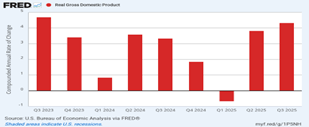
If employers aren’t hiring, what is causing the predictions for 4 percent GDP growth in Q3? It’s a statistical fluke because imports are deducted from exports and other domestic expenditures to calculate the overall GDP growth rate. And small business importers are buying less at the moment. The Gross Domestic Product measures what is produced domestically, in other words.

 This is the k-shaped economy we will have to live with. The NYTimes reports that the unemployment rate for 20-24 year-olds has risen to 9.2 percent. The hiring slowdown means they are competing with more experienced workers for fewer available jobs, at least until the tariff rates have settled.

Interest rates? The Fed is scheduled to cut rates another -0.25 percent in December but what if inflation doesn’t come down? Trump has signaled he wants to continue to lower interest rates regardless of the consequences.

Harlan Green © 2025

Follow Harlan Green on Twitter: https://twitter.com/HarlanGreen

Posted in Consumers, COVID-19, Economy, Politics, Weekly Financial News | Tagged , , , , , , , , , | Leave a comment

Who Won the Shutdown?

Financial FAQs

“What if conservatives succeeded in repealing Obamacare? “Republicans’ Obamacare repeal bill would leave 17 million more people uninsured next year, and 32 million more in 2026, the Congressional Budget Office said in an estimate Wednesday. It also said premiums would double by 2026. …By 2026, three quarters of the population would live in areas with no insurers participating in the non-group market, due to upward pressure on premiums and downward pressure on enrollment, the report found.”Huffington Post

GETTYIMAGES

Republicans didn’t win the recent government shutdown because they don’t understand how important affordable healthcare has become to all Americans, not just the wealthy.

They were in fact attempting to take down Obamacare (ACA) once again by not including the subsidies in the continuing resolution that made it available for middle and low-income folk.

Republicans have proven time and again that they want non-senior Americans to pay for health care out of their own pockets, if not through their employer or business. Their extreme dislike of the federal government providing any public healthcare is most evident in Trump picking a very demented RFK, Jr. to lead the Department of Health & Human Services, while slashing Medicare and Medicaid benefits.

It reveals why they are the party of wealthy oligarchs. They are not at all interested in the health of their constituents. It’s why Republican administrations have attempted to repeal Obamacare more than 30 times and why many of the Republican red states haven’t enlisted in the Obamacare premium subsidies that would enable their own citizens to afford Obamacare

So I cited above a CBO estimate from my 2017 Huffington Post article of the benefits to Americans’ health from Obamacare resulting from its passage.

A 2016 Commonwealth Club study said “…evidence indicates that the ACA has likely acted as an economic stimulus, in part by freeing up private and public resources for investment in jobs and production capacity. Moreover, the law’s payment and other cost-related reforms appear to have contributed to the marked slowdown in health spending growth seen in recent years.”

Some of those benefits are:

· Health care spending growth per person—both public and private—has slowed for five years.

· A number of ACA reforms, particularly related to Medicare, have likely contributed to the slowdown in health care spending growth by tightening provider payment rates and introducing incentives to reduce excess costs.

· Faster-than-expected economic growth and slower-than-expected health care spending have led to multiple downward revisions of the federal deficit and projected deficits.

· These trends have also been a boon to state and local government budgets, as job growth has improved state tax revenues while cost growth in health care programs has slowed. At the same time, expanding insurance to millions of people who were previously uninsured has supported local health systems and enhanced families’ ability to pay for necessities, including health care.

We now must wait for the November 20 release of the delayed September unemployment report to learn just how much the shutdown hurt the American economy.

But the almost complete ignorance of Obamacare’s importance by Republicans during the shutdown enabled Democrats’ big win in the November elections.

Harlan Green © 2025

Follow Harlan Green on Twitter: https://twitter.com/HarlanGreen

Posted in Consumers, COVID-19, Economy, Politics, Weekly Financial News | Tagged , , , , , , , , , , , , , , | Leave a comment

U.S. Economy Is Freezing!

Popular Economics Weekly

“…while the economy is growing thanks to AI spending, it’s a K-shaped expansion: People who were already affluent are becoming more so, but the less well-off are under severe pressure. For example, there are clear signs that middle-to-low income consumers are struggling: car loan and credit card delinquencies are rising, and grocers report that shoppers are buying cheaper varieties of food. At the same time, the affluent are spending freely: the top 10% of the income distribution now accounts for nearly half of all consumer spending.Paul Krugman

PBS.org

This was the wrong season for President Trump’s Republicans to freeze Democrats out of the just passed continuing resolution and Trump demolish the East Wing. We already have a record fall freeze hitting the Midwest and southern states.

And Americans already feeling the cold is a good way to describe the Democrats landslide victories in the November elections. The record government shutdown put the U.S. economy on pause, but in fact much of the damage was already done, says Nobel Laureate Paul Krugman, just as Trump seemed oblivious to the damage being done to the White House,.

Republicans had been losing in the popularity polls this year because they chose to ignore the signs. So they believed that flying blind by keeping the federal government closed without official economic data on employment and inflation was the better option than knowing the truth.

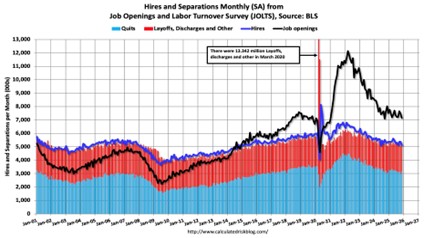
But there are other data to fill the government void in data collecting that affect how consumers behave. The ADP, for instance, a private sector payment provider said private-sector employers shed an average of 11,250 jobs a week in the four weeks ending Oct. 25.

This hit the “middle-to-low income” consumers particularly hard that Krugman is talking about. What about inflation?

Ordinary grocery prices are climbing, forcing consumers to shop for “cheaper varieties of food.” Grocery prices have risen 18.2 percent since January 2022, making a $100 grocery bill approximately $118 today, per CBS News.

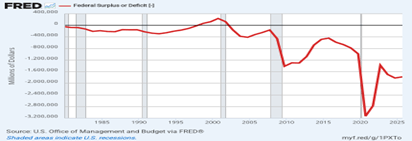
And President Trump is flailing in his attempt to mask the damage his tariff war is causing. Overall consumer inflation is stuck at 3 percent in large part because of the tariffs, so he wants to offer $2,000 rebates to consumers while the Fed is cutting interest rates. This would cost more than the import taxes he has already collected, enlarging the federal debt that has ballooned from his Big Beautiful Bill tax cuts.

And his proposed cuts to legal immigration, from the longer term historical average of one million to 7500 annually, will continue to shrink the workforce, even the number of H-1B work visas for highly qualified workers that are badly needed in the tech sector.

All of this will continue to damage economic growth at a time when worldwide economic growth is being affected by the chaos Trump has generated in tearing up existing foreign trade agreements.

No economy can tolerate such uncertain weather over the longer term. Hence investment decisions also remain frozen while consumers find shelter for the coming economic winter. How severe will it be?

Harlan Green © 2025

Follow Harlan Green on Twitter: https://twitter.com/HarlanGreen
Posted in Consumers, COVID-19, Economy, Politics, Weekly Financial News | Tagged , , , , , , , , , , | Leave a comment

Why Make America Weak?

Financial FAQs

“This great Nation will endure as it has endured, will revive and will prosper. So, first of all, let me assert my firm belief that the only thing we have to fear is fear itself—nameless, unreasoning, unjustified terror which paralyzes needed efforts to convert retreat into advance.” Franklin Delano Rooselvelt

theguardian.com

The Democrat’s election sweep on November 2 is proving that American voters are heeding President Roosevelt’s famous warning at his first inaugural address, that the paralysis has broken for Democrats after the loss to Trump, and fear can be conquered that is the greatest enemy of Democracy.

The November 2 elections showed just how illusory were those fears that Donald Trump and Republicans wanted Americans to believe, the first and foremost that the largest, most prosperous country in the world had grown weak. Americans were in danger, and only he and his oligarchs could save US.

In fact, Donald Trump and the Republican Party have been attempting to weaken everything that makes America the oldest constitutional democracy since his first day in office.

Whether it is the slashing of essential government services via Elon Musk’s DOGE computer hackers (such as social security, Medicare, Medicare) that benefit all Americans, the elimination of the Department of Education that supports our basic universal K-12 and early childhood educational systems, picking the most unqualified to run the FBI, Department of Homeland Services, and Health and Human Services that are no longer fully functional. Americans are suddenly exposed to more disease, domestic terrorism, and natural disasters.

The brutal roundup of undocumented immigrants, whether they have a criminal record, are decimating the ranks of workers that fill agricultural, manufacturing, and service sector jobs needed to maintain economic growth.

The biggest financial threat to ordinary Americans are the rising prices on basic necessities that most Americans depend on due to tariff rates now at Great Depression levels, impoverishing the majority of Americans that live from paycheck-to-paycheck.

It’s become obvious that the Trump administration’s intent has been to instill as much fear as possible in the most vulnerable Americans that the federal government won’t work for them and only Trump and his oligarchs can same them.

But the recent election and huge protests at the No Kings rallies are a sign that millions of Americans haven’t been cowed or paralyzed.

In fact, they have said, as did Howard Beale, the News Anchor in the movie Network, “I’m as mad as hell and not going to take this anymore!”

Harlan Green © 2025

Follow Harlan Green on Twitter: https://twitter.com/HarlanGreen
Posted in Consumers, COVID-19, Economy, Politics, Weekly Financial News | Tagged , , , , , , , , , , , | Leave a comment

Are We Flying Blind?

Popular Economics Weekly

“The United States economy is like a poker game where the chips have become concentrated in fewer and fewer hands, and where the other fellows can stay in the game only by borrowing. When their credit runs out the game will stop.” Marriner Eccles

wallpaperaccess.com

The famous above quote by Roosevelt’s Federal Reserve Chairman, Marriner Eccles on what he believed caused the Great Depression is a warning that the U.S. economy is now flying blind during this government shutdown.

Eccles should know. He guided Federal Reserve policy during the Great Depression that implemented the New Deal.

Economic downturns occur when consumers are tapped out and begin to borrow more than they spend. It is the reason that retail sales and consumer confidence surveys are important signs of whether consumers will continue to shop, or drop, as the saying goes.

And given the economic chaos being sown by the Trump administration during what looks like a record government shutdown, we don’t have any official data being released on when it might happen and what it will look like. So we are flying blind.

There are past recessions that economists look at; the Dot-com bubble that burst in 2001 from over investment in fiber optics that didn’t pan out immediately because it took years for the Internet to be adopted. Now there is over-investment in AI that could follow the same path as the so-called Dot-com recession.

And the Great Depression was largely due to the Herbert Hoover administration allowing tariff rates to rise to unacceptable levels that choked off foreign trade on which many countries, including America, relied on.

There was also the too easy credit conditions of the “Roaring Twenties” that weren’t regulated yet, which allowed the American public to borrow and invest in the stock market for the first time. The October 1929 “Black Friday” market crash followed that precipitated the Great Depression.

So we can take our pick: Trump’s too high tariffs, or too little market regulation allowing shadow lending markets (or junk bonds) to flourish outside of regulated lending channels might cause the next downturn.

Trump’s newest Federal Reserve pick, and former chief economic advisor, Stephen Miran, is even sounding the alarm in calling for larger Federal Reserve rate cuts.

“If you keep policy this tight for a long period of time, then you run the risk that monetary policy itself is inducing a recession,” Miran said in a recent interview cited by the NYTimes.

Another danger sign is The Institute for Supply Management’s (ISM) latest report that American manufacturers contracted for the eighth month in a row with no end in sight because of the Trump administration tariffs, reports MarketWatch, which cited several anecdotes in the ISM Manufacturing report.

“Business continues to be severely depressed. Profits are down and extreme taxes (tariffs) are being shouldered by all companies in our space,” said one executive at a maker of transportation equipment.

“Steel tariffs are killing us,” another manufacturer told ISM.

“The tariffs are still causing issues with imported goods into the U.S.,” an executive at a chemical maker said. “The inflation issues continue.”

The closely followed manufacturing index slipped to 48.7% in October from 49.1% in the prior month, the Institute for Supply Management said Monday. Any number below 50% signals contraction.

I’ve already reported that consumers are feeling less confident in the University of Michigan Sentiment survey.

“Consumers continue to express frustration over the persistence of high prices, with 44% spontaneously mentioning that high prices are eroding their personal finances, the highest reading in a year. Interviews this month highlight the fact that consumers feel pressure both from the prospect of higher inflation as well as the risk of weaker labor markets,said Survey Director Joanne Hsu

The real danger is that we are gleaning all these signs from industry reports outside of the ‘official’ government reports on employment, inflation, and consumer spending just before the holidays.

So, the U.S. economy is flying blind without the usual flight data that tells us where we are headed. Is there a soft landing, or crash landing ahead?

Harlan Green © 2025

Follow Harlan Green on Twitter: https://twitter.com/HarlanGreen
Posted in Consumers, COVID-19, Economy, Politics, Weekly Financial News | Tagged , , , , , , , , , , , | 1 Comment

Will Fed Give Up the Inflation Fight?

Financial FAQs

“Consumers continue to express frustration over the persistence of high prices, with 44% spontaneously mentioning that high prices are eroding their personal finances, the highest reading in a year.” University of Michigan Sentiment Survey

FREDcpi

Federal Reserve Chair Jerome Powell said at his most recent press conference (after the Fed’s October FOMC meet) that they were still committed to achieving a 2 percent inflation target.

Why ? Because inflation is still too high and Chair Powell, et. al., see too much uncertainty ahead. That’s no surprise given the government shutdown, and continuing tariff wars.

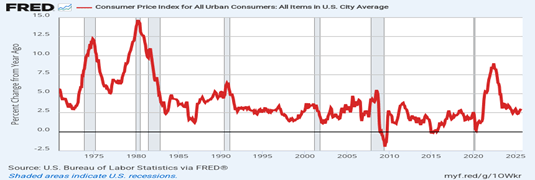
The last period of moderate inflation was the decade after the Great Recession, as seen in the Fred Consumer Price Index chart (large gray bar is GR)—that ended with the COVID-19 pandemic. Moderate inflation returned during the Obama administration when regulations were created that required banks to play by the rules and hold more capital.

But what if the rules are changed again that allow higher inflation and fewer regulations that the Trump administration says it wants?

The moderate inflation ended because of the COVID-19 pandemic when massive liquidity was injected into the economy during the first Trump and Biden administrations to speed up the recovery. Inflation jumped to a high of 9 percent before declining until the retaliatory tariffs, rising again to its current 3%.

So now there is growing doubt that the Fed can maintain the 2 percent inflation target, since the newest members of the Fed Governors that vote on interest rates were Trump-appointed. And a Trump pick will become the new Federal Reserve Chair next year.

This is while President Trump has been calling for lower interest rates, which with higher tariffs would lead to higher inflation.

Trump claims that won’t happen even though he has raised tariffs to Taft-Hartley, Great Depression levels (thus raising import prices), has raised federal debt because of his Big Beautiful Tax Bill, and is loosening financial regulations that limit market speculation (e.g., in Bitcoin).

Add all this to the chaos generated by a White House that almost daily revises its decisions (e.g., TACO Trump), which makes it almost impossible to predict what will happen next.

Trump won’t admit he is responsible for the rise in consumer prices since April 2. But it happened at the same time that he announced his retaliatory tariffs on the rest of the world.

There is pushback from the bond market, which doesn’t like inflation because it reduces the value of bonds. We can see that certain financial markets are already reacting to the inflation uptick with higher interest rates, which is making consumers increasingly unhappy, even with the second -0.25 percent rate cut in October.

This translates into higher mortgage rates as well, which won’t make the housing industry happy either. So, who will lobby against more easy money to prevent another Great Recession, which happened the last time Republicans pushed through such an easy money agenda by blatantly ignoring financial regulations?

Though no one was punished for it, and American taxpayers paid for the bailout of our financial system. Will that happen again, now that Republicans are once again in charge?

Consumers don’t like higher prices, period, and there is another election in 2026. They might even remember the eight million job losses that followed what was the worst economic downturn since the Great Depression.

Harlan Green © 2025

Follow Harlan Green on Twitter: https://twitter.com/HarlanGreen
Posted in Consumers, COVID-19, Economy, Politics, Weekly Financial News | Tagged , , , , , , , , , | Leave a comment

The Truth About High Tariff’s

Popular Economics Weekly

“High tariffs inevitably lead to retaliation by foreign countries and the triggering of fierce trade wars. Then the worst happens: markets shrink and collapse, businesses and industries shut down, and millions of people lose their jobs.” President Reagan

Reagan Library

Was President Reagan predicting what would happen in Trump’s second term as president when he made a radio address about the dangers of high tariffs?

President Trump didn’t like Ontario Prime Minister Dog Ford’s posting of a 1987 radio address by President Reagan criticizing high tariffs that went viral because it was describing what was already happening with Trump’s illegal, retaliatory tariffs that are destroying the American economy and causing our allies to make deals with China.

It was obvious President Trump didn’t want his public to know that starting a tariff war with all 180 countries in the world would trigger “fierce trade wars” and sow economic chaos.

Add the job losses for “millions of people” his massive downsizing of the federal workforce that provides the benefits that protect all Americans, while attacking our institutions of higher learning that prepare us for the future, we can see where this can lead.

His actions are already contributing to a skilled worker shortage and the shrinkage of huge segments of the U.S. working age population with his attacks on immigrants that make up 40 percent of our agricultural workers and a large part of our service industry workers.

Is the chaos he is causing designed to destroy the U.S. economy as we know it, “markets shrink and collapse, businesses and industries shut down,” so that all or most power will be concentrated in the hands of the oligarchs and close allies that support him?

It happened in Russia after the collapse of the Soviet Union. Its collapse caused Russian oligarchs and Putin to snap up whole industries for pennies on the dollar, thus concentrating their wealth where Putin could control it.

Why can’t it happen here? Trump adores Putin as his model, but he would need a cowed tribe of supporters similar to Russia’s serb population, the serfs of old, liberated little more than 100 years ago, to sustain his power. Right now, it’s Trump’s White Christian Nationalists (like Putin’s Russian Orthodox supporters), but they are a small minority.

President Trump will only succeed in his scheme if he can convince enough Americans that his tariffs against the rest of the world (and higher inflation) are good for US because it would bring back better-paying industrial jobs to his base in the Midwest that had suffered from the globalization of manufacturing.

But that’s not what President Reagan said. He would also have to convince enough Americans that destroying large segments of the U.S. economy—in public health, environmental protection, social services—is worth the cost of higher tariffs, rather than live as his red state supporters have suffered under Republican rule; many with no minimum wage, minimal or no health care, no environmental protection from increasingly frequent natural disasters, and above all, a distrust in science that would provide them a better future.

We should ask ourselves, why would President Trump enact his agenda outside of most customs and laws, demolish the East Wing of the White House to build a 90,000 square foot ballroom without approved plans or permits?

Trump can only be stopped from his attempt to set up an American version of Putin’s Oligarchy if enough Americans see what is already happening.

Harlan Green © 2025

Follow Harlan Green on Twitter: https://twitter.com/HarlanGreen
Posted in Consumers, COVID-19, Economy, Politics, Weekly Financial News | Tagged , , , , , , , , , , , , , , , , | Leave a comment

Housing Market Is Recovering

The Mortgage Corner

WASHINGTON (October 23, 2025) – Existing-home sales increased by 1.5% month-over-month in September, according to the National Association of REALTORS® Existing-Home Sales Report. The Report provides the real estate ecosystem, including agents and homebuyers and sellers, with data on the level of home sales, price, and inventory.

FREDexistinghomes

It’s about time. We are seeing a housing revival with existing home sales on a 7-month high for the first time since the 2008-09 Great Recession (wide gray band in FRED graph), as reported by the National Association of Realtors (NAR).

The housing market has been stuck in part because the Fed held off cutting interest rates until its September FOMC. The cut was just -0.25%, and two more rate cuts are expected this year.

That may start a more sustained housing recovery, as fixed mortgage rates are also beginning to decline despite rising inflation since April and Trump’s retaliatory tariffs. (Bond holders don’t like inflation because it reduces the value of bonds.)

“As anticipated, falling mortgage rates are lifting home sales,” said NAR Chief Economist Dr. Lawrence Yun. “Improving housing affordability is also contributing to the increase in sales.”

Affordability has improved because “Inventory is matching a five-year high, though it remains below pre-COVID levels,” Yun added. “Many homeowners are financially comfortable, resulting in very few distressed properties and forced sales. Home prices continue to rise in most parts of the country, further contributing to overall household wealth.”

The 30-year conforming fixed mortgage rate for best credit holders has dipped below 6% to about 5.875% for 0 pts. in closing costs, or 5.50% for a 1 pt. origination fee. The 15-year fixed rate is now 5.25% for 0 pts., and 4.875%, 1 pt. at this writing.

This year’s housing revival first showed up in a boost in new-home sales, according to the National Association of Homebuilders (NAHB). Sales of newly built single-family homes jumped 20.5% earlier in August, to a seasonally adjusted annual rate of 800,000 from an upwardly revised reading in July, according to newly released data from the U.S. Department of Housing and Urban Development and the U.S. Census Bureau.

Much of the new-home sales boost was due to a construction surge to as much as 1.9 million annual units after the COVID-19 pandemic, seasonally adjusted. That and record low interest rates during the pandemic caused bloated inventories that builders are attempting to reduce. So they are offering interest rate buydowns to reduce mortgage rates. It cuts into builders’ profits but adds little to the sales price.

Housing construction has declined since then, decreasing 8.5% in August to a seasonally adjusted annual rate of 1.31 million units and construction will probably remain lower until more buyers come into the housing market as mortgage rates decline further.

What about mortgage rates? That hasn’t stopped homebuyers before. The 30-year conforming fixed rate hovered between 7.5% to 5.0% from the beginning of the housing bubble in 2000 to 2010 when homebuyers went wild with subprime loans, until the Great Recession.

The moral of this tale is that homebuyers and lenders have always found a way to finance a purchase with an almost infinite variety of mortgage choices. But the U.S. population is beginning to shrink because of the immigration restrictions. Builders and governments must find more creative solutions to affordable housing to bring more young adults into the housing market.

Challenging affordability conditions have always created headwinds for the housing sector, but that never stopped those that wanted to own a residence during the era of double-digit interest rates in the 1980s and 90s.

The average 30-year conforming fixed rate mortgage didn’t drop below 10% until the 1990s and 7.5% until 2001.

I foresee lenders finding creative ways to finance more homebuyers in the coming years as well.

Harlan Green © 2025

Follow Harlan Green on: https://twitter.com/HarlanGreen
Posted in Consumers, COVID-19, Economy, Housing, Weekly Financial News | Tagged , , , , , , , , , , , , , | Leave a comment

When Will It End?

Popular Economics Weekly

The government shutdown is a good time to look at Donald Trump’s economic achievements in his second term, if we want any peace and prosperity at all once the real costs of the tariff war and his tax cuts become obvious.

“With yet another round of tariffs taking effect this week — this time on cabinets and other furniture, timber and lumber — the White House insists that its policies are about “fairness” and “reciprocity.” The evidence now tells a different story of higher prices for Americans, lower margins for U.S. firms, collapsing exports in flagship industries, investment paralysis and mounting risks of an economic slowdown.” Veronique de Rugy LATimes

Part of the problem is that Trump has always needed a lot of help to survive his storied temper tantrums, multiple business failures and bankruptcies. He learned how to play a successful businessman that he was not in “The Apprentice” TV show that he touted in his early book,Trump: How to Get Rich.

Huffington Post

With his luxury buildings, award-winning golf courses, high-stakes casinos, and glamorous beauty pageants, Donald J. Trump is one of a kind in American business. Every day, he lives the American dream. Now he shows you how it’s done, in this rollicking, inspirational, and illuminating behind-the-scenes story of invaluable lessons and rich rewards,” said Amazon’s “How To Get Rich” book blurb.

His “American Dream” was never meant for the many, just the few. Many Americans are not living the dream that Trump promised because raising the tariffs to Great Depression levels in the name of “fairness and reciprocity” is raising the prices for all Americans, and slowing economic growth.

The LATimes reported a recent KPMG survey finds that “60% of businesses reported decreased overseas sales” in the first six months of Trump’s tariffs. KPMG finds that nearly half of American companies have already raised prices because of tariffs; two-thirds have passed at least part of those costs on to shoppers; and nearly 40% have paused hiring, with a third cutting jobs.

CEOs overwhelmingly expect tariffs to weigh on business for years. Goldman Sachs estimates U.S. consumers are now footing 55% of the total tariff bill, while foreign exporters bear only a sliver of the costs.

“So much for draining the swamp. All of this explains the wild uncertainty business leaders have experienced in recent months. Retailers are now bracing for 100% tariffs on Chinese goods scheduled for Nov. 1, right before the holiday rush. Some firms have scurried to ship early, but even a few days’ delay at sea could blow up their margins. With deadlines set, delayed and often re-announced with each news conference, companies can’t plan or invest,” said de Rugy.

The NYTimes cites a Moody’s Analytics report that the top 10 percent of U.S. households now account for nearly half of all domestic spending. And the Federal Reserve just reported that consumers’ revolving credit shrank (-5.5%) for the first time since 2020 during the COVID-19 pandemic.

Republicans and Donald Trump have put on quite a show to convince Americans that they are better off by cutting government jobs and benefits in the name of a better use their benefits.

But it’s turning out “How To Get Rich” is a scheme to benefit the very few whose taxes have been reduced. The shutdown will end when enough Americans realize it is being paid for with higher inflation and taxes (tariffs) for the many.

Harlan Green © 2025

Follow Harlan Green on Twitter: https://twitter.com/HarlanGreen

Posted in Consumers, COVID-19, Economy, Politics, Weekly Financial News | Tagged , , , , , , , , , | Leave a comment

Whose Inflation Is It?

Financial FAQs

“Still, despite multiple offsetting drivers, the tariff shock is further dimming already lackluster growth prospects. We expect a slowdown in the second half of this year, with only a partial recovery in 2026, and, compared to last October’s projections, inflation is expected to be persistently higher. Even in the United States, growth is weaker and inflation higher than we projected last year—hallmarks of a negative supply shock.” IMF Global Economic Outlook 2025

FREDcpi

No one wants to admit who is responsible for the sharp rise in consumer prices since April 2. Democrats and the Biden administration had worked to bring the Consumer Price Index (CPI) portrayed in the above graph down to 2.3% from its high of 9% that occurred in 2023 from the COVID-19 pandemic.

But it began to rise again in this April at the same time that Trump announced retaliatory tariffs on the rest of the world. Republicans say the inflation was caused by Biden’s massive government spending programs that sped up the COVID-19 pandemic recovery.

Most economists maintain that the inflation spike was caused in large part because of the supply shortages during the pandemic. President Trump’s tariff war on imports from the rest of the world that he announced on April 2 exacerbated the product shortages as exporters scrambled to find cheaper supply routes to avoid the higher tariffs.

Add to this the looming worker shortage from tighter immigration policies that are shrinking the foreign-born labor supply—another negative supply shock on top of that from tariffs—that is beginning to affect labor productivity.

The International Monetary Fund (IMF) in its latest Global Economic Outlook report says both the tariffs and a looming worker shortage are “hallmarks of a negative supply shock” that will eventually slow down world economic growth.

China is now restricting the export of rare earth minerals, for which Trump has threatened to add an additional 100 percent tariff on China’s exports to US. And the government shutdown will only make things worse in closing down the statistical departments that tell us where we are and might be in six months.

“Overall, despite a steady first half, the outlook remains fragile, and risks remain tilted to the downside,” reports the IMF. “The main risk is that tariffs may increase further from renewed and unresolved trade tensions, which, coupled with supply chain disruptions, could lower global output by 0.3 percent next year. Apart from this, four simmering downside risks are especially worrying.”

What are the “simmering downside risks”? U.S. financial markets are over-invested in AI with little to show for it, while AI is already causing white-collar layoffs, exacerbating the job losses incurred by the ICE roundup of undocumented immigrants.

And we have a record $39 trillion federal debt weighing on the credit markets that is competing with the private capital needed for new plants and equipment.

The Trump administration is vainly attempting to equate the record tariff rates, now at Great Depression levels, let us not forget, with some promised domestic industrial revival.

And Trump wants an easy money Federal Reserve to help grease its wheels. How do you think interest rates and inflation will respond to easier credit? The same way inflation and interest rates responded to Joe Biden’s New, New Deal?

We can’t borrow our way out of this debt mess with tax cuts for the wealthiest.

Harlan Green © 2025

Follow Harlan Green on Twitter: https://twitter.com/HarlanGreen

Posted in Consumers, COVID-19, Economy, Politics, Weekly Financial News | Tagged , , , , , , , , , , , , , , , | Leave a comment