LUCKY LOSER: How Donald Trump Squandered His Father’s Fortune and Created the Illusion of Success

Answering Kennedy’s Call

Born to a rich father who made him the beneficiary of his own highly lucrative investments, Trump received the equivalent of more than $500 million today via means that required no business expertise whatsoever.

A new book just out by Pulitzer Prize-winning journalists Russ Buettner and Suzanne Craig conducts an explosive investigation into the history of Donald Trump’s wealth, revealing how one of the country’s biggest business failures lied his way into the White House, says the Random House press release.

“This is a page turner, with spectacular anecdotes,” said a review by Washington Post’s Bethany McLean . . . “[Lucky Loser] shows in meticulously documented detail how ‘even when Trump appeared to be at his best, he was failing,’ with massive losses on his core business.

These are the acts of a bully, rather than leader, I said in 2017, which is why he seems to have so much in common with V Putin, Marine Le Pen, and other demagogues. Acting tough can be a plus when dealing with North Korea, or even Russia, but not when dealing with Americans who don’t like him or his very anti-American policies.

Random House

Buettner and Craig first revealed his real financial condition in a 2016 NYTimes article.

“The 1995 tax records, never before disclosed, reveal the extraordinary tax benefits that Mr. Trump, the Republican presidential nominee, derived from the financial wreckage he left behind in the early 1990s through mismanagement of three Atlantic City casinos, his ill-fated foray into the airline business and his ill-timed purchase of the Plaza Hotel in Manhattan.”

It heightens the absurdity of Republicans allowing Trump’s MAGA movement to take over the Republican Party.

I knew this when Trump first became President. His multiple bankruptcies of the Trump Casinos when other Atlantic City Casinos were successful, Trump University charged as a criminal enterprise (under RICO), and the fact that he had to rely on Russian Oligarchs to finance his real estate empire when U.S. banks would no longer lend to him, are just the tip of the iceberg of business incompetence.

Fortune Magazine reported in 2016 before becoming the Republican candidate for president on candidate Trump’s negotiating tactics: “The legal actions provide clues to the leadership style the billionaire businessman would bring to bear as commander in chief. He sometimes responds to even small disputes with overwhelming legal force. He doesn’t hesitate to deploy his wealth and legal firepower against adversaries with limited resources, such as homeowners. He sometimes refuses to pay real estate brokers, lawyers and other vendors.”

And, “As he campaigns, Trump often touts his skills as a negotiator,” said Fortune. “The analysis shows that lawsuits are one of his primary negotiating tools. He turns to litigation to distance himself from failing projects that relied on the Trump brand to secure investments.

“The authors prove that without his father’s support, Trump would have been nothing,” continues Washington Post’s McLean. “The book also raises a bigger question about the ‘fake it ‘til you make it’ ethos of modern America. In a world that conflates the ‘trappings of wealth with expertise and ability,’ where ‘fame, detached from any other marketable talent or skill,’ is ‘a highly compensated vocation,’ does it even matter if you never actually make it?”

This tells us best why he was able to take over the Republican Party that has drifted so far from conservative values and was once the environmental party when Republican President Nixon first signed the USEPA into law in 1972.

They had learned to “fake it ‘til you make it”, as was proved by the Trump administrations record in breaking up the USEPA so that Trump’s call to “Drill Baby Drill” for more fossil fuels could continue, and preserving tax cuts first enacted under Trump that will further increase the national debt.

Buettner and Craig’s book will hopefully uncover the truth of Trump’s MAGA policies before it is too late, as most of the modern media has failed to do.

Buettner and Craig’s work exposes how many passes Trump has gotten over the years, how thoroughly he is a creation of the media that has chased fame over blame, which as the authors write, ‘rarely revisited his claims and afforded credibility to everything he said,” concludes McLean’s review.

And now recognizing more signs of Trump’s mental deterioration as he ages makes it even more important that we in the media tell it like it is.

Harlan Green © 2024

Harlan Green on Twitter: https://twitter.com/HarlanGreen

Posted in Politics, Uncategorized | Tagged , , , , , , , | Leave a comment

Retail Sales Slowing

Financial FAQs

Breaking News: The Federal Reserve just announced it’s first rate cut of 0.50%, which lowers its Fed Funds rate from 5.25% to 4.75%.

Advance estimates of U.S. retail and food services sales for August 2024, adjusted for seasonal variation and holiday and trading-day differences, but not for price changes, were $710.8 billion, an increase of 0.1 percent (±0.5 percent)* from the previous month, and up 2.1 percent (±0.5 percent) from August 2023, said the Commerce Department..

Retail sales are slowing, which is another sign that economic growth may be slowing in the third quarter. Total sales for the more recent June 2024 through August 2024 period were up just 2.3 percent (±0.5 percent) from the same period a year ago without accounting for the current 3 percent inflation rate. It means consumer spending isn’t even keeping up with rising prices at the moment.

Vice President Harris announced in her Convention acceptance speech that a major part of her presidency will be to bring back the middle class.

“Building up the middle class will be a defining goal of my presidency,” she said. “I strongly believe when the middle class is strong, America is strong.”

What can she do? It’s becoming clear that our Middle Class–the midsection of U.S. earners and consumers—is finding it more difficult to maintain their standard of living.

For starters, it is finally time for the Fed to act to loosen credit with some interest rate cuts that will help everyone. How many cuts are needed will be the question.

FREDprimerate

Looking at the history of past growth cycles with the Bank Loan Prime Rate that most installment loans are keyed to, (which is now 8.5%). The Prime Rate was held at 3.25% for almost seven years after the Great Recession—2009-16—and again at 3.25% for two years after the COVID-19 pandemic—2020-2022 before being raised to its current 8.50% rate.

That is a tall order, needless to say. It means bringing down credit card interest rates that are mostly 20 percent today down to 15 percent where they were during the so-called period of Great Moderation, 2019-2016. The Bank Prime Rate moves in tandem with the Fed Funds Rate with a 3.25 percent margin (5.25%+3.25%=8.50%).

These were also the periods when GDP growth was within its long-term average of 2 percent, which the Fed has always labored to achieve in its stated goal of balancing maximum employment with stable prices.

The Fed raised its Fed Funds rate 11 times from March 2022 to July 2023 before holding it at the current 5.25 percent (the equivalent of an 8.5 percent Bank Prime Rate, as I said). The Fed must therefore bring it down 2 percent to return to the historical norm of 3.25 percent.

There are many things presidential candidate Harris can do as well: a $25,000 tax deduction for first-time homebuyers, expanded childcare tax deductions, and a middle-class tax cut for those earning less than $400,000 annually that she has touted in speeches.

But let’s start with some draconian interest rate cuts that will lower borrowing costs for everyone. The Fed Funds rate was raised 11 times in 17 months. It can bring it down in one year, if it chooses—0.25% per FOMC meeting times its regular eight meetings per year, for those readers that like numbers.

This will give a huge boost to the middle class, and maintain future growth as well.

Harlan Green © 2024

Harlan Green on Twitter: https://twitter.com/HarlanGreen
Posted in Consumers, COVID-19, Economy, Macro Economics, Politics, Weekly Financial News | Tagged , , , , | Leave a comment

Immigrants Drive Republicans Crazy!

Answering Kennedy’s Call

The stakes are enormous if Republicans succeed in removing most of the estimated 11 million undocumented workers (only half of which are from Mexico and the Latin countries), and cut legal immigration in half, as they have promised to do.

Republicans haven’t let up on their campaign to limit immigration since 2017 when I first wrote about the newly elected Trump administration’s demonization of immigrants.

It’s now become even worse as Presidential candidate Trump and VP candidate JD Vance on the campaign trail have doubled down on demonizing immigrants, saying they are now eating the pets of Ohioans!

Huffington Post

The absurdity of Republicans’ allowing Trump’s MAGA movement to take over the Republican Party has made it even worse for economic growth as well. Any mass deportation of immigrants would cause great harm to the American economy.

For most of the past half-century, adults in the U.S. Baby Boom generation – those born after World War II and before 1965 – have been the main driver of the nation’s expanding workforce, reports the PEW Research Center. But as this large generation heads into retirement, the increase in the potential labor force will slow markedly, and immigrants will play the primary role in the future growth of the working-age population (though they will remain a minority of it).

The stakes are enormous if Republicans succeed in removing most of the estimated 11 million undocumented worker (only half of which are from Mexico and the Latin countries), and cut legal immigration in half, as they have promised to do.

Economic growth will plummet, since it is mainly based on growth of the working age population, as well as labor productivity, which has also fallen since 2000.

The drop in labor productivity is in part because of the drop in capex spending, the investment in new plants and equipment, which has fallen by half since 2010, but also because of the Great Recession. Corporations have chosen to move many jobs overseas where labor is cheaper, rather than investing domestically to improve the productivity of American workers.

The number of adults in the prime working ages of 25 to 64 – 173.2 million in 2015 – will rise to 183.2 million in 2035, according to Pew Research Center projections. (But) That total growth of 10 million over two decades will be lower than the total in any single decade since the Baby Boomers began pouring into the workforce in the 1960s.

The Nobel Economist Paul Krugman said it in his most recent NYTimes Op-ed: “Overall, the move of immigrants to some small cities has been very beneficial, one of the best hopes those cities have for economic resurgence, but the hopes will disappear if immigrants are scared off by a climate of hate;” (or driven out by MAGA Republicans, which is what Trump has been attempting to do).

We are now seeing an ageing Trump whose incoherence is becoming more obvious, especially since Vice President Harris exposed his mental deterioration during the presidential debate.

And MAGA Republicans are blindly following him into the rabbit-hole.

Harlan Green © 2024

Harlan Green on Twitter: https://twitter.com/HarlanGreen
Posted in Uncategorized | Tagged , , , , , , , , | Leave a comment

HOW I LEARNED TO TRAVEL

A Memoir

By Sherry Keith

How I Learned to Travel, available on Amazon, is more than a travelogue, it’s an adventure story of a life of travel lived to the fullest, with an insatiable curiosity about new peoples and places. And Sherry Keith knows how to tell a story of nail-biting adventures in her travels on all continents in more than 60 countries in her work as a consultant for the World Bank and Professor of Social Science, some with her husband, a Professor of Economics, while raising two children.

She seems to have no fear in working in some of the poorest parts of the Amazon, or jungles of Nicaragua, whether as a consultant or in search of another adventure. I highly recommend it for anyone that loves to travel!

Harlan Russell Green

Posted in Uncategorized | Tagged | Leave a comment

Inflation Still in Decline

Popular Economics Weekly

The Consumer Price Index for All Urban Consumers (CPI-U) increased 0.2 percent on a seasonally adjusted basis, the same increase as in July, the U.S. Bureau of Labor Statistics. Over the last 12 months, the all items index increased 2.5 percent before seasonal adjustment,” said the Bureau of Labor Statistics (BLS).

Both the retail Consumer Price Index (CPI) and wholesale Producer Price Index (PPI) iinflation indicators continued to decline in August, which ensures the Fed will keep its promise and begin to cut short-term interest rates next week at its FOMC meeting.

Wholesale PPI prices have declined faster, now down to a 1.8 percent annual rise for raw materials. Retail CPI prices are holding at 2.5 percent annually, mainly because rental rates are still high due to the housing shortage. Gas and home grocery prices continued to decline.

FREDcpi/ppi

The FRED graph compares both indexes, with CPI the dark brown line. The graph shows wholesale PPI inflation (light blue line has been at or below the Fed’s 2 percent target rate several times. Whereas retail CPI prices have been more stubborn, holding at 2.5 percent annually, but plunging sharply from 3.5 percent just this March.

The PPI index actually dropped to zero inflation in June 2023 then rose again. It’s evidence that supply chains have recovered despite the monthly variations, whereas retail inflation is held up by other elements of the supply chain—such as distributors and retail stores adding in their costs and profit margins.

The CPI index for shelter rose 0.5 percent in August and was the main factor in the all items increase. The food index increased 0.1 percent in August, after rising 0.2 percent in July. The index for food away from home rose 0.3 percent over the month, while the index for food at home was unchanged. The energy index fell 0.8 percent over the month, after being unchanged the preceding month.

It’s further evidence of a very soft landing. The all-items CPI was the smallest 12-month increase since February 2021.

So what is next? How will lower interest rates affect the markets going forward?

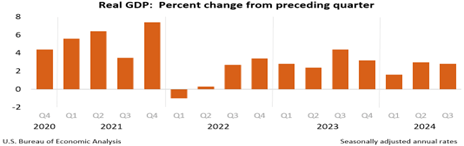
The Atlanta Fed estimate of Q3 growth was raised to 2.5 percent on September 9, up from 2.1 percent on September 4, mainly from private domestic investment, as higher government spending in infrastructure has kicked in.  

So higher economic growth will mainly be due to even more industrial activity as the cost of borrowing continues to decline. But housing construction is sure to be boosted as well, since construction financing will now be cheaper.

That’s probably why the National Association of Homebuilders (NAHB) reported a surprising rise in new-home sales in July.

Sales rose 10.6% to a 739,000 seasonally adjusted annual rate from “significant upward revisions” in June, according to newly released data from the U.S. Department of Housing and Urban Development and the U.S. Census Bureau. The pace of new home sales is up 5.6% from a year earlier.

And this is before any Fed rate cuts. But mortgage rates have already declined substantially with the 30-year conventional Fannie/Freddie fixed rate now as low as 5.75% for one origination point with the best credit record.

“The Census estimate of new home sales is often volatile and subject to revisions and it is possible that the July estimate for sales will be revised lower next month, said chief economist Robert Dietz. “NAHB is forecasting gradual improvements for the home building sector as the Fed eases monetary policy and mortgage interest rates trend lower.”

Another factor in the uptick of home sales is that credit conditions may be loosening for borrowers, reports the Mortgage Bankers Association (MBA).

“Credit availability increased in August, with the conventional credit index reaching its highest level since July 2022. This was driven by increased cash-out refinance and non-QM programs,” said Joel Kan, MBA’s Vice President and Deputy Chief Economist.

Everything is now pointing to a better year ahead with lower interest rates, in other words. But a very large fly in the ointment will be what can happen with the upcoming Presidential election.

Harlan Green © 2024

Follow Harlan Green on Twitter: https://twitter.com/HarlanGreen
Posted in Consumers, COVID-19, Economy, Housing, Politics, Weekly Financial News | Tagged , , , , , , , , , , | Leave a comment

No “Art of the Deal”

Answering Kennedy’s Call

“It’s implicit in a lot of what people write, but it’s never explicit–or, at least, I haven’t seen it. And that is that it’s impossible to keep him focused on any topic, other than his own self-aggrandizement, for more than a few minutes…”

Huffington Post

This is the Donald Trump I first wrote about in The Huffington Post when he had just won the 2016 Presidential election and Tony Schwartz, his first ghost-biographer, described the experience.

Trump’s 2024 Presidential campaign debate with Vice President Kamala Harris just confirmed nothing has changed. He couldn’t complete sentences, much less complete thoughts, during the 90-minute debate with her on ABC.

“President-elect Donald Trump is about to move into the White House,” I wrote then. “This is the man who has become a case-study and textbook model of Narcissism for Psychotherapists. Narcissistic personality disorder (NPD) as defined by Wikipedia, ‘is a long-term pattern of abnormal behavior characterized by exaggerated feelings of self-importance, an excessive need for admiration, and a lack of understanding of others’ feelings.”

“Or a Narcissist can also be defined as one who must believe he cannot do wrong, cannot admit he has ever been wrong or apologized for any of his failings. So it would be helpful to understand President-elect Trump’s failings, in order to understand and perhaps influence (as President Obama says he wants to attempt), just how he might behave as ‘our’ next President.

In fact, that is why Trump doubles down on any who would question him, accusing the accuser of the same misdeeds. Maria Konnikova implied that Trump was a classic Con Artist in her now famous New Yorker article:

“A grifter takes advantage of a person’s confidence for his own specific ends—ends that are often unknowable to the victim and unrelated to the business at hand. He willfully deceives a mark into handing over his trust under false pretenses. He has a plan.”

That must be why Trump maintained during the 2016 campaign that he would convene a special prosecutor to prosecute and jail Hillary Clinton for her “crimes”, when in fact Trump himself has been prosecuted for outright criminal behavior, such as the three Trump University lawsuits that he settled.

Or he accused President Obama of not being born in the US for six years, in the face of overwhelming evidence to the contrary. Was Trump being stupid? No, he was currying favor with the birther movement to gain their support; mainly white male, racist Tea Partiers still fighting the Civil War who wanted to cast doubt on Obama’s legitimacy as the first African American President.

“What ultimately sets con artists apart is their intent,” says Konnikova. “To figure out if someone is a con artist, one needs to ask two questions. First, is their deception knowing, malicious, and directed, ultimately, toward their own personal gain? Second, is the con a means to an end unrelated to the substance of the scheme itself?”

Why does he continue to perpetuate so many cons, when he has broken contracts, filed multiple bankruptcies, and been involved in 4,000 lawsuits at last count–on his way to become the celebrity billionaire? The toll on his supporters–even families–must be devastating to maintain that image of success with overwhelming evidence to the contrary.

A major reason is his very short attention span that has gotten worse with age. It was first described by Tony Schwartz, ghost writer of Trump’s “The Art of The Deal“: “Trump has been written about a thousand ways from Sunday, but this fundamental aspect of who he is doesn’t seem to be fully understood,” Schwartz told Jane Mayer, author of a New Yorker article.

“It’s implicit in a lot of what people write, but it’s never explicit–or, at least, I haven’t seen it. And that is that it’s impossible to keep him focused on any topic, other than his own self-aggrandizement, for more than a few minutes, and even then . . . If he had to be briefed on a crisis in the Situation Room, it’s impossible to imagine him paying attention over a long period of time,” said Schwartz

We can now know the reason for his admiration of Vladimir Putin, for instance, who Trump has been wanting to cultivate since his 1980 Miss Universe contest held in Moscow. It was really an attempt to buy a Moscow luxury hotel. He had to turn to Russian oligarchs and Mafia figures to fund many of his real estate ventures that conventional banks wouldn’t touch. How’s that for a classic conflict-of-interest as President?

He was quoted once upon a time in a New York Times interview that he believed “Presidents cannot have a conflict of interest,” even though it is blatantly unconstitutional under the emolument clause that prohibits gifts or favors from foreign governments or individuals.

Is it possible that he even conned the majority of SCOTUS justices into ruling that presidents are immune from prosecution for almost any activity while president?

So it’s good news that he couldn’t con Vice President Harris, a former prosecutor and Attorney General, that he is above the law.

Harlan Green © 2024

Harlan Green on Twitter: https://twitter.com/HarlanGreen

Posted in Politics | Tagged , , , , , , , , , | Leave a comment

Who Killed America’s Middle Class?

Financial FAQs

A report from the Pew Research Center found that, for the first time since the 1970s, families defined as “middle income” are in a minority in the US – squeezed from both ends by an enlarged poverty-stricken group below them, and an enriched group above them.

Vice President Harris announced in her Convention acceptance speech that a major part of her presidency will be devoted to bring back the middle class.

“Building up the middle class will be a defining goal of my presidency,” she said. “I strongly believe when the middle class is strong, America is strong.”

It’s becoming clear that our Middle Class–the midsection of U.S. earners and consumers–has shrunk alarmingly. And this is the main reason for the political polarization today that in the words of journalist Christopher Hedges, has driven the Republican Party “insane”

Our society has become so polarized that Donald Trump needed the support of the Ku Klux Klan, white nationalists, and Vladimir Putin to become President. Whereas it has been such middle class values of probity, honesty and science, first satirized in Moliere’s Le Bourgeois gentilhomme, (The Middle Class Gentleman), that has been the stabilizing influence in American politics since WWII.

The main difference between poverty and middle class, and between middle class and the wealthiest, noted one researcher, “is belief in, and planning for, moving up as a working assumption.” A report from the Pew Research Center found that, for the first time since the 1970s, families defined as “middle income” are actually in a minority in the US – squeezed from both ends by an enlarged poverty-stricken group below them, and an enriched group above them.

Graph: Fortune Magazine

This graph shows the shrinkage of those defined as middle class from 1979 to 2014 — from 38.8 percent (gray line) to 32.09 percent (blue line), according to the Pew study. The shrinkage reads like a textbook example of the future that French economist Thomas Piketty predicts for the world in his 2014 best-selling, Capital in the Twenty-First Century. In 1971, there were 80 million households in the US defined as middle income – compared with a combined 52 million in the groups above and below. Now, there are 120 million middle-class families, but 121 million rich and poor – “A demographic shift that could signal a tipping point,” says Pew.

So who or what is at fault for the result; record income inequality last reached in 1929 that led to the Great Depression? We can fault President Reagan, who was first to break the unions with his firing of all federally employed Air Traffic Controllers that belonged to PATCO, the traffic controller’s union.

Or, conservatives’ espousal of the Reagan motto, “government is the problem,” which caused the massive downsizing of government regulation, as well as the ensuing de-regulation of whole industries, such as the airlines, telecommunications, and financial markets.

But the truth was that Democrats were also implicated — in fact, from the Presidency of Bill Clinton. For it was President Clinton who veered so far to the right in his 1966 reelection campaign that he preempted the Republican platform by continuing to deregulate the financial markets with the repeal of the Glass-Steagall Act that separated FDIC depositor-insured banking from higher risk investment banking, financed the addition of 100,000 more police to combat the drug epidemic, and downsized poverty programs with welfare reforms that required welfare recipients to take low-paying menial jobs to receive even a limited amount of financial support.

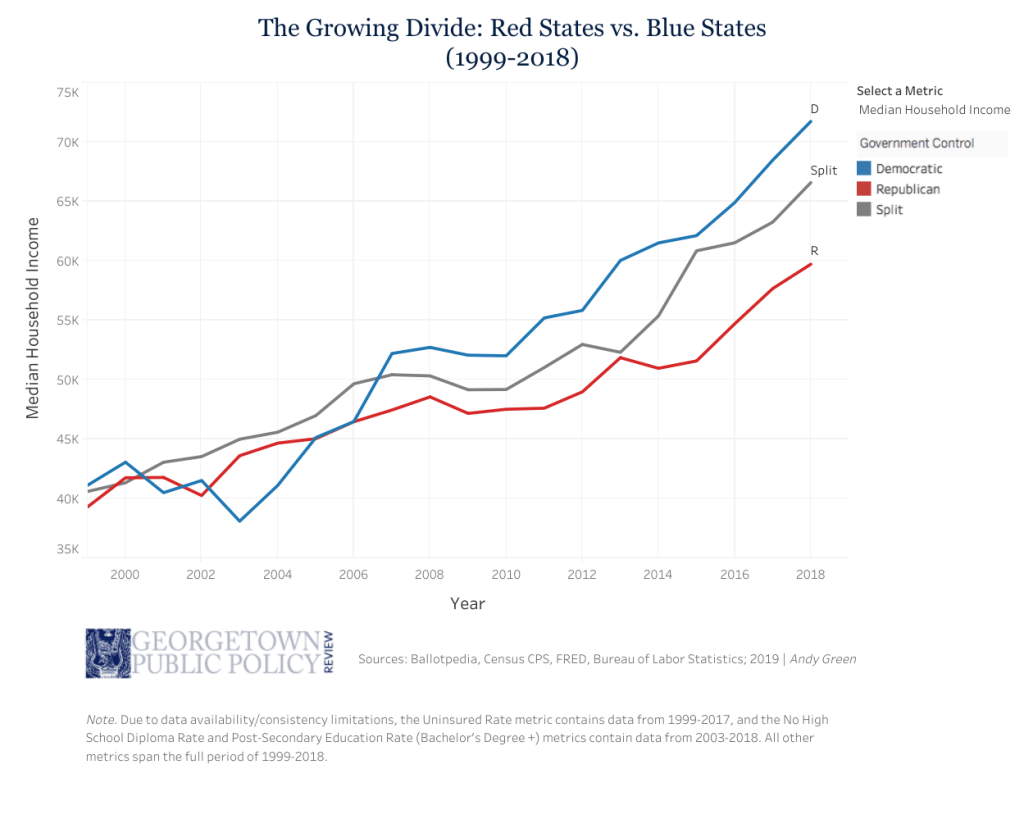
The Republicans, as Chris Hedges said, were driven politically insane. They no longer had those bread and butter issues (such as law and order, smaller government) that were once their own, which led to formation of the Tea Party, and a new political civil war declared on Big Government ruled by the northern elites. It was our 150 year-old Civil War taking a new form—red states vs. blue states—but with almost the same mix of combatants.

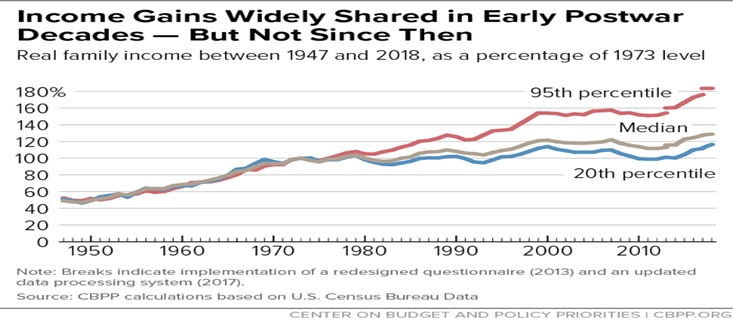
Even more significant is the record income and wealth inequality since 1979 that has resulted; a more partisan and unequal electorate fearing further losses in their status as Americans.

Vice President Harris has said building up the middle class again is one of her priorities. So let us hope a majority of Americans realize this as well in November; that our prosperity and stability rest on a middle class that hasn’t given up hope for a better future.

Harlan Green © 2024

Harlan Green on Twitter: https://twitter.com/HarlanGreen

Posted in Consumers, Economy, Politics | Tagged , , , , | Leave a comment

Antonin Scalia’s White, Male Legacy

Answering Kennedy’s Call

Supreme Court Justice Antonin Scalia’s passing is a shock to die-hard conservatives for good reason. He was the bastion and spokesperson of the originalist interpretation of the Constitution, which meant any law had to divine the original intentions of the founding white male fathers of our nation.

AK-47

The two students and two teachers at Appalachee High School were killed by a 14-year old student with an AR-15 assault rifle has brought back the debate on the causes of such gun violence than kills more than 30,000 Americans every year.

Wednesday’s mass shooting marked the 45th school shooting of 2024 and the deadliest US school shooting since the March 2023 massacre at The Covenant School in Nashville,” said CNN.

Military-style assault rifles had been banned for 10 years during the Clinton administration, but the Republican-led Bush administration didn’t renew the ban. Why? One man, SCOTUS Justice Antonin Scalia, was almost solely responsible for the Supreme Court ruling that legalized assault rifles for use by common citizens.

I wrote about it in Huffington Post at the time of Scalia’s death in 2016.

“Supreme Court Justice Antonin Scalia’s passing is a shock to die-hard conservatives for good reason. He was the bastion and spokesperson of the originalist interpretation of the Constitution, which meant any law had to divine the original intentions of the slave-owning, landowning, founding white male fathers of our nation, which excluded women and non-landowning males (and slaves, of course) from representation.”

So that meant turning the clock back at least one century to a time when the white male patriarchy still ruled, which was a much less democratic time. Scalia’s most noted opinion was to expand Second Amendment gun owners’ rights, which ‘protected’ every citizen’s right to own a gun almost without restriction, because he convinced the majority of SCOTUS that the Second Amendment right to bear arms also protected an individual’s right of self-defense.

The result has been record gun sales and gun deaths (30,000+ per year), as well as mass shootings, and no limit to the purchase of military-style assault rifles with unlimited magazines. Another little-noted result was the higher incidence of gun violence in households with guns, according to the Law Center to Prevent Gun Violence.

In fact, “Research published in the New England Journal of Medicine found that living in a home where guns are kept increased an individual’s risk of death by homicide by between 40 and 170 percent,” said the Law Center. “Another study published in the American Journal of Epidemiology similarly found that “persons with guns in the home were at greater risk of dying from a homicide in the home than those without guns in the home.”

This study determined that the presence of guns in the home increased an individual’s risk of death by homicide by 90 percent.

Whereas other developed countries without that Second Amendment ‘right’, such as Australia, do not allow the purchase of a gun for self-defense to be a sufficient reason for owning such a weapon. And Australia has not had a single incidence of mass shootings since 1996 and the passing of its gun control legislation.

Does it make sense for anyone to own a military-style assault rifle for self-defense when it was manufactured for wartime? The definition of the word, assault, means just that. It was made to assault an enemy during wartime. What purpose could it have in a home, even as a semi-automatic—where children live?

Harlan Green © 2024

Harlan Green on Twitter: https://twitter.com/HarlanGreen

Posted in gun violence | Leave a comment

Economy Has Landed–Part II

Popular Economics Weekly

Fed Chairman Powell finally admitted the U.S. economy has made a soft landing at this year’s Jackson Hole Federal Reserve Conference. “The labor market is no longer overheated, and conditions are now less tight than those that prevailed before the pandemic,” he said in his speech. 

FREDunemployment

It’s a very soft landing. The unemployment rate dropped back to 4.2 percent from 4.3 percent in July and just 142,000 nonfarm payroll jobs were created in August. U.S. job gains in July were also lowered to 89,000 from 114,000, and in June revised down to 118,000 from 179,000.

The Fed is now playing catchup in the opposite direction. They waited too long to begin to restrict credit when the inflation rate first shot up in 2020 and perhaps waited too long to cut interest rates, since the downward momentum of lower job creation has begun.

This doesn’t mean a looming recession, however. It’s possible that third quarter economic growth will remain positive. Most estimates for Q3 growth are in the 2 percent range, down from the 3 percent Q2 GDP growth rate.

The Atlanta Fed estimate of Q3 growth said, “The GDPNow model estimate for real GDP growth (seasonally adjusted annual rate) in the third quarter of 2024 is 2.1 percent on September 4, up from 2.0 percent on September 3,” because consumer spending has slowed but there was an increase in domestic investment.

The New York Fed’s ‘Nowcast’ growth estimate for Q3 is 2.6%.

The Fed’s tools to ‘brake’ inflation have always been crude since they must look in the rearview mirror for data to buttress their policies. They must convince the financial markets as well as the public that their moves are credible with data that measures past months to spot trends—mainly consumer spending and employment.

Better news is that the so-called yield curve (the relation of 2-year bond yields to 10-year bond yields) is no longer inverted. The 2-year bond yield has plunged to 3.67% and 10-year bond yield is 3.87% at this writing.

It has been a credible recession indicator when yields are inverted because banks can’t lend at a lower rate than their cost of money.

The yield curve is steepening again, in other words, because conditions are looking better for investors so that longer-term yields are higher than short-term bond yields, which is where they should be in more normal times.

Consumers must now adjust as well—and save a bit more for any future uncertainties. But they are still solvent and fully employed. And the fact that the Fed is now poised to loosen the credit tourniquet that has stifled growth in many sectors (such as housing and manufacturing) should mean several years of rising prosperity for most Americans.

Harlan Green © 2024

Follow Harlan Green on Twitter: https://twitter.com/HarlanGreen
Posted in Consumers, COVID-19, Economy, Housing, Weekly Financial News | Leave a comment

Why No Recession?

Financial FAQs

I said last month we know why the US economy is still growing. Consumers keep spending, and the unemployment rate, though rising, is just 4.2 percent. The second revision of second quarter economic growth confirms this as well, jumping from 2.4 to a 3.0 percent growth rate.

But the downward revision of -818,000 nonfarm payroll jobs by the BLS from March 2023 to March 2024 showed not as many jobs were created as originally estimated, and it has begun to panic the financial markets.

And if consumers don’t keep spending where they spend the most—leisure and healthcare—what will keep US from a recession? It’s government spending via Bidenomics, President Biden’s legislation to modernize the economy. We should ignore the protests from conservatives of too much government spending and too much public debt for the moment. It’s what is keeping us at full employment.

Paul Krugman opined earlier in the year on the particulars of President Biden’s ‘New’ New Deal legislation, which is investing as much in the US economy as Roosevelt’s New Deal.

“The fact, however, is that Biden has put in place a very ambitious agenda — major enhancements of Obamacare, student debt relief, big infrastructure spending, large-scale promotion of semiconductors and green energy that have led to a surge in manufacturing investment.”

FREDmanfacturing

It has led to a very big jump in Manufacturing investment, for starters, that is creating more high-paying jobs—800,000 manufacturing jobs to date. Although overall manufacturing activity has been shrinking per the latest surveys—even with investments in the construction of new Manufacturing facilities having soared from $78 billion in 2020 to $237 billion this July—it should means better days ahead for the manufacturing sector.

This is important because July’s BLS Job Openings and Labor Turnover Survey (JOLTS) report shows a weakening labor market. The number of job openings dropped to 7.7 million from its high of 11 million openings in 2022 as the economy rushed to recover from the COVID-19 pandemic. (That’s still a lot of jobs looking for workers.)

The number of job openings decreased in health care and social assistance (-187,000); state and local government, excluding education (-101,000); and transportation, warehousing, and utilities (-88,000). Job openings increased in professional and business services (+178,000) and in federal government (+28,000).

BLS.gov

This is further evidence that growth will continue and perhaps keep consumers shopping for bargains, which is why inflation and rising prices should no longer be a problem, even as the Fed begins to cut interest rates this month.

Consumer confidence is rising again as well, which should help sustain the rally, as consumers seem to be worrying less about their job, per the Conference Board survey, even though personal savings have declined to dangerous lows.

“The Conference Board Consumer Confidence Index® rose in August to 103.3 (1985=100), from an upwardly revised 101.9 in July. The Present Situation Index—based on consumers’ assessment of current business and labor market conditions—improved to 134.4 from 133.1 in July.”

So we still depend on consumers to carry most of the load to sustain the strong growth, but government has to give a hand to keep them “in the game,” as I’ve been saying.

We will know more come Friday’s unemployment report.

Harlan Green © 2024

Harlan Green on Twitter: https://twitter.com/HarlanGreen

Posted in Consumers, COVID-19, Economy, Weekly Financial News | Tagged , , , , , | Leave a comment