Consumer Sentiments Rising As Inflation Declines

The Mortgage Corner

UnivMichigan

Consumers are feeling more optimistic, and it’s probably because they are seeing price rises beginning to moderate and prices decline in some areas.

The University of Michigan reported in its preliminary sentiment survey for December that consumer sentiment rose 4 percent above November, recovering most of the losses from November but remaining low from a historical perspective.

“Gains in the sentiment index were seen across multiple demographic groups, with particularly large increases for higher-income families and those with larger stock holdings, supported by recent rises in financial markets…Throughout the survey, concerns over high prices—which remain high relative to just prior to this current inflationary episode—have eased modestly.”

Why in are consumers feeling better? One reason may be gas prices are falling. The national average retail price for a gallon of gas is now $3.33, down $1.69 from June, according to White House data, and now lower than pre-Ukraine war levels.

And a key index of wholesale inflation, the Producer Price Index (PPI), also softened. It rose 0.3 percent in November. The core producer price index, which excludes volatile food, energy and trade prices, also rose 0.3percent in November, up from a 0.2 percent gain in the prior month, but slowed to 7.4 percent gain over the past 12 months from 8.1 percent in the prior month.

Even more importantly for economic growth, the index is down from the peak of 11.7 percent in March when bottlenecks restricted the supply of raw materials that comprise the wholesale price index.

Its reading on future inflation expectations is also looked at by the Fed in an attempt to predict future consumer spending.

Year-ahead inflation expectations improved considerably but remained relatively high, falling from 4.9 percent to 4.6 percent in December, the lowest reading in 15 he months but still well above 2 years ago.

“Declines in short-run inflation expectations were visible across the distribution of age, income, education, as well as political party identification. At 3.0 percent, long run inflation expectations has stayed within the narrow (albeit elevated) 2.9-3.1 percent range for 16 of the last 17 months.”

I’ve highlighted the longer term expectations because it is this statistic that is supplying ammunition for the inflation doves who say the Fed should now pause in their rate hikes to see if their actions to date will induce consumers to spend less, thus pushing down inflation even further.

We are already seeing its effect on the housing industry. I reported recently that the National Association of Realtors® (NAR) reported median house prices were up just 6.6 percent year-over-year (YoY) in October. This is down from the peak growth rate of 25.2 percent YoY in May 2021.

And, Case-Shiller reported that the National Index was up 13.0 percent YoY in August, down from a YoY peak of 20.8% percent in March 2022.
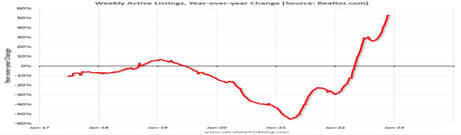
Calculated Risk

Any moderation in inflation is good news for housing, of course. Calculated Risk’s Bill McBride just highlighted a report from the National Association of Realtors (see above graph) that for-sale housing inventories are up 53 percent in one year.

This is perhaps the best reason to believe that as inflation continues to decline, it will revive the housing market as well as bolster consumer confidence.

Harlan Green © 2021

Follow Harlan Green on Twitter: https://twitter.com/HarlanGreen

Posted in Consumers, COVID-19, Economy, Housing, housing market, Weekly Financial News | Leave a comment

Government Is Solution (Not the Problem)

Financial FAQs

BEA.gov

It looks increasingly like the economy is doing the Federal Reserve’s work in bringing down inflation, says the most recent economic data. And our government is doing its part.

Much of recently enacted U.S. government programs will modernize the U.S. economy, increasing its efficiency (e.g., better roads and bridges, Internet, health care, less pollution), which will continue to bring down inflation.

As Nobel Prize-winner Joe Stiglitz said recently in a MarketWatch article, “Thanks to President Joe Biden’s recovery bill (the American Rescue Plan), the United States had the strongest recovery of any of the world’s advanced economies, reducing childhood poverty by almost half in the space of a year.

“Biden also oversaw the passage of the first major infrastructure bill in decades; America’s first major legislative response to climate change, the Inflation Reduction Act; and a major industrial-policy bill, the CHIPS and Science Act, which explicitly recognizes the government’s key role in shaping the economyAnd these landmark bills all passed despite a historically unwieldy Congress,” said Professor Stiglitz.

This Friday’s upcoming Producer Price Index for raw materials should also telegraph another drop in inflation before the Fed Governors convene their last meeting of the year, as raw material prices for almost everything (copper, steel, fossil fuels) are in decline.

A worldwide drop in fossil fuel consumption is causing our gas prices to fall below the $3.50 per gallon price that prevailed before the Ukraine war. This should be good news for continued domestic growth, even if declining prices are a sign of slow growth elsewhere.

Even today’s reports of higher factory activity, and the ISM’s index of service-sector growth show the U.S. economy expanding, not contracting.

The ISM’s non-manufacturing survey, a barometer of U.S. business conditions at service-sector companies such as banks and restaurants rose to 56.5 percent in November, which is a strong showing that shows the economy still expanding. Numbers over 50 percent are a sign the economy is growing, and figures above 55 percent are viewed as exceptional.

“In November, the Services PMI® registered 56.5 percent, 2.1 percentage points higher than October’s reading of 54.4 percent. The Business Activity Index registered 64.7 percent, a substantial increase of 9 percentage points compared to the reading of 55.7 percent in October. The New Orders Index figure of 56 percent is 0.5 percentage point lower than the October reading of 56.5 percent,” said Anthony Nieves, CPSM, C.P.M., A.P.P., CFPM, Chair of the Institute for Supply Management® (ISM®) Services Business Survey Committee.

Economists have pointed out the service sector that includes leisure activities (dining out, travel) is playing catching up as we recover from the pandemic, while consumer spending holds steady over the holidays.

And orders for U.S. manufactured goods rose 1 percent in October, the U.S Census Bureau said Monday. This was the twelfth increase in the past thirteen months. Durable-goods orders rose a revised 1.1 percent in October compared with the initial estimate of a 1 percent gain (things lasting more than 3 years, autos, appliances). Orders for nondurable goods were up 1 percent in the month.

Fed Chair Powell recently said the Fed Governors are leaning to a more moderate increase of just 0.50 percent at their December FOMC meeting, rather than the last four 0.75 percent interest rate increases.

Let us hope they continue to lean in that direction. Consumers may help as they have historically slowed spending in January to save up for taxes and future spending sprees.

Harlan Green © 2022

Follow Harlan Green on Twitter: https://twitter.com/HarlanGreen
Posted in Consumers, COVID-19, Economy, Weekly Financial News | Leave a comment

Too Many New Jobs?

Popular Economics Weekly

FREDavghourlywages

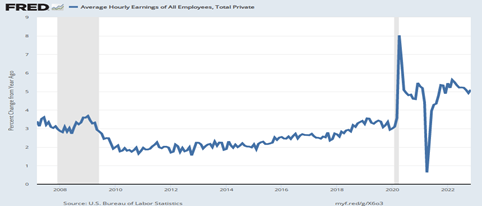
The Fed Governors won’t like this morning’s unemployment report. The U.S. Census Bureau just reported that 263,000 nonfarm payroll jobs were created in November and average hourly wages are still rising 5.1 percent annually.

To make matters worse for the Governors, jobs were created in every job category except retail/trade and transportation/warehousing.

“The unemployment rate was unchanged at 3.7 percent in November and has been in a narrow range of 3.5 percent to 3.7 percent since March. The number of unemployed persons was essentially unchanged at 6.0 million in November,” said the Census Bureau.

What is going on, as I said recently? Short-term interest rates (e.g., that control credit card and auto loan rates) have risen from essentially zero during the pandemic to 4 percent, and the Fed Governors keep threatening to boost them further until consumers cry uncle with their spending and companies stop hiring so many workers!

Top this sign of economic health with third quarter GDP growth just revised higher, and economists now predicting even higher fourth quarter growth—as high as 4.3 percent with the Atlanta Fed’s latest GPNow estimate?

The unemployment rate of 3.7 percent was unchanged and stayed close to a more than a half-century low (really the 1950s). Hourly pay rose 0.6% last month to an average of $32.82. That’s the biggest advance in 13 months, but isn’t that also a result of many states raising their minimum wages to $15 or more from the national 7.25 percent rate that has prevailed since the 1990s (not the red states, unfortunately)?

Hourly pay rose as high as 8 percent in April 2020 when corporations suddenly ramped up production, as portrayed in the enclosed FRED graph, and it started last year’s record growth spurt of 5.7 percent, not seen since the 1960’s high times.

Average wages had been rising no more than 2-3 percent since the Great Recession (large gray bar in graph), and wages make up some two-thirds of production costs, historically. So the Fed is targeting workers’ wages as the main culprit as it has always done. And corporations must stop hiring so many workers, even though the demand for their goods and services is still soaring.

Some (progressive) economists maintain that the main inflation culprit isn’t the workers in wanting higher wages when household incomes are catching up to inflation for the first time since the 1970s. Rather, it’s excessive profiteering of companies, particularly the energy companies riding the wave of higher demand with scarcer resources; but also the supply shortages due to the COVID-19 pandemic that is still limiting supplies and hampering supply chains.

And, we now have a European war causing even more shortages of food and energy supplies.

So, what is the Fed to do with its threats to businesses and consumers that if they don’t stop their spending spree the Fed will cause a recession by raising interest rates too high?

Harlan Green © 2022

Follow Harlan Green on Twitter: https://twitter.com/HarlanGreen

Posted in Consumers, COVID-19, Economy, Weekly Financial News | Tagged , , , , | Leave a comment

Inflation Decline Accelerating

Financial FAQs

The Personal Consumption Expenditure Index (PCE) is declining as well, which is a broader measure of inflation preferred by the Federal Reserve than the Consumer Price Index (CPI). This is probably why Fed Chair Powell sounded more dovish about inflation prospects in Wednesday’s press conference.

The yearly rate of inflation slowed to 6 percent in October from 6.2 percent in the prior month and a 40-year high of 7 percent last summer, as portrayed in the FRED graph below. The PCE index is the best measure of inflation, especially the core gauge that strips out volatile food and energy costs.

“From the same month one year ago, the PCE price index for October increased 6.0 percent (table 11),” said the BEA. Prices for goods increased 7.2 percent and prices for services increased 5.4 percent. Food prices increased 11.6 percent and energy prices increased 18.4 percent. Excluding food and energy, the PCE price index increased 5.0 percent from one year ago.”

FREDpce

The core rate of inflation in the past 12 months slipped to 5 percent from 5.2 percent. It’s also down from a 40-year high of 5.4 percent last February. Consumer’s items were still expensive, however.

Federal Reserve Chairman Jerome Powell’s press conference was noteworthy because he signaled that smaller rate increases (than the last 4 0.75 increases) were in the offing because there were signs that the demand for goods and services was softening.

“The time for moderating the pace of rate increases may come as soon as the December meeting,” Powell said, in a speech to the Brookings Institution.

So much depends on what consumers do over the coming months. They continue to push up prices by keeping up with inflation. Consumer spending had fallen somewhat, though the latest figures coming into the holidays were still robust.

Americans spent more in November on gasoline, per the BEA, largely reflecting an increase in prices at the pump. They also spent more on new cars, dining out and hotel stays.

But gasoline prices, a key ingredient of consumer prices, are about to take another plunge. Average national gasoline prices have already fallen to pre-Ukraine war prices of $3.50 per gallon, a boon to consumers over the holidays.

Why? China’s economy is stagnating as its Communist Party insists on locking down its cities, rather than inoculating most of its citizens, a lesson in hubris for a government that chooses coercion over the protection of its citizens.

The lesson ought to be that our Federal Reserve should listen to the citizens as well, who rather than the government, know what is best for them.

Harlan Green © 2022

Follow Harlan Green on Twitter: https://twitter.com/HarlanGreen
Posted in Consumers, COVID-19, Economy, Weekly Financial News | Leave a comment

Q3 Economic Growth Even Higher!

Popular Economics Weekly

BEA.gov

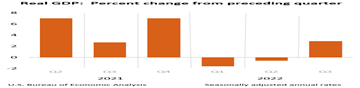
What is going on? The U.S. of Economic Analysis (BEA) just revised third quarter GDP growth higher, from 2.6 percent to 2.9 percent. And why? Mainly because consumers upped their spending in Q3, which increased 1.7 percent from the initial estimate of 1.4 percent.

I predicted consumers would want to celebrate the post-pandemic holidays, because COVID infection rates keep falling, despite the winter flu season, and the economy is still at full employment.

The trade gap also narrowed between exports and imports, meaning that exports increased more than imports, so more of the rest of the world is buying our products.

“The increase in real GDP reflected increases in exports, consumer spending, nonresidential fixed investment, state and local government spending, and federal government spending, that were partly offset by decreases in residential fixed investment and private inventory investment. Imports decreased,” said the BEA.

Exports increased in both goods and services, the BEA added. The rest of the world is wanting more of our industrial supplies and materials (notably nondurable goods), “other” exports of goods, and nonautomotive capital goods. Among services, the increase was led by travel and “other” business services (mainly financial services).

Top this with the Atlanta Fed’s GPNow prediction that Q4 GDP growth could be 4.3 percent. I said in my last column that the Atlanta Fed was right on with its Q3 prediction of 2.9 percent (which the BEA revised GDP upward from 2.6), which makes the Atlanta Fed’s Q4 prediction more credible.

AtlantaFed

“The GDPNow model estimate for real GDP growth (seasonally adjusted annual rate) in the fourth quarter of 2022 is 4.3 percent on November 23, up from 4.2 percent on November 17,” said the Atlanta Federal Reserve, which tracks future growth trends. “After recent releases from the US Census Bureau and the National Association of Realtors, the nowcast of fourth-quarter real gross private domestic investment growth increased from 0.4 percent to 1.0 percent.”

So the debate begins in earnest between inflation hawks and doves. Should our Federal Reserve keep clamping down on growth with more rate increases when consumers are willing to spend what it takes now, including borrowing heavily on their credit cards, to enjoy the holidays?

Won’t they eventually spend less in the New Year, anyway, as they rebuild their savings, which happened this year from January to June quarters? And does the Fed really want to clamp down on manufacturing during wartime when producing more will aid the Ukrainians and bring down prices?

Even wanting to return to a 2 percent inflation target makes little sense now, since their fear of “embedding” consumers’ expectations of higher inflation over the longer term hasn’t happened.

The Conference Board’s confidence survey shows consumers still believing that inflation over the next 5 years won’t rise above 3 percent, even if they remain more pessimistic over the near term.

The problem with inflation hawks is their insistence that they want to see an decrease in wage growth as part of the cure, when household incomes haven’t kept up with inflation since the 1970s. And research has shown that better paid workers produce more!

So targeting wage-earners because they may be earning too much as part of the inflation problem is counter-productive, in my opinion. It’s why the Fed should not boost short-term rates another 1 to 2 points.

And sure enough, Fed Chair Jerome at his latest press conference just announced that they will begin to “moderate” their rate increases. Why? There are 3.5 million workers still out of the workforce, mainly due to early retirement. So policies that increase labor participation should be encouraged, in Powell’s words. But workers will only be encouraged to return if their wages continue to increase more than inflation.

Harlan Green © 2022

Follow Harlan Green on Twitter: https://twitter.com/HarlanGreen

Posted in Consumers, COVID-19, Economy, Politics, Weekly Financial News | Leave a comment

Record Amount Housing Under Construction

The Mortgage Corner

Calculated Risk

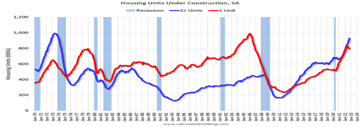
There are a record number of housing units under construction, in part because of pandemic delays in construction (e.g., material shortages), but also because home sales have fallen sharply since the Fed’s rate hikes.

This is causing housing prices to moderate, a leading sign that inflation will also begin to decline more steeply.

Calculated Risk’s Bill McBride says that last week, the National Association of Realtors® (NAR) reported that median house prices were up just 6.6% year-over-year (YoY) in October. This is down from the peak growth rate of 25.2% YoY in May 2021.

And, Case-Shiller reported that the National Index was up 13.0% YoY in August, down from a YoY peak of 20.8% in March 2022.

This hasn’t stopped builders, who seem to be anticipating higher home sales next year. This should also moderate housing prices that have been rising in double digits until recently.

Privately‐owned housing starts in October were at a seasonally adjusted annual rate of 1,425,000, according to the Census Bureau. This is 4.2 percent below the revised September estimate of 1,488,000 and is 8.8 percent below the October 2021 rate of 1,563,000. Single‐family housing starts in October were at a rate of 855,000; this is 6.1 percent below the revised September figure of 911,000. The October rate for units in buildings with five units or more was 556,000.

Apartment construction is out distancing single-family construction because so many cannot afford to purchase in this interest rate environment. The 30-year conforming fixed rate is still hovering around 6 percent and the 5-year fixed rate ARM at 5.5 percent making it slightly more affordable.

Existing-home sales faded for the ninth month in a row to a seasonally adjusted annual rate of 4.43 million, according to the NAR. Sales fell 5.9% from September and 28.4% from one year ago. Prices are moderating, with the median existing-home sales price up to $379,100, an increase of just 6.6% from the previous year, vs. double digits raises in the past year.

Another reason for the high construction inventory is that the inventory of unsold existing homes is still low historically. It slipped for the third consecutive month to 1.22 million at the end of October, or the equivalent of 3.3 months’ supply at the current monthly sales pace, when it is 4-6 months during normal times.

“Inventory levels are still tight, which is why some homes for sale are still receiving multiple offers,” Yun added. “In October, 24% of homes received over the asking price. Conversely, homes sitting on the market for more than 120 days saw prices reduced by an average of 15.8%.”

Much also will depend on the Fed’s actions. It’s a tossup just where interest rates will be next year. The Fed’s latest minutes telegraphed smaller rate hikes looming as inflation subsides and Nobelist Paul Krugman has been saying that he doesn’t see interest rates remaining high over the longer term as producers continue to ramp up production to meet the supply shortages.

Neither do home builders, apparently. There is still a tremendous pent-up demand for housing, whether it’s rentals or owner-occupied, as builders are also playing catchup from the supply shortages caused by the busted housing bubble.

This should make any recession caused by the Fed’s rate hikes short and mild.

Harlan Green © 2021

Follow Harlan Green on Twitter: https://twitter.com/HarlanGreen
Posted in Consumers, COVID-19, Economy, Housing, housing market, Weekly Financial News | Leave a comment

Is It a Recession or Recovery?

Popular Economics Weekly

The recent 1,000 + point surge of the DOW following news of declining inflation in the latest CPI report may have been prompted by the Leuthold Group’s noted market analyst Jim Paulsen in a recent CNBC interview, when he said that “we may by heading for a new recovery rather than a recession.”

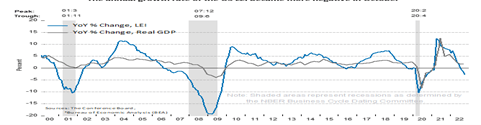
This is while the Conference Board’s Index of Leading Economic Indicators (LEI), a well-regarded prognosticator of future growth, is forecasting recession next year, as is Goldman Sachs and some economists.

The U.S. economy is in limbo at the moment, suspended and not sure of a direction. Half of it is running too hot (e.g., employment) and half too cold (e.g., housing), which means the U.S. economy could go either way in 2023—be in a recession or recovery.

“The US LEI fell for an eighth consecutive month, suggesting the economy is possibly in a recession,” said Ataman Ozyildirim, Senior Director, Economics, at The Conference Board. “The downturn in the LEI reflects consumers’ worsening outlook amid high inflation and rising interest rates, as well as declining prospects for housing construction and manufacturing. The Conference Board forecasts real GDP growth will be 1.8 percent year-over-year in 2022, and a recession is likely to start around yearend and last through mid-2023.”

Conference Board

That would make sense with the slowdown in manufacturing and the fact that housing busts have foretold recessions in the past. But it hasn’t stopped shoppers, which show up in service sector statistics. Retail sales that account for some half of consumer spending jumped a huge 1.3 percent in October, 7.6 percent YoY, with much of the boost due to leisure activities (e.g., dining out and travel).

And the Atlanta Federal Reserve’s GPNow estimate of future growth says fourth quarter growth could be as high as 4.2 percent! Its GPNow estimate proved to be almost right with its third quarter estimate of 2.9 percent (it was actually 2.6 percent) so its Q4 GDP prediction could also be in the ballpark.

Why the jump in GDP? Because the Atlanta Fed’s model shows consumer spending and exports still surging, while consumer expectations and personal incomes have remained high. So why wouldn’t consumers continue to spend in a fully-employed economy?

AtlantaGPNow

“The GDPNow model estimate for real GDP growth (seasonally adjusted annual rate) in the fourth quarter of 2022 is 4.2 percent on November 17, down from 4.4 percent on November 16,” said the Atlanta Fed. “After this morning’s housing starts report from the US Census Bureau, the nowcast of fourth quarter real residential investment growth decreased from -7.6 percent to -11.7 percent.”

Manufacturing activity may be slowing but services are booming as reported in the latest retail sales report. Consumers are keeping up with inflation, in other words, and the holidays are an opportunity to celebrate their world returning to normal. Dining out at restaurants increased 1.3 percent in October, for instance, twice the current inflation rate.

Financial markets rallied again last Tuesday because the Producer Price Index (PPI) for wholesale goods and services continued its decline. Wholesale prices in October rose just 0.2 percent month-month and core inflation without food, energy and trade services declined from 5.6 to 5.4 percent YoY.

Some pundits have characterized this as a goldilocks economy that is neither too hot nor too cold. But half of our economy is still too hot (i.e., employment and consumer spending) and half too cold (manufacturing, housing), as I said.

So our economy is in limbo because of such uncertainty—poised between a recession or an economic recovery. But I believe not for much longer. Our economy is already on a wartime footing because of the $trillions needed to conquer the pandemic and modernize our economy. This should soon conquer the uncertainty and generate a lasting recovery.

Harlan Green © 2022

Follow Harlan Green on Twitter: https://twitter.com/HarlanGreen
Posted in Consumers, COVID-19, Economy, Weekly Financial News | Leave a comment

Inflation Not Stopping Holiday Shoppers

Popular Economics Weekly

When will inflation subside enough to bring down interest rates again? There are estimates that it takes from one year to 10 years to cure large inflation spikes such as occurred this year, based on what pundits and economists see as past history.

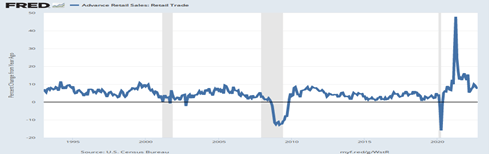
But that hasn’t stopped shoppers. Retail sales that account for some half of consumer spending jumped a huge 1.3 percent in October, 7.6 percent YoY.

FREDretailsales

Consumers are keeping up with inflation, in other words, because it’s the holidays and they want to celebrate their world returning to normal. Dining out at restaurants increased 1.3 percent in October, twice the current inflation rate.

And inflation is already cooling. The Fed has pumped up short-term rates from essentially zero to 4 percent in 2022, which has pummeled stock and bond prices. But financial markets rallied on Tuesday because the Producer Price Index (PPI) for wholesale goods and services continued to decline. Wholesale prices in October rose just 0.2 percent month-month and core inflation without food, energy and trade services declined from 5.6 to 5.4 percent YoY.

Tradingeconomics.com

My bet is that inflation will drop quickly during the coming winter as supply chains continue to improve, which ground to a halt during the worldwide pandemic lock downs.

For instance, the NY Federal Reserve’s Global Supply Chain Pressure Index (GSCPI) stated as much in its latest release. “The GSCPI’s year-to-date movements suggest that global supply chain pressures are falling back in line with historical levels,” it said.

It means that consumer prices will continue to decline as well, since the PPI measures the raw materials and data that go into retail products and services.

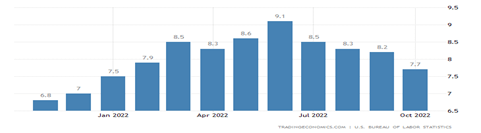
Alas, retail inflation is still too high, since the CPI declined to 7.7 percent in October compared to a year ago, down from 8.2 percent in September. Predictions are all over the map as to when the inflation rate will return to a more normal range. Treasury Secretary Janet Yellen has said in recent testimony it could take several years to return to the Federal Reserve’s two percent target.

Other pundits are predicting as much as 10 years, because they cite the 1970’s era of stagflation. Inflation soared to as high 14 percent in 1981 after 10 years of wage-price spirals. It was another 10 years before inflation returned to its more normal 2-3 percent range.

But this inflationary spiral has lasted just months, not years as in the 1970s, as Nobel Prize-winner and former Federal Reserve Chair Ben Bernanke has pointed out. So, there’s no reason for anyone to press the panic button, stock and bond traders included. Consumers are riding this inflation wave just fine to date.

Why shouldn’t they be upbeat, with Americans still fully employed?

The New York Fed also publishes a Survey of Consumer Expectations of inflation also shows inflation is a short-term problem. “Median one- and three-year-ahead inflation expectations increased to 5.9 percent and 3.1 percent from 5.4 percent and 2.9 percent, respectively. (But) The median five-year-ahead inflation expectations, meanwhile, rose by 0.2 percentage point to 2.4 percent.”

Wholesale prices are still high. The Producer Price Index for final demand in the U.S. rose 0.2 percent month-over-month in October of 2022, the same as a downwardly revised 0.2 percent increase in September. Goods cost went up 0.6 percent, the largest advance since a 2.2 percent rise in June, mainly pushed by a 5.7 percent jump in gasoline cost. Prices for diesel fuel, fresh and dry vegetables, residential electric power, chicken eggs, and oil field and gas field machinery also advanced. In contrast, the index for passenger cars declined 1.5 percent. Meanwhile, services cost fell 0.1 percent, the first decline since November of 2020.

So, the inflation outlook is muddled, but consumers’ inflation expectations give us a better picture of how consumers will behave in the future. It is another ingredient that helps to determine the Fed’s next move, and when shoppers buy or hold.

All this news backs my bet of inflation falling back to historical levels as soon as next summer.

Harlan Green © 2022

Follow Harlan Green on Twitter: https://twitter.com/HarlanGreen

Posted in Consumers, COVID-19, Economy, Weekly Financial News | Leave a comment

Inflation Falling Fast

Financial FAQs

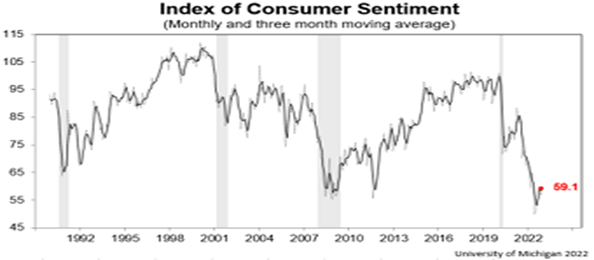
CPI inflation declined to 7.7 percent in October compared to a year ago, down from 8.2 percent in September, the government said Thursday. But it’s not making consumers any happier with the approach of the holidays. The University of Michigan’s survey of consumer sentiment also declined further to 54.7 from 59.9.

Food prices rose 10.9 percent year-over-year. Food at home — grocery store or supermarket purchases — increased by 12.4 percent, ticking down from 13 percent in September, and rose 0.4 percent on the month, the smallest monthly increase in the category since last December, said MarketWatch’s Jeffery Bartash.

But several categories rose far more than the overall rate of inflation. Egg prices rose 43% year-over-year in October, butter increased by 26.7%, and flour and prepared flour mixes were up 24.6%. Lettuce prices rose 17.7% year-over-year, while bread and milk prices rose by 14.8% and 14%, respectively.

Tradingeconomics.com

Such unpleasant news could continue due to a typical scarcity of these products in winter.

“Declines in sentiment were observed across the distribution of age, education, income, geography, and political affiliation, showing that the recent improvements in sentiment were tentative,” wrote Joanne Hsu, director of the survey, in a statement. “Instability in sentiment is likely to continue, a reflection of uncertainty over both global factors and the eventual outcomes of the election.”

UMichigan

How fast will prices continue to decline that might improve sentiment? I noted recently that market strategist Jim Paulsen of the Leuthold Group has done research on the history of such inflationary spikes, and they seem to behave similarly, regardless of monetary policies.

CPI inflation generally taken 12 months to return to more normal levels from its high point, he said. Since this inflation spike peaked in March-April 2022 he maintains we should see inflation returning to a normal range of 2-3 percent by next March-April 2023.

And consumer surveys already show consumers becoming more confident about the future with longer-term inflation expectations holding at 3 percent over the next five years.

Thursday’s 1,000 + point surge of the DOW following news of the latest CPI report may have been prompted by Paulsen’s remarks last Tuesday in a recent CNBC interview that “we may by heading for a new recovery rather than a recession.”

That is to say, if we see inflation continuing to decline into the new year, as Paulsen predicts.

Harlan Green © 2022

Follow Harlan Green on Twitter: https://twitter.com/HarlanGreen
Posted in Consumers, COVID-19, Economy, Weekly Financial News | Leave a comment

We Would Have A Soft Landing (If Fed Will Listen)

Financial FAQs

FREDdurablegoods

After four consecutive 0.75 percent rate hikes, the Fed should slow down its rate increases, say at least three Federal Reserve Governors. That is good news as we try to assess the likelihood of another recession.

It’s good news because there are already signs of a possible soft landing in 2003, if the Fed will take their foot off the economic brakes until there is more certainty of its tightening efforts down the road.

Reuters quotes the Chicago Fed’s Charles Evens (San Francisco and Richmond Fed Presidents also advocate slowing) that it is time for the Federal Reserve to shift to smaller interest rate hikes to avoid tightening monetary policy more than needed and slow the pace further once risks become more “two-sided,” (i.e., a possible recession) Chicago Fed President Charles Evans said on Friday.

“From here on out, I don’t think it’s front-loading anymore, I think it’s looking for the right level of restrictiveness,” Evans told Reuters in an interview, referring to the U.S. central bank’s string of supersized rate hikes.

If the Fed did nothing more this year, we could have a ‘soft landing’ since growth is already slowing in both the manufacturing and service sectors of our economy.

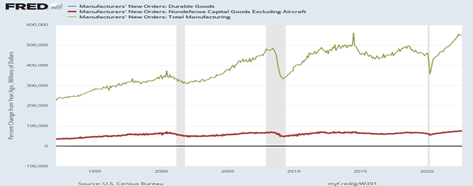
New orders for factory goods are down, for instance (see top line in above FRED graph from 2/92) and holding at a lower level of activity. Orders for manufactured goods rose 0.3 percent in September, the Commerce Department said last Thursday, and orders have risen eleven months of the past year. The factory sector led the economy’s recovery from the pandemic because of huge pent-up demand for things like automobiles and other durable goods after the pandemic.

The ISM’s manufacturing index is now close to breakeven. The S&P global U.S. manufacturing PMI inched up to 50.4 in its “final” reading in October from the “flash” reading of 49.9. This is down from a reading of 52 in September.

“The U.S. manufacturing sector continues to expand,” said ISM Chair Timothy Fiore, “but at the lowest rate since the coronavirus pandemic recovery began. With panelists reporting softening new order rates over the previous five months, the October index reading reflects companies’ preparing for potential future lower demand.”

The Institute for Supply Management (ISM) serviced sector (non-manufacturing) Index that measures conditions at companies such as retailers and restaurants fell to 54.4 percent in October and touched the lowest level since the U.S. lockdowns in 2020, pointing to a slowing U.S. economy. A number above 50 signals expansion; but settling in a more normal range typical of a slower growing economy.

Granted this is before the Fed’s latest rate hikes take hold that could reduce the demand for goods and services even further. Consumer borrowing that is reported by the Fed is a better indicator of consumer wherewithal, since they wouldn’t be shopping as much if they fear an imminent recession.

Consumercredit

Consumer credit has been declining slowly, but again it is back to more normal pre-pandemic levels (see above Fed chart from 1/04). Revolving credit, like credit cards, rose 8.7 percent in September, less than half of the 18.1 percent gain in the prior month. Nonrevolving credit, typically auto and student loans, rose 5.7 percent, up from a 4.5 percent growth rate in the prior month. This category of credit is much less volatile.

The growing danger is to continue to tighten while there are still shortages of food and energy supplies, while demand is already shrinking in the rest of the world.

China’s economic woes are one example. Reuters reports “China’s exports and imports unexpectedly contracted in October, the first simultaneous slump since May 2020, as a perfect storm of COVID curbs at home and global recession risks dented demand and further darkened the outlook for a struggling economy.”

The San Francisco Fed has also flagged the danger with its own published research that suggests we have already tightened too much. U.S. monetary policy is tighter than the Federal Reserve’s policy rate suggests, according to research published Monday by the San Francisco Fed, with financial conditions by September 2022 reflecting the equivalent of a 5.25 percent policy rate, which it the top boundary of Chairman Powell’s own prediction.

“Accounting for the broader stance of policy and comparing the proxy rate to simple rules suggests U.S. monetary policy tightened sooner and more sharply than has been generally recognized,” the Letter said.

Given what could be a brutal economic winter for much of the world, and demand maybe reaching parity with supply so that risks become more “two-sided” in Chicago Fed President Charles Evans words, we may now see a more benevolent Federal Reserve and enjoy the possibility of a soft landing.

Harlan Green © 2022

Follow Harlan Green on Twitter: https://twitter.com/HarlanGreen

Posted in Consumers, COVID-19, Economy, Weekly Financial News | Leave a comment