Americans Still Fully Employed

Popular Economics Weekly

MarketWatch

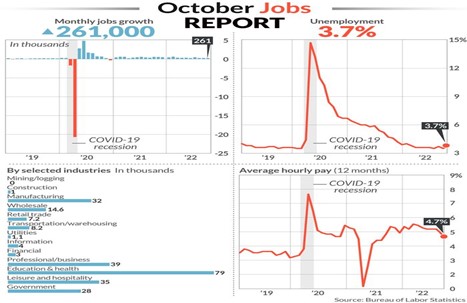
Every sector added jobs in October’s nonfarm unemployment report except mining, and the unemployment rate is still at a record low of 3.7 percent, even with the Fed promising to continue to raise interest rates.

“Total nonfarm payroll employment increased by 261,000 in October, and the unemployment rate rose to 3.7 percent, the U.S. Bureau of Labor Statistics reported today. Notable job gains occurred in health care, professional and technical services, and manufacturing.”

Why are businesses so busy that they see good times ahead rather than a looming recession? One answer is the U.S. economy grew 2.6 percent in the third quarter just reported due to exploding exports after two quarters of negative growth from the aftereffects of the pandemic, and record GDP growth in 2021.

I maintain it’s because we are still recovering from the pandemic, with two years of lock downs repressing demand. And 3 million working-age adults have not returned to the workforce, leaving businesses scrambling to find enough employees.

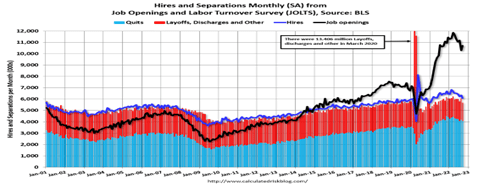
Americans are fully employed and there is a job for every American that wants one. We have almost twice as many job openings as jobs being created. More consumers want to travel and dine out, children are back in school, and supply chains have caught up in most sectors to meet the demand.

Education & Health y in the report added 79,000 jobs, followed by Professional/Business (39,000), Leisure and Hospitality (35,000) and Manufacturing (32,000) new jobs.

It’s incredible that Democrats haven’t trumpeted the need for more workers since it is immigrants that will fill those vacancies. Canada just announced they are welcoming new immigrants to fill their worker shortage, reports the Financial Times Christina Lu.

“Look, folks, it’s simple to me: Canada needs more people,” said Sean Fraser, the Canadian immigration minister. “Canadians understand the need to continue to grow our population if we’re going to meet the needs of the labor force, if we’re going to rebalance a worrying demographic trend, and if we’re going to continue to reunite families.”

Immigration shouldn’t be a political hot potato because of the U.S. worker shortage. Republicans are demonizing immigrants and opposing more workable immigration laws when immigrants are desperately needed to fill the 10 million plus job vacancies.

Nor should the Fed be pushing up the unemployment rate to cure inflation that they say is needed. They have it exactly backwards. More jobs create less pressure on rising wages and greater productivity, both tools that would bring down inflation, which is what happened with today’s unemployment report.

It showed wage increases are slowing from more than 5 percent to 4.7 percent in October, while more than 10 million jobs have come back since 2001 and the Biden presidency.

Then why so much political discontent when the current congress has just passed record-breaking legislation that will help the discontented populace that Nobel prize-winner Angus Deaton described in a recent Project Syndicate article:

“Although two-thirds of the adult US population does not have a four-year college degree, the political system rarely responds to their needs and has frequently enacted policies that harm them in favor of corporate interests and better-educated Americans. What has been “stolen” from them is not an election, but the right to participate in political decision-making – a right that is supposedly guaranteed by democracy. Viewed in this light, their efforts to seize control of the voting system are not so much a repudiation of fair elections as an attempt to make elections deliver some of what they want.”

Who has been delivering what red staters in particular say they want? Republicans have consistently opposed better health care insurance, such as Obamacare and increased Medicare spending, better labor laws, and a higher minimum wage that would most benefit the two-thirds of Americans Professor Deaton mentions.

In fact, government has never been the problem, though from President Reagan’s term onward Republicans have attempted to make it so.

Deaton concludes: “The less-educated Americans who are at a greater risk of dying early did not all vote for Donald Trump in 2016 and 2020; but many of them did. The overlap can be seen by tabulating “deaths of despair” – from suicide, drug overdose, and alcoholic liver disease – across counties and matching them to Trump’s share of the vote.”

We know how to solve this by making government the solution, as we did with the New Deal. And it is what the latest legislation has done—spending $trillions on longer term projects like infrastructure, climate change, and capping health care costs.

But, alas, its effects will take some time to benefit the most discontented Americans.

Harlan Green © 2022

Follow Harlan Green on Twitter: https://twitter.com/HarlanGreen
Posted in Consumers, COVID-19, Economy, Keynesian economics, Politics, Weekly Financial News | Leave a comment

Healthy Economy Should be Fed’s Priority

Financial FAQs

Calculated Risk

Just days before an election that may decide the future growth path of the U.S. economy, the Labor Department’s JOLTS report shows Americans still fully employed. It seems companies aren’t yet ready to shrink their payrolls in the face of high inflation and soaring interest rates.

This is a volatile mix—high inflation and interest rates, vs. plentiful jobs—that may stir many Americans to select a political party in the midterm that wants to cut taxes and many government programs, thus reducing employment, during a war and economy already depressed in many red states, when it is government spending that is keeping America and most developed countries solvent after suffering through the worst pandemic in 100 years.

“The number of job openings increased to 10.7 million on the last business day of September, the U.S. Bureau of Labor Statistics reported today. The number of hires edged down to 6.1 million, while total separations decreased to 5.7 million. Within separations, quits (4.1 million) changed little and layoffs and discharges (1.3 million) edged down.”

The fact that job openings are still almost double the 6.1 million job hires will, alas, probably not deter our Fed from continuing to boost interest rates another 0.75 points tomorrow after conclusion of the FOMC meeting.

By doing so, the Fed will send the wrong message to many Americans, because the investments needed to win the war in Ukraine and cool global warming are far more important priorities than continuing to fight an inflation rate that is already trending downward.

For instance, the Fed’s preferred PCE inflation index has dropped nearly one percent to 6.2 percent in three months, the core rate down to 5.1 percent without food and energy, whereas the Euro Zone just reported the inflation rate in their 19 countries has risen to 10.7 percent.

The European Commission reported annual inflation rates of 11.6 percent in Germany with its terror of inflation that came from the 1920s, 16.8 percent in the Netherlands, and even higher inflation in the Baltic countries and Russia.

So why such a preoccupation with inflation when so much of it is due to outside circumstances the Fed cannot control? Are we still looking in the rear-view mirror of 1970s stagflation, while trying to solve everyone else’s problems?

Psychologists say that people tend to focus on what’s right in front of them—fixing the pain of inflation now, rather than the future benefit of reducing global warming, or even a Ukraine free of the Russian yoke.

It’s sad to see that party politics in the upcoming election has made such a painful choice possible, and that autocrats such as Vladimir Putin are well aware of. He has increased the pain level caused by the food and energy shortages to such a level with his war in the Ukraine that it may convince enough Americans to vote for a party that will opt to reduce support of this war and what it takes to reduce global warming.

So, I was wrong to say last week that draconian choices could be avoided. Plentiful jobs are a necessity to weather the upcoming storms. We may have to tolerate a moderately higher inflation rate in order to maintain near full employment until the storms have passed.

But how to convince voters to conquer their inflation fears for the better good in the upcoming midterm elections?

Harlan Green © 2022

Follow Harlan Green on Twitter: https://twitter.com/HarlanGreen

Posted in Consumers, COVID-19, Economy, Politics, Weekly Financial News | Leave a comment

Third Quarter Growth Turns Positive

Popular Economics Weekly

BEA.gov

The U.S. economy grew 2.6 percent in the third quarter due to exploding exports and declining imports after two quarters of negative growth from the aftereffects of the pandemic, and record GDP growth in 2021.

‘The increase in exports reflected increases in both goods and services,” said the Bureau of Economic Activity (BEA). “Within exports of goods, the leading contributors to the increase were industrial supplies and materials (notably petroleum and products as well as other nondurable goods), and nonautomotive capital goods. Within exports of services, the increase was led by travel and “other” business services (mainly financial services). Within consumer spending, an increase in services (led by health care and “other” services) was partly offset by a decrease in goods (led by motor vehicles and parts as well as food and beverages).” 

Travel and leisure activities jumped because Americans fled their homes after two years of pandemic restrictions. Consumer spending held up and spending on capital goods, a sign of strong future growth prospects, increased at a 10.8 percent pace, but investment in structures and new housing sank as soaring mortgage rates choked off home sales.

Housing remains the worm in the apple of future growth, and a reason there are predictions of some level of recession next year, because housing construction and sales feed so many other sectors, such as insurance, banking and other professional services, as well as causing homeowners to feel less wealthy, the so-called wealth effect that can induce consumers to spend less.

For instance, sales of new single‐family houses in September 2022 were at a seasonally adjusted annual rate of 603,000. This is 10.9 percent below the revised August rate of 677,000 and is 17.6 percent below the September 2021 estimate of 732,000, said the Census Bureau.

More importantly, the inflation rate is steadily declining. The price index for gross domestic purchases increased 4.6 percent in the third quarter, compared with an increase of 8.5 percent in the second quarter. The decline mostly stemmed from a sharp drop in gasoline prices, said the BEA.

This is the disinflation we have been speaking of where the rate of inflation is declining, but it’s not outright deflation when prices are actually falling, a sign of recession. It is indicative of a soft landing, the desirable outcome economists and the Fed are looking for.

Inflation fell even more for consumers as the Personal Consumption Expenditure (PCE) Index that measures consumer spending increased 4.2 percent, compared with an increase of 7.3 percent in Q2. Excluding food and energy prices, the PCE price index increased 4.5 percent, compared with an increase of 4.7 percent.

The labor market is still tight as weekly initial jobless claims rose slightly to 220,000 in the week ended October 22, with companies reluctant to lay off workers. The consensus among economists is that corporate record profits are enabling companies to retain workers, in spite of the higher inflation.

In fact, their record profits may be a sign of profit-taking, since companies (like the oil giants) seem to be making excessive profits on the rising demand for their products.

It is not yet a given that growth will remain positive in the fourth quarter, or that inflation will continue to decline in the face of product shortages (like oil and food), but I am banking on the holidays to bring out shoppers and keep growth positive for the rest of this year.

Harlan Green © 2022

Follow Harlan Green on Twitter: https://twitter.com/HarlanGreen
Posted in Consumers, COVID-19, Economy, Housing, Weekly Financial News | Leave a comment

Can We Stay Fully Employed?

Financial FAQs

Roosevelt Institute

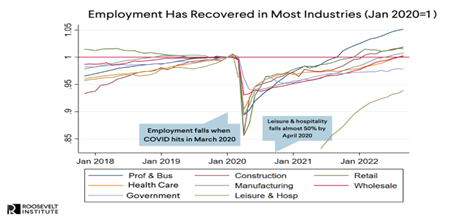
Paul Krugman has forwarded an excellent blog piece by Roosevelt Institute Fellow Justin Bloesch on why we can maintain near-full employment while inflation is returning to the rate that prevailed prior to the pandemic.

Bloesch maintains that full employment and 2 percent inflation rates are possible because there is no longer a higher “natural rate” of unemployment that the Fed must maintain to bring down inflation.

The Fed believes that the best way to bring down inflation is to slow economic growth by inducing lower consumer spending and capital investment by continuing to boost their short-term interest rate target to somewhere between 4.5 to 5 percent.

But the current 3.5-3.6 percent unemployment rate has prevailed since March 2022 even while wage growth and consumer spending have been slowing that are the major ingredients of inflation.

Top that off with supply-side bottlenecks already easing and commodity prices falling, leading us to believe that inflation will return to more historical levels by the spring of 2023.

The probability of such a return to more historical inflation levels of 2-3 percent that prevailed since the 1990s is further increased should the Ukraine War quiet down and China get its post-pandemic COVID problems resolved.

Justin Bloesch’s graph shows that COVID’s shock to the employment system was uniform across all sectors, and the post-pandemic recovery has been uniform across all job sectors as well. This suggests that the COVID pandemic was the main cause of the inflationary surge, and as infection rates continue to decline, more people will want to return to work, keeping unemployment low, and lowering the pressure for employers to raise wages further.

“The better explanation for a temporarily high V/U ratio (i.e., job vacancy to unemployment), and the overall high level of churn in the economy, is just that the economy was rapidly emerging from the pandemic. Many workers did lose their jobs and took jobs in new sectors, and demand for labor was both high and growing rapidly,” said Bloesch. However, as the economy shifts to a slower pace of growth, it is likely that recruiting activity can fall without triggering layoffs.”

This is while the Fed seems to believe that we can’t maintain full employment and a tight labor market without pushing wages even higher as employers compete for scarce workers.

We have had lower inflation during the last few decades, an era labeled the “great moderation” by economists, because of modern technologies like faster just in time supply chains and improved production facilities jn many Asian and third world countries that created an excess of goods and services worldwide.

Harvard Professor Jeffery Frankel, a member of President Clinton’s Council of Economic Advisors, sees commodity prices in particular continuing downward in a recent Project Syndicate article because of the current economic malaise.

“There are two macroeconomic reasons to think that commodity prices in general will fall further. The (slowing) level of economic activity is a self-evidently important determinant of demand for commodities and therefore of their prices. Less obviously, the real interest rate is another key factor. And the current outlook for both global growth and real interest rates suggests a downward path for commodity prices.”

There doesn’t have to be such a draconian tradeoff between what has been called a “natural rate” of unemployment and inflation. In fact, the relationship between employment and inflation seems to have created a lower “natural rate” than the Fed and many forecasters are using to determine what is the ideal interest rate target the Fed should be shooting for.

This is important and might prevent the large number of layoffs the Fed is expecting because of their current policies, given today’s market conditions in a fast-changing world.

Tomorrow’s release of the government’s first estimate of Q3 GDP growth may give us a hint of what kind of slowdown we are already experiencing.

Harlan Green © 2022

Follow Harlan Green on Twitter: https://twitter.com/HarlanGreen
Posted in Consumers, COVID-19, Economy, Weekly Financial News | Leave a comment

Leading Indicators Say Imminent Recession?

Financial FAQs

Conference Board

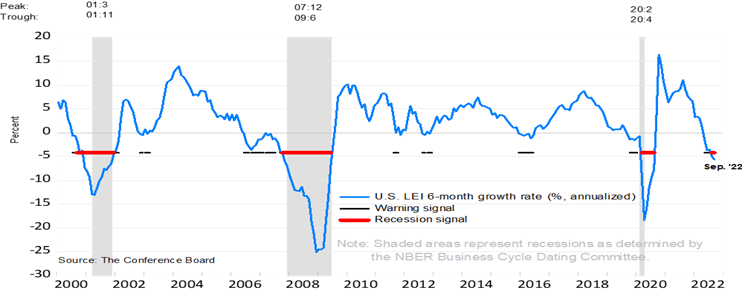
One economic growth measure acknowledged by market professionals but few else is the Conference Board’s Index of Leading Economic Indicators (LEI) that attempts to forecast future economic activity. And it is signaling an upcoming recession, according to its director.

“The US LEI fell again in September and its persistent downward trajectory in recent months suggests a recession is increasingly likely before yearend,” said Ataman Ozyildirim, Senior Director, Economics, at The Conference Board. “The six-month growth rate of the LEI fell deeper into negative territory in September, and weaknesses among the leading indicators were widespread. Amid high inflation, slowing labor markets, rising interest rates, and tighter credit conditions, The Conference Board forecasts real GDP growth will be 1.5 percent year-over-year in 2022, before slowing further in the first half of next year.”

So it is predicting contraction later this year: “The negative contributors—beginning with the largest negative contributor—were stock prices, average consumer expectations for business conditions, the ISM® New Orders Index, the Leading Credit Index™ (inverted), and manufacturers’ new orders for nondefense capital goods excluding aircraft,” said the LEI.

The labor market is slowing but it is still tight with initial jobless claims ultra-low, and inflation beginning to decline, which makes it less likely the U.S. slides into recession this year.

Prices are already plunging is many areas not covered by the standard inflation indexes. The New York Federal Reserve has said its September Survey of Consumer Expectations found that respondents projected their spending will rise by 6 percent over the next year, a sharp drop from the 7.8 percent rise predicted in the August survey. The bank noted that decline in spending expectations was the biggest since the survey began in 2013, while inflation expectations are holding steady, even declining slightly in the near term.

This will be a Federal Reserve induced recession if it materializes. Stock prices and consumer spending are down because of the higher interest rates, with the housing market, another leading indicator, already in recession.

The COVID pandemic and war in Ukraine have thrown a monkey wrench into economic policymaking because inflation reared up so quickly after the worldwide shutdown of economic activity, while governments and Central Banks spent $trillions in various COVID rescue packages in the face of worldwide shortages of goods and services—especially food and energy.

I quoted Adam Tooze, a well-regarded economic historian, last week as sounding the alarm in a recent NYTimes Opinion.

“We now find ourselves in the midst of the most comprehensive tightening of monetary policy the world has seen. And raising interest rates is not going to bring more gas or microchips to market, but rather the contrary. Reducing investment will limit capacity and thus reduce future supply”

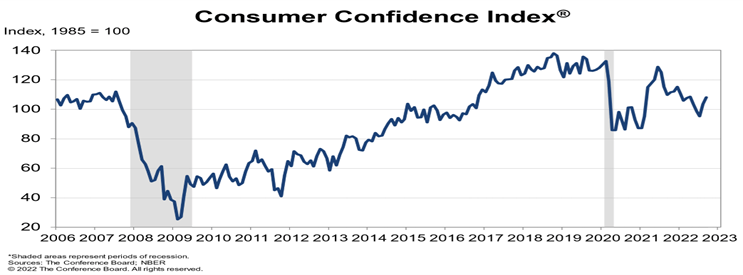
Yet the Conference Board’s confidence index signals consumers are still upbeat, at least through the holidays, which makes it also less likely we see a downturn this year.

“…purchasing intentions were mixed, with intentions to buy automobiles and big-ticket appliances up, while home purchasing intentions fell,” said the Conference Board. The latter no doubt reflects rising mortgage rates and a cooling housing market. Looking ahead, the improvement in confidence may bode well for consumer spending in the final months of 2022, but inflation and interest-rate hikes remain strong headwinds to growth in the short term.”

In fact, Gross Domestic Product is predicted to grow more than 2 percent in Q3 and slightly less in the fourth quarter. So, no recession is yet in the works—at least this year.

Harlan Green © 2022

Follow Harlan Green on Twitter: https://twitter.com/HarlanGreen
Posted in Consumers, COVID-19, Economy, Weekly Financial News | Leave a comment

Homebuilders Losing Confidence

The Mortgage Corner

Calculated Risk

Builder confidence in the market for newly built single-family homes dropped eight points in October to 38—half the level it was just six months ago—according to the National Association of Home Builders (NAHB)/Wells Fargo Housing Market Index (HMI) released today.

This is the lowest confidence reading since August 2012, except for the onset of the pandemic in the spring of 2020, and means the housing sector has been hit hardest by higher interest rates, which have reached nosebleed territory for prospective home buyers.

“This will be the first year since 2011 to see a decline for single-family starts,” said NAHB Chief Economist Robert Dietz. “And given expectations for ongoing elevated interest rates due to actions by the Federal Reserve, 2023 is forecasted to see additional single-family building declines as the housing contraction continues. While some analysts have suggested that the housing market is now more ‘balanced,’ the truth is that the homeownership rate will decline in the quarters ahead as higher interest rates and ongoing elevated construction costs continue to price out many prospective buyers.”

Existing-home sales look no better. The National Association of Realtors reports year-over-year, sales faded by 19.9% (5.99 million in August 2021).

“The housing sector is the most sensitive to and experiences the most immediate impacts from the Federal Reserve’s interest rate policy changes,” said NAR Chief Economist Lawrence Yun. “The softness in home sales reflects this year’s escalating mortgage rates. Nonetheless, homeowners are doing well with near nonexistent distressed property sales and home prices still higher than a year ago.”

This is small comfort to a housing market already in recession, said economist Diane Swonk.

“Mortgage demand plummets 86% from year ago as refis continue to evaporate along with new mortgage demand. The data adds to the collapse we saw in home builder sentiment earlier this week and marks a 25 year low. The housing market recession will get demonstrably worse,” she said in a recent Tweet @DianeSwonk.

The real problem hurting housing is inflation that has spiked higher interest rates, something that President Biden and Democrats have little control over. Worldwide food and energy prices first began to surge with Russia’s invasion of the Ukraine.

The UK just reported its consumer-price index increased 10.1 percent in September year-on-year, up from 9.9 percent in August, according to data from the U.K.’s Office for National Statistics published Wednesday.

The rise in inflation was driven by higher food and non-alcoholic beverage prices, which increased by 14.5 percent on year compared with 13.1 percent in August. Meanwhile, the continued fall in the price of motor fuels made the largest downward contribution, the ONS said.

The UK has one of the better inflation numbers. Turkey, Russian, Brazil and many other countries hit hard by the supply shortages still have double-digit inflation rates.

So, let’s put the blame for high inflation where it belongs—China’s troubles with COVID lockdowns, a war, and lingering hangover from the pandemic, ok?

Harlan Green © 2021

Follow Harlan Green on Twitter: https://twitter.com/HarlanGreen

Posted in Consumers, COVID-19, Housing, housing market, Weekly Financial News | Leave a comment

Retail Sales, Inflation Slowing

Popular Economics Weekly

FREDretailsales

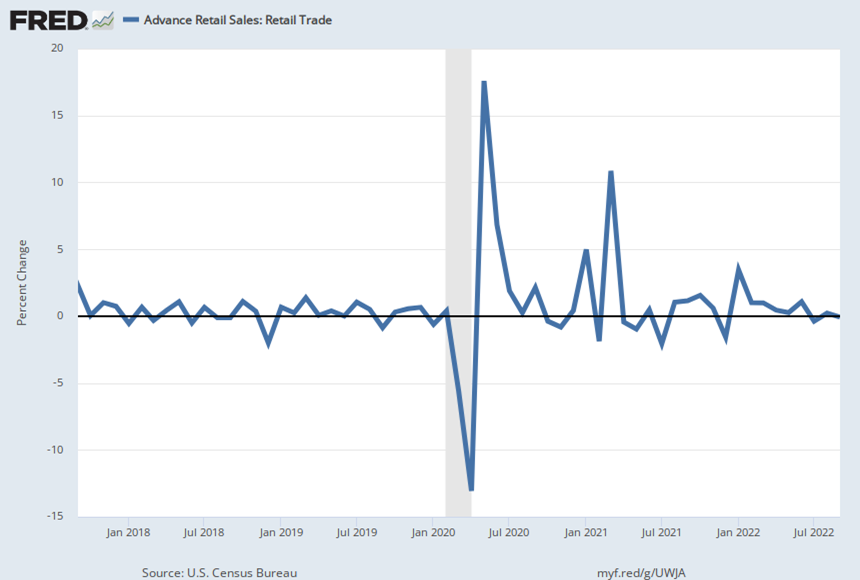
Another part of the inflation puzzle is retail sales; probably the most important picture of consumer demand since consumers power some 70 percent of economic activity. Any decline in retail sales helps the Federal Reserve decide when consumer demand for goods and services cools enough to slow rising inflation, and hence interest rates.

So, its good news to see that retail sales dropped sharply in one month—from 15.5 percent in March 2022 to just 5 percent in April 2022 YoY.

That’s also when Putin began his invasion of Ukraine and food and energy prices began to surge. It’s a sign that consumers pay attention to inflation and are cutting back on spending of their own accord.

FREDcpi

What the headlines don’t yet grasp is that retail sales flattened out in April, as did the 40-year spike in the Consumer Price Index, which has risen just 2 percent over the past three months.

Retail sales are now rising at 7.7 percent YoY and are barely keeping up the with the 8 percent inflation rate. Total sales were flat rather than up 0.2% in September as we had expected, said Reuters:

“Retail sales are slowing as spending shifts back to services. Sales at auto dealerships slipped 0.4% last month, while receipts at service stations dropped 1.4%. Furniture store sales fell 0.7%, while those at building material and garden equipment retailers decreased 0.4%.”

A survey from the University of Michigan on Friday showed consumer sentiment improved further in October, but inflation expectations deteriorated a bit as average national gasoline prices moved towards $4 per gallon after falling over the summer.

“Continued uncertainty over the future trajectory of prices, economies, and financial. markets around the world indicate a bumpy road ahead for consumers,” said survey director Joanne Hsu. “The median expected year-ahead inflation rate rose to 5.1%, with increases reported across age, income, and education. Last month, long run inflation expectations fell below the narrow 2.9-3.1% range for the first time since July 2021, but since then expectations have returned to that range at 2.9%.”

It looks like consumers via their spending habits will know and be the first to tell the Fed when the inflation dragon has been tamed.

Harlan Green © 2022

Follow Harlan Green on Twitter: https://twitter.com/HarlanGreen
Posted in Consumers, COVID-19, Economy, Weekly Financial News | Leave a comment

Inflation Already Declining!

The Mortgage Corner

AtlantaGDPNow

The Atlanta Federal Reserve has just upped their estimate of Q3 economic growth to +2.9 percent after two quarters of negative growth. Why are they thinking that economic growth will resume when the Fed says it intends to push interest rates even higher?

Part of the problem, according to renowned economist Professor Jeremy Segal of the Wharton School in a recent CNBC interview, is the Fed bases its outlook on inflation indicators six months to a year behind actual inflation trends.

They should instead base their actions on current economic indicators, says Segal, such as the real money supply and disposable incomes, which have been falling sharply. The amount of money in circulation controls much of the economic activity of banks as well as consumers and higher interest rates will shrink the M2 money supply even further.

MarketWatch

MarketWatch economist Rex Nutting’s above graphs show that the real money supply, disposable income (i.e., after taxes), and home prices that measure real wealth for the two-thirds of American households that own homes, have been declining for months.

The Atlanta Fed’s GDPNow model estimate for real GDP growth (seasonally adjusted annual rate) is also based on actual economic indicators—such as employment and wholesale trade. As of October 7, its latest forecast for the third quarter of 2022 is 2.9 percent, up from 2.7 percent on October 5.

“After this morning’s employment situation report by the US Bureau of Labor Statistics and the wholesale trade report from the US Census Bureau,” said the GDPNow press release, “the ‘nowcast’ of third quarter real personal consumption expenditures growth and third-quarter real gross private domestic investment growth increased from 1.1 percent and -3.6 percent, respectively, to 1.3 percent and -3.4 percent, respectively.”

Part of the problem may be the Atlanta Fed looks at numbers affecting all Americans vs. Fed Chair Powell looking at numbers that rely on indexes that measure data affecting 30 to 40 percent of our population, such as rents and food prices that have seen the highest price increases.

There are also other leading indicators of inflation, including commodity prices, supply times, the value of the dollar BUXX, 0.25% DXY, 0.16%, says Nutting. Almost all of these have peaked and are now declining. These are other signs that inflationary pressures are lessening.

“The biggest risk to the economy is that the Fed and other central banks will tighten too much, according to 55% of economists surveyed by the National Association of Business Economics,” he said.

If economic growth is positive for the rest of this year, it may be a sign that the actual inflation indicators Professor Segal and Nutting advocate may have bottomed, and economic growth has resumed.

Will the Federal Reserve realize this in time to avert another recession?

Harlan Green © 2021

Follow Harlan Green on Twitter: https://twitter.com/HarlanGreen

Posted in Consumers, COVID-19, Economy, Housing, Weekly Financial News | 1 Comment

Too Much Disinflation Is Bad Planning

Financial FAQs

FREDcapex

The rumblings of an oncoming disinflationary spiral are becoming louder. And it may be as difficult to tame as the current inflationary spike that so worries the Federal Reserve.

What is disinflation as opposed to outright deflation? It’s when prices are still rising but at a lower inflation rate, vs. outright deflation when prices are falling, which occurs during a recession. Deflation last happened during the Great Recession and busted housing bubble.

The COVID pandemic and war in Ukraine have thrown a monkey wrench into economic policy-making because inflation reared up so quickly after the worldwide shutdown of economic activity, when governments and Central Banks spent $trillions in various COVID rescue packages in the face of worldwide shortages of goods and services—especially food and energy sources

The problem is how to cure inflation without causing a recession, since raising interest rates too rapidly harms future economic investment, particularly capital expenditures (capex), as well as consumer spending. Capex investment has abruptly declined after its rapid rise post-COVID, per the above FRED graph.

Adam Tooze, a well-regarded economic historian, is one of the loudest sounding the disinflation alarm in a recent NYTimes Opinion.

“We now find ourselves in the midst of the most comprehensive tightening of monetary policy the world has seen. And raising interest rates is not going to bring more gas or microchips to market, but rather the contrary. Reducing investment will limit capacity and thus reduce future supply”

Former Fed Chair Ben Bernanke, one of three economists just awarded the 2022 Economics Nobel Prize, is contributing to the chorus. He warned that our Fed’s attempt to “fine tune” economic stability risks with interest-rate policies was not a good idea. “I don’t think we understand that well enough, except in perhaps extreme conditions, to try to fine-tune financial stability using monetary policy,” he said when interviewed at the Brookings Institute.

What is our Federal Reserve to do when the Produce Price Index for raw materials and wholesale goods that came out today is still rising? The increase in wholesale prices over the past year is up 8.5 percent, down slightly from 8.7 percent in the prior month. Inflation is still running near a 40-year high.

But prices are already plunging is many areas not covered by the standard inflation indexes. The New York Federal Reserve has said its September Survey of Consumer Expectations found that respondents projected their spending will rise by 6 percent over the next year, a sharp drop from the 7.8 percent rise predicted in the August survey. The bank noted that decline in spending expectations was the biggest since the survey began in 2013, while inflation expectations are holding steady, even declining slightly in the near term.

Adam Tooze’s plea echoes what many economic planners worry about. It’s taken more than two years to bring the COVID pandemic under control. Why not give the world’s economies more time to recover?

Harlan Green © 2022

Follow Harlan Green on Twitter: https://twitter.com/HarlanGreen

Posted in Consumers, COVID-19, Economy, Weekly Financial News | Leave a comment

Employment Slowing Enough?

Popular Economics Weekly

 MarketWatch

Job growth is slowing, but is it enough to call off the inflation hawks, including Federal Reserve Governors, from wanting more rate hikes?

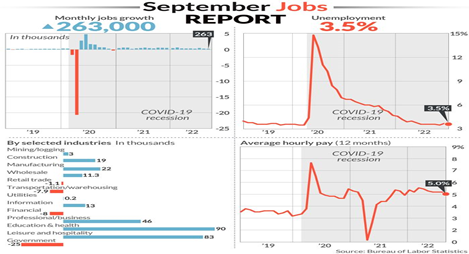
The U.S. Economy is still fully employed for those wanting to work; with a historically low 3.5 percent unemployment rate, 263,000 nonfarm payroll jobs, and hourly wages rising at 5 percent in September’s unemployment report.

It was the smallest jobs gain in 17 months, and we are back to pre-pandemic levels of employment, but inflation is still high because of the Ukraine War and a shortage of goods and services. The so-called supply-chain shortages really mean there is still a worldwide supply shortage, though now there are now plenty of trucks, ships, and planes to deliver them.

Almost all business sectors continued hiring, and people continued to travel and dine out in large numbers, as hotel, restaurants and other companies in the hospitality business created 83,000 new jobs, reflecting strong demand for services such as travel and recreation.

Hiring also rose sharply in health care and professional businesses. Manufacturers added 22,000 jobs and construction firms hired 19,000 people.

All this activity is keeping prices from falling fast enough to please the hawks, but do we even have much choice in the matter? Noted market strategist Jim Paulsen of the Leuthold Group has done research on the history of such inflationary spikes, and they all pretty much behave the same, regardless of monetary policy.

MarketWatch

His graph shows that inflation spikes have come down as fast as they rose. Paulsen maintains this is therefore an excellent buying opportunity for investors because it’s now possible to predict approximately when the inflation surge ends and interest rates decline, which tend to follow inflation trends.

An inflation cycle usually takes approximately 12 months from its beginning to end, so since this inflation spike began in April-May, we should see inflation returning to a normal range by next April-May.

And he sees inflation already subsiding:

  • CL.1, 3.36% are down 30% from June. A gallon of gasoline has fallen 23% since peaking in the same month. Energy is central to the economy, so its price has a big impact on the prices of almost everything. Plus, there is a psychological angle.
  • CSGP, -1.89%, a great source of data on real estate trends and analytics. “We’re seeing a complete reversal of market conditions in just 12 months, going from demand significantly outstripping available units to new deliveries outpacing lackluster demand,” says Jay Lybik, CoStar’s director of multifamily analytics.
  • TGT, -1.96% grabbed headlines in early June when it reported it will have to cut prices to clear inventories. Nike NKE, -2.27% followed suit last week. Those two are not alone in over-ordering merchandise, expecting the pandemic-induced consumer preference for goods over services to continue. This inventory clearing will show up in headline inflation numbers soon.

And consumer surveys already show consumers becoming more confident about the future with inflation expections now below 3 percent over the next five years.

This should be enough to convince inflation hawks to ease up on their inflation fears, amd the Fed to pause and see what the holdays bring. Consumers and businesses seem to be tolerating the moderate Fed rate hikes to date. And there’s no hurry to reverse course, unless prices begin more dramatic declines leading to disinflation, or outright deflation. Why not show patience, Fed Chairman Powell, as consumers seem to be doing and enjoy the holidays!

Harlan Green © 2022

Follow Harlan Green on Twitter: https://twitter.com/HarlanGreen

Posted in Consumers, COVID-19, Economy, Weekly Financial News | Leave a comment