Where’s the Slowdown?

Popular Economics Weekly

Calculated Risk

The Labor Department’s JOLTS report just out shows job openings are still at twice the number of job hirings. How does this justify what seems to be pundits fixation on the possibility of a recurring 1970’s wage-price spiral causing prolonged inflation? It’s one reason Fed Chair Powell has been saying we will feel more pain before the inflation surge is tamed.

The current inflation spike is nothing like what happened in the 1970’s era of stagflation with the Arab oil embargo raising energy prices, and trade unions able to match that inflation with rising wages. Hence the so-called wage-price spiral that created slow growth with high unemployment at the time.

Today in the face of such high inflation the number of job openings in the government’s JOLTS report continues far in excess of job hirings, according to the Bureau of Labor Statistics (BLS) and the unemployment rate has remained at 3.5 percent, a record low. Openings have even risen back to its high from last month’s slight drop to 10.9 million openings. This is while the Fed keeps promising to raise short-term rates until it hurts!

It’s the highest inflation rates in 40 years that the Fed is attempting to conquer. Former Fed Chair Ben Bernanke explained how the current inflation period differed from the 1970s recently in a recent NY Times article, when he said six months of higher inflation today doesn’t equal its 14 month span during the “Great Inflation” of the 1970s.

“In short, the lessons learned from America’s Great Inflation, by both the Fed and political leaders, make a repeat of that experience highly unlikely. The Fed today recognizes that it must take the leading role in controlling inflation, and it has the tools and sufficient political independence to do so. After a delay caused by a misdiagnosis of the economy in 2021, the Fed has accordingly turned to tightening monetary policy, ending its pandemic-era bond purchases, announcing plans to shrink its securities holdings and raising short-term interest rates.”

The number of job openings was little changed at 11.2 million on the last business day of July, the U.S. Bureau of Labor Statistics reported. Hires and total separations were little changed at 6.4 million and 5.9 million, respectively. Within separations, quits (4.2 million) and layoffs and discharges (1.4 million) were little changed.

The hires are blue line and job openings the black line in the above Calculated Risk graph of the JOLTS report. That’s 5.3 million more job vacancies that businesses say they want to fill.

Corporations are so flush with the highest profits ever more than 40 years, as high as in the 1950s post-WWII as a percentage of GDP, that they don’t seem to care their cost of borrowing is rising. But won’t consumers care and cut back on their spending? Probably, which means growth will continue to slow of its own accord, since consumer spending makes up some 70 percent in GDP growth.

Yet, a measure of how consumers feel about the economy right now rose to 145.4 in August from a 15-month low of 139.7 in the prior month, the nonprofit Conference Board said Tuesday.

The Index now stands at 103.2 (1985=100), up from 95.3 in July. The Present Situation Index—based on consumers’ assessment of current business and labor market conditions—improved to 145.4 from 139.7 last month. The Expectations Index—based on consumers’ short-term outlook for income, business, and labor market conditions—increased to 75.1 from 65.6.

“Consumer confidence increased in August after falling for three straight months,” said Lynn Franco, Senior Director of Economic Indicators at The Conference Board. “The Present Situation Index recorded a gain for the first time since March. The Expectations Index likewise improved from July’s 9-year low, but remains below a reading of 80, suggesting recession risks continue. Concerns about inflation continued their retreat but remained elevated.”

“Meanwhile, purchasing intentions increased after a July pullback, and vacation intentions reached an 8-month high. Looking ahead, August’s improvement in confidence may help support, but inflation and additional rate hikes still pose risks to economic growth in the short term,” continued Franco.

We hope that Fed Chair Jerome Powell doesn’t believe the Paul Volcker era has returned, when Volcker raised interest rates to 20 percent to tame the prolonged inflation from the 1970s and caused two recessions before he tamed it.

We are not even in any sustained inflationary wage-price spiral, since wages have fallen slightly as a percentage of GDP ((-1.5 percent, according to MarketWatch’s Rex Nutting) who I quoted last week, whereas corporate profits have soared to post-WWII highs.

That’s why we hope Chairman Powell isn’t looking in the rear-view mirror of past history instead of his windshield to see what’s looming ahead, which is a period of naturally sinking inflation and improved supply-chains with consumers already feeling more optimistic about their future and continued corporate profits that will keep creating new jobs.

Harlan Green © 2022

Follow Harlan Green on Twitter: https://twitter.com/HarlanGreen

Posted in Consumers, COVID-19, Economy, Macro Economics, Weekly Financial News | Leave a comment

What is Real Cause of Inflation?

Financial FAQs

FREDcpiinflation

Fed Chair Jerome Powell just said Americans must now feel the pain if the Fed is to bring inflation back to its long-term 2 percent annual target. But why 2 percent? It was the inflation rate that prevailed since the end of the Great Recession, which resulted in higher unemployment and less than 2 percent annual economic growth—not enough growth to lower the unemployment rate to what it is now—3.5 percent.

And directly targeting short-term interest rates, which harms consumer spending and borrowing the most, it may be record corporate profits doing the most damage in boosting inflation and must be tamed.

In fact, it was difficult work to bring the inflation rate back to 2 percent even then, after the busted housing bubble, since the danger was too-low inflation and the danger of disinflation, or even deflation at the time, because Asian countries could produce an oversupply of consumer goods, keeping prices low and more American workers unemployed.

Now we have too high inflation because the COVID pandemic closed economies that produced those cheap supplies, so we have the supply and supply-chain problems with a Ukraine-Russian war adding to the scarcity.

In addition, corporate profits are at all-time highs. MarketWatch economist Rex Nutting highlighted the record growth in profits since World War Two:

“After-tax corporate profits rose at a 41% annual rate after inflation in the second quarter of the year and have risen at a 17% annual pace since the pandemic recession ended two years ago. Meanwhile, the inflation-adjusted purchasing power of individuals’ after-tax income has fallen for five quarters in a row.”

FRED.gov

In fact, it has been at the expense of workers’ salaries, says Nutting. The data show that hourly compensation declined at a -1.5 percent annual rate in the first half of the year after adjusting for inflation and is now down -2.3percent since the end of the pandemic recession.

So, Fed Chair Powell may be barking up the wrong money tree when he said it might cause substantial pain to consumers and businesses. What if it isn’t rising wages, but corporate profits that are enabling corporations to boost prices, rather than paying their employees more?

“Moreover, there will very likely be some softening of labor market conditions. While higher interest rates, slower growth, and softer labor market conditions will bring down inflation, they will also bring some pain to households and businesses,” he added.

Consumers’ personal consumption expenditures barely keep up with rising prices, which means they will have little effect on future inflation. Personal Consumption Expenditures were up just 0.1 percent in July, vs. being as high as 8.6 percent in April 2021 when their pockets were bulging with the pandemic relief payments.

So let’s not blame the consumer for the inflation that the Fed wants to tame, whoare fighting so many other battles. The new Inflation Protection Act enacting a minimum 15 percent tax rate on corporations and one percent on stock buybacks will hurt those that can afford it–record corporate profits that puts the blame game where it belongs.

The Fed should also continue downsizing their holdings of securities. Just selling some of their $4 trillion plus in Treasury securities ($4.97 trillion on June 8) could raise interest rates more gradually, thus avoiding the danger of inducing another recession.

On June 1, 2022, the Federal Reserve initiated the process of reducing the size of its balance sheet to address rising inflation. According to a May press release, the Fed will initially cap its monthly purchase of Treasury securities at $30 billion for June, July and August – for context, the Federal Reserve purchased an average of $80 billion in Treasury securities per month between March 2020 and March 2022. The cap is set to increase to $60 billion in September and will likely remain at that level through the end of calendar year 2023. The Federal Reserve will also reduce its holdings of mortgage-backed securities over the coming months.

Maybe its businesses that should be feeling more pain, rather than workers?

Harlan Green © 2022

Follow Harlan Green on Twitter: https://twitter.com/HarlanGreen

Posted in Consumers, COVID-19, Economy, Weekly Financial News | Leave a comment

Economic Growth to Resume

Popular Economics Weekly

BEA.gov

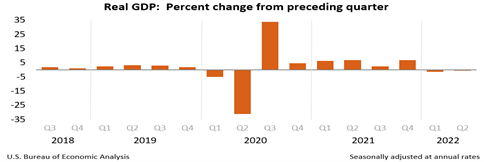
It looks like the slowdown in US economic growth may end as quickly as it began. Second quarter economic growth was slightly less negative in the BEA’s second estimate of GDP growth, because key drivers of growth have been increasing in the latest months.

The Bureau of Economic Analysis press release said, “Real GDP decreased less in the second quarter than in the first quarter, decreasing 0.6 percent after decreasing 1.6 percent. The smaller decrease reflected an upturn in exports and a smaller decrease in federal government spending that were partly offset by a larger decline in private inventory investment, a slowdown in consumer spending, and downturns in nonresidential fixed investment and residential fixed investment. Imports decelerated.”

What this means is that the red-hot job market (528,000 new nonfarm payroll jobs in July), and 1.5 percent increase in consumer spending in Q2 (that makes up some 70 percent of economic activity) have kept our economy from falling into a deeper slowdown, or recession—whatever economists want to call it.

The point is the ‘slowdown’ was so mild and corporate profits high enough that corporations continued to hire rather than fire, and consumers chose to spend rather save during the inflationary surge.

“The number of people who applied for unemployment benefits last week fell to a one-month low of 243,000, indicating layoffs remain near record lows and that a tight labor market is keeping the U.S. economy moving forward,” said MarketWatch’s Jeffrey Bartash.

The Atlanta Federal Reserve’s third quarter estimate, GDP Now estimate ranges from 1.3 to 2.5 percent growth. I will take either of those numbers, as it signals good months of growth ahead, no matter what the Fed Governors do to bring down inflation.

Continued growth depends in part on how consumers flush with savings continue to react to inflation. Most surveys of their expectations say that they don’t see a prolonged inflation, in part because it’s easy to see that the Ukraine war will eventually end that is pushing up food and energy prices, and supply-chain constrictions will ease as other countries recover from the COVID pandemic.

UnivMichigan

China is having especial difficulties in recovering from the pandemic, in part because it is run by an extremely dictatorial communist party that believes it can only hold onto power by suppressing any signs of COVID symptoms with draconian lockdowns, just as it suppresses its populace in other ways to prevent it from looking weak in the public eye.

In fact, inflation is already declining, mainly because world oil prices have plunged, and food prices may also soften with the good news that grain shipments from the Ukraine have finally begun.

U.S. consumers’ are also expecting lower inflation in a year and three years, a New York Federal Reserve survey showed on Monday, as reported by Reuters, indicating U.S. central bankers might be winning the fight to keep the outlook for price growth as they battle to tame high inflation

So, the latest data seem to show economic growth will finally have a tailwind to propel it, rather than the headwind it’s been experiencing since January.

Harlan Green © 2022

Follow Harlan Green on Twitter: https://twitter.com/HarlanGreen

Posted in Consumers, COVID-19, Economy, Weekly Financial News | Leave a comment

Goleta’s Dam Dinner Doesn’t Disappoint and Brings Record Turnout

More than 500 People Attended Scenic Event at Lake Los Carneros Dam

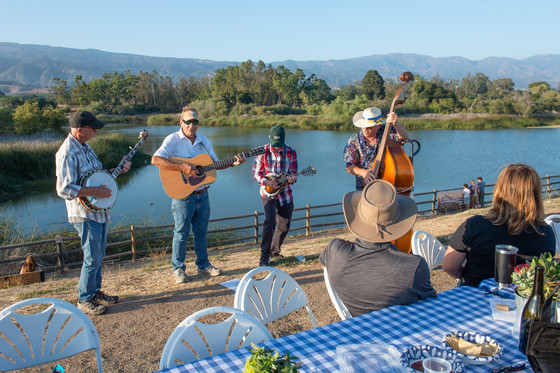
The return of Goleta’s Dam Dinner after a three-year hiatus brought a record turnout this past Saturday, August 20, 2022, to the Lake Los Carneros Lake dam. More than 500 people, many carrying picnic dinners and baked goods to share, flocked to the scenic spot for the #BestDamDinner they have ever had. While many who attended have been coming to the Dam Dinner since it started, we were pleased there were many first-timers as well. Whatever the case, it was the usual, simple, low-key, casual event that keeps people coming back year after year.  

Mayor Paula Perotte said, “I am so glad to see people come back to this special event. I love that there is no agenda, and it is just people breaking bread with neighbors, family, and friends.”

Stay tuned for a video of the event and in the meantime check out all the photos captured by Jay Farbman here: https://photos.app.goo.gl/zYjv19BoS9rkifCn7.

Thanks to the Goleta Valley Historical Society for partnering with the City of Goleta again to put on this community favorite. A special thanks to Pete Wolf with Big Hammer Lures for helping to plan, set up the event, and for creating the yearly Dam Dinner t-shirts once again.

We also want to thank Santa Cruz Markets for donating 50 welcoming succulent arrangements and to Devereux volunteers for creating and delivering the arrangements to the event for all to enjoy and for some to take home as well.

A big shout out also for Goleta-originated vendor Kona Ice for serving up more than 200 snow cones and Elubia’s Kitchen for selling its Dam Pupusas, Dam Tamales and Dam Tacos which were a big hit.

Successful events don’t happen without the collaboration of many partners. We also want to thank the Salt Martians for playing, MarBorg for providing the bathrooms, trash and recycling bins, Santa Barbara Face Painting, and the South Coast Chamber for sharing its tablecloths with us for the event.

We hope you had a dam good time and we look forward to seeing you next year! 

Posted in Uncategorized | Leave a comment

Inflation Not The Real Problem

Financial FAQs

FREDcpiinflation

Inflation is falling again with national gas prices below $4 per gallon while food prices are also beginning to decline.

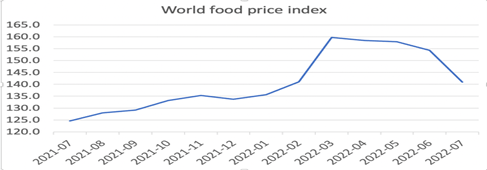
The NY Times’ Paul Krugman has also pointed out that food prices should continue to decline per the UN’s Food and Agricultural Index.

“The FAO Food Price Index* (FFPI) averaged 140.9 points in July 2022, down 13.3 points (8.6 percent) from June,” said the FAO, “marking the fourth consecutive monthly decline. Nevertheless, it remained 16.4 points (13.1 percent) above its value in the corresponding month last year. The July decline was the steepest monthly fall in the value of the index since October 2008, led by significant drops in vegetable oil and cereal indices, while those of sugar, dairy and meat also fell but to a lesser extent.”

FAO.org

Therefore, the Fed should not be focusing on bringing it back to a 2 percent inflation rate with more draconian rate increases that have only prevailed since the Great Recession and busted housing bubble.

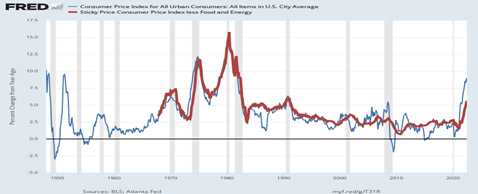
The above FRED graph dating from 1950 shows both the annual consumer price index at 8.5 percent and ‘sticky’ CPI price without food and energy at 5.6 percent in July, down slightly from June.

During our most prosperous times since 1980 it ranged between 2.5 to 5 percent, per the above FRED graph. That’s because profits rose in tandem with rising prices, thus encouraging businesses to hire more workers and expand further.

Since 1980 we have never had a prolonged supply problem, in other words, with retail inflation trending down ever since—until the current post-pandemic era of a Ukraine-Russia war and recovering supply chains, that is.

Why? Because there was never a shortage of supply due to modern technology’s ability to increase productivity that could flood markets with goods and services. Asia with China could produce things more quickly and cheaply that US.

Yes, all that money now raised from the government aid coursing through the economy is causing a temporary inflation problem, but much of it will be invested in future growth—like the infrastructure and inflation reduction act bills just passed.

President Biden’s $1.2 trillion infrastructure bill includes funding allocations of $89.9 billion to improve public transit, $65 billion toward better internet connectivity and access, and money for 500,000 electric vehicle charging stations, which could help address charging “deserts;” areas where it isn’t currently available.

“The infrastructure bill widely focuses on improving passenger and freight transportation, for instance, so steel and material suppliers, including companies that produce materials for buses, trains, bridges, rail, or related equipment, could see heavy activity. Makers of products supporting things like 5G infrastructure and EV stations, too, will see improved demand,” said a Forbes Magazine article on its effects.

And while there will be little inflation reduction in The Inflation Reduction Act bill just passed, the White House says the package will address inflation in two key ways: by lowering energy and health care costs for families and by helping to bring down the deficit.

“And that’s why even Democrats and Republicans, former Treasury secretaries, economists across the board have said that this bill will make a positive impact on inflation while also tackling some of the biggest and long-standing issues facing our country, like prescription drugs and like tackling climate change,” said Brian Deese, director of the National Economic Council, in an interview this week with NPR’s Morning Edition.

As important in bringing down oil prices is that oil and gas drilling is at a 7-year high. U.S. crude oil prices have dipped below $90 per barrel of late, and who knows how much lower oil prices may decline as more alternative energy sources financed by those two bills come on line to replace the need for fossil fuels?

Harlan Green © 2022

Follow Harlan Green on Twitter: https://twitter.com/HarlanGreen

Posted in Consumers, COVID-19, Politics, Weekly Financial News | 1 Comment

Domestic Industrial Production Surging

Financial FAQs

FREDindustrialproduction

U.S. industrial production is the highest since 2018, continuing its climb from the two-month 2020 recession (gray bar in graph). Automobile production highlighted the surge.

This is huge, folks, and a sign that GDP growth in the third quarter may be positive after the first two quarters of negative growth in 2022. Capacity utilization rebounded to 80.3 percent in July from 79.9 percent in the prior month. Output of the U.S. industrial sector was at an all-time high, above the level hit in 2018.

Why the manufacturing surge now? President Biden’s $1.2 trillion infrastructure bill includes funding allocations of $89.9 billion to improve public transit, $65 billion toward better internet connectivity and access, and money for 500,000 electric vehicle charging stations, which could help address charging “deserts;” areas where it isn’t currently available.

“All of that’s good news for manufacturers who are already experiencing high demand, which could “continue on for months, if not years, going forward,” David Zrostlik, president of Stellar Industries, recently said in the Wall Street Journal.

The bill will also improve workers’ productivity by modernizing our transportation networks.

“The infrastructure bill widely focuses on improving passenger and freight transportation, for instance, so steel and material suppliers, including companies that produce materials for buses, trains, bridges, rail, or related equipment, could see heavy activity. Makers of products supporting things like 5G infrastructure and EV stations, too, will see improved demand,” said a Forbes Magazine article on its effects.

Retail sales also surged, which could even boost revisions to Q2 GDP from a negative to possibly breakeven says Reuters’ Wrightson/ICAP.

“Core sales in July (excluding autos and gas) were up 0.7% versus our forecast of a sluggish 0.1% increase, and the May and June levels were revised up markedly.  By themselves, this morning’s numbers should contribute to an upward revision to Q2 GDP on the order of half a percentage point.”

U.S. Manufacturing rose 0.7 percent in July after falling in the prior two months. Motor vehicles and parts output rose 6.6 percent after a 1.3 percent fall on the prior month. Excluding autos, total industrial output increased 0.3 percent. Auto assemblies were the highest since August 2020. Utilities output fell 0.8 percent in July. Mining output, which includes oil and natural gas, rose 0.7 percent, the third straight solid gain.

As important in bringing down oil prices was that oil and gas drilling is at a 7-year high. U.S. crude oil prices have dipped below $90 per barrel of late, and who knows how much lower they may decline?

Prices could ease further if Iran agrees to a new draft nuclear agreement after it backed off from its demand that the Islamic Revolutionary Guards be removed from the U.S. terrorism list, reports the NY Times, opening a potential of at least one million more barrels a day of Iranian petroleum exports (which would make up for the loss from the end of U.S. Petroleum Reserve contribution in November).

Harlan Green © 2022

Follow Harlan Green on Twitter: https://twitter.com/HarlanGreen

Posted in COVID-19, Economy, Weekly Financial News | Leave a comment

The Second Year Can Be Most Difficult

Building Community Answering Kennedy’s Call

Chapter Four (excerpt)

It was becoming obvious that I wasn’t tolerating village life well by the end of my second year in Ismet Pasha, a village settled by Bulgarian Turks in the 1920s after the breakup of the Ottoman Empire. Though I involved myself as much as possible in village activities, and even donated a set of the annotated Koran in Turkish to their new reading room, I began to make longer trips to visit other volunteers to know what they were seeing and doing.

Clair, my female counterpart, had left after the first year and married another volunteer in our group. I was sad to see them leave because they were terrific workers, but Peace Corps rules were no cohabitation of partners unless already married!

I was even anxious when riding the buses for fear of being in an accident, becoming a nervous wreck who smoked a pack- a-day of their “Askerli” cigarettes in that second year. Its brand name was the Turkish word for soldier, and I never knew if it was created to provide the poorly paid Turkish soldier with something he could afford, since a pack cost 40 Kurush, $0.04 cents at the current exchange rate.

The tediousness of becoming a single volunteer was spelled by 45 days of paid vacation leave allowed by the Peace Corps during the two years of service, and semi-annual conferences that brought everyone together for progress reports.

We village volunteers were considered well paid at 60 dollars per month, the equivalent of a Turkish teacher’s salary. To put that in perspective, we could have a good restaurant meal for one dollar, and a haircut for 25 cents. In addition, we were allowed $7.50 per day of vacation allowance. I had money to travel on, as my rent for a small, one room adobe cottage was just $3 per month that second year.

Our own volunteer liaisons were made during holidays and our vacations. I and a female volunteer unfortunately overstayed our vacation time on the island of Rhodes during the winter school break because of a severe Mediterranean storm that capsized a tourist boat with the loss of 40 lives, isolating us long enough so that she was late for her assignment teaching English at a high school.

I was reprimanded for assisting in her delinquency through no fault of her own, and our Peace Corps country director at the time withdrew his offer to put me on training staff after completion of my two years. My loneliness had cost me the possibility of remaining in Turkey for a third year.

Not spending another year in Turkey was probably a good thing, as I was feeling more sad than happy as my two years of service came to an end. As difficult as it was to live in and absorb so much of a foreign culture, it was just as difficult to leave such an intensely emotional and personal experience. Turkish culture was based on very intense relationships; close emotional bonds of either love or hate in friendships as well as families, including strict behavioral guidelines we had to follow between the sexes.

We of Turkey V, the first volunteer rural community development group to serve in any Muslim country, were finally discharged in June of 1966, and it could not have been a day later for me. I had dodged attacks by Turkish sheepdogs, part of the feared and famous Anatolian Mastiff breed, ridden on horseback through sparkling winter snows under the clearest blue skies, weathered some scary illnesses, and was ready to return to western culture.

Had I made a difference, and what did the villagers end up thinking of me? There were so many highs and lows—the companionship with other volunteers that broke the tedium of village life, the vacation travel, visits to ancient, storied civilizations, and being part of such an ancient way of life that was barely changed by a few tractors and combines that sped up the planting and harvest.

Turkey in Later Years

As the Vietnam War dragged on, Americans and the American way did not look so peaceful to the rest of the world. This was one reason Peace Corps left Turkey after 10 years during which some 1600 hundred volunteers had served.

Opposition to the Vietnam War had grown in many European countries, and educated Turkish students were no exception. There were also serious gaffes by American officials, such as appointing former CIA employee Robert Comer to be the next U.S. Ambassador to Turkey. He had overseen the South Vietnamese village pacification plan, and his appointment as Ambassador to Turkey so enraged students that they overturned and burned his car during one of the many anti-war protests.

His predecessor, our own Peace Corps director, had earlier killed an elderly woman dressed in black while driving in Ankara one dark and rainy night. Because he had diplomatic immunity, he was spirited out of Turkey to avoid being charged with manslaughter.

That was not well-received by the students, either. Turkey and the Peace Corps administration agreed it was time to phase out the Peace Corps program that had lasted from 1961 to 1971, after students at several of the technical schools where Peace Corps volunteers taught held a vote and decided that the Peace Corps was no longer welcome.

My last year had been a very lonely, but productive, year, and I had no illusions that most villagers in this part of Anatolia with its semi-arid and mostly treeless environment would stay in their villages much longer. Their industrial revolution was now in full swing.

I hoped our presence there as volunteers had helped them consider us as their friends rather than obnoxious foreigners. I also hoped they saw us presenting a better, more peaceful side of American foreign policy that was more in line with the true face of the America I believed in, despite the Vietnam War.

I believe the Peace Corps Volunteers serving in Turkey did make a difference. We encouraged many of our villagers to work to develop their own land, instead of moving to the cities. Ismet Pasha’s villagers that remained were usually the most prosperous landowners that could exploit more modern farming techniques that I had helped to develop.

There was also talk of the Turks forming their own domestic volunteer corps that had a Turkish precedent. Educated Turkish males already had the option to teach in a village school instead of wearing a military uniform because Turkey had universal male military conscription. But I never knew if it was expanded into something that resembled the Peace Corps, in part because Turkey was changing so fast.

The Return to Turkey

Though today Turkey’s rural population has continued to grow, the percentage of the total population living in villages has declined because of rural-to-urban migration.

In 1970 about 67 percent of the population lived in villages. In 1980 the rural population had declined to 54 percent. Less than 21 percent of Turkey’s population still lived in villages in 2020, according to the World Bank.

That is why I was so startled on a return trip to Turkey. More than 30 years had passed since I left in 1966 and I wanted to know what remained of my work in Ismet Pasha. I had organized a tour group that landed at Istanbul’s Ataturk Airport during a national holiday. It was a shock to see the streets lined with many women covered from head to foot in traditional clothing as we were driven to our hotel. They had to be from the villages to dress so conservatively. It was evidence of the mass migration to cities and how much Istanbul, Turkey’s most European and cosmopolitan city, had changed.

I made a point of visiting Ismet Pasha during the tour, but it seemed a shell of its former self on my return. The mill that produced their flour was gone, a sign of the decline of village life. Its huge grindstone lay beside the road in front of the abandoned bakery building. The villagers no longer baked their own stone ground wheat bread that I remembered; giant kilo loaves steaming just out of the oven that I had enjoyed at meals when invited to dine with them.

The ethnic Turks who still lived in Ismet Pasha, including the son of the Mukhtar I had worked with during my two years, were doing well. Irrigation water was now plentiful from a fully developed irrigation system that watered a large sugar beet crop via elevated concrete canals that funneled water into the fields.

Ismet Pasha that had dirt roads and no electricity when I lived there, now had electricity and a paved main road that give them greater access to markets for their produce in all seasons, so their economic future looked bright.

But the village was also full of Kurds newly arrived from their homeland in eastern Turkey. They were the victims of Turkey’s ongoing war with Kurdish militants belonging to the PKK, their most radical political party that wanted an independent country of their own.

The war had dragged on for years and did not look like it would come to any resolution soon. Millions of Kurds still lived in Turkey and were forbidden to teach their language in the schools at the time.

The ethnic Turks to whom I spoke looked down on the Kurds as bad farmers, transplants that really did not fit in. The Kurds were thought of as a semi-nomadic herding culture, since many of them still lived in the mountains of Syria, Iran, and Turkey. But maybe all the good land around Ismet Pasha was taken, so there was nothing else for the Kurds forcibly transplanted from their homeland to do than raise lifestock? It looked like only families with the largest landholdings were able to take advantage of the new irrigation wells I first brought to the village.

But will Turkey ever become a sectarian democracy ruled by civil law rather than religious law? Or will they be saddled with their current devoutly religious President, Recep Tayyip Erdoğan, an aspiring President-for-life intent on imposing a more religious theocracy rather than continuing their sputtering attemp and most of the remote rural villages ts to join the European Union?

I also saw that the community development precepts I learned in Peace Corps training worked in a Turkish village, because they were much like us, a practical people who believed success in the secular world was as important as the world promised by Islam. Who knows what future might be possible for such a hardworking people?

I felt good about what I had done, and it was now time to move on to find another community I might contribute to.

Harlan Green © 2022

Follow Harlan Green on Twitter: https://twitter.com/HarlanGreen

Posted in Uncategorized | Tagged , , , , | Leave a comment

Cesar Chavez And The United Farmworkers Union

Building Community Answering Kennedy’s Call

The Calexico Funeral

Chapter Nine

César was brilliant at publicizing farmworker conditions and took advantage of another tragedy to make national news. He had me film and photograph the funeral ceremony for that reason.

Forty-five farmworkers were being driven to work before dawn near Blythe, California, in the Imperial Valley that same winter. The bus driver was either drowsy or driving too fast and missed a 90-degree turn in the darkness after the 100-mile, two-hour drive, plunging off the embankment that bordered an 18-foot-deep irrigation canal. Nineteen of the 45 farm workers on the bus were trapped in 10 feet of water unable to escape in the darkness, with many crushed from the impact.

César then organized a funeral and marched 19 caskets that accounted for the dead farmworkers across the Calexico border to a Mexicali cemetery on Avenida Francisco Madera where the drowned victims were buried. It was a magnificent procession with crowds lining the way into Mexico, the borders wide open to let them through.

The Bishop of Baja, California, first gave them a very impressive and special mass and benediction in Calexico’s National Guard Armory before 1,000 mourners, caskets draped with the Aztec eagle, the UFW flag.

It was an incredibly moving sight, as if they were being honored as veterans returned from a war. Few knew at the time that some of those caskets were empty. Many of the bodies had already been taken to the homes of families in Mexico to be mourned. But it was important that 19 caskets crossed the border to commemorate and honor all of them.

The labor contractor who owned the bus, Jesus Ayala, was a well-known scab herder and strikebreaker, said a newspaper description of the accident. The Yuma Sun reported:

The driver, fifty-five-year-old Pablo Navarro Arellano, was in the midst of an eighteen-hour workday when the accident occurred. Typically, his job began at two a.m., when he went to the enormous shape-up at el hoyo, the hole, in Calexico, picked up the workers, and then drove about 130 miles to the farm. There he supervised the lettuce thinning for ten hours, drove back to el hoyo, dropped off the workers, cleaned out the bus, and finally left for home and a few hours’ sleep. The lettuce thinners were paid nothing for the four hours’ travel time between the hole and High and Mighty Farms.

“This tragedy happened because of the greed of the big growers who do not care about the safety of the workers and expose them to grave dangers when they transport them in wheeled coffins to the fields,” UFW leader César Chávez told the crowd, according to a commentary he published in the Los Angeles Times in 1974.1

https://www.latimes.com/archives/lapm-1999-aug-27-me-4246- story.html

My poem better describes what we felt witnessing the tragedy:

The Drowned Bus

The nineteen farmworkers Still looked asleep,

As their bus rose slowly,

Windows streaming water,

Pulled from the irrigation ditch.

Most had been dozing

From the border crossing,

That early morning,

To harvest before sunrise

Penetrated the fields too deeply.

Only such sweat

From the irrigated desert,

Brought melons and strawberries,

To our breakfast tables,

Cool and ready to eat.

They picked what was ripe,

Quit every hot afternoon,

Until their driver,

Dazed by sleepless nights,

Missed his turn.

Those nineteen coffins,

Returned to their casas,

Draped with Aztec eagles

Was such a grand event,

When blessed by Baja’s Bishop.

The writhing procession slowly

Wound its snakelike way

Across the Mexican border that day,

Carrying hissing eagles on its back,

No green cards were needed,

For those now liberated from their past.

Posted in Uncategorized | Tagged , | Leave a comment

Is Inflation Scare Over?

Financial FAQs

BLS.gov

Both the retail Consumer Price Index (CPI) and wholesale inflation index for raw materials—the Producer Price Index (PPI)—fell in July. Since the PPI feeds into retail prices, it’s a sure sign that inflation is on the wane.

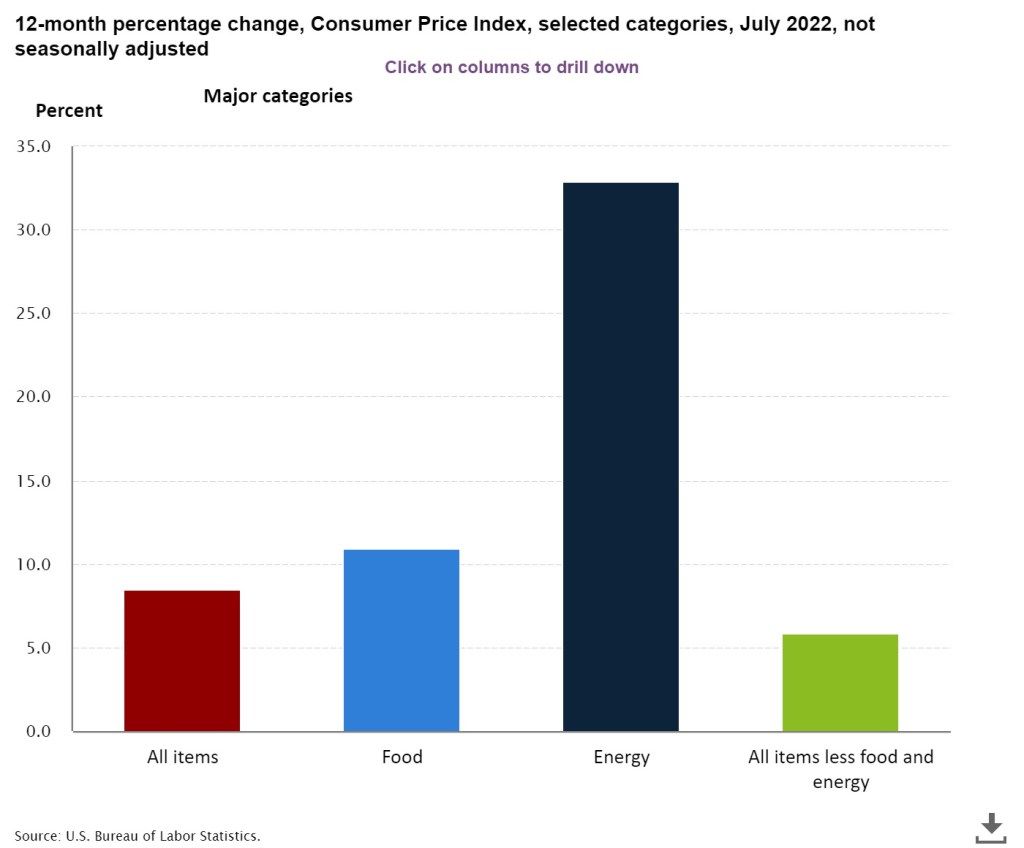
The more important U.S. CPI index was unchanged in July, the Labor Department said Wednesday, compared with the 1.3 percent gain in the prior month. The rate of inflation in the 12 months ended in July retreated to 8.5 percent from a 41-year high of 9.1 percent in June. Energy prices were the main culprit, up 33 percent YoY (black bar in BLS graph.).

But gas prices have been plummeting of late. The nationwide average price for a gallon of gas dropped to $3.99 on Thursday, according to AAA. That’s down 20 percent from the mid-June high, and it’s the first time the average has dipped below $4 since early March..

Both indexes brought the annual increase of core products without volatile food and energy fluctuations back into the 5 percent range, which is till high, but causing markets to breathe easier, because it substantiates that most of the price pressure was due to short term events, like a return to more normal activity from the COVID pandemic, which was a 100-year event, and the Ukraine war’s effect on energy and food shortages.

There are still supply-chain shortages as other countries begin to catch up to the surging demand by American consumers to buy anything and everything available in goods and services.

And there is some good news on that front as well. The Biden administration signed into law the Ocean Shipping Reform Act last June, which is engineered to bolster the maritime commission’s authority to regulate shipping that goes into American ports, which is dominated by foreign carriers.

“The law directs the agency to bulk up enforcement while creating systems that make it easier for aggrieved shippers to file complaints,” says Peter Goodman of the NY Times. “It increases the agency’s funding 50 percent by 2025.”

“The passage of the law has already had an impact, say exporters,” continues Goodman, “prompting ocean carriers to make more containers available at West Coast ports. It has also changed perceptions about the commission’s once-cozy dealings with the carriers.”

Nine container ship carriers dominate the Asia to North America imports, which the U.S. importers would have no control over without more government oversight and regulation. It’s one more example of the U.S. government’s role in keeping us growing during the trying times Americans are currently experiencing.

The closely watched “core” CPI measure of inflation that omits volatile food and energy rose 0.3 percent in July, down from a 0.7 percent gain in the prior month. The 12-month rate remained steady at 5.9 percent.

The U.S. producer price index fell 0.5 percent in July, the Labor Department said today. That’s down from a 1.0 percent jump in June and the first negative monthly print since April 2020.

Core PPI prices are up 5.8 percent from a year earlier, down from 6.4 percent in June. And the cost of goods fell 1.8 percent in July, the largest decline since the 2020 pandemic recession (my emphasis).

These results show that it will take a concerted private-public effort to further tame our inflationary impulses if we want to slow down the Fed’s rate increases and return economic growth to the plus column for the rest of this year.

In fact, governments working together to fix the energy and food shortages worldwide would have the greatest effect on inflation and return all of us to less trying times.

Harlan Green © 2022

Follow Harlan Green on Twitter: https://twitter.com/HarlanGreen

Posted in Uncategorized | Tagged , , , | Leave a comment

The Second Year Can Be Most Difficult

Answering Kennedy’s Call

Chapter Four

It was becoming obvious that I wasn’t tolerating village life well by the end of my second year in Ismet Pasha, a village settled by Bulgarian Turks in the 1920s after the breakup of the Ottoman Empire. Though I involved myself as much as possible in village activities, and even donated a set of the annotated Koran in Turkish to their new library, I began to make longer trips to visit other volunteers to know what they were seeing and doing.

Clair, my female counterpart, had left after the first year and married another volunteer in our group. I was sad to see them leave because they were terrific workers, but Peace Corps rules were no cohabitation of partners unless already married!

I was even anxious when riding the buses for fear of being in an accident, becoming a nervous wreck who smoked a pack- a-day of their “Askerli” cigarettes in that second year. Its brand name was the Turkish word for soldier, and I never knew if it was created to provide the poorly paid Turkish soldier with something he could afford, since a pack cost 40 Kurush, $0.04 cents at the current exchange rate.

The tediousness of becoming a single volunteer was spelled by 45 days of paid vacation leave allowed by the Peace Corps during the two years of service, and semi-annual conferences that brought everyone together for progress reports.

We village volunteers were considered well paid at 60 dollars per month, the equivalent of a Turkish teacher’s salary. To put that in perspective, we could have a good restaurant meal for one dollar, and a haircut for 25 cents. In addition, we were allowed $7.50 per day of vacation allowance. I had money to travel on, as my rent for a small, one room adobe cottage was just $3 per month that second year.

Our own volunteer liaisons were made during holidays and our vacations. I and a female volunteer unfortunately overstayed our vacation time on the island of Rhodes during the winter school break because of a severe Mediterranean storm that capsized a tourist boat with the loss of 40 lives, isolating us long enough so that she was late for her assignment teaching English at a high school.

I was reprimanded for assisting in her delinquency through no fault of her own, and our Peace Corps country director at the time withdrew his offer to put me on training staff after completion of my two years. My loneliness had cost me the possibility of remaining in Turkey for a third year.

Not spending another year in Turkey was probably a good thing, as I was feeling more sad than happy as my two years of service came to an end. As difficult as it was to live in and absorb so much of a foreign culture, it was just as difficult to leave such an intensely emotional and personal experience. Turkish culture was based on very intense relationships; close emotional bonds of either love or hate in friendships as well as families, including strict behavioral guidelines we had to follow between the sexes.

We of Turkey V, the first volunteer rural community development group to serve in any Muslim country, were finally discharged in June of 1966, and it could not have been a day later for me. I had dodged attacks by Turkish sheepdogs, part of the feared and famous Anatolian Mastiff breed, ridden on horseback through sparkling winter snows under the clearest blue skies, weathered some scary illnesses, and was ready to return to western culture.

Had I made a difference, and what did the villagers end up thinking of me? There were so many highs and lows—the companionship with other volunteers that broke the tedium of village life, the vacation travel, visits to ancient, storied civilizations, and being part of such an ancient way of life that was barely changed by a few tractors and combines that sped up the planting and harvest.

Turkey in Later Years

As the Vietnam War dragged on, Americans and the American way did not look so peaceful to the rest of the world. This was one reason Peace Corps left Turkey after 10 years during which some 1600 hundred volunteers had served.

Opposition to the Vietnam War had grown in many European countries, and educated Turkish students were no exception. There were also serious gaffes by American officials, such as appointing former CIA employee Robert Comer to be the next U.S. Ambassador to Turkey. He had overseen the South Vietnamese village pacification plan, and his appointment as Ambassador to Turkey so enraged students that they overturned and burned his car during one of the many anti-war protests.

His predecessor, our own Peace Corps director, had earlier killed an elderly woman dressed in black while driving in Ankara one dark and rainy night. Because he had diplomatic immunity, he was spirited out of Turkey to avoid being charged with manslaughter.

That was not well-received by the students, either. Turkey and the Peace Corps administration agreed it was time to phase out the Peace Corps program that had lasted from 1961 to 1971, after students at several of the technical schools where Peace Corps volunteers taught held a vote and decided that the Peace Corps was no longer welcome.

My last year had been a very lonely, but productive, year, and I had no illusions that most villagers in this part of Anatolia with its semi-arid and mostly treeless environment would stay in their villages much longer. Their industrial revolution was now in full swing.

I hoped our presence there as volunteers had helped them consider us as their friends rather than obnoxious foreigners. I also hoped they saw us presenting a better, more peaceful side of American foreign policy that was more in line with the true face of the America I believed in, despite the Vietnam War.

I believe the Peace Corps Volunteers serving in Turkey did make a difference. We encouraged many of our villagers to work to develop their own land, instead of moving to the cities. Ismet Pasha’s villagers that remained were usually the most prosperous landowners that could exploit more modern farming techniques that I had helped to develop.

There was also talk of the Turks forming their own domestic volunteer corps that had a Turkish precedent. Educated Turkish males already had the option to teach in a village school instead of wearing a military uniform because Turkey had universal male military conscription. But I never knew if it was expanded into something that resembled the Peace Corps, in part because Turkey was changing so fast.

The Return to Turkey

Though today Turkey’s rural population has continued to grow, the percentage of the total population living in villages has declined because of rural-to-urban migration.

In 1970 about 67 percent of the population lived in villages. In 1980 the rural population had declined to 54 percent. Less than 21 percent of Turkey’s population still lived in villages in 2020, according to the World Bank.

That is why I was so startled on a return trip to Turkey. More than 30 years had passed since I left in 1966 and I wanted to know what remained of my work in Ismet Pasha. I had organized a tour group that landed at Istanbul’s Ataturk Airport during a national holiday. It was a shock to see the streets lined with many women covered from head to foot in traditional clothing as we were driven to our hotel. They had to be from the villages to dress so conservatively. It was evidence of the mass migration to cities and how much Istanbul, Turkey’s most European and cosmopolitan city, had changed.

I made a point of visiting Ismet Pasha during the tour, but it seemed a shell of its former self on my return. The mill that produced their flour was gone, a sign of the decline of village life. Its huge grindstone lay beside the road in front of the abandoned bakery building. The villagers no longer baked their own stone ground wheat bread that I remembered; giant kilo loaves steaming just out of the oven that I had enjoyed at meals when invited to dine with them.

The ethnic Turks who still lived in Ismet Pasha, including the son of the Mukhtar I had worked with during my two years, were doing well. Irrigation water was now plentiful from a fully developed irrigation system that watered a large sugar beet crop via elevated concrete canals that funneled water into the fields.

Ismet Pasha that had dirt roads and no electricity when I lived there, now had electricity and a paved main road that give them greater access to markets for their produce in all seasons, so their economic future looked bright.

But the village was also full of Kurds newly arrived from their homeland in eastern Turkey. They were the victims of Turkey’s ongoing war with Kurdish militants belonging to the PKK, their most radical political party that wanted an independent country of their own.

The war had dragged on for years and did not look like it would come to any resolution soon. Millions of Kurds still lived in Turkey and were forbidden to teach their language in the schools at the time.

The ethnic Turks to whom I spoke looked down on the Kurds as bad farmers, transplants that really did not fit in. The Kurds were thought of as a semi-nomadic herding culture, since many of them still lived in the mountains of Syria, Iran, and Turkey. But maybe all the good land around Ismet Pasha was taken, so there was nothing else for the Kurds forcibly transplanted from their homeland to do than raise lifestock? It looked like only families with the largest landholdings were able to take advantage of the new irrigation wells I first brought to the village.

But will Turkey ever become a sectarian democracy ruled by civil law rather than religious law? Or will they be saddled with their current devoutly religious President, Recep Tayyip Erdoğan, an aspiring President-for-life intent on imposing a more religious theocracy rather than continuing their sputtering attemp and most of the remote rural villages ts to join the European Union?

I also saw that the community development precepts I learned in Peace Corps training worked in a Turkish village, because they were much like us, a practical people who believed success in the secular world was as important as the world promised by Islam. Who knows what future might be possible for such a hardworking people?

I felt good about what I had done, and it was now time to move on to find another community I might contribute to.

Harlan Green © 2022

Follow Harlan Green on Twitter: https://twitter.com/HarlanGreen
Posted in Uncategorized | 3 Comments