Leading Indicators Say Imminent Recession?

Financial FAQs

Conference Board

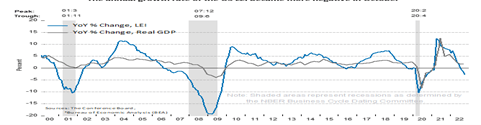
One economic growth measure acknowledged by market professionals but few else is the Conference Board’s Index of Leading Economic Indicators (LEI) that attempts to forecast future economic activity. And it is signaling an upcoming recession, according to its director.

“The US LEI fell again in September and its persistent downward trajectory in recent months suggests a recession is increasingly likely before yearend,” said Ataman Ozyildirim, Senior Director, Economics, at The Conference Board. “The six-month growth rate of the LEI fell deeper into negative territory in September, and weaknesses among the leading indicators were widespread. Amid high inflation, slowing labor markets, rising interest rates, and tighter credit conditions, The Conference Board forecasts real GDP growth will be 1.5 percent year-over-year in 2022, before slowing further in the first half of next year.”

So it is predicting contraction later this year: “The negative contributors—beginning with the largest negative contributor—were stock prices, average consumer expectations for business conditions, the ISM® New Orders Index, the Leading Credit Index™ (inverted), and manufacturers’ new orders for nondefense capital goods excluding aircraft,” said the LEI.

The labor market is slowing but it is still tight with initial jobless claims ultra-low, and inflation beginning to decline, which makes it less likely the U.S. slides into recession this year.

Prices are already plunging is many areas not covered by the standard inflation indexes. The New York Federal Reserve has said its September Survey of Consumer Expectations found that respondents projected their spending will rise by 6 percent over the next year, a sharp drop from the 7.8 percent rise predicted in the August survey. The bank noted that decline in spending expectations was the biggest since the survey began in 2013, while inflation expectations are holding steady, even declining slightly in the near term.

This will be a Federal Reserve induced recession if it materializes. Stock prices and consumer spending are down because of the higher interest rates, with the housing market, another leading indicator, already in recession.

The COVID pandemic and war in Ukraine have thrown a monkey wrench into economic policymaking because inflation reared up so quickly after the worldwide shutdown of economic activity, while governments and Central Banks spent $trillions in various COVID rescue packages in the face of worldwide shortages of goods and services—especially food and energy.

I quoted Adam Tooze, a well-regarded economic historian, last week as sounding the alarm in a recent NYTimes Opinion.

“We now find ourselves in the midst of the most comprehensive tightening of monetary policy the world has seen. And raising interest rates is not going to bring more gas or microchips to market, but rather the contrary. Reducing investment will limit capacity and thus reduce future supply”

Yet the Conference Board’s confidence index signals consumers are still upbeat, at least through the holidays, which makes it also less likely we see a downturn this year.

“…purchasing intentions were mixed, with intentions to buy automobiles and big-ticket appliances up, while home purchasing intentions fell,” said the Conference Board. The latter no doubt reflects rising mortgage rates and a cooling housing market. Looking ahead, the improvement in confidence may bode well for consumer spending in the final months of 2022, but inflation and interest-rate hikes remain strong headwinds to growth in the short term.”

In fact, Gross Domestic Product is predicted to grow more than 2 percent in Q3 and slightly less in the fourth quarter. So, no recession is yet in the works—at least this year.

Harlan Green © 2022

Follow Harlan Green on Twitter: https://twitter.com/HarlanGreen
Posted in Consumers, COVID-19, Economy, Weekly Financial News | Leave a comment

Homebuilders Losing Confidence

The Mortgage Corner

Calculated Risk

Builder confidence in the market for newly built single-family homes dropped eight points in October to 38—half the level it was just six months ago—according to the National Association of Home Builders (NAHB)/Wells Fargo Housing Market Index (HMI) released today.

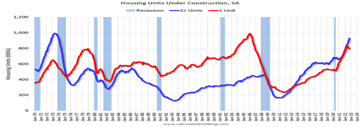
This is the lowest confidence reading since August 2012, except for the onset of the pandemic in the spring of 2020, and means the housing sector has been hit hardest by higher interest rates, which have reached nosebleed territory for prospective home buyers.

“This will be the first year since 2011 to see a decline for single-family starts,” said NAHB Chief Economist Robert Dietz. “And given expectations for ongoing elevated interest rates due to actions by the Federal Reserve, 2023 is forecasted to see additional single-family building declines as the housing contraction continues. While some analysts have suggested that the housing market is now more ‘balanced,’ the truth is that the homeownership rate will decline in the quarters ahead as higher interest rates and ongoing elevated construction costs continue to price out many prospective buyers.”

Existing-home sales look no better. The National Association of Realtors reports year-over-year, sales faded by 19.9% (5.99 million in August 2021).

“The housing sector is the most sensitive to and experiences the most immediate impacts from the Federal Reserve’s interest rate policy changes,” said NAR Chief Economist Lawrence Yun. “The softness in home sales reflects this year’s escalating mortgage rates. Nonetheless, homeowners are doing well with near nonexistent distressed property sales and home prices still higher than a year ago.”

This is small comfort to a housing market already in recession, said economist Diane Swonk.

“Mortgage demand plummets 86% from year ago as refis continue to evaporate along with new mortgage demand. The data adds to the collapse we saw in home builder sentiment earlier this week and marks a 25 year low. The housing market recession will get demonstrably worse,” she said in a recent Tweet @DianeSwonk.

The real problem hurting housing is inflation that has spiked higher interest rates, something that President Biden and Democrats have little control over. Worldwide food and energy prices first began to surge with Russia’s invasion of the Ukraine.

The UK just reported its consumer-price index increased 10.1 percent in September year-on-year, up from 9.9 percent in August, according to data from the U.K.’s Office for National Statistics published Wednesday.

The rise in inflation was driven by higher food and non-alcoholic beverage prices, which increased by 14.5 percent on year compared with 13.1 percent in August. Meanwhile, the continued fall in the price of motor fuels made the largest downward contribution, the ONS said.

The UK has one of the better inflation numbers. Turkey, Russian, Brazil and many other countries hit hard by the supply shortages still have double-digit inflation rates.

So, let’s put the blame for high inflation where it belongs—China’s troubles with COVID lockdowns, a war, and lingering hangover from the pandemic, ok?

Harlan Green © 2021

Follow Harlan Green on Twitter: https://twitter.com/HarlanGreen
Posted in Consumers, COVID-19, Housing, housing market, Weekly Financial News | Leave a comment

Retail Sales, Inflation Slowing

Popular Economics Weekly

FREDretailsales

Another part of the inflation puzzle is retail sales; probably the most important picture of consumer demand since consumers power some 70 percent of economic activity. Any decline in retail sales helps the Federal Reserve decide when consumer demand for goods and services cools enough to slow rising inflation, and hence interest rates.

So, its good news to see that retail sales dropped sharply in one month—from 15.5 percent in March 2022 to just 5 percent in April 2022 YoY.

That’s also when Putin began his invasion of Ukraine and food and energy prices began to surge. It’s a sign that consumers pay attention to inflation and are cutting back on spending of their own accord.

FREDcpi

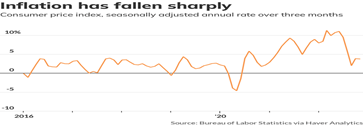
What the headlines don’t yet grasp is that retail sales flattened out in April, as did the 40-year spike in the Consumer Price Index, which has risen just 2 percent over the past three months.

Retail sales are now rising at 7.7 percent YoY and are barely keeping up the with the 8 percent inflation rate. Total sales were flat rather than up 0.2% in September as we had expected, said Reuters:

“Retail sales are slowing as spending shifts back to services. Sales at auto dealerships slipped 0.4% last month, while receipts at service stations dropped 1.4%. Furniture store sales fell 0.7%, while those at building material and garden equipment retailers decreased 0.4%.”

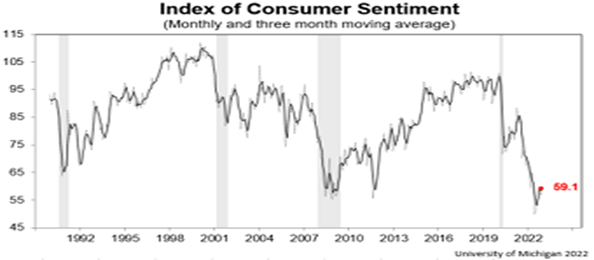
A survey from the University of Michigan on Friday showed consumer sentiment improved further in October, but inflation expectations deteriorated a bit as average national gasoline prices moved towards $4 per gallon after falling over the summer.

“Continued uncertainty over the future trajectory of prices, economies, and financial. markets around the world indicate a bumpy road ahead for consumers,” said survey director Joanne Hsu. “The median expected year-ahead inflation rate rose to 5.1%, with increases reported across age, income, and education. Last month, long run inflation expectations fell below the narrow 2.9-3.1% range for the first time since July 2021, but since then expectations have returned to that range at 2.9%.”

It looks like consumers via their spending habits will know and be the first to tell the Fed when the inflation dragon has been tamed.

Harlan Green © 2022

Follow Harlan Green on Twitter: https://twitter.com/HarlanGreen
Posted in Consumers, COVID-19, Economy, Weekly Financial News | Leave a comment

Inflation Already Declining!

The Mortgage Corner

AtlantaGDPNow

The Atlanta Federal Reserve has just upped their estimate of Q3 economic growth to +2.9 percent after two quarters of negative growth. Why are they thinking that economic growth will resume when the Fed says it intends to push interest rates even higher?

Part of the problem, according to renowned economist Professor Jeremy Segal of the Wharton School in a recent CNBC interview, is the Fed bases its outlook on inflation indicators six months to a year behind actual inflation trends.

They should instead base their actions on current economic indicators, says Segal, such as the real money supply and disposable incomes, which have been falling sharply. The amount of money in circulation controls much of the economic activity of banks as well as consumers and higher interest rates will shrink the M2 money supply even further.

MarketWatch

MarketWatch economist Rex Nutting’s above graphs show that the real money supply, disposable income (i.e., after taxes), and home prices that measure real wealth for the two-thirds of American households that own homes, have been declining for months.

The Atlanta Fed’s GDPNow model estimate for real GDP growth (seasonally adjusted annual rate) is also based on actual economic indicators—such as employment and wholesale trade. As of October 7, its latest forecast for the third quarter of 2022 is 2.9 percent, up from 2.7 percent on October 5.

“After this morning’s employment situation report by the US Bureau of Labor Statistics and the wholesale trade report from the US Census Bureau,” said the GDPNow press release, “the ‘nowcast’ of third quarter real personal consumption expenditures growth and third-quarter real gross private domestic investment growth increased from 1.1 percent and -3.6 percent, respectively, to 1.3 percent and -3.4 percent, respectively.”

Part of the problem may be the Atlanta Fed looks at numbers affecting all Americans vs. Fed Chair Powell looking at numbers that rely on indexes that measure data affecting 30 to 40 percent of our population, such as rents and food prices that have seen the highest price increases.

There are also other leading indicators of inflation, including commodity prices, supply times, the value of the dollar BUXX, 0.25% DXY, 0.16%, says Nutting. Almost all of these have peaked and are now declining. These are other signs that inflationary pressures are lessening.

“The biggest risk to the economy is that the Fed and other central banks will tighten too much, according to 55% of economists surveyed by the National Association of Business Economics,” he said.

If economic growth is positive for the rest of this year, it may be a sign that the actual inflation indicators Professor Segal and Nutting advocate may have bottomed, and economic growth has resumed.

Will the Federal Reserve realize this in time to avert another recession?

Harlan Green © 2021

Follow Harlan Green on Twitter: https://twitter.com/HarlanGreen
Posted in Consumers, COVID-19, Economy, Housing, Weekly Financial News | 1 Comment

Too Much Disinflation Is Bad Planning

Financial FAQs

FREDcapex

The rumblings of an oncoming disinflationary spiral are becoming louder. And it may be as difficult to tame as the current inflationary spike that so worries the Federal Reserve.

What is disinflation as opposed to outright deflation? It’s when prices are still rising but at a lower inflation rate, vs. outright deflation when prices are falling, which occurs during a recession. Deflation last happened during the Great Recession and busted housing bubble.

The COVID pandemic and war in Ukraine have thrown a monkey wrench into economic policy-making because inflation reared up so quickly after the worldwide shutdown of economic activity, when governments and Central Banks spent $trillions in various COVID rescue packages in the face of worldwide shortages of goods and services—especially food and energy sources

The problem is how to cure inflation without causing a recession, since raising interest rates too rapidly harms future economic investment, particularly capital expenditures (capex), as well as consumer spending. Capex investment has abruptly declined after its rapid rise post-COVID, per the above FRED graph.

Adam Tooze, a well-regarded economic historian, is one of the loudest sounding the disinflation alarm in a recent NYTimes Opinion.

“We now find ourselves in the midst of the most comprehensive tightening of monetary policy the world has seen. And raising interest rates is not going to bring more gas or microchips to market, but rather the contrary. Reducing investment will limit capacity and thus reduce future supply”

Former Fed Chair Ben Bernanke, one of three economists just awarded the 2022 Economics Nobel Prize, is contributing to the chorus. He warned that our Fed’s attempt to “fine tune” economic stability risks with interest-rate policies was not a good idea. “I don’t think we understand that well enough, except in perhaps extreme conditions, to try to fine-tune financial stability using monetary policy,” he said when interviewed at the Brookings Institute.

What is our Federal Reserve to do when the Produce Price Index for raw materials and wholesale goods that came out today is still rising? The increase in wholesale prices over the past year is up 8.5 percent, down slightly from 8.7 percent in the prior month. Inflation is still running near a 40-year high.

But prices are already plunging is many areas not covered by the standard inflation indexes. The New York Federal Reserve has said its September Survey of Consumer Expectations found that respondents projected their spending will rise by 6 percent over the next year, a sharp drop from the 7.8 percent rise predicted in the August survey. The bank noted that decline in spending expectations was the biggest since the survey began in 2013, while inflation expectations are holding steady, even declining slightly in the near term.

Adam Tooze’s plea echoes what many economic planners worry about. It’s taken more than two years to bring the COVID pandemic under control. Why not give the world’s economies more time to recover?

Harlan Green © 2022

Follow Harlan Green on Twitter: https://twitter.com/HarlanGreen

Posted in Consumers, COVID-19, Economy, Weekly Financial News | Leave a comment

Employment Slowing Enough?

Popular Economics Weekly

 MarketWatch

Job growth is slowing, but is it enough to call off the inflation hawks, including Federal Reserve Governors, from wanting more rate hikes?

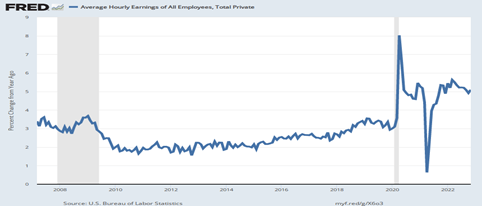
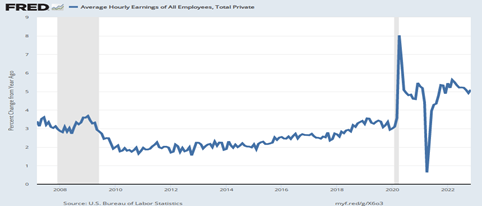
The U.S. Economy is still fully employed for those wanting to work; with a historically low 3.5 percent unemployment rate, 263,000 nonfarm payroll jobs, and hourly wages rising at 5 percent in September’s unemployment report.

It was the smallest jobs gain in 17 months, and we are back to pre-pandemic levels of employment, but inflation is still high because of the Ukraine War and a shortage of goods and services. The so-called supply-chain shortages really mean there is still a worldwide supply shortage, though now there are now plenty of trucks, ships, and planes to deliver them.

Almost all business sectors continued hiring, and people continued to travel and dine out in large numbers, as hotel, restaurants and other companies in the hospitality business created 83,000 new jobs, reflecting strong demand for services such as travel and recreation.

Hiring also rose sharply in health care and professional businesses. Manufacturers added 22,000 jobs and construction firms hired 19,000 people.

All this activity is keeping prices from falling fast enough to please the hawks, but do we even have much choice in the matter? Noted market strategist Jim Paulsen of the Leuthold Group has done research on the history of such inflationary spikes, and they all pretty much behave the same, regardless of monetary policy.

MarketWatch

His graph shows that inflation spikes have come down as fast as they rose. Paulsen maintains this is therefore an excellent buying opportunity for investors because it’s now possible to predict approximately when the inflation surge ends and interest rates decline, which tend to follow inflation trends.

An inflation cycle usually takes approximately 12 months from its beginning to end, so since this inflation spike began in April-May, we should see inflation returning to a normal range by next April-May.

And he sees inflation already subsiding:

  • CL.1, 3.36% are down 30% from June. A gallon of gasoline has fallen 23% since peaking in the same month. Energy is central to the economy, so its price has a big impact on the prices of almost everything. Plus, there is a psychological angle.
  • CSGP, -1.89%, a great source of data on real estate trends and analytics. “We’re seeing a complete reversal of market conditions in just 12 months, going from demand significantly outstripping available units to new deliveries outpacing lackluster demand,” says Jay Lybik, CoStar’s director of multifamily analytics.
  • TGT, -1.96% grabbed headlines in early June when it reported it will have to cut prices to clear inventories. Nike NKE, -2.27% followed suit last week. Those two are not alone in over-ordering merchandise, expecting the pandemic-induced consumer preference for goods over services to continue. This inventory clearing will show up in headline inflation numbers soon.

And consumer surveys already show consumers becoming more confident about the future with inflation expections now below 3 percent over the next five years.

This should be enough to convince inflation hawks to ease up on their inflation fears, amd the Fed to pause and see what the holdays bring. Consumers and businesses seem to be tolerating the moderate Fed rate hikes to date. And there’s no hurry to reverse course, unless prices begin more dramatic declines leading to disinflation, or outright deflation. Why not show patience, Fed Chairman Powell, as consumers seem to be doing and enjoy the holidays!

Harlan Green © 2022

Follow Harlan Green on Twitter: https://twitter.com/HarlanGreen
Posted in Consumers, COVID-19, Economy, Weekly Financial News | Leave a comment

It’s Time For Positive Economic Growth!

Financial FAQs

AtlantaFed

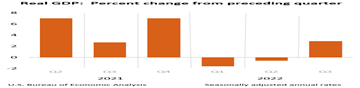
Economists are beginning to predict third quarter grow domestic product (GDP) growth will turn positive after two quarters of negative growth, maybe ending thoughts of a recession occurring next year.

The U.S. trade deficit fell in August to a 15-month low of $67.4 billion, mainly because exports were the second highest on record, which adds to gross domestic product income, while imports dropped 1.1 percent to $326.3 billion, which subtracts from national income, marking the lowest level since early 2021.

The difference between imports and exports is part of the gross domestic product calculation, and the actual deficit between imports and exports narrowed 4.3 percent from $70.5 billion in July, the government said Wednesday. It was the fifth decline in a row.

Why? The U.S. economy has recovered from the COVID pandemic much more quickly than other countries. It should mean solid economic growth will continue, especially since inflation is beginning to decline.

Keep in mind the naysayers believe the Fed will boost interest rates too high, as has happened in the past; such as when former Fed Chair Volcker boosted interest rates so much it caused two back-to-back recessions in 1981-82.

The Atlanta Federal Reserve, noted for its Gross Domestic Product predictions, has also come out with a very optimistic third quarter prediction of economic growth, after the first two quarters of negative growth in 2022.

“The GDPNow model estimate for real GDP growth (seasonally adjusted annual rate) in the third quarter of 2022 is 2.7 percent on October 5, up from 2.3 percent on October 3,” said the Atlanta Fed in its press release. It’s a technical analysis mainly intelligible to economists, and highlights the difference from the negative first and second quarter GDP growth.

BEA.gov

The Atlanta Fed calls it a GDPNow estimate, so it won’t be confused with official U.S. Federal Reserve prediction of Q3 GDP growth, which will come out a month later and is lower at the moment.

Their GDPNow estimate was adjusted upward very abruptly, apparently not anticipating the fast U.S. recovery, especially in exports that add the most to economic growth, as I said, along with inventory buildup (i.e., higher investment). The GDPNow estimate flagged the pickup in exports announced in the final Q2 GDP estimate as well as strong consumer spending.

There are strong indications that inflation is subsiding everywhere, as I’ve been saying, mainly because so much of it was caused by supply-side shocks due to the pandemic and the Ukraine war.

Nobel Laureate Paul Krugman wrote in a recent NYTimes Op-ed that he believes long term there will be a return to lower interest rates and inflation once things calm down.

“Many commentators have asserted that the era of low interest rates is over. They insist that we’re never going back to the historically low rates that prevailed in late 2019 and early 2020, just before the pandemic — rates that were actually negative in many countries.

“But I don’t see that happening. There were fundamental reasons interest rates were so low three years ago. Those fundamentals haven’t changed; if anything, they’ve gotten stronger. So it’s hard to understand why, once the dust from the fight against inflation has settled, we won’t go back to a very-low-rate world.”

Let us see if those “fundamental reasons” haven’t changed, and we can return to a more peaceful world.

Harlan Green © 2022

Follow Harlan Green on Twitter: https://twitter.com/HarlanGreen

Posted in Consumers, COVID-19, Economy, Weekly Financial News | Leave a comment

Will U.S. Economy Slow Enough?

The Mortgage Corner

Calculated Risk

Is the economy slowing enough to cause the Fed to pause in their rather draconian rate hikes that have alarmed the financial markets enough to cause them to believe a recession is imminent?

Wall Street’s bumpy ride is due to higher interest rates that elevate its borrowing costs, and the Fed hasn’t said when they will stop the rate hikes (five times already this year).

We might have to wait for Friday’s unemployment report to know with more certainty if the job market is cooling, which Fed Chairman Powell and the Fed Governors have said is a desired result.

Tuesday’s release of the the total number of hirings and job departures in the September Job Openings and Labor Turnover Survey (JOLTS) report gives us a hint of what’s to come.

The government report released Tuesday found there were more than one million fewer job openings in August than in July — a 10% drop and the biggest one-month decline since April 2020 gives us a hint of what’s to come—as unemployment claims dipped to a five-month low. Employers have slowed hiring amid rising costs, gas price spikes and Federal Reserve interest rate hikes intended to stifle inflation.

“The number of job openings decreased to 10.1 million on the last business day of August, the U.S. Bureau of Labor Statistics reported today. Hires and total separations were little changed at 6.3 million and 6.0 million, respectively. Within separations, quits (4.2 million) and layoffs and discharges (1.5 million) were little changed.”

It reports that some 300,000 new jobs were created in September—subtract 6.0 million separations from 6.3 million hires in the JOLTS report. This is close to the consensus estimate of 275,000 new hires estimated by economists in the upcoming unemployment report.

The broad decrease in job openings was led by healthcare and social assistance, with a decline of 236,000. There were 183,000 fewer job openings in other services, while vacancies decreased by 143,000 in the retail trade industry. Fewer job openings were also reported in the financial activities, professional as well as leisure and hospitality industries.

And the “little changed” quits and discharges figures tell us that employers are reluctant to let go of employees, and employees are reluctant to leave their current jobs. So the labor market is stabilizing and employers are expecting few surprises during the fall and holiday season.

Employers have slowed hiring this year amid rising costs, gas price spikes and Federal Reserve interest rate hikes intended to stifle inflation. Nonetheless, there were positive employment signs. In August, unemployment claims fell to a five-month low and employers continue to hire at a steady rate, as we said.

Also, the ISM barometer of U.S. business conditions at service-sector companies such as hotels and restaurants dipped to 56.7 percent in September. Yet the survey also showed steady growth and rising employment in a sign the economy is still expanding. Numbers over 55 percent in the survey of Supply Managers is considered exceptional.

And another jobs report said U.S. private sector employers added 208,000 jobs in September, up from a revised 185,000 in the prior month, according to the ADP job report released Wednesday. ADP reported annual pay was up 7.8 percent in September, from a revised 7.7 percent in the prior month.

We believe the Fed should now pause in further interest rate boosts to give financial markets time to adjust to the rapid series of rate increases that are driving up long-term as well as short-term interest rates that is harming the housing market at a time when there is still a shortage of affordable housing.

And we are spending vast sums supporting the Ukraine that need to be paid for as it fights to repel Putin’s invasion. So do we need higher interest rates at this time?

Harlan Green © 2021

Follow Harlan Green on Twitter: https://twitter.com/HarlanGreen
Posted in Consumers, COVID-19, Economy, housing market, Weekly Financial News | Leave a comment

Is It Time to Worry About Deflation, and a Recession?

Financial FAQs

CNBC

The Fed is beginning to ease its purchases of Treasury and Mortgage-backed securities in its push to raise interest rates and lower inflation, a policy called Quantitative Tightening (QT) as opposed to the various Quantitative Easing efforts (QE) when it wanted to boost inflation by increasing the money supply at the end of the Great Recession in 2009.

But what if QT, accompanied by the Fed’s short term interest rate hikes—3 percent to date with its federal funds rate up to a range of 3%-3.25%, which is the highest it has been since early 2008—results in shrinking the money supply so much that it causes a recession, or worse?

It’s possible if the Fed continues to boost interest rates while the worldwide energy and food crunch, which is the real reason wholesale and retail prices have risen so fast, ends almost as quickly as it began.

The Fed would then have to reverse course for fear we might fall into a disinflationary spiral, or worse; deflation as Japan experienced in a decade of lost growth. QE enabled our recovery from the Great Recession, a recession almost as bad in terms of lost assets as the Great Depression.

I reported recently that economists such as Nobel Prize-Winner Joe Stiglitz are beginning to signal that possibility.

“Monetary policy typically affects economic performance with long and variable lags, especially in times of upheaval,” said Professor Stiglitz in a recent Project Syndicate article. “Given the depth of geopolitical, financial, and economic uncertainty – not least about the future course of inflation – the Fed would be wise to pause its rate hikes and wait until a more reliable assessment of the situation is possible.”

Some Wall Streeters are joining the chorus to slow down the rate increases. Cathie Wood, CEO of hedge fund Ark Invest, and a vocal proponent of deflation, is getting a few high-profile supporters even as price pressures continued to surprise to the upside, as reported by CNBC.

Jeffrey Gundlach and Elon Musk recently joined Wood’s camp in calling for a decline for prices, expressing worries that the Federal Reserve might go too far. Bond King Gundlach warned of the deflation risk on Tuesday, urging investors to buy long-term Treasurys. Meanwhile, the Tesla CEO called falling commodity prices “neither subtle nor secret” and tweeted to his 100 million followers that “a major Fed rate hike risks deflation.”

Wood has been warning about deflation since last year and is now doubling down on her call as several leading indicators she watches are pointing to deflationary forces instead of inflation, says CNBC.

““Leading inflation indicators like gold and copper are flagging the risk of deflation,” Wood said. “Even the oil price has dropped more than 35% from its peak, erasing most of the gain this year.” Gold prices have slid 6% so far this year. “Inflation is turning into deflation,” she said.

There was a real deflation danger in 2009 and a reason for QE. More precisely, the retail Consumer Price Index used to measure retail inflation had sunk to a minus -1.96 percent with little sign of rising after the shock of the Lehman Brothers collapse and possibility that many other firms on Wall Street were also in danger of collapse.

Congress and the GW Bush administration raised more than $700 billion to save the banks and Wall Street at the time, but it took years to boost demandraise the inflation rate back to 2 percent.

That’s our past history, which seems to put the Fed between a rock and a hard place, as the saying goes. Should it allow the inflation rate to continue to decline on its own, as it is doing, or speed up the process of decline, thus threatening a more severe downturn?

Yikes, what a situation to be in!

Harlan Green © 2022

Follow Harlan Green on Twitter: https://twitter.com/HarlanGreen

Posted in Uncategorized | Leave a comment

The Peace Corps and Rotary International

In the special 60th anniversary edition of WorldView, Shaylyn Romney Garrett, co-author with Robert Putnam of The Upswing: How American Came together a Century Ago and How We can Do It Again, posits a policy prescription for the administration “that would help us move to an ‘upswing’ (a return to the ‘we’ of service to others, vs. the ‘I’ of self-service that has prevailed since the 1960s). National Service is my absolute go-to answer.” As a Returned Peace Corps Volunteer and Rotarian for 27 years, I can attest that we already have vibrant national and international service organizations.

There have been many calls for a national service; AmeriCorps, the domestic equivalent of the Peace Corps, has been a partial answer. Gen. Stanley McChrystal, a former commander of international forces in Afghanistan and head of the “Serve America. Together.” campaign, called on the president to invest in universal national service for 1 million young Americans annually as “the most important strategy we can implement to ensure the strength and security of our nation.” But the foremost national and international service organization is Rotary International, dedicated to the motto “Service Above Self.”

As of 2006, Rotary had more than 1.4 million members in over 36,000 clubs among 200 countries and geographical areas. I served as a Peace Corps Volunteer in Turkey and have been able to continue my community development work as a Rotarian; I have been involved in countless local community projects and international projects, such as in eastern Democratic Republic of Congo assisting in its recovery from the various civil wars it suffered. More important, I am a founding board member of Partnering For Peace, an NPCA affiliate that has joined with the Peace Corps to support Peace Corps projects worldwide. That is a natural partnership of like minds and hearts, committed to both national and international service. It is time to acknowledge Rotary International’s role in both foreign and domestic public service for its growth and vitality. It is a testament to how well Rotarians and the Peace Corps Community are already working together. I already see this “upswing” happening for millions worldwide, as well as in the U.S.

Harlan Green
Turkey 1964–66

Posted in Uncategorized | Leave a comment