Economic Growth Becoming More Sustainable?

Financial FAQs

The analogy that best describes current economic conditions is one where we are in a race to recover from COVID-19 while a European war is raging. The U.S. economy has slowed from a warp speed of 100 mph as it shot out of the pandemic to something like 60 mph, as it returns to a more normal growth mode.

The headlines are telling us growth could slow down even more, and the race come to a grinding halt, either later this year or sometime next year. Why? Because the Fed may continue to raise short term interest rates, and that may not be necessary since 60 mph is the speed we will need to maintain for more sustainable, longer-term growth.

The U.S. economy is cooling off, but the labor market is still red hot, hence the worries the Fed may be too aggressive in raising rates. Job openings in the latest JOLTS report fell slightly in May to a still extremely high 11.3 million (from 11.4 the past 2 months) and layoffs remained near a record low.

Job openings have slipped two months in a row after peaking in March at 11.9 million, but they have topped 11 million for six straight months. Layoffs are also extremely low, the Labor Department said Wednesday.

It’s most meaningful component, hires, and total separations, were little changed at 6.5 million and 6.0 million, respectively. This means there were 500,000 more new hirings than separations (those leaving a job). It is a sign that Friday’s June unemployment report will probably be strong and in line with past months.

Both business sectors, the manufacturing and service industries, are also returning to more normal growth levels. Their measure, surveys of Supply Managers, have shown incredible growth over the past two years.

Tradingeconomics.com

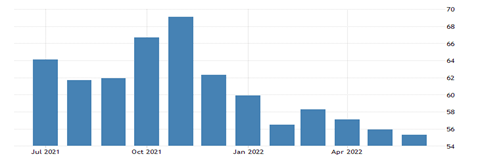
An Institute of Supply Management (ISM) barometer of business conditions at service-oriented companies (see above graph) such as restaurants, hotels and retailers dipped to a two-year low of 55.3 percent in June — yet any number over 50 percent indicates expanding activity.

The Trading Economics graph shows how it soared since July 2021 and reached a nose-bleeding altitude of 69 percent in November 2021.

A similar ISM survey of American manufacturers also showed business slowing to a two-year low to 53 percent in June. The ISM index dropped 3.1 points from 56.1 percent in May, yet that is still a good number.

BEA.gov

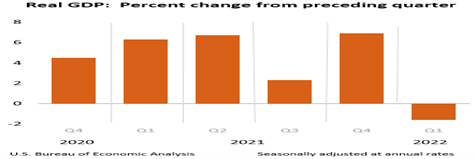
The decline in Q1 GDP was mainly due to a massive rise in imports overshadowing a slowdown in exports. But with the value of the U.S. Dollar at all-time highs the trend has reversed. Exports now exceed imports resulting in the lowest budget deficit this year. Import totals are subtracted from exports in the GDP tally.

Tomorrow’s unemployment report will give us another indication whether we can maintain that 60 mph speed, or will the Fed keep their foot on the brakes and slow growth further?

Harlan Green © 2022

Follow Harlan Green on Twitter: https://twitter.com/HarlanGreen

Posted in Consumers, COVID-19, Economy, Politics, Weekly Financial News | Leave a comment

Inflation Not the Real Problem

The Mortgage Corner

FREDcpi

Why do polls say we are going in the wrong direction and the economy isn’t doing well? Fifty-two percent of American adults say they are worse off financially than they were a year ago, according to a survey conducted for The New York Times this month by the online research platform Momentive.

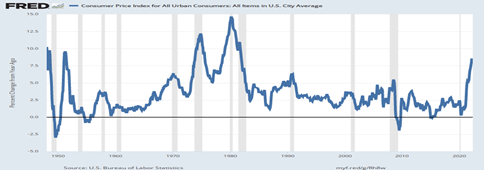
A large part of the discontent is sky-high inflation, the highest in 40 years. Yet it was much higher 40 years ago, per the FRED graph on the Consumer Price Index. It was over 14 percent in 1981 due to the 1970’s era of stagflation that manifested slow growth and lower employment with higher inflation, as per the FRED graph.

It’s difficult to reconcile the pessimism shown in the latest consumer confidence surveys with actual economic data. The University of Michigan’s gauge of consumer sentiment, for instance, fell again to a final June reading of 50 from an initial reading of 50.2 earlier in the month and well below May’s level of 58.4.

Yet U.S. factory orders jumped 1.6 percent in May in a show of strength among manufacturers in a report out today, and the unemployment rate has remained at 3.6 percent for two months.

Maybe it’s a general fear of what’s to come—perhaps a hangover from two years of the pandemic, and now a war that has exacerbated inflation.

The increase in factory orders exceeded the 0.6 percent forecast of economists polled by The Wall Street Journal. The rise in new orders in April was also raised to 0.7 percent from 0.3 percent.

Yet a more recent poll of senior manufacturing executives signaled a slowdown in June. An index of manufacturers slipped to a two-year low in June as orders contracted for the first time since the start of the pandemic in spring 2020.

In fact, inflation is not the real danger to growth, but the fear of rising interest rates. Is that counter-intuitive? When the Fed or inflation hawks sound off on the dangers of inflation above the Fed’s 2 percent target rate, they really mean they don’t like the higher interest rates that tend to follow; which do slow economic growth.

Whereas higher inflation is usually a sign of robust growth; until it crimps consumers’ pocketbooks. For instance, the CPI inflation rate during the record 10-year Clinton era growth range of 2.5-3.5 percent. It only dipped below that during the recent pandemic years, a once-in-a-lifetime event.

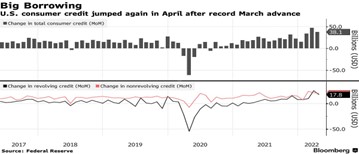
Higher interest rates do most harm. That’s because most economic growth is powered by debt. We know the federal debt is upwards of $22Trillion, or 100 percent of GDP. Whereas consumer debt, either in the form of credit card or installment debt that includes mortgages, is up $38.1B or 10.1 percent annually, as consumers continue to spend with more borrowing.

Bloomberg

Inflation has mostly hovered around the 2 percent target rate historically, and should return to that range by next year, as the FRED graph makes clear, with spikes during extraordinary time, such as the 1970s era of stagflation, as I said.

But interest rates aren’t so flexible, and tend to become in installment loans with fixed monthly payments, in particular. So, we need to pay closer attention to interest rates, if we want to know what will happen next.

Harlan Green © 2022

Follow Harlan Green on Twitter: https://twitter.com/HarlanGreen

Posted in Consumers, COVID-19, Economy, Weekly Financial News | Leave a comment

The Great Clean Air Debate–Part II

Answering Kennedy’s Call

Chapter Six

Environmental Protection Could be Hazardous

At the time, I remember thinking environmental protection should not mean crawling down the partially opened rear stairs of a Boeing 727 passenger jet into a muddy field at San Francisco International Airport.

I had boarded a regularly scheduled Sunday afternoon flight to Los Angeles where I was producing a one-half hour public service television show for the USEPA on the dangers of toxic substances in anything we might eat or drink.

I sat next to a World War II pilot on that cloudy, rainy day in a United Airlines 727. Wisps of clouds raced by as we ascended. I hated the 727 with its three engines in the rear of the plane. It took off and landed like a wounded duck, as far as I was concerned, yet the airlines used it for the shorter flights. It always seemed to land with a deep thud that made me close my eyes on the approach, wondering if it had landed safely, and it seemed to lift off at the very last moment from the end of the runway.

As we climbed, I noticed a vapor streaming from the wing tips. I pointed it out to the former pilot I had just met. He said not to worry too much: they were probably jettisoning some excess fuel.

“But why?” I asked. “Why would they be jettisoning fuel after the takeoff?” It wasn’t long before we knew the answer. The pilot’s voice came over the intercom: “We don’t want you to be alarmed, but we have to return to the airport.”

I looked at my seat partner who seemed calm. He had been regaling me with stories of his fighter pilot days in World War II in the Pacific. “I don’t know what it could be,” he said. “Probably some malfunction in the navigation system, or some of the dials aren’t giving accurate signals.”

That was when the airline pilot told us what was actually happening. “We are returning because a warning light is telling us something is overheating in the cargo bay,” he said over the intercom. “It may be nothing, a light malfunctioning, but we would like you to grab your ankles as we approach landing, just in case.”

That was possible when flying in the 1970s. Seats were farther apart. In fact, airlines competed to offer more leg room rather than less in those days.

Though my heart beat a little faster, I didn’t think anything could really be wrong. But my partner and I grabbed our ankles as we approached, just in case. The plane had been circling while continuing to jettison fuel.

We heard the landing gear lock and the jet engines reverse thrust to slow down the plane as we landed, so I thought the flight was over. Suddenly there was a much louder THUNK, then the plane tilted crazily and began to slowly rotate. Those of us grabbing our ankles could see nothing, but I had the sickening feeling that I was going to die.

The THUNK was followed by a screeching of metal, but I had no idea how long that lasted before the silence. It was a silence that I honestly thought meant the end—I think we all felt that way—even though my mind was racing. Was it even possible this was what the afterlife must be? A limbo of sorts with nothing to see or hear? It was as if, at that moment, I had left my body, and whatever had become of me was hovering overhead.

But then I heard screaming, and a group of uniformed pilots suddenly appeared out of nowhere. It was only later that I realized they were off-duty pilots hitching rides home on the weekend. At this moment they happened to be in the right place at the right time. At least six of them rousted passengers out of their seats.

Most of us were in shock. They had to literally grab some of the passengers and throw them down the inflated chutes that had opened before it dawned on the rest of us that we needed to get the hell out of there.

Being near the tail of this 727, my partner and I had only one escape route. There was an exit staircase that opened under the tail, but it was only partially open. We crawled our way down those steps and found that the tail was sitting in the mud. When we stood up to look around in a slight drizzle, hands and knees covered in the mud, we saw we were in a wet field beside one of the runways. The nose of the plane was buried in a small, corrugated metal shack that must have stopped its slide.

My partner said immediately, “It has to be one of the landing gear.”

“What landing gear?” I asked. I looked up and down the runway we were beside and saw no landing gear. My partner had taken out a miniature Minolta camera and began clicking away in all directions as people continued to crawl or slide out of the plane. Some lay on the ground moaning, as sirens from approaching rescue vehicles screamed louder.

The pilots and crew members herded us away from the fuselage. I saw no smoke, and so thank God, maybe no fire. They were also shouting, “No pictures, please, no pictures, please,” which my partner, of course, ignored. When I looked down the runway that crossed ours, I saw a small object lying in the middle of it. It was our landing gear: four wheels still locked to the strut that anchored it to the wing.

The right-side wing was buried in the ground, and we now could see what had happened. Its landing gear, with all four wheels, had broken off the wing and was laying with its strut assembly barely visible in the distance. We must have skidded for more than a mile before coming to a stop in this muddy field.

The ex-fighter pilot told me that he had once crash landed on a beach and broken his back in the Philippines during World War II. It underscored how lucky we were this time. The United pilot must have landed too soon with too much fuel in the tanks. I had flown enough to know planes usually take off with more fuel than is safe to carry when landing, in case they were stuck in a holding pattern before descending to the tarmac. The extra weight may have caused the wounded duck to hit the runway harder than was safe. But the pilot’s skill probably saved us by keeping the plane’s nose up, said my seat mate, despite the impact that could have flipped us end-over-end.

So I cancelled the television show that weekend, even though United Airlines offered to put me on the next plane to Los Angeles—once the runways were cleared.

There was no map of what we should or could do in those early days. But making the public aware of what was happening to our air and water was a priority. Administrator DeFalco wanted the public to know why we were here and what needed to be done to protect the environment.

It was the dawning of an awareness of how human activity affected the environment, of the growing danger of toxic chemicals that Silent Spring author Rachel Carson had written about. We would educate and inform the public about our mission.

Harlan Green © 2022

Follow Harlan Green on Twitter: https://twitter.com/HarlanGreen

Posted in Politics, Uncategorized | Leave a comment

Inflation Cooling, Manufacturing Stays Hot

Financial FAQs

FREDpce

Inflation hawks that keep calling for more Fed rate hikes see a recession coming. But what if inflation is already beginning to decline?

The rate of inflation over the past year was unchanged at 6.3 percent in May. The yearly rate has backed off a little after touching a 40-year high a few months ago.

But the core rate of inflation that excludes the more volatile food and energy prices slowed to 4.7 percent in the 12 months ended in May from 4.9 percent in April and a 40-year high of 5.2 percent in March. What’s more, the inflation readings in the core PCE rate from February through May were the smallest since the end of 2020, reports the BEA.

This is huge folks, as households spent less and even the more volatile food and energy prices are subsiding. Consumers do know how to self-correct. They buy less and travel less with such high inflation, thus reducing the demand that elevates prices.

Meanwhile manufactures are upping their capital expenditures instead of cutting back for fear of a slowdown in economic growth.

Their so-called capital expenditures are up 13.9 percent in a year, a volume not seen since the 1980s, in a sign that supply bottlenecks are easing.

One reason is orders at U.S. factories for long-lasting goods such as new cars or heavy machinery rose 0.7 percent in May, a stronger than expected reading that showed manufacturers still had plenty of demand for their products even amid signs the economy was slowing. It was the seventh gain in the last eight months, the government said.

This contrasts with the third and last estimate of Q1 2022 GDP growth that was revised downward to minus -1.6 percent, when it had grown 6.9 percent in last year’s fourth quarter.

BEA.gov

The decline in Q1 GDP was mainly due to a massive rise in imports overshadowing a slowdown in exports. Import totals are subtracted from exports in the GDP tally. There was also some reduced consumer spending, as government COVID subsidies have subsided, as I said.

But manufacturers and other businesses are restocking their shelves, which will probably boost second quarter economic growth back into the positive column, though economists are uncertain as to how much.

The surging inflation that is causing so much pain at the gas pump and grocery stores is, after all, a sign of the red-hot growth of consumption outstripping supplies. Many American refineries had also shut down due to decreased consumption during the pandemic and gas prices that hit rock bottom.

Why such wild gyrations in growth? It seems uncertainty over what the Fed will ultimately do to tame inflation is causing the current instability. Will it raise interest rates too high too fast, and cause consumers to close their wallets?

Former Fed Chair Ben Bernanke believes that inflation will not become embedded longer-term, because the ‘70s stagflation was caused by 14 months of rising prices, whereas it has been rising for six months in the current cycle.

One reason for such business optimism is corporations have been reporting record profits, and able to pass most of their increased product costs onto consumers. They are using some of the record profits to hire more workers, because their markets are continuing to expand.

Let’s hope the Fed reads the inflation tea leaves correctly and doesn’t overreact.

Harlan Green © 2022

Follow Harlan Green on Twitter: https://twitter.com/HarlanGreen

Posted in Consumers, COVID-19, Economy, Weekly Financial News | Leave a comment

Developing a Livable Community

Answering Kennedy’s Call

What are the requirements for a livable community? As recently as 2005, the Institute of American Architects said that

“. . . broadly speaking, a livable community recognizes its own unique identity and places a high value on the planning processes that help manage growth and change to maintain and enhance its community character.”

The Goleta Valley still had a rural feeling. It had been settled by immigrant farmers after the Civil War when the huge Spanish rancheros—made up of tens of thousands of acres—were broken up following an especially severe drought that killed the livestock that were the livelihood of the earliest settlers. Now it was a valley filled with lemon and avocado groves.

But a battle had erupted between developers building new subdivisions and environmentalists who wanted to keep the valley as rural and agricultural as possible. The developers had been winning until the environmentalists succeeded in passing a water moratorium that stopped new building projects that didn’t have existing water allotments.

I became involved with community events like the Lemon Festival and July 4th celebrations, where I met residents who wanted to live in a unique community. Many of them had already made several attempts to form their own city to control its development.

I thought the Goleta Valley, an area with more than 50,000 inhabitants, should become a city. Its revenues for needed improvements were spent elsewhere in the county rather than for the benefit of the valley. And Goleta continued to attract high tech businesses due to its closeness to the top-ranked physics and engineering schools of the University of California’s Santa Barbara campus.

The unplanned expansion had not been preserving the open spaces and pedestrian-friendly commercial centers that residents and sustainable development principles required. The third largest oil spill in U.S. history (behind the Gulf of Mexico and the Alaska oil spills) occurred in the Santa Barbara Channel in 1969. More than three million gallons of crude oil leaked from a deep water well and coated 35 miles of South Coast beaches for months, requiring massive cleanup.

The oil spill mobilized the whole South Coast community, searing the memories of those living there, helping to spawn the national environmental movement.

Goleta had a wonderful history, from its earliest Chumash Indian inhabitants to its discovery in the 1500s by Spanish explorer Juan Cabrillo, which led to the founding of California’s mission system. It then became known as “The Good Land”, an agricultural paradise named by a local historian for its abundant and fruitful soils and climate.

But as a bedroom community to Santa Barbara, the Goleta Valley had no real community organization of its own other than the Goleta Valley Chamber of Commerce. It needed an established entity to ask for what was needed to improve the valley’s aging and dilapidated infrastructure, and to reduce chaotic development. More public transportation, water resources, and just smart community planning were needed to mitigate the effects of a growing population.

There was much opposition to any organizing effort that would create more than a bedroom community in the Goleta

Valley. There were those who wanted to “belong” to the City of Santa Barbara so their property values would be the beneficiary of Santa Barbara property values. They wanted no part of a new, more rural city. Then there were the environmentalists that tended to cluster around UC Santa Barbara with its strong environmental studies program. They were afraid a new city would encourage more development.

But in fact, being unincorporated didn’t prevent development: property owners and developers had only to convince one County Supervisor that represented a larger area, rather than a city council responsible for the entire community.

Goletans couldn’t agree on what was unique about their own community. Was it a farming culture, bedroom community, or just funky adjunct to UC Santa Barbara? Many thought that, with prosperous Santa Barbara next door, what was the need for another city on the already crowded South Coast? Hence the impasse that had defeated earlier cityhood attempts.

The first step in building a livable community, in my view, had to be creating a town center that could focus planning efforts, and Old Town Goleta seemed just the place to do it. Old Town had been the historical center of the Goleta Valley with stores, a saloon, and a blacksmith for farmers in the early days.

There were marsh lands and the large Goleta slough to the south. Goleta Valley and Santa Barbara have the only southern facing coastlines in California due to a geological quirk. Early schooners could sail into what was then a bay at high tide, refill their water caskets at a natural spring where UC Santa Barbara is now located, and even dock near Old Town’s center.

Spanish explorers in the 1700s who were looking for mission sites originally thought it could be an ideal site for a mission, as a large island in the center of the slough had originally held five indigenous Chumash Indian villages and was surrounded by water making it easily defensible. But when the Spaniards returned several years later during a drought, there was very little water to protect it. So, they chose to build the mission in Santa Barbara, which had no natural harbor but a seasonal creek that could provide an adequate water supply.

Old Town, with its own past, could give Goleta Valley residents a sense of their own history and separate community identity. It even had a Community Center that hosted many community activities. An associate County Planner at that time, Dan Gira, also thought Goleta should become a city able to determine its future as part of the County’s General Development Plan update.

The update was required by the state of California to accommodate the changes necessitated by a growing population. I was one of many moving to this beautiful area of the South Coast with its unique climate sheltered by east-west mountains and south facing beaches. Santa Barbara and the South Coast has always been a beautiful and very desirable place to live, and the people kept coming.

The County would apply to the state of California for the formation of a Goleta Old Town Redevelopment District, which would allow some tax monies to be withheld for use in Old Town to upgrade its housing and infrastructure. While I loved the beautiful outdoors and the nature that surrounded us, more housing was needed in Old Town. Many Mexican agricultural workers—mostly undocumented—were living in Old Town because of its cheap rents, but landlords were taking advantage by housing ten to twenty of them in a single dilapidated housing unit.

I had to raise $50,000 in the community: 50 percent of the expense the County would incur to do the studies necessary to classify Goleta Old Town as a redevelopment district. The County would chip in its 50 percent in the form of time and labor, and whatever was needed for the feasibility study that would determine if Goleta Old Town fulfilled the state requirements for its redevelopment.

The study would include a report on degraded infrastructure, such as inadequate surface transportation, and the number of bars and other “nonproductive” businesses in Old Town. The point was to determine the extent of blight, or physical deterioration, of the Old Town community, and a cost estimate for fixing those problems.

There was plenty of blight. Goleta’s Old Town had become run down in the 1980s as competing malls were built elsewhere to accommodate the new auto-dependent subdivisions built to hold the growing population. Bars had proliferated as businesses left Old Town. A fire partially destroyed a ten-unit apartment building. A Santa Barbara News-Press reporter covering the fire reported that residents thought the popping noise from breaking Windows sounded like gunfire from gang warfare.

We raised the $50,000, the County Planning Department hired a consultant to write the feasibility study, and it was approved within a year. That gave us the means to begin planning for a new town center, and maybe a city.

Harlan Green © 2022

Follow Harlan Green on Twitter: https://twitter.com/HarlanGreen

Posted in Consumers, Economy, Housing, Politics, Uncategorized | Leave a comment

Jobs Picture Reduces Inflation Worries

Popular Economics Weekly

Calculated Risk

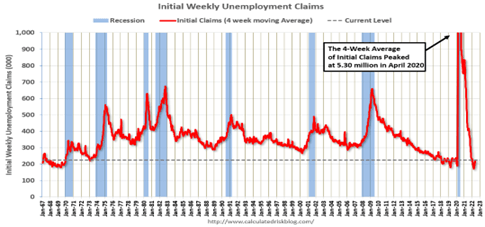
Weekly initial unemployment claims are holding at the lowest level since 1970, which is a sign of an extremely tight labor market.

In the week ending June 18, the advance figure for seasonally adjusted initial claims was 229,000, a decrease of 2,000 from the previous week’s revised level, said the DOL.

It dipped below 200,000 claims once before in 1999 just before the COVID-19 pandemic, per Calculated Risk’s graph.

How is this a sign of an impending recession? Companies are holding on to their workers for dear life, with one of the lowest unemployment rates in history at 3.8 percent. The unemployment rate was only lower in 1950, dipping to 2.5 percent during the record recovery from World War II, per the FRED graph below.

FREDunemploymentrate

In fact, the latest JOLTS report showed there were still 11.4 million job vacancies over the past two months. Most headlines touted that the 11.4 million job openings in May as a “severe” drop from 11.9 million vacancies in April, But that wasn’t a sign of weakness. The 11.9 million April number was revised from the original estimate of 11.4 million, which really meant that April to May job vacancies were in essence unchanged showing openings and new hires (6.6 million) were still at record levels, as I said in an earlier post.

This is while consumers’ personal consumption expenditures have risen 6 percent in a year. Consumer spending that makes up some two-thirds of economic activity has skyrocketed since the pandemic; after just 2 percent average annual growth rates since the Great Recession.

The question pending is whether rising interest rates will slow consumers spending sufficiently to reduce inflation, averting reoccurrence of a 1970’s-style stagflation?

The Fed’s June Open Market Committee press release was optimistic about the prospects for continued growth.

“Overall economic activity appears to have picked up after edging down in the first quarter. Job gains have been robust in recent months, and the unemployment rate has remained low. (But) Inflation remains elevated, reflecting supply and demand imbalances related to the pandemic, higher energy prices, and broader price pressures.”

We must now wait to see what the Fed’s push to raise interest rates will do to future growth.

Harlan Green © 2022

Follow Harlan Green on Twitter: https://twitter.com/HarlanGreen
Posted in Consumers, COVID-19, Economy, Macro Economics, Weekly Financial News | Leave a comment

Goleta’s Dam Dinner is Back!

Answering Kennedy’s Call

Noozhawk

What better way to show the love of your city than the announcement of a unique event that had been suspended for three years due to COVID-19? Goleta, a city just 20 years old, announced that their one-of-a-kind Dam Dinner is back.

“We are so excited for the return of the Annual Goleta Dam Dinner on Saturday, August 20th!” read its press release. “It’s been three long years since we were last able to hold this event, and we hope you will mark your calendars and join us at Lake Los Carneros Dam from 5:00 – 7:00 p.m. for this low-key, yet incredibly special Goleta gathering.”

Other cities have found ways to celebrate the love of their city, a movement that began in 2009 as a church-led movement to find ways to celebrate who they were by bringing people together. County fairs have done that traditionally, but it has been more difficult in urban, less agricultural settings.

The Loveourcities.org NGO was set up to facilitate these events touts on its website. At these community-wide volunteer days, people engage in a variety of projects, including appreciating public servants, visiting convalescent homes, donating blood, building a house with Habitat for Humanity, and working in city parks and schools, among other opportunities.

“We’ve done this every year since then and have helped more than 100 cities do the same, said the Loveourcities organization. “​Over 239,000 people have been involved … young, old, abled, disabled; people from a church or no church at all. Around 1 million volunteer hours have been donated – this is over $32 million dollars in service (independentsector.org) that we’ve given to our communities!”

This free community event offers live music in a beautiful outdoor setting while getting to enjoy dinner with friends and neighbors.

“It was really at the Love of Cities event that Peter Kageyama (guest speaker), a lecturer and consultant on forming such events, talked about placemaking,” said Valerie Cantella, onetime Goleta city press maven. “The City hosted the event at the Goleta Valley Community Center and we offered dinner. Peter spoke and then we did roundtable discussions of ideas that could make Goleta have more of an identity/place feeling. Peter shared pictures of the dinner on a bridge in some city (maybe elsewhere) and we got the idea to do dinner at the Dam.”

You can bring your own picnic dinner or purchase dinner from a local food truck. Wine, beer and lemonade will be for sale. Attendees can also purchase a Dam Dinner t-shirt along with the City’s 20-Year merchandise (t-shirts, hats, totes and mugs),” touted Goleta’s call to the upcoming Dam Dinner at Lake Carneros.

Harlan Green © 2022

Follow Harlan Green on Twitter: https://twitter.com/HarlanGreen
Posted in Uncategorized | Leave a comment

Home Sales Returning to Normal

Financial FAQs

FREDcalculatedrisk

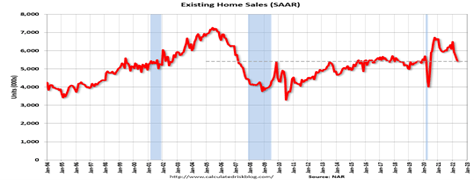
The home sales frenzy that has prevailed since COVID and rock bottom interest rates is finally subsiding.

Existing-home sales retreated for the fourth consecutive month in May, according to the National Association of Realtors®. Month-over-month sales declined in three out of four major U.S. regions, while year-over-year sales slipped in all four regions.

This is slowing rising prices, though the national median price just topped $400,00 for single-family homes, up 15 percent in a year. But it also means annual sales are returning to the range that prevailed since the Great Recession in 2007, as can be seen in Calculated Risk’s above graph.

Calculated Risk’s Bill McBride predicts that housing supplies will increase this year because a record number of homes will be completed due to a record number of housing units under construction—some 1.7 million residential units.

“Supply constraints have lengthened the time from start to completion. We can see the impact of supply constraints by looking at the gap between single family starts and completions. It usually only takes about 6 months between starting a single-family home and completion, but it has taken longer during the pandemic,” said McBride.

Total existing-home sales,1 https://www.nar.realtor/existing-home-sales, completed transactions that include single-family homes, townhomes, condominiums and co-ops, fell 3.4 percent from April to a seasonally adjusted annual rate of 5.41 million in May. Year-over-year, sales receded 8.6 percent (5.92 million in May 2021).

“Home sales have essentially returned to the levels seen in 2019 – prior to the pandemic – after two years of gangbuster performance,” said NAR Chief Economist Lawrence Yun. “Also, the market movements of single-family and condominium sales are nearly equal, possibly implying that the preference towards suburban living over city life that had been present over the past two years is fading with a return to pre-pandemic conditions.”

Total housing inventory registered at the end of May was 1,160,000 units, an increase of 12.6% from April and a 4.1% decline from the previous year (1.21 million). Unsold inventory sits at a 2.6-month supply at the current sales pace, up from 2.2 months in April and 2.5 months in May 2021.

The problem is that first-time buyers have an even more difficult time in purchasing a residence, hence the surge in apartment construction.

First-time buyers were responsible for 27 percent of sales in May, down from 28 percent in April and down from 31 percent in May 2021. NAR’s 2021 Profile of Home Buyers and Sellersreleased in late 2021 – reported that the annual share of first-time buyers was 34 percent.

In fact, first-timers have made up to 40 percent of purchases when interest rates were lower, so will either now have to wait for either changes in zoning laws that allow a greater housing density near transportation hubs, something that communities should encourage that want to attract more working folk to their towns, or the next time interest rates come down.

Harlan Green © 2022

Follow Harlan Green on Twitter: https://twitter.com/HarlanGreen
Posted in Consumers, COVID-19, Housing, housing market, Weekly Financial News | Leave a comment

What is a Livable City?

Building Community Answering Kennedy’s Call

Chapter Twelve

I and several others living in Santa Barbara and the Goleta Valley were interested in a more ecologically friendly and less auto-dependent community. Drs. Susanne Lennard, architect, and her husband, child psychologist Henry Lennard, were two disciples of “livable cities”. They influenced our thinking.

The Lennards founded the Making Livable Cities organization in 1986. It began holding Livable Cities conferences, hosting mayors and urban planners from throughout the world.

In one of those conferences that I attended, the Dean of Urban Planning from Venice, Italy, extolled the virtues of pedestrian-friendly Venice and Venice’s many public spaces that created its close-knit community. He even offered his listeners a personal tour of Venice, should we decide to visit him one day!

Mayors and planners from as far away as India, South America, and Singapore attended and presented papers—all wanting to show off their cities’ people-friendly plans that had evolved over centuries of traditional living.

Central to their ideas was that communities had to be safe from crime, with sustainable economic growth that did little environmental damage. This was achieved by creating town centers built around squares, or plazas that became central community meeting places.

The Greeks and Romans had their public forums and amphitheaters that served their communities. Traditional European cities have open squares or plazas surrounded by shops and apartments from which families can watch their children while doing their own work.

The safety of children must be paramount. Its website, MakingCitiesLivable.org, states:

To be sustainable, a neighborhood, town or city must SUSTAIN ITS CHILDREN [their emphasis]. It must provide a physical environment that ensures children’s health, develops their faculties, and fosters their love for community, and for nature. In this way, children grow up to become agents of sustainability.

It is a messianic statement, but saving cities from themselves is a messianic endeavor. These conferences were tremendously exciting for those interested in building sustainable communities that combined good jobs with a human-scale environment. Dr.

Henry Lennard had developed the concept of child-centered communities where children are able to roam and explore their neighborhoods on their own. They could get to school on streets safe for children without being ferried around by a soccer mom, or anyone in a car that prevented them from exploring their surroundings, creating a sense of autonomy and personal responsibility so important for success in later life.

Many Goleta residents were idealistic former UC Santa Barbara students opposed to anything that hinted at urban; that might disturb the largest Monarch Butterfly Preserve in the west coast, for example. Their vision had to be included in a community plan. Similarly, Goleta and the South Coast in general was becoming another Silicon Valley with major tech startups like Mentor and Citrix corporations located there.

Goleta had also been a major aerospace center in the 1970s and 1980s with Raytheon, General Motor’s Delco and other defense contractors. UC Santa Barbara’s technical expertise was nearby, as was Vandenberg Air Force Base where spy and weather satellites were launched into north-south polar trajectories.

How could we accommodate all this diversity in a well- functioning city?

Harlan Green © 2022

Follow Harlan Green on Twitter: https://twitter.com/HarlanGreen
Posted in Housing, Politics, Uncategorized | Leave a comment

Higher Inflation Doesn’t Mean Stagflation

Financial FAQs

The current headlines would have us believe the bipartisan $1.9 trillion American Rescue Plan and $1.2 trillion American Infrastructure Investment and Jobs Act approved overwhelmingly by both Democrats and Republicans in 2021 will cause prolonged inflation and perhaps lead to a recession.

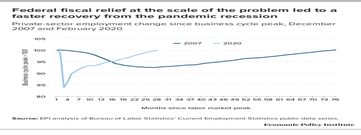
What the twin 2021 bills have done instead is create record employment, with full employment achieved 26 months after the COVID recession, vs. the 76 months it took to reach full employment after the Great Recession, which was because congress shortchanged the prior recovery with too little aid.

EPI.org

Former Fed Chair Ben Bernanke said on Fareed Zakaria’s GPS Sunday that he doubts the current inflation surge might turn into another stagflationary episode. The 1970’s stagflation was caused by 14 years of high inflation, whereas we are suffering from just 6 months of higher inflation, after 40 years with very little inflation since the 1970s.

A recurrence of the stagflation of the 1970s is only possible if rising interest rates engineered by the Fed cause a prolonged slowdown in business activity and consumers spending. The 1970’s inflationary spiral was caused by policies that enabled workers to push up wages every time there was a spike in inflation. Workers’ salaries today are barely keeping up with inflation and declining, rather than staying ahead of it.

The rate of inflation over the past year, based on the more reliable PCE Index, slowed to 6.3 percent in April from a 40-year high of 6.6 percent in March, the first decline in a year and a half.

May’s U.S. CPI surge of 8.6 percent was concentrated in three categories: airfares, used car prices and shelter costs, all in the service industries. Most of the inflation to date is in the goods sector. Surging shelter costs will be the most worrisome trend and that the Fed will watch most closely.

Higher inflation is occurring all over the world from the same factors, which signals that it’s mostly about rising food and energy prices affected by panicky traders worried about food and energy shortages. For example, Russia’s inflation rate is currently18 percent, Turkey’s 70 percent and the EU inflation rate is 8 percent.

The Russian invasion of Ukraine and the sanctions that it triggered account for more than a third of the 40-year high CPI annual inflation of 8.6 percent, according to Mark Zandi, chief economist at Moody’s Analytics, as reported by MarketWatch.

The real question is whether longer term inflation is embedded in consumers’ expectations as happened in the 1970s, which took 14 years, as Bernanke said. But that would mean the so-called ‘supply-shocks’ from COVID, China, and the Ukraine war that are the main cause of the current inflation surge don’t eventually subside, and doesn’t seem likely.

Harlan Green © 2022

Follow Harlan Green on Twitter: https://twitter.com/HarlanGreen
Posted in Consumers, COVID-19, Economy, Weekly Financial News | Leave a comment