Can We Fix the Housing Shortage?

The Mortgage Corner

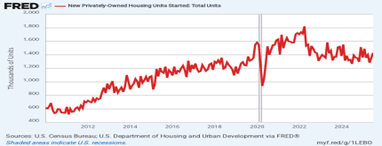
Privately-owned housing starts in July were at a seasonally adjusted annual rate of 1,428,000. This is 5.2 percent above the revised June estimate of 1,358,000 and is 12.9 percent above the July 2024 rate of 1,265,000. Single-family housing starts in July were at a rate of 939,000; this is 2.8 percent above the revised June figure of 913,000.” US Census Bureau
FREDconstruction

The housing shortage is something most of us worry about but are helpless to fix, it seems. There are many culprits—the NIMBY crowd that won’t allow more affordable housing near their single-family homes in cities, too high mortgage rates, but most of all the seeming inability of builders to supply enough new homes due to the shortage of construction workers.

First some history. Originally, much of it was due to the busted housing bubble that led to the Great Recession in 2008. More than one million new homes were built than could be sold, a classic example of oversupply. This resulted in just 600,000 new homes being constructed annually until 2012 when the Fed began its quantitative easing policies under Fed Chair Ben Bernanke that dropped 30-year fixed mortgage rates below 5% for the first time since the 1970s.

This is why I’m using residential housing construction as a good way to measure housing supply in the above FRED graph of housing construction. Starts have hovered around 1.4 million units since 2022 and the end of the COVID-19 pandemic (gray bar).

Construction had soared immediately after the pandemic due to the rock-bottom 30-year fixed mortgage rates, then plateaued to the current 1.4 million. But the Fed raised the rock-bottom rates to combat surging inflation and fixed mortgage rates soared to 7%, making housing purchases almost unaffordable to first-time, entry level buyers.

So, we know high mortgage rates are a major component of the housing shortage. But we can also answer maybe the largest part of the problem, the lack of new homes as highlighted in a recent Forbes Magazine article. Trump’s immigrant sweeps are not only hurting housing construction, but the job market in general.

Immigrants make up 34% of the construction workforce, according to the Associated General Contractors of America. In states like California, Texas, New Jersey, Florida, Georgia and New York, they account for about half. Construction drives 4.5% of U.S. gross domestic product, making it the country’s tenth largest industry.

“Broaden the view and the impact grows. Residential housing, once you include rent and utility payments, fuels 15 to 18% of GDP, according to the National Association of Home Builders. Add commercial building to the mix and construction rises to the top of the chart.”

The good news what may come out of the housing shortage and homeless scourge. The highly unpopular immigrant sweeps of ICE agents invading homes, public streets, and workplaces.

The sharp drop in nonfarm payrolls in the last three unemployment reports is being blamed on the loss of possibly one million immigrants from our labor force, according to labor economists. This will hurt economic growth, because immigrants have traditionally supplied one million new Americans each year to our rapidly declining population growth rate.

Forbes cites a working paper published this month from the American Enterprise Institute (AEI), a conservative economics policy center, that found the Trump administration’s immigration policy will likely result in a negative net migration in 2025—something the U.S. has not experienced in decades”that would shrink labor participation and “put significant downward pressure on growth in the labor force and employment.” 

It’s a very sad tale. Trump’s Republicans have turned their backs on what has been the life blood of American Democracy that we can do little about without another administration.

Harlan Green © 2025

Follow Harlan Green on: https://twitter.com/HarlanGreen

Posted in Consumers, COVID-19, Economy, Housing, housing market, Politics, Weekly Financial News | Tagged , , , , , , , , , , | Leave a comment

This Inflation isn’t Temporary

Popular Economics Weekly

The Producer Price Index for final demand rose 0.9 percent in July, seasonally adjusted, the U.S. Bureau of Labor Statistics reported today. Final demand prices were unchanged in June and moved up 0.4 percent in May. BLS.gov

FREDppi

The Trump administration wants Americans to believe the current inflationary surge is temporary. Why? Because it needs the Fed to lower interest rates to keep economic growth from stalling because of the tariffs. And lowering interest rates in what is still a fully-employed economy is inflationary.

It’s the kind of reverse logic that has characterized so much of the MAGA crowd that wants to believe conspiracies (Epstein?) rather than economic realities.

The Producer Price Index of wholesale goods just out is another unwelcome fact that inflation isn’t temporary because of the tariffs. The tariffs paid by American importers at ports of entry are already showing up in the prices of raw materials producers must pay that will ultimately be passed on to American consumers and businesses.

The PPI is showing July wholesale prices (dark red line) have risen much faster than retail prices (light red line) in the above FRED graph—3.3% vs. 2.7% in a year.

Coffee prices are already up 15%, for instance. Could that have to do with the 50% tariff Trump has levied on Brazil, a major coffee grower, because he doesn’t like its socialist government?

So an unfavorable PPI is another measure of inflation the Trump administration will want to ‘cook’ if their choice for a new head of the Bureau of Labor Statistics is confirmed by the Senate.

 It prices the raw materials and services that go into the retail CPI Index that measures the final consumption of finished products and services. That’s no surprise because material input costs have been rising since April 2 and the announcement of the tariff wars, which belies Trump’s lies that the countries exporting to us will bear the cost of those import taxes for the great privilege of selling to US, yet are ultimately paid by Americans!

All eyes are now on what Fed Chair Powell will say at the Kansas Fed’s Jackson Hole conference this week. Will the 12 Fed Governors that vote at the FOMC meetings decide once again that there is little likelihood of an interest rate cut in September?

They may have to, because the biggest rise in wholesale prices was in the service sector that powers almost two-thirds of consumer activities (leisure, travel, dining out, transportation, and construction).

The index for final demand services moved up 1.1 percent in July, the largest advance since rising 1.3 percent in March 2022. It showed importers are also increasing their profit margins and so passing on the increased costs to consumers and businesses.

Over half of the broad-based July increase is attributable to margins for final demand trade services, which jumped 2.0 percent. (Trade indexes measure changes in margins received by wholesalers and retailers.)

And consumers are beginning to notice, according to the University of Michigan’s consumer sentiment survey.

“Consumer sentiment fell back about 5% in August, declining for the first time in four months. This deterioration largely stems from rising worries about inflation. Buying conditions for durables plunged 14%, its lowest reading in a year, on the basis of high prices,” reports survey Director Joanne Hsu.

Though it hasn’t done much damage to retail sales just yet. Retail sales rose 0.5% last month following a nearly 1% increase in June, reports the Census Bureau.

Automobile sales rose for the second month in a row, said MarketWatch’s Jeffry Bartash. Car buyers have been buying vehicles for the past few months to once again avoid anticipated price increases in the coming months as tariffs take full effect.

So the damage is already being done by Donald Trump’s tariffs. Even grocery prices are soaring that depend on what is produced domestically. Now why would grocery prices also be increasing that aren’t taxed by tariffs? Could it be that there are fewer farm workers to harvest the crops this year?? The ICE folks could answer that question!

Harlan Green © 2025

Follow Harlan Green on Twitter: https://twitter.com/HarlanGreen

Posted in Consumers, COVID-19, Economy, Politics, Weekly Financial News | Tagged , , , , , , , , , | Leave a comment

Who Benefits From America’s IOUs?

Financial FAQs

WASHINGTON (AP) — The U.S. government’s gross national debt has surpassed $37 trillion, a record number that highlights the accelerating debt on America’s balance sheet and increased cost pressures on taxpayers. AP

FREDdebtGDP

Trump and his Republicans’ trade war and big, beautiful tax bill resemble a giant Ponzi scheme in several ways that has created the greatest wealth and income inequality in the developed world.

It is in essence robbing Peter to pay Paul, by using the revenues from the highest tariff rates since the Great Depression, cutting $billions from Medicare, Medicare and Obamacare benefits, Doge-slashing important health and climate research departments as well as foreign aid spending, because Trump must pay down the record national debt that he has declared is a national emergency.

Yet it was generated by generations of mostly Republican tax cuts. President Reagan created the first major national debt in fighting the cold war and Central American contra wars, GW Bush created the first $trillion deficit with his war on terror largely based on fabricated intelligence, and Donald Trump will manage to add some $ 9 trillion to what is now a record $37 trillion from his trade war with almost no understanding or knowledge of foreign trade, as Nobelist Paul Krugman has pointed out several times.

And President Trump just fired the head of the Bureau of Labor Statistics so that he could replace her with someone who will cook the books on inflation and real job numbers.

The history of deficits is portrayed in the above graph of U.S. national debt calculated as a percentage of GDP.

Tump’s original Tax Cuts and Jobs Act (TCJA) had already added $5 trillion to the national debt that peaked at 132.8% as a percentage of GDP in Q1 2020 during the COVID-19 pandemic and it has since dropped to 120% because of the aid bills that the Trump and Biden administrations signed into law boosting economic growth to almost 3% annually.

The White House appeal to the foreign trade court to leave Trump’s tariff war in place is his attempt to keep the Ponzi scheme from imploding, rather than negotiating with congress that has the actual power to make foreign trade agreements.

Executive orders without congressional approval are illegal, unless there is a national emergency. And the soaring national debt could become one, if Trump succeeds in destroying the good faith and credit of the U.S. by renewing the TCJA.

On May 16, Moody’s Ratings downgraded the U.S. credit rating, citing an “inability of the nation to address large and growing deficits.” This downgrade means that for the first time ever, all three major credit ratings agencies have downgraded U.S. credit below their top AAA rating.

Trump is therefore begging an appeals court to allow the tariffs. It could lead to a “GREAT DEPRESSION” Trump said on social media, with Americans “forced from their homes” that will threaten social security and Medicare.

Yet the financial markets aren’t panicking this time, maybe for the wrong reasons, as I said in an earlier column. This is while the Final Demand Producer Price Index has jumped to 3.3% annually, the highest in three years since the COVID-19 induced supply shortages, lessening the chances of Federal Reserve rate cuts.

Wall Street’s over enthusiasm, which was first termed irrational exuberance by Fed Chair Alan Greenspan in the mid-1990s as a warning that stocks were overpriced, has created a new asset bubble much like the dot-com asset bubble, and housing bubble that led to the Great Recession.

And it has led to the greatest income inequality in the developed world which has impoverished Republican-led red states above all, whose citizens are most easily cowed by their policies.

And what will happen when foreign investors, mainly governments, realize a $37 trillion national debt isn’t sustainable indefinitely?

Harlan Green © 2025

Follow Harlan Green on Twitter: https://twitter.com/HarlanGreen

Posted in Consumers, COVID-19, Economy, Politics, Weekly Financial News | Tagged , , , , , , , , , , , | Leave a comment

Trade Wars = Stagflation

Popular Economics Weekly

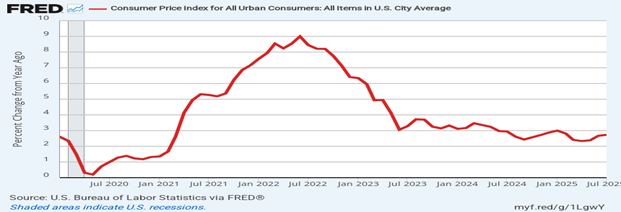
 “The Consumer Price Index for All Urban Consumers (CPI-U) increased 0.2 percent on a seasonally adjusted basis in July, after rising 0.3 percent in June, the U.S. Bureau of Labor Statistics reported today. Over the last 12 months, the all items index increased 2.7 percent before seasonal adjustment.” BLS.gov

FREDcpi

The damage is already being done from Donald Trump’s tariffs that are for the most part illegal—higher inflation. And American consumers and businesses will soon realize what happens to their pocketbooks as they begin to pay for his big, beautiful tax cuts for the wealthiest.

Inflation has been rising since April when President Trump announced his trade war on the rest of the world. The core retail Consumer Price Index without gas and food prices that the Federal Reserve prefers increased to 3.1% annualized, way above the Fed’s target rate to keep inflation from getting out of control.

Though the CPI energy index decreased 1.6% for the 12 months ending July, the food index increased 2.9% over the last year, which worries consumers more. And food prices will continue to increase as Trump chases almost half of the agricultural workers from American fields they harvest in his roundup of undocumented immigrants.

We can learn from past episodes the effects of inflation when out of control, such as the 1970’s stagflation from the OPEC embargo induced oil shortages. The COVID-19 pandemic caused more recent product shortages and supply chains shutdowns as well that pushed CPI inflation to 9% in 2022 and was the Democrats undoing.

The COVID-induced inflation backed down to 3% in a year (June 2023), but voters believed Trump when he said he would bring down inflation on “Day 1”.

Trump’s trade wars are affecting economic growth, the other part of the stagflation equation, because exporters are disrupting supply chains in their attempts to avoid the higher tariffs. And because Trump has declared tariffs on everyone, it’s more difficult for exporters to find a work around.

We have barely begun to see the effect of the tariff hikes because Trump keeps postponing many of them, giving China another 90 days to come to terms, for instance, though China’s tariff rate is already 30 percent.

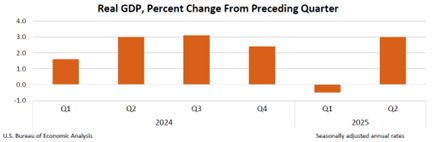
Slowing growth will begin to show up soon enough in his tariff scheme. Q2 GDP grew 3% after its negative -0.5% shrinkage in Q1 because imports dried up after April 2 when Trump announced his trade war.

But GDP growth will shrink again as importers begin to pay a higher tax when more tariff agreenebts kick in. There is one problem, however. Trump may have to refund the $130 billion his administration has already collected to those very same importers, if his appeal to the Foreign Trade Court is denied. And the appeals court may decide so, since he had declared the trade deficit a national emergency, which means the Trump administration must return those funds.

As Paul Krugman said recently on Lawrence O’Donnell’s MSNBC show, The Last Word, it will then be Trump’s problem to unscramble the accounting mess that it will cause in returning the money to those importers that were levied.

Americans will soon see the results in growth when their prices begin to rise in earnest. Trump is literally using the tariff taxes paid by American businesses and ultimately consumers in higher prices to pay for the tax cuts given to his wealthiest supporters, as I said. And that will begin to stall economic growth very soon as Americans have less to invest and spend.

It will be the price we must pay, unfortunately, until enough voters realize President Trump and his Republicans have foisted a giant Ponzi scheme on the American people.

Harlan Green © 2025

Follow Harlan Green on Twitter: https://twitter.com/HarlanGreen

Posted in Consumers, COVID-19, Economy, Politics, Weekly Financial News | Tagged , , , , , , , , | Leave a comment

Irrational Exuberance is Back

Financial FAQs

“How errors of human judgment can infect even the smartest people, thanks to overconfidence, lack of attention to details, and excessive trust in the judgments of others, stemming from a failure to understand that others are not making independent judgments but are themselves following still others—the blind leading the blind.” Robert Shiller, Irrational Exuberance

FREDS&P

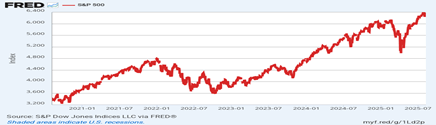
Both the DOW and S&P 500 indexes of the largest publicly traded companies in the U.S. are at record levels, despite Donald Trump having just raised tariffs on 90 countries that he doesn’t like for some reason. April 2 was the last time he made such an announcement and the S&P plunged 828 pts. on the same day (see dip in graph), and the DOW more than 1,000 pts. before resuming their climb.

Yet the financial markets aren’t panicking this time, maybe for the wrong reasons. Their over enthusiasm, which was first termed irrational exuberance by Fed Chair Alan Greenspan in the mid-1990s as a warning that stocks were overpriced, has created a new asset bubble much like the dot-com asset bubble, and housing bubble that led to the Great Recession.

And such massive overinvestment in new technologies such as the current AI investment boom haven’t turned out well, historically.

Nobel Laureate Robert Shiller first wrote about it in his 2000 book, Irrational Exuberance, just before the bursting of the dot-com speculative bubble, which was precipitated by overinvestment in communication technologies such as the nationwide laying of fiber optic cables.

He said at the time: “I define a speculative bubble as a situation in which news of price increases spurs investor enthusiasm, which spreads by psychological contagion from person to person, in the process amplifying stories that might justify the price increases, and bringing in a larger and larger class of investors who, despite doubts about the real value of an investment, are drawn to it partly by envy of others’ successes and partly through a gamblers’ excitement.

Companies are investing $trillions in developing AI, which is powering the largest Magnificent 7 tech stocks such as Apple and Facebook to record highs. Market analysts on CNBC have noted that ten stocks are driving 40 percent of the market’s current rally.

Yet just 9.4% of U.S. businesses used AI in July, including machine learning, natural language processing, virtual agents, and voice recognition, according to the Census Bureau as cited by Barron’s Megan Leonhardt.

S&P members’ current earnings per share reflect this. Stock prices have climbed to 29 times earnings which, according to Professor Shiller’s research, is approaching irrational exuberance territory. This is double the S&P’s historical EPS average price of 15 times earnings over the past 100 years that Dr. Shiller has researched.

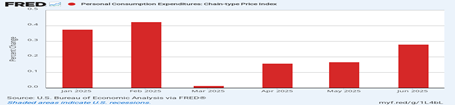
The markets seem to be ignoring Trump’s erratic behavior for other reasons as well. This is in part because of investors’ belief that inflation is mild, though still rising. The Fed’s favored PCE inflation indexfor June increased 2.6 percent. Excluding food and energy, the PCE price index increased 2.8 percent from one year ago, still above the Federal Reserve target inflation rate.

And the long-awaited interest rate cuts financial markets haven been hoping for could begin in September after the very weak July unemployment report that caused Trump to fire the BLS Director.

The markets are also ignoring the damage Trump’s higher tariffs will cause to economic growth. History has shown that stagflation is a recurring problem, even during the COVID-19 pandemic. Supply chains dried up then as the world economies shut down, elevating inflation. And supply deliveries have already slowed from the effects of Trump’s on-again, off-again executive orders, as countries look for ways to reroute their exports.

Maybe the greatest sign of irrational exuberance is investors’ assumption that TACO Trump will eventually settle tariffs back to the 10 to 15 percent rates that he initially promised. But when?

Trump and Republicans have always had a problem with the truth and economic facts (like who benefits most from tax cuts), as has been pointed out by those professionals whose job it is to ascertain the facts (with many losing their jobs because of it).

Irrational exuberance has seriously damaged financial markets in the past and caused $trillions in losses. It happens when investors ignore financial facts that aren’t convenient or follow the herd rather than make the effort to read below the headlines.

What will happen this time when market investors realize this administration doesn’t believe in the facts at all?

Harlan Green © 2025

Follow Harlan Green on Twitter: https://twitter.com/HarlanGreen

Posted in Consumers, COVID-19, Economy, Macro Economics, Weekly Financial News | Tagged , , , , , , , , , , | Leave a comment

What is Q3 Growth To Be?

Popular Economics Weekly

The GDPNow model estimate for real GDP growth (seasonally adjusted annual rate) in the third quarter of 2025 is 2.5 percent on August 5, up from 2.1 percent on August 1. GDPNow

AtlantaFedGDPNow

Predictions for third quarter GDP economic growth are again all over the map, per the Atlanta Fed graph, as were those for Q2, with no finalized tariff agreements. Both consumers and businesses are now attempting to time their purchases because of uncertain import prices.

That’s why the nation’s trade deficit in goods sank 11% in June to a 22-month low as U.S. companies timed when to buy imported goods with on-again, off-again Trump tariffs. a pattern that’s likely to play out over at least a few more months, if not the rest of the year.

It’s also why Q2 GDP grew at 3.0 percent in the initial estimate. Imports shrank (that are deducted from exports to calculate the foreign trade balance of payments and GDP) while Americans waited for TACO Trump to give trading partners another 90-day reprieve from his threatened retaliations.

The two-month GDP average was a 1.3% growth rate. The question will be how the tariff uncertainties play into growth for the rest of the year. And will the inflation already caused by the tariffs ever come down enough to warrant further Fed rate cuts?

The question on everyone’s mind is why President Trump is so erratic in his attempt to control world trade? He claims it is a negotiating tactic to rebalance the large trade imbalances with countries like China, but the import taxes are really meant to cover the $trillions being added to the federal debt from his big, beautiful tax bill.

The uncertainty over future import prices makes third quarter growth difficult to pin down, in other words. There was some good news as nonfarm business sector labor productivity increased 2.4 percent in the second quarter of 2025, the U.S. Bureau of Labor Statistics reported today, as output increased 3.7 percent and hours worked increased 1.3 percent.

Labor productivity had surged as high as 4 percent during the Biden administration’s New, New Deal surge in investments. But any massive loss of immigrant workers that make up 19 percent of the civilian labor force will harm labor productivity as well.

Higher labor productivity is a key ingredient for decent economic growth. We can only hope that there are enough workers to keep the U.S. economy growing as the new tariffs are finalized and begin to affect growth.

This is why the advance number for seasonally adjusted insured unemployment insurance during the week ending July 26 wasn’t good news.

It’s why the 1,974,000 continuing jobless claims was so important as an indicator of the labor market. This is the highest level for insured unemployment since November 6, 2021 when it was 2,041,000 during the COVID-19 pandemic.

This is another alarming sign that will further slow growth at the same time more immigrants are leaving the labor force and not being replaced with the normal immigration flow. The hope is that AI can be the savior that will keep GDP growth from plunging if it boosts the labor productivity numbers.

But robots and software programs won’t replace those lower paying jobs in construction, manufacturing and the service sector of leisure and hospitality that immigrants have always occupied.

Harlan Green © 2025

Follow Harlan Green on Twitter: https://twitter.com/HarlanGreen

Posted in Consumers, COVID-19, Economy, Weekly Financial News | Tagged , , , , , , , , , , | Leave a comment

The Return of Stagflation

The Mortgage Corner

From the same month one year ago, the PCE price index for June increased 2.6 percent. Excluding food and energy, the PCE price index increased 2.8 percent from one year ago.” BEA.gov

FREDpceinflation

President Trump hasn’t succeeded in convincing the Federal Reserve to cut interest rates or fired Chairman Jerome Powell just yet. So he fired the head of the Labor Department’s Bureau of Labor Statistics without cause that published the weak July unemployment report instead.

It is heralding another era of stagflation that has destroyed the wealth of too many Americans.

It now looks like he wants to recreate what happened to two other Republican Presidents—manipulating the data to disguise the fact that looming inflation can be a big problem as it was in the stagflation of the 1970s and housing bubble and Great Recession of 2008 that was the worst economic downturn since the Great Depression.

President Nixon first tried it when combatting the looming oil price-inspired inflation from the Arab Oil Embargo by fixing prices to keep them artificially low, then pushed his Fed Chair Arthur Burns to keep interest rates low in the face of slowing economic growth caused by the OPEC embargo.

It resulted in 14 percent inflation in 1980 that caused then Fed Chair Paul Volcker to raise the Fed Funds rate to 20 percent, resulting in two recessions early in President Reagan’s tenure.

President GW Bush also tried it in 2000 by pushing then Fed Chair Alan Greenspan to keep interest rates low to finance his wars on terror. Greenspan held interest rates too low for too long, which resulted in the housing bubble and Great Recession that followed.

And now Trump is looking for a successor to the Senate-vetted BLS official, Dr. Erika McEntarfer, who will manipulate employment statistics for him. The result will be less trusted unemployment reports, masking the effects of historically high tariffs that will again create product shortages and slow economic growth.

The Labor Department’s unemployment report understated what happened in the past three months, as I said last week. The U.S. economy created 73,000 nonfarm payroll jobs, but just 19,000 and 14,000 payroll jobs in revisions to May and June totals when more data came in (see graph).

The change in total nonfarm payroll employment for May was revised down by 125,000, from +144,000 to +19,000, and the change for June was revised down by 133,000, from +147,000 to +14,000, per the BLS.

Trump’s main reason for wanting to manipulate economic facts? He also wants to hide the damage to the employment numbers from what could be the loss of one million immigrants leaving the adult labor force, many of them running for cover because of the Gestapo tactics of Trump’s Homeland Security masked Storm Troopers breaking into homes and businesses to round up as many undocumented immigrants as possible, as I said last Friday.

It’s really the first indication of the immigrant’s importance in our economy, and why most of July’s hiring was in healthcare (55,000) while government employment lost 12.000 jobs and -87,000 jobs this year.

The next economic shoe to drop will be the changing of the guard at the Federal Reserve. Trump could not bully Fed Chair Powell to lower interest rates sooner, but that will soon change when he appoints a new Fed Chairman.

He will want to politicize the Fed as he is doing to the rest of the federal government when Powell steps down next year, so that he can enact more Republican ‘trickle down’ economic policies first initiated by President Reagan: in particular the tax cuts + deregulation that supposedly increases efficiencies and productivity, but instead increased corporate CEO pay to more than 300 times that of their employees while weakening union collective bargaining laws.

The results of ‘trickle-down’ economics have been frightfully obvious for decades. The Reagan-era creation has succeeded in maximizing profits of the owners of capital and corporate CEOs while suppressing incomes of salaried workers via right to work laws and low minimum wages, mostly in the poorest Republican controlled red states.

It’s why economists are now calling this the second Gilded Age. We are seeing its results—higher inflation and slowing economic growth once again unless a majority of Americans can be convinced to stop the steal of the worst robber baron of all.

Harlan Green © 2025

Follow Harlan Green on: https://twitter.com/HarlanGreen

Posted in Consumers, COVID-19, Economy, Housing, Politics, Weekly Financial News | Tagged , , , , , , , , | Leave a comment

Why the Weak Employment Report?

Popular Economics Weekly

Total nonfarm payroll employment changed little in July (+73,000) and has shown little change since April. The unemployment rate, at 4.2 percent, changed little in July. Employment continued to trend up in health care and in social assistance. Federal government continued to lose jobs.” BLS.gov

FREDunemployment

The Labor Department’s unemployment report actually understated what happened in July. The U.S. economy created 73,000 nonfarm payroll jobs, better than prior months when  just 19,000 and 14,000 payroll jobs were created in sharp revisions to May and June totals as more data was available.

The change in total nonfarm payroll employment for May was revised down by 125,000, from +144,000 to +19,000, and the change for June was revised down by 133,000, from +147,000 to +14,000, per the BLS.

The main reason? It’s estimated that as much as many as one million immigrants left the adult working populartion, many of them running for cover because of the Gestapo tactics of Trump’s Homeland Security masked Storm Troopers breaking into homes and businesses to round up as many undocumented immigrants as possible.

It’s really the first indication of the immigrant’s importance in our economy, and why most of July’s hiring was in healthcare (55,000) while government employment lost 12.000 jobs and -87,000 jobs this year. The manufacturing and wholesale trade sectors also lost jobs.

Since January, some 402,000 people have left the “civilian labor force.” That is, they don’t have a job and are no longer looking for one, reports MarketWatch’s Jeffry Bartash.

A separate number, called “not in labor force,” is even worse. The total has risen by 1.5 million in the first seven months of 2025, an unusually large increase. The last time the economy experienced a similar phenomenon, excluding the pandemic era, was during the recession of 2007-09.

The Trump administration has not been creating many jobs since January, with 158,000 jobs its high point added in April, vs. 323,000 payroll jobs added in December 2024, the last month of the Biden administration, and it’s been downhill for Trump since then (see graph).

In fact, it looks like the Trump administration is doing everything in its power to discourage businesses from hiring as Trump continues to waffle on trade agreements in attempting to look strong when in fact it’s a sign of weakness.

It should be obvious now that he is desperate to levy higher import taxes on as many countries as possible to pay for the huge increase in federal debt caused by his big, beautiful tax cuts.

The weak job report should mean the Fed will initiate interest rate cuts in September, if not sooner, if the job market continues to deteriorate. Fed Chair Powell has said that their main concern is a healthy job market and it doesn’t’ look like this can happen with so many leaving the working population.

Longer term interest rates have plunged on the jobs news, anticipating lower inflation ahead because of the weak job reports, which makes it even easier for the Federal Reserve to ease credit conditions.

Trump’s tax cuts while pushing for lower interest rates to compensate for the economic damage his tariff wars will cause are part of the Republican playbook. And Trump has declared a tariff war on the whole world with no idea of the havoc it will create for the world’s economies, much less ours.

This may be the first sign of what is to come.

Harlan Green © 2023

Follow Harlan Green on Twitter: https://twitter.com/HarlanGreen

Posted in Consumers, COVID-19, Economy, Politics, Weekly Financial News | Tagged , , , , , , , , | Leave a comment

Second Quarter Growth No Big Deal

Financial FAQs

Real gross domestic product (GDP) increased at an annual rate of 3.0 percent in the second quarter of 2025 (April, May, and June), according to the advance estimate released by the U.S. Bureau of Economic Analysis. In the first quarter, real GDP decreased 0.5 percent.” BEA.gov

BEA.gov

The big jump in second quarter economic growth wasn’t a surprise because consumers continued to shop but bought fewer imported goods because Trump’s tariff wars were already raising prices. Imports are a subtraction in the GDP equation.

It might be a one time jump because consumers are saving more and buying less these days, as I’ve been saying, while waiting to see how much damage the Trump tax cuts and higher tariffs might wreak on the U.S. economy, especially those it will harm the most.

The two-month GDP average was a 1.3% growth rate. The U.S. economy expanded at a 2.8% rate in 2024 and 2.9% in 2023 under President Biden, which was in large part because of the New Deal legislation that pumped $billions into economic growth and caused higher inflation.

The Fed then raised their interest rates to bring inflation back down to its present mid-2% range, and Republicans took over the congress. The result was Trump initiated his tariff wars and passage of the big beautiful big tax bill that will increase the federal debt by some $4 trillion.

But because at least some of the additional federal debt must be paid for to preserve the no longer good faith and credit of our economy, Trump has raised tariff rates to 15-20 percent, which means raising taxes on U.S. consumers and businesses.

And as any economist will tell you, taxes slow economic growth, regardless of what Trump and his cabinet cronies say. And our economy is slowing. The so-called final sales of consumers and businesses increased just 1.2 % in Q2, and there is no indication that it might pick up as the tariff agreements (i.e., taxes) are finalized.

Inflation has declined because of less spending. Consumers spending as measured by the personal consumption expenditures (PCE) price index in the Q2 GDP report increased just 2.1 percent, compared with an increase of 3.7 percent. Excluding food and energy prices, the PCE price index increased 2.5 percent, compared with an increase of 3.5 percent because consumers bought ahead of the price increases due to the April 2 tariff announcements.

What about those Federal Reserve interest rate cuts that Trump wants? Fed Chair Powell said at his latest press conference after the July FOMC meet that its twin mandates of price stability and maximum growth are still in balance, so there’s no reason to lower interest rates at this time.

The unemployment rate remains stuck at 4.1-4.2 percent because the mandates are in balance. Powell said the Fed would act to lower interest rates sooner—i.e., ease credit conditions–if the unemployment rate were to increase substantially.

The Trump administration’s agenda paints a sordid picture in following a very similar trajectory of the GW Bush administration—with its wars on terror (like Trump’s tariff wars), huge tax cuts for the wealthiest and less regulation (like Trump’s big beautiful bill) fueling what became the Great Recession.

Trump’s tariffs won’t help the very people in the red states that elected him but raise their prices. His cuts to social services harm those in red states in the most need. His DOGE cuts are not only endangering air travel, but disaster relief when the worst storms are also happening in mainly red state territories.

So, its not even the blue states that Trump wants most to harm, but his own MAGA supporters that will suffer the most. It’s what bullies do, prey on the weakest and most vulnerable, especially immigrants and minorities that are least able to protect themselves.

Harlan Green © 2025

Follow Harlan Green on Twitter: https://twitter.com/HarlanGreen
Posted in Consumers, COVID-19, Economy, Politics, Weekly Financial News | Tagged , , , , , , , , , | Leave a comment

The EU’s New Trade Deal

Popular Economics Weekly

This will hurt the world economy, with the burden falling mainly on lower-income Americans. The Yale Budget Lab estimates that Trump’s tariffs will leave the U.S. economy 0.4 percent poorer in the long run, which is very close to my own back-of-the-envelope calculations.” Paul Krugman

Evelyn Hockstein | Reuters

I quote Paul Krugman again as with Trump’s Japan trade deal because it is also Trump’s usual smoke and mirrors—lots of promises but little substance. Why are markets relieved that Trump’s announced 30 percent EU retaliatory tariffs are now 15 percent, when retaliatory tariffs are illegal according to the Foreign Trade court?

Because it means less chaos and more predictability for the moment, but only for the moment.

Neither the EU nor Americans are better off with the new 15 percent tariffs levied on EU products, but none on U.S. exports to the EU. And it will once again shift more of the burden of paying off the tax cuts that benefit Trump and his buddies “onto poor and working-class families,” per Krugman

There is a very small trade imbalance when services as well as goods are included in our trade with the EU, despite Trump’s claims there’s a huge trade deficit. And U.S. exports to EU have just a 1 percent tax at present, so there’s no discrimination.

The biggest lie of all is Trump’s attempt to disguise the fact that a tariff isn’t an import tax, when it is levied at the U.S. Custom ports on goods entering the U.S., not elsewhere.

“…the tariffs are basically a sales tax that will reduce real income for poor and working-class families by about 1.5 percent, even as cuts in other taxes raise income for the wealthy,”says Krugman.

The trade deals are also hiding the fact that neither Japan nor the EU requirements for investing in the U.S. are specific enough.

The tariffs on EU manufactured autos will be lower than those manufactured in the U.S. and Canada, for instance, as with Japan. And the investment guarantees don’t specify whether they will result in actual factories.

So what are the Europeans really paying for? Protection. They have promised to buy more American weapons and keep Trump on their side in the Ukraine war that requires U.S. weapons to stop Putin and end the war.

There is much more to Trumponomics, Trump’s economic agenda, that I will cover in future columns. His insistence on cutting interest rates resembles GW Bush’s push to have then Fed Chair Alan Greenspan’s Governors keep interest rates artificially low to pay for his wars on terror. The inflation rate then was higher, in the 3-5 percent range.

I believe we will see inflation rise to a similar range when the tariff taxes really begin to take effect and kick in the slower growth plus higher inflation formula that prevailed during the Greenspan era at the Federal Reserve, and led to the Great Recession.

Trump contends the U.S. will no longer be paying as much to defend Europeans. Their smaller defense budgets made it possible for Europeans to afford their universal health plans and better social services, higher minimum wages, paid leave and mandated vacations.

The problem with having a conman as our president, is that most Americans won’t benefit from the cutbacks in military aid to the EU. We aren’t reducing our military budget but increasing it, while reducing our already underfunded social safety net, including social security.

What happens when the smoke clears and ordinary Americans realize that we have been short changed?

Harlan Green © 2025

Follow Harlan Green on Twitter: https://twitter.com/HarlanGreen

Posted in Consumers, Economy, Weekly Financial News | Tagged , , , , , , , | Leave a comment