Will We Repeat the Spanish Influenza Pandemic?

Answering the Kennedys’ Call

Early in Bob Woodward’s just released best-seller, Rage, President Trump said he knew by February that COVID-19 could act much like the Spanish influenza pandemic of 1918-19. It was estimated to have killed 675,000 Americans and 50 million worldwide before it was over.

“It’s deadly stuff,” he said to Woodward, “It’s also more deadly than even your strenuous flus…maybe five times as deadly as the flu.”

Yet despite Trump’s confession that he knew early of its horrendous effects, his downplaying of its dangers to Americans and the world may set the stage for a repeat performance.

This is in part because we are not yet upon the season where it did its greatest damage—the fall and winter. Then combine it with the ordinary flu season that kills from 30,000 to 60,000 every year.

John M Barry’s book, The Great Influenza: The Story of the Deadliest Pandemic in History, first published in 2004 with a 100th anniversary edition reprint in 2018, details the horrors of the Spanish flu pandemic that broke out in the last year of World War One that no one should want repeated.

In a matter of 12 weeks two-thirds of its victims died, from mid-September to mid-December of 1918, said Barry, in as quickly as 24 hours from the onset of symptoms—some symptoms resembling those of the Black Plague. There was a less-deadly surge in the spring of 1919 that sickened even President Woodrow Wilson while he was in Paris negotiating World War One peace terms with Germany.

“I wanted to always play it down,” Trump told Woodward on March 19, even as he had declared a national emergency over the virus days earlier. “I still like playing it down, because I don’t want to create a panic.”

If instead of playing down what he knew, Trump had acted decisively in early February with a strict shutdown and a consistent message to wear masks, social distance and wash hands, experts believe that thousands of American lives could have been saved, maybe preventing an inevitable repeat of the 1918 horrors that should never be repeated.

Why such a stunning disregard for human life by the Trump administration and Republican Party is now the question that needs to be answered.

President Trump is the last vestige of the conservative counterrevolution documented so accurately in Kurt Andersen’s Evil Genius, the Unmaking of America that has so weakened American values and institutions. We have come to a time when disregarding the laws of nature is the new normal, where race-baiting and the scapegoating of minorities have become official government policies.

Doctors Fauci and Redfield seem to believe 1918 may be repeated when they warned recently that the worst is yet to come this winter with a vaccine not generally available to the public before summer or fall of 2021 and the oncoming ordinary flu season that has historically killed thousands more.

Woodward also revealed Trump’s own National Security Advisor Robert O’Brien labeled the new coronavirus pandemic the greatest national security threat he will face as President.

We also now know the national security costs of electing a “useful idiot” to the Oval Office, in the words of Lt. Colonel Alexander Vindman, a decorated Marine veteran and former Russian analyst on the National Security in a recent Atlantic Monthly article.

“President Trump should be considered to be a useful idiot and a fellow traveler, which makes him an unwitting agent of Putin,” Vindman said recently. Useful idiot is a term commonly used to describe dupes of authoritarian regimes; fellow traveler, in Vindman’s description, is a person who shares Putin’s loathing for democratic norms.

He has also been a “useful idiot” for Republicans that have attempted more than 80 times to dismantle our public health system, including the repeal of Obamacare with its preexisting conditions inclusion, which has increased the risks to Americans’ health and well-being during the COVID-19 pandemic.

Even the separation of children from parents seeking asylum from corrupt Central American governments and drug gangs has been revealed to be government policy implemented by the Department of Homeland Security; as documented by the journalist Jacob Soboroff in his new book documenting the horrific Trump policies with immigrant families, Separated: Inside An American Tragedy.

These costs are no longer bearable because they reveal America has come to be governed by the useful idiots of one political party with no real regard for human life, who are determined to hold on to their wealth and power regardless of the consequences.

Harlan Green © 2020

Follow Harlan Green on Twitter: https://twitter.com/HarlanGreen

Posted in Economy, Politics, Uncategorized | Tagged , | Leave a comment

Where are the Jobs?

Popular Economics Weekly

Calculated Risk

The number of job openings increased to 6.6 million on the last business day of July, the U.S. Bureau of Labor Statistics reported last week, a good sign. Labor’s JOLTS report will be an important indicator for the last (September) unemployment situation report that comes out just before the November election.

These changes in the labor market reflected an ongoing resumption of economic activity that had been curtailed due to the coronavirus (COVID-19) pandemic and efforts to contain it, said the BLS. This release includes estimates of the number and rate of job openings, hires, and separations for the total nonfarm sector, by industry, and by four geographic regions.

It is showing that certain segments of the economy are doing well, in durable goods such as autos and home sales, because the top 20 percent of white collar income earners that stay employed while working from home, but not the 80 percent of essential workers that really make our economy grow.

For instance, the unemployment rate for companies involved in travel, hotels, dining out and other forms of leisure and hospitality stood at a stunning 21.3 percent last month, whereas the unemployment rate among banks, insurers, Wall Street brokerages and other companies involved in the handling of money was just 4.2 percent in August.

The JOLTS report showed hires had decreased to 5.8 million in July from 7 million (blue line in graph). This tallied with other indicators that fewer workers were being hired in July. Total separations were little changed at 5.0 million. Within separations, the quits rate rose to 2.1 percent, a sign more workers were finding better jobs. But where are they?

Hires increased in federal government (+33,000), largely because of Census hiring. Hires also increased in real estate and rental and leasing (+26,000). But the total number of hires decreased in all four regions.

The job openings were led by the retail sector, with 172,000 new vacancies, reports the Bureau of Labor Statistics (BLS). There were an additional 146,000 jobs in healthcare and social assistance. In the construction industry, job openings increased by 90,000. The job openings rate shot up to 4.5 percent, the highest since October 2019, from 4.2 percent in June.

While schools have opened for the new academic year, many are conducting virtual classes, reports Reuters. Problems securing childcare have forced some workers, mostly women, to resign from their jobs. The labor participation rate for women dropped in April to levels last seen in the late 1980s and has not rebounded much since.

Jobs decreased in a number of industries, with the largest fall in accommodation and food services (-599,000), followed by other services (-143,000), and health care and social assistance (-137,000).

This doesn’t show a very strong job recovery, and there will be many teachers and students opting to stay at home and study online, if they can afford it.

Over the 12 months ending in July, hires totaled 70.2 million and separations totaled 78.5 million, yielding a net employment loss of 8.2 million. These totals include workers who may have been hired and separated more than once during the year.

I don’t believe the picture will change much come November. Those with jobs will spend, but not the majority of the wage-earners that must face an uncertain job future.

Harlan Green © 2020

Follow Harlan Green on Twitter: https://twitter.com/HarlanGreen

Posted in Consumers, Economy, housing market, Weekly Financial News | Tagged , , | 1 Comment

Who Owns America?

Financial FAQs

seekingalpha.com

Kurt Andersen’s new best seller, Evil Geniuses, The Unmaking of America (2020, Random House), gives a terrific history of the current Gilded Age we are suffering through that has largely benefited Big Business and its enablers.

Just since 1980, Bib Business has occasioned the transfer of some $1 trillion per year in income and wealth from salaried workers that comprise 80 percent of our workforce to corporate shareholders and business owners.

“Until 1980, America’s national split of “gross domestic income was around 60-40 in favor of workers, but then it began dropping and is now approaching 50-50. That change amounts to almost $1 trillion a year, an annual average of around $5,000 that each person with a job isn’t being paid,” said Andersen.

We know this wealth transfer to be true from other sources including that of economist Thomas Piketty, sure to be a future Nobel prize-winner in his best-seller, Capital in the Twenty-First Century that documents the history of income inequality from the last Gilded Age in the early 1900s.

Our last period of greatest inequality was at the turn of the 20th century before income taxes were instituted and President Teddy Roosevelt’s trust-busters broke up the likes of Standard Oil.

Piketty showed the growth rate of capital—i.e., by the owners of businesses and financial assets—has historically been more than double that from wages and salaries of employees since the Industrial Revolution; except for a short period between 1914-1945, when major upheavals and “the consequent advent of new regulations and tax policies along with controls on capital reduced capital’s share of income to historically low levels in the 1950s.”

Andersen echoes Professor Piketty’s history, showing the slow rollback of New Deal policies with the election of Margaret Thatcher in 1979 and Ronald Reagan in 1980 that marked the beginning of the conservative counterrevolution.

Andersen wants to answer the question, How can we remake America after the COVID-19 induced recession? Looking at the history of the last great pandemic, the Spanish flu of 1918-19 that killed some 600,000 Americans, will help us to understand what we should do since we know what happened next—a recession that lasted approximately two years, then the ‘roaring twenties’.

The roaring 1920s was a euphoric surge in optimism from the devastation of World War I and that pandemic for Americans. Credit was expanded exponentially and American went on a spending spree, resulting in massive bubbles in household debt and stocks that resulted in the Great Depression.

Inequality was as great then as it is today. It unfortunately took the Great Depression and another World War to level the playing field in the 1950s to 1970s, until the Thatcher and Reagan-induced counterrevolutions.

Who should own what share of the national wealth has been at the center of all revolutions. It has to do with the “respective shares of global income going to labor and capital and on how those shares have changed since the eighteenth century,” in Piketty’s words.

So answering the question of who should own America is answering the question of whether our gross domestic income comes to be shared in a more equitable fashion, if we want to end this Gilded Age and preserve our democracy from future counterrevolutions.

Harlan Green © 2020

Follow Harlan Green on Twitter: https://twitter.com/HarlanGreen

Posted in Uncategorized | Tagged | Leave a comment

Employment Picture Improving?

Popular Economics Weekly

MarketWatch

It wasn’t as much improvement as expected, and more layoffs are coming with the end of the CARES Act benefits that kept workers on payrolls, or temporarily furloughed.

The Labor Department (BLS) reported the August unemployment rate declined by 1.8 percentage points to 8.4 percent, and the number of unemployed persons fell by 2.8 million to 13.6 million. Both measures have declined for 4 consecutive months but are higher than in February, by 4.9 percentage points and 7.8 million, respectively.

One pundit opined that it could take another 8 months to return to the unemployment rate that prevailed before the pandemic.  But that was a record unemployment rate of 3.5 percent in February, which is probably not attainable in the near future since many of the larger businesses and sectors are beginning to let go of their employees with expiration of the benefits from the CARES Act.

Some 29 million were reportedly receiving jobless benefits as of the middle of last month. Also, 238,000 of the new jobs were for temporary Census Workers whose jobs will disappear once the census count is completed.

While millions of these lower-paid employees are now being brought back a whole new wave of layoffs has been building momentum, says the Wolf Street report.

“Now it’s well-paid jobs with decent benefits at big companies, including tech companies that are being shed. We got a dose of those big-company layoffs over the past few days.”

Wolf Street also reported that October 1 is the day when airlines are free under the bailout package to lay off people involuntarily. Between American Airlines, United Airlines, and Delta, the additional cuts announced so far could amount to more than 55,000 employees.

And difficulties of the airlines business are translating into layoffs at many other industries, including manufacturers of aircraft, engines, and components. Boeing said at the end of July that it is preparing a second round of buyouts this year. The 10 percent cut of its workforce unveiled in April wasn’t enough, amid a flood of cancellations of its key product, the misbegotten 737 MAX.

“So this is now a mix of new job cuts, and temporary furloughs becoming permanent layoffs. Goldman Sachs estimated that nearly a quarter of US workers that were temporarily furloughed probably won’t be called back. That’s millions of people,” says Wolf Street.

Over the past four weeks, nearly 7 million people filed initial unemployment claims under state and federal unemployment insurance programs. This means that over the past four weeks, nearly 7 million people, who were eligible for state or federal unemployment insurance, got newly laid off. That’s a huge and catastrophic number.

And we still have no agreement on another congressional rescue package.

The Fed’s so-called Beige Book, a regular survey of the economy, reported “Continued uncertainty and volatility related to the pandemic, and its negative effect on consumer and business activity, was a theme echoed across the country.”

The pickup in activity seen in May and June has slowed over the past couple of months Cleveland Federal Reserve President Loretta Mester said in a separate speech on Wednesday. She and other senior Fed officials are urging Congress to provide more help to the economy, indicating urgency on the part of a the central bank that historically has shied away from offering advice to lawmakers.

USA Today reports House Speaker Pelosi and Treasury Secretary Steven Mnuchin came to the agreement Tuesday during a phone call about the two sides’ stalled efforts to pass another COVID-19 relief package, a source familiar with the call said. The deal would extend government funding at the same levels they are currently operating at and will likely allow both sides of the aisle to avoid a high-stakes series of negotiations before voters cast their ballots in November.

Let us hope so.  I said in a recent blog that before the pandemic the U.S. counted 30 million workers in the categories we now consider essential: grocery clerks, nurses, cleaners, line cooks, warehouse workers, bus drivers and more. But according to data from the Kaiser Family Foundation published in early May, 1 in 4 essential workers report having difficulties affording basic household expenses, and 1 in 7 are uninsured.

Harlan Green © 2020

Follow Harlan Green on Twitter: https://twitter.com/HarlanGreen
Posted in Economy, Politics, Weekly Financial News | Tagged , , | 2 Comments

What is This Election Really About?

Answering the Kennedys’ Call

image

#eisenhower

Now is the time to cure our record income and wealth inequality, since it’s not only adversely affecting the most vulnerable during this pandemic—including our mostly low-income essential health care and public safety workers—but overall economic growth, and hence any chance of a robust recovery from the current pandemic-induced recession.

According to the Center for Economic Policy and Research cited in an LA Times Op-ed, before the pandemic the U.S. counted 30 million workers in the categories we now consider essential: grocery clerks, nurses, cleaners, line cooks, warehouse workers, bus drivers and more. According to data from the Kaiser Family Foundation published in early May, 1 in 4 essential workers report having difficulties affording basic household expenses, and 1 in 7 are uninsured.

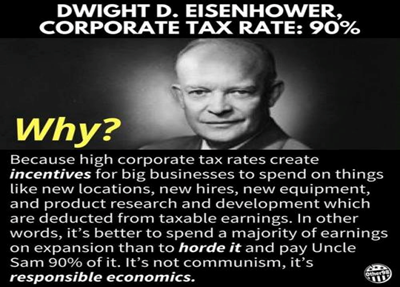
President Eisenhower’s admonition that corporations must pay their fair share to support economic growth is part of the solution to those problems.

I’ve written before about the growing income and wealth inequality that puts America’s distribution of family income ranking closer to Cameroon and Mozambique than the developed countries, according to the CIA World Factbook.

But the coronavirus pandemic has made returning to some degree of income equality that last prevailed in the 1970s more urgent than ever. Our record income and wealth inequality is a major reason for the growth in low-income workers.

U.S. economic growth has been anemic since the Great Recession—even with Republicans’ spectacular 2017 tax cut bill that mostly benefited Wall Street and corporations. The tax cuts were designed to benefit corporations, whose tax rate was cut to a rock bottom 21 percent from 36 percent, giving corporations a profit windfall.

So the upcoming presidential election is really about reversing the huge transfer of wealth (currently $1 trillion per year, per NY Times David Leonhardt) since 1980 when President Reagan’s so-called trickle-down economics program that advocated lower taxes and fewer government regulations took hold.

President Eisenhower’s simple explanation for the 90 percent maximum corporate tax rate that prevailed in the 1950s and 1960s was to encourage corporations to grow and develop “new locations, new hires, new equipment, new product research and development” that would grow the country, rather than “hoard it and pay Uncle Sam.”

But something happened in the 1970s to make taxes and big government unpopular, says Kurt Andersen in his new book, Evil Geniuses, The Unmaking of America (2020, Random House).

Higher marginal tax rates that squeezed growing middle class incomes was certainly part of it, but anti-government, anti-labor sentiments and policies enacted during the 1980s that lowered maximum tax rates put the finishing touches on any possibility of income equality for the 80 percent of salaried workers that no longer shared in the productivity gains from government-financed Research & Development (e.g., Internet, AI, space exploration).

Rutgers University economic historian James Livingston sounded the alarm in a well-known NY Times Op-ed: It’s Consumer Spending, Stupid, some years ago when he showed that corporations for the most part have been using their profits to speculate rather than invest in their future. With lower tax rates they no longer had the incentive to invest in the public good (and America’s future), in other words.

“Between 1900 and 2000, real gross domestic product per capita (the output of goods and services per person) grew more than 600 percent,” said Professor Livingston. “Meanwhile, net business investment declined 70 percent as a share of G.D.P…Since the Reagan revolution, these superfluous profits have fed corporate mergers and takeovers, driven the dot-com craze, financed the “shadow banking” system of hedge funds and securitized investment vehicles, fueled monetary meltdowns in every hemisphere and inflated the housing bubble.”

In other words, this election is not only about choosing a government that can vanquish COVID-19 with effective health care policies, it’s about improving the lives of most Americans. We know there are many programs that would improve income inequality—beginning with a higher minimum wage, enhanced public spending on a better social safety net.

Raising corporate taxes back to historical levels is a start that would enable government to finance some of those necessary changes; or corporations could again heed President Eisenhower’s admonition and spend their monies where it will do the most public good.

Harlan Green © 2020

Follow Harlan Green on Twitter: https://twitter.com/HarlanGreen

Posted in Economy, Keynesian economics, Politics, Uncategorized | Tagged , , , | Leave a comment

Joblessness to Increase This Fall

Popular Economics Weekly

image

FREDinitialclaims

The initial claims for unemployment insurance curve has flattened, rather than continuing to decline as the US economy opens. Not a good sign for future job growth.  Why? The coronavirus infection rate hasn’t declined, in a word, and studies are showing that consumer fears of COVID-19 are hurting the economy more than government decrees to combat the virus.

There were a seasonally adjusted 1.06 million new claims this week, and initial claims have been hovering around the 1 million marker for 3 weeks. The question is when will it decline further, indicating more hiring. But new research posits that may not be happening soon.

The National Bureau of Research (NBER) just put out a Working Paper entitled “Consumers Fear of Virus Outweighs Lockdown…” showing that fear of the effects of COVID-19 outweigh the government restrictions on business operations in causing the “steep drop in business activity.”

This is while CDC director Robert Redfield recently warned in a WebMD interview that America is bracing for “the worst fall, from a public health perspective, we’ve ever had.”

He feared that when the second, or third surge, in the pandemic arrives (depending on who’s counting) with the fall flu season, unemployment might rise again, maybe to levels not seen in recent history. We are still at a 10.2 percent unemployment rate, and next Friday’s August unemployment report might not show any improvement in the rate but may even worsen.

image

COVIDtrackingproject

“By comparing counties with and without restrictions, the NBER researchers conclude that only 7 percentage points of the 60 percentage points overall decline in business activity be attributed to legal restrictions,” said their public summary of the report. “Most of the decline resulted from consumers voluntarily choosing to avoid stores and restaurants.”

And average daily deaths haven’t yet declined from more than 1,000 per day since July and the summer openings. So, any lifting of those restrictions will not have much effect until consumers feel safe enough that the COVID-19 pandemic is under control.

In fact, the researchers’ counter-intuitive conclusion is that lifting lockdowns could have the unintended effect of discouraging consumer spending (which drives 70 percent of economic activity these days), “if repealing lockdowns leads to a fast enough increase in COVID infections and death.”

Retail sales rose 1.2 percent in July, the government said. Economists polled by economists had forecast a 2 percent advance. Receipts have slowed from a 8.4 percent increase in June and a record 18.3 percent gain in May when the economic rebound began. In other words, consumers may be seeing the writing on the wall as we approach the cold season.

There are other more heartening signs that fall economic growth could surge. Real PCE spending rose by 1.6 percent in July.  The combination of the July gains and the upward revisions to May and June puts real spending in July 8 percent above the Q2 average, which guarantees a very large contribution to Q3 GDP from the consumption component. 

The consensus is that GDP growth should spring back some 26 percent from its 32 percent drop in Q2. That could mean an end to the current recession that officially began in February, but no assurance there wouldn’t be a repeat unless consumers feel safer than they do today.

What’s the alternative if consumers still live in fear that COVID-19 hasn’t been controlled, and a safe and effective vaccine isn’t developed for, say, another year that can protect 300 million plus Americans ?

Is anyone listening?

Harlan Green © 2020

Follow Harlan Green on Twitter: https://twitter.com/HarlanGreen

Posted in Consumers, Economy, Politics, Weekly Financial News | Tagged , , , | Leave a comment

Should The Fed Boost Inflation?

Financial FAQs

image

FRED10yrInflation

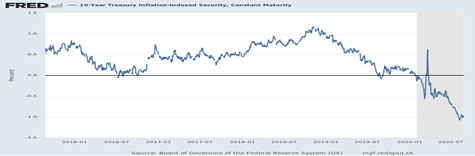
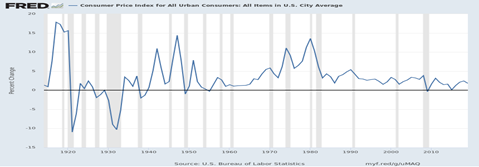
The Federal Reserve is so desperate to support growth in this pandemic that it wants to allow inflation to rise above its 2 percent target range. Why? Inflation and rising prices are usually a sign of economic growth. Inflation is currently running at less than 2 percent (1.81 percent annually).

Money is cheap because interest rates are close to zero, yes zero percent. The current 10-year benchmark Treasury yield is actually minus –1.0 percent after inflation, meaning the U.S. Treasury is paying investors to hold them at present, per the above FRED graph. That’s because money isn’t being used in productive enterprises at the moment, such as building infrastructure, or boosting education spending, or environmental protection, or put in the pockets of lower-income folk that spend most or all of it.

Actually all of those enterprises would pay it forward for the benefit of future generations, but that isn’t happening in the private sector, which is why we will need government to do the investing that private commerce will not.

Corporations and the wealthiest of us aren’t investing much in the future because the present is so uncertain. The dangers of another shutdown due to COVID-19 are very real, given that the U.S. is behind every other developed country and many developing countries in conquering this pandemic. We have the highest number of COVID deaths with Brazil, Mexico, and India next in line.

image

FREDcpiInflation

So Fed Chairman Powell’s announcement that the Fed will ease credit conditions even further is an attempt to pry some of the money loose from the savers with the hope it will be actually be spent on more goods and services.

That is a good thing in itself, but no guarantee that it will boost inflation or economic activity unless there are well-planned public programs to spend it. There is plenty of excess capacity in our COVID-19 economy, so production could be boosted quickly and in turn boost supplies, which keeps prices and inflation from rising too fast.

This is a truism lost on some economists even. Printing lots of money doesn’t necessarily produce higher prices and inflation, unless there is sufficient demand and/or there are production bottlenecks, hence a supply scarcity.

The only real guarantee that we will invest in the future, in what is essentially the public sector that belongs to all of US, is when government is the good caretaker of those public resources—the air, water, natural resources, public education and health services.

It isn’t socialism, but a more robust capitalist system, a public/private partnership that can benefit all Americans.

Harlan Green © 2020

Follow Harlan Green on Twitter: https://twitter.com/HarlanGreen
Posted in Consumers, Economy, Keynesian economics, Politics, Weekly Financial News | Tagged , , | Leave a comment

Why Housing Boom – Part II

The Mortgage Corner

image

Calculated Risk

Total existing-home sales, https://www.nar.realtor/existing-home-sales, completed transactions that include single-family homes, townhomes, condominiums and co-ops, jumped 24.7 percent from June to a seasonally-adjusted annual rate of 5.86 million in July. The previous record monthly increase in sales was 20.7 percent in June of this year. Sales as a whole rose year-over-year, up 8.7 percent from a year ago (5.39 million in July 2019).

And residential construction is almost up to the February high that had been nursed by the Fed’s push for record low interest rates that have boosted purchase and refinance mortgage applications to record volumes as well.

Why the housing boom in the middle of a worldwide pandemic that is killing millions?

Interest rates are at record lows, for one thing. And the recession is probably over for a certain segment of our populace. The numbers also show there is also a tremendous pent up demand from the missing spring months due to the pandemic shutdown that normally boost housing sales.

The conforming 30-year fixed rate is now below 3.0 percent for a one point origination fee, and jumbo conforming is just 1/8th percent higher! In fact, the best lenders are offering 2.75 percent at zero points for the 30-year conforming fixed rate.

“The housing market is well past the recovery phase and is now booming with higher home sales compared to the pre-pandemic days,” said Lawrence Yun, NAR’s chief economist. “With the sizable shift in remote work, current homeowners are looking for larger homes and this will lead to a secondary level of demand even into 2021.”

Reuters news reports housing starts jumped 23 percent last month versus their forecast of a 3 percent gain, with single-family starts up 8 percent from an upward-revised June level and the more volatile multi-family sector spiking 58 percent. (This had to be because of rising rents due to the housing shortage,)

However, overall starts remain 4.5 percent below their February level, with single-family starts down 9 percent since then and multi-family starts up 4 percent.  Single-family permits are up 17 percent and multi-family permits up 22 percent, a very strong sign of future construction activity.  It brought the level of single-family permits to within 1 percent of the February total, while multi-family permits, which bounce around a lot, are up sharply from February.

Construction will have to pick up even more with housing inventories a record lows. Total housing inventory3 at the end of July totaled 1.50 million units, down from both 2.6 percent in June and 21.1 percent from one year ago (1.90 million). Unsold inventory sits at a 3.1-month supply at the current sales pace, down from 3.9 months in June and down from the 4.2-month figure recorded in July 2019; which is way below the more normal 5-6 month supply.

“Housing has clearly been a bright spot during the pandemic and the sharp rebound in builder confidence over the summer has led NAHB to upgrade its forecast for single-family starts, which are now projected to show only a slight decline for 2020,” said NAHB Chief Economist Robert Dietz. “Single-family construction is benefiting from low interest rates and a noticeable suburban shift in housing demand to suburbs, exurbs and rural markets as renters and buyers seek out more affordable, lower density markets.”

The median existing-home price for all housing types in July was $304,100, up 8.5 percent from July 2019 ($280,400), as prices rose in every region. July’s national price increase marks 101 straight months of year-over-year gains. For the first time ever, national median home prices breached the $300,000 level.

This verifies what we are seeing in the financial markets. The recession seems to be over for the top 10 percent of income earners. Many of them have gone back to work, or have white collar jobs and work from home, or don’t have to work because they are so-called ‘rentiers’ that live off their soaring asset values, as seen in the record rise in the S&P 500 index.

What happens next with the inevitable surge in COVID-19 cases this fall, school openings and the ordinary flu season, as I’ve said? Probably not much to the DOW and bonds, or even housing, when all this is over.

However, the rest of the economy not driven by the top 10 percent of income owners, such as actual consumer spending on staples and durable goods, is another story. Nor will corporations see the need to ‘pay it forward’ for future generations, unless we find a better way to create living wages for the other 90 percent of adult-age workers still unemployed.

Harlan Green © 2020

Follow Harlan Green on Twitter: https://twitter.com/HarlanGreen
Posted in Consumers, Housing, housing market, Weekly Financial News | Tagged , , , , | Leave a comment

What’s Next…?

Financial FAQs

image

MarketWatch

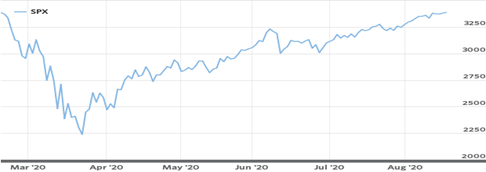
U.S. stocks finished mostly higher Tuesday, with the S&P 500 index notching its first record close since Feb. 19, and marking the quickest recovery from bear-market territory in its history, according to Dow Jones Market Data. 

So what happens next with the inevitable surge in COVID-19 cases this fall, school openings and the ordinary flu season? Probably not much to the DOW and stocks, believe it or not. The rest of the economy not owned by the top 10 percent of income owners is another story, however.

The best predictor of what may happen are other pandemics, such as the 1918 Spanish flu pandemic. But there were other 100,000 plus US deaths in the HINI and Bird flu epidemics of 1958 and 1968 as well.

During the 1918 influenza pandemic as with COVID-19, wealthier people had a better chance of survival: Individuals of moderate and higher economic status had a mortality rate of 0.38 percent, versus 0.52 percent for those of lower economic status and 1 percent for those who were “very poor,” economists Brian Beach, Karen Clay and Martin Saavedra wrote in the paper published this week.

“Compared to individuals who lived in one-room apartments, individuals who lived in two-room, three-room, and four-room apartments had 34 percent, 41 percent, and 56 percent lower mortality, respectively,” they added. In 2020, multigenerational households have also faced similar challenges, especially those with elderly inhabitants and younger people who show no symptoms of the virus, experts say.

This will probably be the case today, especially if congress doesn’t’ provide further adequate aid to states as well as extending unemployment insurance.

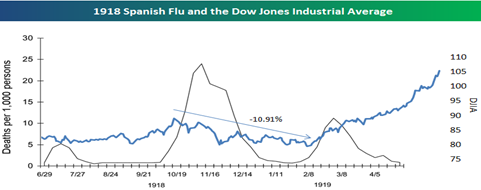
The financial markets were affected by death rate surges, in particular, but recovered quickly, as the combined Spanish flu-DOW Jones graph shows. The DOW fell slightly during each of the three spikes in death rates. It finally began its rise to new heights in the spring of 1919 only after the third spike, but the recession for most Americans didn’t formally end until 1922, according to the National Bureau of Economic Research (NBER).

image

seekingalpha.com

We can draw from this that ordinary consumers held back from spending until the virus had vanished. Americans were recovering from World War I and all the wartime controls, just as they did after World War II. But there was no New Deal in 1919 to help boost ordinary spending, no union regulations to aid organizing, no government-insured mortgage giants like Fannie Mae, FHA and the VA-guaranteed home loans to boost housing, so household spending didn’t pick up until 1922.

We can therefore conclude that we will not see any substantial pickup on GDP growth until next year, at the earliest. Consumers spending has an even larger effect on actual economic growth (70 percent) today than it did post-World War I, but the financial markets, which are still controlled by financially flush banks and major corporations will keep boosting stock and bond prices, as long as money is cheap.

The Fed learned this lesson in December of 2018, when it began to raise short term interest rates and the financial markets momentarily crashed. Ty then abruptly reversed course and began the current easing to bring interest rates in effect to zero, even becoming negative interest rates, when inflation is taken into account.

But this won’t help the majority of Americans, unfortunately, who don’t have the wherewithal to spend or borrow, unless more government financial aid is forthcoming that repeats the $3 trillion CARES Act, as the New Deal did to lift US out of the Great Depression.

Conversely the Fed will have to keep interest rates close to or below zero to keep the financial markets afloat.  Not a very healthy state of affairs with a $24 trillion national debt hanging over American heads.

Harlan Green © 2020

Follow Harlan Green on Twitter: https://twitter.com/HarlanGreen

Posted in Consumers, Economy, Politics, Weekly Financial News | Tagged , , , , , , | Leave a comment

Happy Consumers Are the Key…

Popular Economics Weekly

image

FREDretailsales

Are we heading for a fall in the Fall when the ordinary flu season begins? The chickens may be coming home to roost, as the saying goes, because the US economy opened to soon.

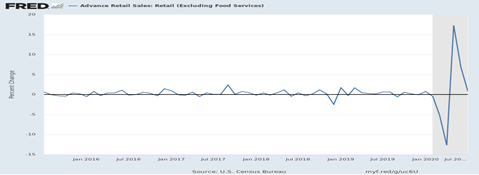
Retail sales rose 1.2 percent in July, the government said Friday. Economists polled by economists had forecast a 2 percent advance. Receipts have slowed from a 8.4 percent increase in June and a record 18.3 percent gain in May when the economic rebound began. Consumers may be seeing the writing on the wall.

And CDC director Robert Redfield just warned in a WebMD interview on Wednesday that America is bracing for “the worst fall, from a public health perspective, we’ve ever had.”

This is not because cooler weather somehow makes the coronavirus worse, or that the summer’s heat kills the virus, which has been a common misconception about the coronavirus causing the disease COVID-19. Rather, fall and winter become influenza’s time to shine.

We are stuck at the highest unemployment rate achieved during the Great Recession (10 percent) that ended in 2009 in July’s unemployment report. But it took until 2018 to return to anything resembling full employment (4 percent), another 8 years, as I said last week.

image

CDC

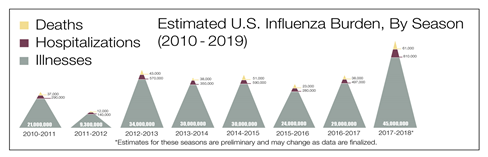
So will it take this long to return to full employment again? So far we have only restored about 9.3 million jobs, leaving more than half of the Americans who lost their jobs still unemployed, and the flu season is about to start that historically kills between 12,000 and 61,000 deaths a year.

“We’re going to have COVID in the fall, and we’re going to have flu in the fall. And either one of those by themselves can stress certain hospital systems,” Redfield said, noting that many hospitals have already been overwhelmed by the number of coronavirus patients. There have also been reports of hospitals in New York, Texas and Arizona calling in refrigerated trucks to serve as temporary morgues to handle the number of dead bodies during the pandemic. And the ordinary flu has seen between 140,000 and 810,000 people hospitalized each year since 2010.”

Retailers have been on a roller-coaster ride since the pandemic began, sinking in March and April and recovering rapidly in the following two months as the economy reopened. The more mild increase in sales in July (+1.2%) might be a sign of what lays ahead, however.

And consumer sentiment has stagnated; another sign that consumers are becoming more cautious as the flu season hits at the same time as schools normally open. The preliminary reading of the consumer sentiment survey in August edged up to 72.8 from 72.5 in July, but it’s still just barely above the pandemic low, the University of Michigan also said Friday.

And we know what can happened next, since children will bring those virus bugs home to parents and grandparents as schools re-open. Economists such as Nobelist Paul Krugman are becoming ever more worried that this could turn what has been a mild recession to date, into a Great Depression.

Harlan Green © 2020

Follow Harlan Green on Twitter: https://twitter.com/HarlanGreen
Posted in Consumers, Economy, Politics, Weekly Financial News | Tagged , , , , | Leave a comment