There are Plenty of Available Jobs!

Financial FAQs

Calculated Risk

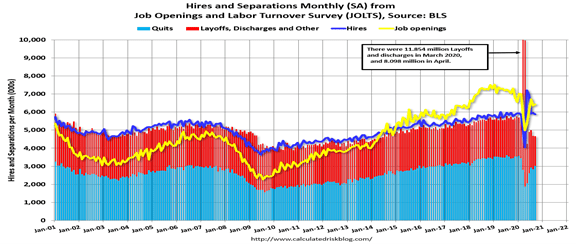
The 6.4 million job openings on the last business day of September, were “little changed” from prior months, the U.S. Bureau of Labor Statistics reported yesterday. But it is below the 7 million job openings in the months before the pandemic.

The Calculated Risk graph shows job openings (yellow line), hires (dark blue), Layoff, Discharges and other (red column), and Quits (light blue column) from the JOLTS report that gives us the best jobs picture outside the Labor Department’s monthly unemployment report.

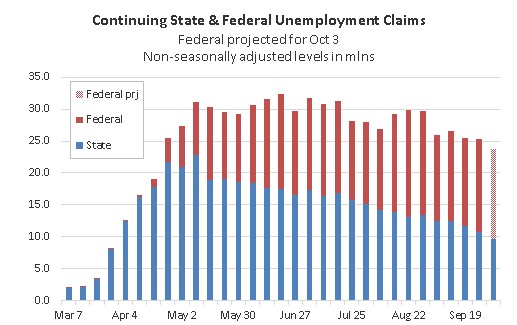
And the number of Americans filing claims for unemployment benefits has remained above its 665,000 peak during the 2007-09 Great Recession. At least 21.5 million people were still receiving unemployment benefits in mid-October.

So the JOLTS report shows the spring back in job openings, but fallback in hires as the year end approaches.

How will the new Biden administration bring back those jobs with COVID-19 numbers surpassing last summer and predicted to rise through at least December?

The good news is that the economy was growing and unemployment at record lows before the pandemic hit. There was no housing boom and bust, or overleveraged financial markets and poor credit controls that caused the Great Recession.

But there is still the record income inequality worsened with this pandemic that will slow down any recovery. Consumer demand would be boosted by raising the national minimum wage, which Biden advocates. President Biden could do this for federal contract workers, but congress would have to approve a raise to it nationally.

We could recover quickly, if we regain a national resolve to work together, as this election seems to have mandated, in other words.

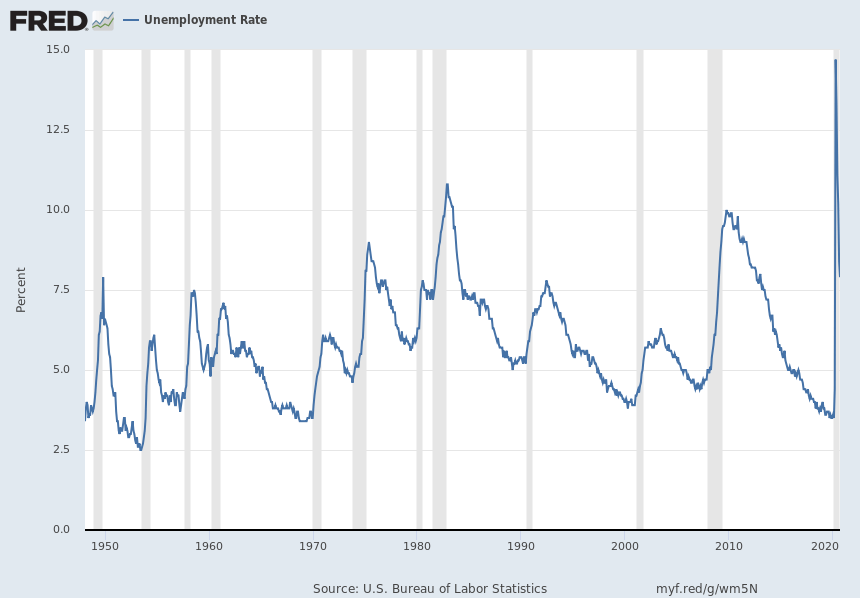
The U.S. has already regained 630,000 jobs in October and the unemployment rate fell sharply again to 6.9 percent, said the Bureau of Labor Statistics, reflecting a surprising show of strength for the economy even as coronavirus cases rose to record highs.

“These improvements in the labor market reflect the continued resumption of economic activity that had been curtailed due to the coronavirus (COVID-19) pandemic, and efforts to contain it,” the BLS said in its press release. “In October, notable job gains occurred in leisure and hospitality, professional and business services, retail trade, and construction. Employment in government declined.”
Covidtrackingproject

President-elect Biden’s creation of a COVID-19 national task force and implementing national mandates for mask wearing, testing, and vaccinations once he is in the White House should help to control its further spread and shorten the recovery time, bringing consumers back to their shopping ways.

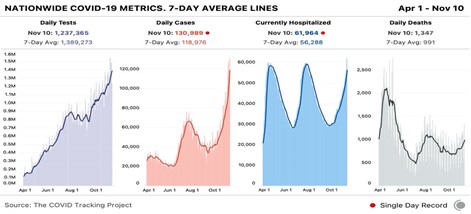
The states reported 1.2 million tests and 131k cases, the highest single-day total since the pandemic started on Tuesday, reports the Covid Tracking Project. There are 62k people currently hospitalized with COVID-19. The death toll was 1,347, and now totals 231,659 Americans since the beginning of the pandemic.

So I see sunnier days ahead if we can prevent even worse consequences due to the current phase two or three surge in infections and deaths. That means convincing most Americans to follow the science. President-elect Biden will have the bully pulpit to do so.

Harlan Green © 2020

Follow Harlan Green on Twitter: https://twitter.com/HarlanGreen
Posted in Consumers, Economy, Politics, Weekly Financial News | Tagged , , , , | Leave a comment

When Will Our Economic Civil War End?

Answering the Kennedys’ Call

@WIL_inequality

When Joe Biden becomes our new President in January 2021 and signals an ambitious ‘new’ new deal to rebuild America, the economic civil war that reached a high point with this presidential election has to end.

Americans must reach agreement on what needs to be done to vanquish the worst disease since the 1918-19 Spanish flu pandemic that killed an estimated 675,000 Americans, for starters. It has infected 10 million Americans and 50 million worldwide at this writing.

And how do we then rebuild from this recession, the worst since the Great Depression (yes, the Great Depression) with 11 million jobs still lost and many more unemployed? What tends to be forgotten is the 1932 depression only became the Great Depression when the US economy plunged back into negative growth in 1937. And we are in a second pandemic-induced recession begun in February this year after barely recovering from the 2017-19 Great Recession.

If this economic war isn’t resolved because of what could be an intransigent Republican-majority Senate in 2021, it will be more difficult to implement any new deal that will revitalize the American economy as did the original New Deal that brought us out of the Great Depression and a horrific WWII.

This election is more than a battle over states vs. federal government rights, in other words, as was the civil war with poorer southern states fighting the industrial north to preserve private property rights that included holding slaves—also private property in their eyes.

This modern economic war is also about nostalgia for an illusory past with modern Republicans’ attempts to privatize as much as they can and limit public welfare and social policies by repealing Obamacare and cutting taxes that would support more spending on public projects—our outmoded infrastructure, public K-12 education system (that is ranked last in the developed countries), more R&D support to keep US a leader in scientific research and environmental protection—all battles over who owns and benefits from the role of governments in our capitalist system.

The modern version of this economic civil war is also being fought over a false economic theory first popularized with Adam Smith’s The Wealth of Nations, written in 1776. He said low taxes and regulations on businesses and their profits created higher productivity and greater wealth for all.

At its core this has meant to most modern conservatives maximizing profits should be the sole goal of corporations; that making sure the owners of industries and the owners of capital receive most of the profits from their businesses. Enough of their wealth will then ‘trickle down’ to workers to satisfy their wants and needs as well.

The problem highlighted with this laissez-faire economic policy by economists like Lord John Maynard Keynes in the 1930s and Thomas Piketty more recently is the historical fact that owners’ rate of profit growth from their capital ownership (5 percent historically) has been more than twice that of workers’ incomes (approximately 2 percent). Hence there is an inherent inequality built into capitalism if not regulated via progressive taxes and regulations to level the playing field.

So it was a shockingly new idea when Henry Ford first realized that his workers could only buy more of his cars when he raised their salaries to $5 per day. Their demand for more cars would only increase with an increase in their salaries and benefits. Hence the recognition that only by increasing workers’ incomes and benefits would there be sustainable economic growth with less booms and busts, such as occurred during the Great Depression and more recent recessions—both caused in large part by the record income inequality.

What if we could learn from history? Would there still be an ongoing economic civil war?

The federal government has the means to pay it forward for future generations by funding projects that are too risky for private enterprise. Would we have gone to the moon, built our modern infrastructure of dams, energy grids, established the Internet, or built our freeway system otherwise?

Of course not. The economic civil war of states vs. federal rights, lower vs. higher taxes, less vs. more regulations, does not have to continue, if President-elect Biden is the negotiator and compromiser he is touted to be. But that can only happen if there is agreement on the mechanisms that create a more level playing field.

The world of Adam Smith’s free market, low tax and regulation world that prevailed in England’s early industrial towns and cities, and that Republicans attempted to resurrect with trickle-down economic theories in the 1980s, hasn’t worked today because of the essential role governments play to fight pandemics, or advance scientific research to protect us from many future unknowns.

A majority of Americans in this election—five million and counting—have said that the income and wealth inequality resulting from owners garnering the lion’s share of income and wealth will no longer be tolerated. It has taken natural or human-made catastrophes—like wars and disease pandemics—to bring Americans together in past times. Let US not lose this opportunity the COVID-19 pandemic has presented to end the economic civil war once and for all, and begin a lasting economic peace.

Harlan Green © 2020

Follow Harlan Green on Twitter: https://twitter.com/HarlanGreen

Posted in Consumers, Economy, Keynesian economics, Politics | Tagged , , , , | Leave a comment

Another Good Employment Report

Financial FAQs

FREDunemployment

The U.S. regained 630,000 jobs in October and the unemployment rate fell sharply again to 6.9 percent, said the Bureau of Labor Statistics, reflecting a surprising show of strength for the economy even as coronavirus cases rose to record highs.

“These improvements in the labor market reflect the continued resumption of economic activity that had been curtailed due to the coronavirus (COVID-19) pandemic, and efforts to contain it,” the BLS said in its press release. “In October, notable job gains occurred in leisure and hospitality, professional and business services, retail trade, and construction. Employment in government declined.”

There are still 11 million workers without jobs of the 22 million jobs lost due to the pandemic shutdown, so it will take much more time to bring the employment picture back to something like what prevailed before the pandemic, and “dark days” for COVID-19 infection rates when the holidays kick in lie ahead, said both Drs. Fauci and Birx in recent days.

That means a lot more suffering and deaths this winter and into next year for many, before any vaccine can be widely administered.

Private-sector employment rose by a more robust 906,000, but a sharp decline in government employment pulled down the overall total. The number of persons who usually work full time rose by 1.2 million to 123.6 million, and the number who usually work part time increased by 1.0 million to 26.2 million.

The number of persons employed part time for economic reasons increased by 383,000 to 6.7 million in October, after declines totaling 4.6 million over the prior 5 months.

Federal Reserve Chair Powell said yesterday after the conclusion of their latest FOMC meeting that more pandemic relief aid is needed to keep economic growth expanding, to no one’s surprise. The rise in new cases “is particularly concern,” the Fed chairman said.

It also means much more than relief aid is needed to rebuild the American economy for the future. It took 10 years after the Great Recession for the unemployment rate to drop to its pre-pandemic low.

The U.S. counted 107,872 new infections on Wednesday, according to a New York Times tracker, and at least 1,616 Americans died. In the past week, the U.S. has averaged 91,878 cases a day, a 51 percent increase from two weeks ago.

The U.S. leads the world by cases with 9.49 million and deaths with 233,777, according to data aggregated by Johns Hopkins University, and accounts for more than a fifth of global cases and fatalities.

So Powell’s warning of “tragic’ economic risks if another coronavirus aid package isn’t passed by congress seems obvious.

“Over time, household insolvencies and business bankruptcies would rise, harming the productive capacity of the economy and holding back wage growth,” Powell said. “By contrast, the risks of overdoing it seem, for now, to be smaller.”

And those hurt most by any further delay in passing another relief package that would benefit states as well federal government programs are the essential workers most needed to conquer the pandemic.

Employment of those in the bottom rung of the wage distribution scale remains 21 percent below its February level, while it was only 4 percent lower for workers who receive higher wages.

Harlan Green © 2020

Follow Harlan Green on Twitter: https://twitter.com/HarlanGreen

Posted in Consumers, Economy, Weekly Financial News | Tagged , | Leave a comment

How Will US Economy Survive COVID-19?

Popular Economics Weekly

FREDpersonalconsumption

The US economy must first survive this pandemic before it will benefit most Americans. Some sectors are doing better, but ignore the financial market swings, which benefit 401(k)s, but not most Americans.

Advance estimates of U.S. retail and food services sales for September 2020, adjusted for seasonal variation and holiday and trading-day differences, show an increase of 1.9 percent from the previous month, and 5.4 percent above September 2019 as an example.

This is a huge bump in spending as consumers left their confined spaces in July, which is mainly why GDP growth rose 33 percent in Q3 from its second quarter pandemic low, since consumers account for most GDP activity.

But it was mostly in so-called durable goods—autos, planes, appliances that last more than three years. The majority of services businesses, such as restaurants, lodgings and travel, will be suffering through much of next year until most Americans are vaccinated and feel it’s safe enough to re-engage with the larger world. Appliance sales are booming, for instance, because most of us remain at home during the pandemic out of caution.

The real question will be how much more will Americans suffer this winter due to the pandemic.

ADP

As a prelude to Friday’s official unemployment report, payroll data processor ADP reports a smaller increase of 365,000 new nonfarm payroll jobs in October, mostly in the service industries and down from 753,000 the prior month.

Last month’s US payrolls reported by the Labor Department increased by 661,000 nonfarm payroll jobs last month with an unemployment rate of 7.9 percent, so job creation may be declining in the government’s official report this Friday.

“The labor market continues to add jobs, yet at a slower pace,” said Ahu Yildirmaz, vice president and cohead of ADP Research Institute. “Although the pace is slower, we’ve seen employment gains across all industries and sizes.”

But that still begs the question of what will happen with coronavirus infections now reaching 100,000 per day and the infection rate rising to 9.3 percent, which means a faster community spread.

According to the Washington Post, Deborah Birx, one of the White House’s most senior coronavirus advisers, issued her warning in an internal memo on November 2, saying that “We are entering the most concerning and most deadly phase of this pandemic … leading to increasing mortality.” And the White House, she wrote, is not doing enough: “This is not about lockdowns — it hasn’t been about lockdowns since March or April. It’s about an aggressive balanced approach that is not being implemented.”

The U.S. counted 92,660 new cases on Tuesday, according to a New York Times tracker, and at least 1,130 fatalities. In the past week, the U.S. has averaged 88,168 cases a day, up 46% from the average two weeks ago.

Does anyone believe things can get any better before this pandemic is controlled?

Harlan Green © 2020

Follow Harlan Green on Twitter: https://twitter.com/HarlanGreen

Posted in Consumers, Economy, Politics, Weekly Financial News | Tagged , , | Leave a comment

Q3 Real GDP Jumps +33 Percent

Popular Economics Weekly

Calculated Risk

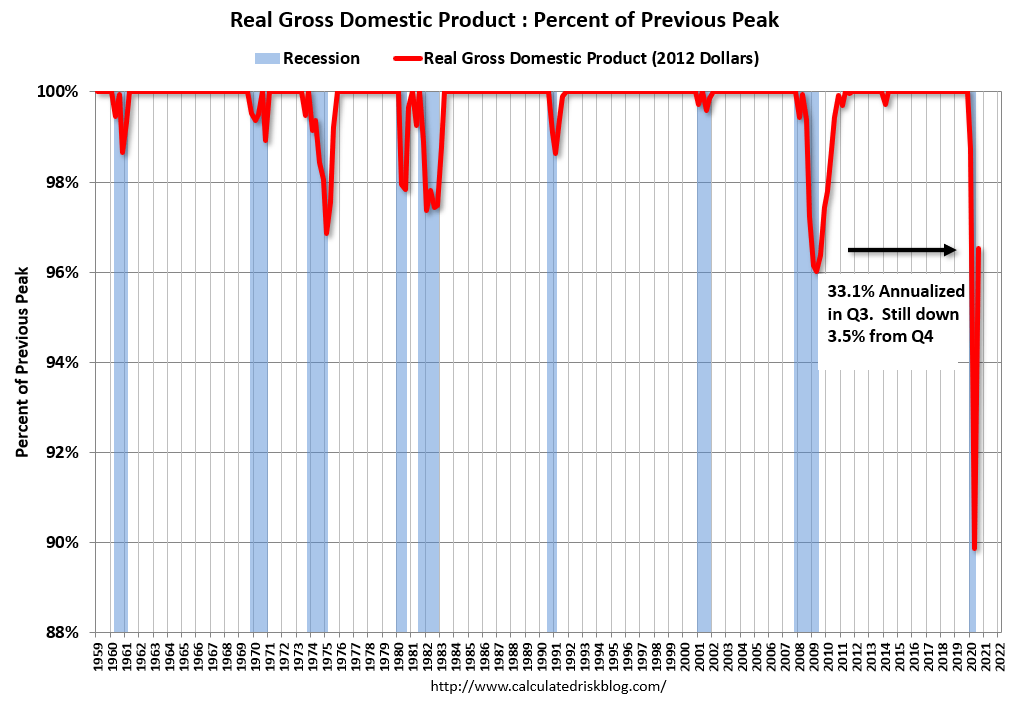
We are not really out of the COVID recession, per Calculated Risk graph, even though the US Bureau of Economic Analysis (BEA) “advance” estimate of third quarter GDP growth increased +33.1 percent. But it’s still 3.5 percent below last year’s fourth quarter growth rate.

Its blue bars portray past recessions, so the graph also tells us how severely this pandemic has affected economic growth. Real GDP had declined -31.4 percent in Q2.

The main driver of the rebound was consumption spending, which rose at a 40.7 percent growth rate.  The biggest surprises were weaknesses in government spending and a very large rebound in inventories, as businesses stocked up for the holidays. 

“We had thought federal spending would grow enough to keep overall public spending positive,” says Reuters, “but reported spending was down at both the federal and state levels, subtracting 0.7 percentage points from growth.” 

This is precisely why congress’s inaction on passing another pandemic relief package is so maddening. It’s now declining state and local spending that is suppressing growth and additional job creation.

Positive economic growth for the rest of this year is also in doubt, as initial unemployment claims haven’t fallen fast enough to stay ahead of COVID-19, since more consumers are staying home because COVID-19 infection rates are already rising with the fall season and we haven’t even reached the holidays, when families and friends tend to gather.

Altogether, the number of people receiving benefits from eight separate state and federal programs fell by 415,727 to an unadjusted 22.7 million as of Oct. 10, the latest data available, which means 22 million of the formerly employed haven’t yet found another job.

Economists are concerned that rising coronavirus cases will lead people to stay home, and cause service industries to begin another round of layoffs. Adding to the sense of unease, Congress went home for the presidential election without passing addition coronavirus financial relief.

COVID Tracking Project

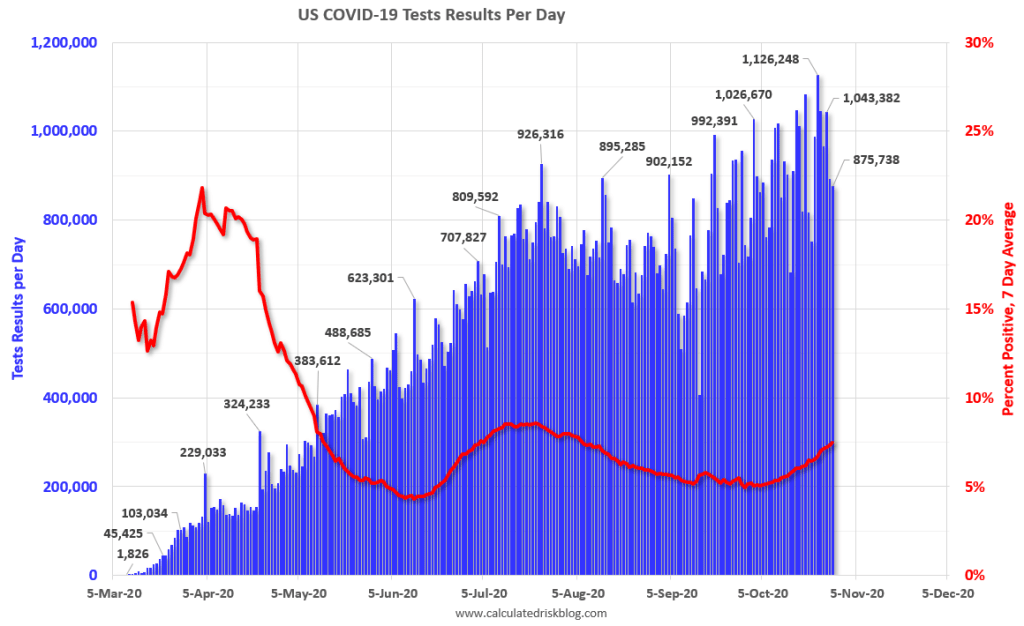
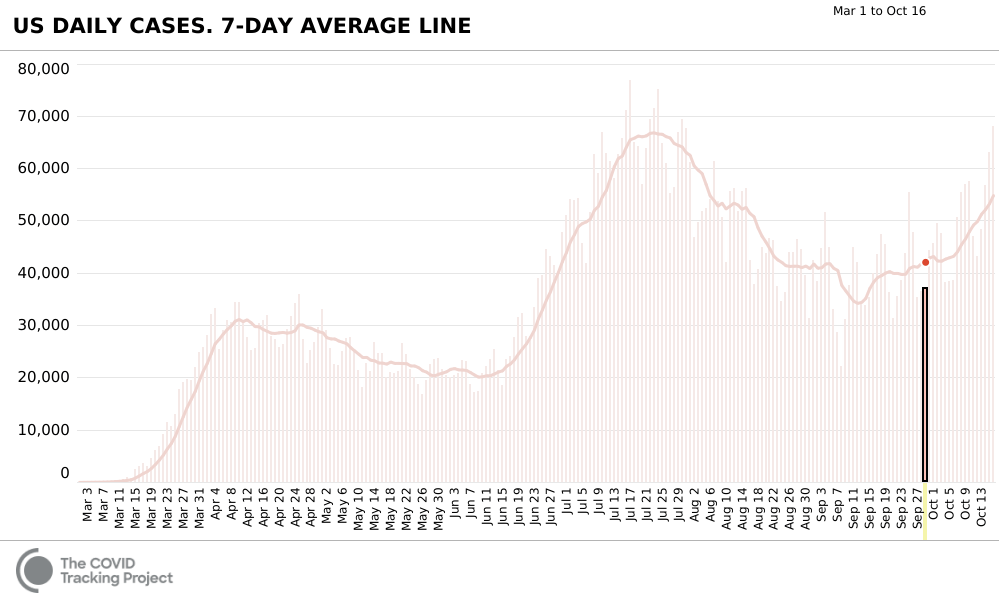
There are now more than 70,000 positive tests per day, surpassing the former 68,000 peak in August, not a good sign. Infection rates have risen above 7 percent (red line in graph), also a sign of faster community spreading of the virus in the long expected third surge in virus infections.

So consumers that drive 70 percent of economic activity are in a quandary. Will the pandemic surge continue, and so require consumers to stay at home, as is already happening in France and Germany with their new lock downs from rising infection rates?

The Conference Board’s latest consumer confidence report was a mixed bag.

“Consumer confidence declined slightly in October, following a sharp improvement in September,” said Lynn Franco, Senior Director of Economic Indicators at The Conference Board. “Consumers’ assessment of current conditions improved while expectations declined, driven primarily by a softening in the short-term outlook for jobs. There is little to suggest that consumers foresee the economy gaining momentum in the final months of 2020, especially with COVID-19 cases on the rise and unemployment still high.”

Senior Director Franco sums up consumers’ current forebodings–what might happen for the rest of this year–and maybe into much of next year, until consumers have some confidence in an effective COVID-19 vaccine.

Harlan Green © 2020

Follow Harlan Green on Twitter: https://twitter.com/HarlanGreen
Posted in Consumers, Economy, Politics, Weekly Financial News | Tagged , | Leave a comment

End of the Age of Narcissism–Part II?

Answering the Kennedys’ Call

USAToday

South Dakota’s Sturgis Motorcycle Rally this August was notable for the estimated 450,000 attending during the COVID-19 pandemic. It happened in spite of the almost unanimous warnings given by public health officials that it could be the mother-of-all super-spreader events.

Is this the last cry from a culture of narcissism that has prevailed in America since at least the 1970s, a culture of ‘me first’ with the credo of personal freedom unhindered by a regard for the welfare of others?

“Within weeks of the gathering,” reported WashPost, “the Dakotas, along with Wyoming, Minnesota and Montana, were leading the nation in new coronavirus infections per capita. The surge was especially pronounced in North and South Dakota, where cases and hospitalization rates continued their juggernaut rise into October.”

There were no state and local health officials to identify and monitor attendees returning home, or to trace chains of transmission after people got sick. “Some, however, believe the nearly 500,000-person gathering played a role in the outbreak now consuming the Upper Midwest,” according to WashPost.

And a USA TODAY analysis showed COVID-19 cases grew at a faster rate than before after at least five of President Trump’s most recent political rallies in the following counties: Blue Earth, Minnesota; Lackawanna, Pennsylvania; Marathon, Wisconsin; Dauphin, Pennsylvania; and Beltrami, Minnesota.

“Together, those counties saw 1,500 more new cases in the two weeks following Trump’s rallies than the two weeks before – 9,647 cases, up from 8,069.” 

Why the almost suicidal determination of those bikers, and Trump die-hard supporters, to behave with such a blatant disregard for their own health, or that of others?

Were they making a desperate last stand against a pandemic that outnumbered them? Many of the attendees maintained it was an infringement of their personal freedom to not be able to participate in such public gatherings that obviously meant so much to them.

“I don’t think there was nothing that was going to stop me,” said one middle-aged biker who was infected with COVID-19 at the Sturgis rally, according to the WashPost.

In every other western country going through the same struggle to control the new coronavirus, super-spreader event wouldn’t be allowed or even considered in this day and age. Yet no authorities, or our Commander-in-Chief, mandated the banning of super-spreader events as a public health danger that could ultimately infect tens of thousands of Americans.

What will it take to end to such destructive behavior, based on a credo of personal freedom that has also fragmented our country into red and blue states? Are we seeing an end in President Donald Trump’s failing faux populism which has always been for the benefit of the financial elites, rather than discontented proletariat, and who has been diagnosed by multiple mental health professionals with a Narcissistic Personality Disorder?

This behavior is another description of a sociopathy—to use a clinical term—that has infected one political party, a political party that is in effect destroying itself. The natural world has signaled such behavior without a regard for the welfare of others can no longer be tolerated. Mother Nature in the form of this COVID-19 pandemic is calling for an end it to this culture of narcissism during the worst disease pandemic in 100 years.

Harvard political scientist Robert Putnam with co-author Shaylyn Romney Garrett, in his latest best-seller, The Upswing, How America Came Together a Century Ago and How We can Do It Again, believes we are seeing the dawn of a new era with the youth of America, one that eclipses the culture of narcissism and advances Teddy Roosevelt’s progressive policies of more than a century ago that broke up big business monopolies and instituted more egalitarian public policies, ultimately leading to FDR’s New Deal.

“America’s challenges will be equally difficult to solve—and will therefore require just as much youthful courage, vigor, and imagination to overcome. And so, to a large extent, America’s fate lies in the hands of the post-Boomer generations. Today’s young people did not cause today’s problems. But like their predecessors 125 years ago, they must forgo the cynicism of drift and embrace the hope of mastery.”

Will it signal the dawning of a new, more forward looking era, a new, new deal? Let us hope so, beginning with the results of this presidential election.

Harlan Green © 2020

Follow Harlan Green on Twitter: https://twitter.com/HarlanGreen
Posted in Macro Economics, Politics, Uncategorized | Tagged , , , | Leave a comment

The Housing Boom Continues

The Mortgage Corner

Calculated Risk

Total existing-home sales, https://www.nar.realtor/existing-home-sales, including single-family homes, townhomes, condominiums and co-ops, rose 9.4 percent from August to a seasonally-adjusted annual rate of 6.54 million in September.

The housing boom continues in the middle of the coronavirus pandemic. Overall home sales are up 20.9 percent from a year ago (5.41 million in September 2019).

“Home sales traditionally taper off toward the end of the year, but in September they surged beyond what we normally see during this season,” said Lawrence Yun, NAR’s chief economist. “I would attribute this jump to record-low interest rates and an abundance of buyers in the marketplace, including buyers of vacation homes given the greater flexibility to work from home.”

That is one of the reasons for the surge—more well-healed, white collar buyers are working from home as the pandemic has accelerated the digital revolution, and a central work location is no longer needed.

Couple this with the upcoming 5G networks that will power more of everything—manufacturing, services, and online education, for starters. The World Economic Forum described what is possible with the wider band widths and faster speeds that 5G will bring to economic growth.

“Think about a world in which not just people but all things are connected: cars to the roads they are on; doctors to the personal medical devices of their patients; augmented reality available to help people shop and learn and explore wherever they are. This requires a massive increase in the level of connectivity.”  

And it is exacerbating the existing housing shortage.  Builders are playing catch up to this speeding up of the surge in demand.

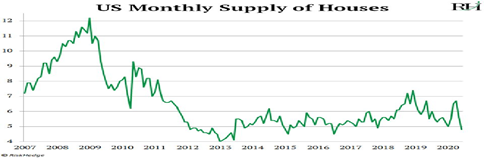
Total housing inventory at the end of September totaled just 1.47 million units, down 1.3 percent from August and down 19.2 percent from one year ago (1.82 million). Unsold inventory sits at a 2.7-month supply at the current sales pace, down from 3.0 months in August and down from the more normal 4.0-month figure recorded in September 2019.

Builders are responding.  U.S. single-family homebuilding raced to a more than 13-year high in September. The report from the Commerce Department showed single-family homebuilding jumped 8.5 percent to a seasonally adjusted annual rate of 1.108 million units last month. That offset a 16.3 percent decline in starts for the volatile multi-family segment to a pace of 307,000 units, said the National Association of Homebuilders (NAHB). Overall, housing starts increased 1.9 percent to a rate of 1.415 million units last month.

Homebuilding has advanced 11.1 percent year-on-year, with single-family starts surging 22.3 percent. Further gains in single-family home construction are likely, said Reuters, with building permits shooting up 7.8 percent to a rate of 1.119 million units last month, the highest level since March 2007

Scarce inventory has been problematic for the past few years, according to Yun, an issue he says has worsened in the past month due to the dramatic surge in lumber prices and the dearth of lumber resulting from California wildfires.

Mortgage rates are helping to offset some of those high home prices, however. A 30-year conforming fixed-rate mortgage dropped to 3 percent in August and has averaged below 3 percent in the past few weeks, the lowest on record.

I said last week that the NAR also reports pending home sales for contracts closing in some two months are also surging, which will boost sales through the end of the year. Pending home sales in August continued to move upward, marking four uninterrupted months of positive contract activity. Each of the four major regions have experienced growth in month-over-month and year-over-year pending home sales transactions.

Harlan Green © 2020

Follow Harlan Green on Twitter: https://twitter.com/HarlanGreen

Posted in Consumers, Economy, Housing, housing market, Uncategorized, Weekly Financial News | Tagged , | Leave a comment

The Winter Pandemic is Coming

Financial FAQs

COVIDTrackingProject

There is little doubt that this fall and winter will show a surge in pandemic illnesses and deaths. States in the Midwest and South will hurt the most, but also some northern states like Montana, North and South Dakota that don’t have statewide mask-wearing requirements.

At least 793 new coronavirus deaths and 65,327 new cases were reported in the United States on Oct. 15. Over the past week, there has been an average of 54,399 cases per day, an increase of 25 percent from the average two weeks earlier.

And this is just at the start of the flu season. As of Friday afternoon, more than 8,036,100 people in the United States had been infected with the coronavirus and at least 217,800 have died, according to a New York Times database.

Who is listening as the holidays approach? Dr. Fauci has warned that “This is an outbreak of historic proportions, the likes of which we have not seen in 102 years,” he said, referencing the 1918 flu. Death rates are actually increasing in 23 of those states at this writing.

Just look at the numbers. There are now 40 states with increasing infection rates, and 22 states with increasing death rates. North and South Dakota, Kansas, Montana and Alabama are the deadliest states, according to John Hopkins.

Calculated Risk

There were 913,976 test administered this Friday, and a positivity rate rising above 5 percent again; anything above that infection rate is not considered controllable by epidemiologists. So what does this pandemic surge mean for economic growth?

We will be looking in the rear-view mirror with the upcoming Q3 GDP forecasts that predict on average a 35 percent GDP growth that could fool US into thinking the pandemic-induced recession has ended. A 35 percent annualized increase in Q3 GDP is about 7.8 percent QoQ, and would still leave real GDP down about 3.3 percent from last year’s Q4.

The Q3 growth surge is partly due to a huge and probably temporary jump in retail sales, up 1.9 percent from August to September (seasonally adjusted), and were up 5.4 percent from September 2019.

So what should be done? Harvard Professors Larry Summers and David Cutler predict a much worst outcome if more pandemic relief isn’t passed this year.

They have just published a study in The Journal of the American Medical Association that says the total cost of the pandemic is estimated at more than $16 trillion, or approximately 90 percent of the annual gross domestic product of the US by the fall of 2021 when the pandemic is predicted to have subsided. Approximately half of this amount is the lost income from the COVID-19–induced recession; the remainder is the economic effects of shorter and less healthy life.

“However, increased investment in testing and contact tracing (approx. $100m) could have economic benefits that are at least 30 times greater than the estimated costs of the investment in these approaches,” they said.

Professor Summers said in a recent Sunday Fareed Zakaria CNN interview that the total cost of the pandemic — including more than 10 weeks of near total lockdown across most of the country, which caused the GDP in second quarter to drop by more than a third — will eclipse the money the U.S. has spent on every war since September 11, 2001, including those in Afghanistan, Iraq and Syria.

Now is the time, they say, to borrow more when the cost of money is so cheap—at almost zero interest—to start the projects that will bring down the pandemic infection rates and bring back longer-term growth and prevent the enormous wastage in life and property that present inaction is costing Americans.

There is really no alternative, or we will end up approaching the horrific 1918 Spanish flu death count when we were much less prepared.

Harlan Green © 2020

Follow Harlan Green on Twitter: https://twitter.com/HarlanGreen

Posted in Consumers, Economy, Politics, Weekly Financial News | Tagged , , | Leave a comment

Back to a ‘V’-Shaped Recovery?

Popular Economics Weekly

FREDcontinuedclaims

Richard Clarida, No.2 official at the Federal Reserve said on Wednesday that the U.S. recession begun in March with the coronavirus pandemic may already be over.

“This recession was by far the deepest one in postwar history but it also may go into the record books as the briefest recession in U.S. history,” Clarida said in prepared remarks to an Institute for International Finance conference. The flow of economic data since May has been “surprisingly strong,” he said.

Why? There is much pent up consumer demand with a record personal savings rate double (approximately 14 percent) what it was pre-pandemic because of the March to June economic shutdown when they couldn’t spend on anything but essentials.

Meanwhile, initial jobless claims remained worryingly high in the week of October 10.  The seasonally adjusted level of state claims rebounded by 53K to 898K, which is the highest reading since the first half of August, said Reuters’ Wrightson/ICAP data service.  In not seasonally adjusted terms, claims were up 76K, with the increase spread across a range of states:  Indiana was up 19K, Illinois and Massachusetts were each up 10K, Georgia was up 8K, for instance. 

The pace of new layoffs continues to be a source of concern.  “We continue to think it is an open question whether there will be enough new hires and worker call-backs in October to offset the ongoing job losses,” said ICAP.  “The string of positive payroll gains could be interrupted this month.”

FREDunemployment

October’s unemployment report won’t be released until Friday after the November election. September’s unemployment rate fell to 7.9 percent from 8.4 percent in August.

In the continuing claims data, workers continued to fall off the state rolls in the week of October 3 as they exhausted their regular benefits.  The number of beneficiaries slid 1.2 million in seasonally adjusted terms to a level of 10.0 million still collecting some form of unemployment benefits. 

Economists’ consensus is that the economy should rebound at a 31.9 percent annualized rate in the July-September quarter. The economy sank at a record minus -31.4 percent rate in the second quarter.

The Fed vice chairman was not all upbeat though. He said the outlook for the economy was unusually uncertain and depends on the course of the virus. It will take time for the economy to recover all the lost ground in the recession and he said more help from Fed policy and Congressional spending “will be needed.”

I believe a full recovery in the consumer-dependent service sector probably won’t happen until next summer, at least, once a reliable vaccine is developed and widely distributed.

Harlan Green © 2020

Follow Harlan Green on Twitter: https://twitter.com/HarlanGreen
Posted in Uncategorized | Tagged , , | Leave a comment

Booming Home Sales Create Housing Shortage

The Mortgage Corner

Booming Realtors’ existing-home sales are showing there is a very severe housing shortage with record sales and a record low housing inventory. Santa Barbara Realtor Jim Witmer said the demand for Santa Barbara homes is huge and inventory is being held back by seller’s concerns about the virus.  Buyers are making decisions based on spending more time at home, with work space and more amenities. 

“This trend continues as more people relocate to the safety and lifestyle offered by Santa Barbara.  This should continue to drive our values up.  The supply is limited and it is a good time to be a seller,” said Witmer.

Inventory levels are at record lows, with just 228 homes listed for sale in the MLS in September, down 22 percent from January.

The NAR reports that housing affordability declined in August compared to a year ago, despite median incomes rising. However, the jump in home prices—up 11.7 percent—was way above family income increases of 2.2 percent. August 2019).

“Home sales continue to amaze, and there are plenty of buyers in the pipeline ready to enter the market,” said Lawrence Yun, NAR’s chief economist. “Further gains in sales are likely for the remainder of the year, with mortgage rates hovering around 3% and with continued job recovery.”

Forbes

Total housing inventory at the end of August totaled 1.49 million units, down 0.7 percent from July and down 18.6 percent from one year ago (1.83 million). Unsold inventory sits at a 3.0-month supply at the current sales pace, down from 3.1 months in July and down from the 4.0-month figure recorded in August 2019.

Scarce inventory has been problematic for the past few years, according to Yun, an issue he says has worsened in the past month due to the dramatic surge in lumber prices and the dearth of lumber resulting from California wildfires.

Mortgage rates are helping to offset some of those high home prices, however. A 30-year fixed-rate mortgage dropped to 3 percent in August and has averaged below 3% in the past few weeks, the lowest on record.

The NAR also reports pending home sales for contracts closing in some two months are also surging, which will boost sales through the end of the year. Pending home sales in August continued to move upward, marking four uninterrupted months of positive contract activity. Each of the four major regions experienced growth in month-over-month and year-over-year pending home sales transactions.

The Pending Home Sales Index (PHSI),* www.nar.realtor/pending-home-sales, a forward-looking indicator of home sales based on contract signings, rose 8.8 percent to 132.8 – a record high – in August. Year-over-year, contract signings rose 24.2 percent.

The sale pendings reported by Santa Barbara MLS are again much higher than the previous year (50 percent), so we can expect October to also be a big month for sales, said Witmer.

Harlan Green © 2020

Follow Harlan Green on Twitter: https://twitter.com/HarlanGreen
Posted in Uncategorized | Leave a comment