
“When Will We Ever Learn?”

Answering the Kennedys’ Call

image

@TBPInvictus

Bob Dylan wrote his ode to ending wars, Where Have All the Flowers Gone? in the 1960s but it could just as well apply to today’s war against the novel coronavirus pandemic that is killing more Americans than all the wars since World War II. It ends with the stanza:

Where have all the graveyards gone?
Covered with flowers every one
When will we ever learn?

Yet one political party has chosen to surrender to the pandemic, rather than follow the scientific guidelines of the CDC, WIH, and FDA in many of the red states it controls.

Thirty-eight U.S. states have seen a rise in cases in the last 14 days, says MarketWatch’s Jeffrey Bartash. Harvard Global Health Institute researchers have developed a national tracker to trace the severity of the outbreak on a state-by-state basis, and it’s flashing red for red states like Arizona, Florida, Louisiana, South Carolina and Georgia with 25 cases per 100,000 people.

Republicans aere also ignoring the rising death toll by holding political rallies without mandating the mask and social-distancing requirements in the face of today’s 63,500 plus coronavirus infections per day in the US and still rising.

President Trump was going to hold a rally in Portsmouth, New Hampshire that is now postponed, in spite of the objections of its Police Commissioner, Stefany Shaheen, who has called such a rally without requiring mask-wearing and social-distancing the waging of “biological warfare” against vulnerable New Hampshire residents—and even the diehard out of state Trump supporter’s already arriving in New Hampshire that has one of the lowest infection rates in the US.

This is after Trump held a rally in Tulsa, Oklahoma that Tulsa’s Medical Director said caused an outbreak of COVID-19 infections. “The president lives in a biological bunker,” said Shaheen. “He gets tested all of the time and yet the people attending this rally are not. They’re not getting daily testing. They don’t know if the person next to them without a mask has COVID-19. It is unacceptable and it’s dangerous.”

There is no rational or moral reason to hold any large gatherings at this time when all the health agencies say many states and counties should in fact close down again, since the pandemic is now racing out of control.

Even Dr. Fauci is now warning about the consequences of such ignorance. “When you don’t have unanimity in an approach to something, you’re not as effective in how you handle it,” he said in an interview Thursday with FiveThirtyEight’s PODCAST-19, as quoted by Bartash. “So I think you’d have to make the assumption that, if there wasn’t such divisiveness, that we would have a more coordinated approach.”

The U.S. death toll stands at 133,291. Brazil is second to the U.S. with 1.76 million cases and 69,184 deaths. India is third measured by cases at 793,802, followed by Russia with 712,863 and Peru with 316,448.

Why are Republicans making such a cold and really very stupid political calculation while President Trump’s ratings continue to fall? Why won’t they learn the lessons this pandemic is showing them?

Perhaps it’s because the credo of self-reliance is no more than a myth propagated by those who refuse to share their wealth.

Mother Nature’s latest pandemic will win in any encounter with the followers of an ideology choosing to ignore safety measures in the name of self-reliance, as I said yesterday, rather than a “unanimity of approach.”

What mother doesn’t rely on the shared generosity of others to raise their children?

Harlan Green © 2020

Follow Harlan Green on Twitter: https://twitter.com/HarlanGreen
Posted in Politics, Uncategorized | Tagged , | Leave a comment

COVID-19—WHO Wins?

Popular Economics Weekly

image

https://twitter.com/jfkirkegaard

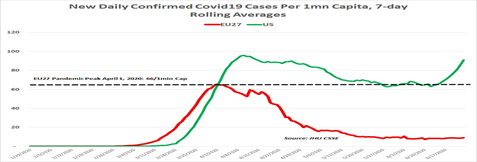
Conquering the pandemic really means depending on the cooperation across borders of races and ethnicities that separate regions and countries. COVID-19 is winning the battle in those countries and states with the worst outbreaks that believe in isolation rather than cooperation; such as the red US states of Texas, Arizona, and Florida, or authoritarians that isolate their countries to maintain their power, such as Brazil and Russia.

Mother Nature’s latest Haymaker—COVID-19—will win in any encounter with the followers of an ideology choosing to ignore the safety measures in the name of self-reliance that protect them from COVID-19’s ravage (the US, for example, vs. European countries like Denmark and Norway that locked down their economies early and are recovering more quickly).

The best evidence that shows who wins the battle with this pandemic is to compare countries that believe in educating their populace in the scientific and economic advantages of cooperation during a pandemic—e.g., European countries with advanced social safety nets—with the Trump administration’s refusal to even acknowledge that this novel coronavirus is worse than the ordinary flu (see above graph).

“European countries have used a combination of lockdowns, public health guidance, tests and contact tracing to beat back the virus,” said NY Times’ David Leonhardt in a recent View column. “Large parts of Europe have begun reopening, including schools, so far without sparking major new outbreaks.”

It’s productive to look at the Nordic countries because Sweden is also an outlier in having chosen not to lock down its economy. Early results after three months of the pandemic show that Sweden didn’t benefit at all in economic growth by ignoring the safety measures, and suffered the consequences with its higher death rate, according to JF Kierkegaard of the Peterson Institute for International Economics.

Why? Sweden’s industries depended on supply chains for parts and equipment from other countries that were in lockdown to protect their own citizens. Whereas Norway’s GDP, for example, is predicted to shrink -3.9 percent this year, Sweden’s GDP could have a -4.5 percent drop, according to their central banks.

The novel coronavirus can only be defeated by the sharing of wealth and knowledge. COVID-19 exposes those that refuse to do so, because it means sharing their wealth.

Sharing also means caring, as economic activities will return where shoppers feel safe in our modern consumer-dependent economies. That does not bode well for American consumers in particular who worry about the uncertain healthcare coverage provided by their employers if they have job to return to.

It doesn’t bode well for business confidence as well if the safety guidelines recommended by the World Health Organization (WHO) aren’t followed by all countries.

Senator Elizabeth Warren said it best at the beginning of her political career: “There is nobody in this country who got rich on their own. Nobody. ..You built a factory and it turned into something terrific or a great idea – God bless! Keep a hunk of it. But part of the underlying social contract is you take a hunk of that and pay forward for the next kid who comes along.”

And there is no country that got rich on its own, a truth that is lost on those who won’t understand what Mother Nature is telling us.

Harlan Green © 2020

Follow Harlan Green on Twitter: https://twitter.com/HarlanGreen
Posted in Consumers, Economy, Politics, Uncategorized | Tagged , , , | Leave a comment

Why So Much Inequality?

Financial FAQs

ISM NonMfg bus act v comp

Wrightson/ICAP

Nobel Laureate and NYTimes columnist Paul Krugman has said it would probably take something on the scale of an alien invasion to create the emergency programs and policies that would benefit all Americans, such as another New Deal that brought US out of the Great Depression.

Well, it looks like we have an alien invasion with the new coronavirus pandemic infecting and killing so many. But can we unite to revive a new, New Deal spirit that government is the solution, and this alien coronavirus the problem?

We need such government programs and leadership similar to that which enabled us to survive the Great Depression and win WWII. That is the only way we can not only stop the spread of COVID-19, but revive the American economy. This means in part to establish policies that counter the massive transfer of wealth from workers to the owners of capital since the 1970s that now total $1Trillion annually, per an excellent NY Times article in the Sunday Review section.

Other countries are already enacting variations of New Deal policies that either pay companies directly to retain their workers, or support unemployed workers with a much more generous social safety net.

The U.S. must first find a way to bridge the yawning income gap that exists between the workers and the owners of capital. It is the fact that 40 percent of working Americans most affected by the COVID-19 pandemic have really no savings for such emergencies as the pandemic, in part because they earn less than a living wage in jobs like meat packing or warehousing, in retail or leisure and hospitality.

And more than 30 states are seeing a resurgence of COVID-19 infection rates that probably means a reversing of the re-openings since May of facilities that cater to large public gatherings, such as restaurants and bars.

What is a living wage? A living wage earner anyone that earns at least $15 per hour. Just do the math for a 40-hour work week, and there are only a few states that even have a $15 per hour minimum wage target. It comes to earnings of $2,580 per month, and $30,960 per year.

Nearly one-third of American households, 29 percent, live in “lower class” households, the Pew Research Center found in a 2018 report. The median income of that group was $25,624 in 2016. That means many of the 40 percent workers are, or were, middle class per PEW’s classification.

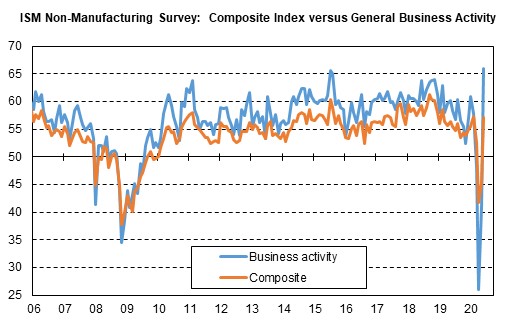
Some good news is that the Institute for Supply Management (ISM) reported its non-manufacturing index surged to it largest single-month percentage-point increase in the NMI® since its debut in 1997 (see the above graph). It’s telling us the service sector of the economy is growing again, but from a lower starting point.

“The NMI® registered 57.1 percent, 11.7 percentage points higher than the May reading of 45.4 percent,” said the report. This reading represents growth in the non-manufacturing sector after a two-month period of contraction preceded by 122 straight months of expansion.”

It is a sign the consumer sector is coming back to life that makes up two-thirds of economic activity, but how many consumers can take advantage of its services with some 15 million still out of work?

A University of Chicago-Beckman Institute survey also per the NY Times article found that 68 percent of the unemployed have unemployment insurance incomes with the $600 per month addition in the CARES Act (regardless of their previous income) that surpassed the take-home pay of their last job.

But those benefits expire by the end of July, and many of the 40 percent in the Leisure and Hospitality industries won’t be rehired until tourism and travel revive as well. That could take a long time with the novel coronavirus spreading again and regions such as the EU banning travel from countries with high infection rates, such as the U.S.

The bottom line is that at least 40 percent of working Americans will suffer even more from effects of the Coronavirus pandemic, unless government steps in to supplement their incomes in some way.

One big help is the suggestion by Baharat Ramamurti and Lindsay Owens of the Roosevelt Institute in another recent NY Times Op-ed that unemployment benefits be extended not only until they are able to find work again, but work that pays at least as much as their unemployment insurance.

And there is tremendous uncertainty among economists on when the current pandemic-caused recession will end. So it will take more than one-time programs such as the HEROES and CARES Acts to bring us back to sustainable economic growth for all Americans.

Let’s start by raising the national minimum wage above the current $7.25 per hour, last raised in 2009, and finally achieving universal health care for all Americans that almost all other countries in the world—developed and underdeveloped—already have.

This smacks of a new, New Deal, of course—a federal government that is required to serve all the people, which neo-conservatives and their special interests from the end of the Great Depression have lobbied against.

But that was 80 years ago, and now we have COVID-19 wreaking havoc on the economy as well as the physical health of too many Americans. Maybe this is the alien invasion that may finally unite us.

Harlan Green © 2020

Follow Harlan Green on Twitter: https://twitter.com/HarlanGreen
Posted in Consumers, Economy, Keynesian economics, Politics, Weekly Financial News | Tagged , , | Leave a comment

Hendrika’s Best Review Ever!

When a Toy Dog Became a Wolf and the Moon Broke Curfew: A Memoir
by Hendrika de Vries
She Writes Press

Book review by Mark Heisey

“Being the old, dark child of the past, I was the one bound to my mother through the secret memories that everyone wanted to leave behind and forget.”

De Vries’s memoir tells of her time as a child in Amsterdam during the Nazi occupation. Her father, the traditional provider and protector, is taken to a German POW camp, and the young de Vries and her mother are suddenly left alone in an occupied city with no one to depend on but themselves. As the war goes on and the occupation lengthens, food and safety become scarce. De Vries’ mother begins to take bold steps to ensure the safety and welfare of her child. Even as suspicions run high, and neighbors report neighbors, de Vries’ mother begins associating with the resistance. She even shelters a young Jewish girl in their home, fully aware of the danger that brings to herself and her own daughter.

At just over two hundred pages, this book is a quick read with clean, clear sentences. Although much of the narrative is based on the recollections of a young girl and the stories she has been told, the memoir feels genuine with honest, flawed characters who show courage and toughness in the face of terrible circumstances. The addition of family photos and documents helps establish the historical accuracy and allows the reader to get a better sense of the men, women, and children involved. Fascinating in itself is the author’s recollection of life after the occupation is lifted, and the war is over. The exploration of the range of psychological impacts on the survivors and the difficulty of living in a post-war country without enough jobs or housing sheds light on the internal wars that can plague the survivors for years.

World War II is a subject much discussed in a variety of genres. In regard to personal narratives, Elie Wiesel’s Night and The Diary of A Young Girl by Anne Frank are classic examples. De Vries’ memoir is a welcome addition to this group. What stands out in this work is the strength of these women, the sacrifices they made, and the risks they took to protect what they held dear. The terrors of concentration camps are well-known, but less well-known is the plight of those left behind in Nazi-occupied cities. The author’s book brings Kristin Hannah’s The Nightingale to mind. Although Hannah’s book is fiction, both works bring to light the hardships faced by the women left behind and the courage these women showed to protect not only their loved ones but also their neighbors and friends and the countries in which they lived. Their sacrifices were no less significant nor less heroic than those facing the enemy on the front lines.

It often seems the domestic battles, possibly due to the psychological impact, are the last to be told after wartime. De Vries’s memoir sheds new light on this aspect of World War II and is a compelling read on its own. Ultimately, this memoir inspires and embodies the words de Vries’ mother told her: “‘ We are facing cold, dark days, but I want you never to forget this feeling of warmth and light, and I want you to know that no matter what happens, all this light and warmth will return.'”

A 2020 Eric Hoffer Book Award Grand Prize Short List winner

RECOMMENDED by the US Review

Follow Harlan Green on Twitter: https://twitter.com/HarlanGreen

Posted in Uncategorized | Leave a comment

Why the Uneven Recovery?

Financial FAQs

image

Wrightson.com

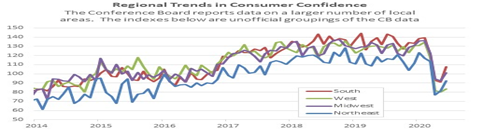
Consumer confidence is returning from its recent lows over the past two months with it main index up 12.1 points for a 3-month high in May as the lockdowns ease in some states, said the Conference Board today. The above graph shows the differences in the four U.S. regions, with the South having the highest and Northeast the lowest confidence levels.

We are not sure if overall confidence will continue to rise and consumers consume again, however, because Dr. Fauci remarked Tuesday in congressional testimony that we could have as many as 100,000 infections per day in coming months from the 45,000 per day reported yesterday and today, as COVID-19 infection rates resurge with the openings that aren’t following CDC and NIH guidelines—that is, ignoring the mask wearing and social isolation requirements that would slow the spread of the pandemic.

This hasn’t stopped consumer confidence from rising to date as workers return to work and retail shops and businesses open again, says the Conference Board:

“Consumer Confidence partially rebounded in June but remains well below pre-pandemic levels,” said Lynn Franco, Senior Director of Economic Indicators at The Conference Board. “The re-opening of the economy and relative improvement in unemployment claims helped improve consumers’ assessment of current conditions, but the Present Situation Index suggests that economic conditions remain weak.

“Looking ahead, consumers are less pessimistic about the short-term outlook, but do not foresee a significant pickup in economic activity. Faced with an uncertain and uneven path to recovery, and a potential COVID-19 resurgence, it’s too soon to say that consumers have turned the corner and are ready to begin spending at pre-pandemic levels,” said Franco.

Another sign of the uneven recovery is the 44 percent surge in pending home sales, which means the top 10-20 percent of income-earners that can afford to own a home aren’t doing so badly. The Pending Home Sales Index (PHSI), www.nar.realtor/pending-home-sales, a forward-looking indicator of home sales based on contract signings, rose 44.3 percent to 99.6 in May, chronicling the highest month-over-month gain in the index since NAR started this series in January 2001, though year-over-year contract signings are still down 5.1 percent.

Construction spending is also surging to meet the demand for more housing. During the first five months of this year, construction spending amounted to $543.2 billion, 5.7 percent (±1.2 percent) above the $513.7 billion for the same period in 2019.

“This has been a spectacular recovery for contract signings, and goes to show the resiliency of American consumers and their evergreen desire for homeownership,” said Lawrence Yun, NAR’s chief economist. “This bounce back also speaks to how the housing sector could lead the way for a broader economic recovery.”

image

FRED4-weekavg.continuedclaims

Really? We have a long way to go, if that’s the case. Thursday’s unemployment report will probably show more improvement in the job formation picture from last month’s surprise 2.5 million increase, but that leaves us with some 20 million still unemployed and receiving continuing unemployment benefits; 30 million when state continuing claims are included.

NAR now expects existing-home sales to reach 4.93 million units in 2020 and new home sales to hit 690,000. “All figures light up in 2021 with positive GDP, employment, housing starts and home sales.” Yun noted that in 2021, sales are forecast to rise to 5.35 million units for existing homes and 800,000 for new homes, which means back to a normal sales rate.

Yet it’s becoming more obvious to me this could turn into a real depression lasting more than two quarters even though Automatic Data Processing Inc., a private payroll surveyor said today private-sector employers added 2.37 million jobs in June. Small employers added 937,000 jobs in June. Midsize companies added 559,000 jobs. And large businesses added 873,000. The services sector experienced a large gain in June, adding 1.9 million jobs.

Will the ‘official’ Labor Department employment report be enough to reassure consumers? Economists are predicting from 4 to 8 million workers will be called back to work. (It was actually 4.8 million jobs). But that survey was done before the latest coronavirus surge and rollbacks of openings in 13 states.

Harlan Green © 2020

Follow Harlan Green on Twitter: https://twitter.com/HarlanGreen

Posted in Consumers, Economy, Housing, housing market, Weekly Financial News | Tagged , , , | Leave a comment

Job Losses Still Too High

Popular Economics Weekly

image

St.LouisFRED

The U.S. economy is recovering very slowly, in part because the number filing for first-time unemployment benefits is still too high (see above graph). Why? Businesses are still shedding workers because the COVID-19 pandemic is not under control in the U.S. Total infections are now surpassing April highs, which means some states will have to slow down their re-openings as well as the rehiring of workers.

CDC and NIH experts Drs. Redfield and Fauci testified Tuesday to congress that COVID-19 is surging rather than fading, as President Trump has asserted in recent speeches. In fact, Dr. Fauci said they won’t even have reliable diagnostic tests that will tell them how patients are infected until this fall.

Dr. Fauci said the U.S. is “still in the middle of the first wave” and the imperative is to “get this outbreak under control over the next couple of months,” in his testimony.

It is also affecting world-wide growth. Economist Mohamed El-Erian writes in Project-Syndicate: “

The world’s leading international economic institutions – the International Monetary Fund, the OECD, and the World Bank – now warn that it may take at least two years for the global economy to regain what has been lost to COVID-19. If the major economies face additional waves of infections, recovery would take even longer.”

According to World Bank forecasts, the global economy will shrink by 5.2 percent this year. That would represent the deepest recession since the Second World War, with the largest fraction of economies experiencing declines in per capita output since 1870, the World Bank says in its June 2020 Global Economic Prospects.

This in fact mirrors what happened after the world’s last worst pandemic—the 1918-20 Spanish flu outbreak from which the U.S. economy didn’t recover until 1922.

And growth in the developed countries will be worse where the pandemic has been the most severe and where there is heavy reliance on global trade, tourism, commodity exports, and external financing, says the World Bank.

Guess which country has the worst death toll and infection rates? It is the U.S., which means U.S. GDP growth in predicted to shrink by 5-6 percent this year say all three of the international economic institutions El-Erian highlighted.

In the week ending June 20, the advance figure for seasonally adjusted initial jobless claims was 1,480,000, a decrease of 60,000 from the previous week’s revised level. The Labor Department said the advance seasonally adjusted insured unemployment rate was 13.4 percent for the week ending June 13, a decrease of 0.5 percentage point from the previous week’s revised rate. The advance number for seasonally adjusted insured unemployment during the week ending June 13 was 19,522,000, a decrease of 767,000 from the previous week’s revised level.

And WHO also warned of a new and dangerous phase of the pandemic. Eighty-one nations have seen a growth in new cases over the past two weeks. Only 36 have seen declines.

“Many people are understandably fed up with being at home,” Dr. Tedros Adhanom Ghebreyesus, director general of the WHO, said in a news conference in which he described the new phase of the virus. “Countries are understandably eager to open up their societies and their economies. But the virus is still spreading fast. It is still deadly and most people are still susceptible.”

We said last week that many employers, the including auto and airline sectors, had been hiring back their employees over the past month, hence a surprise jump in employment with the 2.5 million jobs increase in May.

Now both consumer sentiment and retail sales are beginning to recover, but only in those states and counties that listen to the experts, which means this recovery will be uneven at best.

Harlan Green © 2020

Follow Harlan Green on Twitter: https://twitter.com/HarlanGreen
Posted in Economy, Macro Economics, Politics, Weekly Financial News | Tagged , , , , , , | Leave a comment

Have Home Sales Reached Bottom?

The Mortgage Corner

image

Reuters/ICAP

Why is it important to report on the housing market? Because there is a housing shortage  already (Forbes says up to 3.8 million unit shortfall to date), and the NYTimes, among others, is predicting a record wave of bankruptcies of large and small companies that could put even more than the 20 million unemployed already out of work.

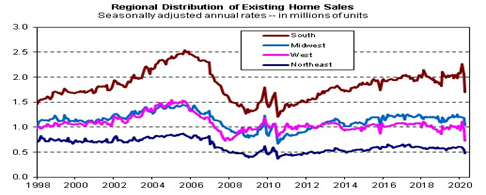
Existing-home sales fell in May, marking a three-month decline in sales as a result of the coronavirus outbreak, according to the National Association of Realtors. Each of the four major regions witnessed dips in month-over-month and year-over-year sales, with the Northeast experiencing the greatest month-over-month drop.

Total existing-home sales, https://www.nar.realtor/existing-home-sales, completed transactions that include single-family homes, townhomes, condominiums and co-ops, slumped 9.7 percent from April to a seasonally-adjusted annual rate of 3.91 million in May, according to the NAR. Overall, sales fell year-over-year, down 26.6 percent from a year ago (5.33 million in May 2019), which shows how deep is this recession.

And the pandemic is reaching “forest fire” proportions according to some experts with no end in sight, so it’s important to ask if existing-home sales have bottomed out their decline in sales in May.

image

NYTimes.com

Other indicators, including pending-home future sales, already down 22 percent in April, will be the first indicator that tells us whether sales will drop further and inventories increase from their current lows. It largely depends on how many workers are able to return to work, as I’ve said earlier.

The latest pending-home sales numbers reveal the greatest decline since NAR begin tracking such transactions in January 2001. However, chief economist LawrenceYun expects that April will be the lowest point for pending contracts. We will know next Monday, June 29, when May pending-home sales are released.

“Sales completed in May reflect contract signings in March and April – during the strictest times of the pandemic lockdown and hence the cyclical low point,” said Yun. “Home sales will surely rise in the upcoming months with the economy reopening, and could even surpass one-year-ago figures in the second half of the year.”

Yun is surprisingly sunny about the rest of this year. “Given the surprising resiliency of the housing market in the midst of the pandemic, the outlook for the remainder of the year has been upgraded for both home sales and prices, with home sales to decline by only 11 percent in 2020 with the median home price projected to increase by 4 percent,” Yun said. “In the prior forecast, sales were expected to fall by 15 percent and there was no increase in home price.”

I am not so optimistic after seeing the many ups and downs of housing in recent years. We are really in another Great Recession, at least, and the NY Times says more than 6,800 companies filed for Chapter 11 bankruptcy protection last year.  This year will almost certainly have more, according to NY Times reporter Mary Williams Walsh. The flood of petitions from the worst economic downturn since the Great Depression could swamp the system, making it harder to save the companies that can be rescued, bankruptcy experts said per Walsh.

But rather than be the total pessimist, I can hope that we contain this ‘forest fire’ sooner rather than later, as well as the bankruptcy problem by continued government support that boosts spending in such as infrastructure, spending that has been too long postponed.

It might even now have the attention of congress, as the NY Times graph above doesn’t lie.

Harlan Green © 2020

Follow Harlan Green on Twitter: https://twitter.com/HarlanGreen

Posted in Consumers, housing market | Tagged , , , | Leave a comment

Economic Recovery Picks Up Steam

Popular Economics Weekly

image

FREDUMich

The head of steam analogy seems to be working for our economic recovery, as consumers let off steam after two months of staying at home with a burst of shopping activity from the re-openings.

We said last week that many employers, the including auto and airline sectors, had been hiring back their employees over the past month, hence a surprise jump in employment with the 2.5 million jobs increase in May. Now both consumer sentiment and retail sales are beginning to recover.

Consumer sentiment posted its second monthly gain in early June,” said U. of Michigan survey chief economist Richard Curtin last Friday, “paced by gains in the outlook for personal finances and more favorable prospects for the national economy due to the reopening of the economy. The turnaround is largely due to renewed gains in employment, with more consumers expecting declines in the jobless rate than at any other time in the long history of the Michigan surveys.”

image

FRED/MarketWatch

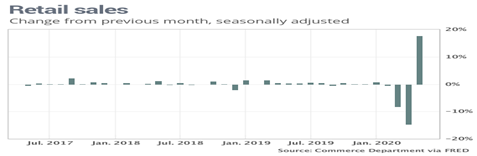
And retail sales jumped 17.7 percent last month, the government said Tuesday, after two months of record declines. Sales had tumbled by a record 14.7 percent in April and 8.2 percent in March. The rebound in sales also reflects the loosening of restrictions on business activity after two months of stay-at-home orders to combat the coronavirus pandemic.

The burst of activity comes from pent-up consumer demand, as we said; i.e., not being able to shop for at least two months. Federal tax payments to families and more generous unemployment benefits also helped stoke higher sales.

Yet even after the rebound in May, sales were still 6 percent lower compared to the same month in 2019, showing the lingering damage caused by the lockdown of the economy. This tells me we will have a U-shaped economic recovery where GDP contraction will bottom in Q2 and GDP begin a gradual rise in Q3, rather than a quick return to normal growth (the V-shaped recovery).

This is because “Few consumers anticipate the reestablishment of favorable economic conditions anytime soon. Bad times financially in the economy as a whole during the year ahead were still expected by two-thirds of all consumers, and a renewed downturn was anticipated by nearly half over the longer term,” said U. Michigan chief economist Curtin.

Sales increased across the board with autos up 44 percent, clothing sales up 188 percent, 90 percent at home-furnishing stores and 88 percent at stores that sell books, music, sporting goods and other hobby items. Receipts also increased 29 percent at bars and restaurants that bore the brunt of the coronavirus lockdowns in March and April, says MarketWatch.

A gradual return to what will be called the ‘new normal’, particularly for consumers that power most economic growth, is really due to the lack of any national coordination of the pandemic response.

The perennially poor and science-denying red states currently have the highest infection rates with the exception of Oregon in second place and purple Florida ranked fourth, according to today’s NPR COVID-19 dashboard.

States that listen to the scientists will recover first and return sooner to a more normal growth, whereas the states and local governments that choose not to listen to experts in their haste to perhaps salvage the November election will continue to suffer from higher rates of infections and social-isolation.

Harlan Green © 2020

Follow Harlan Green on Twitter: https://twitter.com/HarlanGreen

Posted in Consumers, Economy, Politics, Weekly Financial News | Tagged , , , , | Leave a comment

The Recession Has Arrived, No Big Surprise!

Financial FAQs

The Dow plunged 1,862 points on Thursday, as the Business Cycle Dating Committee of the National Bureau of Economic Research, which maintains a chronology of the peaks and troughs in economic activity in the United States, had just determined that a peak in monthly US economic activity occurred in February 2020.

The NBER press release said, “…The peak marks the end of the expansion that began in June 2009 and the beginning of a recession. The expansion lasted 128 months, the longest in the history of U.S. business cycles dating back to 1854. The previous record was held by the business expansion that lasted for 120 months from March 1991 to March 2001.”

And Fed Chairman Jerome Powell gave some further bad news. The Federal Reserve on Wednesday slashed its estimate for U.S. gross domestic product this year to -6.5 percent, yes minus 6.5 percent, when many economists were predicting a return to growth by the end of the year. It also raised its median forecast for 2020 unemployment to 9.3 percent.

Powell and the Fed Governors are saying we could have several years of very slow growth. This is exactly what happened from the 1918-20 Spanish flu pandemic, the only real historical comparison. That recession lasted from 1920-22 before growth resumed and became what is known as the “Roaring Twenties”, as I’ve said.

image

Reuters

However, initial claims for unemployment was better news as it is continuing to decline per the above graph. It fell to 355K to 1.542 million in the week of June 6 in seasonally adjusted terms, another sign that the work shutdown is ending, which could shorten the recession. 

Reuters ICAP news says “Our guess is that employment will rise again on a net basis in June as more workers are called back from temporary layoffs, but at the same time there continues to be a heavy flow of new job losses as the corporate sector re-evaluates the post-pandemic outlook.” 

image

Reuters

And lastly, we have the just released JOLTS report, the Job Openings and Labor Turnover Survey, (above graph) that counts the number of hires and layoffs each month confirming that hiring tumbled 1.6 million to a record low 3.5 million in April. Job openings declined 965,000 to 5.0 million on the last business day of April, the lowest since December 2014 when six to seven million job openings had been the norm for the past several years.

How do we make sense of all this news? Firstly, ignore the stock market as worthy of any prediction of future prosperity. It’s attempting to parse discounted earnings at least six months from now, but really more like one year. And who knows what earnings will be in one year?

Also, even if a vaccine in developed by the end of this year or early next year, as Dr. Fauci keeps hoping, how will it be distributed to most of the earth’s now 8 billion in population? Because no one will be safe until we all are safe, if we want to resume normal economic activity, which has no borders.

So I am maintaining it will be at least two years before consumers or producers return to what would be normal activity, and what will be the ‘new normal’ everyone is talking about when people can safely gather again in large shopping mall or stadium crowds, for instance?

Harlan Green © 2020

Follow Harlan Green on Twitter: https://twitter.com/HarlanGreen
Posted in Consumers, Economy, Macro Economics, Weekly Financial News | Tagged , , , , , | Leave a comment

May Employment Rise is Big Surprise!

Financial FAQs

image

MarketWatch.com

What happened? American workers are suddenly going back on the job; at least 2.5 million of them, according to the Labor Department. That knocks down the number of unemployed to maybe 20 million, and surprised economists.

A private payroll survey (ADP) that precedes the government’s had said on Thursday their estimate of -2.8 million jobs lost had caused them to lower their guess for the official BLS number (on Friday) to the -4 million to -5 million range, versus an earlier forecast of -8 million. 

“These improvements in the labor market reflected a limited resumption of economic activity that had been curtailed in March and April due to the coronavirus (COVID-19) pandemic and efforts to contain it,” said the Bureau of Labor Statistics (BLS). “In May, employment rose sharply in leisure and hospitality, construction, education and health services, and retail trade. By contrast, employment in government continued to decline sharply.”

In fact, American businesses have been going back to work for more than one month, especially in the airline, automobile, leisure and hospitality industries, per the BLS.

American Airlines said Thursday that it expects to fly in July about 55 percent of the domestic capacity that was flown during July 2019, as load factor improved 55 percent at the end of May from 15 percent for the month of April.

“We’re seeing a slow but steady rise in domestic demand,” said Vasu Raja, senior vice president of network strategy. “After a careful review of data, we’ve built a July schedule to match.”

Airline travel has picked up substantially, in other words. On Wednesday, the International Air Transport Association (IATA) said daily flights increased by 30 percent between April 21 and May 27. The IATA said the improvement in the data suggests “the industry has seen the bottom of the crisis, provided there is no recurrence.”

And tens of thousands of autoworkers started streaming back into car and truck plants across the South and Midwest in May, “a critical step toward bringing the nation’s largest manufacturing industry back to life,” according to the NYTimes.

Ford, General Motors, and Fiat Chrysler restarted, after Toyota, Honda and Tesla began reopening plants. Hyundai restarted a plant in Alabama on May 4, according to the NYTimes.

The manufacturing sector lost 1.32 million jobs in April, but gained 225,000 jobs back in May. The so-called underemployment rate that includes part timers and those who have stopped looking for a job recently fell to 21.2 percent from 22.8 percent in April. But it was just 7 percent in February, so the latest payroll numbers are nothing to crow about.

Cities such as Detroit have also announced that hundreds of its employees are returning to work. Detroit Mayor Mike Duggan revealed to Detroit Regional Chamber President and CEO Sandy K. Baruah that the city is preparing “to send hundreds back to work in areas like cutting grass, road work, and construction.”

The DOW Jones is up more than 900 at this writing, and S&P 500 up more than 90 points on the surprise news. It looks like many companies called back their workers at the earliest opportunity with either emails or texts after two months of layoffs, thus escaping the notice of statisticians.

Is this improvement just a blip, as COVID-19 infection rates continue to climb in most of the country? We have to assume this will continue as more of the economy opens this summer, and demonstrations against police brutality continue.

Any real improvements will also depend on how returning workers are treated at their job places. Will they follow CDC guidelines of workers safety with appropriate disinfection protocols, including the continued wearing of masks and social-distancing?

Today’s financial market euphoria smacks of an irrational exuberance based in the belief that further disruptions due to the pandemic and street protests will die down.

Harlan Green © 2020

Follow Harlan Green on Twitter: https://twitter.com/HarlanGreen

Posted in Consumers, Economy, Weekly Financial News | Tagged , , , | Leave a comment