What is This Election Really About?

Answering the Kennedys’ Call
image

#eisenhower

Now is the time to cure our record income and wealth inequality, since it’s not only adversely affecting the most vulnerable during this pandemic—including our mostly low-income essential health care and public safety workers—but overall economic growth, and hence any chance of a robust recovery from the current pandemic-induced recession.

According to the Center for Economic Policy and Research cited in an LA Times Op-ed, before the pandemic the U.S. counted 30 million workers in the categories we now consider essential: grocery clerks, nurses, cleaners, line cooks, warehouse workers, bus drivers and more. According to data from the Kaiser Family Foundation published in early May, 1 in 4 essential workers report having difficulties affording basic household expenses, and 1 in 7 are uninsured.

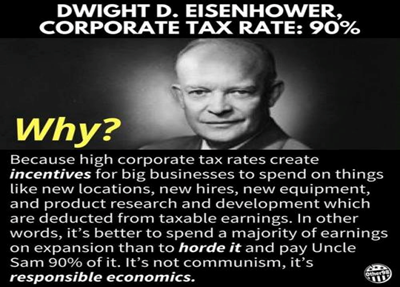
President Eisenhower’s admonition that corporations must pay their fair share to support economic growth is part of the solution to those problems.

I’ve written before about the growing income and wealth inequality that puts America’s distribution of family income ranking closer to Cameroon and Mozambique than the developed countries, according to the CIA World Factbook.

But the coronavirus pandemic has made returning to some degree of income equality that last prevailed in the 1970s more urgent than ever. Our record income and wealth inequality is a major reason for the growth in low-income workers.

U.S. economic growth has been anemic since the Great Recession—even with Republicans’ spectacular 2017 tax cut bill that mostly benefited Wall Street and corporations. The tax cuts were designed to benefit corporations, whose tax rate was cut to a rock bottom 21 percent from 36 percent, giving corporations a profit windfall.

So the upcoming presidential election is really about reversing the huge transfer of wealth (currently $1 trillion per year, per NY Times David Leonhardt) since 1980 when President Reagan’s so-called trickle-down economics program that advocated lower taxes and fewer government regulations took hold.

President Eisenhower’s simple explanation for the 90 percent maximum corporate tax rate that prevailed in the 1950s and 1960s was to encourage corporations to grow and develop “new locations, new hires, new equipment, new product research and development” that would grow the country, rather than “hoard it and pay Uncle Sam.”

But something happened in the 1970s to make taxes and big government unpopular, says Kurt Andersen in his new book, Evil Geniuses, The Unmaking of America (2020, Random House).

Higher marginal tax rates that squeezed growing middle class incomes was certainly part of it, but anti-government, anti-labor sentiments and policies enacted during the 1980s that lowered maximum tax rates put the finishing touches on any possibility of income equality for the 80 percent of salaried workers that no longer shared in the productivity gains from government-financed Research & Development (e.g., Internet, AI, space exploration).

Rutgers University economic historian James Livingston sounded the alarm in a well-known NY Times Op-ed: It’s Consumer Spending, Stupid, some years ago when he showed that corporations for the most part have been using their profits to speculate rather than invest in their future. With lower tax rates they no longer had the incentive to invest in the public good (and America’s future), in other words.

“Between 1900 and 2000, real gross domestic product per capita (the output of goods and services per person) grew more than 600 percent,” said Professor Livingston. “Meanwhile, net business investment declined 70 percent as a share of G.D.P…Since the Reagan revolution, these superfluous profits have fed corporate mergers and takeovers, driven the dot-com craze, financed the “shadow banking” system of hedge funds and securitized investment vehicles, fueled monetary meltdowns in every hemisphere and inflated the housing bubble.”

In other words, this election is not only about choosing a government that can vanquish COVID-19 with effective health care policies, it’s about improving the lives of most Americans. We know there are many programs that would improve income inequality—beginning with a higher minimum wage, enhanced public spending on a better social safety net.

Raising corporate taxes back to historical levels is a start that would enable government to finance some of those necessary changes; or corporations could again heed President Eisenhower’s admonition and spend their monies where it will do the most public good.

Harlan Green © 2020

Follow Harlan Green on Twitter: https://twitter.com/HarlanGreen

Posted in Economy, Keynesian economics, Politics, Uncategorized | Tagged , , , | Leave a comment

Joblessness to Increase This Fall

Popular Economics Weekly

image

FREDinitialclaims

The initial claims for unemployment insurance curve has flattened, rather than continuing to decline as the US economy opens. Not a good sign for future job growth.  Why? The coronavirus infection rate hasn’t declined, in a word, and studies are showing that consumer fears of COVID-19 are hurting the economy more than government decrees to combat the virus.

There were a seasonally adjusted 1.06 million new claims this week, and initial claims have been hovering around the 1 million marker for 3 weeks. The question is when will it decline further, indicating more hiring. But new research posits that may not be happening soon.

The National Bureau of Research (NBER) just put out a Working Paper entitled “Consumers Fear of Virus Outweighs Lockdown…” showing that fear of the effects of COVID-19 outweigh the government restrictions on business operations in causing the “steep drop in business activity.”

This is while CDC director Robert Redfield recently warned in a WebMD interview that America is bracing for “the worst fall, from a public health perspective, we’ve ever had.”

He feared that when the second, or third surge, in the pandemic arrives (depending on who’s counting) with the fall flu season, unemployment might rise again, maybe to levels not seen in recent history. We are still at a 10.2 percent unemployment rate, and next Friday’s August unemployment report might not show any improvement in the rate but may even worsen.

image

COVIDtrackingproject

“By comparing counties with and without restrictions, the NBER researchers conclude that only 7 percentage points of the 60 percentage points overall decline in business activity be attributed to legal restrictions,” said their public summary of the report. “Most of the decline resulted from consumers voluntarily choosing to avoid stores and restaurants.”

And average daily deaths haven’t yet declined from more than 1,000 per day since July and the summer openings. So, any lifting of those restrictions will not have much effect until consumers feel safe enough that the COVID-19 pandemic is under control.

In fact, the researchers’ counter-intuitive conclusion is that lifting lockdowns could have the unintended effect of discouraging consumer spending (which drives 70 percent of economic activity these days), “if repealing lockdowns leads to a fast enough increase in COVID infections and death.”

Retail sales rose 1.2 percent in July, the government said. Economists polled by economists had forecast a 2 percent advance. Receipts have slowed from a 8.4 percent increase in June and a record 18.3 percent gain in May when the economic rebound began. In other words, consumers may be seeing the writing on the wall as we approach the cold season.

There are other more heartening signs that fall economic growth could surge. Real PCE spending rose by 1.6 percent in July.  The combination of the July gains and the upward revisions to May and June puts real spending in July 8 percent above the Q2 average, which guarantees a very large contribution to Q3 GDP from the consumption component. 

The consensus is that GDP growth should spring back some 26 percent from its 32 percent drop in Q2. That could mean an end to the current recession that officially began in February, but no assurance there wouldn’t be a repeat unless consumers feel safer than they do today.

What’s the alternative if consumers still live in fear that COVID-19 hasn’t been controlled, and a safe and effective vaccine isn’t developed for, say, another year that can protect 300 million plus Americans ?

Is anyone listening?

Harlan Green © 2020

Follow Harlan Green on Twitter: https://twitter.com/HarlanGreen

Posted in Consumers, Economy, Politics, Weekly Financial News | Tagged , , , | Leave a comment

Should The Fed Boost Inflation?

Financial FAQs

image

FRED10yrInflation

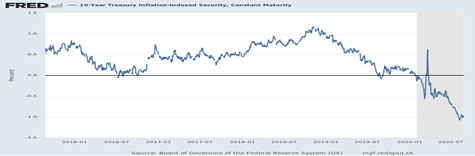
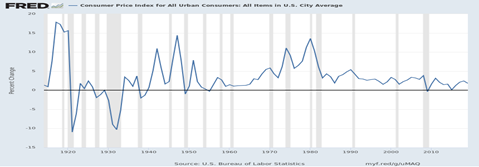
The Federal Reserve is so desperate to support growth in this pandemic that it wants to allow inflation to rise above its 2 percent target range. Why? Inflation and rising prices are usually a sign of economic growth. Inflation is currently running at less than 2 percent (1.81 percent annually).

Money is cheap because interest rates are close to zero, yes zero percent. The current 10-year benchmark Treasury yield is actually minus –1.0 percent after inflation, meaning the U.S. Treasury is paying investors to hold them at present, per the above FRED graph. That’s because money isn’t being used in productive enterprises at the moment, such as building infrastructure, or boosting education spending, or environmental protection, or put in the pockets of lower-income folk that spend most or all of it.

Actually all of those enterprises would pay it forward for the benefit of future generations, but that isn’t happening in the private sector, which is why we will need government to do the investing that private commerce will not.

Corporations and the wealthiest of us aren’t investing much in the future because the present is so uncertain. The dangers of another shutdown due to COVID-19 are very real, given that the U.S. is behind every other developed country and many developing countries in conquering this pandemic. We have the highest number of COVID deaths with Brazil, Mexico, and India next in line.

image

FREDcpiInflation

So Fed Chairman Powell’s announcement that the Fed will ease credit conditions even further is an attempt to pry some of the money loose from the savers with the hope it will be actually be spent on more goods and services.

That is a good thing in itself, but no guarantee that it will boost inflation or economic activity unless there are well-planned public programs to spend it. There is plenty of excess capacity in our COVID-19 economy, so production could be boosted quickly and in turn boost supplies, which keeps prices and inflation from rising too fast.

This is a truism lost on some economists even. Printing lots of money doesn’t necessarily produce higher prices and inflation, unless there is sufficient demand and/or there are production bottlenecks, hence a supply scarcity.

The only real guarantee that we will invest in the future, in what is essentially the public sector that belongs to all of US, is when government is the good caretaker of those public resources—the air, water, natural resources, public education and health services.

It isn’t socialism, but a more robust capitalist system, a public/private partnership that can benefit all Americans.

Harlan Green © 2020

Follow Harlan Green on Twitter: https://twitter.com/HarlanGreen
Posted in Consumers, Economy, Keynesian economics, Politics, Weekly Financial News | Tagged , , | Leave a comment

Why Housing Boom – Part II

The Mortgage Corner

image

Calculated Risk

Total existing-home sales, https://www.nar.realtor/existing-home-sales, completed transactions that include single-family homes, townhomes, condominiums and co-ops, jumped 24.7 percent from June to a seasonally-adjusted annual rate of 5.86 million in July. The previous record monthly increase in sales was 20.7 percent in June of this year. Sales as a whole rose year-over-year, up 8.7 percent from a year ago (5.39 million in July 2019).

And residential construction is almost up to the February high that had been nursed by the Fed’s push for record low interest rates that have boosted purchase and refinance mortgage applications to record volumes as well.

Why the housing boom in the middle of a worldwide pandemic that is killing millions?

Interest rates are at record lows, for one thing. And the recession is probably over for a certain segment of our populace. The numbers also show there is also a tremendous pent up demand from the missing spring months due to the pandemic shutdown that normally boost housing sales.

The conforming 30-year fixed rate is now below 3.0 percent for a one point origination fee, and jumbo conforming is just 1/8th percent higher! In fact, the best lenders are offering 2.75 percent at zero points for the 30-year conforming fixed rate.

“The housing market is well past the recovery phase and is now booming with higher home sales compared to the pre-pandemic days,” said Lawrence Yun, NAR’s chief economist. “With the sizable shift in remote work, current homeowners are looking for larger homes and this will lead to a secondary level of demand even into 2021.”

Reuters news reports housing starts jumped 23 percent last month versus their forecast of a 3 percent gain, with single-family starts up 8 percent from an upward-revised June level and the more volatile multi-family sector spiking 58 percent. (This had to be because of rising rents due to the housing shortage,)

However, overall starts remain 4.5 percent below their February level, with single-family starts down 9 percent since then and multi-family starts up 4 percent.  Single-family permits are up 17 percent and multi-family permits up 22 percent, a very strong sign of future construction activity.  It brought the level of single-family permits to within 1 percent of the February total, while multi-family permits, which bounce around a lot, are up sharply from February.

Construction will have to pick up even more with housing inventories a record lows. Total housing inventory3 at the end of July totaled 1.50 million units, down from both 2.6 percent in June and 21.1 percent from one year ago (1.90 million). Unsold inventory sits at a 3.1-month supply at the current sales pace, down from 3.9 months in June and down from the 4.2-month figure recorded in July 2019; which is way below the more normal 5-6 month supply.

“Housing has clearly been a bright spot during the pandemic and the sharp rebound in builder confidence over the summer has led NAHB to upgrade its forecast for single-family starts, which are now projected to show only a slight decline for 2020,” said NAHB Chief Economist Robert Dietz. “Single-family construction is benefiting from low interest rates and a noticeable suburban shift in housing demand to suburbs, exurbs and rural markets as renters and buyers seek out more affordable, lower density markets.”

The median existing-home price for all housing types in July was $304,100, up 8.5 percent from July 2019 ($280,400), as prices rose in every region. July’s national price increase marks 101 straight months of year-over-year gains. For the first time ever, national median home prices breached the $300,000 level.

This verifies what we are seeing in the financial markets. The recession seems to be over for the top 10 percent of income earners. Many of them have gone back to work, or have white collar jobs and work from home, or don’t have to work because they are so-called ‘rentiers’ that live off their soaring asset values, as seen in the record rise in the S&P 500 index.

What happens next with the inevitable surge in COVID-19 cases this fall, school openings and the ordinary flu season, as I’ve said? Probably not much to the DOW and bonds, or even housing, when all this is over.

However, the rest of the economy not driven by the top 10 percent of income owners, such as actual consumer spending on staples and durable goods, is another story. Nor will corporations see the need to ‘pay it forward’ for future generations, unless we find a better way to create living wages for the other 90 percent of adult-age workers still unemployed.

Harlan Green © 2020

Follow Harlan Green on Twitter: https://twitter.com/HarlanGreen
Posted in Consumers, Housing, housing market, Weekly Financial News | Tagged , , , , | Leave a comment

What’s Next…?

Financial FAQs

image

MarketWatch

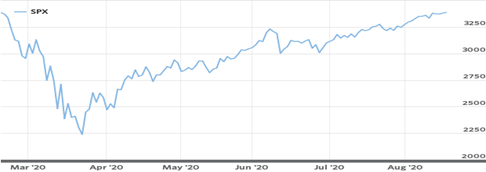
U.S. stocks finished mostly higher Tuesday, with the S&P 500 index notching its first record close since Feb. 19, and marking the quickest recovery from bear-market territory in its history, according to Dow Jones Market Data. 

So what happens next with the inevitable surge in COVID-19 cases this fall, school openings and the ordinary flu season? Probably not much to the DOW and stocks, believe it or not. The rest of the economy not owned by the top 10 percent of income owners is another story, however.

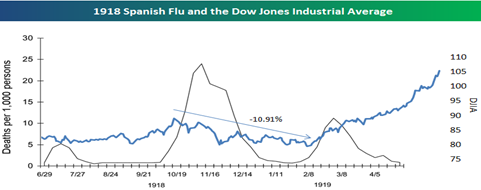
The best predictor of what may happen are other pandemics, such as the 1918 Spanish flu pandemic. But there were other 100,000 plus US deaths in the HINI and Bird flu epidemics of 1958 and 1968 as well.

During the 1918 influenza pandemic as with COVID-19, wealthier people had a better chance of survival: Individuals of moderate and higher economic status had a mortality rate of 0.38 percent, versus 0.52 percent for those of lower economic status and 1 percent for those who were “very poor,” economists Brian Beach, Karen Clay and Martin Saavedra wrote in the paper published this week.

“Compared to individuals who lived in one-room apartments, individuals who lived in two-room, three-room, and four-room apartments had 34 percent, 41 percent, and 56 percent lower mortality, respectively,” they added. In 2020, multigenerational households have also faced similar challenges, especially those with elderly inhabitants and younger people who show no symptoms of the virus, experts say.

This will probably be the case today, especially if congress doesn’t’ provide further adequate aid to states as well as extending unemployment insurance.

The financial markets were affected by death rate surges, in particular, but recovered quickly, as the combined Spanish flu-DOW Jones graph shows. The DOW fell slightly during each of the three spikes in death rates. It finally began its rise to new heights in the spring of 1919 only after the third spike, but the recession for most Americans didn’t formally end until 1922, according to the National Bureau of Economic Research (NBER).

image

seekingalpha.com

We can draw from this that ordinary consumers held back from spending until the virus had vanished. Americans were recovering from World War I and all the wartime controls, just as they did after World War II. But there was no New Deal in 1919 to help boost ordinary spending, no union regulations to aid organizing, no government-insured mortgage giants like Fannie Mae, FHA and the VA-guaranteed home loans to boost housing, so household spending didn’t pick up until 1922.

We can therefore conclude that we will not see any substantial pickup on GDP growth until next year, at the earliest. Consumers spending has an even larger effect on actual economic growth (70 percent) today than it did post-World War I, but the financial markets, which are still controlled by financially flush banks and major corporations will keep boosting stock and bond prices, as long as money is cheap.

The Fed learned this lesson in December of 2018, when it began to raise short term interest rates and the financial markets momentarily crashed. Ty then abruptly reversed course and began the current easing to bring interest rates in effect to zero, even becoming negative interest rates, when inflation is taken into account.

But this won’t help the majority of Americans, unfortunately, who don’t have the wherewithal to spend or borrow, unless more government financial aid is forthcoming that repeats the $3 trillion CARES Act, as the New Deal did to lift US out of the Great Depression.

Conversely the Fed will have to keep interest rates close to or below zero to keep the financial markets afloat.  Not a very healthy state of affairs with a $24 trillion national debt hanging over American heads.

Harlan Green © 2020

Follow Harlan Green on Twitter: https://twitter.com/HarlanGreen

Posted in Consumers, Economy, Politics, Weekly Financial News | Tagged , , , , , , | Leave a comment

Happy Consumers Are the Key…

Popular Economics Weekly

image

FREDretailsales

Are we heading for a fall in the Fall when the ordinary flu season begins? The chickens may be coming home to roost, as the saying goes, because the US economy opened to soon.

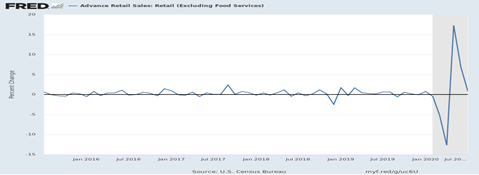
Retail sales rose 1.2 percent in July, the government said Friday. Economists polled by economists had forecast a 2 percent advance. Receipts have slowed from a 8.4 percent increase in June and a record 18.3 percent gain in May when the economic rebound began. Consumers may be seeing the writing on the wall.

And CDC director Robert Redfield just warned in a WebMD interview on Wednesday that America is bracing for “the worst fall, from a public health perspective, we’ve ever had.”

This is not because cooler weather somehow makes the coronavirus worse, or that the summer’s heat kills the virus, which has been a common misconception about the coronavirus causing the disease COVID-19. Rather, fall and winter become influenza’s time to shine.

We are stuck at the highest unemployment rate achieved during the Great Recession (10 percent) that ended in 2009 in July’s unemployment report. But it took until 2018 to return to anything resembling full employment (4 percent), another 8 years, as I said last week.

image

CDC

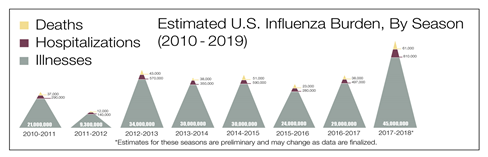
So will it take this long to return to full employment again? So far we have only restored about 9.3 million jobs, leaving more than half of the Americans who lost their jobs still unemployed, and the flu season is about to start that historically kills between 12,000 and 61,000 deaths a year.

“We’re going to have COVID in the fall, and we’re going to have flu in the fall. And either one of those by themselves can stress certain hospital systems,” Redfield said, noting that many hospitals have already been overwhelmed by the number of coronavirus patients. There have also been reports of hospitals in New York, Texas and Arizona calling in refrigerated trucks to serve as temporary morgues to handle the number of dead bodies during the pandemic. And the ordinary flu has seen between 140,000 and 810,000 people hospitalized each year since 2010.”

Retailers have been on a roller-coaster ride since the pandemic began, sinking in March and April and recovering rapidly in the following two months as the economy reopened. The more mild increase in sales in July (+1.2%) might be a sign of what lays ahead, however.

And consumer sentiment has stagnated; another sign that consumers are becoming more cautious as the flu season hits at the same time as schools normally open. The preliminary reading of the consumer sentiment survey in August edged up to 72.8 from 72.5 in July, but it’s still just barely above the pandemic low, the University of Michigan also said Friday.

And we know what can happened next, since children will bring those virus bugs home to parents and grandparents as schools re-open. Economists such as Nobelist Paul Krugman are becoming ever more worried that this could turn what has been a mild recession to date, into a Great Depression.

Harlan Green © 2020

Follow Harlan Green on Twitter: https://twitter.com/HarlanGreen
Posted in Consumers, Economy, Politics, Weekly Financial News | Tagged , , , , | Leave a comment

What Future Job Growth?

Financial FAQs

image

Calculated Risk

The Job Openings and Labor Turnover Survey (JOLTS) put out by the Labor Department (BLS) probably only makes sense to economists, because it gives a picture of the job market in coming months, as well as the present.

It literally measures the number of job openings (yellow line in graph) vs. hires (blue line) for a month; June in this case; enabling economist to measure whether the demand for new jobs is rising or falling. And though hires decreased slightly to 6.7 million from 7.2 million, it “was still the highest level in series history,” per the BLS.

Job openings rose 518,000 to 5.9 million in June, according to the Labor Department on Monday. That’s above the median forecast of 5.3 million jobs in an Econoday survey of economists. However, the number of jobs available was running around 7 million before the pandemic.

Job openings, another measure of demand, increased in June to 5.889 million from 5.371 million in May, so the number of hires was almost one million higher than vacancies (6.7 hires -5.9 vacancies), meaning there is large number of unfilled jobs to be filled.

So this statistic probably gives the best monthly picture of where the jobs market is headed. The number of job openings (yellow) is still down 18 percent year-over-year, and quits were down 25 percent year-over-year, says Calculated Risk.

Quits are voluntary separations. (see light blue columns at bottom of graph for trend for “quits”) that tells us whether employees are moving on to better paying jobs. More workers are therefore hanging on to their current jobs at the moment, due no doubt to the uncertainty of the pandemic outcome.

In the words of the BLS, “These changes in the labor market reflected a limited resumption of economic activity that had been curtailed in March and April due to the coronavirus (COVID-19) pandemic and efforts to contain it. This release includes estimates of the number and rate of job openings, hires, and separations for the total nonfarm sector, by industry, and by four geographic regions.”

The largest gains in openings came from accommodation and food service, other service and arts. The biggest declines were in construction and state and local government education, per Marketwatch.

Why are stocks and bonds continuing to rally in the face of the worst infection and death rates in developed countries,? It’s really the record low interest rates with the benchmark 10-year Treasury bond yield down to almost zero (0.58%) at times that are keeping stock and bond prices at record highs (and bond yields at comparable lows).

image

FRED

Watch interest rates, as it’s really the Fed’s doing, as it has pumped extra $trillions into the economy and held short term interest rates also close to zero. There is really too much unused money not being put into useful endeavors, because corporations are reluctant to invest in an uncertain future,and the federal government won’t do more than provide pandemic relief rather than investing in future growth—e.g., in public works projects like infrastructure, education, and the environment.

So there is no plan for post-pandemic growth right now, or maybe until November. Democrats are thinking of the future with the Biden campaign’s “Biden Plan for Leading the Democratic World,” while Republicans are still obsessed with trade wars and ignoring the Wuhan virus that is hurting us much more than China.

The bottom line is there are 13 million fewer jobs than before the pandemic, and still no national plan for combating the pandemic and therefore putting them back to work.

Harlan Green © 2020

Follow Harlan Green on Twitter: https://twitter.com/HarlanGreen
Posted in Economy, Macro Economics, Politics, Weekly Financial News | Tagged , , , , | Leave a comment

Employment Picture Still Unclear

Popular Economics Weekly

image

Marketwatch.com

The official unemployment rate fell for the third month in a row to 10.2 percent from 11.1 percent, the government said Friday. The hot pace of U.S. employment growth in the late spring gave way in July to a sharp slowdown in hiring as the economy added back just 1.76 million jobs, “underscoring the fragile nature of a recovery with the coronavirus still running rampant in many states,” said Marketwatch’s Jeff Bartash.

We have merely returned to the highest unemployment rate achieved during the Great Recession (10 percent) that ended in 2009. But it took until 2018 to return to anything resembling full employment (4 percent), another 8 years. Even then many millions were still either working part time that couldn’t find full time work, or had given up looking for work.

Will that happen again? So far we have only restored about 9.3 million, leaving more than half of the Americans who lost their jobs still unemployed.

The Bureau of Labor Statistics said today, “These improvements in the labor market reflected the continued resumption of economic activity that had been curtailed due to the coronavirus (COVID-19) pandemic and efforts to contain it. In July, notable job gains occurred in leisure and hospitality, government, retail trade, professional and business services, other services, and health care.”

What’s more, an even larger 31 million people were collecting unemployment benefits in mid-July based on the most recent numbers available. And the divided Congress still hasn’t agreed to extend a $600 federal unemployment bonus that expired at the end of July, we know at this writing, which is another potential roadblock for the recovery, .

It’s a decided mixed picture, in other words, with most sectors adding workers at this moment, except for Mining/Logging and the Information services.

Overall business activity has been picking up in both the manufacturing and service sectors, according to surveys by the Institute of Supply Managers (ISM) released earlier in the week. But said surveys are also deceptive, since they tell us whether there is an increase or decrease in activity, but not actual numbers.

The service sector supply managers’ index rose to 58.1 percent with any number above 50 signifying expansion; 67.2 percent said business activity had ramped up and 67.7 percent had new orders. They included Health Care & Social Assistance; Retail Trade; Transportation & Warehousing; Wholesale Trade; Educational Services; and Construction among the 15 businesses that make up the survey, just as do the jobs’ numbers in the unemployment report.

“This reading represents growth in the services sector for the second straight month after contraction in April and May, preceded by a 122-month period of expansion,” said the ISM non-manufacturing report.

Manufacturing also did well in the ISM manufacturing survey.

“The July PMI® registered 54.2 percent,” said the report, “up 1.6 percentage points from the June reading of 52.6 percent. This figure indicates expansion in the overall economy for the third month in a row after a contraction in April, which ended a period of 131 consecutive months of growth.”

 image

FRED

And lastly, new applications for unemployment benefits, a rough gauge of layoffs, fell by 249,000 in early August to 1.19 million, touching the lowest level since the coronavirus pandemic began more than four months ago.

It was a surprising decline that also suggests some improvement in the labor market despite another surge in coronavirus cases in many U.S. states, as we said.

So it’s probably safe to say that congress has to get its act together and provide more recovery assistance if we want actual positive economic growth in the fall. The Fed’s easy money policy that has driven short-term interest rate to essentially zero can’t prevent an even deeper recession that began in February without more congressional aid.

That was the lesson we learned in the Great Recession. A divided congress that won’t act creates a divided country.

Harlan Green © 2020

Follow Harlan Green on Twitter: https://twitter.com/HarlanGreen
Posted in Consumers, Economy, Politics, Weekly Financial News | Tagged , , , | Leave a comment

Alas, The Recovery That Was…

Financial FAQs

image

Reuters.com

Because the deadline has passed to renew unemployment benefits enacted by the CARES Act, it looks like there will be no quick economic recovery in the fall. I am supposing the recovery could ultimately be shaped like a ‘W’—sporadic spurts of growth and declines in growth with new COVID-19 surges, given there is no coordinated national response to the pandemic.

And what about school openings when 60 percent of the major elementary school districts will have at-home schoolings this school year, according to a CNN survey, and no national guidance on what constitutes safe re-openings?

This has to be why Republicans are pushing for the full re-opening of schools, regardless of the dangers to children. It keeps at least one parent at home who isn’t working when they want to speed up the reopening of businesses.

The huge jump in consumer spending in May and June highlights what could have been if benefits had been renewed with the additional $600 per week boost to unemployment compensation, and which Republicans don’t want to renew.

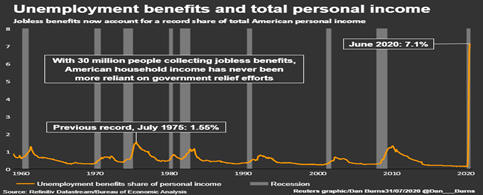
The above Reuters graph highlights the record 7.1 percent boost given by the additional benefits since the CARES Act was implemented.

Consumer spending, which accounts for more than two-thirds of U.S. economic activity, rose 5.6 percent last month after a record 8.5 percent jump in May as more businesses reopened, the Commerce Department said. But most of the spending was due to the $600 boost to low-income service workers that tend to spend more of their incomes.

Consumers boosted purchases durable goods such as auto and appliances that last more than three years, as well as clothing and footwear. They also spent more on healthcare, dining out and on hotel and motel accommodation, though outlays on services remained lackluster because of caution sparked by the virus.

Q2 economic growth had plunged 32.9 percent because consumer spending fell minus -35 percent during this period. So growth will only recover when consumers feel safe enough venture out of their rabbit holes, I said last week. They will instead choose to save more—currently a huge 25 percent of their personal incomes vs. more normal 3-6 percent—and spend less.

image

FREDunemploymentrate

That is why Friday’s upcoming unemployment report is so important. Dallas Fed President Robert Kaplan on Monday said he now expected an unemployment rate in a range of 9 -10 percent at the end of the year. Ten percent was the highest unemployment rate during the Great Recession when some 8 million jobs were lost.

The June unemployment rate was 11.1 percent and estimates are for July to show a 10.5 percent rate, according to an average estimate of economists. It took more than eight years, from October 2009 at the end of the Great Recession until March 2018, for the unemployment rate to drop from 10 to 4 percent, which is considered full employment.

How long might this depression last with today’s political polarization?

Harlan Green © 2020

Follow Harlan Green on Twitter: https://twitter.com/HarlanGreen
Posted in Consumers, Economy, Politics, Weekly Financial News | Tagged , , , , | Leave a comment

When Will Growth Return?

Financial FAQs

image

FRED-MarketWatch

The headline decline in Q2 GDP growth only touches the surface of what economic growth to expect this fall and winter. The drop of minus -32.9 percent was inevitable with the pandemic lockdowns, but not the severity of any recovery.

Q2 plunged this much because consumer spending plunged -35 percent during this period. And since consumers power some 70 percent of economic activity—i.e., GDP growth—it will only recover when consumers feel safe enough venture out of their rabbit holes.

And when can that happen with new record COVID-19 death rates in California, Idaho, Florida, N. Carolina, Texas and Arizona? The infection and death rate curves are still rising, rather than even plateauing.

As NY Times columnist and pandemic authority Don McNeil, Jr. put it today, “One or several vaccines may be available by year’s end…But by then the virus may have in its grip virtually every village and city on the globe.”

And so consumers will not be happy, but begin to hunker down again, even without new stay-in-home mandates. It’s just too dangerous out there when there’s not even a national mandate to wear masks, much less keeping safe distances, or getting quick testing results, as I said yesterday.

That is why consumer confidence fell to 92.6 this month from a revised 98.3 in June, the Conference Board said Tuesday, which is a major indicator of future consumer behavior.

Initial jobless claims also rose last week to 1.43 million, when it should be declining. Continuing claims of those receiving benefits for more than one week now total 17 million. It is not a good sign for any fall or winter revival.

The saddest fact of this pandemic is that science doesn’t lie, but politicians do about the efficacy of mask-wearing and social-isolation, in particular. Why would they? Even asking the question flies in the face of common sense. Infected populations with such a highly transmittable disease facing possible death or even lifelong debilitation from COVID-19, will not be in any hurry to resume normal activities.

It’s as simple as that.

Harlan Green © 2020

Follow Harlan Green on Twitter: https://twitter.com/HarlanGreen

Posted in Consumers, Economy, Politics, Weekly Financial News | Tagged , , , | Leave a comment