Why Today’s Irrational Exuberance?

Financial FAQs

image

Wrightson-ICAP

Fed Chairman Alan Greenspan said in a memorable 1996 speech, “…how do we know when irrational exuberance has unduly escalated asset values, which then become subject to unexpected and prolonged contractions as they have in Japan over the past decade?”

He was then talking about the penchant for investors to act irrationally in ignoring very high stock valuations accompanying very low interest rates that could show a stock market, and maybe the overall economy, about to enter a down cycle.

Does that sound familiar? We have today the S&P index of 500 top stocks with a price-to-earning ration above 18—i.e., it’s price is 18 times annual earnings, before expenses (EBITDA—earnings before interest, taxes, depreciation, and amortization) when the historical long-term P/E earnings ratio is 15, according to Nobel economist Robert Shiller in his 2000 best-seller, Irrational Exuberance; and which increases the odds of a recession.

For instance, the irrational behavior that Greenspan was warning about wasn’t manifested until the Dot-com bubble bust of 2000 and following 2001 recession, when the P/E ratio reached 44 times earnings. In other words, stock prices were way out of whack with earnings that had been declining—so much so that stock prices had flattened and corporations were barely issuing any dividends at all—a sign that their earnings were depressed.

And what depresses an economy more than depressed corporate earnings, which then depresses job formation, consumer incomes, and overall economic growth?

Professor Shiller gave the 100-year history of stock market P/Es in his book. The last time it had reached great heights was in 1929, and the beginning of the Great Depression.

So irrational exuberance is something to worry about when looking at stock valuations. We are in similar, but not identical circumstances today. The S&P P/E ratio is 18, according to Forbes Magazine.

“On a cautionary note related to the earnings skid,” says Forbes, “the S&P 500’s price-to-earnings ratio has been on the rise and now stands near 18 times projected earnings over the next 12 months. That’s way above the 14 level where we started the year, and it exceeds the long-term average of around 16. Remember, it’s harder to grow the “P” side of that equation when the “E” side is on the decline.”

Why such irrational exuberance today, after past history tells us what happens when investors act irrationally in the face of reality?

Professor Shiller explains it thusly: “(President) Trump has for decades touted a glamorous narrative of his life by “surrounding himself with apparently adoring beautiful women, and maintaining the appearance of vast influence,” Shiller said in a recent op-ed in Britain’s the Guardian newspaper. “The end of confidence in Trump’s narrative is likely to be associated with a recession,” Shiller warned.

Shiller goes much deeper into human behavior in Irrational Exuberance. Human beings have a natural inclination to listen to hearsay and word-of-mouth stories when they make financial decisions, such as buying a home, or stocks. This is in part because of the complexity of modern financial markets, but also because such research is difficult and requires some expertise.

The busted housing bubble is the best example of such irrational exuberance, when consumers believed that housing prices could never fall, because they hadn’t in modern history—at least since WWII—so they kept elevating housing prices with the aid of so-called liar loans, because interest rates had fallen far below inflation rates at the time.

Inflation was so far above interest rates that there was a zero cost to borrowing mortgages, in particular, since rising inflation devalued loan principal faster than the actual loan payments over a 15 or 30-year mortgage.

This could happen again today, in other words. Although corporate profits are still at record highs, they may have already begun their descent to more historical levels, and maybe even lower, if consumers become disillusioned with the Trump ‘success’ narrative, as Professor Shiller has said.

Harlan Green © 2019

Follow Harlan Green on Twitter: https://twitter.com/HarlanGreen
Posted in Consumers, Economy, Keynesian economics, Weekly Financial News | Tagged , , , , , | Leave a comment

October Employment No Big Deal

Popular Economics Weekly

image

MarketWatch.com

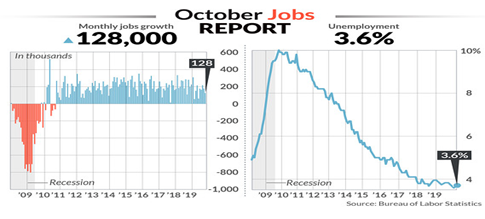
Total nonfarm payroll employment rose by 128,000 in October, and the unemployment rate was little changed at 3.6 percent, the U.S. Bureau of Labor Statistics reported today. Notable job gains occurred in food services and drinking places, social assistance, and financial activities.

But most were not the good-paying jobs that will support a household, or buy a home. Restaurants and bars led the way in hiring by adding 48,000 jobs. Professional jobs rose by 22,000, social-assistance providers added 20,000 jobs, and financial companies increased employment by 16,000.

Payrolls fell by 36,000 in manufacturing that mostly reflected the GM strike, and government employment slipped by 3,000.

Just the 22,000 Professional jobs are considered middle-class, white collar jobs. In fact, most consumers and jobs are stuck with low-paying service sector jobs in retail, warehousing, and even healthcare.

This is a major reason U.S. economic growth is gradually slowing, as many economists reported last week. Hence the uncertainty about an upcoming recession, since consumers are still optimistic about job prospects and flush with earnings from the very low unemployment rate.

But ‘very low’ unemployment has been masking the real problem with this recovery. Wages and salaries have not been rising fast enough, in jobs that support an adequate standard of living, to bring back anything close to boom times again for most Americans.

Why not? We have to look at the history of economic recoveries.

The Obama administration’s one-time American Recovery and Reconstruction Act of 2009 put some $850 billion back into governments to end the Great Recession, which boosted a flurry of infrastructure improvements, and helped to balance some state budgets, but it didn’t even begin to catch up to the $2 trillion plus shortfall in outmoded infrastructure that included not only roads and bridges, but airports, the energy grid, water and sanitation facilities (e.g., Flint, Michigan and Newark, NJ), and a K-12 elementary education system ranked at the bottom in the developed world.

This is what any responsible governance policies should continue to do. The current economic recovery has benefited just the top 10 percent in income-earners, which is the reason for so much discontent among blue collar, working folk.

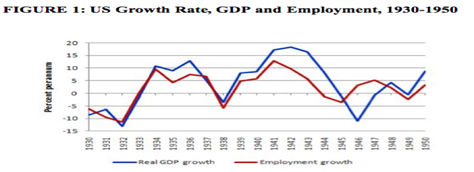
It was called the New Deal when we had a leader capable of answering the call, as did a President named Roosevelt, who said just prior to his reelection in 1936: “the old enemies of peace: business and financial monopoly, speculation, reckless banking, class antagonism, sectionalism…are unanimous in their hate for me — and I welcome their hatred.”

image

Livingnewdeal.org

In fact, President Roosevelt did falter in 1937, when Republican’s won a congressional majority and he agreed to attempt to rebalance the federal budget while the Federal Reserve reduced the money supply as it had in 1930; which helped to precipitate the original downturn. The U.S. economy then dropped back into a second recession, which is why it was called the Great Depression; before Roosevelt reinstituted New Deal spending programs that brought growth back to pre-Great Depression levels.

“The New Deal ushered in a Golden Age for public works, as Washington at last took a leading role in funding infrastructure,” said one study of the New Deal. “The federal government, working hand-in-hand with state and local agencies, financed (and provided relief labor for) a huge array of projects. These emphasized the newest forms of technology and infrastructure, including highways, airports, dams, and electric grids, as well as more traditional public works, such as libraries, schools and parks.”

Those same policies need to be enacted today to bring back this recovery from the Great Recession, and keep it from becoming another Great Depression.

Harlan Green © 2019

Follow Harlan Green on Twitter: https://twitter.com/HarlanGreen
Posted in Consumers, Economy, Keynesian economics, Politics, Weekly Financial News | Tagged , , , , | Leave a comment

A Weak Unemployment Report Tomorrow?

Financial FAQs

image

ADP

There could be a sharp drop in new job creation in tomorrow’s Labor Department unemployment report. Why? The GM strike could have shaved as much as 65,000 jobs from the report due to layoffs over the past month, reports the ADP guesstimate of private payroll growth for October.

ADP (Associated Data Processing, a private payroll provider) estimates that private payroll growth in Friday’s employment report for October will rise 125,000. Less manufacturing, and the risk that the GM strike may sharply lower payrolls, ADP estimates payrolls will fall but not too sharply, down 4,000.

The goods-producing sector (manufacturing, construction, and manufacturing) could lose -13,000 jobs, and the service-providing sector add +138,000 jobs. But payrolls could rebound sharply in November, as GM workers and parts subsidiaries return to work, says ICAP.

Reuters/ICAP reports “The GM strike will have a noticeable impact on the payroll data this month.  We have assumed that the strike will reduce manufacturing payrolls by 65K, of which 50K would be from GM itself and 15K from auto suppliers…That would lower our forecast for overall nonfarm payrolls this month to 70K, but the impact would only be temporary.  We expect a strong snapback in November that could push overall payroll growth to something approaching 200K.”

image

BEA.gov

The BEA’s Personal Income and Outlays report also showed a slight slowing in consumer spending, per the above graph. Real Disposable Income (blue bar) was 50 percent higher than spending (brown bar), which meant consumers were saving more, spending less due to the economic uncertainty in several sectors—e.g., manufacturing, foreign trade and tariffs, potential budget cutbacks in Medicare and Medicaid, and general uncertainty that no more than 10 percent of American workers have benefited from the longest recovery cycle in U.S. history.

All this is to prepare US for a downer of an unemployment report tomorrow. Will there be just 70,000 non-farm payroll jobs created, and the unemployment rate rise from its very low 3.5 percent? Will this put a further dent in consumer spending and confidence?

Let us hope the holidays provide some cheer!

Harlan Green © 2019

Follow Harlan Green on Twitter: https://twitter.com/HarlanGreen

Posted in Consumers, Economy, Keynesian economics, Weekly Financial News | Tagged , , , | Leave a comment

Lower Q3 GDP Growth = Slowing Economy

Popular Economics Weekly

image

BEA.gov

Real gross domestic product (GDP) increased at an annual rate of 1.9 percent in the third quarter of 2019, according to the “advance” estimate released by the Bureau of Economic Analysis. In the second quarter, real GDP increased 2.0 percent.

U.S. economic growth is gradually slowing; how much is still uncertain, since consumers are still optimistic about job prospects and flush with earnings from the very low unemployment rate.

“The mismatched trends in personal finances and buying conditions have resulted in the lackluster pace of consumer spending throughout the expansion, said U of Michigan’s chief economist, Richard Curtin. “Earlier in the expansion, dismal growth in household incomes and jobs were matched with record favorable references to prices and interest rates on home and vehicles, while in the later part of the expansion very favorable incomes and job prospects were matched with the fewest favorable references to prices and interest rates in decades-with those lows becoming the expected norm.”

The mismatch has kept consumer indebtedness (aside from education loans) at manageable levels, and positive finances have recently buoyed spending so as to ensure the continuation of the expansion.

The BEA report said the increase in real GDP in the third quarter reflected positive contributions from personal consumption expenditures (PCE), federal government spending, residential fixed investment, state and local government spending, and exports that were partly offset by negative contributions from nonresidential fixed investment and private inventory investment. Imports, which are a subtraction in the calculation of GDP, increased.

There is more to this story, of course; in this case the almost total lack of any inflation. The Fed’s preferred measure of inflation, the PCE implicit price deflator, fell to 1.5 percent, down from 2.4 percent last quarter, which is not a healthy sign of demand, but sliding into disinflationary territory. Steadily declining inflation is usually a precursor to deflation, the most outward sign of shrinking GDP growth—and a possible recession.

image

FRED

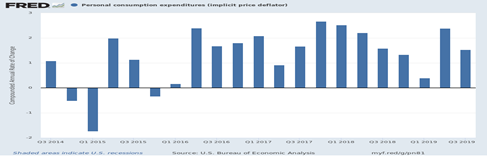
The housing industry also contributed to the economy’s growth for the first time in nearly two years. Residential investment climbed 5.1 percent. And ultra-low mortgage rates have drummed up more demand and spurred builders to boost construction.

The NRA’s just-released pending home sales report also showed higher home sales ahead.

Pending home sales grew in September, marking two consecutive months of increases, according to the National Association of Realtors. The Pending Home Sales Index (PHSI), www.nar.realtor/pending-home-sales, a forward-looking indicator based on contract signings, rose 1.5 percent to 108.7 in September. Year-over-year contract signings jumped 3.9 percent. An index of 100 is equal to the level of contract activity in 2001.

Historically low mortgage rates played a significant role in the two straight months of gains, according to Lawrence Yun, NAR’s chief economist. “Even though home prices are rising faster than income, national buying power has increased by 6% because of better interest rates,” he said. “Furthermore, we’ve seen increased foot traffic as more buyers are evidently eager searching to become homeowners.”

Consumers could remain optimistic through the holidays, but I doubt much beyond that. There is too much uncertainty from businesses, where capital investments have plunged. Although consumer spending didn’t match the second quarter’s 4.6 percent increase, outlays still rose 2.9 percent. Consumer spending accounts for about 70 percent of all U.S. economic activity.

Harlan Green © 2019

Follow Harlan Green on Twitter: https://twitter.com/HarlanGreen

Posted in Consumers, Economy, housing market, Weekly Financial News | Tagged , , | Leave a comment

Do We Need a New Jobs Deal?

Popular Economics Weekly

image

Calculated Risk

The best picture we have of current and future job trends is the Labor Department’s JOLTS report (i.e., Job Openings and Labor Turnover Survey). Calculated Risk’s colorful graph shows Job Openings (yellow line) hasn’t yet dropped below 7 million openings in August, though it is falling.

This is a given while there were 5.8 million Hires (dark blue line), so there are still 1.2 million job vacancies searching for employees. It gives a good picture of the huge labor turnover rate in the $20 trillion U.S. economy.

It is also why it is so difficult to predict the next recession, or depression. I maintain we need another New Deal that boosts public spending on health care, education, infrastructure, R&D, and the environment, if we want to continue the longest economic recovery ever.

How low must the number of Job Openings fall—maybe 1-2 million?—for anyone to begin to worry that a lack of available jobs might begin to hurt growth? The yellow line of the Job Openings tally dipped to some 2.4 million openings in 2009 at the bottom of the Great Recession.

The red and blue columns show Layoff, Discharges and other, and Quits (light blue column), which are basically flat, which means we are at the top of this business cycle. The only hint of a downward trend in job formation is the downward curve in the number of Job Openings (yellow line).

We really must look for any downward trend in retail sales, and consumer spending to tell us the direction of economic growth. Retail sales dropped 0.3 percent last month as households slashed spending on building materials, online purchases and especially automobiles, the first spending decline since February.

What else should we look for? Nobel prize-winning behavioral economist Robert Shiller believes consumer spending is holding up in this longest economic upturn since WWII because of the Trump presidency. The fact that he touts himself as a successful businessman creates a general sense of optimism about jobs and the economy.

“Trump has for decades touted a glamorous narrative of his life by “surrounding himself with apparently adoring beautiful women, and maintaining the appearance of vast influence,” Shiller said in a recent op-ed in Britain’s the Guardian newspaper. “The end of confidence in Trump’s narrative is likely to be associated with a recession,” Shiller warned.

So such optimism can be a two-edged sword. While Trump’s affluent lifestyle has been “a resounding inspiration to many consumers and investors … a severe recession may be his undoing,” Shiller warned.

What else could cause such an outcome? The Great Recession that ended in June 2009 could have been a second Great Depression; but for the Obama administration’s passage of the $835 billion American Reinvestment and Recovery Act emergency aid package that gave states as well as Washington enough dollars to stop the losses.

But, alas, the religiously right wing Tea Party that resisted almost all public spending took over the house in 2010, sharply cutting back further government programs. The focus turned to austerity measures that hurt the Midwest and southern states depending on government largesse to support them, after the loss of all those manufacturing jobs.

The result was the discontent we see today. We still need another New Deal that will invest in our future generations, rather than a “glamorous narrative” to sustain this recovery, in other words.

Harlan Green © 2019

Follow Harlan Green on Twitter: https://twitter.com/HarlanGreen

Posted in Consumers, Economy, Keynesian economics, Politics, Weekly Financial News | Tagged , , , | Leave a comment

Residential Construction Holding Up

The Mortgage Corner

image

Calculated Risk

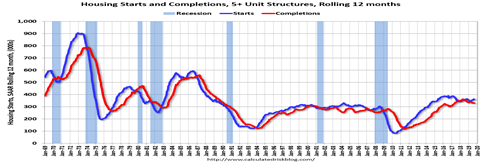
Privately‐owned housing starts in September were at a seasonally adjusted annual rate of 1,256,000. This is 9.4 percent below the revised August estimate of 1,386,000, but is 1.6 percent above the September 2018 rate of 1,236,000, said the US Census Bureau.

Behind the headline is a small gain, to 918,000, for single-family starts. These boost GDP growth per unit than multi-family starts which dropped a very sharp 28.2 percent to 338,000. The three-month average for single-family starts is up very sharply, at 901,000 for the 5th straight increase.

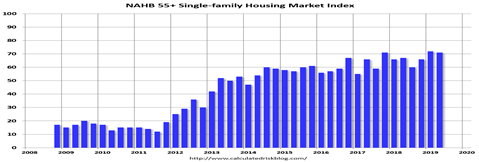
The low mortgage rates are giving increasingly positive signals from the housing sector including a 3 point jump of builders’ optimism in the housing market index to a 71 level for October that easily exceeds economists’ consensus range, says the National Association of Homebuilders (NAHB).

image

Calculated Risk

Components showing the most strength are present sales and traffic where the index jumped 4 points to 54 for the best reading since early last year. This move offers evidence perhaps that low rates, now under 4 percent for conventional mortgages, are attracting new buyers, something that the housing sector, which has struggled all year to move higher, badly needs. This report will help lift expectations for new home sales and new home permits, as well as existing-home sales.

Total existing-home sales, https://www.nar.realtor/existing-home-sales, completed transactions that include single-family homes, townhomes, condominiums and co-ops, fell 2.2 percent from August to a seasonally adjusted annual rate of 5.38 million in September. Despite the decline, overall sales are up 3.9 percent from a year ago (5.18 million in September 2018).

Lawrence Yun, NAR’s chief economist, said that despite historically low mortgage rates, sales have not commensurately increased, in part due to a low level of new housing options. “We must continue to beat the drum for more inventory,” said Yun, who has called for additional home construction for over a year. “Home prices are rising too rapidly because of the housing shortage, and this lack of inventory is preventing home sales growth potential.”

And lastly, the National Association of Realtors’ housing affordability index is up 12.6 percent YOY as of August, reports Reuter’s ICAP data research site, also a good sign for future trends. This is due to both rising incomes and lower interest rates, while national housing prices have slowed their rise.

“Mortgage applications recently increased 33 percent from a year ago but were down 0.2 percent from July 2019,” says the NAR. “With improving affordability conditions, new home sales increased in August with an increase in housing starts. Homes are currently affordable due to low mortgage rates and because the job market is performing well, but home prices are currently outpacing incomes.”

The Realtors’ Housing Affordability Index calculation assumes a 20 percent down payment and a 25 percent qualifying ratio (principal and interest payment to income).

So a robust housing market could mitigate what is increasingly looking like a looming manufacturing recession, as I said last month. And with the 30-year fixed conforming rate now as low as 3.25 percent for the most creditworthy borrowers, more homebuyers will be eligible, if homebuilders can continue to increase the supply of new homes.

Harlan Green © 2019

Follow Harlan Green on Twitter: https://twitter.com/HarlanGreen
Posted in Housing, housing market, Weekly Financial News | Tagged , , | Leave a comment

Lower Retail Sales Hint at Weaker Economic Growth Ahead

Popular Economics Weekly

image

Fred

U.S. retail sales that mirror consumer spending, which powers some two-thirds of U.S. GDP growth, fell for the first time in seven months in September, raising fears that a slowdown in the American manufacturing sector could be starting to bleed into the consumer side of the economy.

The Commerce Department said Wednesday that retail sales dropped 0.3 percent last month as households slashed spending on building materials, online purchases and especially automobiles. The decline was the first since February.

Retail sales have increased 2.3 percent year-over-year, which is not a good number, as can be seen in the above graph dating from 2015. It averaged closer to 4 percent from 2010 to 2015, before falling to its current level.

And manufacturing has been hurting this year, as manufacturing production fell 0.5 percent, in the Fed’s latest Industrial Production report, after rising 0.6 percent in August due to a strike at General Motors. U.S. industrial output overall dropped 0.4 percent from a month earlier in September 2019. That was the sharpest decline in industrial output since April. For the third quarter as a whole, industrial production rose at an annual rate of 1.2 percent following declines of about 2 percent in both the first and the second quarters, per the below graph, with brown bars in graph showing negative growth. 

image

Tradingeconomics.com

Hence economic growth is looking weaker for the third quarter, with GDP growth now forecast at just 1.5 percent, according to a projection by CNBC and Moody’s Analytics.

“Weak consumer spending and inventory data caused economists responding to the Rapid Update tracker to lower their collective GDP projections by one-tenth of a percentage point to 1.5 percent, the lowest level yet for Q3,” said CNBC.

Consumers must keep spending more than they are saving to keep this economic afloat, in other words. The University of Michigan sentiment survey says consumers are optimistic on that score.

Econoday commented that last Friday’s U of Michigan survey bounced sharply higher in October, to a much stronger-than-expected 96.0 that easily exceeds Econoday’s consensus range.

“The assessment of current conditions is the strong point in October’s report, up nearly 5 points to 113.4 in what is a positive indication for consumer spending this month. Expectations are also higher, up 1.4 points to 84.8 and together with the jump in current conditions, suggest that the impeachment inquiry of President Trump is not having a significant impact on the consumer. In fact, the report notes that the ongoing GM strike was mentioned by respondents nearly twice as much as the impeachment.”

The GM strike has reportedly been settled, but the trade wars haven’t, so it remains to be seen whether consumers can remain this optimistic about their future.

Harlan Green © 2019

Follow Harlan Green on Twitter: https://twitter.com/HarlanGreen

Posted in Consumers, Economy, Weekly Financial News | Tagged , , | Leave a comment

Nobel Prize in Economics Breaks New Ground

Popular Economics Weekly

STOCKHOLM (AP) — The 2019 Nobel Prize in Economic Sciences has been awarded Monday to Abhijit Banerjee, Esther Duflo and Michael Kremer “for their experimental approach to alleviating global poverty.”

It was ground-breaking for several reasons. Firstly, the Nobel committee is recognizing that the field of economics is finally becoming more science than social science by championing empirical field research, rather than purely academic research that was conducted mostly in ivory towers with mathematical formulas.

For instance, Prof George Akerlof, one of three that won the 2001 Nobel Prize, was the first of several so-called behavioral economists to win for his research on how individuals actually make financial decisions. He proved that humans don’t always act rationally in their best interests without institutional safeguards, such as Lemon Laws that prevent faulty used car sellers from putting new car dealers out of business.

Though the proof was done with mathematical formulas, it began the ongoing divorce from what was originally called Political Economics. What else to call it when one major branch of microeconomics was under the assumption that investors and wage earners actually acted in their own best interests in a level playing field without government oversight, yet never was validated with actual results?

The lines had been drawn between conservatives that advocated Adam Smith’s pronouncement that free, mostly unregulated markets with low taxation would remain healthy of their own accord and were the best way to maximize prosperity for all; with the Keynesian, New Deal economics of progressives that wanted governments to discipline capital markets for their excesses.

These opposing viewpoints on how human beings made financial decisions were based more on political choices than actual scientific research on financial behavior until research in other fields, such as psychology were brought into economics.

Hence this new approach is called ‘experimental’, because it prioritized actual field work using scientific methods to improve the lives of the poorest in developing countries. What did they discover?

“The Laureates’ research findings,” said the Nobel Prize announcement“– and those of the researchers following in their footsteps – have dramatically improved our ability to fight poverty in practice. As a direct result of one of their studies, more than five million Indian children have benefitted from effective programmes of remedial tutoring in schools. Another example is the heavy subsidies for preventive healthcare that have been introduced in many countries,” (that made preventative healthcare accessible to the poor).

It looks like this is becoming a worldwide movement to alleviate poverty and income inequality in developed countries as well, such as the U.S. of A. that has been lagging other developed (and underdeveloped) countries in improving the lives of our poorest citizens—thanks in large part to Big Business’s proclivity to maximize profits over every other corporate goal.

One example of this trend: JP Morgan Chase CEO Jamie Dimond announced in August a Statement on the Purpose of a Corporation by the Business Roundtable, a group of almost 200 large businesses, in which they “share a fundamental commitment to all of our Stakeholders”.

“While each of our individual companies serves its own corporate purpose,” said Dimond, “we share a fundamental commitment to all of our stakeholders. We commit to:

  • · Delivering value to our customers. We will further the tradition of American companies leading the way in meeting or exceeding customer expectations.
  • · Investing in our employees. This starts with compensating them fairly and providing important benefits. It also includes supporting them through training and education that help develop new skills for a rapidly changing world. We foster diversity and inclusion, dignity and respect.
  • · Dealing fairly and ethically with our suppliers. We are dedicated to serving as good partners to the other companies, large and small, that help us meet our missions.
  • · Supporting the communities in which we work. We respect the people in our communities and protect the environment by embracing sustainable practices across our businesses.
  • · Generating long-term value for shareholders, who provide the capital that allows companies to invest, grow and innovate. We are committed to transparency and effective engagement with shareholders.

It remains to be seen if corporate behavior  that is in large part responsible for the record income inequality we see with the globalization of market forces actually changes. But this award shines a light on what can happen when the Economic Sciences begin to follow the rules of scientific discovery, rather than the Political Economic verities of old.

Harlan Green © 2019

Follow Harlan Green on Twitter: https://twitter.com/HarlanGreen
Posted in Keynesian economics, Macro Economics, Politics, Weekly Financial News | Tagged , , , , | Leave a comment

Donald Trump’s Reptilian Brain

Does this description sound familiar? “Territoriality, hierarchical structure of power, control, ownership, wars, jealousy, anger, fear, hostility, worry, stuck or frozen with fear, aggressiveness, conflict, extremist behavior, competitiveness, cold-blooded, dog-eat-dog beliefs, might is right, and survival of the fittest,” is one definition of reptilian behavior.

It also describes the behavior of President Donald Trump. Psychotherapists have been attempting to explain POTUS’s behavior in psychological terms. Many have said he suffers from NPD, or Narcissistic Personality Disorder, defined in the DSM V treatment manual, as “… grandiosity, seeking excessive admiration, and a lack of empathy (Ronningstam & Weinberg, 2013).”

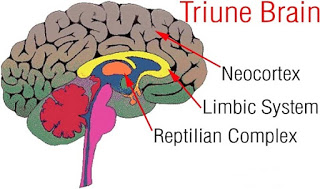
But why not turn to the biological sciences to describe President Trump’s behavior? The human brain is most simplistically described as having three parts; the earliest reptilian brain that contains our brute survival mechanisms; the mammalian limbic brain is the center of emotions and empathy; and neo-cortex the thinking part that modulates urges emanating from the other regions of the brain because of its ability to reason and judge.

A more basic way to define the reptilian brain is it contains the fight, flight, or freeze commands when an animal or human feels threatened. I am reminded of the behavior of pet Pythons, the largest of our snakes, who have literally turned on their owners—some eaten, others strangled, even though the Pythons were supposedly domesticated.

The most common explanation given by Herpetologists for such ‘aberrant’ behavior is that some pet Pythons were just biding their time when handled by their owners—they were measuring the size of their owner to know if they could be ingested. So they were following their basic instincts, as Trump is want to do. There have been cases of adult humans being attacked and fully ingested by Burmese Pythons—the largest Pythons—in the wild, as well.

What else could explain the behavior of this President whose success can only be attributed to a lifetime of lies and deceptions; who has ‘ingested’ those working closest to him by destroying their reputations, if they displease or are no longer of use to him?

The human species is mammalian because we give live birth to our offspring. But mammals evolved originally from reptiles; hence we still have the earliest reptilian brain that has been called the “lizard brain” because it provides the basic elements we need to survive.

This also explains POTUS’s authoritarian behavior, as perhaps that of the most extreme autocrats; Hitler, Stalin, and Vladimir Putin, who have literally killed their own people.

The question is how much longer Americans will tolerate such reptilian behavior?

Harlan Green © 2019

Follow Harlan Green on Twitter: https://twitter.com/HarlanGreen
Posted in Uncategorized | Tagged , , | Leave a comment

The U.S. Economy Is Slowing!

Financial FAQs

Late Monday, the U.S. blacklisted 28 Chinese companies because of their alleged role in human-rights violations against Muslim minorities ahead of the high-level discussions which will be led by China Vice Premier Liu He on Thursday.

Bloomberg also reported the Trump administration is moving ahead with discussions around possible restrictions on capital flows into China, with a particular focus on investments made by U.S. government pension funds.

These unilateral actions by the Trump administration will be enough to bring on a mild recession sometime next year. Why? Because attempting to isolate the 2nd largest, or largest economy in the world—depending on which economic measure is used—can only harm international trade on which U.S. and world economic growth depends these days.

Manufacturing activity is already contracting, signaling that it is in a recession. The service sector will take longer to see the effects of the U.S. decoupling from China and international trade in general from the various trade wars because services are less dependent on foreign trade.

And last week Trump also said he would add a 10 percent tariff in September to the remaining $300 billion in Chinese imports that had previously been excluded from earlier U.S. duties. China retaliated by suspending purchases of American farm crops and letting the value of its currency fall, effectively making Chinese goods cheaper to buy and negating some of the damage from U.S. tariffs.

These are consumer goods, such as TVs, computers, wash machines that American consumers buy.

image

FRED

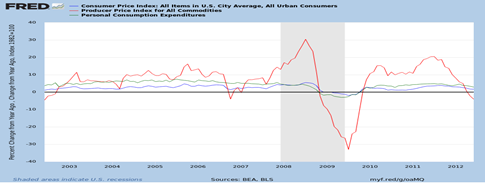
The result? Both the Producer Price Index for wholesale goods out today (red line in graph), and probably the upcoming Consumer Price Index (dark blue line) shows where we are heading.

Wholesale prices are falling because of declining demand for unfinished goods, which are the raw material for finished products. The increase in wholesale inflation over the past 12 months slid to 1.4 percent from 1.8 percent, marking the lowest level in almost three years, according to MarketWatch.

“Similarly, a more closely followed measure that strips out volatile food, energy and trade-margin costs was flat in September. The increase in the so-called core PPI over the past year dropped to 1.7 percent from 1.9 percent,” said MarketWatch

Another sign of declining demand is the 10-year Treasury yield declining to 1.52 percent; also recession territory, as investors flee stocks to the safe haven of U.S. Treasury securities.

It means the Fed will probably continue to lower their interest rates in an attempt to boost spending, which could keep consumers spending for a while longer, but at a lower level as they retain more of their earnings as savings; hence a mild recession, but it’s enough of a slowdown for consumers to realize that current economic policies cannot improve their living conditions.

Harlan Green © 2019

Follow Harlan Green on Twitter: https://twitter.com/HarlanGreen

Posted in Consumers, Economy, Politics, Weekly Financial News | Tagged , , , | Leave a comment